💥UPSC 2026, 2027, 2028 UAP Mentorship (March Batch) + Access XFactor Notes & Microthemes PDF

Archives: News

  • e-Commerce: The New Boom

    [pib] Amendments to the Consumer Protection (E-commerce) Rules, 2020

    For the purposes of preventing unfair trade practices in e-commerce, the Central Government had notified the Consumer Protection (E-Commerce) Rules, 2020 with effect from 23 July 2020.

    Consumer Protection (E-commerce) Rules, 2020

    The proposed amendments aim to bring transparency in the e-commerce platforms and further strengthen the regulatory regime to curb the prevalent unfair trade practices.

    The proposed amendments are as follows:

    (a) Chief Compliance Officer

    • To ensure compliance of the rules, the appointment of Chief Compliance Officer, a nodal contact person for 24×7 coordination with law enforcement agencies, officers to ensure compliance to their orders and Resident Grievance Officer for redressing of the grievances of the consumers on the e-commerce platform, has been proposed.
    • This would ensure effective compliance with the provisions of the Act and Rules and also strengthen the grievance redressal mechanism on e-commerce entities.

    (b) Registration of e-coms

    • Putting in place a framework for registration of every e-commerce entity with the DPIIT for allotment of a registration number which shall be displayed prominently on the website as well as invoice of every order placed by the e-commerce entity.
    • This would help create a database of genuine e-commerce entities and ensure that the consumers are able to verify the genuineness of an e-commerce entity before transacting through their platform.

    (c) Prohibition of miss-selling

    • The goods and services entities selling goods or services by deliberate misrepresentation of information have been prohibited.

    (d) Expiry dates

    • This would ensure that consumers are aware of the expiry date of the products they are buying on the e-commerce platform.
    • It compels all sellers on marketplace e-commerce entities and all inventory e-commerce entities to provide the best before or use before the date to enable consumers to make an informed purchase decision.

    (e) Fair and equal treatment

    • It has been provided that where an e-commerce entity offers imported goods or services, it shall incorporate a filter mechanism to identify goods based on country of origin and suggest alternatives to ensure fair opportunity to domestic goods.

    (f) Fall-back liability

    • This would ensure that consumers are not adversely affected in the event where a seller fails to deliver the goods or services due to negligent conduct by such seller in fulfilling the duties and liabilities.

    Why need such an amendment?

    It was observed that there was an evident lack of regulatory oversight in e-commerce which required some urgent action.

    • Manipulating search results: Moreover, the rapid growth of e-commerce platforms has also brought into the purview the unfair trade practices of the marketplace e-commerce entities engaging in manipulating search result to promote certain sellers.
    • Preferential treatment: This includes preferential treatment to some sellers, indirectly operating the sellers on their platform, impinging the free choice of consumers, selling goods close to expiration etc.
    • Flash sales: Certain e-commerce entities are engaging in limiting consumer choice by indulging in “back to back” or “flash” sales. This prevents a level playing field and ultimately limits customer choice and increases prices.

    Check this PYQ from CSP 2012:

    Q. With reference to consumer’s rights / privileges under the provision of law in India which of the following statements correct?

    1. Consumer are empowered to take samples for food testing
    2. When consumer fi les a complaint in any consumer forum, no fee is required to be paid.
    3. In case of death of consumer, his/her legal heir can file a complaint in the consumer forum on his/her behalf.

    Select the correct answer using the codes given below:

    (a) Only 1

    (b) 2 and 3 only

    (c) 1 and 3 only

    (d) 1, 2 and 3

  • Industrial Sector Updates – Industrial Policy, Ease of Doing Business, etc.

    Corporates need commitment to sustainability and community alongside pursuit of profit

    The article calls the corporates to adopt new capitalism in the aftermath of the pandemic which involves alongside the profit motives the commitment to giving back.

    Capitalism in the aftermath of Covid-19

    • The 2008 crisis was caused by the excesses of global finance, whereas the 2020 economic crisis was caused by a pandemic that spilled over to the economy.
    • While the current pandemic is the first of its kind in nine decades, the dire economic consequences are very similar to that global financial crisis just a decade ago.
    • What is also similar is the policy response that has followed both the 2008 and 2020 crises — the Keynesian prescription of the government stimulating a depressed economy by using monetary and fiscal instruments.
    • Cheap liquidity preserves the wealth of the asset-owning classes even as the real economy stalls.
    •  However, over-stretched governments head towards a debt/fiscal crisis which eventually forces austerity, hitting those dependent on government handouts.
    • It is this inequality in outcomes that is unlikely to happen this time.
    • Already, the G-7 has pledged to maintain a minimum level of corporation tax.
    • There have also been calls for additional taxation, particularly on the assets of the wealthy.

    What corporates can do

    • Instead of waiting for governments to react under popular pressure, corporates must themselves set out on a different path.
    • Covid-19 has brought home the fragility of human life and the deeply interconnected fate of humanity.
    • Outside of the pandemic, there is no better example of this than climate change which, if left uncontrolled, could devastate the world.
    • While governments negotiate, corporates must respond with voluntary commitments to mitigate climate change.
    • Climate change mitigation should be at the core of all business models going forward.
    • In addition, promoters need to come forward to pledge more of their wealth towards philanthropy.
    •  India implemented the concept of corporate social responsibility as part of its legal framework a decade ago.

    Investor pressure for action towards environment

    • The ability of the private sector to work for the greater good seems implausible.
    • But it is already happening — not because of government regulation, but because of investor pressure.
    • Progressive actions towards the environment and society are being rewarded by investors.
    • The absence of such progressive actions is being penalised.
    • Market forces are, after all, embedded in society.
    • They are perfectly capable of moving beyond profit.

    Threat of new-age tech capitalism

    • The real challenge for society, government and capitalists comes from the new-age tech capitalists.
    • They are the new monopolists or oligopolists who don’t exercise their power over society by charging a supernormal price.
    • In fact, a lot of them provide goods and services at hefty discounts.
    • Instead, what they seek is to control information and influence choices.
    • Many of the promoters of such enterprises are philanthropists but society and governments have a different set of concerns on how they exercise power.

    Conclusion

    An imperfect world is passing through a perfect storm. There will be big changes on the other side. Capitalism will survive. It could thrive by choosing its own pathway or it could stumble along under the hammer of big government fuelled by populist backlash.

  • Foreign Policy Watch: India-Russia

    Russia-China Relations and its effects on India-Russia Relations

    The article highlights Russia’s increasing inclinations towards China and its implications for India.

    Context

    Russian President Vladimir Putin has recently asserted that both the Indian Prime Minister, Narendra Modi, and the Chinese President, Xi Jinping, are “responsible” enough to solve issues between their countries, while underlining the need to debar any “extra-regional power” to interfere in the process.

    Implications for India-Russia ties

    • By this remark, Russia expects India to give up all efforts to reverse Beijing’s encroachment strategies.
    • The remarks can only be seen as reinforcing China’s claim that the Quadrilateral or Quad is aimed at containing China’s influence in the Indo-Pacific region.
    • Russia’s continued criticism of the Indo-Pacific and the Quad suggests the divergent perspectives of India and Russia on how to deal with China’s rise to global prominence.
    • While India needs Russia’s partnership for its defence needs, India cannot endorse the Russian perspective on the Indo-Pacific and the Quad
    • The Russian attitude toward China’s growing power and influence will be the touchstone of Russia’s relations with India.
    • Russia has rejected the Indo-Pacific construct in favour of the Asia-Pacific on the ground that the first is primarily an American initiative designed to contain both China and Russia.
    • With the rise of populist nationalism amidst the decline of globalisation, the resolution of the Sino-Indian boundary dispute appears a difficult task.

    Background of India’s balancing strategies

    • Following the disintegration of the Union of Soviet Socialist Republics (USSR), India soon realised Russia was much weaker than the erstwhile USSR and incapable of helping India balance potential threats from Beijing. 
    • On the other hand, Russia began to cast Moscow as the leader of a supposed trilateral grouping of Russia-India-China against a U.S.-led unipolar world.
    • Russia became an early proponent of the ‘strategic triangle’ to bring together the three major powers.
    • India’s fear of the unipolar moment too made it easier for India to become part of this initiative.
    • But China’s dismissive attitude toward Indian capabilities, coupled with an emerging China-Pakistan nexus, prevented the success of this trilateral.
    • India, instead, invested its diplomatic energies in rapprochement with the United States.
    • Thus, India decided to get integrated in the economic order it once denounced.
    • Economic liberalisation also allowed India to buy sophisticated weapons from a wider global market that included suppliers such as Israel and France.
    • As the logic of intensive engagement with the West was effectively established, strategic partnership with the U.S. was a logical corollary.
    • India has been searching for other major powers to balance against China as it does not have the sufficient means for hard balancing.
    • India has deepened its ties with Japan and Australia in a way that is close to soft balancing. 
    •  among all of India’s balancing efforts, the stupendous growth in ties with the U.S. has been the greatest source of concern for China which views the India-U.S. rapprochement as containment.

    Way forward for India-Russia ties

    • While other powers such as France, Australia, Japan and Russia will have an impact on the emerging maritime structures of the Indo-Pacific region, it is the triangular dynamic between India, China and the U.S. that is going to be the most consequential.
    • Russia is yet to realise that it will gain immensely from the multilateralism that the Indo-Pacific seeks to promote.
    • Being China’s junior partner only undermines Moscow’s great-power ambitions.
    • Given Russia’s preoccupation with ‘status’ rivalry with the U.S., Russia’s view of India-China relations seems understandable.
    • But there is a danger in permitting it to harden into a permanent attitude as an increasingly pro-Beijing Russia might adopt more aggressive blocking of India’s policy agendas.
    • That is why India is particularly interested in a normalisation of relations between Washington and Moscow.
    • The normalisation of relations between the U.S. and Russia will help India steer ties among the great powers.

    India-China ties

    • Non-alignment, painful memories of colonial subjugation, opposition to great-power hegemony, and strong beliefs in sovereignty and strategic autonomy have been the key influencers in shaping India’s and China’s engagement with each other as well as the western world.
    •  But this has begun to change as Beijing is asserting its hegemony over Asia.
    • In such circumstances, multilateral forums such as the Russia-India-China (RIC) grouping and BRICS (Brazil, Russia, India, China and South Africa) have little practical value for Indian diplomacy.
    • Without China’s reciprocity, options before India are limited.
    • The response cannot be just symbolic or rhetorical. The absence of any material evidence of reciprocity is bound to doom an attempt at Sino-Indian rapprochement.

    Conclusion

    China is undoubtedly the most powerful actor in its neighbourhood but it cannot simply have its way in shaping Asia’s new geopolitics.

  • Minimum Support Prices for Agricultural Produce

    How green are India’s agri-exports?

    The article highlights the unsustainability of agri-exports owing to their water-intensive nature and subsidies provided in their production.

    India’s agri-exports

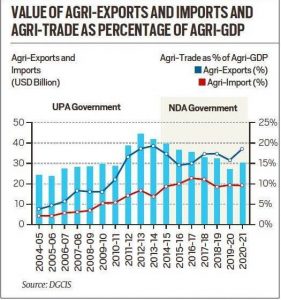
    • Agri-exports touched $41.8 billion in FY 2020-21, registering a growth of 18 per cent over the previous year.
    • Amongst the various agri-commodity exports, rice ranks first with 17.7 million tonnes valued at $8.8 billion, roughly 21 per cent of the total value of agri-exports.
    • It is followed by marine products ($6 billion), spices ($4 billion), bovine (buffalo) meat ($3.2 billion) and sugar ($2.8 billion).

    Trend analysis of agri-exports

    • During the last seven years, agri-exports have remained lower than the level reached in FY2013-14 ($43.3 billion).
    • That was when the highest agri-trade surplus (exports minus imports) was generated ($27.8 billion).
    • That was also when Indian agriculture was most globally integrated, with agri-trade (exports plus imports) touching 20 per cent of the agri-GDP.
    • It has slid to 13.5 per cent by FY2020-21, indicating India is becoming less globally competitive in exports and more protectionist in imports, presumably in the name of Atmanirbhar Bharat.
    • It is high time to review current agri-trade policies and accompanying tariff structures.

    Why sustainability of agri-exports is a concern?

    • From a strategic point of view, however, one must ask whether this growth rate can be sustained over a longer period, and the implications it has for Indian agriculture.
    • Water consumption: India is a water-stressed country with per capita water availability of 1,544 cubic metres in 2011, down from 5,178 cubic metres in 1951.
    • It is well known that a kg of sugar has a virtual water intake of about 2,000 litres.
    • In 2020-21, India exported 7.5 million tonnes of sugar, implying that at least 15 billion cubic metres of water was exported through sugar alone.
    • Rice, needs around 3,000 to 5,000 litres of water for irrigating a kg, depending upon topography.
    • Also, rice cultivation contributes to more than 18 per cent of the GHG emission generated from agriculture.
    • Subsidies: Power and fertiliser subsidies account for about 15 per cent of its value in states like Punjab and Haryana.
    • If these subsidies are withdrawn, rice will not be as preferred a crop with farmers as it is today.

    Way forward

    •  Farming practices such as alternate wetting drying (AWD), direct-seeded rice (DSR) and micro-irrigation will have to be taken up on a war footing.
    • Farmers may be incentivised and rewarded to save water, switch from paddy and sugar to other less water guzzler crops, and reduce the carbon footprint.
    • It is high time that policymakers revisit the entire gamut of rice and sugar systems from their MSP/FRP to their production in an environmentally sustainable manner.
    • At least in the case of rice, procurement will have to be limited to the needs of PDS, and within PDS, it is high time to introduce the option of direct cash transfers.

    Consider the question “Rice and sugar forms the part of India’s agri-basket. However, there are concerns over their sustainability. What are the reasons for concerns and suggest the measure to deal with these concerns” 

    Conclusion

    To maintain the sustainability of the agri-exports, crops must be produced efficiently and with minimal subsidies. The government needs to take steps to ensure that with rice and sugar.

  • Health Sector – UHC, National Health Policy, Family Planning, Health Insurance, etc.

    Centre must make way for states in Covid fight

    The States are better equipped to deal with the health emergencies and the Centre needs to augment them in their efforts. The article deals with this issue.

    Role of the States in health crisis

    • Covid-19 pandemic is a national crisis calling for concerted efforts by both, the Government of India (GoI) and state governments.
    • Health is a state subject, and the states have been pioneering many health programmes on their own, some with support and funding from the GoI, for a very long time.
    • The number of employees in the health wing of the GoI is negligible as compared to that in any state government.
    • The GoI must help them, motivate them to do better and assist them in their task.
    • Also, the GoI must and can play a major role is in vaccination.

    Role of the Central government

    • It must try to augment supplies by encouraging companies to produce more and through imports/gifts.
    •  However, whatever it procures must be allotted to states in proportion to their eligible population.
    • State governments must be involved in this policy.
    • The vaccination policy may be left to the state governments based on the allocation. 
    • The GoI must also augment supplies of critical medical goods through imports and donations from friendly nations in view of their acute shortage.
    • It must distribute them to the needy states transparently and equitably.

    Steps that need to be taken

    • Lockdowns need to be lifted in a calibrated manner depending on local conditions.
    • Lockdowns are not the solution, they just buy breathing time which can be used by governments to ramp up capacity.
    • State governments must set up efficient and well-functioning control rooms and telemedicine centres to guide people on home treatment and timely admission to hospitals.
    • The private sector can also be fully involved in these efforts.
    • Bed capacity must be increased in both private and public sectors, with all necessary requirements such as oxygen, medicines, and health workers.
    • It is also important to put in place a standard guidance protocol for health workers and control rooms to guide patients through the disease.
    •  Enforcement of masks and distancing in public places must go on till the country is fully vaccinated.
    • The measures suggested above require hard work and efficient management by state governments, by a team of reputed professionals and civil servants.
    • Daily briefing by a professional, not a politician, is the need of the hour at both the Centre and state level, giving some confidence and assurance to the public.

    Consider the question “In dealing with the health crisis the Union Government and the State governments are better placed for certain roles.  In light of this, examine the important role of the States in dealing with the Covid pandemic and how the Union government can complement it.”

    Conclusion

    The central government must realise that states are on the forefront in this war, and therefore, play a supporting and proactive role. It has only a minor, behind-the-scenes role in the health sector.

  • Foreign Policy Watch: India-China

    NATO and China

    In a communiqué issued following the June 14 summit of its member-states in Brussels, the North Atlantic Treaty Organization (NATO), for the first time, explicitly described China as a security risk.

    Try answering this question:

    Q.NATO has been an ideal vehicle for power-projection around the world by the US. Critically comment.

    China as a global threat

    • China has never figured in NATO summit declarations before, except for a minor reference in 2019 to the “opportunities and challenges” it presented.
    • But China’s stated ambitions and assertive behaviour present systemic challenges to the rules-based international order and to areas relevant to NATO security.
    • China has reacted sharply. It has urged NATO to view China’s development rationally, stop exaggerating various forms of China threat theory.
    • The other two threats identified by the NATO communiqué are on predictable lines: Russia and terrorism.

    Focus over two nations

    • There is a significant difference, however, between a strategic focus on countering Russia and casting China as a “systemic challenge”.
    • This goes back to NATO’s founding mandate and subsequent history.

    What is NATO, btw?

    • NATO, the planet’s largest — and largest-ever — military alliance, was formed in 1949 by 12 Allied powers to counter the massive Soviet armies stationed in Eastern and Central Europe after Second World War.
    • According to Paul-Henri Spaak, the second Secretary-General of NATO, it was, ironically enough, Joseph Stalin who is the true father of NATO.
    • It was Stalin’s overreach — especially with the Berlin blockade of 1948-49 and the orchestrated coup in Czechoslovakia in 1948 — that convinced a diverse set of war-ravaged European nations to come together under an American security blanket.
    • The collective defence principle enshrined in NATO’s Article V states that “an attack against one ally is considered as an attack against all allies”.
    • The formation of NATO, and its Soviet counterpart, the Warsaw Pact, in 1955, inaugurated the Cold War era.

    NATO and its relevance now

    • NATO was completely successful in its mission of protecting the “Euro-Atlantic area” from Soviet expansion and preventing war between the two superpowers.
    • When the Soviet Union collapsed in 1991, questions were raised about NATO’s relevance and future.
    • Since the Non-aligned Movement (NAM) became irrelevant when the Communist bloc disappeared, one cannot justify the continuation of a military alliance formed to protect Europe from Communist expansion.

    Post-Cold War era mandate of NATO

    • Its bureaucracy succeeded in refashioning NATO for the post-Cold war era.
    • The refashioning rested on a paradigm shift — from collective defence, which implied a known adversary, to collective security, which is open-ended, and might require action against any number of threats.
    • The threat included unknown ones and non-state actors.
    • In other words, the elimination of one threat to Europe — communist Russia — did not necessarily mean that security risks to Europe have vanished.

    Why dismantle a beneficial arrangement

    • Another factor in the persistence of NATO is that, like all successful alliances, it has been a mutually beneficial arrangement.
    • For Europe, it was an attractive bargain where, in exchange for a marginal loss in autonomy, it enjoyed absolute security at a cheap price.
    • Not having to spend massively on defence allowed Europe to focus on building powerful economies and invest its surplus in a strong welfare state.
    • NATO also offered the added bonus of keeping Germany down — historically a major factor for peace and stability in the region.

    An effective American weapon

    • For the US, NATO has been an ideal vehicle for power projection around the world — in places beyond the Euro-Atlantic area, such as Iraq, Afghanistan and Libya.
    • It views NATO as a tool to ensure the primacy of American interests across the globe.
    • Unsurprisingly, NATO’s post-Cold War role has evolved in tandem with U.S. foreign policy priorities.
    • The NATO doctrine of “enlargement”, which Russia calls “expansion”, is essentially about extending the American military footprint by bringing in new members.
    • That is how NATO’s membership today stands at 30, having added 14 members between 1999 and 2020.

    The final truth

    • The Biden administration wants to mobilize NATO member-states behind its larger objective of containing China.
    • NATO’s European member states may view China as an economic rival and adversary, but they are unconvinced by the American line that it is an outright security threat.
    • This line also, in a way, points to the underlying logic behind NATO’s persistence in the post-Soviet world.
    • Unlike the Soviet Union, China offers no alternative vision of society that could make Western capitalism insecure.
    • In fact, its own economy is already deeply integrated into Western markets. China, nonetheless, is perceived as posing a ‘threat’.
    • It remains to be seen how far an ageing Europe would be willing to commit itself to a strategic path that prefers confrontation to collaboration like the US.

    Also read:

    India & NATO

  • Pharma Sector – Drug Pricing, NPPA, FDC, Generics, etc.

    Section 27A of the NDPS Act

    Last week, the Tripura High Court, in a significant verdict, discovered an oversight in drafting the 2014 amendments to the Narcotics Drugs and Psychotropic Substances Act, 1985.

    What is Section 27A?

    • The NDPS had unintentionally rendered a key provision of the Act, Section 27A which provides for punishment of those financing illicit trafficking, inoperable.
    • This section has been consistently evoked since a year after the alleged suicide of a notable Bollywood actor after drugs intoxication.

    What is the provision?

    • The NDPS Act, 1985 is the principal legislation through which the state regulates the operations of narcotic drugs and psychotropic substances.
    • It provides a stringent framework for punishing offenses related to illicit traffic in narcotic drugs and psychotropic substances through imprisonments and forfeiture of property.
    • Section 27A of the NDPS Act, 1985, prescribes the punishment for financing illicit traffic and harboring offenders.
    • The court may, for reasons to be recorded in the judgment, impose a fine exceeding two lakh rupees.”

    So why is this provision inoperable?

    • The text of the provision says that offences mentioned under Section 2(viiia) sub-clauses i-v are punishable through Section 27A.
    • However, Section 2 (viiia) sub-clauses i-v, which is supposed to be the catalog of offences, does not exist after the 2014 amendment.
    • So, if Section 27A penalises a blank list or a non-existent provision, it can be argued that it is virtually inoperable.

    What was the 2014 amendment?

    • In 2014, a key amendment was made to the NDPS Act to allow for better medical access to narcotic drugs.
    • Since the regulation under NDPS was very stringent, despite being a leading manufacturer of morphine, an opioid analgesic used as a painkiller, it was difficult to access the drug even for hospitals.

    Exceptions for essential drugs

    • The 2014 amendment essentially removed state-barriers in transporting, licensing drugs classified as “essential narcotic drugs”, and made it centralized.
    • This was done by first introducing a provision in Section 2 that defines essential narcotic drugs, and subsequently in Section 9 allowing the manufacture, possession, transport, import inter-State, export inter-State, sale, purchase, consumption and use of essential narcotic drugs.
    • The amendment to add the definition of essential narcotic drugs re-lettered the old Section 2(viii)a that was the catalog of offences as Section 2(viii)b, and under the Section 2(viii)a, defined essential narcotic drugs.
    • However, the drafters missed amending the enabling provision in Section 27A to change Section 2(viii)a to Section 2(viii)b.

    How was this error noticed?

    • In 2016, an accused sought bail before a special judge in West Tripura in Agartala citing this omission in drafting.
    • The accused’s plea was that since Section 27A penalized a blank list, he could not be charged under the offence.
    • The district judge then referred the case to the Tripura High Court.

    What did the HC decide?

    • The Law Ministry had argued that the court must overlook the omission and read the legislation as a whole. It also told the court that the provision would be amended to rectify the dissonance.
    • The Tripura HC agreed with the government’s view, but said that it may not be the best solution.
    • The amendment is yet to take place. However, criminal laws cannot be amended retrospectively.
    • Article 20 of the Constitution guarantees protection against double jeopardy.
    • So even if the amendment is brought in, the result of the drafting error could lead to more constitutional questions being raised.

    Back2Basics: Article 20 of the Indian Constitution

    The Article 20 is one of the pillars of fundamental rights guaranteed by the Constitution of India. It mainly deals with protection of certain rights in case of conviction for offences.

    (1) No person shall be convicted of any offence except for violation of a law in force at the time of the commission of the Act charged as an offence, nor be subjected to a penalty greater than that which might have been inflicted under the law in force at the time of the commission of the offence.

    (2) No person shall be prosecuted and punished for the same offence more than once.

    (3) No person accused of any offense shall be compelled to be a witness against himself.

  • Global Geological And Climatic Events

    What is Summer Solstice?

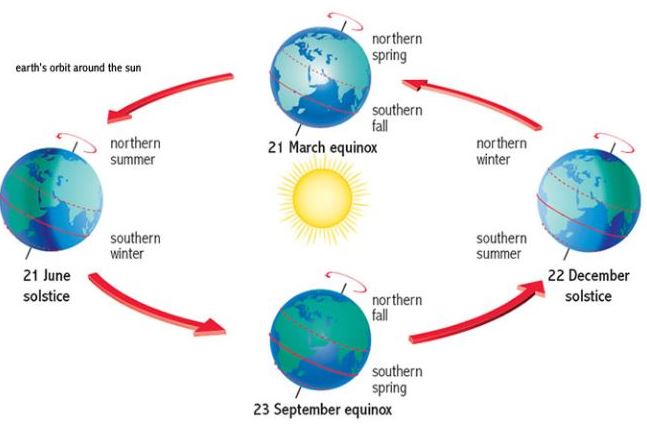
    The summer solstice will happen today around 9:02 am on Monday (Indian Standard Time).

    What is Summer Solstice?

    • Solstice means “sun stands still” in Latin.
    • The longest day of 2021 for those living north of the Equator is June 21.
    • This day is characterized by a greater amount of energy received from the sun.
    • In technical terms, this day is referred to as the summer solstice, the longest day of the summer season. It occurs when the sun is directly over the Tropic of Cancer, or more specifically right over 23.5-degree north latitude.

    The Southern Hemisphere receives most sunlight on December 21, 22 or 23 when the northern hemisphere has its longest nights– or the winter solstice.

    Why do we have summer solstice?

    • Since Earth rotates on its axis, the Northern Hemisphere gets more direct sunlight between March and September over the course of a day.
    • This also means people living in the Northern Hemisphere experience summer during this time.
    • The rest of the year, the Southern Hemisphere gets more sunlight.
    • During the solstice, the Earth’s axis — around which the planet spins, completing one turn each day — is tilted in a way that the North Pole is tipped towards the sun and the South Pole is away from it.

    Answer this PYQ in the comment box:

    Q.On 21st June, the Sun (CSP 2019):

    (a) Does not set below the horizon at the Arctic Circle

    (b) Does not set below the horizon at Antarctic Circle

    (c) Shines vertically overhead at noon on the Equator

    (d) Shines vertically overhead at the Tropic of Capricorn

    Some other facts

    • Summer solstice does not mean the earliest sunrise or latest sunset.
    • Although June 21 will be the longest day in 2021, it does not necessarily mean that it brings the earliest sunrise or latest sunset.
    • It depends on the latitudinal location of the country.
  • Zoonotic Diseases: Medical Sciences Involved & Preventive Measures

    What is Gain-of-Function Research?

    With the re-emergence of the Wuhan lab-leak origin theory, questions are also being raised on what gain-of-function research is, and whether the benefits of conducting such research outweigh the risks of pathogens escaping from labs.

    What is gain-of-function research?

    • In virology, gain-of-function research involves deliberately altering an organism in the lab, altering a gene, or introducing a mutation in a pathogen to study its transmissibility, virulence and immunogenicity.
    • It is believed that this allows researchers to study potential therapies, vaccine possibilities and ways to control the disease better in future.
    • Gain-of-function research involves manipulations that make certain pathogenic microbes more deadly or more transmissible.
    • This is done by genetically engineering the virus and by allowing them to grow in different growth mediums, a technique called as serial passage.

    Antithesis to this theory

    • There is also ‘loss-of-function’ research, which involves inactivating mutations, resulting in a significant loss of original function, or no function to the pathogen.
    • When mutations occur, they alter the structure of the virus that is being studied, resulting in altered functions. Some of these significant mutations might weaken the virus or enhance its function.

    Associated risks

    • Some forms of gain-of-function research reportedly carry inherent biosafety and biosecurity risks and are thus referred to as ‘dual-use research of concern’ (DURC).
    • This indicates that while the research may result in benefits for humanity, there is also the potential to cause harm — accidental or deliberate escape of these altered pathogens from labs may cause even pandemics.

    Essential component of vaccine development

    • The current medical countermeasures are often insufficient largely because of resistance mechanisms that lead to ‘escape mutants’, i.e., drug-resistant strains.
    • There is, hence, a continual need to develop new antiviral drugs and additional options, such as immunotherapy, based on neutralizing monoclonal antibodies.
    • Ultimately, gain-of-function studies, which enhance viral yield and immunogenicity, are required for vaccine development.

    What is the situation in India?

    • In India, all activities related to genetically engineered organisms or cells and hazardous microorganisms and products are regulated as per the “Manufacture, Use, Import, Export and Storage of Hazardous Microorganisms/Genetically Engineered Organisms or Cells Rules, 1989”.
    • Last year, the Department of Biotechnology issued guidelines for the establishment of containment facilities, called ‘Biosafety labs’, at levels two and three.
    • The notification provides operational guidance on the containment of biohazards and levels of biosafety that all institutions involved in research, development and handling of these microorganisms must comply with.

    Should research continue?

    • Scientists have differing opinions on the issue, particularly since the emergence of the COVID-19 pandemic.
    • While those on the side of gain-of-function research say that it makes science and governments battle-ready for future pandemics, there have been a rising number of calls to suspend such research.
    • Proponents of gain-of-function research believe that “nature is the ultimate bioterrorist and we need to do all we can to stay one step ahead”.
    • Some researchers thinks it is time to stop such research.
    • Science policymakers “must wrestle with defining the rare instances in which the benefits of experiments that enhance a virus’s capacity to survive and flourish in human hosts outweigh any risks.
  • Wildlife Conservation Efforts

    Species in news: Rare Black Softshell Turtle (Nilssonia nigricans)

    A major temple in Assam has signed a MoU with NGOs, the Assam State Zoo-cum-Botanical Garden and the Kamrup district administration for the long-term conservation of the rare freshwater black softshell turtle or the Nilssonia nigricans.

    Two years back, one species from our newscard: Species in news: Hump-backed Mahseer made it into the CSP 2019.  The ‘Puntius Sanctus’ fish in the newscard creates such a vibe yet again.

    A stand-alone species being mentioned in the news for the first time (and that too from Southern India) find their way into the prelims. Make special note here.


    Q.Consider the following pairs

    Wildlife Naturally found in
    1. Blue-finned Mahseer Cauvery River
    2. Irrawaddy Dolphin Chambal River
    3. Rusty-spotted Cat Eastern Ghats

    Which of the pairs given correctly matched? (CSP 2019)

    (a) 1 and 2 only

    (b) 2 and 3 only

    (c) 1 and 3 only

    (d) 1, 2 and 3


    Nilssonia nigricans

    • Until sightings along the Brahmaputra’s drainage in Assam, the black softshell turtle was thought to be “extinct in the wild”.
    • It was confined only to ponds of temples in northeastern India and Bangladesh.
    • The International Union for Conservation of Nature had in 2021 listed the turtle as “critically endangered”.
    • But it does not enjoy legal protection under the Indian Wildlife (Protection) Act of 1972, although it has traditionally been hunted for its meat and cartilage, traded in regional and international markets.

Join the Community

Join us across Social Media platforms.