💥UPSC 2026, 2027, 2028 UAP Mentorship (March Batch) + Access XFactor Notes & Microthemes PDF

Archives: News

  • Blockchain Technology: Prospects and Challenges

    Cryptocurrency and Regulation of Official Digital Currency Bill, 2021

    With the likely scenario of India’s government banning private cryptocurrencies, the Reserve Bank of India (RBI) is planning to introduce an official digital currency for the country.

    What is the news?

    • An earlier government bill on cryptocurrency in 2019 reportedly sought to ban cryptocurrency and criminalise its possession in India. However, it was not introduced in Parliament.
    • The detailed text of the bill has not been released in the public domain so far.
    • The bill also says that there will be a regulation to help RBI create its own CBDC (central bank digital currency).

    What are Cryptocurrencies?

    • A cryptocurrency is a digital asset designed to work as a medium of exchange wherein individual coin ownership records are stored in a ledger existing in a form of a computerized database.
    • It uses strong cryptography to secure transaction records, to control the creation of additional coins, and to verify the transfer of coin ownership.
    • It typically does not exist in physical form (like paper money) and is typically not issued by a central authority.
    • Cryptocurrencies typically use decentralized control as opposed to centralized digital currency and central banking systems.

    Hues over the Bill

    • The past year has seen a surge in the number of cryptocurrency investors in India and in trading volumes.
    • Cryptocurrency exchanges such as CoinDCX and Coinswitch Kuber have also raised early-stage funding for their operations.
    • The bill may spark an end to the nascent cryptocurrency industry in the country.

    What were the provisions of 2019 Bill?

    Definition of cryptocurrencies:

    • The 2019 Bill defined cryptocurrency as any information, code, number or token, generated through cryptographic means or otherwise, which has a digital representation of value and has utility in business activity, or acts as a store of value or a unit of account.

    Ban:

    • The 2019 Bill bans the use of cryptocurrency as legal tender or currency.
    • It also prohibits mining, buying, holding, selling, dealing in, issuance, disposal or use of cryptocurrency.
    • Mining is an activity aimed at creating a cryptocurrency and/or validating cryptocurrency transactions between a buyer and a seller.

    In particular, the use of cryptocurrency was prohibited for:

    1. use as a medium of exchange, store of value or unit of account,
    2. use as a payment system,
    3. providing services such as registering, trading, selling or clearing of cryptocurrency to individuals,
    4. trading it with other currencies,
    5. issuing financial products related to it,
    6. using it as a basis of credit,
    7. issuing it as a means of raising funds, and
    8. issuing it as a means for investment.

    Why the govt wants to ban cryptocurrencies?

    Sovereign guarantee

    • Cryptocurrencies pose risks to consumers.  They do not have any sovereign guarantee and hence are not legal tender.

    Market volatility

    • Their speculative nature also makes them highly volatile.  For instance, the value of Bitcoin fell from USD 20,000 in December 2017 to USD 3,800 in November 2018.

    Risk in security

    • A user loses access to their cryptocurrency if they lose their private key (unlike traditional digital banking accounts, this password cannot be reset).

    Malware threats

    • In some cases, these private keys are stored by technical service providers (cryptocurrency exchanges or wallets), which are prone to malware or hacking.

    Money laundering

    • Cryptocurrencies are more vulnerable to criminal activity and money laundering.  They provide greater anonymity than other payment methods since the public keys engaging in a transaction cannot be directly linked to an individual.

    Regulatory bypass

    • A central bank cannot regulate the supply of cryptocurrencies in the economy.  This could pose a risk to the financial stability of the country if their use becomes widespread.

    Power consumption

    • Since validating transactions is energy-intensive, it may have adverse consequences for the country’s energy security (the total electricity use of bitcoin mining, in 2018, was equivalent to that of mid-sized economies such as Switzerland).

  • Electoral Reforms In India

    Maharashtra to introduce ballot papers along with EVMs

    Maharashtra Assembly Speaker has directed the State Law and Justice Department to prepare the draft of a Bill which provides an option to voters to exercise their franchise on ballot papers along with electronic voting machines (EVMs).

    Manner of holding elections

    • Article 328 of the Indian Constitution and number 37 of the State List of the seventh schedule of the Constitution provide rights to the State legislature to formulate a law on the manner of holding elections within the State.
    • The state cannot abolish the EVMs completely.
    • They are just demanding an additional provision of ballot paper as well for whoever wants to use that.
    • Directions have been given to check the constitutional validity of the argument and prepare the draft of a Bill.

    Background

    • The Election Commission has been conducting all elections through EVMs since 2001.
    • The Indian EVM is a direct recording device, which is a stand-alone machine.
    • The Election Commission has clarified several times that Indian EVMs don’t talk to any machine outside its own system – be it through a wired network, internet, satellite, and WiFi or Bluetooth.
    • The EVM is not connected to the server, so cyber hacking of Indian EVMs is not possible unless an authorised person acts with malafide intention.
    • In 2014, a whopping 55.38 crore people cast their votes in EVMs in the parliamentary elections.

    Considerations behind such a move

    • On EVMs, a voter can never be 100% sure about whom he or she has voted and whether that particular candidate has received the vote.
    • It is a right of every voter to be 100% sure about it and also essential for the democratic process.”
    • Over the past few years, serious concerns and doubts had been raised over the EVMs and whether those could be manipulated.
    • The option of ballot voting would boost people’s confidence in the electoral process which would ultimately lead to an increase in voting percentage.

    Q.The EC’s role in ensuring the people’s faith in democracy is paramount. The loss of public faith in democracy and its protector institutions spells nothing but disaster. Discuss.

  • Indian Army Updates

    Exercise Yudh Abhyas 2021

    The 16th edition of Indo-U.S. joint military exercise ‘Yudh Abhyas’ is set to be held in Rajasthan between February 8 and 21.

    Yudh Abhyas

    • The exercise near the India-Pakistan border aims at enhancing cooperation and interoperability between the two armies and will focus on counter-terrorism operations under the UN mandate.
    • The drill comes days after the air forces of India and France held a five-day joint exercise in Rajasthan in January.
    • Exercise with U.S. Army is significant in terms of security challenges faced by both the nations in the backdrop of global terrorism.
    • The joint military exercise will enhance the level of defence cooperation between both armies which will also foster the bilateral relations between both nations.
    • It reiterates India’s key role as a key partner in the Indo-Pacific region.
  • Government Budgets

    Economy needs much more than what Budget 2021 offers

    The article highlights the areas of economy for which the allocation in the Budget has either been kept unchanged or reduced, signaling the missed opportunity to revive the economy.

    Including the off-budget items

    • An important feature of the Budget is the transparency on including the off-budget items.
    • The step will result in cleaning up of the balance-sheet of the Food Corporation of India (FCI).
    • The FCI was saddled with a debt of Rs 3.75 lakh crore by the end of December 2020, a significant part of which is now paid by the government.
    • So is the case of the fertiliser subsidy for which the pending Rs 65,000 crore was cleared.

    What was the increase in expenditure due to pandemic

    • The total expenditure of the government in 2020-21 hardly increased compared to the pre-pandemic budget estimates (BE).
    • The total increase in revised estimates (RE) for 2020-21 is only Rs 33,000 crore, around 1 per cent more than what was budgeted.
    • The government did raise the expenditure on food subsidy, direct benefit transfer to Jan Dhan accounts (Rs 33,000 crore) and the increase in the Mahatma Gandhi National Rural Employment Guarantee (MGNREGA) (Rs 50,000 crore) and so on.
    • But it did so not by generating resources and expanding the fiscal deficit but by cutting down essential expenditure such as agriculture (Rs 18,000 crore), education (Rs 14,000 crore) and social welfare (Rs 14,000 crore).

    No increase in health budget

    • The Budget announced increase in the health budget to Rs 2.23 lakh crore.
    • This number was achieved by adding one-time expenditures on the vaccine, Finance Commission grants and inclusion of expenditure on drinking water, sanitation and nutrition.
    • However, the budget of the health ministry for 2021-21 is lower at Rs 74,602 crore compared to the revised estimates of Rs 82,445 crore for the current year.

    No increase in agriculture budget

    • Like in many other essential ministries, the agriculture ministry also witnessed a cut with estimates of 2021-22 lower by Rs 11,000 crore than last year.
    • Real investment in agriculture has been lower than 2013-14 for every year of this government.

    Lack of attention on employment generation in rural area

    • The lifeline provided by expenditure in rural areas on infrastructure creation and employment generation has either seen a decline in budgeted expenditure or remained stagnant.
    • The budget for the ministry of rural development is lower by Rs 66,000 crore compared to the RE of last year.
    • The MGNREGA budget of Rs 73,000 crore is barely enough to cover the increase in wages by 11 per cent announced in March.
    • It is only 1.8 per cent higher than the actual expenditure of 2019-20, but 52 per cent lower than the RE of last year.
    • Similarly, for the Pradhan Mantri Gram Sadak Yojna (PMGSY), the budget for 2021-22 has been cut by Rs 4,500 crore, not even enough to cover inflation between the two years.

    Consider the question “The Budget 2021-22 has been hailed for bringing in more transparency to the budgeting exerciese? Examine the context for this, how it will benefit the country?”

    Conclusion

    Estimates for next year point to missed opportunities to use fiscal measures to revive the ailing economy. Unlike the pandemic, where the arrival of vaccines has given hope, the ailing economy needs much more than this budget.

  • Government Budgets

    The Budget bids goodbye to fiscal orthodoxy

    A whopping fiscal deficit at 9.5% of GDP for FY21 highlights departure of India’s fiscal policy from the path of fiscal consolidation. The article highlights the issues related to such departure.

    Important departure

    • With its fiscal deficit at 9.5% of GDP for FY21 and 6.8% in FY22 Budget for 2021-22 seems to signal “spend like there is no tomorrow”.
    • For well over a decade-and-a-half, we have tried attaining deficit targets set out in the Fiscal Responsibility and Budget Management (FRBM) Act (2003).
    • In this Budget, target of FRBM Act has not been adhered to.
    • The Budget thus marks an important departure from one of the key tenets of the Washington Consensus that was based on macroeconomic stability.
    • In previous years, Medium Term Fiscal Policy cum Fiscal Strategy Statement would give the indicators for the past two years as well as the projections for the next two years.
    • In this year’s Budget, the yearly projections are missing.
    • The Finance Minister has promised to introduce an amendment to the FRBM Act to formalise the new targets.

    The theoretical basis for departure

    • The Economic Survey laid the groundwork for a departure from rigid adherence to fiscal consolidation. 
    • It has a quote from economist Olivier Blanchard, “If the interest rate paid by the government is less than the growth rate (IRGD), then the intertemporal budget constraint facing the government no longer binds.”
    • The “intertemporal budget constraint” means that any debt outstanding today must be offset by future primary surpluses.
    • The Survey argues that in India, the growth rate is higher than the interest rate most of the time. 
    • The Survey says that, in the current situation, expansionary fiscal policy will boost growth and cause debt to GDP ratios to be lower, not higher.

    Key concerns

    • An important factor for adhering to the fiscal constraint in the past was the fear that the rating agencies would downgrade India if total public debt crossed, say, 10%-11% of GDP.
    • That is a risk that cannot be wished away unless the rating agencies have decided to toe the IMF-World Bank line on fiscal deficits.
    • Another concern is that a large fiscal deficit can fuel a rise in inflation.
    • A third concern is that, with the tax to GDP ratio not rising as expected, the sale of public assets has become crucial to reduction in fiscal deficits in the years ahead. This is a high-risk strategy.
    • A large-scale privatisation almost always involves substantial FDI.
    • In South East Asia and Eastern Europe, privatisation of banks meant a large rise in foreign presence in the domestic economies.

    Consider the question “The Budget 2021-22 is characterised by its departure from the path of fiscal consolidation. Examine the theoretical basis for such departure. What are the key concerns?”

    Conclusion

    If the nation’s political economy came in the way of our meeting the FRBM targets, it is also likely to pose an obstacle to large-scale privatisation. A departure from fiscal orthodoxy is welcome. But the government needs to think of ways to make it more sustainable.


    Back2Basics: Interest Rate Growth Differential

      • A key indicator of an economy’s long-run debt sustainability is the differential between interest paid on government debt and the economy’s nominal growth rate.
      • When the cost of raising debt is lower than the gross domestic product (GDP) growth rate, public debt comes with low fiscal costs.
      • In such a situation, the debt-to-GDP ratio of the economy declines as debts are rolled over.


  • Foreign Policy Watch: India-Sri Lanka

    Sri Lanka pushes India out of Colombo Terminal Project

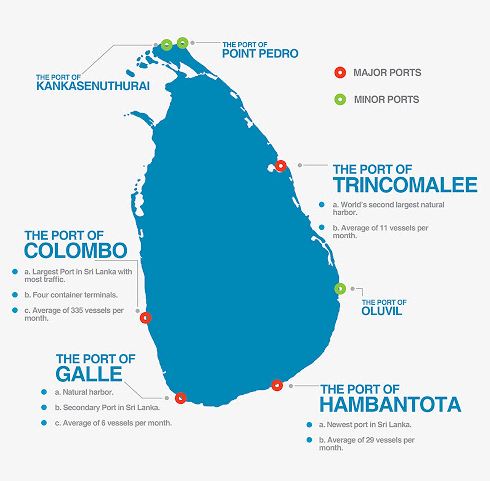
    After the strong opposition from within, the Sri Lankan government was forced to revoke a 2019 agreement with India and Japan to develop the strategic East Container Terminal (ECT) at the Colombo Port.

    Map Reading: Note all these major ports and try recalling their sequences in the clockwise and counter-clockwise direction.

    What is the news?

    • PM Mahinda Rajapaksa made a statement that the operation of the east terminal would be done by Sri Lanka Ports Authority on its own.
    • Its cabinet has approved a proposal to develop the West Terminal at the Colombo Port as a PPP with India and Japan, which is seen as a bid to compensate India.
    • It is unclear whether India would accept the latest proposal.

    What is the Project?

    • The tripartite agreement, signed by India, Sri Lanka and Japan, proposes to develop the ECT, which is located at the newly expanded southern part of the Colombo Port.
    • The ECT is located 3 km away from the China-backed international financial city, known as Port City, currently being built in Colombo.
    • A Chinese company was behind the controversial 2018 Hambantota port project, signed its first contract in the Port City last month.
    • It is also on the map of China’s Belt and Road Initiative (BRI).

    India’s reaction

    • A few weeks ago EAM S. Jaishankar visited Sri Lanka where he discussed the development of the stalled project.
    • India’s first response was that the island nation should not be taking a decision in a unilateral manner on an existing tripartite agreement.

    Compensatory offer to India

    • After the decision on revoking the 2019 agreement, SL has approved another proposal to develop the west terminal of the Colombo port with Japan and India.
    • Commercially, the west terminal offer is better for India as it gives 85% stake for developers of the West Terminal against the 49% in ECT.

    Sri Lanka expects India to rethink. Why?

    • Indian response to this compensatory offer is unclear since there was no formal communication by SL authorities.
    • Geo-politically, west terminal is almost the same India considers the security aspect and the necessity to have a port terminal in Sri Lanka.
    • There is no difference between East and West Terminals except for the fact that development of the ECT is partially completed while the development of the West Terminal has to start from scratch.

    SL version of the revocation

    • Incumbent PM Mahinda Rajapaksa said the pressure was immense on the President Gotabaya Rajapaksa to cancel the 2019 agreement.
    • The pressure was brewing so much that he was becoming so unpopular among the people.
    • As per the agreement signed by the former Maithripala Sirisena-Ranil Wickremesinghe administration, India and Japan together were to hold 49% stake in ECT.
    • What had finally made the government surrender before trade unions were the increasing support of many more sections in the society for the protests against privatization.

    The inevitable factor: China

    • This move can be easily interpreted as a reaction to Chinese communication to Sri Lanka.
    • China has reportedly instigated trade unions and civil societies against this project.

    Q.The threat of Chinese presence in South Asia can be tackled more effectively if India changes course in its dealings with its neighbours and becomes more sensitive to their concerns. Critically analyse.

    Outcome: Souring of the ties

    • For India, the strategic ECT project was important. Even the EAM has visited Colombo in January in this regard.
    • Critics of the Sri Lankan government anticipate many national and international impacts surrounding the latest decision on ECT.
    • Meantime, internationally an offended India can make life tough for Sri Lanka, isolating the tiny island nation, geo-politically and on the economic front.
    • The economic isolation will not help Sri Lanka at a time when the country is taking steps to revive the economy amid a pandemic.
  • Police Reforms – SC directives, NPC, other committees reports

    India Justice Report, 2020

    The second edition of the Indian Justice Report (IJR) was recently launched.

    Note the findings of this report. It is the only such report of its kind published in India.

    India Justice Report

    • The IJR is an initiative of Tata Trusts in collaboration with Centre for Social Justice, Common Cause and Commonwealth Human Rights Initiative among others.
    • It was first published in 2019.
    • It brings together otherwise siloed statistics from authoritative government sources, on the four pillars of justice delivery – Police, Judiciary, Prisons and Legal Aid.

    Major highlights of the Report

    • The report highlights stark conclusions when aggregated for an all-India picture.
    • Women comprise only 29 per cent of judges in India.
    • Two-thirds of the country’s prisoners are yet to be convicted.
    • In the last 25 years, since 1995, only 1.5 crore people have received legal aid, though 80 per cent of the country’s population is entitled to.
    • The report gives ranks Maharashtra once again at the top of the 18 large- and mid-sized states (with a population of over one crore each), followed by Tamil Nadu, Telangana, Punjab and Kerala.
    • The list of seven small states (population of less than one crore each) was topped by Tripura, followed by Sikkim and Goa.

  • Urban Transformation – Smart Cities, AMRUT, etc.

    Jal Jeevan Mission (Urban) to revive urban water bodies

    The urban water supply mission under the Jal Jeevan Mission announced in the Budget would include rejuvenation of water bodies as well as 20% of supply from reused water.

    Access to safe drinking water has been a grave problem for India, especially in rural areas where lack of usable water has resulted in decades-old sanitation and health problems.

    Jal Jeevan Mission

    • Jal Jeevan Mission, a central government initiative under the Ministry of Jal Shakti, aims to ensure access of piped water for every household in India.
    • The mission’s goal is to provide to all households in rural India safe and adequate water through individual household tap connections by 2024.
    • The Har Ghar Nal Se Jal programme was announced by FM in Budget 2019-20 speech.
    • This programme forms a crucial part of the Jal Jeevan Mission.
    • The programme aims to implement source sustainability measures as mandatory elements, such as recharge and reuse through greywater management, water conservation, and rainwater harvesting.

    Urban component of the mission

    • The mission is meant to create a people’s movement for water, making it everyone’s priority.
    • There are an estimated gap of 2.68 crore urban household tap connections that the Mission would seek to bridge in all 4,378 statutory towns.
    • The Mission would also aim to bridge the gap of 2.64 crore sewer connections in the 500 cities under the existing Atal Mission for Rejuvenation and Urban Transformation (AMRUT).
    • The mission would include rejuvenation of water bodies to boost the sustainable freshwater supply and the creation of green spaces.
  • Modern Indian History-Events and Personalities

    [pib] Centenary of ‘Chauri Chaura’ Incident

    PM will inaugurate the centenary Celebrations at Chauri Chaura at Gorakhpur Dist. Uttar Pradesh.

    ‘Chauri Chaura’ Incident

    • The incident took place on 4 February 1922 at Chauri Chaura in the Gorakhpur district of the United Province.
    • A large group of protesters participating in the Non-Cooperation Movement clashed with police who opened fire.
    • In retaliation the demonstrators attacked and set fire to a police station, killing all of its occupants.
    • The incident led to the death of three civilians and 22 policemen.
    • Mahatma Gandhi, who was strictly against violence, halted the non-co-operation movement on the national level on 12 February 1922, as a direct result of this incident.

    Try this PYQ:

    Q.The ‘Swadeshi’ and ‘Boycott’ adopted as methods of struggle for the first time during the

    (a) Agitation against the Partition of Bengal

    (b) Home Rule Movement

    (c) Non-Cooperation Movement

    (d) Visit of the Simon Commission to India

    Background

    • In the early 1920s, Indians, led by Mahatma Gandhi, were engaged in a nationwide non-cooperation movement.
    • Using non-violent methods of civil disobedience known as Satyagraha, protests were organised by the INC to challenge oppressive regulations such as the Rowlatt Act.

    Course of the incident

    • Two days before the incident, on 2 February 1922, volunteers participating in the Non-cooperation Movement led by a retired Army soldier named Bhagwan Ahir.
    • The protest was planned against high food prices and liquor sale in the marketplace.
    • Several of the leaders were arrested and put in the lock-up at the Chauri Chaura police station.
    • In response to this, a protest against the police was called on 4 February, to be held at the local marketplace.
    • Infuriated by the gunfire into their ranks, the crowd set the chowki ablaze, killing all of the Indian policemen and other staff trapped inside.

    Aftermath

    • Appalled at the outrage, Gandhi went on a five-day fast as penance for what he perceived as his culpability in the bloodshed.
    • In reflection, Gandhi felt that he had acted too hastily in encouraging people to revolt against the British Raj without sufficiently emphasizing the importance of non-violence.
    • On 12 February 1922, the Indian National Congress halted the Non-co-operation Movement on the national level as a direct result of the Chauri Chaura tragedy.
  • Wetland Conservation

    [pib] India gets its first Centre for Wetland Conservation and Management

    The Ministry of Environment, Forest and Climate Change has announced the establishment of a Centre for Wetland Conservation and Management (CWCM).

    What are Wetlands?

    • A wetland is a distinct ecosystem that is flooded by water, either permanently or seasonally, where oxygen-free processes prevail.
    • The primary factor that distinguishes wetlands from other landforms or water bodies is the characteristic vegetation of aquatic plants, adapted to the unique hydric soil.
    • Wetlands provide a wide range of important resources and ecosystem services such as food, water, fibre, groundwater recharge, water purification, flood moderation, erosion control and climate regulation.

    Ecological significance of wetlands

    • Wetlands provide a wide range of important resources and ecosystem services such as food, water, fibre, groundwater recharge, water purification, flood moderation, erosion control and climate regulation.
    • They are, in fact, a major source of water and our main supply of fresh water comes from an array of wetlands which help soak rainfall and recharge groundwater.
    • Just as forests are called the ‘lungs of the earth’, wetlands are the ‘kidneys’ that regulate water and filter waste from the landscape.

    About CWCM

    • WCM would serve as a knowledge hub and enable exchange between State/ UT Wetland Authorities, wetland users, managers, researchers, policy-makers and practitioners.
    • It would function as a part of the National Centre for Sustainable Coastal Management (NCSCM), Chennai.
    • It would address specific research needs and knowledge gaps and will aid in the application of integrated approaches for conservation, management and wise use of the wetlands.

    Why need such a centre?

    • India has nearly 4.6% of its land as wetlands, covering an area of 15.26 million hectares and has 42 sites designated as Wetlands of International Importance (Ramsar Sites), with a surface area of 1.08 million hectares.
    • The year 2021 also commemorates the 50th anniversary of the signing of the Ramsar Convention on Wetlands on 2 February 1971 in Ramsar, Iran, celebrated annually as World Wetlands Day.

    Back2Basics: Ramsar Convention

    • The Convention on Wetlands of International Importance (better known as the Ramsar Convention) is an international agreement promoting the conservation and wise use of wetlands.
    • It is the only global treaty to focus on a single ecosystem.
    • The convention was adopted in the Iranian city of Ramsar in 1971 and came into force in 1975.
    • Traditionally viewed as a wasteland or breeding ground of disease, wetlands actually provide fresh water and food and serve as nature’s shock absorber.
    • Wetlands, critical for biodiversity, are disappearing rapidly, with recent estimates showing that 64% or more of the world’s wetlands have vanished since 1900.
    • Major changes in land use for agriculture and grazing, water diversion for dams and canals and infrastructure development are considered to be some of the main causes of loss and degradation of wetlands.

    Enthusiasts can read this document:

    Faunal Diversity in Ramsar Wetlands of India

Join the Community

Join us across Social Media platforms.
