💥UPSC 2027,2028 Mentorship (April Batch) + Access XFactor Notes & Microthemes PDF

Archives: News

  • Russian Invasion of Ukraine: Global Implications

    US-Russia to extend the New START Treaty

    Why in the News?

    U.S. President Donald Trump has indicated a willingness to extend the New START Treaty with Russia by one year, until February 2027, as the treaty is due to expire next February.

    About the New START Treaty:

    • About: New Strategic Arms Reduction Treaty (New START); Bilateral nuclear arms control pact between the United States and Russia.
    • Signed: April 8, 2010, in Prague by U.S. President Barack Obama and Russian President Dmitry Medvedev; Came into Force: February 5, 2011.
    • Initial Duration: 10 years, set to  be expired in February 2021; extended by 5 years to February 2026.
    • Proposed Further Extension: To February 2027, as hinted by U.S. President Donald Trump.
    • Objective: Limit and verify the number of deployed strategic nuclear weapons to ensure predictability and strategic stability between the two nuclear superpowers.
    • Ceilings:
      • 1,550 deployed strategic nuclear warheads.
      • 700 deployed intercontinental ballistic missiles (ICBMs), submarine-launched ballistic missiles (SLBMs), and heavy bombers.
      • 800 deployed and non-deployed launchers and bombers combined.
    • Verification Regime:
      • Regular on-site inspections.
      • Biannual data exchanges.
      • Notifications of movement or deployment of nuclear assets.
      • Telemetry sharing for missile tests.
    • Administering Authority: U.S. Department of State and Russian Ministry of Foreign Affairs under a joint commission.
    • Scope: Applies only to strategic (long-range) nuclear forces, not tactical nuclear weapons.
    • Historical Context:
      • Successor to START I (1991) and START II (1993).
      • Last remaining arms control treaty after the collapse of the INF Treaty (2019) and U.S. withdrawal from the ABM Treaty (2001).
    • Significance: Serves as the final legal constraint on the two largest nuclear arsenals, reducing risk of an unconstrained arms race.

    Implications of Extending the New START

    • Maintains Strategic Stability: Retains verifiable limits on the world’s two largest nuclear stockpiles, reducing risk of escalation or miscalculation.
    • Prevents Arms Race: Avoids a strategic vacuum that could lead to rapid weapon modernization and expansion by both nations.
    • Diplomatic Leverage: Provides a diplomatic window for future multilateral disarmament talks, possibly involving China and other nuclear powers.
    • Global Signalling: Reinforces commitment to nuclear restraint and non-proliferation under the spirit of the Nuclear Non-Proliferation Treaty (NPT).
    • Risks of Non-Extension:
      • Collapse of all bilateral arms control between the U.S. and Russia.
      • Accelerated nuclear modernization programs.
      • Weakened global disarmament norms and potential CTBT irrelevance.
  • World’s Highest Motorable Road constructed at Mig La Pass in Ladakh

    Why in the News?

    The Border Roads Organisation (BRO) has achieved a historic milestone by constructing the world’s highest motorable road at Mig La Pass, situated 19,400 feet above sea level in Ladakh.

    • Strategic Value: Enables rapid troop movement and logistics support in high-altitude sectors; promotes eco-tourism and local trade.

    What is Project Himank?

    • Overview: A flagship Border Roads Organisation (BRO) initiative launched in December 1985 to build and maintain roads in Ladakh’s high-altitude regions.
    • Key Achievements: Built Umling La Road, Chisumle–Demchok, Darbuk–Shyok–DBO, Kargil–Zanskar, and now the Mig La Road (19,400 ft) under severe climatic stress.

    About Mig La Pass:

    • Importance: Crucial for India’s border logistics network, enabling swift troop deployment, supply transport, and surveillance near LAC and LoC.
    • Location: Situated on the Changthang Plateau, eastern Ladakh, near the Line of Actual Control (LAC) with China.
    • Elevation: Stands at 19,400 ft (5,913 m), now the highest motorable road in the world (2025), overtaking Umling La (19,024 ft).
    • Alignment: Lies along the Likaru–Mig La–Fukche route, forming a third strategic link from Hanle to Fukche near the Indo-China border.
    • Connectivity Role: Provides access to remote frontier villages—Hanle, Rongo, Kuyul, and Demchok—improving healthcare, communication, and supply access.
    • Geography: Part of the Changthang cold desert, with thin air, permafrost, and extreme cold, posing major engineering challenges.
    • Historical Link: Follows ancient Indo-Tibetan trade routes, reflecting Ladakh’s role in trans-Himalayan Silk Route exchanges.
    [UPSC 2007] Which one of the following Himalayan passes was reopened around in the middle of the year 2006 to facilitate trade between India and China?

    Options: (a) Chang La (b) Jara La (c) Nathu La* (d) Shipki La


  • Tribes in News

    SC upholds Property Inheritance Rights for Gond Tribal Women

    Why in the News?

    The Supreme Court of India has affirmed that women of the Gond community, a Scheduled Tribe under Article 342, are entitled to inherit ancestral property, even where no explicit tribal custom confers this right.

    Supreme Court Verdict on Gond Women’s Inheritance Rights:

    • Background: Case concerned women of the Gond Scheduled Tribe seeking equal inheritance rights over their maternal grandfather’s ancestral property.
    • Lower Court Rulings: The trial court and Madhya Pradesh High Court dismissed the plea, holding that no tribal custom granted such rights and placing the burden of proof on the women.
    • Supreme Court Review: On 17 July 2025, a Bench of Justices Sanjay Karol and Joymalya Bagchi examined whether constitutional equality overrides unwritten tribal customs excluding women from succession.
    • Legal Context: Under Section 2(2) of the Hindu Succession Act (1956), Scheduled Tribes are excluded unless specifically notified—none apply to Gonds—so the dispute was governed by customary tribal law.

    Supreme Court’s Ruling:

    • Presumption of Equality: The Court reversed lower findings, holding that equality must be presumed unless a proven, valid custom denies it.
    • Burden of Proof: Stated that custom cannot be presumed; it must be ancient, certain, and reasonable, proven through credible evidence.
    • Gender Justice: Rejected patriarchal inferences drawn from Hindu traditions, asserting such predispositions have “no place” in the case.
    • Guiding Principle: In absence of valid custom, courts must decide per “justice, equity, and good conscience.”

    Constitutional Principles Applied:

    • Article 14: Ensures equality before law; male-only inheritance lacks rational basis.
    • Article 15(1):  Prohibits sex-based discrimination; used to strike down exclusion of women.
    • Article 38: Mandates elimination of inequality across social and gender lines.
    • Article 46:  Requires protection of Scheduled Tribes from exploitation and injustice.
    • Hindu Succession (Amendment) Act, 2005 cited for illustrating gender-equal intent, not direct applicability.

    Constitutional–Customary Balance:

    • Conflict: Between tribal autonomy under Fifth/Sixth Schedules and constitutional equality under Part III.
    • Precedent Shift: Unlike Madhu Kishwar v. State of Bihar (1996), which upheld male-only inheritance, the 2025 ruling held that when custom is unproven or discriminatory, Article 14 prevails.
    • Significance: Moves jurisprudence from deference to custom toward enforcement of constitutional morality, ensuring tribal women’s equal property rights.
    [UPSC 2023] Explain the constitutional perspectives of Gender Justice with the help of relevant Constitutional Provisions and case laws.

    [UPSC 2015] Discuss the possible factors that inhibit India from enacting for its citizens a uniform civil code as provided for in the Directive Principles of State Policy.


  • Nobel and other Prizes

    Physics Nobel Prize for Quantum Tunneling

    Why in the News?

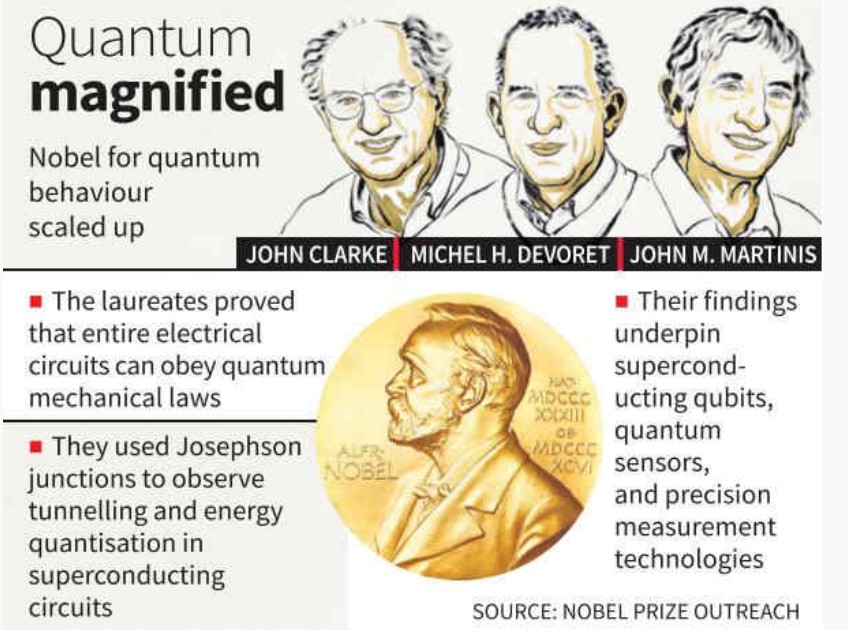
    The 2025 Nobel Prize in Physics has been awarded to John Clarke, Michel Devoret, and John Martinis for their discovery of macroscopic quantum mechanical tunnelling and energy quantisation in an electric circuit.

    nobel

    Discovery of Macroscopic Quantum Effects:

    • Essence of the Discovery: John Clarke, Michel Devoret, and John Martinis proved that quantum effects—tunnelling and energy quantisation—can occur in macroscopic electrical circuits, not just in atoms or particles.
    • Experiments (UC Berkeley, 1984–85): Demonstrated that superconducting circuits, visible to the naked eye, act as quantum systems when isolated from external disturbances.
    • Observed Phenomena:
      • Macroscopic Quantum Tunnelling: Electric current “jumps” through an insulating barrier even when classical physics predicts no flow.
      • Energy Quantisation: The circuit holds only discrete energy levels, behaving like an artificial atom that exchanges energy in fixed quanta.
    • Scientific Breakthrough: First experimental proof that quantum mechanics governs engineered large-scale systems, forming the foundation of quantum computing.

    The Josephson Junction:

    • Structure: Two superconductors separated by a thin insulating layer, allowing the passage of Cooper pairs paired electrons that move as a single quantum entity.
    • Mechanism: Though insulators block current in classical systems, Cooper pairs tunnel through the barrier, producing a supercurrent without resistance.
    • Key Berkeley Findings:
      • The phase difference across the junction behaved as a quantum variable, showing discrete energy states.
      • Spontaneous tunnelling of current produced measurable voltage, confirming macroscopic quantum tunnelling.
    • Outcome: The Josephson junction became the first laboratory model of macroscopic quantum behaviour and the prototype for superconducting qubits used in today’s quantum computers.

    Significance:

    • Redefined Quantum Boundaries: Established that quantum laws are universal, applying from electrons to circuits of billions of atoms when quantum coherence is preserved.
    • Foundation for Quantum Computing: Provided the conceptual basis for superconducting qubits, now central to Google, IBM, and TIFR quantum processors.
    • Technological Impact: Enabled innovations in quantum sensors, precision metrology, and quantum communication through microwave-to-optical conversion.
    • Philosophical Insight: Resolved the scale question of how large a system can remain quantum,  proving that superconducting isolation preserves coherence even at macroscopic levels.
    • Legacy: Bridged the quantum–classical divide, converting a theoretical boundary into experimentally verified reality, launching the modern quantum technology era.
    [UPSC 2022] Which one of the following is the context in which the term “qubit” is mentioned?

    Options:  (a) Cloud Services b) Quantum Computing* (c) Visible Light Communication Technologies (d) Wireless Communication Technologies


  • Judicial Reforms

    [7th October 2025 ] The Hindu Op-ed: Calling out the criticism of the Indian Judiciary

    PYQ Relevance

    [UPSC 2023] Constitutionally guaranteed judicial independence is a prerequisite of democracy”. Comment.

    Linkage: The article defends judicial independence as the backbone of India’s democracy, arguing that blaming courts for developmental delays undermines their constitutional role as checks on executive excesses. It reinforces that true democracy thrives only when judicial autonomy remains uncompromised.

    Mentor’s Comment

    In an era where the pursuit of Viksit Bharat (Developed India) dominates public discourse, the judiciary is increasingly being portrayed as a bottleneck in India’s development journey. However, this narrative is not only simplistic but dangerous. This article delves deep into the recent criticism of India’s judiciary, particularly remarks made by Sanjeev Sanyal, and explores whether such allegations hold ground. It highlights how governance failures, legislative vagueness, and unchecked executive litigation are often the real culprits behind systemic inefficiencies. The aim is to help aspirants understand the complex interlinkages between judiciary, governance, and development, a recurring UPSC theme.

    Introduction

    The judiciary has long been one of the cornerstones of India’s democracy. Yet, it often finds itself under scrutiny for delays, pendency, and procedural rigidities. The recent remarks by Sanjeev Sanyal, member of the Prime Minister’s Economic Advisory Council, blaming the judiciary as the “single biggest hurdle” in India’s development, reignited a larger debate: Is the judiciary obstructing growth, or is it merely reflecting systemic governance failures? This question is crucial for UPSC aspirants because it encapsulates multiple administrative, ethical, and policy dimensions, from judicial accountability to executive responsibility and the balance of powers enshrined in the Constitution.

    Why in the News?

    At the Nyaya Nirman Conference, Sanjeev Sanyal claimed that India’s judiciary is the “single biggest hurdle” to achieving Viksit Bharat within 20–25 years. His comments triggered debate as it was not the first time that the judiciary was blamed for impeding development. What makes it significant is the reduction of a constitutional pillar into a scapegoat — reflecting a wider trend of executive deflection from governance failures. The issue is striking because judicial delays, though real, are often symptoms of legislative imprecision, government over-litigation, and vacant judicial posts, not merely judicial inefficiency.

    Is the Judiciary the “Single Biggest Hurdle” to Development?

    1. Oversimplified blame – The criticism ignores that the judiciary merely enforces laws framed by Parliament. For instance, Section 12A of the Commercial Courts Act, 2015 mandates pre-suit mediation — a legislative choice, not a judicial one.
    2. Structural imbalance – Judicial delays stem from vacancies (over 30%), poor digital infrastructure, and overburdened lower courts rather than deliberate obstructionism.
    3. Reality check – India’s judiciary handles one of the world’s heaviest caseloads, with judges hearing 50–100 cases per day, highlighting efficiency within constraints.

    What Lies Behind Judicial Delays?

    1. Government as the biggest litigant – The Union and State governments account for nearly 50% of all cases. Tax authorities, ministries, and PSUs appeal even routine orders, consuming judicial time and resources.
    2. Arbitrary tendering & contractual behaviour – Governments frequently breach contracts or impose unreasonable conditions, compelling contractors and citizens to litigate for basic rights.
    3. Vague and outdated laws – Laws are often drafted imprecisely, leading to interpretational disputes. The new criminal laws and upcoming Income-Tax Act recycle old frameworks with cosmetic changes.

    Are Courts Overworked or Underworked?

    1. Myth of short working hours – Court sittings (10:30 AM–4 PM) mask the hours of preparatory and post-hearing work, including judgment writing and research.
    2. Vacations misunderstood – Vacations are largely used to complete reserved judgments, not for leisure. Vacation benches continue urgent hearings.
    3. Caseload pressure – District courts bear the brunt, where justice delivery meets the common citizen. High pendency here directly affects the perception of delay.

    How Does Poor Law-Making Add to Judicial Burden?

    1. Ambiguity in drafting – The 99-to-1 problem, as noted by Sanyal himself, arises due to poorly framed laws meant to control the 1% of abusers, complicating life for the 99%.
    2. Linguistic confusion – Replacement of terms like “notwithstanding” with “irrespective” in new laws reflects shallow reform, creating fresh waves of litigation rather than clarity.
    3. Superficial reform – Cosmetic renaming (Codes → Sanhitas) in criminal law reform fails to address colonial legacies or procedural inefficiencies.

    What is the Broader Message for Governance and Democracy?

    1. Deflecting accountability – Calling courts the bottleneck diverts attention from executive and legislative lapses.
    2. Constitutional balance – Judiciary serves as a check on arbitrary power, ensuring that speed does not override justice.
    3. True development – A “Viksit Bharat” cannot emerge by weakening judicial independence but by strengthening institutional capacity across all pillars of democracy.

    Conclusion

    Blaming the judiciary for India’s developmental delays is a misdiagnosis of a systemic illness. The judiciary, though imperfect, mirrors the inefficiencies entrenched in India’s governance — from poor drafting and over-litigation to resource neglect. The real challenge lies not in reducing judicial authority but in reforming governance practices, streamlining litigation, and investing in judicial infrastructure. A strong, independent judiciary is not an obstacle but the guarantor of sustainable development and rule of law.

  • The Crisis In The Middle East

    Why Trump’s proposed stabilization force in Gaza will not find things easy

    Introduction

    With the Gaza conflict entering its third year, US President Donald Trump’s “Comprehensive Plan to End the Gaza Conflict” , a 20-point roadmap, has reignited global discussion on Palestine’s future. While both Israel and Hamas have agreed to an immediate ceasefire and prisoner exchange, the second, more ambitious part, a long-term peace framework and deployment of an International Stabilisation Force (ISF), faces deep geopolitical and operational challenges. The ISF, envisioned as a temporary yet long-term internal security mechanism under a “Board of Peace” chaired by Trump, is supposed to oversee “terror-free areas” handed over from Israel’s Defence Forces (IDF). But historical evidence from Afghanistan, Lebanon, and Iraq shows why such an effort may fail before it even begins.

    What is the International Stabilisation Force (ISF)?

    1. Temporary but long-term mechanism: The ISF is designed to act as a “temporary” yet enduring internal security arrangement, forming part of a larger apolitical Palestinian committee.
    2. Trump’s oversight: It would be supervised by a “Board of Peace” chaired by Trump, tasked with ensuring security transition in Gaza.
    3. Mandate confusion: The ISF’s deployment is proposed “immediately” after Israeli Defence Forces withdraw from designated “terror-free zones.”
    4. Not UN-mandated: Unlike traditional UN peacekeeping forces, the ISF would lack international legitimacy and neutrality, as it is not under the UN Security Council’s (UNSC) authorisation.

    Why is the ISF Not Comparable to UN Peacekeeping?

    1. Absence of neutrality: International peacekeeping has always required UN-mandated neutrality; the ISF, dominated by US and allied interests, lacks this legitimacy.
    2. Hostility in the region: Due to Arab hostility towards the US and Israel’s disregard for UN mandates, any non-UN force would face rejection from regional actors.
    3. UN precedent: Since 2004, UNSC resolutions have repeatedly called for peacekeeping only under UN authority, especially within occupied Palestinian territories until a two-state solution is achieved.
    4. Contradiction with global norms: Past experiences, from NATO’s ISAF in Afghanistan to multinational forces in Lebanon, show that non-UN interventions invite political opposition and legitimacy crises.

    Why is Implementation Difficult in Palestine?

    1. Israel’s selective compliance: Israel has historically undermined UN peacekeeping mandates (e.g., UNIFIL in Lebanon) and is unlikely to cooperate fully with an externally led force.
    2. Hamas’ rejection of disarmament: Hamas has refused to disarm without Israel’s full withdrawal, a non-negotiable precondition.
    3. Political vacuum: There are no strong Palestinian institutions capable of ensuring political control and governance in post-conflict Gaza.
    4. UNSC resolutions ignored: While resolutions call for a two-state solution and prohibit occupation, Israel’s actions, including settlements and security zones, contravene these commitments.
    5. Lack of Arab consensus: Arab states remain divided on participation in any force seen as legitimising Israeli occupation.

    What Lessons Do Historical Precedents Offer?

    1. Afghanistan (2001–2021): The NATO-led ISAF mission initially succeeded in stabilising Kabul but failed to create self-sustaining security institutions; the Taliban returned to power in 2021.
    2. Lebanon (1982–2000): The Multinational Force (MNF), dominated by the US and UK, withdrew amid heavy local opposition and attacks, transferring responsibility to the UN’s UNIFIL.
    3. Iraq (post-2003): The absence of a UN framework led to severe legitimacy deficits, insurgency, and long-term instability.
    4. These precedents underscore that external interventions without inclusive local ownership often end in strategic failure.

    What Are the Broader Challenges in Trump’s Plan?

    1. Contradictory goals: Trump’s plan envisions Israel’s partial withdrawal but simultaneously retains security control, an inherent contradiction.
    2. Palestinian exclusion: The proposal does not recognise any Palestinian political institutions or grant them meaningful authority.
    3. Legal limitations: Without UNSC authorisation, the ISF would lack the legal basis to operate or enforce peace.
    4. Regional optics: Arab and Islamic states would perceive this as another Western attempt to militarise peace under the guise of “stabilisation.”

    Conclusion

    Trump’s proposed International Stabilisation Force may appear bold on paper, but it suffers from a crisis of legitimacy, political trust, and historical amnesia. Without a UN mandate, regional consensus, or Palestinian participation, the plan risks deepening divisions rather than healing them. As history shows, no external force can impose peace where sovereignty and justice remain unresolved.

    PYQ Relevance

    [UPSC 2024] ‘Terrorism has become a significant threat to global peace and security.’ Evaluate the effectiveness of the United Nations Security Council’s Counter Terrorism Committee (CTC) and its associated bodies in addressing and mitigating this threat at the international level.

    Linkage: Trump’s proposed International Stabilisation Force (ISF), lacking a UN mandate, underscores the limits of ad-hoc coalitions in tackling terrorism, contrasting with the UNSC-CTC’s institutional approach to coordinated, legitimate counter-terrorism efforts. It highlights the need for UN-backed, multilateral mechanisms over unilateral interventions for sustainable global peace.

  • Nobel and other Prizes

    The Nobel laurates’ work has redefined the immune system itself

    Introduction

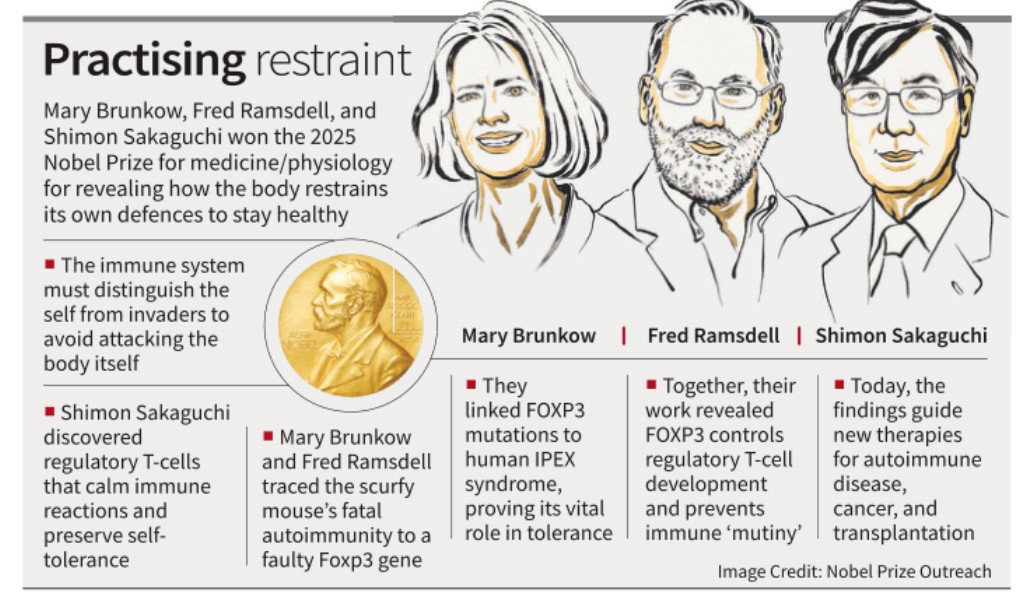
    For decades, the immune system was viewed as a binary apparatus either attacking foreign invaders or remaining silent toward the body’s own cells. This year’s Nobel laureates, Mary Brunkow, Fred Ramsdell, and Shimon Sakaguchi, dismantled that simplistic view by uncovering the critical role of regulatory T-cells (Tregs) and the FOXP3 gene in maintaining self-tolerance. Their findings fundamentally redefined how scientists perceive immune regulation and opened the path for precision immunotherapy — one of modern medicine’s most promising frontiers.

    The Science of Self-Tolerance: Why It’s in the News

    The Nobel Committee’s recognition of research on regulatory T-cells (Tregs) and FOXP3 marks a watershed moment in immunology. For the first time, the prize acknowledges discoveries that explain how the immune system prevents itself from attacking the body. The work explains why autoimmune disorders like Type 1 diabetes, rheumatoid arthritis, and lupus occur when this “self-check” mechanism fails. It also connects molecular immunology to emerging therapies for cancer and transplantation. This is a landmark shift from viewing immunity as mere “defence” to seeing it as a balance of activation and restraint, a concept that has redefined global biomedical research.

    nobel

    How the Nobel-winning Discovery Unfolded

    1. Early Understanding: In the 1990s, immunologists believed that self-reactive T-cells were deleted during their maturation. However, this could not explain why some autoreactive T-cells still existed in healthy people.
    2. Sakaguchi’s Breakthrough (1995): Identified a subset of CD4⁺ T-cells whose removal in mice led to multiple autoimmune disorders. Restoring them prevented disease — proving they act as regulators of immune overreaction.
    3. Discovery of FOXP3 Gene: Brunkow and Ramsdell, working in an industry lab (Celltech Chiroscience), traced severe autoimmune disease in male “scurfy” mice to a gene mutation on the X chromosome. They named it FOXP3.
    4. Human Correlation: Soon, mutations in FOXP3 were linked to lethal autoimmune syndromes in boys, confirming its pivotal role in human immune regulation.

    How These Discoveries Transformed Immunology

    • Redefining the Immune System: The immune system is now seen not as an on/off mechanism but as a dynamic ecosystem that balances activation (attack) with restraint (tolerance).
    • New Therapeutic Frontiers:
      1. Autoimmune Diseases: Efforts are underway to expand or stabilise Tregs to curb harmful immune activation without broad immunosuppression.
      2. Transplant Medicine: Infusion of engineered Tregs improves graft acceptance and reduces rejection rates.
      3. Cancer Research: Selective depletion or reprogramming of tumour-associated Tregs enhances anti-tumour immunity without triggering autoimmunity.

    From Lab to Life: The Translational Challenge

    1. Incremental Progress: Immunologists warn against overestimating breakthroughs. The immune system has multiple overlapping control layers, making clinical translation slow.
    2. High Cost Barrier: Cell-based therapies remain expensive, leading to inequitable access between high- and low-income populations.
    3. Ethical and Policy Dilemmas: Who gets access first? How do we regulate genetic manipulation or Treg engineering? These questions highlight the intersection of science, ethics, and public policy.

    Private Sector and Scientific Innovation

    1. Industrial Discovery: The fact that Brunkow and Ramsdell made their discoveries in an industry setting (Celltech Chiroscience) underscores the potential of private-sector-led innovation in fundamental science.
    2. Public–Private Synergy: It reinforces how collaborations between academic research and biotech industry can accelerate discovery and application, a model India can emulate in its biotechnology policy framework.

    Broader Implications for India and Global Health

    1. Indian Relevance: India’s growing burden of autoimmune diseases (such as lupus, celiac, and thyroiditis) highlights the need for indigenous immunogenetic research.
    2. Policy Perspective: Translating such research into affordable therapies aligns with National Biotechnology Development Strategy and Ayushman Bharat’s preventive healthcare goals.
    3. Global Impact: These discoveries open a new era of personalised immunotherapy, integrating molecular biology, bioethics, and equitable access.

    Conclusion

    The 2025 Nobel Prize reminds the world that progress in science often lies not in creating new weapons against disease but in understanding balance, the balance within nature and within ourselves. The discovery of Tregs and FOXP3 has rewritten textbooks, inspired therapies, and expanded our conception of what “self” and “immunity” truly mean. For policymakers and scientists alike, it represents the future, a fusion of molecular precision, ethical responsibility, and social justice.

    PYQ Relevance

    [UPSC 2021] The Nobel Prize in Physics of 2014 was jointly awarded to Akasaki, Amano and Nakamura for the invention of Blue LEDs in the 1990s. How has this invention impacted the everyday life of human beings?

    Linkage: Both the 2014 Nobel for Blue LEDs and the 2025 Nobel for Treg–FOXP3 discovery represent paradigm shifts where scientific breakthroughs moved from lab theory to real-world transformation — the former revolutionised energy efficiency, while the latter is redefining human health and immune regulation.

  • Organic Farming – Paramparagat Krishi Vikas Yojna (PKVY), NPOF etc.

    [pib] 10 Years of Paramparagat Krishi Vikas Yojana (PKVY)

    Why in the News?

    After a decade (2015–2025), Paramparagat Krishi Vikas Yojana (PKVY) has evolved from a pilot cluster model into a national ecosystem of training, certification, and market access.

    About Paramparagat Krishi Vikas Yojana (PKVY):

    • Launch: Introduced in 2015 under the Ministry of Agriculture & Farmers Welfare as part of the National Mission for Sustainable Agriculture (NMSA) to promote organic and traditional chemical-free farming.
    • Cluster-Based Model: Farmers form 20 ha+ clusters for collective organic adoption, resource sharing, and easier certification & marketing.
    • Eligibility & Funding Flow: Open to farmers/institutions with land up to 2 ha; applications via Regional Councils → Annual Action Plans → States → DBT to farmers.
    • Financial Support: ₹31,500/ha over 3 years, covering inputs, training, certification, and marketing.
    • Certification Systems:
      1. NPOP (Third-Party Certification): for export and formal markets.
      2. PGS-India (Participatory Guarantee System): community-driven, peer-reviewed certification for domestic markets.
      3. Large Area Certification (LAC): initiated in 2020 to fast-track certification in areas with no prior chemical use, reducing conversion time.
    • Digital Integration: Jaivik Kheti portal links farmers, buyers, input suppliers for transparent, traceable organic trade.

    Achievements (as of Jan 2025):

    • Scale: ₹2,265.86 crore released; 15 lakh ha organic area, 52,289 clusters, 25.3 lakh farmers.
    • Certification: Sikkim fully organic, Lakshadweep & Dantewada LAC-certified, expansion to Nicobar & Ladakh.
    • Digital Reach: 6.23 lakh farmers, 19,016 groups, 8,676 buyers on Jaivik Kheti portal.
    • Institutional Growth: 9,268 FPOs formed; expanded market linkages for premium organic produce.
    • Ecological Gains: Reduced chemical load, improved soil fertility, local input ecosystems strengthened.

    Challenges:

    • Yield Dip: Transitional productivity loss strains small farmers.
    • Certification Costs: Verification and residue testing remain expensive.
    • Market Gaps: Uneven price premiums and weak buyer networks.
    • Cluster Variation: Success depends on local leadership and coordination.
    • Sustainability: Post-funding continuity often uncertain; technical gaps persist.
    [UPSC 2018] With reference to organic farming in India, consider the following statements:

    1. The National Programme for Organic Production’ (NPOP) is operated under the guidelines and directions of the Union Ministry of Rural Development.

    2. The Agricultural and Processed Food Products Export Development Authority’ (APEDA) functions as the Secretariat for the implementation of NPOP.

    3. Sikkim has become India’s first fully organic State.

    Which of the statements given above is/are correct?

    Options: (a) 1 and 2 only (b) 2 and 3 only* (c) 3 only (d)1, 2 and 3


  • Higher Education – RUSA, NIRF, HEFA, etc.

    [pib] PM-SETU Scheme

    Why in the News?

    PM has launched the Pradhan Mantri Skilling and Employability Transformation through Upgraded ITIs (PM-SETU) Scheme to modernize India’s Industrial Training Institutes (ITIs) into industry-aligned centers of excellence.

    About the PM-SETU Scheme:

    • Overview: Centrally Sponsored Scheme under the Ministry of Skill Development & Entrepreneurship (MSDE).
    • Objective: Upgrade 1,000 Government ITIs into modern, industry-linked institutions that address evolving global skill demands.
    • Financing: Supported by the World Bank and Asian Development Bank (ADB); co-funded by Centre, States, and Industry.
    • Implementation Model: Operates on a Hub-and-Spoke structure
      • 200 Hub ITIs act as Centres of Excellence.
      • 800 Spoke ITIs extend outreach and training access across districts.
    • Target: Skill 20 lakh youth over five years through new and revamped programs.

    Key Features:

    • Industry Partnership: Each cluster managed by a Special Purpose Vehicle (SPV) with an Anchor Industry Partner, ensuring outcome-based, employment-linked training.
    • Curriculum Reform: New demand-driven, industry-aligned courses and flexible pathways — diplomas, short-term modules, and executive programs.
    • Infrastructure Modernization:
      • Advanced machinery, incubation and innovation centres, and production units in hub ITIs.
      • Integration of placement services and trainer-training facilities.
    • Centres of Excellence (NCOEs): Upgradation of 5 National Skill Training Institutes (NSTIs) at Bhubaneswar, Chennai, Hyderabad, Kanpur, and Ludhiana into global-standard NCOEs with international collaboration.
    • Pilot Phase: Begins with Patna and Darbhanga ITIs (Bihar) as the first upgraded hubs.
    • Youth Empowerment Focus: Links skilling with innovation, startups, and MSMEs to create self-employment opportunities and strengthen India’s human-capital base.

    Also in News: National Scheme for ITI Upgradation & NCOEs

    • Cabinet-approved (May 2025) companion initiative with an outlay of ₹60,000 crore:
      • Central Share: ₹30,000 cr;  State: ₹20,000 cr;  Industry: ₹10,000 cr.
      • 50 % of the Central share co-financed by World Bank and ADB.
    • Purpose: Upgrade 1,000 ITIs and establish 5 NCOEs as Government-owned, Industry-managed skill institutions.
    • Features:
      • Need-based investment flexibility for each ITI.
      • Training-of-Trainers (ToT) infrastructure upgrade and training for 50,000 trainers.
      • Enhanced alignment of local workforce supply with MSME and industrial demand.
      • Introduction of an industry-led SPV model for better accountability and course relevance.


    [UPSC 2018] With reference to Pradhan Mantri Kaushal Vikas Yojana, consider the following statements:

    1. It is the flagship scheme of the Ministry of Labour and Employment.

    2. It, among other things, will also impart training in soft skills, entrepreneurship, financial and digital literacy.

    3. It aims to align the competencies of the unregulated workforce of the country to the National Skill Qualification Framework.

    Which of the statements given above is/are correct?

    Options: (a) 1 and 3 only (b) 2 only (c) 2 and 3 only* (d) 1, 2 and 3


  • Tax Reforms

    SC to examine Constitutional Validity of Securities Transaction Tax (STT)

    Why in the News?

    The Supreme Court of India has agreed to examine a petition challenging the constitutional validity of the Securities Transaction Tax (STT) imposed under the Finance Act, 2004.

    Legal Context of this Case:

    Petitioner: Aseem Juneja – contends that STT violates fundamental and economic rights.

    Bench: Headed by Justice J.B. Pardiwala; formal notice issued to Union Ministry of Finance.

    • The plea invokes Article 265“No tax shall be levied or collected except by authority of law.”
    • The Court will assess reasonableness, equity, and proportionality in transaction-based taxation.
    • A ruling against STT may impact ₹30,000-crore annual revenue and require redesign of securities taxation.

    SC to examine Constitutional Validity of Securities Transaction Tax (STT)

    What is the Securities Transaction Tax (STT)?

    • About: A direct tax levied on purchase and sale of securities through recognised stock exchanges.
    • Introduction: Under the Finance Act, 2004, to ensure transparency and curb tax evasion in capital markets.
    • Objective: Replace complex capital-gains tracking with a small, upfront levy to counter under-reporting and increase tax buoyancy.
    • Administered by: Central Board of Direct Taxes (CBDT), Ministry of Finance.
    • Scope: Applies to-
      1. Equity shares of listed companies
      2. Derivatives (futures & options)
      3. Equity-oriented mutual funds and ETFs.
    • Purpose:
      • Simplify tax collection from capital market participants.
      • Create a traceable, automated tax mechanism.
      • Generate steady revenue while discouraging speculative trading.
    • Nature: A transaction-based tax (TBT) collected automatically at the time of trade, irrespective of overall profit or loss.
    • Distinctive features:
        • Applies even on loss-making trades payable merely for conducting a transaction.
        • Non-refundable and non-adjustable, unlike TDS.
        • Raises transaction costs for high-frequency traders.
    • Imposition of STT:
      • Mode of collection: Automatically deducted by stock exchanges on every taxable trade and deposited into the government account; Ensures near-universal compliance and minimal evasion.
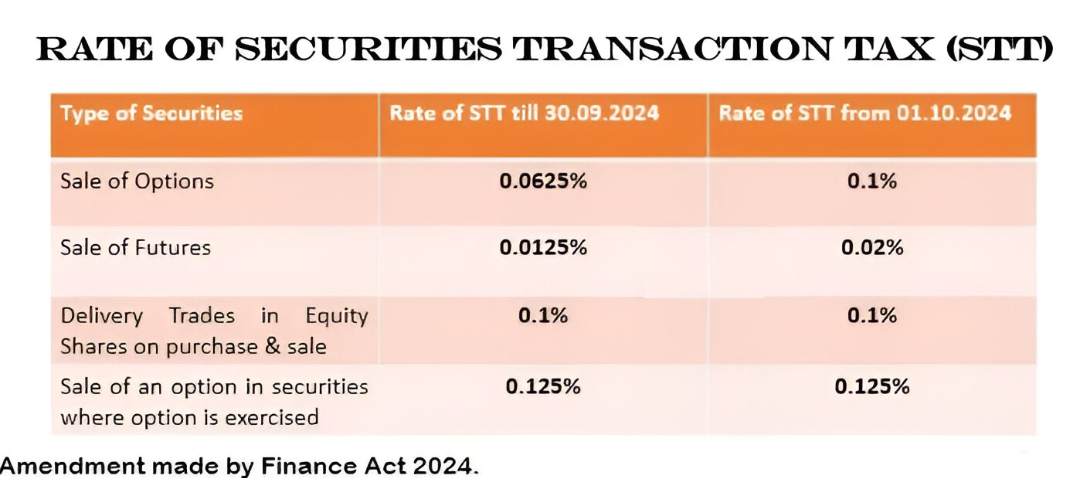
      • Rate & coverage: Varies across instruments and between buy/sell transactions; Periodically revised through Union Budgets.

    Key Grounds of Challenge:

    • Violation of Fundamental Rights:
      1. Article 14 (Equality): Unequal treatment; tax imposed irrespective of gain or loss.
      2. Article 19(1)(g) (Right to Trade): Penalises the act of trading itself.
      3. Article 21 (Livelihood & Dignity): Non-refundable levy burdens small traders.
    • Double Taxation: Traders already pay Capital Gains Tax on profits; STT adds a second layer on the same transaction.
    • Arbitrariness / Lack of Proportionality: Taxing even unprofitable transactions violates the principle of reasonable classification and fiscal fairness.
    • No Refund or Adjustment Mechanism: Absence of provision similar to TDS refunds; creates permanent loss even when income is negative.
    • Changed Circumstances: With digital audit trails, PAN-linked demat accounts, and near-complete transparency, the original rationale (to curb evasion) may no longer hold.
    [UPSC 2009] Consider the following:

    1. Fringe Benefit Tax 2. Interest Tax 3. Securities Transaction Tax

    Which of the above is/are Direct Tax/Taxes?

    Options: (a) 1 only (b) 1 and 3 only (c) 2 and 3 only (d) 1,2 and 3*


Join the Community

Join us across Social Media platforms.