💥UPSC 2027,2028 Mentorship (April Batch) + Access XFactor Notes & Microthemes PDF

Archives: News

  • Festivals, Dances, Theatre, Literature, Art in News

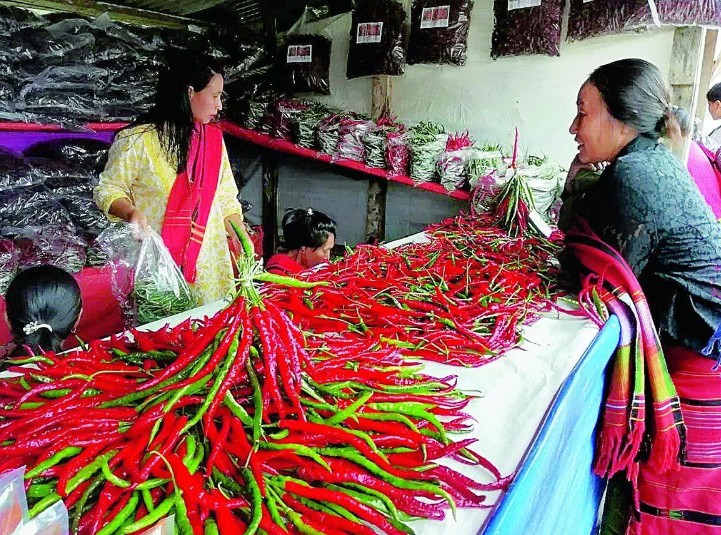
    Sirarakhong Hathei Chilli Festival

    Why in the News?

    The 14th Sirarakhong Hathei Chilli Festival was inaugurated in Manipur.

    Sirarakhong Hathei Chilli Festival

    About Sirarakhong Hathei Chilli Festival:

    • Overview: An annual agricultural and cultural festival celebrated in Sirarakhong village, Ukhrul district, Manipur.
    • Origin: Began in 2010 to promote the Hathei chilli and its farming traditions.
    • Focus: Highlights the Geographical Indication (GI)-tagged Hathei chilli, which received GI status in 2021.
    • Activities: Involves flag hoisting, Tangkhul Naga cultural events, buyer–seller meets, marketing programmes, exhibitions, and awareness drives on government schemes.

    Salient Features of Hathei Chilli:

    • Local Identity: Known as Sirarakhong chilli, indigenous to Ukhrul district.
    • Cultivation: Grown on slopes under the traditional jhum system.
    • Distinct Qualities: Recognised for its bright red colour, unique flavour, and medium pungency.
    • ASTA Value: Possesses a high American Spice Trade Association colour value, making it sought after for food colouring.
    • Nutritional Benefits: Rich in antioxidants, Vitamin C, and calcium, with medicinal value.
    • Uses: Widely used in cooking, pickles, flavouring, food colouring, and processing industries.
    • Uniqueness: Its qualities stem from the soil and climate of Sirarakhong, not reproducible elsewhere.
    [UPSC 2018] Consider the following pairs:

    Tradition- State

    1. Chapchar Kut festival — Mizoram

    2. Khongjom Parba ballad — Manipur

    3. Thong-To dance — Sikkim

    Which of the pairs given above is/are correct?

    Options: (a) 1 only (b) 1 and 2* (c) 3 only (d) 2 and 3


  • Textile Sector – Cotton, Jute, Wool, Silk, Handloom, etc.

    What is PM MITRA Park?

    Why in the News?

    Prime Minister recently laid the foundation stone for India’s first PM MITRA (Mega Integrated Textile Region and Apparel) Park in Dhar, Madhya Pradesh.

    About PM MITRA Scheme:

    • Overview: Introduced by the Ministry of Textiles in 2021, the scheme aims to strengthen India’s textile sector by creating 7 world-class integrated parks.
    • Concept: Designed on the vision Farm to Fibre to Factory to Fashion to Foreign, each park consolidates the entire textile value chain—spinning, weaving, dyeing, processing, printing, and garment-making—within a single ecosystem.
    • Sites Selected: Tamil Nadu (Virudhunagar), Telangana, Karnataka, Maharashtra, Gujarat, Madhya Pradesh (Dhar), and Uttar Pradesh (Lucknow).
    • Timeline: All parks are targeted to be established by 2026–27, with each covering around 1,000+ acres.
    • Implementation Structure:
      • Special Purpose Vehicle (SPV): Each park will be developed by an SPV jointly owned by the Centre and State Governments, operating in Public–Private Partnership (PPP) mode.
      • Development Capital Support (DCS): Up to ₹500 crore per park provided by the Centre to SPVs.
      • Competitive Incentive Support (CIS): Up to ₹300 crore per park offered to manufacturing units to encourage rapid implementation.

    Key Features and Benefits:

    • Integrated Value Chain: All stages of textile production are located in one hub, reducing transport costs, delays, and inefficiencies.
    • World-Class Infrastructure: Includes incubation centres, design/testing labs, effluent treatment plants, reliable utilities, logistics facilities, and worker hostels.
    • Employment Generation: Each park expected to create ~1 lakh direct and ~2 lakh indirect jobs, especially benefiting women and rural youth.
    • Investment Boost: Scheme aims to attract over ₹70,000 crore in investments in the textile sector.
  • Governor vs. State

    [18th September 2025] The Hindu Op-ed: A judicial nudge following stuck legislative business

    PYQ Relevance:

    UPSC 2022: Discuss the essential conditions for exercise of the legislative powers by the Governor. Discuss the legality of re-promulgation of ordinances by the Governor without placing them before the Legislature.

    Linkage: The recent Supreme Court directive fixing a timeline for Governors under Article 200 directly relates to the constitutional limits on gubernatorial powers discussed in the 2022 question. Both highlight that the Governor, as a constitutional head, must act on the aid and advice of the Council of Ministers and not misuse discretion to stall legislation. Just as re-promulgation of ordinances undermines legislative supremacy, withholding assent indefinitely violates constitutional morality and federal balance.

    Mentor’s Comment:

    The recent Supreme Court intervention fixing a time limit for Governors and the President to act on Bills marks a constitutional milestone. This decision is not merely about timelines but about strengthening federalism, ensuring legislative efficacy, and curbing misuse of gubernatorial discretion. For UPSC aspirants, it becomes a vital case study in Centre-State relations, separation of powers, and the evolving role of the judiciary in sustaining democracy.

    Introduction

    The Supreme Court’s decision to prescribe a three-month time limit for Governors and the President to take a final call on Bills under Article 200/201 has reignited debates on federalism, separation of powers, and the scope of judicial activism. For decades, Governors have been accused of sitting indefinitely on Bills, creating a legislative deadlock and undermining the democratic will of elected legislatures. This judicial nudge aims to resolve what has become a serious constitutional anomaly, ensuring that governance does not remain hostage to political manoeuvring.

    Why is this in the news?

    The issue is significant because, for the first time, the Supreme Court has imposed a specific timeline—three months—for Governors and the President to act on Bills, despite the Constitution prescribing none. This intervention arose after repeated instances where Governors withheld assent or simply delayed action on Bills for years, undermining legislative functioning. The decision is both a remedy for constitutional paralysis and a reinforcement of federal balance, making it a landmark moment in India’s constitutional journey.

    Judicial clarity on Article 200:

    1. Four options under Article 200: Assent to the Bill, withhold assent, return the Bill for reconsideration, or reserve it for the President.
    2. No discretion intended: The omission of the words “in his discretion” (present in Government of India Act, 1935, Section 75) shows the Constituent Assembly wanted Governors to act only on aid and advice of the Council of Ministers.
    3. Judicial commissions’ stand: Both Sarkaria and Punchhi Commissions reiterated that Governors are constitutional heads, not independent power centres.

    Has the Governor misused discretionary powers?

    1. Contradictory judicial stance: While Shamsher Singh (1974) acknowledged discretionary scope, later judgments including Nabam Rebia (2016) and Tamil Nadu Governor case (2025) rejected such independence.
    2. Risk of overreach: Allowing Governors unilateral discretion would convert them into “super constitutional authorities,” stalling state governance.
    3. Expert view: D.D. Basu highlighted that unlike UK sovereigns, Indian Governors have no scope for withholding assent independently.

    Why did the Supreme Court fix a timeline?

    1. Legislative paralysis: Governors had sat on Bills for years without decision, blocking governance.
    2. Judicial remedy: By fixing three months, the Court ensured smooth functioning of legislatures, akin to how Article 21’s scope was expanded through judicial interpretation in Maneka Gandhi.
    3. Federal protection: Recent rulings in State of Punjab v. Governor (2023) and State of Tamil Nadu v. Governor (2025) strengthened states’ autonomy, preventing misuse of gubernatorial office.

    Could the Union have intervened earlier?

    1. Role under Article 355: The Union is duty-bound to ensure constitutional governance in states. A Governor blocking Bills indefinitely amounts to violation of constitutional provisions.
    2. Non-intervention so far: Successive Union governments avoided directing Governors, leading to judicial stepping in.
    3. Judicial nudge as necessity: The Court’s ruling acts as a constitutional guardrail in absence of executive remedy.

    Implications for federalism and democracy

    1. Strengthening federal balance: Prevents Governors from acting as political agents of the Centre.
    2. Judicial activism or necessity?: Critics see it as judicial overreach, but history shows courts often expand constitutional meaning to meet new realities (e.g., Article 21 due process).
    3. Legislative efficiency: Restores faith in elected assemblies’ authority, ensuring people’s mandate is not subverted.

    Conclusion

    The Supreme Court’s directive to Governors and the President is a pragmatic response to a constitutional vacuum. It plugs misuse, safeguards federalism, and ensures legislative efficiency. Far from amending the Constitution, it exemplifies how judicial interpretation adapts constitutional principles to emerging challenges. This marks a significant moment where judicial innovation has strengthened democracy by preventing paralysis of governance.

  • Health Sector – UHC, National Health Policy, Family Planning, Health Insurance, etc.

    The Hard Truth About Out-of-Pocket Health Expenditure

    Introduction

    In India, healthcare financing is still heavily dependent on households directly paying for medical services. This out-of-pocket expenditure (OOPE) often pushes families into a vicious cycle of poverty and ill-health. The National Health Accounts (NHA) claims that OOPE as a share of total health expenditure has sharply declined, from 64% in 2013-14 to 39% in 2021-22. On the surface, this appears to be a major policy success. However, a closer look suggests that these numbers may be misleading, as they rely heavily on a single survey base (NSS 75th round, 2017-18) and ignore the lived realities of health shocks, especially during COVID-19.

    Is OOPE in India Really Declining?

    1. NHA estimates: Show a steep decline in OOPE—from 64% in 2013-14 to 49% in 2017-18, and further to 39% in 2021-22.
    2. Basis of estimation: The 2017-18 NSS (75th round) forms the primary source, with later estimates extrapolated only for inflation.
    3. Question of accuracy: The decline may be linked to lower ailment reporting and reduced hospitalisation, not to falling medical costs.

    How Do Other Data Sources Contradict NHA?

    1. Consumer Expenditure Survey (CES) 2022-23: OOPE as share of household consumption rose—from 5.5% to 5.9% in rural areas and 6.9% to 7.1% in urban areas (2011-12 to 2022-23).
    2. Longitudinal Ageing Study in India (LASI): Shows higher hospitalisation rates among the elderly, contrary to NSS-based decline.
    3. CPHS-CMIE Data: Reveals a V-shaped trend—steep fall in OOPE during COVID-19 due to under-utilisation, followed by a sharp rise. The NHA completely misses this fluctuation.
    4. National Income Accounts (NIA): Estimates show a steady rise in household health spending as a share of GDP, contradicting the NHA’s declining trend.

    Why Are NHA Estimates Considered Flawed?

    1. Single-source dependency: NHA depends mainly on the NSS morbidity survey, which underreports ailments.
    2. Exclusion of COVID-19 impact: No NSS data during the pandemic, leading to an unrealistic secular decline in NHA series.
    3. Ignoring insurance and premiums: Even after including premiums, NHA still shows a steep, unexplained fall in OOPE.
    4. Political convenience: Numbers risk being used for policy propaganda without reflecting ground-level hardship.

    What Are the Real Consequences of High OOPE?

    1. Poverty trap: Families borrow, sell assets, or cut consumption, leading to intergenerational poverty.
    2. Social impacts: Children drop out of school, women work longer hours, households skip meals.
    3. Rising health costs: Medicine prices and private care charges continue to rise, eroding household savings.
    4. COVID-19 experience: Families suffered catastrophic costs, which remain invisible in official accounts.

    What Is the Way Forward?

    1. Diversified data sources: Use CES, LASI, CMIE, NFHS, and private medical sales databases alongside NSS.
    2. Regular, timely surveys: Health rounds of NSS must be more frequent to capture shocks like pandemics.
    3. Integration with NIA: Align NHA estimates with National Income Accounts for consistency.
    4. Transparent policymaking: Avoid over-reliance on selective data that paints a rosy picture.

    Conclusion

    The debate over out-of-pocket health expenditure in India highlights the gulf between official statistics and lived realities. While the National Health Accounts show a sharp decline in OOPE, independent surveys and household-level data point towards rising medical costs and deepening financial distress. Over-reliance on a single survey base not only distorts the picture but also risks misleading health policy. For a country aspiring to achieve Universal Health Coverage, credible, diversified, and transparent data must form the backbone of decision-making. Without this, India risks celebrating statistical success while millions continue to be pushed into poverty and ill-health by catastrophic healthcare expenses.

    PYQ Relevance

    [UPSC 2021] Besides being a moral imperative of a Welfare State, primary health structure is a necessary precondition for sustainable development. Analyse.

    Linkage: The persistence of high out-of-pocket health expenditure (OOPE) despite claims of decline shows the weakness of India’s primary health structure, as families still bear catastrophic costs. A robust primary health system would reduce dependence on expensive hospitalisation and prevent poverty traps. Thus, strengthening primary health care is not just a welfare obligation, but essential for achieving sustainable and inclusive development.

  • Iran’s Nuclear Program & Western Sanctions

    Let Griger counters, not guesses, shape Iran Actions

    Introduction

    The nuclear question has once again moved to the forefront of global geopolitics. Following the U.S. strikes on Iran’s underground nuclear site at Fordow in June 2025, the E3 (Britain, France, Germany) invoked the “snapback” clause of the 2015 nuclear deal, citing Iranian violations. If diplomacy falters, UN sanctions on enrichment, arms transfers, finance, and shipping will return, escalating global risks. The crisis is magnified by the absence of verified facts after the International Atomic Energy Agency (IAEA) staff withdrew from Iran. In this environment of speculation and heightened risks, verification, not guesswork, must anchor diplomacy.

    Why is this news significant?

    The crisis is not just another Middle Eastern standoff; it is unprecedented in multiple ways. For the first time since 2015, the snapback clause has been triggered, threatening the revival of stringent UN sanctions. The crisis has exposed the vacuum of verified facts, as IAEA inspectors have been expelled, leaving the world to act on rumors. The stakes are global from oil markets and shipping insurance to regional stability and nuclear proliferation. For India, the challenge is sharper: ensuring uninterrupted oil flows through the Strait of Hormuz, stability in its extended neighborhood, and the safety of 8 million Indian citizens in West Asia.

    Why does the absence of IAEA verification matter?

    1. Verification as the hinge of diplomacy: IAEA access substitutes speculation with facts and provides baselines for negotiations.
    2. Market stability: Comparable IAEA presence in Ukraine’s Zaporizhzhia plant calmed global markets; similar oversight in Iran could reduce volatility.
    3. Iran’s sovereignty concerns: Iran argues that inspectors compromise sovereignty and risk enabling strikes — past Israeli and U.S. strikes followed IAEA disclosures.
    4. Parliamentary resistance: Such episodes have hardened Iranian domestic opposition to IAEA cooperation.

    What are the risks if Iran withdraws from the NPT?

    1. Legal vacuum: Withdrawal strips the IAEA of legal authority to inspect Iranian sites.
    2. Escalation to uncharted territory: Harder sanctions, further isolation, and the military option returning to the table.
    3. Global instability: From oil prices to nuclear proliferation, the fallout would be worldwide.

    How is India placed in this unfolding crisis?

    1. Bridge-builder role: As a long-standing IAEA Board member with ties across divides, India is well-positioned to facilitate consensus.
    2. SCO and BRICS engagement: India joined others in condemning U.S.-Israel strikes, supporting a multilateral call for technical IAEA access.
    3. Technical contribution: India’s IAEA-certified Tarapur facility could analyze samples under safeguards, providing credible support.
    4. Energy and diaspora stakes: Protecting oil supplies and ensuring the safety of Indians abroad makes stability in West Asia non-negotiable for New Delhi.

    What are the choices before the global community?

    1. Diplomatic opening: Iran’s recent agreement with the IAEA in Cairo (Sept 9, 2025) and allowing inspectors at Bushehr offer small openings.
    2. Snapback pause: If Iran extends verification to bombed sites, E3 may pause the snapback, shifting momentum back to diplomacy.
    3. Alternative — escalation: Failure of diplomacy risks sanctions, military standoffs, and cycles of strike and counterstrike.

    Conclusion

    The Iran nuclear standoff represents a defining moment for global non-proliferation and regional stability. What the world requires today is not speculation, but credible verification, structured dialogue, and sustained diplomacy. For India, the stakes go beyond principles of international order to immediate concerns of energy security, diaspora protection, and regional peace. By using its credibility in multilateral forums and offering technical expertise, India can position itself as a constructive stakeholder. Ultimately, the crisis will test whether global powers can rise above unilateralism and competing interests to uphold collective security and prevent a slide into escalation.

    PYQ Relevance

    [UPSC 2018] In what ways would the ongoing US-Iran Nuclear Pact Controversy affect the national interest of India? How should India respond to this situation?

    Linkage: The ongoing U.S.-Iran nuclear pact controversy directly impacts India’s energy security, diaspora safety in West Asia, and regional stability. Escalation could disrupt oil supplies through the Strait of Hormuz and complicate India’s strategic balance between the U.S., Iran, and Gulf states. India must respond with measured diplomacy, supporting verification through the IAEA while safeguarding its vital national interests.

  • Renewable Energy – Wind, Tidal, Geothermal, etc.

    Govt to push Geothermal Pilots under New Policy

    Why in the News?

    The Ministry of New & Renewable Energy (MNRE) has launched its first National Policy on Geothermal Energy, aiming to create a regulatory and developmental framework for tapping geothermal resources.

    Govt to push Geothermal Pilots under New Policy

    India’s Geothermal Policy, 2025: Key Highlights

    • Launch: India’s first National Policy on Geothermal Energy was officially notified in September 2025 by the Ministry of New and Renewable Energy (MNRE).
    • Alignment with Goals: The policy is designed to support Net Zero by 2070, dovetailing with India’s renewable energy targets.
    • Scope: Applies to both power generation and direct-use applications such as district heating, agriculture, aquaculture, spa tourism, and industrial cooling.
    • Implementation Agency: MNRE is the nodal agency; other ministries, state governments, oil & gas firms, and academic institutions will collaborate.
    • Financial & Regulatory Support:
      • Tax incentives, grants, concessional financing, long-term leases (up to 30 years).
      • Viability Gap Funding (VGF) to offset high upfront costs (₹36 crore per MW).
      • Open access waivers, must-run status, and parity with other renewables.
    • Repurposing Wells: A strong focus on repurposing abandoned oil & gas wells for geothermal energy; MNRE already working with ONGC, Vedanta Ltd’s Cairn Oil & Gas, Reliance.
    • Global Collaboration: Partnerships with Iceland, Norway, US, and Indonesia for R&D, Enhanced Geothermal Systems (EGS) and Advanced Geothermal Systems (AGS).
    • Pilot Projects: Five sanctioned projects for resource assessment and demonstration across multiple regions.

    Geothermal Energy Scenario in India:

    • Potential: Estimated at 10.6 GW (10,600 MW), as identified by the Geological Survey of India (GSI).
    • Mapping: Over 381 hot springs mapped with surface temperatures ranging 35°C – 89°C.
    • Global Context: According to the International Energy Agency (IEA), India, US, and China together account for 75% of global potential for next-gen geothermal.
    • Projects & Status:
      • NO grid-connected geothermal plants yet; focus is on pilot, demo, and R&D projects.
      • 20 kW pilot binary-cycle plant commissioned at Manuguru, Telangana.
      • Ongoing pilots: Puga (Ladakh), Chhumathang (Ladakh), Cambay (Gujarat), Barmer (Rajasthan).
      • IIT Madras + Vedanta project: retrofitting abandoned oil wells in Barmer to generate 450 kWh of electricity.
    • Future Roadmap:
      • 10 GW target by 2030, ~100 GW potential by 2045.
      • Vision 2047: Viksit Bharat, hybrid solar-geothermal projects, and heating for cold regions (Ladakh, NE, Andamans).

    Govt to push Geothermal Pilots under New Policy

    Major Geothermal Sites in India

    Region/State Site/Province Key Features & Notes
    Ladakh (Himalayan Province) Puga Valley High-temperature hot springs; identified by US ITA (2024) as most promising; pilot projects underway.
    Chhumathang Similar potential as Puga; targeted for power generation and direct heating applications.
    Himachal Pradesh Manikaran Popular hot spring zone; suitable for pilot geothermal plants and tourism-linked heating.
    Satluj, Beas, Spiti Valleys Multiple geothermal spots mapped by GSI; moderate-to-high potential.
    Uttarakhand Tapoban & Alaknanda Valley Himalayan geothermal systems; identified for research and pilot use.
    Gujarat Cambay Graben Abandoned oil wells available for repurposing (ONGC, Reliance, Vedanta pilots).
    Lasundra (Vadodara) Known hot spring site; potential for direct-use applications.
    Chhattisgarh Tattapani Field Well-studied geothermal site; suitable for direct heat use and demonstration projects.
    Jharkhand / West Bengal Damodar Valley Identified geothermal prospects; part of GSI mapping.
    Surajkund (Jharkhand) Among hottest springs in India (85–87°C).
    Andaman & Nicobar Islands Volcanic geothermal fields High geothermal promise; strategic as islands rely on costly power (₹30–32/unit → could drop below ₹10–11).
    Telangana Manuguru 20 kW pilot binary-cycle geothermal power plant commissioned.
    Other States Madhya Pradesh, Odisha, Maharashtra, Meghalaya Multiple small hot spring clusters mapped by GSI; low-to-moderate potential.


    [UPSC 2013] Consider the following:

    1. Electromagnetic radiation

    2. Geothermal energy

    3. Gravitational force

    4. Plate movements

    5. Rotation of the earth

    6. Revolution of the earth

    Which of the above are responsible for bringing dynamic changes on the surface of the earth?

    (a) 1, 2, 3 and 4 only (b) 1, 3, 5 and 6 only (c) 2, 4, 5 and 6 only (d) 1, 2, 3, 4, 5 and 6 *


  • Mother and Child Health – Immunization Program, BPBB, PMJSY, PMMSY, etc.

    [pib] Swasth Nari, Sashakt Parivar Abhiyaan (SNSPA)

    Why in the News?

    Prime Minister has launched the Swasth Nari, Sashakt Parivar Abhiyaan (SNSPA) alongside the 8th Rashtriya Poshan Maah.

    [pib] Swasth Nari, Sashakt Parivar Abhiyaan (SNSPA)

    About Swasth Nari, Sashakt Parivar Abhiyaan (SNSPA):

    • Launch: Introduced on 17 September 2025 by the PM, jointly led by Ministry of Health and Family Welfare and the Ministry of Women and Child Development.
    • Objective: Strengthen women’s, children’s, and family health services, focusing on rural, tribal, and underserved regions.
    • Scale: Over 10 lakh health camps at Ayushman Arogya Mandirs, Community Health Centres (CHCs), and District Hospitals.
    • Screenings: Anaemia, hypertension, diabetes, TB, breast and cervical cancers, sickle cell disease, reproductive health conditions.
    • Services offered: Maternal, child, adolescent health including antenatal care, immunisation, nutrition counselling, menstrual hygiene, mental health, lifestyle awareness.
    • Digital Monitoring: SASHAKT portal ensures real-time data tracking and transparency.
    • Jan Bhagidaari: Collaboration with private hospitals, SHGs, Anganwadis, Panchayati Raj institutions, volunteers.
    • Tribal Focus: Specialised medical services and tailored counselling for remote and tribal areas.

    What is Rashtriya Poshan Maah?

    • Overview: Part of POSHAN Abhiyaan (National Nutrition Mission); celebrated annually since 2018.
    • 2025 Edition: 8th Poshan Maah, aligned with SNSPA for synergised impact.
    • Aim: Mobilise communities to improve nutrition of children, pregnant women, lactating mothers, and adolescent girls.
    • Activities: Poshan Panchayats, health and nutrition camps, recipe demos, rallies, school-Anganwadi outreach, Jan Andolan approach.
    • Focus Areas (2025):
      • Anaemia Mukt Bharat and micronutrient awareness.
      • Complementary feeding practices for infants and toddlers.
      • Poshan-Vatika (nutri-gardens) for food security.
      • Promotion of traditional and regional diets for sustainable nutrition.
    [UPSC 2024] With reference to the ‘Pradhan Mantri Surakshit Matritva Abhiyan’, consider the following statements:

    1. This scheme guarantees a minimum package of antenatal care services to women in their second and third trimesters of pregnancy and six months post-delivery health care service in any government health facility.

    2. Under this scheme, private sector health care providers of certain specialities can volunteer to provide services at nearby government health facilities.

    Which of the statements given above is/are correct?

    Options: (a) 1 only (b) 2 only* (c) Both 1 and 2 (d) Neither 1 nor 2


  • Launch of Bima Sugam Portal

    Why in the News?

    Bima Sugam, envisioned as the world’s largest online marketplace for insurance, was officially launched by the Bima Sugam India Federation (BSIF) at the IRDAI headquarters in Hyderabad.

    What is Bima Sugam?

    • Overview: World’s largest unified digital marketplace for insurance products and services, initiated by the Insurance Regulatory and Development Authority of India (IRDAI).
    • Coverage: Includes life, health, motor, travel, property, agricultural, and commercial insurance.
    • Function: Works like Unified Payments Interface (UPI) for insurance, providing common infrastructure for purchase, renewal, management, and claims.
    • Stakeholders: Brings together insurers, intermediaries, agents, brokers, banks, and customers on a single platform.
    • Governance: Operated by the Bima Sugam India Federation (BSIF) with equity participation from insurance companies.
    • Policy Goal: Forms part of India’s Digital Public Infrastructure (DPI), aligned with the vision of Insurance for All by 2047.
    • Working:  The simplified way for a user on the platform would be as follows:
      • Registration: A person can register using Aadhaar-based KYC or other valid ID.
      • e-Bima Account Creation: A secure, integrated insurance repository has been created.
      • Policy search and comparison: Products from all registered insurance companies are listed with standardized information for easy comparison.
      • Purchase: Policies can be purchased digitally with instant e-documentation and secure payments.
      • Service: Policyholders can renew, update, port, or cancel policies and receive real-time assistance.
      • Claims: Users can submit claims and track the process; insurance companies and TPAs will use backend access for faster verification and settlement.

    Key Features:

    • Phased Rollout: Begins as an information and guidance hub; full transactions enabled gradually.
    • Low-Cost Model: Minimal user charges, unlike private aggregators that rely on high commissions.
    • Centralised Database: Enables policy comparison, customer query resolution, and faster product adoption.
    • Secure Digital Storage: Provides safe policy storage with robust security and compliance standards.
    • Inclusive Ecosystem: All insurers mandated as members, ensuring transparency and fair access.
    [UPSC 2014] With reference to “Aam Admi Bima Yojana”. Consider the following statements:

    1. The member insured under the scheme must be the head of the family or earning member of the family in a rural landless household.

    2. The member insured must be in the age group of 30 to 65 years.

    3. There is a provision for free scholarship for up to two children of the insured who are studying between classes 9 and 12.

    Which of the statements given above is/are correct?

    Options: (a) 1 only (b) 2 and 3 only (c) 1 and 3 only* (d) 1, 2 and 3


  • WTO and India

    WTO Agreement on Fisheries Subsidies

    Why in the News?

    The World Trade Organization (WTO) Agreement on Fisheries Subsidies has entered into force on 15 September 2025, three years after adoption in June 2022.

    What is the WTO Agreement on Fisheries Subsidies?

    • Nature: First WTO treaty centred on environmental sustainability, designed to reduce harmful subsidies that drive illegal, unreported, and unregulated (IUU) fishing and overfishing.
    • Core Prohibitions:
      • Subsidies for IUU fishing vessels or operators.
      • Subsidies for fishing in overfished stocks, unless linked to recovery plans.
      • Subsidies for high-seas fishing in areas outside coastal state jurisdiction or Regional Fisheries Management Organizations.
    • Transparency: Members must provide detailed reports on fish stocks, fleets, catch volumes, and subsidies.
    • Transition Period: Two years allowed for developing countries and least developed countries before full implementation.
    • Phased Approach: Called Fish One, to be followed by Fish Two covering overcapacity and fleet subsidies.
    • Global Significance: Contributes to Sustainable Development Goal 14.6, which seeks elimination of harmful subsidies to protect global fish stocks.

    India and this Agreement: 

    • Position: India welcomed the treaty, noting it is one of the lowest fisheries subsidizers despite its large fishing community.
    • Equity Argument: Urged that historic subsidizers and industrial fishing nations take greater obligations, based on polluter pays principle and common but differentiated responsibilities (CBDR).
    • Sector Context: India’s fisheries are dominated by millions of small-scale, traditional fishers dependent on coastal resources, requiring fair treatment.
    • Benefits for India:
      • Curbing IUU fishing by foreign industrial fleets, protecting coastal livelihoods.
      • Allowing space for stock-rebuilding subsidies tied to sustainability.
      • Ensuring fair competition for Indian traditional fishers in global trade.
    [UPSC 2015] The terms ‘Agreement on Agriculture’, ‘Agreement on the application of Sanitary and Phytosanitary Measures’ and ‘Peace Clause’ appear in the news frequently in the context of the affairs of the

    Options: (a) Food and Agricultural Organization (b) United Nations Framework Conference on Climate Change (c) World Trade Organization* (d) United Nations Environment Programme


  • Dams and Hydroprojects

    In news: Almatti Dam

    1. Why in the News?

    Karnataka govt. has approved Upper Krishna Project Phase-III to raise Almatti dam height, while Maharashtra warned of moving the Supreme Court against it.

    Why is Maharashtra opposing it?

    • Fears submergence of villages and agricultural land in its territory if water levels rise further.
    • Worries about reduced water availability downstream, affecting its irrigation and drinking water projects.

    About Almatti Dam:

    • Overview: It is a hydroelectric and irrigation project built on the Krishna River in North Karnataka.
    • Completion: July 2005, as part of the Upper Krishna Irrigation Project (UKP).
    • Dimensions: Height 52.5 m, length 3.5 km.
    • Power Generation: A 290 MW station using vertical Kaplan turbines (five of 55 MW and one of 15 MW).
    • Two separate powerhouses: Almatti I and II generate power before releasing water into the Narayanpur Reservoir.
    • Functions: Provides irrigation, potable water, hydroelectric power, and helps in flood management.

    Back2Basics: Krishna River

    In news: Almatti Dam

    • Origin: Near Mahabaleshwar (Satara, Maharashtra), in the Western Ghats.
    • Length: ~1,300 km, second-longest river in peninsular India after Godavari.
    • Course: Flows through Maharashtra (303 km), Karnataka (480 km), Telangana, and Andhra Pradesh, before emptying into the Bay of Bengal.
    • Major Tributaries:
      • Right-bank: Ghatprabha, Malprabha, Tungabhadra.
      • Left-bank: Bhima, Musi, Munneru.
    • Hydropower & Irrigation Projects: Includes Koyna, Tungabhadra, Srisailam, Nagarjuna Sagar, Almatti, Narayanpur, Bhadra.


    [UPSC 2005] The Almatti Dam is on the river:

    Options: (a) Godavari (b) Cauvery (c) Krishna* (d) Mahanadi


Join the Community

Join us across Social Media platforms.
