💥UPSC 2026, 2027, 2028 UAP Mentorship (March Batch) + Access XFactor Notes & Microthemes PDF

Archives: News

  • Health Sector – UHC, National Health Policy, Family Planning, Health Insurance, etc.

    Global Report on Medical Data Leak


    Medical details of over 120 million Indian patients have been leaked and made freely available on the Internet, according to a recent report.

     Global Report on Medical Data Leak

    • It is published by Greenbone Sustainable Resilience, a German cybersecurity firm.
    • The first report was published in October 2019 in which Greenbone revealed a widespread data leak of a massive number of records, including images of CT scans, X-rays, MRIs and even pictures of the patients.
    • The follow-up report, which was published, classifies countries in the “good”, “bad” and “ugly” categories based on the action taken by their governments after the first report was made public.
    • India ranks second in the “ugly” category, after the U.S.

    Highlights of the report

    • As per the follow-up report, Maharashtra ranks the highest in terms of the number of data troves available online, with 3,08,451 troves offering access to 6,97,89,685 images.
    • The next is Karnataka, with 1,82,865 data troves giving access to 1,37,31,001 images.
    • The number of data troves containing this sensitive data went up by a significant number in the Indian context a month after the initial report was published.
    • It is a notable fact for the systems located in India, that almost 100% of the studies (data troves) allow full access to related images stated the report.

    What led to the leaks?

    • Greenbone’s original report says the leak was facilitated by the fact that the Picture Archiving and Communications Systems (PACS) servers, where these details are stored.
    • These servers are not secure and linked to the public Internet without any protection, making them easily accessible to malicious elements.

    Impact of leaks

    • The leak is worrying because the affected patients can include anyone from the common working man to politicians and celebrities.
    • In image-driven fields like politics or entertainment, knowledge about certain ailments faced by people from these fields could deal a huge blow to their image.
    • The other concern is of fake identities being created using the details, which can be misused in any possible number of ways.
  • Animal Husbandry, Dairy & Fisheries Sector – Pashudhan Sanjivani, E- Pashudhan Haat, etc

    National Programme for Bovine Breeding and Dairy Development

    • The Minister of State for Fisheries, Animal Husbandry and Dairying has provided certain information in Parliament regarding the ongoing National Programme for Cattle and Buffalo Breeding.
    • The scheme is subsumed under Rashtriya Gokul Mission since December 2014.

    National Programme for Bovine Breeding and Dairy Development

    • The NPBBDD has been formulated by merging four ongoing schemes of the Department of Animal Husbandry, Dairying and Fisheries in the dairy sector.
    • It was launched in Feb 2014.
    • This merger has been done to integrate milk production and dairying activities in a scientific and holistic manner to meet the increasing demand for milk in the country.

    Components of the scheme

    NPBBDD has the following three components.

    • National Programme for Bovine Breeding (NPBB)
    • National Programme for Dairy Development (NPDD) and
    • Rashtriya Gokul Mission.

    Differences between all these schemes:

    1) National Programme for Bovine Breeding

    It aims-

    • To arrange quality Artificial Insemination services at farmers’ doorstep
    • To bring all breedable females under organized breeding through Artificial Insemination or natural service using germplasm of high genetic merits

    2) National Programme for Dairy Development

    It aims-

    • To create and strengthen infrastructure for the production of quality milk including cold chain infrastructure linking the farmer to the consumer
    • To strengthen dairy cooperative societies/Producers Companies at the village level
    • To increase milk production by providing technical input services like cattle-feed, and mineral mixture etc.

    3) Rashtriya Gokul Mission

    It aims-

    • To undertake breed improvement programme for indigenous cattle breeds so as to improve the genetic makeup and increase the stock.
    • To enhance milk production and productivity of indigenous bovines.
    • To upgrade non-descript cattle using elite indigenous breeds like Gir, Sahiwal, Rathi, Deoni, Tharparkar, Red Sindhi.
  • Textile Sector – Cotton, Jute, Wool, Silk, Handloom, etc.

    Purified Terephthalic Acid (PTA)

    • During her Budget speech, FM Mrs. Sitharaman said that the government was abolishing in “public interest” an anti-dumping duty that was levied on imports of a chemical called PTA.
    • Domestic manufacturers of polyester have called the move a huge relief for the industry, claiming they had been fighting to remove the duty for four-and-a-half years.

    What is PTA?

    • Purified Terephthalic Acid (PTA) is a crucial raw material used to make various products, including polyester fabrics.
    • PTA makes up for around 70-80% of a polyester product and is, therefore, important to those involved in the manufacture of man-made fabrics or their components, according to industry executives.
    • This includes products like polyester staple fibre and spun yarn.
    • Our cushions and sofas may have polyester staple fibre fillings. Some sportswear, swimsuits, dresses, trousers, curtains, sofa covers, jackets, car seat covers and bed sheets have a certain proportion of polyester in them.

    What led to the government decision?

    • There has been persistent demand that they should be allowed to source that particular product at an affordable rate, even if it means importing it.
    • She had said easy availability of this “critical input” at competitive prices was desirable to unlock “immense” potential in the textile sector, seen as a “significant” employment generator.
    • The duty had meant importers were paying an extra $27-$160 for every 1,000 kg of PTA that they wanted to import from countries like China, Taiwan, Malaysia, Indonesia, Iran, Korea and Thailand.
    • Removing the duty will allow PTA users to source from international markets and may make it as much as $30 per 1,000 kg cheaper than now, according to industry executives.
  • Water Management – Institutional Reforms, Conservation Efforts, etc.

    Ujh Multi-purpose Project


    The Union government has approved a nearly ₹6,000-crore multi-purpose project for the Ujh multi-purpose project.

    Ujh Multi-purpose Project

    • The project will store around 781 million cubic meters of water of river Ujh, a tributary of river Ravi.
    • It aims to provide uninterrupted water for irrigation to farmers in J&K’s Kathua district and to produce power.
    • After completion of the project, utilization of waters of eastern rivers allotted to India as per the Indus Water Treaty would be enhanced by utilising the flow that presently goes across the border to Pakistan.

    Back2Basics

    Indus Waters Treaty, 1960

    • The IWT is a water-distribution treaty between India and Pakistan, brokered by the World Bank signed in Karachi in 1960.
    • According to this agreement, control over the water flowing in three “eastern” rivers of India — the Beas, the Ravi and the Sutlej was given to India
    • The control over the water flowing in three “western” rivers of India — the Indus, the Chenab and the Jhelum was given to Pakistan
    • The treaty allowed India to use western rivers water for limited irrigation use and unrestricted use for power generation, domestic, industrial and non-consumptive uses such as navigation, floating of property, fish culture, etc. while laying down precise regulations for India to build projects
    • India has also been given the right to generate hydroelectricity through run of the river (RoR) projects on the Western Rivers which, subject to specific criteria for design and operation is unrestricted.

    Present Status of Development

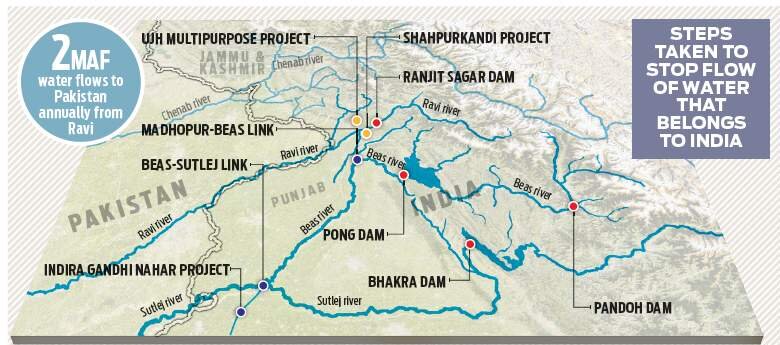
    • To utilize the waters of the Eastern rivers which have been allocated to India for exclusive use, India has constructed Bhakra Dam on Satluj, Pong and Pandoh Dam on Beas and Thein (Ranjitsagar) on Ravi.
    • These storage works, together with other works like Beas-Sutlej Link, Madhopur-Beas Link, Indira Gandhi Nahar Project etc has helped India utilize nearly entire share (95 %) of waters of Eastern rivers.
    • However, about 2 MAF of water annually from Ravi is reported to be still flowing unutilized to Pakistan below Madhopur.
    • The three projects will help India to utilize its entire share of waters given under the Indus Waters Treaty 1960:

    I. Resumption of Construction of Shahpurkandi project

    • It is a dam project under construction on Ravi River.

    II. Construction of Ujh multipurpose project

    • It is a dam project under construction on Ujh, a tributary of Ravi River.

    III. 2nd Ravi Beas link below Ujh

    • This project is being planned to tap excess water flowing down to Pakistan through river Ravi, even after construction of Thein Dam.
    • It aims constructing a barrage across river Ravi for diverting water through a  tunnel link to Beas basin.
  • Velutheeyam Alloy

    A tri-metal sculpture of Jesus Christ( Healing Christ) in Thiruvalla, Kerala has entered the Universal Records Forum’s (URF) book of world records.

    Velutheeyam

    • The statue was sculpted with an alloy of zinc, copper, and velutheeyam (an alloy of tin and aluminium).
    • A URF team adjudged that the 368-cm tall statue, weighing 2,400 kg, is the largest one of its kind in the world.
    • It took 18 months for sculpting the statue.
  • Government Budgets

    [op-ed snap] No rescue in sight

    Context

    The disconnect between Budget and Economic Survey is much greater this year.

    Background of the economy as the budget is introduced

    • The 2020 Budget was presented against the background of-
      • Slowing economy.
      • Poor investment climate.
      • Declining consumption demand and
      • Stagnant exports.
      • The steady deceleration in growth, which registered at 4.5 per cent in the second quarter of the current fiscal — the lowest in the last 26 quarters — presented a challenge as well as an opportunity.

    Infrastructure investment

    • The hope of substantial increase in allocation for infra: The hope was that there will be a substantial increase in infrastructure investment, which in turn will trigger investment demand, but the actual allocations are not promising.
      • This was particularly surprising in the wake of the recent announcement that there will be an investment of Rs 103 trillion in the next five years to leapfrog India to a $5-trillion economy.
      • Private sector expected to contribute: Much of the investment for this will have to be made by the private sector and it is hoped that the allocation of Rs 20,000 crore in equity in specified infrastructure finance companies will help them to leverage more than Rs 1 lakh crore of investment support.

    Budgetary allocation for capital expenditure

    • 1.7% of GDP to 1.8 %: The budgetary allocation for capital expenditure for the current year, which is estimated at 1.7 per cent of GDP this year, is budgeted at 1.8 per cent in 2020-21.
    • Agriculture, irrigation and rural development: The Budget also contained 16 action points on agriculture, irrigation and rural development and the Rs 2.83 lakh crore allocation is higher than the budget estimate for the previous year by just 2.5 per cent and revised estimate by 13.2 per cent.
      • But the allocation looks impressive only because there was a massive cut (Rs 26,000 crore) in the budget estimate over the revised estimate.
    • Transport infrastructure: The allocation to transport infrastructure in the Budget- at Rs 1.7 lakh crore-is just 7.6 per cent higher than the revised estimate for 2019-20.
    • MGNREGA and PM-Kisan Samman Nidhi: The allocations to schemes like the MGNREGA has been cut from Rs 71,002 crore (RE) in the current year to Rs 61,500 crore in 2020-21.
      • PM Kisan Samman Nidhi: For schemes like PM Kisan Samman Nidhi, it is just as much as was budgeted for 2019-20.
      • As a consequence, not much is expected in terms of propping up the consumption demand.

    Slippage in fiscal deficit

    • Increase in fiscal deficit expected: The slippage in fiscal deficit from the target set in the budget estimate in 2019-20 was expected for the following reasons-
      • Below expected nominal GDP growth: Nominal GDP growth was 7.5 per cent as against the estimated 12 per cent in the budget.
      • Overestimation in the growth of tax revenue at 18.3 per cent over the pre-actuals of the previous year.
      • Missed disinvestment target: The slippage in achieving the disinvestment target of Rs 1.03 lakh crore.
    • Thus, it is not surprising that the fiscal deficit for the current year stands estimated at 3.8 per cent of GDP and for the next year at 3.5 per cent.
    • Off-budget financing: The major concern is that the reported off-budget financing is almost 0.85 per cent. This does not capture the bills and refunds payable by the government.

    Would the budgeted and revised estimates realise?

    • On disinvestment front: The disinvestment revenue is estimated at Rs 65,000 crore though the realisation so far has been just Rs 18,000 crore, which implies another Rs 47,000 crore will have to be mobilised in the next two months.
    • On tax revenue front: The RE of tax revenue for the current year is over 14 per cent higher than the actual for 2018-19.
      • This is perhaps predicated on the hope that the scheme, “Vivad se Vishwas”, which allows the settlement of disputed tax to be paid without interest and penalty.

    Tax reforms in the budget

    • DDT abolition: On tax reforms, the abolition of dividend distribution tax (DDT) was expected.
    • Complicating Income tax: The reforms in individual income tax complicates the tax by creating six brackets.
      • The best practice approach to tax reform is to broaden the base, reduce the rates and reduce the number of brackets to make it a simple tax.
    • What could have been done? The government could have simply-
      • Phased out the tax concessions.
      • Indexed the brackets for inflation and
      • Reduced the rates of tax with an appropriate adjustment in the brackets.

    Conclusion

    The impact of fiscal developments on the states’ finances is clearly adverse. The shortfall in tax devolution in 2019-20 from the budgeted amount works out to Rs 1.53 lakh crore and the total shortfall in transfers amounted to Rs 1.41 lakh crore. Besides starving funds for various projects, this has serious repercussions on budget management at the state level.

  • Coronavirus – Health and Governance Issues

    [op-ed snap] Our expectations could mutate in response to the coronavirus

    Context

    In some ways, China is setting the standard for a public health response that may become a way of life in the 21st century.

    Origin of the outbreak and deadly it could turn out?

    • Outbreak of unknown virus: In December 2019, an outbreak of viral pneumonia of unknown etiology emerged in Wuhan, a city in the central Chinese province of Hubei.
    • Discovery of novel coronavirus:  A few weeks later, the World Health Organization (WHO) and Chinese health authorities announced the discovery of a novel coronavirus, known now as 2019-nCoV, as being responsible for the pneumonia.
    • Important questions: The two most important questions asked in a fast-evolving pandemic of this nature are:
      • 1) How deadly is the disease, and;
      • 2) Can it be contained?
      • The latest available figures suggest that the death toll in China is 304 and 14,411 have been infected. The current fatality rate estimate of 2% is unstable and is likely to fall as more cases are detected.

    Containment attempts by China and spread to the other countries

    • Unprecedented attempt by China: The attempt at containment started late, but has never been attempted in the fashion that China has gone about it.
      • Wuhan lockdown: Belatedly, on 23 January, China locked down Wuhan and 12 other cities, quarantining 52 million people in one sweeping action.
      • This is the first known case in modern history of any country locking down an entire large city.
    • Reports of confirmed cases from other countries: Confirmed cases have since been reported from Hong Kong, Macau, Taiwan, Thailand, South Korea, Japan, Singapore, Australia and the US.
      • India reported its first case from Kerala of a medical student from Wuhan University, followed by two more.
      • Singapore and the US have now banned foreign nationals who have recently been in China from entering the country.
      • Russia, Canada, the UK and India have begun evacuating citizens from Hubei province.

    Research on coronavirus so far

    • Coronaviruses (CoVs) are characterized by club-like spikes that project from their surface, an unusually large RNA genome and a unique replication strategy.
      • CoVs cause a variety of diseases in mammals and birds, ranging from enteritis in hoofed animals to potentially lethal human respiratory infections.
      • Genome sequence: The 2019-nCov genome was sequenced in China in early January and reported in The Lancet last week.
      • It suggests that the original host of this coronavirus was a bat reservoir, though it is unclear whether there was an intermediate host.
    • A recent entry to the human host: The uniformity of the sequenced genome suggests that the virus has entered human hosts very recently.
    • Recent emergence from the animal reservoir: Several other countries, including the US and France, have sequenced the RNA of the 2019-nCoV as well. These sequences and their similarity to the initial samples from China suggest a single, recent emergence from an animal reservoir.

    Tests and vaccine development

    • How is the virus tested? Testing for 2019-nCoV requires a reverse transcription polymerase chain reaction test (RT-PCR) which converts RNA into DNA, making study and comparison easier.
    • No vaccine yet: There are no vaccines yet for this virus, but promising paths have been identified, borrowed from the SARS related vaccines.
      • Development of an effective vaccine may only come after the 2019-nCoV is contained, but it may still be useful if there were to be a subsequent outbreak.
      • The frequency of future outbreaks is only likely to increase because of climate change, global travel and fast mutating viruses.

    What lessons can India learn?

    • Develop framework and capacity: For India, this global health emergency should serve as an eye-opener.
      • If lockdown turns out to be a useful tool to prevent the spread of a deadly virus, India will need to develop the framework and capacity to implement such a drastic measure.
      • Under-equipped municipalities: Our municipalities are hopelessly under-equipped to implement strict isolation and containment strategies.
      • We will need to develop the capacity to build large facilities for housing patients in isolation wards.
      • Use of pre-cast: This will require India to accelerate the use of construction methods like pre-cast technology.
    • Protocol and instructions: The National Centre for Disease Control (NCDC) has been proactive in updating its protocol related to the 2019-nCov and has clear instructions for reporting and assay preparation.
    • Develop capacity in geographically diverse regions: Samples in India need to be sent to the National Institute of Virology in Pune.
      • While the public health and epidemic escalation framework appears capable of handling a small number of cases well, it is not clear how it will stand up to a large number of cases in a specific geographic region.

    Conclusion

    “Nothing happens quite by chance. It is a question of accretion of information and experience,” said Jonas Salk, the virologist who developed the polio vaccine, in some ways, China is setting the standard for a public health response that may become a necessary way of life in the 21st century. India must use this as a guidepost to greater preparedness.

  • BREXIT

    [op-ed snap] What Brexit means for the EU and its partners

    Context

    On January 31, 2020, the United Kingdom left the European Union, the EU project will be taken forward by the 27 member states.

    A structured exit

    • Minimum disruption:  This is largely thanks to the Withdrawal Agreement that was negotiated with the U.K., which enabled “an orderly Brexit”.
      • One that, at least for now, minimises disruption for our citizens, businesses, public administrations, as well as for our international partners.
    • An arrangement of the transition period: Under this agreement, the EU and the U.K. agreed on a transition period, until the end of 2020 at least.
      • During which the U.K. will continue to participate in the EU’s Customs Union and in the Single Market, and to apply EU law, even if it is no longer a Member State.
      • During this period, the U.K. will also continue to abide by the international agreements of the EU, as we made clear in a note verbale to our international partners.

    Building a new partnership between the EU and the UK

    • Degree of continuity: With the transition period in place, there is a degree of continuity. This was not easy given the magnitude of the task.
      • By leaving the Union, the U.K. automatically, mechanically, legally, leaves hundreds of international agreements concluded by or on behalf of the Union.
    • Building new partnership: That work will start in a few weeks as soon as the EU 27 Member States have approved the negotiating mandate proposed by the European Commission, setting out our terms and ambitions for achieving the closest possible partnership with a country which will remain EU’s ally, partner and friend.
    • Links and shared values: The EU and the U.K. are bound by history, by geography, culture, shared values and principles and a strong belief in rules-based multilateralism. Our future partnership will reflect these links and shared beliefs.
    • Working on topics beyond trade: Both sides want to go well beyond trade and keep working together on security and defence, areas where the U.K. has experiences and assets that are best used as part of a common effort.
    • Cooperation on the wide topics: In a world of big challenges and change, of turmoil and transition, we must consult each other and cooperate, bilaterally and in key regional and global fora, such as the United Nations, the World Trade Organization, the North Atlantic Treaty Organization or the G20.
    • Collective responses to handle global challenges: Today’s global challenges- from climate change to cybercrime, terrorism or inequality — require collective responses.
      • The more the U.K. is able to work in lockstep with the EU and together with partners around the world, the greater would be chances of addressing these challenges effectively.

    Way forward

    • Continuing project forward as 27: At the very core of the EU project is the idea that it is stronger together; that pooling resources and initiatives is the best way of achieving common goals. Brexit does not change this, and efforts must be taken to continue this project forward as 27.
    • Note for the partners: EU’s partners can be sure that EU will stay true to an ambitious, outward-looking agenda-be it on trade and investment, on climate action and digital, on connectivity, on security and counter-terrorism, on human rights and democracy, or on defence and foreign policy.


  • Judicial Reforms

    Gram Nyayalayas

    The Supreme Court has directed the states, which are yet come out with notifications for establishing Gram Nyayalayas, to do so within four weeks.

    What are Gram Nyayalayas?

    • Gram Nyayalayas were established for speedy and easy access to the justice system in the rural areas across the country.
    • The Gram Nyayalayas Act came into force on October 2, 2009.
    • In terms of Section 3(1) of the Act, it is for the State Governments to establish Gram Nyayalayas in consultation with the respective High Courts.
    • The Act authorizes the Gram Nyayalaya to hold mobile court outside its headquarters.
    • However, the Act has not been enforced properly, with only 208 functional Gram Nyayalayas in the country ( Sept. 2019) against a target of 5000 such courts.
    • The major reasons behind the non-enforcement include financial constraints, reluctance of lawyers, police and other government officials.

    Features of the Gram Nyayalayas

    • Gram Nyayalaya are established generally at headquarter of every Panchayat at intermediate level or a group of contiguous panchayat in a district where there is no panchayat at intermediate level.
    • The Gram Nyayalayas are presided over by a Nyayadhikari, who will have the same power, enjoy same salary and benefits of a Judicial Magistrate of First Class.
    • Such Nyayadhikari are to be appointed by the State Government in consultation with the respective High Court.

    Jurisdiction

    • A Gram Nyayalaya have jurisdiction over an area specified by a notification by the State Government in consultation with the respective High Court.
    • The Court can function as a mobile court at any place within the jurisdiction of such Gram Nyayalaya, after giving wide publicity to that regards.
    • The Gram Nyayalayas have both civil and criminal jurisdiction over the offences and nature of suits specified in the First, Second and Third schedule of the Act.
    • The pecuniary jurisdiction of the Nyayalayas are fixed by the respective High Courts.
    • Appeals in criminal matter can be made to the Sessions Court in the respective jurisdiction and in civil matters to the District Court within a period of one month from the date of judgment.

    Trials

    • Gram Nyayalayas can follow special procedures in civil matters, in a manner it deem just and reasonable in the interest of justice.
    • Civil suits are proceeded on a day-to-day basis, with limited adjournments and are to be disposed of within a period of six months from the date of institution of the suit.
    • In execution of a decree, the Court can allow special procedures following rules of natural justice.
    • Gram Nyayalayas allow for conciliation of the dispute and settlement of the same in the first instance.
    • Gram Nyayalayas has been given power to accept certain evidences which would otherwise not be acceptable under Indian Evidence Act.
  • Climate Change Impact on India and World – International Reports, Key Observations, etc.

    Global Go To Think-Tank Index

    Centre for Science and Environment (CSE) was placed No. 16 among 2019’s ‘top environment policy think tanks’ of the world in Global Go To Think Tank Index.

    Think-Tank Index

    • The Index is released by University of Pennsylvania each year since 2008.
    • It evaluates public-policy research analysis and engagement organisations that generate policy-oriented research, analysis, and advice on domestic and international issues.
    • It claims to enable policy makers and the public to make informed decisions on public policy.
    • The 2020 report raised some critical threats and opportunities that think tanks across the globe face.
    • It called upon such organisations to develop national, regional, and global partnerships and create new, innovative platforms to deliver for an ever-expanding audience of citizens, policy makers and businesses.

    India’s performance

    • CSE climbed up two notches in the 14th version of the report.
    • The organisation also moved up three places among ‘best independent think tanks’ to be at No.123 in the world and sixth among Indian think tanks.
    • Globally, it was ranked 41 of 60 organisations committed to energy and resource policy. It remained at No.58 among organisations working on science and technology policy in the world — fifth in India.

    CSE as forerunner

    • CSE was named the ‘national climate leader’ from India for 2019 in the first National Climate Leader Awards published in the Global Spotlight Report #22 by Climate Scorecard.
    • CSE also received the prestigious Indira Gandhi Prize for Peace, Disarmament and Development for 2018 in 2019 for ‘pioneering work on environment and sustainable development’.
    • CSE also featured in four other rankings in the report: ‘top water security think tanks’; ‘top energy and resource policy think tanks’; ‘top science and technology policy think tanks’ and ‘best independent think tanks’.
    • It also ranked 18 among 78 global think tanks for its work on ‘water security’ — second in India after Ashoka Trust for Research in Ecology and the Environment.

Join the Community

Join us across Social Media platforms.