💥UPSC 2026, 2027, 2028 UAP Mentorship (March Batch) + Access XFactor Notes & Microthemes PDF

Archives: News

  • Electoral Reforms In India

    [op-ed snap] When defection is a mere detour for an MLA

    Context

    In the recently concluded by-election in Karnataka, most of the disqualified MLA’s were re-elected. This set of the event lay down a well-structured framework to sidestep the law, it even set a dangerous precedent for neutralising the consequences of the Anti-Defection Law altogether.

    Historical background

    • Defection is not new to the Indian political landscape.
    • An independent MLA from Haryana had switched parties three times in two weeks in 1967.
    • The recurrence of this phenomenon led to the 1985 Anti-Defection Law.

    Provisions of the law

    • The law defined three grounds for disqualification-Giving up party membership, violation of whip, and abstaining from voting.
    • Before the amendment, the law allowed for a “split” in the party if at least one-third of the MLAs defect.
    • 91st Constitutional Amendment in 2003 deleted the provision allowing split.
    • Resignation is not the condition for disqualification.
    • This loophole was exploited by the MLAs in Karnataka while they resigned.
    • The resignation was not accepted by the speaker of the house and declared the MLAs disqualified.
    • Law puts no time constraint on the speaker to decide on the resignation of MLAs.

    Speaker as a tribunal under law

    • The law originally protected the Speaker’s decision from judicial review.
    • This safeguard was struck down in Kihoto Hollohan v. Zachillhu and Others (1992).
    • In this case, the SC upheld the Speaker’s discretionary power, it underscored that the Speaker functioned as a tribunal under the law.
    • This made the Speaker’s decision subject to judicial review.
    • The same was said in Shrimanth Balasaheb Patel & Others v. Speaker Karnataka Legislative Assembly & Others (2019).


    Neutral role of the SC

    • The SC struck down ban on Karnataka disqualified MLAs from contesting election till 2023.
    • This effectively removed the only possible permanent solution to the problem.


    Way forward

    The minimum period limit of six years is needed to ensure that the defectors are not allowed to enter the election fray for at least one election cycle which is five years.

  • Modern Indian History-Events and Personalities

    In news: Partition of Bengal

    West Bengal Governor drew widespread condemnation over his tweet referring to a table, apparently used by Lord Curzon to sign papers pertaining to the Partition of Bengal in 1905, as “iconic”.

    Who was Lord Curzon?

    • Curzon, India’s Viceroy between 1899 and 1905, was one of the most controversial and consequential holders of that post.
    • The partition of the undivided Bengal Presidency in 1905 was one of his most criticised moves, which triggered widespread opposition not only in Bengal but across India, and gave impetus to the freedom movement.
    • Curzon was deeply racist, and convinced of Britain’s “civilizing mission” in India.
    • In 1901, he described Indians as having “extraordinary inferiority in character, honesty and capacity”.
    • He was deeply intolerant of Indian political aspirations.

    The Partition of Bengal

    • In July 1905, Curzon announced the partition of the undivided Bengal Presidency.
    • The Presidency was the most populous province in India, with around 8 crore people, and comprised the present-day states of West Bengal, Bihar, parts of Chhattisgarh, Odisha, and Assam, as well as today’s Bangladesh.
    • A new province of East Bengal and Assam was announced, with a population of 3.1 crore, and a Muslim-Hindu ratio of 3:2. Bengal, the western province, was overwhelmingly Hindu.
    • While the move was ostensibly aimed at making the administration of the large region easier, Curzon’s real intentions were far less benign.

    Aftermath of the partition

    • The partition provoked great resentment and hostility in Bengal.
    • It was clear to the Bengal Congress and patriotic Indians in both Bengal and elsewhere that Curzon’s motive was to crush the increasingly loud political voices of the literate class in the province, and to provoke religious strife and opposition against them.
    • But the protests against the partition did not remain confined to this class alone.
    • A campaign to boycott British goods, especially textiles, and promote swadeshi began.
    • There were marches and demonstrations with the protesters singing Bande Mataram to underline their patriotism and challenge the colonialists.
    • Samitis emerged throughout Bengal, with several thousand volunteers.
    • Rabindranath Tagore led the marches at many places, and composed many patriotic songs, most famously ‘Amar Sonar Bangla’ (My Golden Bengal), which is now the national anthem of Bangladesh.
    • The message of patriotism and Bengali nationalism was showcased in Jatras, or popular theatre.

    Scrapping of the partition

    • Curzon left for Britain in 1905, but the agitation continued for many years.
    • Partition was finally reversed in 1911 by Lord Hardinge in the face of unrelenting opposition.
  • Foreign Policy Watch: India-Pakistan

    Non-Nuclear Aggression Agreement

    Pakistan has recently shared a list of its nuclear installations with India under the said bilateral agreement.

    Exchange of list of nuclear installations

    • The list was handed over to an Indian High Commission in accordance with Article-II of the Agreement on Prohibition of Attacks against Nuclear Installations and Facilities between Pakistan and India.
    • It was signed on December 31, 1988.
    • The agreement contains the provision that both countries inform each other of their nuclear installations and facilities on 1st of January every year.

    What is Non-Nuclear Aggression Agreement?

    • The Non-nuclear aggression agreement is a bilateral and nuclear weapons control treaty between India and Pakistan, on the reduction (or limitation) of nuclear arms.
    • Both pledged not to attack or assist foreign powers to attack on each’s nuclear installations and facilities.
    • The treaty was drafted in 1988, and signed by the PM Rajiv Gandhi and his counterpart Benazir Bhutto on 21 December 1988; it entered into force on January 1991.
    • The treaty barred its signatories to carry out a surprise attack (or to assist foreign power to attack) on each other’s nuclear installations and facilities.
    • Starting in January 1992, India and Pakistan have annually exchanged lists of their respective military and civilian nuclear-related facilities.
  • Rural Distress, Farmer Suicides, Drought Measures

    NCRB Report on Farmers Suicide

    In 2017, 10,655 people involved in agriculture committed suicide in India, according to data released January 2, 2020 by the National Crime Record Bureau (NCRB).

    NCRB had released the 2017 crime data last October 2019, but held back information on suicides.

    Highlights of the report

    • NCRB highlighted that the toll was the lowest since 2013.
    • Among those who took their lives, 5,955 were farmers / cultivators and 4,700 agricultural labourers — both lower than in 2016.
    • They comprised 8.2 per cent of all suicide cases in the country in 2017.
    • In 2016, 6270 farmers killed themselves, down from 8,007 in 2015, while 5,109 farm hands committed suicide, up from 4,595.
    • The number of women farmers committing suicide, however, jumped to 480 in 2017 from 275 in ’16.

    Farm suicides over half a decade

    Years No. of farm sector suicides No. of farmers
    2017 10,655 5,955
    2016 11,379 6270
    2015 12,602 8007
    2014 12,360 5650

    Statewise data

    • In 2017, the most number of farm suicides were reportedly in Maharashtra (34.7 per cent), followed by Karnataka (20.3 per cent), Madhya Pradesh (9 per cent), Telangana (8 per cent) and Andhra Pradesh (7.7 per cent).
    • The trend was quite similar to previous year: In 2016, Maharashtra accounted for 32.2 per cent, Karnataka 18.3 per cent, MP 11.6 per cent, Andhra 7.1 per cent and Chhattisgarh 6 per cent.
    • In 2015 too Maharashtra tops in farmers suicides followed by Karnataka, Madhya Pradesh in 2016.
    • West Bengal, Odisha, Nagaland, Manipur, Mizoram, Uttarakhand, Chandigarh, Dadra and Nagar Haveli, Daman and Diu, Delhi, Lakshadweep and Puducherry reported zero suicides by farmers or agricultural labourers.

    Causes of Farmers Suicide

    • Major causes of farm suicides were reportedly bankruptcy / indebtedness, problems in the families, crop failure, illness and alcohol / substance abuse.

    Assist this newscard with:

    [Burning Issue] Annual Crime in India Report-2017

  • Higher Education – RUSA, NIRF, HEFA, etc.

    SATCOM technology

    The Rajasthan government has started using satellite communication technology in a big way to enhance the learning outcome in educational institutions and generate awareness about social welfare schemes while giving priority to the five aspirational districts selected by NITI Aayog in the State.

    SATCOM

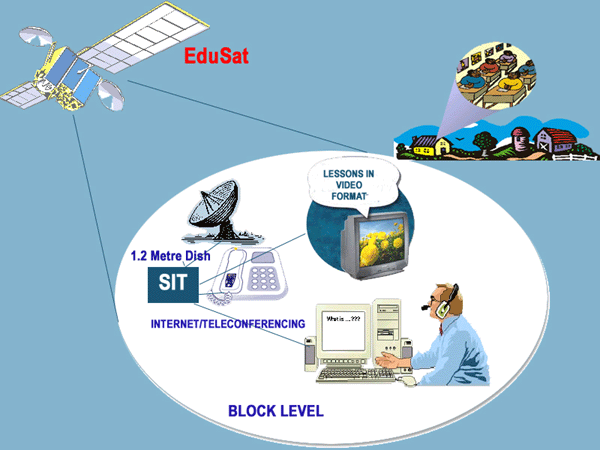
    Rajasthan has taken an initiative to provide the facility of receive only terminals (ROT) and satellite interactive terminals (SIT) for getting the services of subject experts in the government schools and colleges and propagate various schemes in the remote areas with no Internet connectivity.

    What are ROT and SIT?

    • Satellite Interactive Terminal (SIT) is one of the six selected user networks used by CEC-UGC.
    • It is operating independently with their user terminals anywhere in the main land of India.
    • It has one main teaching end along with remote SITs and ROTs.
    • At present, there are over hundred SITs and ROTs under CEC EDUSAT network, installed at various colleges, and Universities across the country.

    Back2Basics

    EDUSAT

    • EDUSAT is the first Indian Satellite built exclusively for serving the educational sector. It was launched in September 2004 by the ISRO.
    • The satellite based distance education system enables virtual classrooms at rural and remote locations across the country.
    • Consortium for Educational Communication (CEC) has started two-way audio-video communication through EDUSAT network from 5th September 2005.
    • ISRO set up a nationwide multi-user educational network in its EDUSAT national Ku – band.
  • Health Sector – UHC, National Health Policy, Family Planning, Health Insurance, etc.

    2020 as the “Year of the Nurse and Midwife”

    The World Health Organisation (WHO) has selected the year 2020 as the international “Year of the Nurse and Midwife”.

    Year of the Nurse and Midwife

    • It was decided in the honour of 200th birthday of Florence Nightingale.
    • WHO said that nurses and midwives are the people who devote their lives to caring for children and mothers, looking after senior citizens and giving lifesaving immunizations.
    • The declaration will help to strengthen nursing and midwifery for Universal Health Coverage.
    • The declaration will also help to endorse “The NursingNow!” a three-year campaign (2018-2020) to improve health globally by raising the status of nursing.
  • Arabica Coffee

    India’s Arabica production has hit an all-time low this coffee-picking season.

    Coffee Production in India

    • Coffee is grown in three regions of India with Karnataka, Kerala and Tamil Nadu forming the traditional coffee growing region.
    • It is followed by the new areas developed in the non-traditional areas of Andhra Pradesh and Orissa in the eastern coast of the country and with a third region comprising the NE states.
    • Indian coffee, grown mostly in southern states under monsoon rainfall conditions, is also termed as “Indian monsooned coffee”.
    • The two well known species of coffee grown are the Arabica and Robusta.

    History of Coffee in India

    • In the Indian context, coffee growing started with a saint, Baba Budan who, while returning from a pilgrimage to Mecca, smuggled seven coffee beans from Yemen to Mysore in India.
    • He planted them on the Chandragiri Hills now named after the saint as Baba Budan Giri in Chikkamagaluru district of Karnataka.
  • Digital India Initiatives

    ‘MANI’ app

    With an eye to aid the differently-abled, the Reserve Bank of India (RBI) has launched a mobile app to identify currency notes.

    MANI App

    • ‘MANI’, is an acronym for Mobile Aided Note Identifier.
    • The visually challenged can identify the denomination of a note by using the application, which can also work offline once it is installed.
    • A user will have to scan the notes using the camera and it will give the audio output to give out results in Hindi and English.
    • RBI has clarified that the app does not authenticate a note as either genuine or counterfeit.
  • Swachh Bharat Mission

    [Op-ed snap]The ABCDEF of implementation

    Context

    Over the years many well-designed schemes failed to make a significant dent on the lack of access to basic services that a large proportion of our population faced. However, Swachh Bharat Mission (SBM) has thrown up six guiding principles, which can be applied to any large transformation scheme.

    What made the difference?

    • Final delivery of service was considered as the only metric of success.
    • There has been a relentless emphasis on taking all schemes to fruition on the ground.
    • The success has thrown up six important guiding principles that can be applied to any large transformation scheme — the ABCEDF of implementation.

    A-Align

    • Different people at different levels may have competing priorities. So, goal congruence has to be achieved across the administrative ecosystem i.e. aligning the goal.
    • The message must percolate down to all the levels.
    • After the announcement of SBM the Department of Drinking water and Sanitation had to ensure that the message reaches the Chief Ministers, 700 district collectors, and 2,50,000 sarpanches.
    • The three layers of the PM-CM-DM model working in cohesion is the first and most important step towards policy translating into real delivery.
    • Team SBM-Grameen ensured sanitation remained on everyone’s agenda.

    B-Believe

    • Believing in the set goal is crucial for achieving success.
    • When faced with seemingly insurmountable goals, teams that don’t genuinely believe that the goal can be achieved find themselves not motivated enough.
    • This lack of motivation results in them not trying enough and not achieving results- a self-fulfilling prophecy.
    • So, the next important step is to build a team of people who believes that the goal is achievable.
    • The SBM brought in a unique blend of young professionals and experienced but driven bureaucrats, at the center and in the states, and each person quickly became a believer.

    C-Communicate

    • At its core, SBM is a behavioral change program.
    • Communication at all levels, above and below the line, mass and inter-personal, is fundamental to the SBM.
    • Trained grassroots volunteers called Swachagrahis were created, who went from door to door to communicate the message of swachhata.
    •  SBM attempted to make sanitation glamorous.
    • Glamour was sought to achieve by engaging extensively with media, leveraging popular culture, and associating Bollywood stars, sportspersons, and other influencers.
    • A recent study estimated that each rural Indian was reached by SBM messaging about 3,000 times over the past five years.

    D-Democratise

    • Democratize means developing a feeling of belonging or being part of something.
    • SBM has become a sort of Jan Andolan.
    • It nudged people to realise that sanitation is not an individual good, but a community good, as its full benefits accrue only when it is universal.
    •  Over the years, everyone became a stakeholder and sanitation became everyone’s business.
    • Even corporates, NGOs, civil society organizations and other government ministries and departments played a role in mainstreaming sanitation.

    E-Evaluate

    • The SBM was operating at a massive scale in a largely decentralised manner
    • As progress started surpassing expectations many people questioned the veracity of official administrative progress figures.
    • So, it became important to encourage third-party monitoring.
    • The monitoring evaluates outputs, outcomes, and impacts to reinforce the credibility and keep the implementers motivated.
    • At the same time, pockets of excellence emerged which deserved to be studied and shared with others to replicate.
    • The various organization conducted an assessment with regard to various factors.
    • World Bank, UNICEF, Bill and Melinda Gates Foundation and WHO conducted various assessments of sanitation coverage and usage, successes and areas of improvement, as well as the health, economic and social impacts of the SBM.

    F-Follow-through

    • There is a strong focus on not declaring SBM a “mission accomplished”.
    • The SBM is continuing to work towards sustaining the ODF behaviour and ensuring that no one is left behind.
    • Recently released a forward-looking 10-year sanitation strategy, articulating the goal of moving from ODF to ODF Plus.
    • This post-delivery follow-through is critical to ensure that the change becomes the norm and that things don’t reset to what they used to be in the past.

    Conclusion

    The lessons learned from SBM and these guiding principles could be applied in the implementation of other such policies. And aligning with this goal, the Jal Jeevan Mission is being designed to deliver, based on the ABCDEF of implementation.

  • Foreign Policy Watch: India-SAARC Nations

    [Op-ed snap]The new worry of depleting diplomatic capital

    Context

    India’s recent actions at home like the decision to amend Article 370, or the CAA 2019, may take a toll on its international relations.

    Effects on the relation with the U.S. and Europe:

    • In the U.S. bipartisan support for India had been the norm for at least two decades.
    • The dwindling of Democrat support was evident early on during the “Howdy Modi” event in September 2019.
    • In that event, only three out of the two dozen lawmakers at the event were from the Democratic Party.
    • In the weeks that followed the event, the State Department and several bipartisan committees have issued statements of concern over continued detentions in Kashmir and the CAA.
    • They also held hearings in the U.S. Congress, and even referred to Kashmir in the annual Foreign Appropriations Act for 2020.
    • The same issue found a voice in the U.K. parliament.
    • In the European Parliament, there was also discussion on Kashmir.
    • Kashmir became a campaign talking point between Labour and Conservative candidates in the U.K. elections.

    Deterioration in relations with Bangladesh and the neighbourhood

    • In the neighbourhood, Pakistan is predictably angry.
    • While Afghanistan is more muted.
    • The real damage has been done to ties with Bangladesh.
    • In the last decade, Dhaka and New Delhi had worked hard on building connectivity, opening energy routes, trade and developing travel links.
    • Bangladesh is upset for being clubbed together with Afghanistan and Pakistan on the issue of treatment of minorities.
    • At the same time, Bangladesh’s repeated requests for help on the Rohingya refugee issue were unheeded.
    • The OIC plans for a special meet on Kashmir and the CAA in April 2020.
    • If Bangladesh which defends India at the OIC feels that India’s actions are discriminatory, Arab countries could also become more vocal.

    Possible fallouts

    • The U.S. Commission for International Religious Freedom (USCIRF) has already recommended sanctions be considered against Home Minister.
    • In the U.S. Congress lawmakers can effectively block defence sales to India, or pursue sanctions on the S-400 missile system purchase from Russia.
    • On the international stage, the United Nations and its affiliated bodies could provide a platform for India to be targeted.
    • At FATF, India hopes to blacklist Pakistan for terror financing.
    • Break in ties with Turkey and Malaysia for their comment at UN on Kashmir could also lead them to veto India’s position at the FATF.
    • Unrest in the country could lead to a lower number of foreign visitors and visit cancellation/postponement by leaders.
    • All this also takes a toll on its diplomatic resources that have been diverted for much of the year in firefighting negative international opinion.

    Conclusion

    • The government must consider the impact of its domestic actions on India’s diplomatic capital.
    • This capital is a complex combination of the goodwill the country has banked on over decades as a democratic, secular, stable power, bilateral transactions it can conduct in the present, and the potential it holds for future ties, particularly in terms of its economic and geopolitical strengths.

Join the Community

Join us across Social Media platforms.
