💥UPSC 2027,2028 Mentorship (April Batch) + Access XFactor Notes & Microthemes PDF

Archives: News

  • Internal Security Architecture Shortcomings – Key Forces, NIA, IB, CCTNS, etc.

    How have deception techniques evolved

    Introduction

    Modern warfare is no longer about firepower alone; it is equally about deception. As precision-guided missiles, drones, and AI-enabled targeting systems grow deadlier, militaries are turning to decoy technologies to confuse radars, mislead missiles, and protect valuable assets. India’s reported use of the AI-enabled X-Guard decoy during Operation Sindoor shows how deception has become a central element of national security strategy.

    The Growing Relevance of Deception in Modern Warfare:

    1. Evolving threat environment: Precision-guided munitions, drones, and AI-enabled targeting systems make military platforms highly vulnerable.
    2. Strategic asset: Decoys create confusion, waste enemy munitions, and buy crucial time for retaliation.
    3. Game-changing event: Operation Sindoor showcased India’s successful use of an AI-enabled decoy, termed by experts as “the best instance of spoofing and deception ever seen.”

    Inside the X-Guard Fibre-Optic Towed Decoy 

    1. Lightweight & reusable: At just 30 kg, retractable and deployable in flight.
    2. Radar mimicry: Replicates the Rafale’s Radar Cross Section (RCS), doppler velocity, and spectral signature across multiple bands.
    3. 360-degree jamming: Works seamlessly with the Rafale’s SPECTRA suite to form a layered defensive shield.
    4. Operational success: Reports suggest Pakistan’s J-10C fighters misidentified decoys as actual aircraft, wasting advanced PL-15E missiles.

    Global landscape of comparable decoy systems: 

    1. BriteCloud (Leonardo UL): Used on Eurofighter Typhoons, Gripen-Es, and some F-16s.
    2. AN/ALE-50/55 series (Raytheon/BAE Systems): Deployed on U.S. Navy F/A-18E/F Super Hornets.
    3. Adaptability to UAVs: Modified for platforms like Israeli Herons and U.S. MQ-9 Reapers.

    Battlefield deception on Land Forces: 

    1. Inflatable & heat-emitting decoys: Simulate tanks, artillery, and missile batteries to divert strikes.
    2. Ukraine’s wooden & 3D-printed fakes: Exhaust Russian drone and missile stocks.
    3. Russia’s Inflatech decoys: Create entire armoured formations in minutes.
    4. Indian Army initiative (2025): Issued a request for decoys mimicking T-90 tanks, including thermal and acoustic signatures.

    Naval countermeasures and Decoy strategies

    1. Layered naval countermeasures: Chaff, acoustic decoys, and offboard active deception protect against missiles and submarines.
    2. Nulka decoy (Australia–U.S.): Self-propelled system mimicking large ship radar signatures to mislead missile guidance.

    Conclusion

    Deception, once limited to camouflage and dummy equipment, has evolved into a sophisticated digital-age shield. Airborne fibre-optic decoys, inflatable ground tanks, and naval missile deflectors now define modern survivability. India’s reported use of the X-Guard highlights its adaptation to the evolving battlefield. For a relatively low investment, such systems deliver high-impact protection, proving that in the wars of tomorrow, deception may be as decisive as destruction.

    PYQ Relevance

    “How is S-400 air defence system technically superior to any other system presently available in the world?”

    Linkage: This question shows UPSC’s focus on defence technology and comparative capability analysis. The same lens applies to India’s deployment of AI-enabled decoys like the X-Guard FOTD, which enhance survivability against advanced missile systems. Both highlight the importance of evaluating cutting-edge military technology for national security.

  • Modern Indian History-Events and Personalities

    In news: Women Revolutionaries of Bengal 

    Why in the News?

    This newscard is an excerpt from the original article published in the Indian Express.

    Women in Revolutionary Movements:

    Pritilata Waddedar:

    • Early Life: Born on 5 May 1911 in Chittagong. One of the first Bengali women to lead an armed revolutionary group.
    • Education: Graduated in philosophy from Bethune College, Kolkata; became a school teacher.
    • Inspiration: Influenced by revolutionary literature and women’s activism; joined Deepali Sangha.
    • Role: Collected bomb cases, distributed pamphlets, gathered jail intelligence by posing as relatives.
    • Legacy: Left a suicide note explaining her cause; remembered as a fearless martyr.

    Kalpana Datta:

    • Early Life: Born in 1913 in Sripur, Chittagong; studied at Bethune College, joined Chhatri Sangha.
    • Activities: Conducted reconnaissance before the European Club attack; arrested a week earlier.
    • Later Role: Joined bombing attempt to free Surya Sen; sentenced to life, released in 1939.
    • Post-freedom: Became a Communist Party leader, focused on social activism.

    Bina Das:

    • Early Life: At 21, attempted assassination of Governor Stanley Jackson (1932) with a revolver supplied by Kamala Das Gupta.
    • Networks: Part of secret revolutionary student circles.
    • Court Statement: Famous for her passionate resistance plea before Calcutta High Court.

    Begum Rokeya Sakhawat Hossain:

    • Early Life: Born on 9 December 1880; pioneer of women’s rights and education.
    • Writings: Authored “Sultana’s Dream” (1908), envisioning a feminist utopia.
    • Institutions: Founded the first school for Muslim girls in Kolkata; formed Muslim Women’s Association (1916).
    • Activism: Led women’s conferences, challenged purdah, advocated education.

    Kamala Das Gupta:

    • Early Life: Born in Dhaka; completed MA in history at Kolkata. Initially Gandhian, later joined Jugantar.
    • Role: Provided shelter, weapons, and materials; arrested multiple times.
    • Connection: Supplied Bina Das with revolver for her assassination attempt.
    • Legacy: Wrote “Rakter Akshare” and “Swadhinata Sangrame Nari”; led refugee relief and vocational training.

    Nanibala Devi:

    • Early Life: Disguised as a revolutionary’s wife; spied in prisons for intelligence.
    • Sacrifice: Endured brutal police torture (including red chili powder) without revealing secrets.
    • End: Died in poverty but symbolised courage and resilience.

    Labanya Prabha Ghosh:

    • Early Life: Born on 14 August 1897, Purulia.
    • Contribution: Helped establish Shilpashram, hub of revolutionaries like Subhas Bose, C.R. Das.
    • Political Role: First woman MLA from Purulia; wrote and edited nationalist journals.
    • Later Activism: Led movements for land rights, justice for the poor.

    Matangini Hazra (“Gandhi Buri”):

    • Early Life: Born in 1870, Hogla village, Midnapore; widowed young, lived in poverty.
    • Freedom Struggle: Joined Salt Satyagraha, arrested for making salt; resisted chowkidari tax.
    • Repression: Imprisoned and beaten; served the sick during epidemics.
    • Martyrdom: Killed by police firing while leading Quit India procession (1942), holding the tricolour until death.
    [UPSC 2009] During the freedom struggle, Aruna Asaf Ali was a major woman organizer of underground activity in

    Options:

    (a) Civil Disobedience Movement

    (b) Non-Cooperation Movement

    (c) Quit India Movement*

    (d) Swadeshi Movement


  • Urban Transformation – Smart Cities, AMRUT, etc.

    Census 2027 and Urban Area Definition

    Why in the News?

    The Registrar General of India (RGI) has announced that the same definition of “urban area” used in Census 2011 will be retained in Census 2027 to ensure comparability of data and analysis of urbanisation trends.

    Background and Urbanisation Trends:

    • Census 2011 Data: India’s population was 121 crore – 68.8% rural (83.3 crore) and 31.2% urban (37.7 crore).
    • Trend: Urban share grew from 17.3% in 1951 to 31% in 2011, showing rapid urbanisation.
    • Units: 6,40,867 villages and 15,870 urban units recorded in 2011.

    Definition of Urban Area:

    • Statutory Towns: Include municipal corporations, nagar palikas, town panchayats, cantonment boards, and notified town area committees.
    • Census Town Criteria:
      • Minimum population of 5000;
      • Population Density ≥ 400 persons per sq. km;
      • Workforce: ≥ 75% of male workers in non-agricultural activities.
    • District HQs: Headquarters not legally notified as towns will be Census Towns only if they meet criteria.
    • Exclusions: Plantations and orchards outside statutory towns will not be treated as “forests” under this definition.

    Special Features of Census 2027:

    • Caste Data: For the first time, caste enumeration included (approved April 2024).
    • Worker Classification: Male agricultural workers (cultivators, labourers, livestock, forestry, fishing, hunting, plantations) excluded when calculating non-agricultural engagement.
    • Error Correction: Grouping multiple villages into one Census Town discontinued; identification now at village level.

    Preparatory Work and Timelines:

    • Jurisdiction Updates: All changes in villages/towns/wards updated till 31 December 2025.
    • Boundary Freeze: Administrative boundaries fixed on 1 January 2026.
    • Village Review: Villages with 4,000+ population in 2011 re-examined to meet 5,000 threshold by 2027.
    • Phases:
      • Houselisting & Housing Census (HLO) – April 2026.
      • Population Enumeration (PE) – February 2027.
    [UPSC 2002] Consider the following statements about the megacities of India:

    I. Population of each megacity is more than 5 million.

    II. All the megacities are important sea ports.

    III. Megacities are either national or State capitals.

    Which of these statements are correct?

    (a) I, II and III

    (b) I and II

    (c) II and III

    (d) I and III *


  • Innovations in Biotechnology and Medical Sciences

    Asgard Archaea and the Evolution of Complex Cells

    Why in the News?

    Recent research by IISc on Asgard archaea — the closest living relatives of eukaryotes — has shed new light on how simple prokaryotic cells evolved into complex eukaryotic cells with nuclei, cytoskeletons, and organelles.

    About Asgard Archaea:

    • Nature: Tiny microbes living in deep-sea mud and extreme environments.
    • Evolutionary Link: Closest relatives of eukaryotic cells (plants, animals, humans).
    • Importance: Help explain how simple prokaryotic cells (bacteria/archaea) evolved into complex eukaryotic cells.
    • Significance: Considered the “missing link” in the origin of complex life.

    Findings from Indian Institute of Science (IISc) Study:

    • Focus: Scientists studied a subgroup called Odinarchaeota.
    • Discovery: Found two FtsZ genes (most microbes have one) and a tubulin-like gene.
      • FtsZ1: Works like bacterial proteins → forms straight filaments and attaches to cell membranes.
      • FtsZ2: Builds spiral structures but needs helper proteins to stick to membranes.
    • Division of Labour: Cooperation of FtsZ1 and FtsZ2 shows early signs of cellular specialisation.
    • Clue for Evolution: Suggests Asgard microbes were already experimenting with primitive “cytoskeleton” systems, paving way for complex cells.
    [UPSC 2012] Which one of the following sets of elements was primarily responsible for the origin of life on the Earth?

    Options:

    (a) Hydrogen, Oxygen, Sodium

    (b) Carbon, Hydrogen, Nitrogen*

    (c) Oxygen, Calcium, Phosphorus

    (d) Carbon, Hydrogen, Potassium


  • Indian Missile Program Updates

    Integrated Air Defence Weapon System (IADWS) 

    Why in the News?

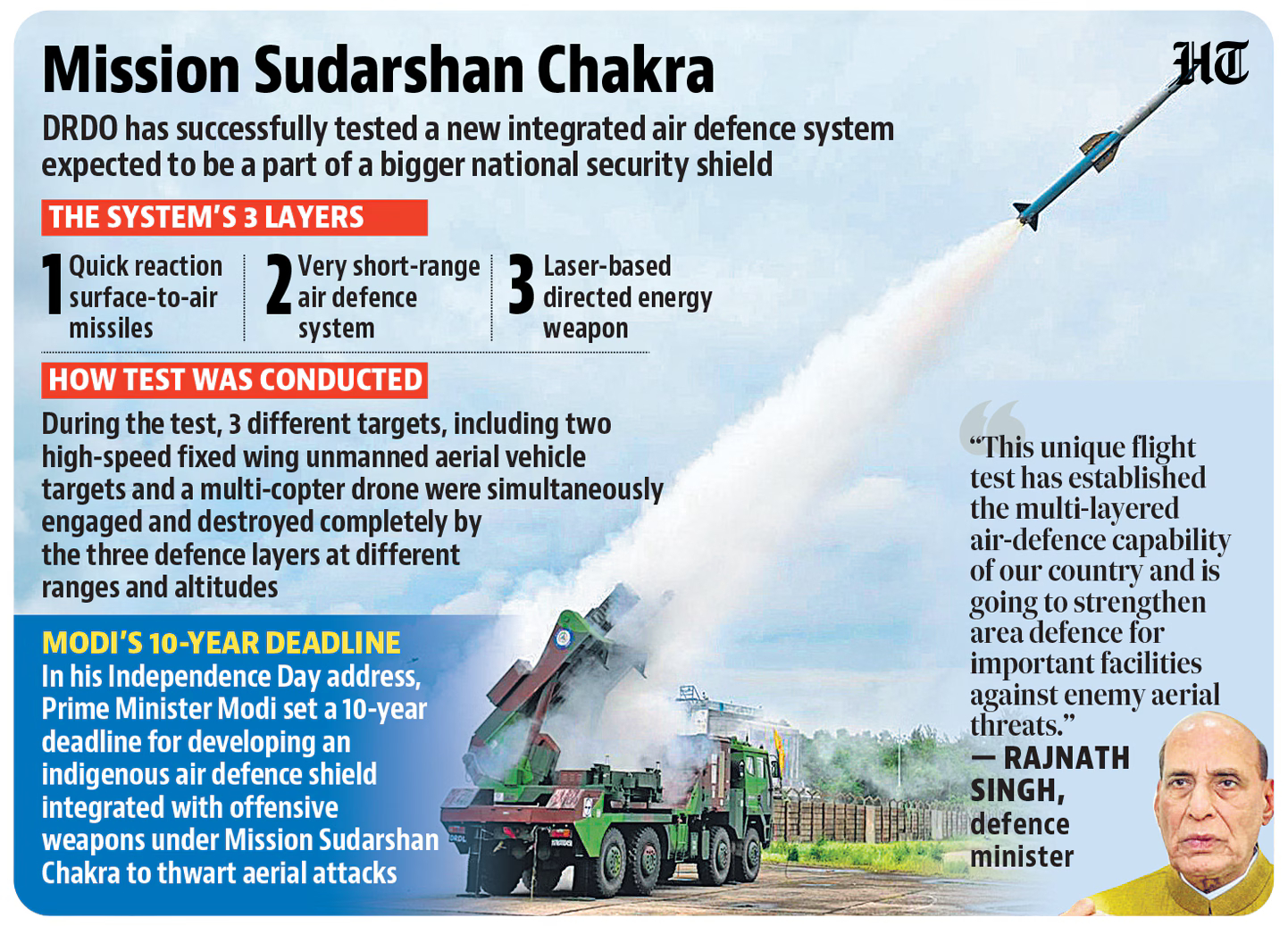
    The DRDO has successfully conducted the maiden flight-tests of the Integrated Air Defence Weapon System (IADWS) off the coast of Odisha.

    Integrated Air Defence Weapon System (IADWS) 

    About the Indigenous Air Defence Weapon System (IADWS):

    • Overview: A multi-layered indigenous system developed to neutralise a wide spectrum of aerial threats.
    • Integration: Combines 3 components viz. Quick Reaction Surface-to-Air Missiles (QRSAM), Very Short Range Air Defence System (VSHORADS), and Directed Energy Weapon (DEW).
    • Control: All systems are networked through a Command-and-Control Centre developed by the Defence Research and Development Laboratory (DRDL), Hyderabad.

    Key Components of IADWS:

    1. QRSAM:
      • Short-range missile system for protecting moving Army armoured formations.
      • Range: 3–30 km.
      • Equipped with 360° surveillance and tracking radars.
      • Fully automated, mobile, and capable of “search on move” and “track on move.”
    2. VSHORADS:
      • Fourth-generation man-portable air defence system (MANPAD).
      • Range: 300 m – 6 km.
      • Targets include drones, UAVs, and low-altitude aerial threats.
      • Deployable across Army, Navy, and Air Force.
    3. Directed Energy Weapon (DEW):
      • Vehicle-mounted laser system.
      • Range: <3 km.
      • Proven in field trials against UAVs and drone swarms.

    Strategic Significance:

    • Multi-Layer Defence: Provides aerial protection up to 30 km against threats from drones to fighter jets.
    • Self-Reliance: Enhances indigenous capability, reducing dependence on imported defence systems.
    • National Security: Strengthens preparedness for Mission Sudarshan Chakra — India’s planned national air defence shield.
    • Technological Integration: Demonstrates India’s leap in combining missile and laser-based defence on a single platform.
    • Geostrategic Importance: Seen as a milestone in India’s path to advanced, self-reliant defence systems.
    [UPSC 2018] What is “Terminal High Altitude Area Defense (THAAD)”, sometimes seen in the news?

    Options:

    (a) An Israeli radar system

    (b) India’s indigenous anti-missile programme

    (c) An American anti-missile system*

    (d) A defence collaboration between Japan and South Korea


  • Wildlife Conservation Efforts

    Nepal officially joins IBCA

    Why in the News?

    Nepal has officially joined the International Big Cat Alliance (IBCA), an India-led global initiative to protect seven species of big cats.

    About the International Big Cat Alliance (IBCA)

    • Overview: A global multi-country, multi-agency alliance of 95 countries (range and non-range) focused on conserving big cats and their habitats.
    • Launch: Proposed by PM Modi in 2019; officially launched in April 2023 on Project Tiger’s 50th anniversary.
    • Conservation Scope: Works to protect 7 species of big cats — tiger, lion, leopard, snow leopard, cheetah, jaguar, and puma.
    • Functions: Operates through advocacy, knowledge-sharing, eco-tourism promotion, and resource mobilisation.
    • Conflict Mitigation: Aims to reduce human–wildlife conflict and restore degraded habitats.
    • Institutional Structure:
      • Governance: Managed by a General Assembly, elected Council, and Secretariat headed by a Secretary-General.
      • Headquarters: Permanent base established in India following ratification of the HQ agreement.

    Global Participation

    • Membership: Includes 95 countries across Asia, Africa, the Americas, and Europe/Central Asia. Examples:
      • Asia: India, China, Nepal, Pakistan, Iran.
      • Africa: Kenya, Congo, Ghana.
      • Americas: Brazil, Ecuador, United States.
      • Europe/Central Asia: Russia, Kazakhstan.
    • Ratification: Bhutan, Eswatini, Cambodia, Guinea, India, Liberia, Nicaragua, Somalia, and Suriname have deposited ratification instruments.

    India’s Role:

    • Biodiversity Hub: India hosts 5 of the 7 big cats — tiger, lion, leopard, snow leopard, and cheetah — and holds 70% of global tiger population.
    • Funding: Government committed ₹150 crore for 2023–2028; mobilising international contributions.
    • Leadership: India sets global benchmarks in wildlife conservation and ecological stewardship, positioning itself as a leader in big cat protection.
    [UPSC 2024] Consider the following statements:

    1. Lions do not have a particular breeding season.

    2. Unlike most other big cats, cheetahs do not roar.

    3. Unlike male lions, male leopards do not proclaim their territory by scent marking.

    Which of the statements given above are correct?

    (a) 1 and 2 only * (b) 2 and 3 only (c) 1 and 3 only (d) 1, 2 and 2


  • Festivals, Dances, Theatre, Literature, Art in News

    NCERT textbooks introduce Indian Art Forms

    Why in the News?

    For the first time, the National Council of Educational Research and Training (NCERT) has introduced Indian classical music, dance, theatre, and visual arts into primary and middle school textbooks (Classes 3 to 8).

    About Classical Arts in School Textbooks

    • For the first time, NCERT has integrated Indian classical arts (music, dance, theatre, and visual arts) into textbooks for Classes 3 to 8.
    • The reform aligns with the National Education Policy (NEP) 2020, which mandates rooting education in India’s ethos and cultural heritage.
    • Music content includes swar, laya, shabd, Sanskrit shloka recitations, folk songs, ragas from Hindustani & Carnatic music.
    • Dance content covers 8 classical dance forms — Bharatnatyam, Kathak, Kathakali, Kuchipudi, Manipuri, Mohiniyattam, Odissi, and Sattriya.
    • Draws from ancient texts like Natyashastra, Brihaddeshi, Sangita Damodara, Abhinaya Darpanam.
    • Pedagogy: Emphasis on exposure, appreciation, and creativity rather than mastery. Includes storytelling, abhinaya (expressions), theatre, group performances.

    Classical Dance Forms Mentioned:

    Dance Form Details
    Bharatnatyam (Tamil Nadu) Oldest dance form; temple origins; fixed torso, bent legs, intricate footwork; emphasis on abhinaya and mudras; devotional themes (Bhakti rasa).
    Kathak (North India) Storytelling tradition (katha = story); features fast spins (chakkars) and rhythmic footwork; evolved in temples & Mughal courts; uses ghungroo.
    Kathakali (Kerala) Dance-drama with elaborate costumes, makeup, masks; based on Ramayana, Mahabharata, Puranas; strong gestures, expressions (navarasas).
    Kuchipudi (Andhra Pradesh) Blend of dance & drama with dialogue; famous Tarangam item (dance on brass plate); Vaishnav themes (Krishna stories); brisk, graceful movements.
    Manipuri (Manipur) Graceful, devotional form linked to Ras Lila of Krishna; lyrical movements, cylindrical skirt for women; avoids forceful footwork; spiritual style.
    Mohiniyattam (Kerala) “Dance of the enchantress”; soft, feminine style; gentle swaying movements; solo, mostly by women; white-golden costume; mood of lasya (grace).
    Odissi (Odisha) Temple dance linked to Jagannath worship; tribhangi posture and chauka stance; sculptural quality like temple carvings; strong Vaishnava themes.
    Sattriya (Assam) Introduced by Srimanta Sankardev in monasteries (sattras); devotional Vaishnava themes; combines dance, drama, music; recognised as classical in 2000.


    [UPSC 2012] How do you distinguish between Kuchipudi and Bharatanatyam dances?

    1. Dancers occasionally speaking dialogues is found in Kuchipudi dance but not in Bharatanatyam.

    2. Dancing on the brass plate by keeping the feet on its edges is a feature of Bharatanatyam but Kuchipudi dance does not have such a form of movements.

    Options:

    (a) 1 only*

    (b) 2 only

    (c) Both 1 and 2

    (d) Neither 1 nor 2


  • Judicial Pendency

    [23rd August 2025] Set the guardrails for AI use in courtrooms

    Mentors Comment

    Artificial Intelligence (AI) is steadily entering the Indian judiciary, promising efficiency in a system burdened with nearly five crore pending cases. However, without proper guardrails, it risks undermining the very foundation of justice. The recent Kerala High Court guidelines mark India’s first attempt at framing policy around AI use in judicial processes. This is a critical juncture where technology and justice intersect demanding careful balance between innovation and accountability.

    Introduction

    The integration of Artificial Intelligence into courts represents a paradigm shift in India’s judicial landscape. While AI tools such as transcription, translation, and defect detection offer solutions to systemic inefficiencies, their unregulated use could lead to serious ethical and legal risks. From mistranslations of legal terminology to hallucinations in Large Language Models (LLMs), the challenges are real. The need of the hour is a structured framework that ensures AI strengthens, rather than weakens, the judiciary’s integrity and human-centric decision-making.

    The Growing Relevance of AI in Courts

    • First policy initiative: In July 2025, the Kerala High Court released the “Policy Regarding Use of Artificial Intelligence Tools in District Judiciary,” the first of its kind in India.
    • Case Management & Reducing Pendency: AI can assist in case listing, tracking, and prioritization to improve efficiency. Eg: The Supreme Court Portal for Assistance in Court’s Efficiency (SUPACE) developed by the Supreme Court helps judges analyze case facts quickly.
    • Enhancing Transparency & Access to Justice: AI chatbots and online portals assist litigants in understanding procedures, filing cases, and accessing justice without middlemen. Eg: The Supreme Court’s AI-driven translation project ‘SUVAS’ (Supreme Court Vidhik Anuvaad Software) translates judgments into regional languages to empower citizens.

    Why are AI-enabled court processes risky?

    • Mistranslation risks: In India, the Supreme Court’s AI-based translation initiative SUVAS once mistranslated “leave granted” as “chhutti manzoor” (holiday approved) in Hind
    • Hallucinations in AI: LLMs such as Whisper generate fictitious phrases when encountering pauses, leading to unreliable records.
    • Bias in legal research: AI search results may amplify user patterns, invisibilising relevant precedents, impacting fair adjudication.
    • Reductionist adjudication: AI risks turning nuanced judicial reasoning into mere rule-based inference, undermining human judgment.

    How is AI being used in courts today?

    • Pilot tools: Market tools are in test use for transcription of oral arguments and witness depositions, though without timelines or safeguards.
    • Manual checks: Current safeguards include retired judges and translators manually vetting AI-generated judgments.
    • Risk of dependency: Courts adopting AI pilots without frameworks risk becoming dependent on vendors without sustainable adoption plans.

    What are the guardrails necessary for responsible AI use? 

    • Critical AI literacy: Judges, lawyers and staff need capacity-building to understand both potential and limitations of AI.
    • Transparency rights: Litigants should be informed if AI is used in research or judgment-writing; they should also have the right to opt out.
    • Procurement standards: Courts need standardised procurement guidelines to assess reliability, explainability, data handling, and vendor compliance.
    • Dedicated tech offices: The Vision Document for Phase III of the eCourts Project suggests creating technology offices to guide courts in evaluating and adopting AI tools.

    The way forward for AI in judiciary

    • Balanced adoption: AI must serve the ends of justice, not replace human reasoning.
    • Infrastructure readiness: Reliable internet and hardware are prerequisites before full-scale deployment.
    • Oversight and accountability: Independent monitoring systems and ethical review frameworks must be built into adoption.

    Conclusion

    AI can be a transformative force in India’s judiciary, addressing inefficiencies in a system struggling under massive case pendency. But technology without guardrails risks introducing new layers of error, bias, and opacity. The ultimate purpose of judicial reform must remain the same, to deliver fair, timely, and human-centred justice. Clear guidelines, transparency, and ethical oversight will determine whether AI strengthens or weakens the rule of law in India.

    Value Addition

    AI is already being deployed in judicial systems worldwide to improve efficiency, accessibility, and decision-making.

    1. Legal Interpretation Aid: Judges in the U.S. used AI to clarify the meaning of complex legal terms during sentencing appeals.
    2. Victim Impact Statement: Arizona courts allowed AI to recreate a victim’s voice for delivering impact statements.
    3. Affordable Legal Services: Garfield AI in the UK provides cheap legal documents, reducing case backlog.
    4. Responsible AI Use Rules: California courts framed formal guidelines for safe AI adoption in judicial work.
    5. Transcription & Translation (India): Supreme Court uses AI for live transcription and translation of hearings.
    6. Case Summarization (India): Nyay-Darpan delivers summaries and similar case retrieval in consumer law disputes.
    7. Case Classification (Brazil): AI model routes Supreme Court cases, cutting delays in document handling.
    8. AI Judge for Small Claims (China): Smart Courts handle repetitive small cases via AI systems.
    9. Judicial Summaries (Brazil): AI tools assist in generating summaries, easing court management.
    10. Access to Justice (Canada): Botler AI chatbot helps citizens understand rights in harassment cases.

    PYQ Relevance

    [UPSC 2018] E-Governance is not only about utilization of technology but also about the ‘use value’ of information. Explain.

    Linkage: The 2018 UPSC question on E-Governance and ‘use value’ of information directly links to AI in judiciary: while AI can speed up translations, research, and transcription, its real worth lies in enhancing accessibility, transparency, and fairness in justice delivery—not just technological adoption.

  • Make in India: Challenges & Prospects

    Reforming the steel framework

    Introduction

    Independence Day speeches are often symbolic, but in 2025 the Prime Minister shifted focus to frontier technologies, semiconductors, clean energy, AI, quantum computing, and defence indigenisation. Unlike earlier years, this vision was paired with the acknowledgment that bureaucratic inertia and regulatory red tape remain India’s toughest hurdles. The central challenge is whether India’s governance structures can keep pace with its technological ambitions.

    Significance of the 2025 Speech by the Prime Minister 

    • Future focus: Strong emphasis on frontier areas like semiconductors, EVs, and jet engines.
    • Symbolic push: The PM asked if fighter jet engines should not be Indian-made.
    • Bold promise: India will shed dependency in two decades.
    • Data milestone: India is the largest per capita data consumer (32 GB), ahead of China and the US.

    India’s current position in technology and self-reliance

    • Strength in mid-tech: Success in fintech, data access, and digitisation
    • Emerging hubs: Bengaluru, Hyderabad, Pune, Gurugram drive high-tech growth.
    • Import dependency: India depends heavily on imports in semiconductors, defence hardware, AI hardware, and clean energy technologies.
    • Global presence: Firms like Nvidia and IBM rely on India’s talent pool, but domestic ecosystems remain thin.

    Bureaucratic Challenges that obstruct deep-tech ambition

    • Colonial bureaucratic legacy: The Westminster model prioritised control over innovation and accountability.
    • Rigid steel frame: The “steel frame” of the civil services designed to ensure subservience to colonial administrators remains rigid even a century after the Public Service Commission’s creation in 1926.
    • Unrealised reforms: The Veerappa Moily Committee (2005) suggested domain experts and ethics codes-still pending.
    • Lateral entry limits: Attempts at inducting experts face systemic resistance.

    Why are regulatory and judicial reforms critical?

    • Persistent red tape: The Deregulation Commission (2025) was set up to identify redundant compliance norms, but structural bottlenecks persist.
    • Judicial backlog: Slow dispute resolution and investment climate, affectshigh-tech sectors.
    • Comparative lessons:
      • US & China: Despite different models, both empower political leadership over bureaucracy to push national interests.
      • UK: Even Britain debates its bureaucratic model, Dominic Cummings under Boris Johnson pushed for external competition and greater ministerial control.

    How does this link to Viksit Bharat@2047?

    • Ambition vs. architecture: India’s goal of becoming a deep-tech powerhouse is contingent not just on financial investment but on restructuring governance.
    • Symbolic timing: The UPSC centenary in 2026 is a historic chance for overhaul.
    • Future-readiness: Without structural reform, Atmanirbhar Bharat may remain aspirational.

    Conclusion

    India’s ambition to lead in deep-tech must be matched with institutional reform. The PM’s 2025 speech acknowledged that Atmanirbharta is as much about fixing bureaucratic bottlenecks as building jet engines or quantum labs. The centenary of UPSC offers an opportune moment to align India’s governance with its 2047 goals.

    Value Addition
    Committees on Civil Service Reforms

    1. Santhanam Committee (1964)

    • Focus: Preventive corruption measures.
    • Key suggestion: Creation of the Central Vigilance Commission (CVC).

    2. Kothari Committee (1976)

    • Focus: Recruitment and exam structure of Civil Services.
    • Key suggestion: Recommended 3-stage exam (Prelims, Mains, Interview), which is still followed today.

    3. Satish Chandra Committee (1989)

    • Focus: Review of recruitment and selection.
    • Key suggestion: Increased emphasis on aptitude and ethics in recruitment.

    4. Hota Committee (2004)

    • Focus: Ethics, transparency, and performance.
    • Key suggestion: Right to Information, performance-linked incentives, citizen charters.

    5. Second Administrative Reforms Commission (ARC) – Veerappa Moily (2005–2009)

    Most comprehensive civil service reform report (15 volumes). Key suggestions:

    • Lateral entry of domain experts.
    • Code of Ethics & Code of Conduct.
    • Citizen-centric administration
    • Performance-based appraisal system.
    • Training in e-governance and modern management practices

    6. Punchhi Commission (2010) – on Centre-State relations

    • Relevant link: Stressed need for civil service neutrality in federal governance.

    7. Baswan Committee (2016)

    1. Focus: UPSC exam age and attempts.
    2. Key suggestion: Reduce maximum age for UPSC CSE (though not implemented).

    8. Current initiatives 

    • Lateral entry into Joint Secretary and Director-level posts.
    • Mission Karmayogi (2020): National Programme for Civil Services Capacity Building (NPCSCB) to train officers with competency-based framework.
    • Deregulation Commission (2025): Identifying and scrapping redundant compliances.

    Mapping Microthemes

    • GS Paper-II: Civil Service Reform, Regulation, Judiciary
    • GS Paper -III: Tech missions, Defence Indigenisation, Atmanirbhar Bharat
    • GS Paper -IV: Accountability, Ethics in governance

    PYQ Relevance

    [UPSC 2016] Civil Services “Traditional bureaucratic structure and culture have hampered the process of socio-economic development in India.” Comment.

    Linkage: PM Modi’s Independence Day 2025 address highlighted that despite India’s technological advances, the colonial-era bureaucratic “steel frame” continues to obstruct innovation, investment, and governance reforms. The traditional bureaucratic structure—designed for control rather than development—remains a bottleneck in achieving Atmanirbhar Bharat. Thus, the speech directly echoes the UPSC 2016 theme that outdated bureaucratic culture hampers socio-economic transformation.

  • Foreign Policy Watch: India-Canada

    Canada will match U.S. exemptions to punishing tariffs, says Canadian official

    Introduction

    Canada has decided to drop retaliatory tariffs and mirror the U.S. exemptions on goods covered under the United States-Mexico-Canada Agreement (USMCA). This represents a success in preserving tariff-free trade for over 85% of Canada-U.S. commerce. But sector-specific tariffs like the 50% duties on steel and aluminium continue to hurt Canadian industries. The development is crucial, given Canada’s heavy reliance on the U.S. market, with more than 75% of its exports heading south.

    Significance of the News

    1. Tariff Alignment: Canada has chosen to align its tariff exemptions with those of the U.S., signaling a conciliatory move in contrast with earlier retaliatory tariffs.
    2. First-time Reset: For the first time since retaliatory duties were announced, Canada is rolling them back to match U.S. exemptions under USMCA, a notable policy reversal.
    3. Trade Dependence: With over 75% of Canadian exports going to the U.S., the stakes are extremely high, making tariff negotiations critical for economic stability.
    4. Striking Data: 85% of Canada-U.S. trade is still tariff-free, reflecting both success in negotiations and risks if the pact weakens.

    What is USMCA?

    1. USMCA Pact: Signed in 2020, it replaced NAFTA and provides preferential treatment for Canadian and Mexican goods entering the U.S.
    2. Carve-out Mechanism: Goods shielded under the agreement are protected from punitive tariffs, preserving market access.
    3. Upcoming Review : The pact is up for review in 2026, adding urgency to Canada’s attempt to preserve smooth trade relations.

    How does Canada benefit from this carve-out?

    1. Preferential Access: Canadian goods remain shielded from most punitive duties.
    2. Export Stability: With 75% of exports going to the U.S., the pact secures critical market access.
    3. Low Tariff Burden: U.S. average tariffs on Canadian goods remain among the lowest globally.

    What are the challenges despite tariff exemptions?

    1. 232 Tariffs: The U.S. has imposed sector-specific duties, including 50% tariffs on steel and aluminium, straining Canadian industries.
    2. Renegotiation Risk: U.S. Commerce Secretary Howard Lutnick has hinted at reopening USMCA talks, creating uncertainty.
    3. Dependence Dilemma: Canada retains some retaliatory tariffs, but its heavy reliance on U.S. markets weakens bargaining power.

    Why is this crucial for North American trade stability

    1. Export Dependence: More than 75% of Canada’s exports and 80% of Mexico’s exports head to the U.S., underlining their vulnerability.
    2. Regional Integration: The USMCA has reestablished tariff-free trade for the majority of goods, preventing economic disruption in North America.
    3. Geopolitical Context: At a time of growing global protectionism, North America’s internal trade pact provides a stabilising force, but also exposes Canada and Mexico to unilateral U.S. decisions.

    Conclusion

    Canada’s decision to align its tariffs with U.S. exemptions under USMCA reflects both pragmatism and vulnerability. While the pact secures tariff-free trade for the majority of goods, sector-specific tariffs and the looming threat of renegotiation highlight the fragile foundation of North American trade integration. For Canada, the challenge lies in balancing sovereignty with economic dependence, a dilemma increasingly relevant in today’s protectionist world.

    Value Addition

    United States–Mexico–Canada Agreement (USMCA)

    Key Features (vs. NAFTA)

    1. Rules of Origin – Higher thresholds for auto production (75% North American content vs. 62.5% under NAFTA).
    2. Labour Provisions – Stronger labour standards; Mexico required to reform labour laws.
    3. Digital Trade – New rules on data flows, e-commerce, and IP rights absent in NAFTA.
    4. Sunset Clause – Agreement reviewed every 6 years; expires after 16 years unless renewed.
    5. Agriculture – U.S. gained greater access to Canadian dairy market.

    PYQ Relevance

    [UPSC 2018] How would the recent phenomena of protectionism and currency manipulations in world trade affect macroeconomic stability of India?

    Linkage: The USMCA episode shows how U.S. protectionism through sectoral tariffs (like 50% on steel/aluminium) can destabilize even close trade partners like Canada. Such measures reflect the larger global trend of tariff wars and currency leverage, which disrupt supply chains and investment flows. For India, this highlights risks to macroeconomic stability via trade deficits, inflationary pressures, and exchange rate volatility.

Join the Community

Join us across Social Media platforms.
