💥UPSC 2026, 2027, 2028 UAP Mentorship (March Batch) + Access XFactor Notes & Microthemes PDF

Archives: News

  • Foreign Policy Watch: India-Bangladesh

    In Bangladesh, fake promises and a false enemy

    Why in the News

    Bangladesh’s temporary suspension of visa and consular services at its missions in New Delhi and Agartala signals heightened diplomatic sensitivity. Bangladesh is undergoing a phase of acute political uncertainty following the removal of Sheikh Hasina, accompanied by the rapid capture of state institutions by right-wing Islamist forces.

    Introduction

    Bangladesh’s political crisis is rooted in a cycle of exaggerated leadership narratives, institutional erosion, and manufactured external enemies. The replacement of governance accountability with ideological mobilisation has weakened democratic foundations and distorted public discourse. 

    What explains Bangladesh’s recurring political instability?

    1. Leadership-centric politics: Political legitimacy remains tied to personalities rather than institutions, resulting in fragile democratic consolidation.
    2. Hero-villain narratives: Excessive glorification of Sheikh Hasina and vilification of successors undermines rational political assessment.
    3. Institutional weakness: Democratic institutions lack resilience to withstand regime transitions.

    How has regime change altered Bangladesh’s political balance?

    1. Islamist consolidation: Right-wing Islamist groups have expanded influence by filling governance vacuums.
    2. Institutional capture: Key state institutions have been overtaken, weakening checks and balances.
    3. Ideological polarisation: Governance discourse has shifted from policy to identity mobilisation.

    Why is India projected as the ‘false enemy’?

    1. Scapegoating strategy: Blaming India diverts attention from domestic governance failures.
    2. Misleading narratives: India is framed as obstructing Bangladesh’s development and identity.
    3. Public misperception: Social media amplification sustains false external blame.

    What role do political parties play in deepening the crisis?

    1. BNP repositioning: The Bangladesh Nationalist Party seeks electoral revival through mobilisation rather than reform.
    2. Jamaat-e-Islami resurgence: Ideological groups leverage instability to normalise radical discourse.
    3. Electoral uncertainty: Premature elections risk further destabilisation amid weak state capacity.

    Why are elections insufficient to restore democracy?

    1. Procedural democracy gap: Elections without institutional strength fail to ensure legitimacy.
    2. Administrative fragility: Limited state capacity undermines free and fair electoral conduct.
    3. Exclusionary politics: Absence of inclusive participation erodes democratic credibility.

    What risks does Bangladesh face going forward?

    1. Radicalisation drift: Ideological dominance threatens pluralism and minority security.
    2. Governance paralysis: Competing factions weaken decision-making authority.
    3. Regional implications: Political instability impacts South Asian strategic balance.

    What is the China angle in Bangladesh’s political churn?

    1. Strategic vacuum utilisation: Political instability creates space for expanded Chinese influence through economic and political engagement.
    2. Infrastructure leverage: Governance uncertainty increases reliance on externally financed infrastructure projects.
    3. Narrative competition: Anti-India discourse indirectly strengthens China’s positioning as a non-interfering partner.
    4. Regional balance shift: Weak democratic institutions reduce Bangladesh’s strategic autonomy in great-power competition.
    5. Policy asymmetry: Absence of institutional checks amplifies external strategic influence.

    How does the crisis impact Bangladesh-India relations?

    1. Trust deficit: Sustained political narratives portraying India as a hostile actor weaken diplomatic goodwill and public perception.
    2. Policy continuity stress: Regime change and ideological flux reduce predictability in bilateral cooperation frameworks.
    3. Security spillovers: Political instability raises risks of cross-border radicalisation and misinformation.
    4. Economic engagement uncertainty: Domestic volatility constrains long-term trade, transit, and connectivity initiatives.
    5. Diplomatic insulation: India’s limited engagement approach reduces exposure to Bangladesh’s internal political churn.

    Way Forward

    1. Diplomatic Restraint
      1. Non-intervention posture: Preserves India’s credibility by avoiding actions that validate external-interference narratives.
      2. Institutional engagement: Sustains dialogue strictly through formal diplomatic channels.
      3. Crisis insulation: Limits bilateral fallout from Bangladesh’s internal political volatility.
    2. Narrative Neutralisation
      1. Public messaging discipline: Avoids rhetoric that could be appropriated by domestic political actors in Bangladesh.
    3. Functional Engagement Focus
      1. Issue-based cooperation: Anchors bilateral interaction in non-political domains.
      2. Institutional continuity: Keeps technical and bureaucratic channels operational despite political churn.
      3. Long-term stability: Avoids transactional engagement tied to regime personalities.
    4. Strategic Autonomy Preservation
      1. Non-alignment in internal contests: Avoids perceived preference for any political or ideological group.
      2. Regional balance: Prevents third-party strategic leverage arising from bilateral tensions.
      3. Policy patience: Accepts delayed outcomes over short-term visibility.

    Conclusion

    Bangladesh’s crisis is primarily self-inflicted, arising from weak institutions, ideological opportunism, and misplaced blame. Sustainable democracy requires rebuilding institutional credibility rather than pursuing electoral quick fixes or external scapegoats. India’s role remains marginal to Bangladesh’s internal democratic outcomes.

    PYQ Relevance

    [UPSC 2022] “India is an age-old friend of Sri Lanka.” Discuss India’s role in the recent crisis in Sri Lanka in the light of the preceding statement.

    Linkage: It tests India’s neighbourhood policy during internal political crises. This is directly comparable to India’s constrained engagement and diplomatic restraint in Bangladesh.

  • International Space Agencies – Missions and Discoveries

    NASA Loses Contact with MAVEN  

    Why in the News?

    The National Aeronautics and Space Administration has lost contact with its Mars orbiter Mars Atmosphere and Volatile Evolution (MAVEN), which has been studying the Red Planet’s atmosphere for over a decade.

    About MAVEN Mission

    • Launch: by NASA
    • Launch site: Cape Canaveral, Florida
    • Mars orbit insertion: September 2014
    • Mission type: Mars orbiter
    • Primary objective: Study the loss of Mars atmosphere to space

    Scientific Objectives

    • Measure the thin upper atmosphere of Mars
    • Study the ionosphere, which consists of charged particles
    • Observe interaction of sunlight and solar wind with the Martian atmosphere
    • Explain how Mars changed from a warm and wet planet to a cold and dry one
    [2016] Consider the following statements: The Mangalyaan launched by ISRO: 

    1. is also called the Mars Orbiter Mission. 

    2. made India the second country to have a spacecraft orbit the Mars after USA. 

    3. made India the only country to be successful in making its spacecraft orbit the Mars in its very first attempt. 

    Which of the statements given above is/are correct? 

    (a) 1 only (b) 2 and 3 only (c) 1 and 3 only (d) 1, 2 and 3

  • Indian Navy Updates

    Anjadip Inducted into Indian Navy  

    Why in the News?

    The Indian Navy received Anjadip, the third of eight Anti Submarine Warfare Shallow Water Craft (ASW SWC), on December 22, 2025 at Chennai.

    About Anjadip and ASW SWC Project

    • Type: Anti Submarine Warfare Shallow Water Craft
    • Role: Anti submarine warfare, coastal surveillance, mine laying
    • Length: Around 77 metres
    • Propulsion: Waterjets
    • Distinction: Largest Indian naval warships propelled by waterjets

    Builder and Collaboration

    • Designed and built by Garden Reach Shipbuilders and Engineers
    • Project executed under Public Private Partnership
    • Private partner: Larsen and Toubro Shipyard, Kattupalli
    • Classification: Built as per Indian Register of Shipping rules
    [2016] Which one of the following is the best description of ‘INS Astradharini’, that was in the news recently? 

    (a) Amphibious warfare ship 

    (b) Nuclear-powered submarine 

    (c) Torpedo launch and recovery vessel 

    (d) Nuclear-powered aircraft carrier 

  • Climate Change Impact on India and World – International Reports, Key Observations, etc.

    Southern Ocean  

    Why in the News?

    Scientists have found that the Southern Ocean mitigates global surface warming by absorbing a large share of carbon released by human activities.

    About the Southern Ocean

    • Also known as the Antarctic Ocean
    • Fourth largest ocean by surface area
    • Described by the International Hydrographic Organisation as the southernmost part of the World Ocean

    Formation and Geological History

    • Formed around 34 million years ago
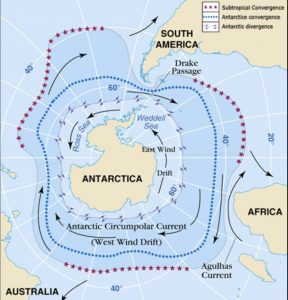
    • Resulted from the separation of Antarctica and South America
    • Opening of the Drake Passage allowed free circumpolar water flow
    • This isolation contributed to Antarctic cooling and ice sheet formation

    Role of the Southern Ocean

    Climate Regulation

    • Absorbs large amounts of atmospheric carbon dioxide
    • Takes up excess heat generated by global warming
    • Acts as a major carbon sink

    Global Ocean Circulation

    • Drives large scale circulation of ocean waters
    • Influences heat and nutrient distribution worldwide
    • Plays a role in deep water formation

    Sea Ice Dynamics

    • Seasonal expansion and retreat of sea ice affects albedo
    • Influences global climate feedback mechanisms

    Prelims Pointers

    • Southern Ocean surrounds Antarctica completely
    • Antarctic Circumpolar Current has no continental barrier
    • Drake Passage is key to global ocean circulation
    • Southern Ocean absorbs both heat and carbon dioxide
    • Crucial for long term climate stability
    [2011] Westerlies in the southern hemisphere are stronger and persistent than in the northern hemisphere. Why? 

    1. Southern hemisphere has less landmass as compared to northern hemisphere. 

    2. Coriolis force is higher in southern hemisphere as compared to northern hemisphere. 

    Which of the statements given above is/are correct? 

    (a) 1 only (b) 2 only (c) Both 1 and 2 (d) Neither 1 nor 2

  • J&K – The issues around the state

    Chillai Kalan Begins in Kashmir 

    Why in the News?

    The higher reaches of Kashmir Valley witnessed snowfall and the plains received rain as Chillai-Kalan, the harshest 40 day winter phase, began on December 21, 2025.

    What is Chillai Kalan

    • Meaning: Big cold in Kashmiri
    • Duration: 40 days
    • Period: December 21 to January 30
    • Significance: Coldest phase of winter in Kashmir
    • Belief: Rain or snow on the first day is considered a good omen and indicates heavy snowfall ahead

    Importance of the Precipitation

    • Ended a prolonged dry spell in the Valley
    • Helped reduce dust and dryness
    • Expected to improve water availability and snow reserves
    • Dry winter last year had caused
      • Health issues like cough and cold
      • Problems for agriculture and tourism sector

    Follow-Up Cold Phases

    After Chillai Kalan, Kashmir experiences two shorter cold spells

    • Chillai Khurd meaning small cold
    • Chillai Bacha meaning baby cold

    Prelims Pointers

    • Chillai Kalan is unique to Kashmir climate tradition
    • Heavy snowfall during this phase replenishes glaciers and water sources
    • Gulmarg and Sonamarg are key winter tourism centres
    • Sadhna Top is strategically important due to its proximity to the Line of Control
    [2015] Consider the following statements: 

    1. The winds which blow between 30° N and 60° S latitudes throughout the year are known as westerlies. 

    2. The moist air masses that cause winter rains in North-Western region of India are part of westerlies. 

    Which of the statements given above is/are correct? 

    (a) 1 only (b) 2 only (c) Both 1 and 2 (d) Neither 1 nor 2

  • Foreign Policy Watch: India-Middle East

    Syria Latest News  

    Why in the News?

    Recently, the US military carried out a strike against the Islamic State group in Syria.

    About Syria

    Location

    • Located on the eastern coast of the Mediterranean Sea
    • Lies in southwestern Asia
    • Part of the Levant region

    Bordering Countries

    • North: Turkey
    • West: Lebanon
    • East: Iraq
    • South: Jordan
    • Southwest: Israel

    Capital City

    • Damascus
    • One of the oldest continuously inhabited cities in the world

    Geographical Features of Syria

    Physiographic Division

    • Syria has two major natural regions
      • Western region
      • Eastern region

    Western Region

    • Narrow and fertile coastal plains
    • Lies along the eastern Mediterranean coast
    • Supports agriculture and major population centres

    Eastern Region

    • Dominated by the Syrian Desert
    • Composed of dry steppe and true desert landscape
    • Sparse population and arid climate

    Rivers and Lakes

    Major River

    • Euphrates River
    • Flows across eastern Syria before entering Iraq
    • Lifeline for irrigation and settlements

    Important Lake

    • Lake al Assad
    • Man made reservoir on the Euphrates River
    • Created by the Tabqa Dam

    Deserts and Relief

    Desert Region

    • Southern and eastern Syria form part of the northern Syrian Desert
    • Extends into Iraq and Jordan

    Highest Point

    • Mount Hermon
    • Height: 2,814 metres
    • Located near the Syria Lebanon Israel border region

    Prelims Pointers

    • Syria has a Mediterranean coastline despite being largely desert
    • Euphrates is the most important river system of Syria
    • Damascus is inland and not a coastal capital
    • Syrian Desert links West Asia with Mesopotamia
    • Strategic location connecting Asia, Europe and Africa
    [2017] Mediterranean Sea is a border of which of the following countries? 

    1. Jordan 

    2. Iraq 

    3. Lebanon 

    4. Syria 

    Select the correct answer using the code given below: 

    (a) 1, 2 and 3 only (b) 2 and 3 only (c) 3 and 4 only (d) 1, 3 and 4 only

  • Foreign Policy Watch: India-Africa

    [22nd December 2025] The Hindu OpED: Unlocking the Potential of India-Africa Economic Ties

    PYQ Relevance

    [UPSC 2021] “If the last few decades were of Asian’s.” In the light of this statement, examine India’s influence in Africa in recent years.

    Linkage: This question is directly relevant as it examines India’s expanding strategic, economic and diplomatic footprint in Africa. India’s recent focus on trade diversification, manufacturing partnerships, MSME integration, and multilateral engagement with Africa reflects its effort to align with Africa’s emerging role in the global economy.

    Introduction

    India-Africa economic relations have gained renewed momentum following high-level diplomatic engagements in 2025, including the Prime Minister’s visits to Namibia, Ghana, and Ethiopia. Africa’s recognition of India as a full-time G20 member and the African Union’s inclusion in the G20 framework have created institutional depth in bilateral ties. While cultural affinity and political solidarity have long defined the relationship, contemporary engagement is increasingly shaped by trade diversification, manufacturing cooperation, and services-led integration.

    Why India-Africa Economic Engagement Matters Now

    1. Export Diversification Imperative: Addresses India’s overdependence on the US and EU, which together accounted for nearly 40% of India’s exports in FY24 amid slowing growth and market volatility.
    2. Trade Scale and Growth Potential: Bilateral trade stands close to USD 100 billion, positioning Africa as India’s fourth-largest trading partner.
    3. Strategic Market Shift: Aligns India’s trade strategy with fast-growing African consumer markets and industrial demand.
    4. Geopolitical Realignment: Reinforces South-South cooperation at a time of fragmentation in global economic governance.

    Current Trade Structure and Limitations

    1. Export Concentration: Indian exports to Africa in FY24 amounted to USD 38.17 billion, dominated by petroleum products, engineering goods, pharmaceuticals, rice, and textiles.
    2. Import Dependence: Africa accounts for only around 6% of India’s total imports, indicating asymmetrical trade engagement.
    3. Geographic Concentration: Nigeria, South Africa, and Tanzania remain the principal destinations, limiting regional diversification.
    4. Comparative Disadvantage: China remains Africa’s largest trading partner with bilateral trade exceeding USD 200 billion, reflecting deeper industrial integration.

    Shifting from Commodity Trade to Manufacturing Partnerships

    1. Value-Added Manufacturing: Facilitates transition from low-value commodity exports to joint manufacturing and cross-border value chains.
    2. Industrial Incentive Utilisation: Addresses underutilisation of incentives offered by African governments for manufacturing investments.
    3. Preferential Market Access: Enables Indian firms to retain access to US markets through favourable African tariff regimes.
    4. Consumer Demand Alignment: Captures Africa’s expanding consumer base and rising industrial demand beyond hydrocarbons.

    Leveraging Regional Trade Frameworks

    1. AfCFTA Integration: Expands market access through engagement with the African Continental Free Trade Area.
    2. Regional Economic Communities: Strengthens India’s trade footprint across East, West, and Southern Africa.
    3. Rules-Based Trade Expansion: Facilitates harmonisation of standards, customs procedures, and logistics networks.

    MSMEs as Drivers of India-Africa Trade Expansion

    1. Trade Finance Accessibility: Prioritises scaling up Lines of Credit and improving MSME access to export finance.
    2. Risk Mitigation Instruments: Supports adoption of local currency trade and joint insurance pools to manage political and commercial risks.
    3. Market Entry Enablement: Addresses policy gaps that limit MSME participation in African markets compared to Europe and the US.
    4. Sustainable Trade Linkages: Strengthens long-term trade relations through MSME-led engagement.

    Logistics, Connectivity, and Trade Facilitation

    1. Freight and Port Modernisation: Reduces logistics costs through investments in port infrastructure and hinterland connectivity.
    2. Trade Corridors: Supports development of India-Africa maritime corridors to streamline supply chains.
    3. Cost Competitiveness: Enhances export viability by lowering transport and transaction costs.

    Services Trade and Digital Integration

    1. IT and Digital Services: Leverages India’s strengths in IT, digital trade, and health services.
    2. Skill Development: Expands professional services exports through training and capacity-building initiatives.
    3. People-to-People Linkages: Strengthens educational, health, and digital exchanges to deepen economic integration.
    4. Policy Facilitation: Addresses regulatory barriers restricting services trade with African economies.

    Role of the Indian Public Sector

    1. Strategic Investments: Strengthens Indian public sector presence in African manufacturing, mining, and mineral exploration.
    2. Infrastructure Development: Supports renewable energy, agro-processing, and logistics infrastructure.
    3. Risk Absorption Capacity: Enables public sector entities to navigate political and financial risks more effectively than private firms.
    4. Investment Reorientation: Reduces overreliance on Mauritius-based investments aimed at tax optimisation.

    Conclusion:

    India’s engagement with Africa is transitioning from limited, commodity-driven exchanges to a structured, long-term economic partnership anchored in trade diversification, manufacturing collaboration, MSME participation, services integration, and infrastructure connectivity. As global supply chains realign and Africa’s growth prospects strengthen, a calibrated strategy combining private enterprise, public sector leadership, and multilateral frameworks can enable India to deepen its economic footprint while reinforcing South-South cooperation and strategic autonomy.

  • Fertilizer Sector reforms – NBS, bio-fertilizers, Neem coating, etc.

    Reforming the fertiliser subsidy demands political courage, offers high rewards

    Introduction

    India’s fertiliser subsidy, the second-largest subsidy after food, has expanded rapidly due to rising global energy prices, import dependence, and skewed pricing policies. In 2024-25, the subsidy is estimated to touch nearly ₹2 lakh crore, with projections of ₹2.5 lakh crore in FY26. The article argues not for withdrawal, but for reorientation of subsidies to correct price signals, improve nutrient balance, and enhance productivity while protecting farmers’ incomes.

    Why Fertiliser Subsidy Reform Is Back in Focus

    1. Fiscal Expansion: Fertiliser subsidy projected at ~₹2.5 lakh crore in FY26, compared to ₹1.37 lakh crore allocated to agriculture and farmers’ welfare.
    2. Policy Asymmetry: Urea prices remain fixed and among the cheapest globally, while DAP and MOP prices are decontrolled.
    3. Macroeconomic Risk: Heavy import dependence, ~78% for natural gas, ~90% for phosphatic fertilisers, and near-total dependence for potash, exposes India to global commodity shocks.
    4. Structural Distortion: Price controls undercut the Nutrient-Based Subsidy (NBS) regime introduced in 2010.
    5. Reform Window: Stable growth and low inflation provide a favourable macroeconomic context for politically difficult reforms.

    How Price Controls Have Distorted Nutrient Use

    1. Urea Price Fixation: Urea sold at a fixed price of ~₹242 per 45-kg bag encourages excessive nitrogen use.
    2. NBS Design Flaw: Subsidy linked to nutrient content for P and K, but not applied uniformly to urea.
    3. Skewed Consumption: Farmers over-apply nitrogen while under-applying phosphorus and potassium.
    4. N:P:K Ratio Collapse: National ratio deteriorated to ~10.9:4:1 against the recommended 4:2:1.
    5. State-Level Distortion: Punjab applies ~61% more nitrogen than recommended, underuses potassium by ~89%, and phosphorus by ~8%.

    What Data Reveal About Productivity Outcomes

    1. China Comparison:
      1. Fertiliser use: ~373 kg/ha (China) vs ~182 kg/ha (India).
      2. N:P:K ratio: ~2.6:1.1:1 (China) vs ~10.9:4:1 (India).
      3. Agri-GVA: ~$1.27 trillion (China) vs ~$0.63 trillion (India).
    2. Land Productivity Gap: China generates double India’s agri-GVA despite similar cropped area.
    3. Yield Plateauing: Excess nitrogen creates “lush green fields” but fails to increase yields or grain quality.
    4. Soil Degradation: Imbalanced nutrient use reduces soil organic carbon and long-term productivity.

    Why Nutrient Use Efficiency Remains Low

    1. Low NUE Levels: Estimated at only 35-40%, indicating large nutrient losses.
    2. Atmospheric Losses: Nitrogen escapes as nitrous oxide, a greenhouse gas ~278 times more potent than CO₂.
    3. Water Pollution: Nitrate leaching contaminates groundwater, making it non-potable.
    4. Diversion and Leakage: ~20-25% of subsidised urea diverted to non-agricultural uses or smuggled across borders.
    5. Declining Response Ratio: Fertiliser-to-grain response ratio fell from ~1:10 (1970s) to ~1:2.7 (2015).

    What Policy Design Lessons Emerge from China

    1. Per-Unit Land Subsidy: Direct input subsidy on a per-mu basis rather than product-based price control.
    2. Market-Determined Prices: Fertiliser prices allowed to reflect market conditions.
    3. Innovation Incentives: Over 60% fertiliser consumption through complex fertilisers.
    4. Integrated Nutrient Management: Policy steers farmers toward balanced nutrient application.
    5. Outcome: Higher productivity with better nutrient balance despite higher fertilizer intensity.

    What Reform Pathways Does the Article Propose

    1. Gradual Price Decontrol: Phased dismantling of urea price controls.
    2. Direct Income Support: Protects farmers through equivalent cash transfers.
    3. NBS Recalibration: Reduce nitrogen subsidy while increasing support for phosphorus and potassium.
    4. Micronutrient Promotion: Encourages customised blends and soluble fertilisers through fertigation.
    5. Data Integration: Identification of tenant farmers using PM-KISAN data, land records, satellite imagery, and fertiliser sales.

    What Are the Expected Gains from Reform

    1. Fiscal Savings: Estimated annual savings of ~₹40,000 crore.
    2. Resource Reallocation: Redirects funds toward agri-R&D, irrigation, and high-value agriculture.
    3. Income Enhancement: Precision farming and balanced nutrients improve yield quality and farm profitability.
    4. Environmental Protection: Reduces greenhouse emissions and groundwater contamination.
    5. Growth Multiplier: Higher rural incomes stimulate demand for manufactured goods.

    Conclusion

    Reforming the fertiliser subsidy regime is not a question of fiscal retrenchment but of policy correction. By restoring price signals, improving nutrient balance, and protecting farmers through direct support, India can convert a distortionary subsidy into a productivity-enhancing instrument. The challenge is political, but the rewards are structural and long-term.

    PYQ Relevance

    [UPSC 2014] What are the different types of agriculture subsidies given to farmers at the national and at state levels? Critically analyse the agricultural subsidy regime with reference to the distortions created by it.

    Linkage: The question is directly relevant as it focuses on agricultural subsidies and the distortions arising from their design, a core GS III issue. The article offers concrete evidence of how fertiliser price controls create nutrient imbalance, fiscal stress, and environmental damage, strengthening the critical analysis required in this question.


  • Economic Indicators and Various Reports On It- GDP, FD, EODB, WIR etc

    GDP is growing rapidly, Why isn’t private capex?

    Introduction

    India recorded real GDP growth of over 8% in the recent quarter, even after adjusting for the post-COVID base effect. However, this growth has not translated into a revival of private capital expenditure (capex). Private investment as a share of GDP remains near 11-12%, significantly below earlier peaks. This divergence between output growth and investment momentum raises concerns regarding the sustainability and quality of economic expansion.

    Why in the News?

    India is witnessing a structural decoupling between GDP growth and private investment, a departure from historical growth cycles where investment led expansion. Despite low corporate leverage, improved profitability, and strong balance sheets, private firms are refraining from capacity expansion. Private capex as a share of GDP in 2023-24 stands at 11.5%, among the lowest since the early 2000s, even as overall GDP growth remains strong. This contradiction signals deeper constraints within the investment climate and demand structure.

    Why Has Private Investment Stagnated Despite High GDP Growth?

    1. Low Private Capex Share: Private investment remains around 11-12% of GDP, compared to over 15% during earlier growth phases, indicating limited contribution to growth momentum.
    2. Historical Contrast: During the mid-2000s investment boom, private capex expanded alongside GDP, unlike the present phase where growth is consumption- and public-investment-driven.
    3. Persistence of Trend: The stagnation has continued for over a decade, suggesting structural rather than cyclical causes.

    How Do Existing Capacities Affect Investment Decisions?

    1. Underutilised Capacity: Manufacturing capacity utilisation remains below 75%, reducing incentives for fresh investment.
    2. Sufficient Production Headroom: Firms meet incremental demand without adding new plants, weakening the case for capex.
    3. Sectoral Evidence: Manufacturing output growth has not been matched by expansion in installed capacity.

    Why Are Corporates Prioritising Deleveraging Over Expansion?

    1. Debt Reduction Strategy: Indian companies reduced leverage significantly after the balance sheet stress of the previous decade.
    2. Cash Accumulation: Firms are holding cash or investing in financial assets instead of productive capital.
    3. Merger and Acquisition Preference: Investment flows favour acquisitions rather than greenfield capacity creation.

    What Role Does Demand Uncertainty Play?

    1. Uneven Consumption Recovery: Demand recovery remains skewed, limiting visibility for long-term investment.
    2. Export Volatility: Weak global demand constrains export-led investment decisions.
    3. Cautious Business Sentiment: Firms delay irreversible investments under uncertain macroeconomic conditions.

    How Has Public Investment Substituted for Private Capex?

    1. Public Capex Surge: Government capital expenditure has expanded rapidly, compensating for private investment weakness.
    2. Crowding-In Limitations: Public capex has not yet generated sufficient downstream demand to trigger private investment.
    3. Infrastructure-Led Growth Bias: Growth relies disproportionately on state-led infrastructure spending.

    Why Has Investment Efficiency Declined?

    1. ICOR Trends: Higher Incremental Capital Output Ratios indicate reduced efficiency of capital deployment.
    2. Financialisation of Profits: Corporate profits increasingly channelled into financial investments rather than physical assets.
    3. Shift in Corporate Strategy: Emphasis on balance sheet strength over expansion.

    Conclusion

    Sustained GDP growth without commensurate private investment reflects a fragile growth model. While public expenditure has stabilised economic momentum, long-term expansion depends on reviving private capex through demand certainty, capacity utilisation improvement, and investment confidence. Without this transition, growth risks remaining shallow and state-dependent.

    PYQ Relevance

    [UPSC 2020] Explain the meaning of investment in an economy in terms of capital formation. Discuss the factors to be considered while designing a concession agreement between a public entity and private entity.

    Linkage: The question examines investment as capital formation. It directly aligns with the article’s focus on weak private GFCF despite strong GDP growth, highlighting the investment-growth disconnect.

  • Defence Sector – DPP, Missions, Schemes, Security Forces, etc.

    Dark Eagle Hypersonic Missile System

    Why in the News?

    The United States Army and United States Navy have successfully completed integrated testing of the Dark Eagle Long Range Hypersonic Weapon (LRHW) system.

    About Dark Eagle Hypersonic Missile System

    • Hypersonic missile system developed for the United States Army
      Non nuclear, ground-launched weapon system
      • Designed for strategic attack missions
      • Developed by Lockheed Martin and Northrop Grumman
      • Intended to penetrate Anti Access Area Denial (A2 AD) environments

    Strategic Role

    • Suppresses long range enemy fires
      • Penetrates advanced missile defense systems
      • Delivers rapid, precise, and time critical strikes
      • Enhances conventional deterrence without nuclear escalation

    Prelims Pointers

    • Country: United States
      • Type: Ground launched hypersonic weapon
      • Nuclear status: Non nuclear
      • Speed: Up to Mach 17
      • Key component: Common Hypersonic Glide Body
      • Objective: Penetration of A2 AD defenses
    [2022] Which one of the following statements best reflects the idea behind the “Fractional Orbital Bombardment System” often talked about in media?

     (a) A hypersonic missile is launched into space to counter the asteroid approaching the Earth and explode it in space. 

    (b) A spacecraft lands on another planet after making several orbital motions. 

    (c) A missile is put into a stable orbit around the Earth and deorbits over a target on the Earth. 

    (d) A spacecraft moves along a comet with the same speed and places a probe on its surface.

Join the Community

Join us across Social Media platforms.