💥UPSC 2027,2028 Mentorship (April Batch) + Access XFactor Notes & Microthemes PDF

Archives: News

  • Climate Change Negotiations – UNFCCC, COP, Other Conventions and Protocols

    PM launches Mission LiFE

    World

    Context

    • Our world today is in turmoil, facing multiple, mutually reinforcing crises. for the first time since it began over 30 years ago, the United Nations Development Programme’s Human Development Report has warned that global human development measures have declined across most countries in the past two years.

    Background

    • Ever increasing Existential threat: The greatest existential threat of all, the triple planetary crisis of climate change, pollution and biodiversity loss.
    • Climate change and extreme forms of weather events associated with it: Nine of the warmest years on record have come in the past decade alone. This year’s record-breaking heat waves, floods, droughts, and other extreme forms of weather have forced us to face these increasingly devastating impacts.
    • Window for action is closing fast: Climate change is a disruption multiplier in a disrupted world, rolling back progress across the global Sustainable Development Goals. Commitments we have now will not keep warming below the 1.5°C target that gives us the best chance of averting catastrophe.
    • LIFE, a fresh perspective: LIFE, or Lifestyle for Environment, announced by Prime Minister Narendra Modi at COP26 in November 2021, brings a fresh and much-needed perspective.

    World

    What is “LIFE” called by PM Narendra Modi?

    • LIFE: “LIFE – Lifestyle for the Environment”, PM Modi had proposed the one-word mass movement “LIFE” at the 26th session of the Conference of the Parties to the UN Framework Convention on Climate Change at Glasgow last November.
    • A theme for COP27: “LIFE”, a global initiative launched by Prime Minister Narendra Modi, will be the theme of the India pavilion at the upcoming COP27 at Sharm-El-Sheikh in Egypt.
    • LIFE Movement: Subsequently, PM Modi launched ‘Lifestyle for the Environment – LIFE Movement’ on 5 June on the occasion of world environment day.
    • What is the vision of LIFE: The vision of ‘LIFE’ is to live a lifestyle that is in tune with our planet and does not harm it The people who live such a lifestyle can be called “Pro-Planet people.”

    What is LiFE-Movement?

    • Objective of LiFE: The idea promotes an environmentally conscious lifestyle that focuses on ‘mindful and deliberate utilisation’ instead of ‘mindless and wasteful consumption’.
    • Aim of LiFE: The LiFE Movement aims to utilise the power of collective action and nudge individuals across the world to undertake simple climate-friendly actions in their daily lives. The LiFE movement, additionally, also seeks to leverage the strength of social networks to influence social norms surrounding climate.
    • Creating Pro-planet people: The Mission plans to create and nurture a global network of individuals, namely ‘Pro-Planet People’ (P3), who will have a shared commitment to adopt and promote environmentally friendly lifestyles.
    • Seeks to behavioural change and individual actions: Through the P3 community, the Mission seeks to create an ecosystem that will reinforce and enable environmentally friendly behaviours to be self-sustainable. LIFE recognizes that small individual actions can tip the balance in the planet’s favour.
    • Mission liFE for India: Mission LiFE borrows from the past, operates in the present and focuses on the future. Reduce, Reuse and Recycle are the concepts woven into our life. The Circular Economy has been an integral part of our culture and lifestyle.

    World

    What can be done to fulfil the vision of LiFE?

    • Cultivating the attitude of individual responsibility starting from the home: Mindful choices cultivated by LIFE animate this spirit actions such as saving energy at home; cycling and using public transport instead of driving; eating more plant-based foods and wasting less; and leveraging our position as customers and employees to demand climate-friendly choices.
    • Applying the nudging techniques to encourage positive behaviour: Many of the goals of LIFE can be achieved by deploying ‘nudges’, gentle persuasion techniques to encourage positive behaviour. The UN Environment Programme (UNEP) employs proven nudging techniques such as discouraging food waste by offering smaller plates in cafeterias; encouraging recycling by making bin lids eye-catching; and encouraging cycling by creating cycle paths.
    • Adopting greener consumption habits: According to the UNEP, more than two-thirds of greenhouse gas emissions can be attributed to household consumption and lifestyles the urgent cuts to global emissions we need can only be achieved through widespread adoption of greener consumption habits.

    World

    How India could be the torch bearer?

    • Historical wisdom: “Vasudhaiv kutumbakam” which means the world is one family, India insists on this philosophy. In the words of Mahatma Gandhi, “the world has enough for everyone’s need, but not enough for everyone’s greed.” Even The Prime Minister recalled that Mahatma Gandhi talked about a zero-carbon lifestyle.
    • India’s proven track record of mass movements: India has a proven track record translating the aspirations of national missions into whole-of-society efforts. The success of the Swachh Bharat Mission, which mobilised individuals and communities across socio-economic strata to become drivers of collective good health and sanitation is an example.
    • India is strong to uphold Climate Justice: LIFE resonates with the global climate justice India has rightfully called for highlighting enhanced obligations those in developed countries bear, to support climate adaptation and mitigation for those most affected, yet least responsible. The average carbon footprint of a person in high income country is more than 80 times higher than that of a person in a least developed country. It is common sense and only fair to call on the developed world to shoulder a proportionate share of this transition.
    • Indi’s leadership on climate action at the international stage: From the Panchamrit targets announced by Mr. Modi at COP26, to support for the International Solar Alliance, the Coalition for Disaster Resilient Infrastructure and South-South cooperation platforms, from the world’s fifth largest economy with vibrant businesses making enormous investments in renewables and electric mobility, to a world class public digital tech stack, India brings scale, expertise and legitimacy; a well-positioned founding UN Member State bridging the G20 and G77.
    • India’s COP pavilions setting up an example: India has been setting up its pavilions at COPs since 2015 to showcase its achievements in climate actions. Several think tanks, civil society organizations, industry bodies and private sector organise side events at the India pavilion.

    Conclusion

    • While governments and industry carry the lion’s share of responsibility for responding to the crisis of climate change, we as consumers play a large role in driving unsustainable production methods. With COP27 next month, we should commit to be an active partner of a global network of ‘Pro-Planet People’ (P3), to adopt and promote environmentally friendly lifestyles.

    Mains Question

    Q. In the time of the triple planetary crisis of climate change, pollution and biodiversity loss, India shows a path for mitigating the climate crisis through LiFE movement. Discuss.

    UPSC 2023 countdown has begun! Get your personal guidance plan now! (Click here)

  • Trade Sector Updates – Falling Exports, TIES, MEIS, Foreign Trade Policy, etc.

    China’s total trade surplus with India ‘surpasses $1 trillion’

    china

    The favourable trade balance that China has enjoyed with India, since bilateral trade began to boom in the early 2000s, has now exceeded $1 trillion.

    India-China bilateral trade

    • In 2021, annual two-way trade crossed $100 billion for the first time, reaching $125.6 billion, with India’s imports accounting for $97.5 billion, pegging the imbalance at close to $70 billion.
    • This is certainly a healthy deficit compared to the industrial development in both nations.

    A quick backgrounder

    • Trade ties began to boom since the early 2000s.
    • This was driven largely by India’s imports of Chinese machinery and other equipment.
    • It rose up from $3 billion in the year 2000 to $42 billion in 2008, the year China became India’s largest trading partner.

    The Hindi-Chini buy buy

    • A third of machinery and almost two-fifths of organic chemicals that India purchases from the world come from China.
    • Automotive parts and fertilizers are other items where China’s share in India’s import is more than 25 per cent.
    • Several of these products are used by Indian manufacturers in the production of finished goods, thus thoroughly integrating China in India’s manufacturing supply chain.
    • For instance India sources close to 90 per cent of certain mobile phone parts from China.

    India’s export to China

    • Even as an export market, China is a major partner for India.
    • China is the third-largest destination for Indian shipments.
    • At the same time, India only accounts for a little over two percent of China’s total exports, according to the Federation of Indian Export Organisation (FIEO).

    Should we worry about this?

    • Trade deficits/surpluses are just accounting exercises and having a trade deficit against a country doesn’t make the domestic economy weaker or worse off.
    • In this light, India’s trade imbalance with China should not be viewed in isolation.
    • For instance, pharmaceuticals that India exports to the world require ingredients that are imported from China.
    • Chinese imports of Indian seafood are one area that has recently shown robust growth and carries scope to grow in future.

    So, having a trade deficit is good?

    • Of course NOT. Running persistent trade deficits across all countries raises two main issues.
    1. Availability of foreign exchange reserves to “buy” the imports.
    2. Lack of domestic capacity to produce most efficiently.

    Can we ban trade with China?

    Ans. Certainly NOT!

    • It will hurt the Indian poor the most: This is because the poor are more price-sensitive. For instance, if Chinese TVs were replaced by either costlier Indian TVs or less efficient ones, unlike poor, richer Indians may buy the costlier option.
    • It will punish Indian producers and exporters: Several businesses in India import intermediate goods and raw materials, which, in turn, are used to create final goods — both for the domestic Indian market as well as the global market (as Indian exports).
    • Pharma sector could be worst hit: For instance, of the nearly $3.6 billion worth of ingredients that Indian drug-makers import to manufacture several essential medicines, China catered to around 68 per cent.
    • Ban will barely hurt China: According to the United Nations Conference on Trade and Development (UNCTAD) data for 2018, 15.3% of India’s imports are from China, and 5.1% of India’s exports go to China.
    • Chinese money funds Indian unicorns: India and China have also become increasingly integrated in recent years. Chinese money, for instance, has penetrated India’s technology sector, with companies like Alibaba and Tencent strategically pumping in billions of dollars into Indian startups such as Zomato, Paytm, Big Basket and Ola.
    • India will lose policy credibility: It has also been suggested that India should renege on existing contracts with China. This can be detrimental to India’s effort to attract foreign investment.

    China is our Frenemy. Here is why.

    • The first thing to understand is that turning a border dispute into a trade war is unlikely to solve the border dispute.
    • Worse, given India and China’s position in both global trades as well as relative to each other, this trade war will hurt India far more than China.
    • Again, these measures will be most poorly timed since the Indian economy is already at its weakest point ever — facing a sharp GDP contraction.

    Way forward

    • In the long term, under the banner of self-reliance, India must develop its domestic capabilities and acquire a higher share of global trade by raising its competitiveness.
    • But no country is completely self-sufficient and that is why trade is such a fantastic idea.
    • For the long run, a more effective strategy needs to be built to provide an ecosystem that addresses the cost disability of Indian manufacturing leading to such imports.


    UPSC 2023 countdown has begun! Get your personal guidance plan now! (Click here)

  • Right To Privacy

    TN bans online ‘Games of chance’ and Gambling

    Online gambling and online games of chance have been banned in Tamil Nadu. At the same time, the other online games will be regulated.

    What is Online Gaming?

    • Online games refer to games that are played over some form of computer network, most often the Internet.

    Types of gaming

    • The types of online gaming include:
    1. E-sports (well-organized electronic sports which include professional players) ex. Chess
    2. Fantasy sports (choosing real-life sports players and winning points based on players’ performance) ex. MPL cricket
    3. Skill-based (mental skill) ex. Archery
    4. Gamble (based on random activity) ex. Playing Cards, Rummy

    Online gaming sector in India

    • In the past few years, India’s nascent online gaming industry witnessed an unprecedented rise, catapulting it to the top five mobile gaming markets in the world.
    • Registering a growth rate of 38%, online gaming is the next sunrise industry.
    • Currently, there are more than 400 gaming companies in India, and it is home to 420 million online gamers, second only to China, according to an analysis by KPMG.

    Why is the gaming industry booming in India?

    1. Digital India boom in the gaming industry
    2. Narrowing of the digital divide
    3. IT boom

    Other factors promoting the boom

    1. Growing younger population
    2. Higher disposable income
    3. Inexpensive internet data
    4. Introduction of new gaming genres, and
    5. Increasing number of smartphone and tablet users

    Prospects of online gaming

    • State List Subject:  The state legislators are, vide Entry No. 34 of List II (State List) of the Seventh Schedule, given exclusive power to make laws relating to betting and gambling.
    • Distinction in laws: Most Indian states regulate gaming on the basis of a distinction in law between ‘games of skill’ and ‘games of chance’.
    • Classification on dominant element: As such, a ‘dominant element’ test is utilized to determine whether chance or skill is the dominating element in determining the result of the game.
    • Linked economic activity: Staking money or property on the outcome of a ‘game of chance’ is prohibited and subjects the guilty parties to criminal sanctions.
    • ‘Game of Skill’ debate: Placing any stakes on the outcome of a ‘game of skill’ is not illegal per se and may be permissible. It is important to note that the Supreme Court recognized that no game is purely a ‘game of skill’ and almost all games have an element of chance.

    Need for regulation

    • No comprehensive regulation:  India currently has no comprehensive legislation with regards to the legality of online gaming or boundaries that specify applicable tax rates within the betting and gambling industry.
    • Ambiguity of the sector: The gaming sector is nascent and is still evolving, and many states are bringing about legislation seeking to bring about some order in the online gaming sector.
    • State list subject: Online gaming in India is allowed in most parts of the country. However, different states have their own legislation with regards to whether online gaming is permitted.
    • Economic advantage: Well-regulated online gaming has its own advantages, such as economic growth and employment benefits.

    Issues with online gaming

    • Gaming addiction: Numerous people are developing an addiction to online gaming. This is destroying lives and devastating families.
    • Compulsive gaming: Gaming by children is affecting their performance in schools and impacting their social lives & relationships with family members. Ex. PUBG
    • Impact on psychological health: Online games like PUBG and the Blue Whale Challenge were banned after incidents of violence and suicide.
    • Threat to Data privacy: Inadvertent sharing of personal information can lead to cases of cheating, privacy violations, abuse, and bullying.
    • Betting and gambling: Online games based on the traditional ludo, arguably the most popular online game in India, have run into controversy, and allegations of betting and gambling.

    Why hasn’t a comprehensive law yet materialized?

    • Earlier, states like Tamil Nadu, Telangana, Andhra Pradesh, and Karnataka also passed laws banning online games.
    • However, they were quashed by state High Courts on grounds that an outright ban was unfair to games of skill:
    1. Violation of fundamental rights of trade and commerce, liberty and privacy, speech and expression;
    2. Law being manifestly arbitrary and irrational insofar as it did not distinguish between two different categories of games, i.e. games of skill and chance;
    3. Lack of legislative Competence of State legislatures to enact laws on online skill-based games.

    Way forward

    • Censoring: Minors should be allowed to proceed only with the consent of their parents — OTP verification on Aadhaar could resolve this.
    • Awareness: Gaming companies should proactively educate users about potential risks and how to identify likely situations of cheating and abuse.
    • Regulating mechanism: A Gaming Authority in the central government should be created.
    • Accountability of the gaming company: It could be made responsible for the online gaming industry, monitoring its operations, preventing societal issues, suitably classifying games of skill or chance, overseeing consumer protection, and combatting illegality and crime.
    • All-encompassing legislation: the Centre should formulate an overarching regulatory framework for online games of skill. India must move beyond skill-versus-chance debates to keep up with the global gaming industry.

    UPSC 2023 countdown has begun! Get your personal guidance plan now! (Click here)

  • Historical and Archaeological Findings in News

    Lothal: ‘Oldest Dock in the World’, to get heritage complex

    lothal

    Prime Minister has reviewed the construction of the National Maritime Heritage Complex (NMHC) site at Gujarat’s Lothal via video conferencing.

    Where is Lothal?

    • Lothal was one of the southernmost sites of the Indus Valley civilization, located in the Bhal region of what is now the state of Gujarat.
    • The port city is believed to have been built in 2,200 BC. Lothal was a thriving trade centre in ancient times, with its trade of beads, gems and ornaments reaching West Asia and Africa.
    • The meaning of Lothal (a combination of Loth and (s) thal) in Gujarati is “the mound of the dead”.
    • Incidentally, the name of the city of Mohenjo-daro (also part of the Indus Valley Civilisation, now in Pakistan) means the same in Sindhi.
    • In the region, it can be compared with other Indus port towns of Balakot (Pakistan), Khirasa (in Gujarat’s Kutch) and Kuntasi (in Rajkot).

    When was it discovered?

    • Indian archaeologists started the search for cities of the Harappan Civilisation post-1947 in Gujarat’s Saurashtra.
    • Archaeologist SR Rao led the team which discovered a number of Harappan sites at the time, including the port city of Lothal.
    • Excavation work was carried out in Lothal between February 1955 and May 1960.
    • Adjacent to the excavated areas stands the archaeological site museum, where some of the most prominent collections of Indus-era antiquities in India are displayed.

    How was it identified as port city?

    • The National Institute of Oceanography in Goa discovered marine microfossils and salt, gypsum crystals at the site, indicating that sea water once filled the structure and it was definitely a dockyard.
    • It had the world’s earliest known dock, connecting the city to an ancient course of the Sabarmati river.
    • A metropolis with an upper and a lower town had in on its northern side a basin with vertical wall, inlet and outlet channels which has been identified as a tidal dockyard.
    • Satellite images show that the river channel, now dried, would have brought in considerable volume of water during high tide, which would have filled the basin and facilitated sailing of boats upstream.

    What heritage value does it hold?

    • Lothal was nominated in April 2014 as a UNESCO World Heritage Site, and its application is pending on the tentative list of UNESCO.
    • It is the only port-town of the Indus Valley Civilisation.
    • Its heritage value is comparable to following ancient port-towns around the world-
    1. Xel Ha (Peru)
    2. Ostia (Port of Rome)
    3. Carthage (Port of Tunis) in Italy
    4. Hepu in China,
    5. Canopus in Egypt
    6. Gabel (Byblos of the Phoenicians),
    7. Jaffa in Israel,
    8. Ur in Mesopotamia
    9. Hoi An in Vietnam

    Building up of Heritage Complex

    • The project began in March 2022, and is being developed at a cost of Rs 3,500 crore.
    • It will have several innovative features such as Lothal mini-recreation, which will recreate Harappan architecture and lifestyle through immersive technology.
    • It has four theme parks – Memorial theme park, Maritime and Navy theme park, Climate theme park, and Adventure and Amusement theme park.


    UPSC 2023 countdown has begun! Get your personal guidance plan now! (Click here)

  • Innovations in Biotechnology and Medical Sciences

    What is RNA Origami?

    rna

    This newscard is an excerpt of the original article published in The Hindu.

    Note: It appears to be too much biological. And suddenly out of our ease of understanding.

    What is Ribo Nucleic Acid (RNA)?

    • RNA is an important biological macromolecule that is present in all biological cells.
    • It is principally involved in the synthesis of proteins, carrying the messenger instructions from DNA, which itself contains the genetic instructions required for the development and maintenance of life.
    • In some viruses, RNA, rather than DNA, carries genetic information.
    • The type of RNA dictates the function that this molecule will have within the cell.
    • Aside from the coding region of messenger RNA (mRNA) molecules that will be translated into proteins, other cellular RNA elements are involved in different processes.

    What are RNA Origami?

    • RNA origami is the nanoscale folding of RNA, enabling the RNA to create particular shapes to organize these molecules.
    • It is an attempt to generate complex human-made RNA-based devices.
    • They are stable in cells, interact with other biomolecules, including other RNA and proteins, and enable unique applications, particularly in the context of gene regulation.

    Why are they used?

    So far there have been two approaches in RNA origami and both attempt to regulate the production of protein.

    (1) To achieve precise control of protein production

    • Self-inhibiting protein expression cassettes were made by installing a strong binding site for the expressed protein in its own gene.
    • Afterwards, RNA origami decorated with the same protein-binding sites was expressed in large excess.
    • In this way, the RNA origami serves as a protein-sponge that sequesters proteins in the cell and allows expression of the self-inhibited protein.
    • This approach helped to regulate several proteins simultaneously and turn on enzymatic pathways for improved product yields.

    (2) Using for gene editing

    • The RNA origamis were integrated in the small RNAs that guide CRISPR-Cas9 enzyme to target specific sequences in the DNA genome.
    • Its scaffolds were decorated with protein-binding sites capable of recruiting transcription factors.
    • By targeting the RNA scaffolds to promoter regions, the transcription factors activated gene expression.
    • Researchers have shown that the expression strength can be tuned by the orienting the scaffold and level of transcription factors recruited.
    • These multi-enzyme pathways could be controlled for high-yield production of the anti-cancer drug violacein.


    UPSC 2023 countdown has begun! Get your personal guidance plan now! (Click here)

  • Air Pollution

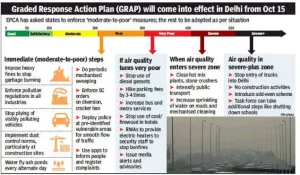
    GRAP Stage II kicks in as Delhi’s air quality may turn ‘very poor’

    The Commission for Air Quality Management directed New Delhi authorities to enforce stage II of the Graded Response Action Plan (GRAP) with immediate effect.

    Graded Response Action Plan (GRAP)

    • In 2014, when a study by the WHO found that Delhi was the most polluted city in the world, panic spread in the Centre and the state government.
    • Approved by the Supreme Court in 2016, the plan was formulated after several meetings that the Environment Pollution (Prevention and Control) Authority (EPCA) held with state government and experts.
    • The result was a plan that institutionalized measures to be taken when air quality deteriorates.
    • GRAP also works as an emergency measure.
    • It includes strict measures such as a ban on the entry of heavy vehicles, the odd-even road rationing restrictions, and a halt of construction work – each of which is likely to be impractical at a time when the pandemic has exacted heavy economic costs and public transport has been seen as an infection risk.

    How does it work?

    • As such, the plan does not include action by various state governments to be taken throughout the year to tackle industrial, vehicular and combustion emissions.
    • When the air quality shifts from poor to very poor, the measures listed under both sections have to be followed since the plan is incremental in nature.
    • If air quality reaches the severe+ stage, GRAP talks about shutting down schools and implementing the odd-even road-space rationing scheme.

    Measures taken under GRAP

    1) Severe+ or Emergency

    (PM 2.5 over 300 µg/cubic metre or PM10 over 500 µg/cu. m. for 48+ hours)

    • Stop entry of trucks into Delhi (except essential commodities)
    • Stop construction work
    • Introduce odd/even scheme for private vehicles and minimise exemptions
    • Task Force to decide any additional steps including shutting of schools

    2) Severe

    (PM 2.5 over 250 µg/cu. m. or PM10 over 430 µg/cu. m.)

    • Close brick kilns, hot mix plants, stone crushers
    • Maximise power generation from natural gas to reduce generation from coal
    • Encourage public transport, with differential rates
    • More frequent mechanized cleaning of road and sprinkling of water

    3) Very Poor

    (PM2.5 over 121-250 µg/cu. m. or PM10 over 351-430 µg/cu. m.)

    • Stop use of diesel generator sets
    • Enhance parking fee by 3-4 times
    • Increase bus and Metro services
    • Apartment owners to discourage burning fires in winter by providing electric heaters during winter
    • Advisories to people with respiratory and cardiac conditions to restrict outdoor movement

    4) Moderate to poor

    (PM2.5 over 61-120 µg/cu. m. or PM10 over 101-350 µg/cu. m.)

    • Heavy fines for garbage burning
    • Close/enforce pollution control regulations in brick kilns and industries
    • Mechanized sweeping on roads with heavy traffic and water sprinkling
    • Strictly enforce a ban on firecrackers


    UPSC 2023 countdown has begun! Get your personal guidance plan now! (Click here)
  • Gravitational Wave Observations

    Black Hole, Resolving the Mistry

    Black Hole

    Context

    • For the very first time, scientists noted that this observation of the Laser Interferometer Gravitational Wave (LIGO) observatories coincided with the measurements made by other telescopes that measured visual and electromagnetic signals.

    What is Black hole?

    • A black hole is a place in space where gravity pulls so much that even light can not get out. The gravity is so strong because matter has been squeezed into a tiny space. This can happen when a star is dying.
    • Because no light can get out, people can’t see black holes. They are invisible. Space telescopes with special tools can help find black holes. The special tools can see how stars that are very close to black holes act differently than other stars.

    Black Hole

    What is the background?

    • LIGO Observations: In 2017, astrophysicists observed an unusual feat among the stars. The Laser Interferometer Gravitational Wave(LIGO)observatories recorded a signal which indicated that two massive and dense stellar bodies had merged to form a third body, likely a black hole.
    • Generation gravitational waves: In the process they gave off vibrations that quite literally shook the universe and its very fabric of space time.
    • Neutron stars: Scientists, piecing together evidence from complementary measurements, surmised that the event they had observed was of two neutron stars merging and forming a black hole and, in the process, giving off light.

    Black Hole

    What are the observations through telescopes?

    • The matter moving faster than light: An unusual jet of matter was observed that gave an illusion of travelling faster than light. These were all exciting phenomena observed for the very first time by telescopes and observatories.
    • Confirmation by Hubble Space Telescope: Now, using data that had been recorded by the Global astro metric Interferometer for Astrophysics (GAIA) spacecraft and Hubble Space Telescope instruments, scientists have confirmed that the above picture is correct. They have made it more precise and descriptive.
    • Seven times the speed of light: In a paper published in Nature, they describe measuring the “apparent speed” of the jet to be about seven times the speed of light.
    • Lorenz factor: They have also measured more accurately a factor called the Lorenz factor which scales with the actual speed of the particles in the jet. Unlike earlier estimates which placed this factor at about 4, the present paper estimates this factor to be over 40. This is because they measure the speed of the relativistic jet to be close to 0.9997c, where “c” is the speed of light.
    • Clarity about the source as neutron star in block hole generation: This resolves the earlier fuzziness about what the source was and puts the source clearly as massive neutron stars merging to give a black hole and throwing off relativistic jets of particles in the process.

    Black Hole

    Merging of Neutron stars

    • Born out of Supernova explosion: Neutron stars are stellar corpses, left behind after a star has undergone a supernova explosion and reached the end of its lifetime. They are extremely dense, containing more mass than the sun in a sphere that is a few tens of kilometre wide.
    • Produces fast moving material: This has been seen in many active galactic nuclei  galaxy centres that harbour black holes and binary star systems within our galaxy, where one of the stars is a black hole. “Mostly, black holes are responsible for producing such fast moving material

    Why present observations about black Hole are significant?

    • Estimating changing position of sky: The present measurements and observations made with GAIA data are extremely challenging. They amount to measuring the position of an object in sky coordinates. These authors measured a change in sky position one millionth the span of the full moon. Normally, if one were making these measurements from earth-based telescopes, it would require data from radio telescopes spaced apart by intercontinental distances.
    • VLBI technique: This technique is called Very Long Baseline Interferometry (VLBI) and was used in the earlier papers. “Here, the authors could beat VLBI in precision because they calibrated Hubble Space Telescope data with GAIA, which is a precision astrometry mission.
    • It’s an estimate not a measurement: the researchers used both their Hubble Space Telescope and GAIA optical position measurement along with the earlier VLBI position measurement to get a better estimate of the speed of the source and angle (viewing angle) with which it is travelling with respect to us on earth. This estimate requires plugging in equations of the special theory of relativity. “So, it is an estimate as opposed to a measurement.
    • Improvement in estimation: we have learnt that neutron star mergers can result in material moving with speeds as high as 0.9997c.Earlier results using Very Long Baseline Interferometry had pegged this value at about 0.938c. with the new results this lower limit has been improved. Even earlier, with VLBI, it was understood that it was a neutron star merger that produced such ultra-relativistic material. Before the VLBI results, there were several models that could replicate the observations.
    • Explanation using ultra realistic material: The observations could be explained both by ultra-relativistic material and non relativistic material, with some differences in assumptions. That study indicated that the observed gamma ray bursts were produced along with the ultra-relativistic material.

    Conclusion

    • Current discovery strengthens the hypothesis that such neutron star mergers are responsible for a class of gamma ray bursts. Gamma ray bursts are flashes of extreme gamma ray photons that release a huge amount of energy nearly 1047 They come from different galaxies in the universe and are observed here quite frequently.

    Mains Question

    Q. What is the neutron star and how the merger of two stars produces a black hole? How LIGO and Hubble space telescope are useful in demystifying the black Hole phenomenon?

    UPSC 2023 countdown has begun! Get your personal guidance plan now! (Click here)


  • Foreign Policy Watch: India-United States

    Fateful Triangle China,USA and India and Changing World Order

    China

    Context

    • America’s national security strategy issued by the Joe Biden Administration last week and the Chinese Communist Party’s 20th Congress this week promise to reshape the geopolitics of Asia and the Indo-Pacific.

    Historical background of USA-CHINA

    • Context of World War II: Asia has seen multiple phases in the US-China relationship. In the second half of the 19th century, American missionaries began to arrive in China and began to generate empathy for the nation. During World War II, Washington backed Chinese nationalists in their fight against Japanese occupation.
    • US efforts to isolation China: The US tried to isolate China from 1949 when the communists prevailed over the nationalists.
    • Cooperation to counter Soviet: The 1970’s saw the US and communist China come together to counter the Soviet Union.
    • Multiple Economic engagement: The 1980s saw the beginning of an economic engagement that turned into a huge commercial and technological partnership from the 1990s.

    China

    What is the USA’s assumption and China’s ambition?

    • China as responsible stakeholder: The US establishment dismissed the idea of China as potential threat and bet that Beijing could become a “responsible stakeholder” in the world order.
    • Democratization of Chinese society is inevitable: America also believed that China’s growing economic prosperity would inevitably lead to greater democratisation of its society.
    • Visible decline of west: China, however, has steadily moved in the other direction, especially under Xi, who has convinced himself that the West is in terminal decline.
    • China’s ambition to change the world order: Xi is determined to seize this moment to reshape the Asian as well as the global order to suit Chinese interests. At the same time, China has become increasingly repressive at home.
    • Explicit expression of ambition: Xi made no effort to hide China’s new geopolitical ambition nor has he been defensive about his authoritarian rule. This, in turn, bestirred the US into rethinking its China policy in the second decade of the 21st century.

    China

    How China is asserting itself?

    • Asserting own version of Global order: Beijing, argues that recent history points to the superiority of the Chinese system over the Western one. And it offers its own versions of a global order – economic, political and social. Since the end of the Cold War, ideological arguments had receded into the background but are now back in significant play.
    • China offering model Economic Globalization: China continues to sing praises of the model of economic globalisation that has facilitated Beijing’s rise over the last four decades. But under Xi, China has emphasised the importance of self-reliance in the name of a “dual circulation strategy”.
    • Leveraging world’s dependence for strategic gain: At the same time, Beijing has sought to enhance the world’s dependence on its economy and leverage it for strategic benefit. The profound political backlash against trade and economic cooperation with China in the US led to the questioning of economic globalisation in the Trump years.
    • China building the powerful military: As China became a richer country, it also focused on building a powerful army. Using both the instruments of hard power, China under Xi has actively sought to undermine US alliances in Asia and mount pressure on American forward military presence in Asia.

    China

    How USA’s policy is changing towards China?

    • Structured policy of rivalry: The traditional soft attitude to China yielded to a more confrontational approach during the Donald Trump presidency. Joe Biden has developed that into a more structured policy of competing with China.
    • Combine challenge of China and Russia: The National Security Strategy of the Trump administration postulated the return of great power rivalry and the need to respond to the challenges presented by Russia and China. Biden’s NATIONAL SECURITY STRATEGY builds on that proposition and identifies China as the more demanding challenge than Russia, despite Moscow’s aggression against Ukraine.
    • China is more capable than Russia: In his foreword to the National security strategy, Biden says “Russia poses an immediate threat to the free and open international system, recklessly flouting the basic laws of the international order today, as its brutal war of aggression against Ukraine has shown.” He names China, on the other hand, as “the only country with both the intent to reshape the international order and, increasingly, the economic, diplomatic, military and technological power to advance that objective”. While the European challenge is real, the Biden Administration now sees the Indo-Pacific as the principal strategic theatre.
    • Projecting China as autocracy against the democracy: The US has sought to locate the conflict with China (and Russia) as a fundamental struggle between “democracies and autocracies”. Recognising the limited enthusiasm for the framing in Asia, the National security strategy now talks of broadening the coalition to include countries that may not be democratic. Beijing, on the other hand, argues that recent history points to the superiority of the Chinese system over the Western one.
    • Building the bilateral alliances: The US is now pushing back. The principal instrument in the US response has been rebuilding the traditional bilateral alliances with Japan and Australia as well as constructing new partnerships with countries like India and developing new regional coalitions.

    India’s role in shaping the world order

    • Convergence of National interest wit USA: Today, Indian and American policies are converging. For both Delhi and Washington, Beijing presents the main national challenges.
    • Reducing economic dependence on China: On the economic and technological front, both India and the US are trying to reduce their exposure to China.
    • Keeping independent foreign policy: On the geopolitical front, a US plan to look beyond formal alliances suits Delhi, which is wedded to an independent foreign policy.
    • Opportunity for cooperation: It is never easy to translate abstract convergence into concrete policies. The current churn in Asia provides Delhi and Washington with a historic opportunity to build on the new convergences in the areas of trade, technology, and geopolitics.

     Conclusion

    • changing world order will have short term repercussion on economic front for developing country like India. India has a great opportunity to be the rule maker of new global order rather than just a rule follower. World order of 21st century will revolve around the fateful triangle of India, China and USA.

    Mains Question

    Q.Why the present world order is challenged by China? What role India can play as rule maker of new World order?

    UPSC 2023 countdown has begun! Get your personal guidance plan now! (Click here)

  • Waste Management – SWM Rules, EWM Rules, etc

    The solution to the E-waste problem lies in scientific recycling

    E-wasteContext

    • International E-Waste Day is held on October 14 every year as an opportunity to reflect on the impacts of e-waste. This year’s slogan is ‘Recycle it all, no matter how small!
    • Hoarding of small, unused, dead or broken plug-in and battery-operated products is the focus of this year’s 5th annual International E-Waste Day.

    What is mean by E-Waste?

    • E-waste is a popular, informal name for electronic products nearing the end of their “useful life.”Computers, televisions, VCRs, stereos, copiers, and fax machines are common electronic products. Many of these products can be reused, refurbished, or recycled.

    Why E-waste is important?

    • Highly valuable metals: E-waste is a rich source of metals such as gold, silver, and copper, which can be recovered and brought back into the production cycle. There is significant economic potential in the efficient recovery of valuable materials in e-waste and can provide income-generating opportunities for both individuals and enterprises.
    • No harm if stored safely: It is said that the electrical and electronic equipment (EEE) after their useful life does not cause any harm to health and the environment if it is stored safely in households/stores. If the end of life EEE (e-waste) is opened-up and unscientific methods are used for extraction of precious and semi-precious material from it, then it causes health risks and damage to the environment.

    E-wasteWhy E-waste is hazardous to environment and health?

    • Highly toxic in nature: E-waste can be toxic, is not biodegradable and accumulates in the environment, in the soil, air, water and living things.
    • Adverse effects on health: High levels of contaminants such as lead, mercury, cadmium and arsenic, which can lead to irreversible health effects, including cancers, miscarriages, neurological damage and diminished IQs.etc.
    • Adverse effects on environment: There are problems with toxic materials leaching into the environment. For example, open-air burning and acid baths being used to recover valuable materials from electronic components release toxic materials leaching into the environment.
    • Plastic used in electronics highly Hazardous: Hazardous chemicals such as bromine, antimony and lead are applied to electronics like laptops and music systems as flame retardants. They find their way into food-contact items and other everyday products as the demand for black plastics in consumer products is met partly by sourcing from e-waste.

    According to the study conducted by Waste Electrical and Electronic Equipment (WEEE) Forum

    • Non-profit Waste Electrical and Electronic Equipment (WEEE) Forum is an international association of 46 e-waste producer responsibility organizations which started the day in 2018.
    • According WEEE studies: Roughly 5.3 billion mobile/smartphones will drop out of use this year.The electronics would reach a height of around 50,000 km if stacked flat and on top of each other. That’s an eighth of the distance to the moon.
    • WEEE Survey:The forum surveys conducted to reveal why so many households and businesses fail to bring in for repair or recycling. The results were consolidated by the United Nations’ Institute for Training and Research (UNITAR) Sustainable Cycles Programme.
    • Results of WEEE surveys: Of 8,775 European households in six countries, the average household contains 74 e-products. Of 74 average total e-products, 13 are being hoarded. This is the story almost everywhere.The top five hoarded small electronic products were (in order): small electronics and accessories (eg, headphones, remotes), small equipment, small IT equipment (eg, hard drives, routers, keyboards, mice), mobile and smartphones, small food preparation appliances .LED lamps ranked the top of the list of products most likely to be trashed.

    E-wasteWhat is the present status of E-waste in India?

    • Statistics: Approximately 8 lakh tonnes per annum of plastic waste is recycled and 1.67 lakh tonnes per annum is co-processed in Cement Kilns, said the government. There are 468 authorised dismantlers/recyclers in 22 states having a processing capacity of 13.85 lakh tonnes of e-waste in the country.
    • The e-waste management rules: The e-Waste (Management) Rules were notified in 2016 which got amended from time to time. So far, the Environment Ministry has notified 21 types of electrical and electronic equipment (EEE) as e-waste
    • No recent studies on the pollution caused by e-waste: In the recent Parliament session, Minister of State for Environment, Forests and Climate Change, Ashwini Kumar Choubey in his reply to Kerala Rajya Sabha member V Sivadasan (CPM) said no study has been carried out by Central Pollution Control Board (CPCB) to assess the damage caused to the environment by e-waste.

    Current scenario and issues in E-waste recycling

    • Crude and Scrappage: As of today, some 95% of e-waste is managed by the informal sector which operates under inferior working conditions and relies on crude techniques for dismantling and recycling.
    • Infrastructure lacunae: Another important issue is the lack of sufficient metal processing infrastructure which is why recyclers have to export materials to global smelters.
    • Price competencies: As aggregators are mostly informal, they demand up-front cash payments.
    • Bloomed informal network: The informal network is well-established and rests on social capital ties that PROs have yet to establish and are hence insulated from reaching the viable number of aggregators.
    • Policy failure: Policy changes have tried repeatedly to formalize the sector, but issues of implementation persist on the ground.

    E-wasteWay forward

    • Effective design: Since India is highly deficient in precious mineral resources, there is a need for a well-designed, robust and regulated e-waste recovery regime that would generate jobs and wealth.
    • Consumer responsibility: The consumers must responsibly consume the product for its useful life and then weigh between the chances of repair or disposal with utmost consciousness towards the environment.
    • Recyclable products: On the supply side, e-waste can be reduced when producers design electronic products that are safer, and more durable, repairable and recyclable.
    • Reuse: Manufacturers must reuse the recyclable materials and not mine rare elements unnecessarily to meet new production.
    • Commercial recycling: Rather than hoping that informal recyclers become formal it would be more feasible for companies and the state to design programs ensure e-waste easily makes its way to proper recyclers.

    Conclusion

    • Concerted efforts are important to generate a momentum of sustained efforts towards increasing disposal through formal and scientific channels and catalyzing sustainable consumption patterns is the need of the hour.

    Mains Question

    Q.The size and complexity of the e-waste problem are growing at a much quicker rate than the efficacy of strategies to contain it. Discuss the impact of unscientific recycling of E-waste on Environment and human health.

    UPSC 2023 countdown has begun! Get your personal guidance plan now! (Click here)

  • Direct Benefits Transfers

    India’s Direct Benefit Transfer Schemes

    Transfer

    Context

    • Last week, the International Monetary Fund (IMF) lauded India’s Direct Benefit Transfer (DBT) Scheme as a “logistical marvel” that has reached hundreds of millions of people and specifically benefitted women, the elderly and farmers. Paolo Mauro, Deputy Director in the IMF’s Fiscal Affairs Department, praised the role of technological innovation in achieving this feat.

    What is Direct Benefit Transfer(DBT)?

    • With the aim of reforming Government delivery system by re-engineering the existing process in welfare schemes for simpler and faster flow of information/funds and to ensure accurate targeting of the beneficiaries, de-duplication and reduction of fraud Direct Benefit Transfer (DBT) was started on 1st January, 2013.
    • DBT Mission was created in the Planning Commission to act as the nodal point for the implementation of the DBT programmes. The Mission was transferred to the Department of Expenditure in July, 2013 and continued to function till 14.9.2015. To give more impetus, DBT Mission and matters related thereto has been placed in Cabinet Secretariat under Secretary (Co-ordination & PG).

    Transfer

    Efforts behind the efficient DBT

    • Mission-mode approach for financial inclusion: Government endeavoured to open bank accounts for all households, expanded Aadhaar to all, and scaled up the coverage of banking and telecom services.
    • Public Finance Management System through Aadhar: It evolved the Public Finance Management System and created the Aadhaar Payment Bridge to enable instant money transfers from the government to people’s bank accounts.
    • Participation of various stakeholders for extensive UPI: The Aadhaar-enabled Payment System and Unified Payment Interface further expanded interoperability and private-sector participation.
    • Directly receiving of subsidies: This approach not only allowed all rural and urban households to be uniquely linked under varied government schemes for receiving subsidies directly into their bank accounts but also transferred money with ease.

    What is the Present status of DBT?

    • The status of JAM trinity (Jan Dhan Aadhar Mobile)
    • By 2022, more than 135 crore Aadhaar’s have been generated,
    • There are 47 crore beneficiaries under Pradhan Mantri Jan Dhan Yojana,
    • Mobile subscribers number more than 120 crores.
    • Riding on this network, the DBT programme has reached commanding heights towards achieving the government’s vision of “sabka vikas”.
    • Last mile banking through Bank Mitras: 5 lakh Bank Mitras delivering branchless banking services.
    • DBT applicable to government schemes: Becoming the major plank of the government’s agenda of inclusive growth, it has 318 schemes of 53 central ministries spanning across sectors, welfare goals and the vast geography of the country.

    Transfer

    How benefits are delivered through DBT?

    • DBT in rural areas: In rural Bharat, DBT has allowed the government to provide financial assistance effectively and transparently to farmers with lower transaction costs be it for fertilisers or any of the other schemes including the PM Kisan Samman  Nidhi, PM Fasal Bima Yojana, and PM Krishi Sinchayi Yojana  thus becoming the backbone for supporting the growth of the agricultural economy.
    • DBT in urban area: In urban India, the PM Awas Yojana and LPG Pahal scheme successfully use DBT to transfer funds to eligible beneficiaries.
    • Benefits under MGNAREGA: The benefits received under the Mahatma Gandhi National Rural Employment Guarantee Act and Public Distribution System drive the rural demand-supply chain.
    • Various assistance programmes: Various scholarship schemes and the National Social Assistance Programme use the DBT architecture to provide social security.
    • Scheme for rehabilitation: DBT under rehabilitation programmes such as the Self Employment Scheme for Rehabilitation of Manual Scavengers opens new frontiers that enable social mobility of all sections of society.
    • DBT as last mile support in Pandemic: The efficacy and robustness of the DBT network were witnessed during the pandemic. It aided the government to reach the last mile and support the most deprived in bearing the brunt of the lockdown. From free rations to nearly 80 crore people under the Pradhan Mantri Garib Kalyan Yojana, fund transfers to all women Jan Dhan account holders and support to small vendors under PM-SVANidhi, DBT helped the vulnerable to withstand the shock of the pandemic.

    Transfer

    What are the reasons for successful DBT schemes?

    • An enabling policy regime: Proactive government initiatives and supportive regulatory administration allowed the private and public sector entities in the financial sector to overcome longstanding challenges of exclusion of a large part of the population.
    • Creation of a dedicated ecosystem: These are essential elements of the pioneering ecosystem created by the government for the aggressive rollout of the ambitious DBT programme, achieving impressive scale in a short span of six years.

    Conclusion

    • Direct Benefit Transfer has transformed the welfare aspect of the governance. Going forward digital and financial literacy, robust grievance redressal, enhancing awareness and an empowering innovation system are some of the aspects that would require continued focus. This would play a vital role for India in meeting the diverse needs of its population and ensuring balanced, equitable and inclusive growth.

    Mains Question

    Q.Enlist the schemes that comes under DBT. How DBT has changed the lives of needy people in urban and rural India?

    UPSC 2023 countdown has begun! Get your personal guidance plan now! (Click here)


Join the Community

Join us across Social Media platforms.
