💥UPSC 2026, 2027, 2028 UAP Mentorship (March Batch) + Access XFactor Notes & Microthemes PDF

Archives: News

  • Foreign Policy Watch: India-Australia

    India and Australia

    Context

    India and Australia, which share common values and interests, must work together with resolve to shape the economic and strategic environment so that it continues to support collective security and prosperity.

    India-Australia ties: A background

    • The ties are a Comprehensive Strategic Partnership full of practical, tangible actions that strengthen ties and benefit the region.
    • India and Australia are a small group of countries to hold annual leaders’ summits and biennial 2+2 talks involving foreign and defence ministers.
    • The defence forces of both the countries are undertaking more complex activities together, such as in Exercise Malabar with the US and Japan.
    • We coordinate closely on maritime domain awareness.
    • This year both countries deployed P-8 surveillance aircraft to each other’s territories for joint patrols.
    • Australia has also committed to a package of partnership initiatives in our update to the India Economic Strategy.
    • Cooperation on climate and sustainability: India and Australia have great potential to cooperate on climate and sustainability.

    Why India matters to Australia

    • Securing supply chain: India’s economy, manufacturing capabilities and talent ensure it will play a key role in securing supply chains and restarting post-pandemic growth.
    • Balance of power: Its military has the capacity and capability to respond to natural disasters, help stabilise an uncertain region and contribute to an effective balance of power.
    • Technological and scientific capabilities: Its technological and scientific capabilities are gateways to a cleaner and more sustainable world.
    •  Commitment to democracy: Most of all, India’s people have the optimism, the commitment to democracy, the drive and the goodwill to make our region safer, freer and better.

    Vision for open, inclusive and resilient Indo-Pacific region

    • As the bilateral relationship deepens, both the countries must begin to work more together with others in the region.
    • Responding to humanitarian crises and natural disasters: There is enormous potential in the Indian and Pacific oceans, where we each have vital interests in combating climate change, illegal fishing and people smuggling and responding to humanitarian crises and natural disasters.
    •  Australia has a vision for an open, inclusive and resilient Indo-Pacific region.
    • It is a vision for a region that is more integrated rather than divided, where trade and investment flow freely based on agreed rules and treaty commitments, where disputes are resolved through dialogue in accordance with international law, and where a strategic culture that respects the rights of all states, big and small, prevails.
    • It is a vision that Australia share with partners like ASEAN, and partners like India.
    • Whether through joint activities with like-minded countries, or the support of regional and multilateral architecture, Australia is ensuring the region has options and balance.

    Conclusion

    India and Australia’s interests don’t just align, they are inextricably entwined. Expect this relationship to grow and prosper, our cooperation to deepen.

    UPSC 2023 countdown has begun! Get your personal guidance plan now! (Click here)

  • Urban Floods

    Why Assam gets flooded every year

    Disaster struck Dima Hasao, central Assam’s hill district, in mid-May after incessant heavy rainfall.

    Impacts of the disaster

    • The 170 km railway line connecting Lumding in the Brahmaputra Valley’s Hojai district and Badarpur in the Barak Valley’s Karimganj district was severely affected.
    • The Assam government and Railway Ministry’s assessments said the district suffered a loss of more than ₹1,000 crore, but ecologists say the damage could be irreversibly higher.

    How severe has the rain been in Assam?

    • Assam is used to floods, sometimes even four times a year, resultant landslides and erosion.
    • But the pre-monsoon showers this year have been particularly severe on Dima Hasao, one of three hill districts in the State.
    • Landslips have claimed four lives and damaged roads.
    • The impact has been most severe on the arterial railway, which was breached at 58 locations leaving the track hanging in several places.
    • The disruption of train services, unlikely to be restored soon, has cut off the flood-hit Barak Valley, parts of Manipur, Mizoram and Tripura.

    Why is the railway in focus post-disaster?

    • Dima Hasao straddles the Barail, a tertiary mountain range between the Brahmaputra and Barak River basins.
    • The district is on the Dauki fault (the prone-to-earthquakes geological fractures between two blocks of rocks) straddling Bangladesh and parts of the northeast.
    • British engineers were said to have factored in the fragility of the hills to build the railway line over 16 years by 1899.
    • The end result was an engineering marvel 221 km long over several bridges and through 37 tunnels, laid along the safer sections of the hills.

    A faulty experiment

    • A project to convert the metre gauge track to broad gauge was undertaken in 1996 but the work was completed only by March 2015 because of geotechnical constraints and extremist groups.
    • The broad-gauge track was realigned to be straighter, but a 2009-10 audit report revealed that the project had been undertaken without proper planning and visualisation of the soil strata behaviour.
    • The report gave the example of the disaster-prone Tunnel 10 on the realigned track that was pegged 8 meters below the bed of a nearby stream.

    Is only the railway at fault?

    • There is a general consensus that other factors have contributed to the situation Dima Hasao is in today.
    • Roads in the district, specifically the four-lane Saurashtra-Silchar (largest Barak Valley town) East-West Corridor, have been realigned or deviated from the old ones that were planned around rivers and largely weathered the conditions.
    • The arterial roads build over the past 20 years often cave in and get washed away by floods or blocked by landslides.
    • Shortened cycles of jhum or shifting cultivation on the hill slopes and unregulated mining have accentuated the “man-made disaster”.
    • Massive extraction of river stone, illegal mining of coal and smuggling of forest timbe has led to the disaster.
    • These activities have increased water current besides weakening either side of riverbanks.

    How vital are the rail and highway through Dima Hasao?

    • Meghalaya aside, Dima Hasao is the geographical link to a vast region comprising southern Assam’s Barak Valley, parts of Manipur, Mizoram and Tripura.
    • Moreover, this track is vital for India’s Look East policy that envisages shipping goods to and from Bangladesh’s Chittagong port via Tripura’s border points at Akhaura and Sabroom.
    • These are the last railway station near the Feni River that serves as the India-Bangladesh border.


    UPSC 2023 countdown has begun! Get your personal guidance plan now! (Click here)

  • Indian Army Updates

    Explained: BSF powers and jurisdiction

    A blueprint that defines the extended jurisdiction of the Border Security Force (BSF) and its new logistical requirements in frontier States has been prepared and is soon expected to be submitted to the Union Home Ministry.

    What is the news?

    • While in Punjab, West Bengal and Assam, the BSF jurisdiction, from the border towards the hinterland, was enhanced from the earlier 15 km to 50 km.
    • In Gujarat the same limit has been reduced from 80 km to 50 km, while in Rajasthan the limit has been kept unchanged at 50 km.

    Do you know?

    BSF currently stands as the world’s largest border guarding force. It has been termed as the First Line of Defence of Indian Territories.

    About Border Security Force (BSF)

    • The BSF is India’s border guarding organization on its border with Pakistan and Bangladesh.
    • It comes under the Ministry of Home Affairs.
    • It was raised in the wake of the 1965 War on 1 December 1965 for ensuring the security of the borders of India and for matters connected therewith.
    • The BSF has its own cadre of officers but its head, designated as a Director-General (DG), since its raising has been an officer from the Indian Police Service (IPS).

    What are the new modifications?

    • The MHA has exercised the powers under the Border Security Force Act of 1968.
    • It has thus outlined the area of BSF’s jurisdiction.

    Powers exercised by BSF in its jurisdiction

    BSFs jurisdiction has been extended only in respect of the powers it enjoys under:

    1. Criminal Procedure Code (CrPC)
    2. Passport (Entry into India) Act, 1920 and
    3. Passport Act, 1967

    Arrest and search

    • BSF currently has powers to arrest and search under these laws.
    • It also has powers to arrest, search and seize under the NDPS Act, Arms Act, Customs Act and certain other laws.

    Sanctions behind such powers

    • Scarcely populated borders: At that time, border areas were sparsely populated and there were hardly any police stations for miles.
    • Trans-border crimes: To prevent trans-border crimes, it was felt necessary that BSF is given powers to arrest.
    • Manpower crunch: While police stations have now come up near the border, they continue to be short-staffed.

    Various issues at Borders

    1. Encroachment
    2. Illegal incursion
    3. Drug and cattle smuggling

    Impact on State Police jurisdiction

    • Such moves are aimed to complement the efforts of the local police.
    • Thus, it is an enabling provision.
    • It’s not that the local police can’t act within the jurisdiction of the BSF.
    • The state police have better knowledge of the ground.
    • Hence BSF and local Police can act in cooperation.

    Criticism of the move

    • At a basic level, the states can argue that law and order is a state subject and enhancing BSF’s jurisdiction infringes upon powers of the state government.
    • In 2012, then Gujarat CM and the present PM had opposed a central government moves to expand BSF’s jurisdiction.


    UPSC 2023 countdown has begun! Get your personal guidance plan now! (Click here)

  • Women empowerment issues – Jobs,Reservation and education

    Judicial Validity of the Talaq-e-Hasan mode of Divorce

    A public interest litigation (PIL) seeking to invalidate Talaq-e-Hasan, the prescribed Islamic way of divorce, has been filed in the Supreme Court.

    What is the PIL about?

    • The petition seeks to make the prescribed Islamic way of divorce Talaq-e-Hasan unconstitutional as it is violative of Articles 14, 15, 21 and 25 of the Constitution.
    • The petitioner has been unilaterally divorced through the Talaq-e-Hasan mode by her husband.
    • She also prayed that Section 2 of the Muslim Personal Law (Shariat) Application Act, 1937 that permits Muslims to practise unilateral divorce be declared void.

    Basis of the PIL

    • The hearing comes almost five years after the five judge Bench headed by then CJI J.S. Khehar invalidated instant triple talaq in their verdict in the Shayara Bano vs the Union of India Case.
    • The invalidation of instant triple talaq where the court held, “What is bad in theology is bad in law as well”, led to the enactment of the Muslim Women (Protection of Rights on Marriage) Act 2019.

    What is Triple Talaq?

    • In instant triple talaq a man pronounces multiple divorce in one go.
    • It has no scope for reconciliation between the feuding couple, and often ends a marriage instantly.
    • It is, as the judges held, not mentioned anywhere in the Quran which prescribes a code of divorce largely through Surah Baqarah, verses 226 to 237 and the opening six verses of Surah Talaq.
    • Incidentally, triple talaq in this manner has been banned in many Muslim countries, including Egypt, Pakistan, Jordan, Kuwait, Iraq, Malaysia etc.

    How is Talaq-e-Hasan different from instant triple talaq?

    • Unlike instant triple talaq, Talaq-e-Hasan is pronounced with a gap of at least one month or one menstrual cycle.
    • Only a single revocable divorce takes place through the first pronouncement of Talaq-e-Hasan.
    • The husband and wife are supposed to live together after this pronouncement and have the option of rapprochement.
    • If the couple is not able to mend fences in the intervening period and the husband does not annul divorce through word or by establishing intimacy, the talaq stays valid.
    • At the end of this month, the husband has to pronounce divorce for the second time.
    • Likewise for the third time. After the second pronouncement too, the divorce is revocable, and the couple may resume their conjugal relationship anytime they so desire.
    • If, however, the third pronouncement is made after at least one menstrual cycle, then irrevocable divorce takes place.

    Why such hue over menstrual cycle?

    • Significantly, no divorce can be administered when the woman is undergoing her menstrual cycle.
    • Even in the case of pregnancy, no divorce takes place.
    • And if such a pronouncement is made, it remains in abeyance till the end of pregnancy.

    Are there other options of divorce apart from the Talaq-e-Hasan?

    • The third option of divorce besides Talaq-e-Hasan and the now repudiated instant triple talaq, is Talaq-e-Ahsan.
    • Under this form, a single pronouncement is made.
    • Following the pronouncement, a woman has to go through iddat or a waiting period of three months.
    • During this period the divorce can be cancelled.
    • However, failure to annul divorce during this period results in it being finalised after which a woman is independent, and free to marry another man or stay single, as she may choose.
    • Both Talaq-e-Hasan and Talaq-e-Ahsan enjoy legal validity in almost all Muslim countries.
    • Interestingly, women too have a right to end an unsuccessful marriage through Khula.

    Legal status of Khula in India

    • In April 2021, the Kerala High Court held this form of divorce valid.
    • The court overruled a 49-year-old verdict in K.C. Moyin vs Nafeesa and Others (1972) that barred Muslim women from dissolving their marriage through non-judicial modes.
    • There is some debate among religious scholars on the ways of Khula.
    • Some hold that the man’s consent is necessary in Khula while most say that he enjoys no such privilege.


    UPSC 2023 countdown has begun! Get your personal guidance plan now! (Click here)

  • Global Geological And Climatic Events

    Summer Solstice 2022: What is it and how is it significant?

    Yesterday, June 21 was the day of the summer solstice in the northern hemisphere.

    What is Summer Solstice?

    • Solstice means “sun stands still” in Latin.
    • The longest day of 2021 for those living north of the Equator is June 21.
    • This day is characterized by a greater amount of energy received from the sun.
    • In technical terms, this day is referred to as the summer solstice, the longest day of the summer season.
    • It occurs when the sun is directly over the Tropic of Cancer, or more specifically right over 23.5-degree north latitude.

    The Southern Hemisphere receives most sunlight on December 21, 22 or 23 when the northern hemisphere has its longest nights– or the winter solstice.

    Why do we have summer solstice?

    • Since Earth rotates on its axis, the Northern Hemisphere gets more direct sunlight between March and September over the course of a day.
    • This also means people living in the Northern Hemisphere experience summer during this time.
    • The rest of the year, the Southern Hemisphere gets more sunlight.
    • During the solstice, the Earth’s axis — around which the planet spins, completing one turn each day — is tilted in a way that the North Pole is tipped towards the sun and the South Pole is away from it.

    Answer this PYQ in the comment box:

    Q.On 21st June, the Sun (CSP 2019):


    (a) Does not set below the horizon at the Arctic Circle

    (b) Does not set below the horizon at Antarctic Circle

    (c) Shines vertically overhead at noon on the Equator

    (d) Shines vertically overhead at the Tropic of Capricorn


    Post your answers here.

    Some interesting facts

    • During the June solstice compared to any other time of the year, the North Pole is tipped more directly toward the sun, and the south pole is tipped more directly away from the sun.
    • As a result, all locations north of the equator see days longer than 12 hours and all locations south see days shorter than 12 hours.
    • The sun’s path across the sky is curved—NOT a straight line on the summer solstice.
    • Based on Earth’s current orbit, the summer solstice date rotates between June 20, 21 and 22 and is not fixed since it depends on the physics of our solar system and not on human calendar.


    UPSC 2023 countdown has begun! Get your personal guidance plan now! (Click here)

  • Foreign Policy Watch: India-Iran

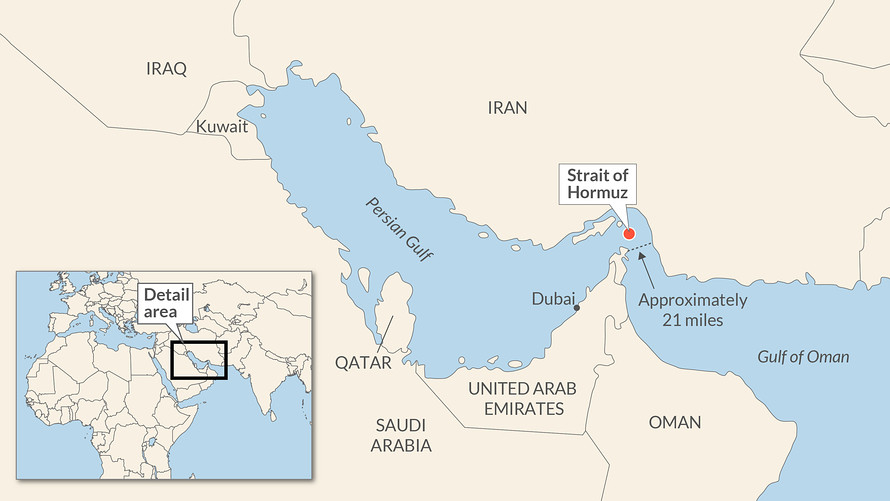
    Places in news: Strait of Hormuz

    A US Navy warship fired a warning flare to wave off an Iranian speedboat coming straight at it during a tense encounter in the strategic Strait of Hormuz.

    Why in news?

    • The Strait of Hormuz, a narrow waterway in the Middle East marks the most sensitive transportation choke point for global oil supplies.

    Strait of Hormuz

    • The Strait of Hormuz is a narrow channel, approximately 30 miles wide at the narrowest point, between the Omani Musandam Peninsula and Iran.
    • It connects the Persian Gulf to the Gulf of Oman.
    • The Strait is deep and relatively free of maritime hazards.
    • Its depth is greatest near the Musandam Peninsula and tapers as you move north toward the Iranian shore.

    Why is it important?

    • Oil tankers carrying crude from ports on the Persian Gulf must pass through the strait.
    • Around 21 million barrels of oil a day flowed through it in 2018, equivalent to roughly a third of global seaborne oil trade and about 21% of global petroleum liquids consumption.


    UPSC 2023 countdown has begun! Get your personal guidance plan now! (Click here)

  • Monetary Policy Committee Notifications

    Communication gap between the MPC and RBI

    Context

    Communication is a critical element of monetary policy. Yet there seems to be a gap between what the MPC says and what the RBI does.

    About MPC

    • The Reserve Bank of India Act, 1934 (RBI Act) has been amended by the Finance Act, 2016,  to provide for a statutory and institutionalised framework for a Monetary Policy Committee, for maintaining price stability, while keeping in mind the objective of growth.
    • Highest monetary policy-making body: By law, the Monetary Policy Committee is the highest monetary policy-making body in the land, tasked with deciding monetary policy changes at regular intervals.
    • Composition: The MPC will have six members – the RBI Governor (Chairperson), the RBI Deputy Governor in charge of monetary policy, one official nominated by the RBI Board and the remaining three members would represent the Government of India.
    • The MPC will be chaired by the Governor.
    • Under the inflation targeting regime, the most important role in communication belongs to the MPC.

    Communication with public

    • Monetary policy changes are communicated through formal statements, with the discussions underlying these decisions also being published, so that the public can understand why the MPC decided the way that they did.
    • Communication gap: Over the past few years, a communication gap seems to have opened up between what the MPC has been saying and what the RBI has been doing, thereby potentially eroding the credibility of the IT framework.
    • Influencing inflation expectations: Communication is an important part of the ability of the central bank to influence inflation expectations. 

    Following are the ways which indicate the communication gap between the RBI and the MPC, with several implications for the credibility of the MPC.

    1] Separate statements

    • During the first few years of the inflation-targeting regime from 2016 to 2018, the process of communication worked quite well.
    • On the days of policy announcements, the governor and his deputies would participate in a press conference.
    • From 2019 onwards, however, things began to change.
    • Governor’s separate statement: The RBI began to release a separate governor’s statement on the day of the monetary policy meeting, presenting an inflation outlook and even explaining the decision taken by the MPC.
    • MPC statement: It has overlapped with the MPC statement; at times, it has seemed somewhat different.
    • For example, following the June 8 Monetary Policy Review the MPC highlighted inflation concerns, and voted in favour of raising the policy repo rate.
    • On the same day, a governor’s statement mentioned that the central bank will also remain focussed on the orderly completion of the government’s borrowing programme.
    • Confusion: The issuance of two such different statements can lead to confusion, especially as lowering inflation and lowering government bond yields are contradictory policy objectives.

    Why is communication so crucial? To influence inflation expectations!

    • If the public believes the central bank is committed to keeping inflation under control, then it will act accordingly.
    • Firms will moderate their price increases, fearing that large price rises will make them uncompetitive.
    • Meanwhile, workers will accept moderate wage increases, while investors will accept low interest rates on their bond purchases.
    • With everyone acting in this way, it will be easier for the central bank to ensure that inflation indeed remains low.
    • Anchored inflation expectations: If inflation expectations are well anchored, then it becomes relatively easy for the central bank to ensure that inflation returns to the target level before too long.

    2] Change in the Monetary Policy Corridor width during pandemic

    • Deciding the repo rate: The most important task of the MPC, enshrined in the RBI Act (Amended), 2016 that introduced IT, is to decide the repo rate, since this has long been the lynchpin of India’s monetary policy framework.
    •  Ever since the early 2000s, policy had aimed to keep overnight money market rates in a corridor, with the lower bound established by the reverse repo rate and the upper bound by the repo rate.
    • Since the width of this corridor was fixed, once the repo rate was decided, the reverse repo rate was automatically determined, and market overnight rates adjusted accordingly.
    • During the Covid-19 pandemic, the RBI constantly adjusted the reverse repo rate even as the MPC kept the repo rate unchanged.
    • As a result, the fixed width of the corridor was lost, and the MPC lost any role in determining interest rates.

    3] Introduction of policy instruments outside the remit of MPC

    • During pandemic, the RBI introduced a number of new policy instruments, again outside the remit of the MPC.
    • GSAP: It brought in the GSAP programme through which it pre-commited to buying a certain amount of dated government bonds in order to control their yields.
    • Variable reverse repo auctions: It then introduced variable reverse repo auctions, and more recently, replaced the reverse repo rate with the long-dormant standing deposit facility rate.
    • The rationale for this was not explained in the MPC statement.
    • All unconventional monetary policy announcements were kept outside the MPC statement.
    • This raised the questions about the role of the committee in deciding monetary policy actions at a crucial time like the pandemic.

    4] Intervention in the foreign exchange market

    • The RBI has been intervening in the foreign exchange market to manage the rupee.
    • Forex interventions by definition influence the domestic monetary base and inflation.
    • Yet the MPC in its monetary policy statements does not discuss either the exchange rate dynamics or the forex interventions.
    • Just as it does not discuss the RBI’s interventions in the bond market to lower the yields.

    Way forward

    • In its latest two statements, the MPC indicated that policy would now be focusing on bringing India’s inflation rate under control.
    • Clear policy framework: If the RBI is going to be successful in this endeavour, the first step must be to close the communication gap, by reintroducing a simple and clear policy framework and restoring the central role of the MPC.

    Conclusion

    The net result of all these actions is a potential loss of both clarity and credibility. The communication gap will need to be closed in order for the RBI to become successful in bringing inflation back to its 4 per cent target level.

    UPSC 2023 countdown has begun! Get your personal guidance plan now! (Click here)


    Back2Basics: Monetary Policy Corridor

    • The Corridor in the monetary policy of the RBI refers to the area between the reverse repo rate and the MSF rate.
    • Reverse repo rate will be the lowest of the policy rates whereas Marginal Standing Facility is something like an upper ceiling with a higher rate than the repo rate.
    • The MSF rate and reverse repo rate determine the corridor for the daily movement in the weighted average call money rate.
    • As per the monetary policy of the RBI, ideally, the call rate should travel within the corridor showing a comfortable liquidity situation in the financial system and economy.

    What is GSAP?

    • The G-Sec Acquisition Programme (G-SAP) is basically an unconditional and a structured Open Market Operation (OMO), of a much larger scale and size.
    • G-SAP is an OMO with a ‘distinct character’.
    • The word ‘unconditional’ here connotes that RBI has committed upfront that it will buy G-Secs irrespective of the market sentiment.

  • Foreign Policy Watch: India-Sri Lanka

    In Sri Lankan crisis, a window of economic opportunity

    Context

    The commonality between Sri Lanka and the southern parts of India remains a less-emphasised yet significant aspect of India-Sri Lanka relations.

    Crisis in Sri Lanka and relief provided by India

    • The present economic crisis in Sri Lanka has pushed it closer to India for immediate relief.
    • India, as part of its ‘Neighbourhood First’ policy, has extended support to the people of Sri Lanka in the form of aid (close to $3.5 billion) to help secure Sri Lanka’s food, health and energy security by supplying it essential items such as food, medicines, fuel and kerosene.
    • The latest in the series was the signing of an agreement on June 10 between the Government of Sri Lanka and the Export-Import Bank of India for a $55-million short term Line of Credit to facilitate the procurement of urea for paddy crop in the ongoing ‘Yala’ season.
    • On its part, Tamil Nadu decided to provide aid of ₹123 crore, comprising 40,000 tonnes of rice, 137 types of life-saving drugs and 500 tonnes of milk powder.

    Sri Lanka-India sub-regional context

    • During his second term as Prime Minister, Mr. Wickremesinghe while delivering a lecture in Chennai, in August 2003, called for the development of the south India-Sri Lanka sub-region as a single market.
    • Such a market would provide more opportunities for the economic growth of both countries.
    • In 2016 he highlighted the fact that the five Indian southern States, with a total population of 250 million, had a combined gross state domestic product of nearly $450 billion; with the addition of Sri Lanka’s $80 billion GDP, the sub-region would have a $500 billion economy, having an aggregate population of around 270 million.

    Challenges

    • Possibility of greater economic collaboration: Whether this bonhomie can lead to greater economic collaboration between Sri Lanka and south India, not necessarily Tamil Nadu alone, given the historical baggage, is anybody’s guess.
    • Baggage of history: Some sections of the Sinhalese still hold the view that India had been a threat to Sri Lanka and it can still be a threat to them.
    • The manner in which the Rajapaksa regime unilaterally scrapped in February 2021 a tripartite agreement signed in 2019 with India and Japan for the development of Colombo’s East Container Terminal was a reflection of the historical baggage.
    • This perception can be traced to history when Sri Lanka was invaded by rulers of south India who humbled the Sinhala kings.
    • In the aftermath of the 1983 anti-Tamil pogrom, the support provided by the Indian government to Tamil rebels only strengthened this perception.
    • Modest investment in Sri Lanka’s development: Despite India’s open willingness to take part in the development of Sri Lanka after the civil war, the scale of its involvement has been modest.
    • Incomplete projects due to lack of political will: After the cancellation of the tripartite agreement, India was later provided with projects such as the West Container Terminal, the Trincomalee oil tank farm and a couple of renewable projects, there were several proposals that envisaged India’s participation but did not see the light of day.
    • Another project, a collaboration between NTPC Limited and the Ceylon Electricity Board, was cancelled.
    • Other projects too such as the development of the Kankesanthurai harbour and the expansion of the Palaly airport in Jaffna, both envisaging Indian participation, would have become a reality had there been show of political will from the other side.
    • The project of building a sea bridge and tunnel, connecting Rameshwaram to Talaimannar, remains on paper.

    Way forward

    • Infrastructure development: Even now, there is enormous scope for collaboration between the two countries in the area of infrastructure development.
    • Cross-border energy trade: The economic crisis has revived talk of linking Sri Lanka’s electricity grid with that of India.
    • If this project takes off, the first point of interconnectivity on the Indian side will most likely be in Tamil Nadu.
    • India has cross-border energy trade with Bangladesh, Nepal, Bhutan and Myanmar.
    • Facilitating people-to-people interaction: The apprehension in the minds of sections of the Sinhalese majority about India being a threat can be dispelled only by facilitating greater people-to-people interaction, including pilgrimages by monks and other sections of Sri Lankan society to places of Buddhist importance not only in north India but also in the south (Andhra Pradesh).

    Conclusion

    Much more will have to be done but the opportunity created by the current circumstances should be utilised to bring Indian and Sri Lankan societies closer — a prerequisite to achieving an economic union between Sri Lanka and the southern States of India.

    UPSC 2023 countdown has begun! Get your personal guidance plan now! (Click here)

  • BRICS Summits

    China to host BRICS Virtual Summit

    Chinese President Xi Jinping will host a virtual summit of the leaders of the BRICS countries. PM Modi is expected to join.

    Why in news?

    • China is keen for the grouping to explore expansion and include new developing country members.
    • Under the “BRICS Plus” format, the forthcoming summit is also expected to be attended by leaders of invited emerging countries.

    What is BRICS?

    • BRICS is an acronym for the grouping of the world’s leading emerging economies, namely Brazil, Russia, India, China and South Africa.
    • The BRICS Leaders’ Summit has convened annually. It does not exist in form of an organization, but it is an annual summit between the supreme leaders of five nations.

    Its inception

    • On November 30, 2001, Jim O’Neill, a British economist who was then chairman of Goldman Sachs Asset Management, coined the term ‘BRIC’ to describe the four emerging economies of Brazil, Russia, India, and China.
    • He made a case for BRIC on the basis of econometric analyses projecting that the four economies would individually and collectively occupy far greater economic space and become among the world’s largest economies in the next 50 years or so.

    How it has formed?

    • The grouping was formalized during the first meeting of BRIC Foreign Ministers on the margins of the UNGA in New York in September 2006.
    • The first BRIC Summit took place in 2009 in the Russian Federation and focused on issues such as reform of the global financial architecture.

    Who are the members?

    • South Africa was invited to join BRIC in December 2010, after which the group adopted the acronym BRICS. South Africa subsequently attended the Third BRICS Summit in Sanya, China, in March 2011.
    • The Chairmanship of the forum is rotated annually among the members, in accordance with the acronym B-R-I-C-S.
    • The importance of BRICS is self-evident: It represents 42% of the world’s population, 30% of the land area, 24% of global GDP and 16% of international trade.
    • The five BRICS countries are also members of G-20.

    Also read

    [Burning Issue] BRICS and its relevance in today’s world


    Back2Basics: BRICS Plus

    • The BRICS outreach to Africa began at the last summit hosted by South Africa, in 2013. It has picked up momentum now but African leaders want more.
    • They need big loans from the New Development Bank (NDB) for their infrastructure projects.
    • China introduced the “BRICS Plus” format at the Xiamen summit last year by inviting a few countries from different regions.
    • South Africa emulated it, arranging the attendance of top-level representation of five nations of its choice: Argentina, Jamaica, Turkey, Indonesia and Egypt.
    • The precise role of “BRICS Plus” countries will take time to evolve but an immediate benefit is the immense opportunities it provides for networking among leaders.


    UPSC 2023 countdown has begun! Get your personal guidance plan now! (Click here)

  • Labour, Jobs and Employment – Harmonization of labour laws, gender gap, unemployment, etc.

    The job puzzle

    Context

    The government has assured the creation of one million jobs over the next one-and-a-half years. This may be optimistic, but if it does materialise, the employment landscape will change dramatically.

    Background

    • What is the unemployment rate? Expressed in percentage, the unemployment rate is defined as the share of people who are without any job.
    • Joblessness in the country essentially relates to educated young adults seeking jobs in the formal economy.
    • The government recently announced it would recruit 10 lakh people in “mission mode” over the next one-and-a-half years.
    • The announcement came at a time when the unemployment rate for youth (aged 15-29 years) in urban areas has been hovering at over 20 per cent for the last several quarters.

    What is the employment situation in India today?

    • If jobs are being created on a progressive basis, there will be an increase in income generation, which in turn, should spur consumption.
    • Therefore, if consumption picks up – this can be indicated by the growth in the consumer goods segments — then one can be confident of jobs being created.
    • What is the situation in India? Consumer durable goods have been registering negative or slightly positive growth for the last five years or so — this is a reflection of the purchasing power of the people that ultimately can be linked to job creation.
    • There have been talks of start-up economy in the country and their achievements.
    • Interestingly, it is a well-known fact that, globally, 80-85 per cent of start-ups fold up in the first couple of years mainly due to non-viable models that fail the scaling-up challenge.
    • Therefore, while start-ups sound exciting, job creation at scale cannot be part of these experiments, unless there is an assured flow of funds.

    Challenge in recruiting 10 lakh people

    • It will be a really big task given that presently the central government offices house around 3.45 million personnel as per the budget for 2022-23.
    • Short time frame: The first challenge is in recruiting such a large number in this short period of time considering that there are fairly lengthy processes involved in hiring people to government departments.
    • Finding meaningful role: Hiring such a number is good for the country, but finding meaningful roles for them in various departments needs to be seriously examined.
    • Quite clearly, plans need to be in place to provide work to this set of new employees.
    • Increase in cost for the government: The third issue that would have to be kept in mind is the increase in cost for the government.
    • As per the budget for 2022-23, the average outgo per employee was around Rs 12.20 lakh.
    • Assuming the new set earns half of the existing average, the additional cost would be at least Rs 60,000 crore.
    • The salary outlay for the year was Rs 4.22 lakh crore.
    • These provisions would have to be made in subsequent budgets.

    Conclusion

    The overall unemployment picture looks complex today. While the government’s intent to add over a million jobs in the next 18 months is laudable, the task is audacious and challenging from both an administrative and financial point of view.

    UPSC 2023 countdown has begun! Get your personal guidance plan now! (Click here)

Join the Community

Join us across Social Media platforms.