💥UPSC 2027,2028 Mentorship (May Batch) + Access XFactor Notes & Microthemes PDF

Archives: News

  • River Interlinking

    Bedti-Varada Interlinking Project

    Environmental groups in Karnataka have criticised the project to link the Bedti and Varada rivers in Karnataka, calling it ‘unscientific’ and a ‘waste of public money’.

    Bedti-Varada Interlinking Project

    • The Bedti-Aghanashini-Varade river-linking project was also included in the country’s major rivers project devised by the then PM Vajpayee government.
    • The Central Government had created a task force to prepare action plans for interlinking the riverbeds in 2002.
    • The project cost and the source of investments were ascertained and suggested that the project be taken up in 2016.

    Key details

    • The Bedti-Varada project was envisaged in 1992 as one to supply drinking water by the then government.
    • The plan aims to link the Bedti, a river flowing west into the Arabian Sea, with the Varada, a tributary of the Tungabhadra river, which flows into the Krishna, which in turn flows into the Bay of Bengal.
    • A massive dam will be erected at Hirevadatti in Gadag district under the project. A second dam will be built on the Pattanahalla river at Menasagoda in Sirsi, Uttara Kannada district.
    • Both dams will take water to the Varada via tunnels of length 6.3 kilometres and 2.2-km. The water will reach at a place called Kengre.
    • It will then go down a 6.88 km tunnel to Hakkalumane, where it will join the Varada.
    • The project thus envisages taking water from the water surplus Sirsi-Yellapura region of Uttara Kannada district to the arid Raichur, Gadag and Koppal districts.



  • Wildlife Conservation Efforts

    Places in news: Keibul Lamjao National Park (KLNP)

    Activists surrounding the Keibul Lamjao National Park (KLNP) in Manipur have now taken up the cudgels to ensure that the government does not shift the proposed heritage park from the approved site.

    Keibul Lamjao National Park (KLNP)

    • The KLNP is a national park in the Bishnupur district of the state of Manipur in India.
    • It is 40 km2 in area, the only floating park in the world, located in North East India, and an integral part of Loktak Lake.
    • The national park is characterized by floating decomposed plant material locally called Phumdi at the south–eastern side of the Loktak Lake, which has been declared a Ramsar site.
    • It was created in 1966 as a wildlife sanctuary to preserve the natural habitat of the endangered Eld’s deer.
    • In 1977, it was gazetted as national park.

    Key faunas

    • KLNP is home to the last of the brow-antlered deer (Rucervus eldii eldii), one of the most endangered deer in the world.
    • It is locally called as Sangai.
    • The animal is, in fact, in danger of losing its home—most of the phumdis, or floating swamps, are unable to sustain its weight.
    • In 1951, it was reported extinct, but British tea planter and naturalist Edward Pritchard Gee rediscovered it in 1953.


    UPSC 2023 countdown has begun! Get your personal guidance plan now! (Click here)

  • Russian Invasion of Ukraine: Global Implications

    The tricky restructuring of global supply chains

    Context

    After the go-go 1990s and 2000s the pace of economic integration stalled in the 2010s, as firms grappled with the aftershocks of a financial crisis, a populist revolt against open borders and President Donald Trump’s trade war.

    Background of globalisation

    • After the Berlin Wall fell in 1989, main theme of globalisation was efficiency.
    • Companies located production where costs were lowest, while investors deployed capital where returns were highest.
    • Governments aspired to treat firms equally, regardless of their nationality, and to strike trade deals with democracies and autocracies alike.
    • Low prices: All this kept prices low for consumers and helped lift 1bn people out of extreme poverty as the emerging world, including China, industrialised.


    Recent worries with globalisation

    • Volatile capital flows destabilised financial markets. Many blue-collar workers in rich countries lost out.
    • Recently, two other worries have loomed large.
    • Cost in case of disruption is high: First, some lean supply chains are not as good value as they appear: mostly they keep costs low, but when they break, the bill can be crippling.
    • Covid-19 was a shock, but wars, extreme weather or another virus could easily disrupt supply chains in the next decade.
    • Dependencies on autocracies have increased: The second problem is that the single-minded pursuit of cost advantage has led to a dependency on autocracies that abuse human rights and use trade as a means of coercion.
    • Hopes that economic integration would lead to reform—what the Germans call “change through trade”—have been dashed: autocracies account for a third of world gdp.

    The fragile state of the international trade and beginning of new phase in globalisation

    • The pandemic and war in Ukraine have triggered a once-in-a-generation reimagining of global capitalism in boardrooms and governments.
    • Supply chain resilience: The supply chains are being transformed, from the $9trn in inventories, stockpiled as insurance against shortages and inflation, to the fight for workers as global firms shift from China into Vietnam.
    • Preferring security over efficiency: This new kind of globalisation is about security, not efficiency: it prioritises doing business with people you can rely on, in countries your government is friendly with.
    • One indication that companies are shifting from efficiency to resilience is the vast build-up in precautionary inventories: for the biggest 3,000 firms globally these have risen from 6% to 9% of world gdp since 2016.
    • Many firms are adopting dual sourcing and longer-term contracts.
    • Investment pattern is inverted: The pattern of multinational investment has been inverted: 69% is from local subsidiaries reinvesting locally, rather than parent firms sending capital across borders.
    • Strategic autonomy: The industries under most pressure are already reinventing their business models, encouraged by governments that from Europe to India are keen on “strategic autonomy”.
    • Moving towards vertical integration: The car industry is copying Elon Musk’s Tesla by moving towards vertical integration, in which you control everything from nickel mining to chip design.
    • Long-term supply deals: In energy, the West is seeking long-term supply deals from allies rather than relying on spot markets dominated by rivals.

    Challenges

    • Protectionism: The danger is that a reasonable pursuit of security will morph into rampant protectionism, jobs schemes and hundreds of billions of dollars of industrial subsidies.
    • Long-run inefficiencies: The long-run inefficiency from indiscriminately replicating supply chains would be enormous.
    • Were you to duplicate a quarter of all multinational activity, the extra annual operating and financial costs involved could exceed 2% of world gdp.

    Way forward

    • Restraint: Because of the above challenges, restraint is crucial.
    • Diversification: Governments and firms must remember that resilience comes from diversification, not concentration at home.
    • Diversify in the areas controlled by autocracies: The choke-points autocracies control amount to only about a tenth of global trade, based on their exports of goods in which they have a leading market share of over 10% and for which it is hard to find substitutes.
    • The answer is to require firms to diversify their suppliers in these areas, and let the market adapt. 

    Conclusion

    Will today’s governments be up to the task? Myopia and insularity abound. But if you are a consumer of global goods and ideas—that is to say, a citizen of the world—you should hope globalisation’s next phase involves the maximum possible degree of openness.

    UPSC 2023 countdown has begun! Get your personal guidance plan now! (Click here)

  • Judicial Reforms

    Judicial Reforms in India

    Context

    Following are the reforms needed in the various aspects of the higher judiciary

    Removing the disparity between retirement ages of HC and SC judges

    • High Court judges now retire at 62 and Supreme Court judges at 65.
    • It is high time that we did away with the disparity between the retirement ages of High Court and Supreme Court judges.
    • There is no good reason for this difference.
    • Intense pressure and competition: The obvious negative fallout of a differential retirement age simply is intense pressure and competition to make it to the top court and thus get three more years.
    • If this is done away with, several judges of mettle would prefer to be Chief Justices and senior judges in the High Courts exercising wide power of influence rather than being a junior judge on a Bench of the Supreme Court.
    • There is good work to be done in the High Courts, and we need good men there.

    Create a cadre of public service for retired judges

    • SeveralSupreme Court judges focus on arbitrations after retirement.
    • A minority of judges devote themselves to public service; sadly, this is a very small minority.
    • Another lot are appointed to various constitutional posts and tribunals and commissions.
    • It would be worthwhile reform to create a cadre of public service for retired judges and from this pool make appointments to the constitutional and statutory posts and special assignments.
    • Such judges should receive the full pay and the facilities of a judge of the Supreme Court for life.
    • We should have a culture of public service for senior judges, and those who do not fit in such culture should not be a part of senior ranks.

    Reform in the process of appointment of Chief Justice of India

    • No constitutional basis: It is generally assumed that the seniormost judge of the Supreme Court should be the Chief Justice of India.
    • The Constitution mandates no such thing.
    • Article 124 merely states that the President will appoint every judge of the Supreme Court, and this includes the Chief Justice, and each of these judges shall hold office until they attain the age of 65 years.
    • The requirement about appointing the seniormost judge to be the CJI was devised in the Second Judges case (1993) and the consequent Memorandum of Procedure which is an usurpation of the President’s power.
    • There is no good reason why any one particular person should have a vested interest in the top job, and we are better served by eliminating such expectation.
    • Let all serve equally under the constitutional throne for the entire length of their tenure.

    But who then shall be the CJI?

    • As per the Constitution the judges of the High Court, senior advocates and distinguished jurists are eligible for the appointment as the judge of the Supreme Court.
    • Chief Justice of HC: When a serving CJI retires, his successor should be the best reputed Chief Justice of a High Court who has proved himself worthy both in judicial office as well as administrative leadership and has those qualities of heart and head which mark a good leader.
    • The same process is followed in the appointment of the Chief Justice of the United States Supreme Court.
    • Security of tenure: The appointee should have a clear three-year term.
    • He should not function as the primus super pares — calling the shots and having their unfettered way.
    • He should instead function in a true collegiate manner, especially in regard to the roster of allotment of cases, especially the sensitive ones, and appointments to the Supreme Court and High Courts and other important matters of judicial and administrative importance.

    Conclusion

    Though there are several issues that need reforms in the higher judiciary, the above reforms can serve as the precursor to the other reforms to come.

    UPSC 2023 countdown has begun! Get your personal guidance plan now! (Click here)

  • Foreign Policy Watch: India-Australia

    India and Australia

    Context

    India and Australia, which share common values and interests, must work together with resolve to shape the economic and strategic environment so that it continues to support collective security and prosperity.

    India-Australia ties: A background

    • The ties are a Comprehensive Strategic Partnership full of practical, tangible actions that strengthen ties and benefit the region.
    • India and Australia are a small group of countries to hold annual leaders’ summits and biennial 2+2 talks involving foreign and defence ministers.
    • The defence forces of both the countries are undertaking more complex activities together, such as in Exercise Malabar with the US and Japan.
    • We coordinate closely on maritime domain awareness.
    • This year both countries deployed P-8 surveillance aircraft to each other’s territories for joint patrols.
    • Australia has also committed to a package of partnership initiatives in our update to the India Economic Strategy.
    • Cooperation on climate and sustainability: India and Australia have great potential to cooperate on climate and sustainability.

    Why India matters to Australia

    • Securing supply chain: India’s economy, manufacturing capabilities and talent ensure it will play a key role in securing supply chains and restarting post-pandemic growth.
    • Balance of power: Its military has the capacity and capability to respond to natural disasters, help stabilise an uncertain region and contribute to an effective balance of power.
    • Technological and scientific capabilities: Its technological and scientific capabilities are gateways to a cleaner and more sustainable world.
    •  Commitment to democracy: Most of all, India’s people have the optimism, the commitment to democracy, the drive and the goodwill to make our region safer, freer and better.

    Vision for open, inclusive and resilient Indo-Pacific region

    • As the bilateral relationship deepens, both the countries must begin to work more together with others in the region.
    • Responding to humanitarian crises and natural disasters: There is enormous potential in the Indian and Pacific oceans, where we each have vital interests in combating climate change, illegal fishing and people smuggling and responding to humanitarian crises and natural disasters.
    •  Australia has a vision for an open, inclusive and resilient Indo-Pacific region.
    • It is a vision for a region that is more integrated rather than divided, where trade and investment flow freely based on agreed rules and treaty commitments, where disputes are resolved through dialogue in accordance with international law, and where a strategic culture that respects the rights of all states, big and small, prevails.
    • It is a vision that Australia share with partners like ASEAN, and partners like India.
    • Whether through joint activities with like-minded countries, or the support of regional and multilateral architecture, Australia is ensuring the region has options and balance.

    Conclusion

    India and Australia’s interests don’t just align, they are inextricably entwined. Expect this relationship to grow and prosper, our cooperation to deepen.

    UPSC 2023 countdown has begun! Get your personal guidance plan now! (Click here)

  • Urban Floods

    Why Assam gets flooded every year

    Disaster struck Dima Hasao, central Assam’s hill district, in mid-May after incessant heavy rainfall.

    Impacts of the disaster

    • The 170 km railway line connecting Lumding in the Brahmaputra Valley’s Hojai district and Badarpur in the Barak Valley’s Karimganj district was severely affected.
    • The Assam government and Railway Ministry’s assessments said the district suffered a loss of more than ₹1,000 crore, but ecologists say the damage could be irreversibly higher.

    How severe has the rain been in Assam?

    • Assam is used to floods, sometimes even four times a year, resultant landslides and erosion.
    • But the pre-monsoon showers this year have been particularly severe on Dima Hasao, one of three hill districts in the State.
    • Landslips have claimed four lives and damaged roads.
    • The impact has been most severe on the arterial railway, which was breached at 58 locations leaving the track hanging in several places.
    • The disruption of train services, unlikely to be restored soon, has cut off the flood-hit Barak Valley, parts of Manipur, Mizoram and Tripura.

    Why is the railway in focus post-disaster?

    • Dima Hasao straddles the Barail, a tertiary mountain range between the Brahmaputra and Barak River basins.
    • The district is on the Dauki fault (the prone-to-earthquakes geological fractures between two blocks of rocks) straddling Bangladesh and parts of the northeast.
    • British engineers were said to have factored in the fragility of the hills to build the railway line over 16 years by 1899.
    • The end result was an engineering marvel 221 km long over several bridges and through 37 tunnels, laid along the safer sections of the hills.

    A faulty experiment

    • A project to convert the metre gauge track to broad gauge was undertaken in 1996 but the work was completed only by March 2015 because of geotechnical constraints and extremist groups.
    • The broad-gauge track was realigned to be straighter, but a 2009-10 audit report revealed that the project had been undertaken without proper planning and visualisation of the soil strata behaviour.
    • The report gave the example of the disaster-prone Tunnel 10 on the realigned track that was pegged 8 meters below the bed of a nearby stream.

    Is only the railway at fault?

    • There is a general consensus that other factors have contributed to the situation Dima Hasao is in today.
    • Roads in the district, specifically the four-lane Saurashtra-Silchar (largest Barak Valley town) East-West Corridor, have been realigned or deviated from the old ones that were planned around rivers and largely weathered the conditions.
    • The arterial roads build over the past 20 years often cave in and get washed away by floods or blocked by landslides.
    • Shortened cycles of jhum or shifting cultivation on the hill slopes and unregulated mining have accentuated the “man-made disaster”.
    • Massive extraction of river stone, illegal mining of coal and smuggling of forest timbe has led to the disaster.
    • These activities have increased water current besides weakening either side of riverbanks.

    How vital are the rail and highway through Dima Hasao?

    • Meghalaya aside, Dima Hasao is the geographical link to a vast region comprising southern Assam’s Barak Valley, parts of Manipur, Mizoram and Tripura.
    • Moreover, this track is vital for India’s Look East policy that envisages shipping goods to and from Bangladesh’s Chittagong port via Tripura’s border points at Akhaura and Sabroom.
    • These are the last railway station near the Feni River that serves as the India-Bangladesh border.


    UPSC 2023 countdown has begun! Get your personal guidance plan now! (Click here)

  • Indian Army Updates

    Explained: BSF powers and jurisdiction

    A blueprint that defines the extended jurisdiction of the Border Security Force (BSF) and its new logistical requirements in frontier States has been prepared and is soon expected to be submitted to the Union Home Ministry.

    What is the news?

    • While in Punjab, West Bengal and Assam, the BSF jurisdiction, from the border towards the hinterland, was enhanced from the earlier 15 km to 50 km.
    • In Gujarat the same limit has been reduced from 80 km to 50 km, while in Rajasthan the limit has been kept unchanged at 50 km.

    Do you know?

    BSF currently stands as the world’s largest border guarding force. It has been termed as the First Line of Defence of Indian Territories.

    About Border Security Force (BSF)

    • The BSF is India’s border guarding organization on its border with Pakistan and Bangladesh.
    • It comes under the Ministry of Home Affairs.
    • It was raised in the wake of the 1965 War on 1 December 1965 for ensuring the security of the borders of India and for matters connected therewith.
    • The BSF has its own cadre of officers but its head, designated as a Director-General (DG), since its raising has been an officer from the Indian Police Service (IPS).

    What are the new modifications?

    • The MHA has exercised the powers under the Border Security Force Act of 1968.
    • It has thus outlined the area of BSF’s jurisdiction.

    Powers exercised by BSF in its jurisdiction

    BSFs jurisdiction has been extended only in respect of the powers it enjoys under:

    1. Criminal Procedure Code (CrPC)
    2. Passport (Entry into India) Act, 1920 and
    3. Passport Act, 1967

    Arrest and search

    • BSF currently has powers to arrest and search under these laws.
    • It also has powers to arrest, search and seize under the NDPS Act, Arms Act, Customs Act and certain other laws.

    Sanctions behind such powers

    • Scarcely populated borders: At that time, border areas were sparsely populated and there were hardly any police stations for miles.
    • Trans-border crimes: To prevent trans-border crimes, it was felt necessary that BSF is given powers to arrest.
    • Manpower crunch: While police stations have now come up near the border, they continue to be short-staffed.

    Various issues at Borders

    1. Encroachment
    2. Illegal incursion
    3. Drug and cattle smuggling

    Impact on State Police jurisdiction

    • Such moves are aimed to complement the efforts of the local police.
    • Thus, it is an enabling provision.
    • It’s not that the local police can’t act within the jurisdiction of the BSF.
    • The state police have better knowledge of the ground.
    • Hence BSF and local Police can act in cooperation.

    Criticism of the move

    • At a basic level, the states can argue that law and order is a state subject and enhancing BSF’s jurisdiction infringes upon powers of the state government.
    • In 2012, then Gujarat CM and the present PM had opposed a central government moves to expand BSF’s jurisdiction.


    UPSC 2023 countdown has begun! Get your personal guidance plan now! (Click here)

  • Women empowerment issues – Jobs,Reservation and education

    Judicial Validity of the Talaq-e-Hasan mode of Divorce

    A public interest litigation (PIL) seeking to invalidate Talaq-e-Hasan, the prescribed Islamic way of divorce, has been filed in the Supreme Court.

    What is the PIL about?

    • The petition seeks to make the prescribed Islamic way of divorce Talaq-e-Hasan unconstitutional as it is violative of Articles 14, 15, 21 and 25 of the Constitution.
    • The petitioner has been unilaterally divorced through the Talaq-e-Hasan mode by her husband.
    • She also prayed that Section 2 of the Muslim Personal Law (Shariat) Application Act, 1937 that permits Muslims to practise unilateral divorce be declared void.

    Basis of the PIL

    • The hearing comes almost five years after the five judge Bench headed by then CJI J.S. Khehar invalidated instant triple talaq in their verdict in the Shayara Bano vs the Union of India Case.
    • The invalidation of instant triple talaq where the court held, “What is bad in theology is bad in law as well”, led to the enactment of the Muslim Women (Protection of Rights on Marriage) Act 2019.

    What is Triple Talaq?

    • In instant triple talaq a man pronounces multiple divorce in one go.
    • It has no scope for reconciliation between the feuding couple, and often ends a marriage instantly.
    • It is, as the judges held, not mentioned anywhere in the Quran which prescribes a code of divorce largely through Surah Baqarah, verses 226 to 237 and the opening six verses of Surah Talaq.
    • Incidentally, triple talaq in this manner has been banned in many Muslim countries, including Egypt, Pakistan, Jordan, Kuwait, Iraq, Malaysia etc.

    How is Talaq-e-Hasan different from instant triple talaq?

    • Unlike instant triple talaq, Talaq-e-Hasan is pronounced with a gap of at least one month or one menstrual cycle.
    • Only a single revocable divorce takes place through the first pronouncement of Talaq-e-Hasan.
    • The husband and wife are supposed to live together after this pronouncement and have the option of rapprochement.
    • If the couple is not able to mend fences in the intervening period and the husband does not annul divorce through word or by establishing intimacy, the talaq stays valid.
    • At the end of this month, the husband has to pronounce divorce for the second time.
    • Likewise for the third time. After the second pronouncement too, the divorce is revocable, and the couple may resume their conjugal relationship anytime they so desire.
    • If, however, the third pronouncement is made after at least one menstrual cycle, then irrevocable divorce takes place.

    Why such hue over menstrual cycle?

    • Significantly, no divorce can be administered when the woman is undergoing her menstrual cycle.
    • Even in the case of pregnancy, no divorce takes place.
    • And if such a pronouncement is made, it remains in abeyance till the end of pregnancy.

    Are there other options of divorce apart from the Talaq-e-Hasan?

    • The third option of divorce besides Talaq-e-Hasan and the now repudiated instant triple talaq, is Talaq-e-Ahsan.
    • Under this form, a single pronouncement is made.
    • Following the pronouncement, a woman has to go through iddat or a waiting period of three months.
    • During this period the divorce can be cancelled.
    • However, failure to annul divorce during this period results in it being finalised after which a woman is independent, and free to marry another man or stay single, as she may choose.
    • Both Talaq-e-Hasan and Talaq-e-Ahsan enjoy legal validity in almost all Muslim countries.
    • Interestingly, women too have a right to end an unsuccessful marriage through Khula.

    Legal status of Khula in India

    • In April 2021, the Kerala High Court held this form of divorce valid.
    • The court overruled a 49-year-old verdict in K.C. Moyin vs Nafeesa and Others (1972) that barred Muslim women from dissolving their marriage through non-judicial modes.
    • There is some debate among religious scholars on the ways of Khula.
    • Some hold that the man’s consent is necessary in Khula while most say that he enjoys no such privilege.


    UPSC 2023 countdown has begun! Get your personal guidance plan now! (Click here)

  • Global Geological And Climatic Events

    Summer Solstice 2022: What is it and how is it significant?

    Yesterday, June 21 was the day of the summer solstice in the northern hemisphere.

    What is Summer Solstice?

    • Solstice means “sun stands still” in Latin.
    • The longest day of 2021 for those living north of the Equator is June 21.
    • This day is characterized by a greater amount of energy received from the sun.
    • In technical terms, this day is referred to as the summer solstice, the longest day of the summer season.
    • It occurs when the sun is directly over the Tropic of Cancer, or more specifically right over 23.5-degree north latitude.

    The Southern Hemisphere receives most sunlight on December 21, 22 or 23 when the northern hemisphere has its longest nights– or the winter solstice.

    Why do we have summer solstice?

    • Since Earth rotates on its axis, the Northern Hemisphere gets more direct sunlight between March and September over the course of a day.
    • This also means people living in the Northern Hemisphere experience summer during this time.
    • The rest of the year, the Southern Hemisphere gets more sunlight.
    • During the solstice, the Earth’s axis — around which the planet spins, completing one turn each day — is tilted in a way that the North Pole is tipped towards the sun and the South Pole is away from it.

    Answer this PYQ in the comment box:

    Q.On 21st June, the Sun (CSP 2019):


    (a) Does not set below the horizon at the Arctic Circle

    (b) Does not set below the horizon at Antarctic Circle

    (c) Shines vertically overhead at noon on the Equator

    (d) Shines vertically overhead at the Tropic of Capricorn


    Post your answers here.

    Some interesting facts

    • During the June solstice compared to any other time of the year, the North Pole is tipped more directly toward the sun, and the south pole is tipped more directly away from the sun.
    • As a result, all locations north of the equator see days longer than 12 hours and all locations south see days shorter than 12 hours.
    • The sun’s path across the sky is curved—NOT a straight line on the summer solstice.
    • Based on Earth’s current orbit, the summer solstice date rotates between June 20, 21 and 22 and is not fixed since it depends on the physics of our solar system and not on human calendar.


    UPSC 2023 countdown has begun! Get your personal guidance plan now! (Click here)

  • Foreign Policy Watch: India-Iran

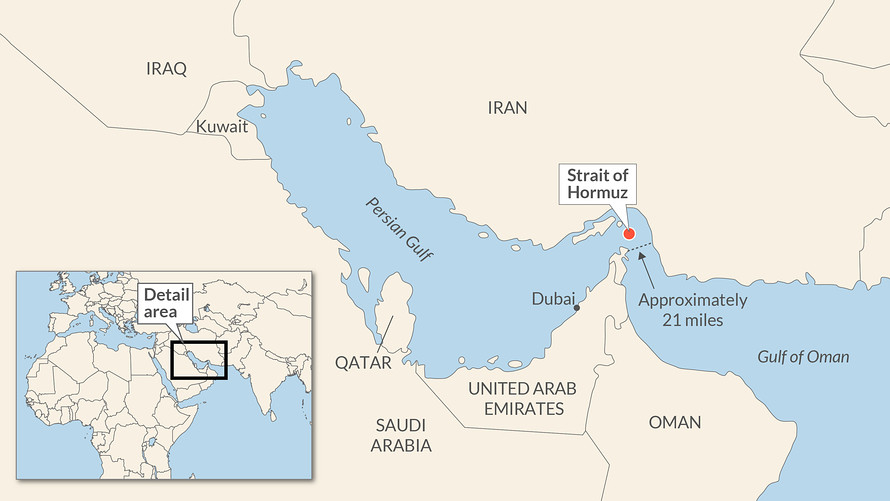
    Places in news: Strait of Hormuz

    A US Navy warship fired a warning flare to wave off an Iranian speedboat coming straight at it during a tense encounter in the strategic Strait of Hormuz.

    Why in news?

    • The Strait of Hormuz, a narrow waterway in the Middle East marks the most sensitive transportation choke point for global oil supplies.

    Strait of Hormuz

    • The Strait of Hormuz is a narrow channel, approximately 30 miles wide at the narrowest point, between the Omani Musandam Peninsula and Iran.
    • It connects the Persian Gulf to the Gulf of Oman.
    • The Strait is deep and relatively free of maritime hazards.
    • Its depth is greatest near the Musandam Peninsula and tapers as you move north toward the Iranian shore.

    Why is it important?

    • Oil tankers carrying crude from ports on the Persian Gulf must pass through the strait.
    • Around 21 million barrels of oil a day flowed through it in 2018, equivalent to roughly a third of global seaborne oil trade and about 21% of global petroleum liquids consumption.


    UPSC 2023 countdown has begun! Get your personal guidance plan now! (Click here)

Join the Community

Join us across Social Media platforms.