| PYQ Relevance[UPSC 2024] What changes has the Union Government recently introduced in the domain of Centre-State relations? Suggest measures to be adopted to build the trust between the Centre and the States and for strengthening federalism. Linkage: The PYQ highlights emerging tensions in Centre-State relations due to delimitation and Census-linked representation changes, directly impacting federal balance. It links to debate on cooperative vs competitive federalism, where trust deficit may widen due to perceived political centralisation in electoral restructuring. |
Mentor’s Comment
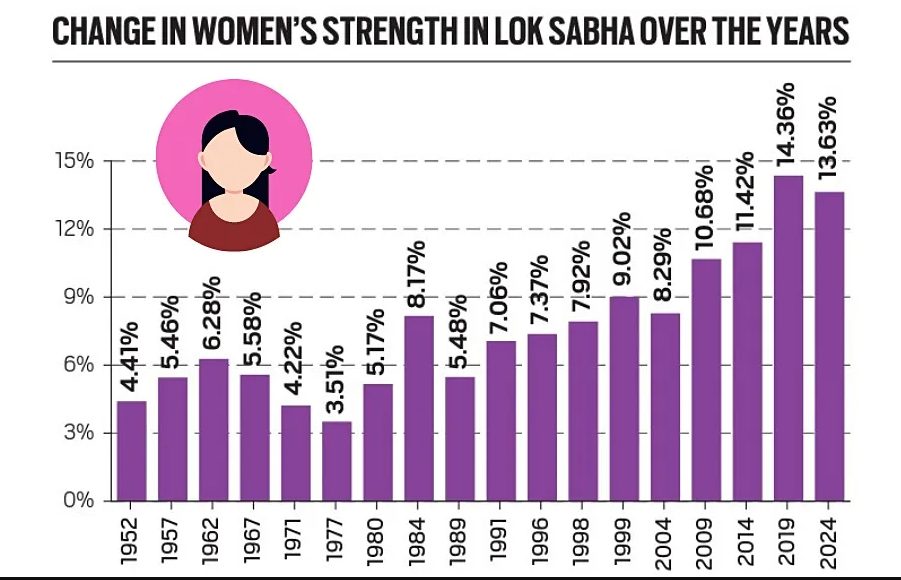
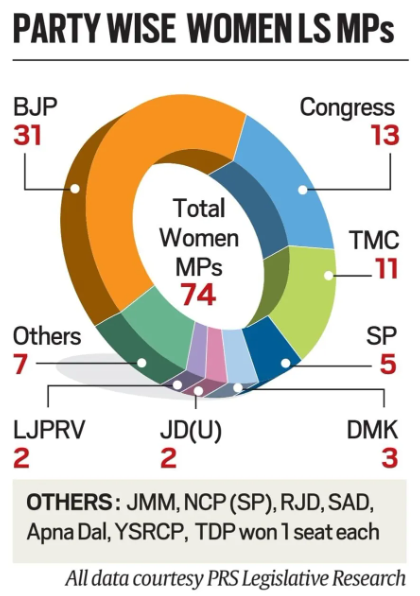
Nari Shakti Vandan Adhiniyam, 2023 mandates 33% reservation for women in legislatures but ties its implementation to the completion of the Census and subsequent delimitation. This conditionality has sparked controversy because it delays actual implementation to potentially 2029 or beyond, despite unanimous parliamentary passage. The issue becomes sharper as the government plans a special session of Parliament and advances delimitation discussions without a completed Census, raising concerns of political expediency.
Why is delimitation, rather than women’s reservation, the core issue?
- Conditional Implementation: Links reservation to Census and delimitation, delaying execution till 2029 or beyond, unlike immediate enactment expectations.
- Political Leverage: Enables ruling dispensation to redraw constituencies, influencing electoral outcomes before reservation kicks in.
- Shift in Debate: Moves discourse from gender justice to power redistribution, diluting the core objective of representation.
- Control over Representation: Determines who gets elected from where, making delimitation more decisive than reservation itself.
- Timing Advantage: Aligns delimitation with electoral cycles, allowing strategic gains during upcoming general elections.
How does the delay in Census affect constitutional processes?
- Census Delay: Postpones 2021 Census by 5+ years, disrupting statutory timelines for delimitation.
- Data Vacuum: Creates absence of reliable population data, affecting planning and representation.
- Policy Paralysis: Impacts schemes like NFSA and PM Garib Kalyan Anna Yojana, which rely on population estimates.
- Institutional Disruption: Delays constitutional exercises like seat allocation and reservation rotation.
- Credibility Concerns: Digital Census claims with data expected only by 2027 reduce transparency and trust.
What are the implications of delimitation on federal balance?
- Seat Redistribution: Increases representation of high population states (e.g., UP, Bihar).
- Federal Inequality: Penalizes states that achieved population control (e.g., Kerala, Tamil Nadu).
- Regional Imbalance: Creates North-South divide in political power.
- Political Centralization: Strengthens influence of certain regions in national policymaking.
- Disproportionate Representation: Alters Lok Sabha composition, impacting coalition politics and governance.
How does caste census complicate the process further?
- Policy Expansion: Adds caste enumeration to 2027 Census, expanding scope of data collection.
- Social Justice Dimension: Enables targeted welfare and sub-categorization within OBCs.
- Delay Risk: Extends timeline for Census to Delimitation to Reservation, delaying reforms.
- Political Sensitivity: Introduces identity-based mobilization, increasing contestation.
- Administrative Complexity: Requires extensive verification and classification mechanisms, slowing execution.
Is the process aligned with constitutional principles?
- Procedural Deviation: Initiates delimitation discourse without updated Census data, deviating from precedent.
- Democratic Deficit: Limits parliamentary debate and stakeholder consultation.
- Anti-Federal Concerns: Risks central dominance over states’ representation.
- Transparency Issues: Lack of clarity on methodology and timeline.
- Constitutional Morality: Undermines spirit of fair representation and cooperative federalism.
What lessons emerge from past reservation policies?
- 73rd & 74th Amendments: Ensured ~40% women’s representation (~15 lakh women) in local bodies.
- Immediate Implementation: Reservation was enforced without linkage to delimitation delays.
- Grassroots Empowerment: Strengthened political participation and leadership among women.
- Institutional Success: Demonstrates feasibility of large-scale reservation reforms.
- Contrast with Present: Current model introduces procedural bottlenecks absent in past reforms.
Can delimitation and Census-linked reforms strengthen democratic representation and governance in India?
- Rational Representation: Delimitation ensures equal representation based on updated population, strengthening democratic fairness.
- Data-Driven Governance: Census-linked processes enable evidence-based policymaking and welfare targeting.
- Comprehensive Reform: Integrating women’s reservation, delimitation, and caste census can create a more inclusive system.
- Correcting Malapportionment: Addresses distortions caused by frozen constituencies since 1971/2001.
- Long-term Structural Gains: If executed transparently, it can modernize India’s electoral architecture for future decades.
Conclusion
Delimitation, when linked with delayed Census and conditional reservation, shifts the reform from women’s empowerment to structural power redistribution. Ensuring timely Census, transparent delimitation, and decoupled implementation of women’s reservation remains essential to uphold federal balance, electoral fairness, and constitutional integrity, while enabling inclusive and data-driven governance.



















 Context
 Covid-19 Impact
 Discrimination as factor
 Status in India
 Steps taken by India
 Context
 Why there is recent spike in violence against women?
 Woman as the foundation stone of every family, society and nation
 Conclusion
 Context
  The gender gap in employment
 Government initiatives
 Context
  Persistent gender norms in japan
 Context
 Constraints in women empowerment


