💥UPSC 2026, 2027, 2028 UAP Mentorship (March Batch) + Access XFactor Notes & Microthemes PDF

Type: Explained

  • Prolonged exposure to coal mining causes respiratory, skin diseases in workers: study  

    Note4Students

    From UPSC perspective, the following things are important:

    Prelims level: Coal production in India

    Mains level: Coal Mining and its challenges;

    Why in the News?

    A new study by the National Foundation of India (NFI) reveals that 75% of focus group participants have chronic respiratory and skin ailments due to prolonged exposure to coal mining pollutants.

    • The study report titled, “At the Crossroads: Marginalised Communities and the Just Transition Dilemma”, is a sequel to the 2021 study by NFI on the socio-economic impact of coal transitions in India.
    Key Highlights of the reports by the National Foundation for India:

      • The study covered two districts each from three central Indian states—Chhattisgarh, Jharkhand, and Odisha surveying 1209 households and conducting 20 Focused Group Discussions (FDGs).
    • Other key findings of the study are: 
      • Health Concerns: Prolonged exposure to coal mining pollutants has resulted in widespread respiratory and skin diseases among the local populations. At least 75% of participants in Focus Group Discussions (FGDs) reported issues such as chronic bronchitis, asthma, and various skin conditions.
      • Economic Impact/ Economic Dependency on Coal: The phasing down of coal is expected to result in significant job losses and economic downturns in coal-dependent regions. This will not only impact the coal miners and workers directly but also the broader local economy.
      • Caste-Based Inequities: Access to resources and opportunities is significantly skewed, with marginalized communities such as Scheduled Castes (SCs), Scheduled Tribes (STs), and Other Backward Classes (OBCs) being disproportionately affected.
    • The report identifies several challenges in achieving a just transition, including the need to upskill a largely under-educated workforce and the lack of alternative livelihoods. 
    • It underscores the importance of community-specific policies, robust institutional mechanisms, and coordinated efforts between government bodies.
    • The study offers a potential framework for safeguarding the interests of these communities through:
      • Alternative Livelihoods: Emphasizing the development of new economic opportunities beyond coal.
      • Ecological Restoration: Promoting environmental recovery to mitigate the health impacts of coal mining.
      • Inclusive Policies: Ensuring that the transition policies are inclusive and consider the needs of marginalized communities.


    Present Challenges of Medical Expenses and Shift from Coal:

    • Health Concerns: People living closer to coal mines face higher medical expenses due to increased incidence of lung and breathing-related diseases and skin infections.
    • Economic concerns: The global shift away from coal is expected to result in job losses and economic downturns in coal-dependent regions, affecting both coal miners and the broader local economy.
      • Economic disparities exist with varying income levels and irregular wage receipt patterns in coal-dependent districts.
      • Dhanbad and Koriya, solely reliant on coal production, reported lower incomes compared to diversified industrial districts.

    Way Forward:

    • Diversification of Local Economies: Develop alternative industries and economic activities in coal-dependent regions to reduce reliance on coal mining. Promote skill development programs to help coal workers transition to new employment opportunities in emerging sectors such as renewable energy, manufacturing, and services.
    • Investment in Health Infrastructure: Enhance healthcare facilities in coal mining regions to address the higher incidence of lung, and breathing-related diseases, and skin infections. Implement comprehensive health monitoring and support programs for communities living near coal mines.
    • Promotion of Renewable Energy: Accelerate the shift towards renewable energy sources, building on the recent trend of increased capacity addition in renewable energy. Invest in renewable energy infrastructure and create job opportunities in the renewable sector to offset job losses in coal mining.
    • Government and Policy Support: Implement policies and provide financial support for a ‘just transition’ to ensure that workers and communities dependent on coal mining are not left behind.
    • Community Engagement and Participation: Involve local communities in planning and decision-making processes related to the transition from coal.

    Mains question for practice : 

    Q Analyse the health and socioeconomic impacts of prolonged coal mining in India, as highlighted by the National Foundation for India’s survey. 10M

    Mains PYQ: 

    Q In spite of adverse environmental impact, coal mining is still inevitable for Development”. Discuss. (UPSC IAS/2017)

  • Electronic System Design and Manufacturing Sector – M-SIPS, National Policy on Electronics, etc.

    Why India needs to build disaster resilience in its critical infrastructure?

    Note4Students

    From UPSC perspective, the following things are important:

    Prelims level: Critical Infrastructure Sectors;

    Mains level: Resilience Mechanism

    Why in the News?
    The unprecedented surge in electricity demand offers a glimpse into the kind of stress that critical infrastructure endures during extreme weather events and resulting disasters.

    Present Challenges in India -> High Temperatures and Electricity Demand:

    • Record-breaking Electricity Demand: Delhi experienced record-breaking electricity demand due to persistently high temperatures.
    • Frequent Power Cuts: The high demand led to frequent power cuts in Delhi and neighbouring areas.
    • Worsening Conditions: Other regions in central and eastern India faced similar or worse situations, with high night temperatures exacerbating the situation.
    • Heat-related Deaths: The lack of electricity and high temperatures likely contributed to several heat-related deaths.

    Mounting Losses:

    • Increased Economic Losses: Despite early warnings and quick responses reducing human casualties, economic and other losses from extreme weather events and disasters have been rising due to their increasing frequency and intensity.
    • Government Expenditure: States spent over Rs 1.5 lakh crore between 2018 and 2023 on disaster and natural calamity aftermaths.
    • Long-term Costs: Long-term costs include livelihood losses and reduced agricultural land fertility, which are projected to worsen over time.
    • Job Losses: A 2022 World Bank report projected that heat-related stress could result in a loss of around 34 million jobs in India by 2030.
    • Food Wastage: Food wastage due to non-air-conditioned transportation is estimated at about $9 billion annually.
    • Uncounted Infrastructure Damage: Damage to critical infrastructure like transportation, telecommunications, and power supply is often uncounted in government figures, particularly for privately owned services, causing massive disruptions.

    Incorporating Resilience:

    • Disaster Management Plans: Infrastructure sectors have disaster management plans to prepare and respond to events, such as backup power supplies for hospitals, waterlogging prevention for airports and railways, and underground telecommunication lines.
    • Slow Progress: Despite plans, much of India’s infrastructure remains extremely vulnerable to disasters.
    • Future Infrastructure: India is still developing much of its infrastructure, and it is more cost-effective to incorporate disaster resilience during construction than to retrofit later. Upcoming projects need to be climate-smart, sustainable, energy-efficient, and disaster-resilient.
    A case study of Odisha:

    The Coalition for Disaster Resilient Infrastructure (CDRI) studied Odisha’s electricity transmission and distribution infrastructure, revealing its extreme fragility. Over 30% of distribution substations are within 20 km of the coastline; 80% of electricity poles are susceptible to high wind speeds; over 75% of distribution lines are over 30 years old and not cyclone-resistant.


    Note: CDRI’s Created in 2019, CDRI aims to make critical infrastructure resilient to natural disasters. It serves as a knowledge hub and collaborates with over 30 countries, but only a few Indian states have engaged with CDRI.

    Way Forward:

    • Proactive Infrastructure Planning and Investment: Future infrastructure projects in India must integrate disaster resilience at the planning and construction stages. This approach ensures that new developments are sustainable, energy-efficient, and capable of withstanding extreme weather events, reducing the need for costly retrofits later.  
    • Collaboration with Expert Bodies and Adoption of Best Practices: States and infrastructure sectors should actively seek expertise and collaboration from organisations like the Coalition for Disaster Resilient Infrastructure (CDRI).  

    Mains question for practice: 

    Q Discuss the implications of extreme weather events on critical infrastructure in India, citing recent examples. What measures can be taken to enhance the resilience of infrastructure against such events? 15M

    Mains PYQ:

    Q Describe the benefits of deriving electric energy from sunlight in contrast to conventional energy generation. What are the initiatives offered by our government for this purpose? (UPSC IAS/2020)


  • Indian Army Updates

    Will the Agnipath scheme be revamped? | Explained 

    Note4Students

    From UPSC perspective, the following things are important:

    Mains level: Issues Associated with the Scheme

    Why in the news?

    Following the 2024 election results, NDA allies Janata Dal (United) and Lok Janshakti Party (Ram Vilas) raised concerns about the Agnipath scheme and called for discussions on the matter.

    What is the Agnipath scheme?

    • The Agnipath scheme recruits soldiers, sailors, and airmen into the Indian armed forces for a four-year term, replacing the previous system of permanent recruitment. After completing their four-year tenure, up to 25% of Agniveers can be selected for permanent positions within the armed forces.
    • Agniveers can obtain educational certificates and skill certifications during their service. They receive a lump sum amount upon completing their tenure but are not eligible for a pension.

    Issues Associated with the Scheme

    • Personnel Shortage: There is a significant shortage of personnel in the ‘below officer’s rank’ cadres, exacerbated by the recruitment freeze during the COVID-19 pandemic. The Army retires around 60,000 soldiers annually but only recruits 40,000, leading to a growing shortfall.
    • Low Conversion Rate: The 25% conversion rate from Agniveers to regular soldiers is considered insufficient to address the personnel shortage.
    • Compressed Training: The four-year tenure necessitates a shorter training period, which may impact the quality of training.
    • Political and Social Opposition: The scheme has faced political opposition and led to violent protests in some parts of the country. Critics argue for a clause-by-clause review or complete scrapping of the scheme.

    Present Scenario

    As the Agnipath scheme marks two years since its implementation, the Department of Military Affairs (DMA) in the Defence Ministry is reviewing the scheme based on feedback from the armed forces.

    • Feedback Compilation: The Navy and Air Force have compiled their feedback, while the Army is still in the process.
    • Recommendations: Suggestions include increasing the intake numbers, raising the permanent recruitment rate from 25% to at least 50%, and extending the age limit for technical recruits from 21 to 23 years.
    • Review Process: The DMA will compile all recommendations and submit them to the Defence Ministry for potential adjustments to the scheme.

    Way forward:

    • Enhance Educational and Skill Development Opportunities: Partner with educational institutions to provide Agniveers with advanced degrees and certifications that are recognized nationwide. Offer vocational training and skill development programs that are aligned with industry standards, improving post-service employability.
    • Increase Permanent Induction Rate: Raise the conversion rate of Agniveers to permanent positions from 25% to at least 50% to address the personnel shortage effectively.
  • Monsoon Updates

    Analyzing Maharashtra’s Water Crisis    

    Note4Students

    From UPSC perspective, the following things are important:

    Prelims level: Driest region in India

    Mains level: Why do different regions of Maharashtra experience varied levels of water stress?

    Why in the news?

    After last year’s deficient monsoon, the Maharashtra government declared several parts of the state as drought-hit.

    Why do different regions of Maharashtra experience varied levels of water stress?

    • Geographical Differences: Coastal areas receive excessive rainfall leading to flooding. Marathwada lies in the rain-shadow region, receiving significantly less rainfall (600-800 mm) compared to the western side of the Western Ghats (2,000-4,000 mm).
    • Topography and Soil: Marathwada has clayey black soil (regur) which retains moisture but has a low infiltration rate, leading to poor groundwater recharge. The region’s topography, with parallel tributaries and gently sloping hills, results in uneven water distribution, with valleys having perennial groundwater and upland areas facing acute water scarcity.
    • Impact of Climate Change: Increasing drought severity and frequency in central Maharashtra due to climate change, worsening water stress in regions like Marathwada and North Karnataka.

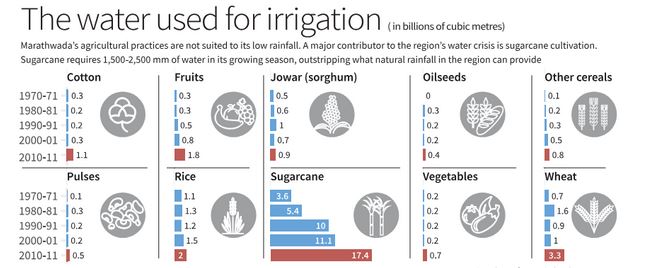
    Why is sugarcane production not suited for regions with less rainfall?

    • High Water Requirement: Sugarcane needs 1,500-2,500 mm of water during its growing season, which is much higher than the annual rainfall in low-rainfall areas like Marathwada.
    • Irrigation Demands: Sugarcane requires almost daily irrigation, consuming 61% of the region’s irrigation water while occupying only 4% of the cropped area. This heavy water usage restricts the irrigation of other crops that are more suitable for the region’s climate, such as pulses and millet.
    • Government Policies: Long-standing government support for sugarcane pricing and sales has encouraged its cultivation in unsuitable regions. The recent promotion of sugarcane-juice-based ethanol production exacerbates the issue, diverting water resources away from more sustainable agricultural practices.

    What is meant by the rain-shadow effect?

    • The rain-shadow effect occurs when moist winds from the Arabian Sea rise over the Western Ghats, causing heavy rainfall on the western side. By the time these winds descend on the eastern side (Western Maharashtra and Marathwada), they lose most of their moisture, resulting in significantly lower rainfall.
    • Impact on Marathwada: Marathwada, located in the rain-shadow region, receives only 600-800 mm of annual rainfall, contributing to its dry climate and water scarcity issues.

    Note: Marathwada and North Karnataka have emerged as the second driest regions in India after Rajasthan.

    How can supply-side solutions help the situation?

    • Watershed Management: Building water-conserving structures such as contour trenches, earthen bunds, and gully plugs to capture and store runoff. Designing silt-trapping mechanisms to prevent soil erosion and maintain water retention structures.
    • Rainwater Harvesting: Implementing measures to capture rainwater runoff from agricultural fields to recharge groundwater and reduce dependency on external water sources.
    • Utilizing Government Programs: Leveraging funds from the Mahatma Gandhi National Rural Employment Guarantee Scheme (MGNREGS) for watershed management projects and training farmers in water conservation techniques.
    • Promoting Water-Efficient Practices: Encouraging the use of water-efficient irrigation methods, such as drip irrigation, to optimize water usage. Shifting to drought-resistant crops and high-value, low-water-using crops to reduce water demand and improve agricultural sustainability.

    Conclusion: The state government has announced a massive Rs 59,000 crore package to transform the Marathwada region, with a focus on tackling the water crisis. This includes reviving stalled irrigation projects worth Rs 13,677 crore to make the region drought-free through water linking and diverting floodwaters to the Godavari basin

    Mains PYQ:

    Q Elaborate the impact of National Watershed Project in increasing agricultural production from waterstressed areas. (UPSC IAS/2019)

  • Internal Security Architecture Shortcomings – Key Forces, NIA, IB, CCTNS, etc.

    India needs the anchor of a National Security Strategy 

    Note4Students

    From UPSC perspective, the following things are important:

    Mains level: Challenges Involved in the Near Future for the Indian Government

    Why in the news? 

    The newly elected National Democratic Alliance government is confronted with several longstanding and complex national security issues.

    Strategic Relations with the US and Competition with China:

    • China’s Multifaceted Challenges: China poses an unprecedented array of interconnected challenges, including a significant naval build-up, geoeconomic clout in South Asia, and leverage in global supply chains.
    • Strategic Relations with the US: India must navigate its strategic partnership with the United States while managing competition with China.
    • Global Conflicts Impact: Distant conflicts, such as those in Ukraine and Gaza, reveal new technologies and tactics of war that could spread to India’s neighbourhood, influencing its strategic relations and defence strategies.

    Challenges Involved in the near future for the Indian Government:

    • Decisions on Military Investments: The government must decide on key defence projects, such as building another aircraft carrier and implementing theaterisation.
    • Holistic National Security: There is a need to step back and consider national security holistically, rather than making piecemeal decisions that could waste resources and undermine national goals.
    • Managing Strategic Risks: Addressing strategic risks like climate change, pandemics, and China’s growing influence requires coordinated, long-term policy efforts.
    • Synchronizing Efforts: Various arms of the government, including the military and national security agencies, need to synchronize their efforts more effectively.

    Blueprint for Expanding Power:

    • Comprehensive Strategic Assessment: A National Security Strategy (NSS) would compel the government to thoroughly review threats, opportunities, and global security trends.
    • Framework for Long-Term Planning: An NSS would provide a coherent framework for long-term strategic planning, helping to allocate resources effectively and develop necessary military capabilities and international partnerships.
    • Signaling Intent to Allies and Adversaries: An NSS would clarify India’s strategic intent, signaling its role as a net security provider in the Indian Ocean and its stance on regional security issues.
    • Coordinated National Security Efforts: An NSS would align the efforts of different national security agencies and military branches, fostering better coordination and integration.

    Issue of Accountability:

    • Transparency and Accountability: An NSS would serve as a tool to ensure that the government’s policies are transparent and accountable to Parliament and the citizens.
    • Adherence to Political Leadership’s Intent: It would help ensure that the bureaucracy adheres to the political leadership’s strategic direction.
    • Public Document: A strong NSS should be a public document, endorsed by the Prime Minister, to synchronize efforts across the government and signal political intent both domestically and internationally.
    • Rational Decision-Making: An NSS would help identify trade-offs and opportunity costs, enabling political leaders to make informed, rational decisions for long-term national growth and security.

    Conclusion: Develop a coherent strategic framework within the NSS that outlines India’s national security objectives, priorities, and methodologies for achieving them. This framework should guide decision-making on defense investments, international partnerships, and response strategies to global challenges like climate change and pandemics.

    Mains PYQ:

    Q What introduces friction into the ties between India and the United States is that Washington is still unable to find for India a position in its global strategy, which would satisfy India’s National self-esteem. (UPSC IAS/2019)

  • Russian Invasion of Ukraine: Global Implications

    ICC issues arrest warrants for Russian defence leaders 

    Note4Students

    From UPSC perspective, the following things are important:

    Prelims level: What is ICC?

    Mains level: Does ICC have the power to prosecute Russia?

    Why in the news?

    On Monday, June 24, the International Criminal Court (ICC) issued arrest warrants for former Russian Defence Minister Sergei Shoigu and current Chief of Staff of the Armed Forces Valery Gerasimov for “alleged international crimes” related to the Ukraine war.

    Who are the Russian leaders and what effect does the move have on them?

    • Sergei Shoigu: Former Russian Defence Minister, key ally of Putin, led the invasion of Ukraine in February 2022, removed from his post in May 2024.
    • Valery Gerasimov: Current Chief of Staff of the Armed Forces, Deputy Defence Minister since November 2012, seen as the most powerful man in the government after Putin and Shoigu.
    • Impact on Shoigu and Gerasimov: Both have suffered reputational damage since the war began, criticized by Russian nationalists for failing to swiftly win the war against Ukraine.

    What do the ICC charges say?

    • Charges Against Shoigu and Gerasimov: Directing attacks at civilian objects, causing excessive incidental harm to civilians or damage to civilian objects.
    • Responsibility: The two officials bear individual criminal responsibility for their actions, ordering the commission of crimes, and failing to exercise proper control over their forces.
    • Specific Acts: Missile strikes against Ukrainian electric infrastructure, constituting multiple acts against a civilian population.

    What is ICC?

    • Establishment: Headquartered in The Hague, Netherlands, established under the 1998 Rome Statute.
    • Purpose: Investigates and tries individuals charged with genocide, war crimes, crimes against humanity, and the crime of aggression.
    • Membership: 123 countries are party to the Rome Statute, including Britain, Japan, Afghanistan, and Germany. The USA, India, and China are not members.
    • Function: Prosecutes heinous offences when a country’s own legal system fails to act, unlike the ICJ which deals with inter-state disputes.
    • Jurisdiction: Limited to offences occurring after July 1, 2002, committed in a country that ratified the agreement or by a national of a ratifying country, or cases referred by the UN Security Council.

    Does ICC have the power to prosecute Russia?

    • Russia’s Stance: Kremlin spokesman Dmitry Peskov stated that any decision of the ICC was “null and void” due to Russia not being an ICC member.
    • Effect on Leaders: Putin and other leaders risk arrest if they travel to a state party to the ICC, which is obliged to arrest them under international law. This deepens Russia’s isolation from the West.
    • Ukraine’s Position: Ukraine is not a State Party to the Rome Statute but has accepted ICC’s jurisdiction over alleged crimes occurring on its territory under Article 12(3) of the Statute. This requires Ukraine to cooperate with the ICC without delay or exception.

    Conclusion: The ICC’s charges against Russian leaders highlight significant legal and geopolitical challenges, deepening Russia’s isolation and emphasizing the need for global accountability in addressing war crimes and international conflicts.

    Mains question for practice: 

    Q In light of the recent arrest warrants issued against Russian leaders, discuss the effectiveness and limitations of the ICC in prosecuting individuals from non-member states.15M

  • Surrogacy in India

    Centre amends Maternity Leave Rules for Surrogacy

    Note4Students

    From UPSC perspective, the following things are important:

    Prelims level: Surrogacy (Regulation) Act, 2021

    Why in the News?

    • The Centre has notified amended rules allowing women government employees to take 180 days of maternity leave for children born through surrogacy.
      • Changes are introduced in the Central Civil Services (Leave) Rules, 1972.
      • There were previously no rules granting maternity leave to women government employees for children born through surrogacy.

    Back2Basics: Surrogacy (Regulation) Act, 2021 

    • Purpose: The Act aims to regulate surrogacy in India by prohibiting commercial surrogacy and allowing only altruistic surrogacy.
    • Eligibility Criteria:
      • Only Indian couples who have been legally married for at least five years can opt for surrogacy.
      • The woman must be between 25 to 50 years old, and the man must be between 26 to 55 years old.
      • Both partners must not have any living biological, adopted, or surrogate children.
    • Surrogate Mother Criteria:
      • The surrogate mother must be a close relative of the intending couple.
      • She should be a married woman having her own child and must be 25 to 35 years old.
    • Prohibitions:
      • Commercial surrogacy is banned under this Act.
      • Any form of payment to the surrogate mother beyond medical expenses and insurance coverage is prohibited.
    • Penalties:
      • Engaging in commercial surrogacy can lead to imprisonment up to 10 years and a fine up to Rs 10 lakhs.
    • Regulatory Bodies:
      • The Act establishes a National Surrogacy Board at the national level and State Surrogacy Boards at the state level to oversee the implementation of the law.

    About the Central Civil Services (Leave) (Amendment) Rules, 2024

    • The amendment is issued under this notification, exercising the powers conferred by the proviso to Article 309 of the Constitution.
      • Article 309 provides that acts of the appropriate Legislature may regulate the recruitment and conditions of service of persons appointed to public services and posts in connection with the affairs of the Union or any State.
    • Authority: The President of India has made these amendments to the Central Civil Services (Leave) Rules, 1972.

    Features and Benefits:

    • Surrogacy Inclusion: These amendments specifically address the needs of surrogacy, providing equitable maternity, paternity, and childcare leave benefits to government employees involved in surrogacy.
    • Enhanced Leave Entitlements:
      • Maternity Leave: 180 days for both the surrogate and the commissioning mother.
      • Paternity Leave: 15 days for the commissioning father within six months of the child’s birth.
      • Child Care Leave: Available to the commissioning mother. Female government servants and single male government servants are already allowed childcare leave for a maximum of 730 days (2 years!) during their entire service for the care of their two eldest surviving children.
    • Flexibility and Inclusivity:
      • The amendments aim to provide more flexible and inclusive leave options for government employees, recognizing diverse family structures and reproductive choices.
    • Support for Families:
      • These changes enhance support for government employees, ensuring they can adequately care for their children and family needs, especially in cases of surrogacy.
    • Administrative Implementation:
      • The rules simplify the process for applying for and approving leave, ensuring that employees can easily access their entitlements.

    Impact:

    • Employee Well-being: Improved leave policies contribute to better work-life balance and overall well-being for government employees.
    • Gender Equality: By providing paternity leave and child care leave in surrogacy cases, the rules promote gender equality and shared parenting responsibilities.
    • Organizational Efficiency: Streamlined leave procedures and clear guidelines help maintain productivity and efficiency within government departments.

    PYQ:

    [2020] In the context of recent advances in human reproductive technology, “Pronuclear Transfer” is used for:

    (a) fertilization of egg in vitro by the donor sperm

    (b) genetic modification of sperm-producing cells

    (c) development of stem cells into functional embryos

    (d) prevention of mitochondrial diseases in offspring

  • Foreign Policy Watch: India-Maldives

    From China tilt to a balancing with Beijing and Delhi  

    Note4Students

    From UPSC perspective, the following things are important:

    Mains level: Economic difficulties in Male

    Why in the news?

    Amid mounting domestic and foreign policy challenges in Male, Mohamed Muizzu appears to be seeking reconciliation with India.

    Economic Difficulties in Maldives

    • Debt Burden: Maldives faces severe economic strain with a debt-to-GDP ratio of 110% and significant debt servicing obligations, including around $512 million annually in 2024 and 2025.
    • Foreign Reserves: Foreign reserves are critically low at $622 million, insufficient to cover debt maturities and sustain imports amid rising inflation.
    • Dependence on Imports: Heavy reliance on imports for essential goods exacerbates economic vulnerabilities, particularly amidst food and fuel inflation.
    • Revenue Generation: The government struggles with low domestic revenue generation capacity, further complicating fiscal management and debt sustainability.
    • Diversification Efforts: Efforts to diversify economic partnerships beyond traditional allies like India and China reflect a strategy to mitigate economic dependencies and attract diverse investments.

    What do the ties between India and China imply?

    • Geopolitical Competition: India and China’s engagements in countries like the Maldives reflect a broader competition for influence in the Indian Ocean region. Both countries strategically invest in infrastructure and security partnerships to enhance their regional foothold.
    • Economic Leverage: China’s substantial investments in the Maldives, including infrastructure projects under the Belt and Road Initiative (BRI), provide economic leverage but also raise concerns about debt sustainability and strategic dependencies.
    • Strategic Alignment: While India emphasizes developmental assistance and strategic partnerships focused on security and governance, China’s engagements often prioritize infrastructure development and economic cooperation, reflecting different strategic priorities.
    • Regional Stability: Both India and China play pivotal roles in ensuring stability and security in the Indian Ocean region. Their respective approaches influence regional dynamics and perceptions among neighbouring countries regarding economic partnerships and security alignments.

    India’s stand

    • Balanced Approach: India continues to engage with the Maldives despite geopolitical shifts and maintains a stance of constructive diplomacy, offering economic support and emphasizing mutual respect.
    • Long-term Engagement: Inviting President Muizzu to Prime Minister Modi’s swearing-in signals India’s commitment to long-term bilateral relations and stability in the Indian Ocean region.
    • Strategic Importance: India views the Maldives as crucial for maritime security and regional stability, underpinning its continued diplomatic efforts and economic assistance.

    Conclusion: India can increase its economic assistance to the Maldives through grants, concessional loans, and capacity-building initiatives aimed at improving fiscal management and revenue generation capabilities. And focus on projects that enhance infrastructure resilience, promote sustainable development, and support economic diversification efforts beyond traditional sectors.

    Mains PYQ:

    Q Discuss the political developments in Maldives in the last two years. Should they be of any cause of concern to India? (UPSC IAS/2013) 

  • Finance Commission – Issues related to devolution of resources

    Finance Commission and Indian Cities

    Note4Students

    From UPSC perspective, the following things are important:

    Prelims level: Finance commission

    Mains level: 16th Finance Commission can catalyse municipal-level financial reforms

    Why in the news? 

    With the new Lok Sabha and Union government in place, this final piece focuses on how the 16th Finance Commission can drive substantive public finance reforms for India’s cities.

    Note: The Sixteenth Finance Commission has been requested to make its recommendations available by October 31, 2025, covering an award period of 5 years commencing 1st April, 2026.

    16th Finance Commission can catalyse municipal-level financial reforms     

    • Strengthening State Finance Commissions: The Commission should emphasize the need for state governments to constitute state finance commissions on time, provide them with adequate resources, and ensure their recommendations are taken seriously.
    • Fiscal Decentralization: The 16th FC should recommend a formula-based approach for predictable fiscal transfers from state governments to municipalities, moving away from the current practice of ad hoc, discretionary grants. This will enhance the financial autonomy of urban local bodies.
    • Revenue Optimization: The Commission should incentivize municipalities to enhance their own revenues through measures like property tax reforms, user charges, and leveraging land assets. This will reduce their dependence on state grants and promote fiscal responsibility.
    • Fiscal Responsibility and Budget Management: The 16th FC can provide incentives for municipalities to adopt fiscal responsibility and budget management frameworks to accelerate municipal borrowings for infrastructure development. This will enable cities to access capital markets for financing their growth.
    • Transparency and Citizen Participation: The 16th FC can encourage municipalities to enhance transparency and citizen participation in urban governance for improved accountability at the neighbourhood level. This will make urban local bodies more responsive to the needs of citizens.

    Need for the Reforms

    • Inadequate Funding and Resource Utilization: Indian cities face significant financial shortfalls and struggle to effectively utilize the funds they have, leading to underdeveloped infrastructure and services.
    • Lack of Accountability: There is minimal accountability regarding how municipal spending improves citizens’ lives, resulting in inefficient use of resources and unmet public needs.
    • Fiscal Decentralization: Cities need predictable fiscal transfers for effective planning, but state governments often delay constituting State Finance Commissions (SFCs) and implementing their recommendations.
    • Revenue Optimization: Cities underutilize their revenue-generating powers due to outdated valuation processes controlled by state governments. Comprehensive reforms are needed at all stages of revenue collection.
    • Transparency and Fiscal Responsibility: The legal framework for financial accounting, reporting, and budgeting is inconsistent across states. Standardized formats, mandatory accounting standards, and management accounting systems are necessary to improve transparency and fiscal responsibility.

    Activities by State Governments

    • Timely Constitution and Implementation of State Finance Commissions: State governments must ensure the timely establishment and effective implementation of SFC recommendations to support fiscal decentralization and provide predictable funding to cities.
    • Updating Valuation Processes: States should regularly update guidance values or circle rates to reflect current market values, enabling cities to optimize revenue collection and ensure financial sustainability.
    • Enhancing Legal and Institutional Frameworks: States should establish and enforce standardized formats for financial accounting, reporting, and budgeting to ensure consistency, transparency, and comparability across municipalities.
    • Empowering Local Governments: States should delegate reasonable expenditure authority to city councils, reducing dependency on state-level approvals and enabling more efficient and responsive local governance.
    • Mandating Transparency and Citizen Participation: States should mandate public disclosure of municipal financial data and project details in machine-readable formats and support the implementation of participatory budgeting to enhance transparency and citizen involvement in governance.

    Conclusion: The 16th Finance Commission can drive critical municipal-level financial reforms by strengthening state finance commissions, promoting fiscal decentralization, optimizing revenues, enhancing fiscal responsibility, and encouraging transparency and citizen participation in governance.

    Mains PYQ:

    Q How is the Finance Commission of India constituted? What do you know about the terms of reference of the recently constituted Finance Commission? Discuss. (15) (UPSC IAS/2018)

  • Panchayati Raj Institutions: Issues and Challenges

    How the PESA has boosted Forest Conservation in India?

    Note4Students

    From UPSC perspective, the following things are important:

    Prelims level: PESA Act

    Mains level: How PESA ensures Equitable Representation

    Why in the News?

    Conservation policies in India have long wrestled with dual conflicts: balancing conservation goals against local communities’ resource extraction needs, and reconciling conservation with the imperative of economic development.

    Structural Mandate of Panchayat (Extension to Scheduled Areas) Act (PESA):

    • PESA was passed in 1996 and it mandates local government councils in Scheduled Areas to reserve all chairperson positions and at least half of the seats for Scheduled Tribes (ST).
    • This legislative framework is designed to empower marginalized communities by giving them a direct say in local governance and resource management.

    Implementation in India:

    • Unlike the 73rd Amendment (which applies to non-Scheduled Areas), PESA ensures mandated representation for STs in decision-making bodies.
    • Variations in PESA implementation across states highlight challenges and successes in translating legislative intent into effective governance structures.

    How it Ensures Equitable Representation:

    • Impact on Forest Conservation: The study employs a “difference-in-differences” methodology to analyze the effect of PESA on forest cover. Findings indicate that areas with mandated ST representation under PESA experience lower rates of deforestation and higher afforestation rates compared to areas without such representation.
    • Economic Incentives for Conservation: ST communities, dependent on forest resources for livelihoods, are incentivized to protect forest cover under PESA. This “forest stewardship” mechanism emerges as STs engage in sustainable practices and resist deforestation pressures driven by mining and commercial interests.

    On Democratic Decentralization:

    • Comparison with Administrative Decentralization: The paper distinguishes between administrative decentralization (focused on efficiency) and democratic decentralization. Democratic decentralization, as exemplified by PESA, emphasizes representative and accountable local governance structures with decision-making autonomy over resource management.
    • Single Umbrella Institution: Advocates for consolidating power into a single, empowered institution that integrates both conservation and development objectives. Such an institution would better navigate the complexities of balancing local economic interests with sustainable conservation practices.

    Conclusion: PESA serves as a critical example of how legislative mandates for political representation can drive positive environmental outcomes while addressing socio-economic disparities among forest-dwelling communities in India.

    Mains PYQ:

    Q What are the two major legal initiatives by the state since Independence, addressing discrimination against Scheduled Tribes (ST)? (UPSC IAS/2017)
