💥UPSC 2026, 2027, 2028 UAP Mentorship (March Batch) + Access XFactor Notes & Microthemes PDF

Type: India Mapping

  • Climate Change Impact on India and World – International Reports, Key Observations, etc.

    Places in news: Qeqertaq Avannarleq Island

    Note4Students

    From UPSC perspective, the following things are important:

    Prelims level: Qeqertaq Avannarleq

    Mains level: Impact of climate change

    A group of researchers who went out to collect samples off the coast of Greenland in July found themselves on a tiny, uninhabited and previously unknown island.

    Qeqertaq Avannarleq

    • Measuring 60×30 metres and with a peak of three metres above sea level, it has now become the new northernmost piece of land on Earth.
    • Before this, Oodaaq was marked as the Earth’s northernmost terrain.
    • The new island is made up of seabed mud and moraine, i.e. soil, rock and other material left behind by moving glaciers, and has no vegetation.
    • The group has suggested the discovery be named ‘Qeqertaq Avannarleq’, which is Greenlandic for “the northernmost island”.

    How this island came to existence?

    Ans. Undoubtedly, climate change in Greenland

    • Global warming has had a severe effect on the ice sheet of Greenland.
    • The new island, which was exposed by shifting pack ice, is, however, not a direct consequence of climate change.

    UPSC 2022 countdown has begun! Get your personal guidance plan now! (Click here)

  • Wetland Conservation

    Places in news: Pantanal Wetlands

    Note4Students

    From UPSC perspective, the following things are important:

    Prelims level: Pantanal Wetlands

    Mains level: Not Much

    Pantanal, the world’s largest tropical wetlands is facing a severe crisis due to wildfires and climate change.

    Pantanal Wetlands

    • The Pantanal is a natural region encompassing the world’s largest tropical wetland area, and the world’s largest flooded grasslands.
    • It is located mostly within the Brazilian and extends to some portions of Bolivia and Paraguay.
    • It sprawls over an area estimated at between 140,000 and 195,000 square kilometer.
    • Roughly 80% of the Pantanal floodplains are submerged during the rainy seasons, nurturing a biologically diverse collection of aquatic plants and helping to support a dense array of animal species.

    Risks faced

    • Unlike the Amazon rainforest, vegetation in the Pantanal has evolved to coexist with fire — many plant species there require the heat from fires to germinate.
    • Often caused by lightning strikes, those natural fires spring up at the end of the dry season, but the surrounding floodplains prevent them from spreading.
    • What’s different now is the drought, contributing further to the unusually dry conditions and exacerbating the fire risk.

    UPSC 2022 countdown has begun! Get your personal guidance plan now! (Click here)

  • Wetland Conservation

    Places in news: Deepar Beel Wildlife Sanctuary

    Note4Students

    From UPSC perspective, the following things are important:

    Prelims level: Deeper Beel

    Mains level: Wetland conservation

    The Ministry of Environment, Forest and Climate Change has notified the eco-sensitive zone of the Deepar Beel Wildlife Sanctuary on the south-western edge of Guwahati.

    Deepar Beel

    • Deepar Beel is one of the largest freshwater lakes in Assam and the State’s only Ramsar site besides being an Important Bird Area.
    • It is located to the south-west of Guwahati city, in Kamrup Metropolitan district.
    • It is a permanent freshwater lake, in a former channel of the Brahmaputra River, to the south of the main river.
    • It is also called a wetland under the Ramsar Convention which has listed the lake in November 2002, as a Ramsar Site for undertaking conservation measures on the basis of its biological and environmental importance.

    Major threats

    • Deepar Beel has long been used as a sponge for Guwahati’s sewage via a couple of streams.
    • The wetland has also suffered from seepage of toxins from a garbage dump at Boragaon adjoining it.
    • It has for decades been threatened by a railway track — set to be doubled and electrified — on its southern rim, a garbage dump, and encroachment from human habitation and commercial units.
    • The water has become toxic and it has lost many of its aquatic plants that elephants would feed on.

    UPSC 2022 countdown has begun! Get your personal guidance plan now! (Click here)

  • Wetland Conservation

    Places in news: Sambhar Lake

    Note4Students

    From UPSC perspective, the following things are important:

    Prelims level: Sambhar Lake

    Mains level: Not Much

    The world-famous Sambhar Salt Lake in Rajasthan is constantly shrinking with the degradation of soil and water quality and a decline in the population of migratory birds.

    Sambhar Lake

    • The lake, situated 80 km south-west of Jaipur, is the country’s largest inland saline water body which attracts thousands of migratory birds every year.
    • The death of more than 20,000 birds belonging to about 10 species which migrate annually to the lake had made international headlines in 2019.
    • The lake receives water from six rivers: Mantha, Rupangarh, Khari, Khandela, Medtha and Samod.
    • Sambhar has been designated as a Ramsar site because the wetland is a key wintering area for tens of thousands of pink flamingos and other birds that migrate from northern Asia and Siberia.

    Threats: Illegal mining

    • 30% of the Sambhar Lake’s area had been lost to mining and other activities, including the illegal salt pan encroachments.
    • It has also threatened the livelihoods of local people who have always lived in harmony with the lake and its ecology.

    Try answering this:

    Which one of the following is an artificial lake? (CSP 2014)

    (a) Kodaikanal (Tamil Nadu)

    (b) Kolleru (Andhra Pradesh)

    (c) Nainital (Uttarakhand)

    (d) Renuka (Himachal Pradesh)

    Post your answers here.

    UPSC 2022 countdown has begun! Get your personal guidance plan now! (Click here)

  • Global Geological And Climatic Events

    Hawaii’s Kilauea Volcano

    Note4Students

    From UPSC perspective, the following things are important:

    Prelims level: Volanic eruptions in news

    Mains level: Volcanic landforms

    Geologists have detected a swarm of earthquakes at Hawaii’s Kilauea volcano, though it was not erupting.

    Kilauea Volcano

    • Kilauea is about 200 miles south of Honolulu, on the Big Island of Hawaii.
    • It is one of the world’s most active volcanoes, having erupted 34 times since 1952. In Hawaiian tradition, Kilauea is home to the volcano goddess Pele.
    • From 1983 to 2018, it erupted almost continuously, in some cases sending streams of lava that covered farms and homes.
    • At the end of this decades-long eruption, Kilauea spewed lava from vents in a residential neighborhood on its eastern flank and destroyed more than 700 homes.
    • In December, Kilauea erupted at the crater, creating a lake with enough lava to fill 10 Hoover dams. That eruption ended in May.

    Do not skip answering this PYQ:

    Consider the following statements:

    1. The Barren Island volcano is an active volcano located in the Indian Territory.
    2. Barren Island lies about 140 km east of Great Nicobar.
    3. The last time the Barren Island volcano erupted was in 1991 and it has remained inactive since then.

    Which of the statements given above is/are correct? (CSP 2014)

    (a) 1 only

    (b) 2 and 3 only

    (c) 3 only

    (d) 1 and 3 only

    UPSC 2022 countdown has begun! Get your personal guidance plan now! (Click here)


    Back2Basics: Volcanic Landforms

    • Note the intrinsic and extrinsic types of volcanic landforms

    • A volcano has 3 main characteristics
    1. Cone shaped mountain
    2. Formed by rock or ash thrown from the inside of the earth
    3. At times, opening or depression at top
    • The three main types of volcanos are:

    1. Cinder cone Volcano: The cinder cones are small volcanoes with steep sides. Even though they are small, these are the ones you probably hear about.  They are very explosive and made of ash and rock.  Most of the cinder cones are small and less than 500 meters high.  A famous cinder cone is Sunset Crater Volcano in Arizona.
    2. Shield Volcanoes: A shield is a low and broad volcano that usually has a very wide crater (a dent in the Earth’s surface). It is formed from thin layers of lava after consistent low-grade eruptions.  The largest volcano in the world is a shield volcano.  It is located in Hawaii.
    3. Composite volcanoes: They are the tallest type of volcano. They look very impressive but do usually have quiet and slow lava flows.  They sometimes have small eruptions that cause ash and rock to go flying.  One of the most famous volcanoes in the world is a composite volcano.  It is Mount Fuji in Japan.
  • Modern Indian History-Events and Personalities

    Places in news: Indira Point

    Note4Students

    From UPSC perspective, the following things are important:

    Prelims level: Indira Point

    Mains level: NA

    The Swarnim Vijay Varsh Victory Flame was taken to Indira Point, the southernmost tip of the country on August 22, 2021, as part of its voyage to the Nicobar Group of Islands.

    Indira Point

    • Indira Point is the southernmost point of Indian Territory.
    • It is a village in the Nicobar district at Great Nicobar Island of Andaman and Nicobar Islands in India.
    • Rondo Island, Indonesia’s northernmost island in Sabang district of Aceh province of Sumatra, lies 163 km south of Little Andaman Island and 145 km or 80 nautical miles from Indira point.
    • The point was formerly known as Pygmalion Point and Parsons Point. It was renamed in honour of Indira Gandhi during mid-1980s.
    • Galathea National Park and Lighthouse are the major attractions here.

    India and Indonesia are upgrading the deep sea port Sabang under the strategic military and economic collaboration to protect the channel between Great Nicobar Island and Rondo Island which is 612 km or 330 nautical miles from Indira Point.

    What is Swarnim Vijay Varsh?

    • It marks the 50th anniversary of the 1971 India-Pakistan war.
    • Vijay Diwas is celebrated every year on December 16 to mark India`s triumph in liberating Bangladesh.
    • The journey of the Victory Flame is taken from north to south corners of India.
  • Tourism Sector

    Places in news: Cattle Island on Hirakud Reservoir

    Note4Students

    From UPSC perspective, the following things are important:

    Prelims level: Cattle Island

    Mains level: Not Much

    The Odisha Forest and Environment Department is all set to begin ‘Island Odyssey’ and ‘Hirakud Cruise’ ecotourism packages for tourists to islands inside the reservoir.

    Cattle Island

    • ‘Cattle island’, one of three islands in the Hirakud reservoir, has been selected as a sight-seeing destination.
    • When large numbers of people were displaced from their villages when the Hirakud dam was constructed on the Mahanadi river in 1950s, villagers could not take their cattle with them.
    • They left their cattle behind in deserted villages.
    • As the area started to submerge following the dam’s construction, the cattle moved up to Bhujapahad, an elevated place in the Telia Panchayat under Lakhanpur block of Jharsuguda district.
    • Subsequently named ‘Cattle island’, it’s surrounded by a vast sheet of water.

    Other islands

    • Then there is an “island of bats”, also within the reservoir, just 1 km away from the Debrigarh ecotourism project.
    • It is the habitat of hundreds of bats.
    • Tourists also get a magnificent view of the sunset from the reservoir. ‘Sunset island’ is one of the three stops on the unique boat ride.

    UPSC 2022 countdown has begun! Get your personal guidance plan now! (Click here)

  • Water Management – Institutional Reforms, Conservation Efforts, etc.

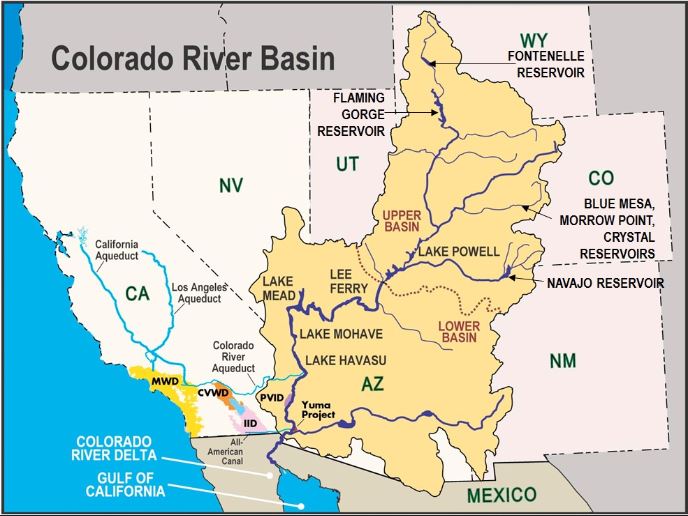
    Water shortage in Colorado River Basin

    Note4Students

    From UPSC perspective, the following things are important:

    Prelims level: Major rivers of the world

    Mains level: NA

    The federal government in the US has declared a water shortage for the Colorado river basin due to a historic drought.

    Try this PYQ

    Q. Consider the following pairs

    River – Flows into

    1. Mekong — Andaman Sea
    2. Thames — Irish Sea
    3. Volga — Caspian Sea
    4. Zambezi — Indian Ocean

    Which of the pairs given above is/are correctly matched?(CSP 2020)

    (a) 1 and 2 only

    (b) 3 only

    (c) 3 and 4 only

    (d) 1, 2 and 4 only


    Post your answers here (you need to sign-in for that).

    Colorado River

    • The Colorado River flows from the Rocky Mountains into the southwestern US and into Mexico.
    • The river is fed by snowmelt from the Rocky and Wasatch mountains and flows a distance of over 2,250 km (river Ganga flows through a distance of roughly 2,500 km) across seven states and into Mexico.
    • The Colorado River Basin is divided into the Upper (Wyoming, Colorado, New Mexico, Utah and northern Arizona) and Lower Basins (parts of Nevada, Arizona, California, southwestern Utah and western New Mexico).
    • In the Lower Basin, the Hoover Dam controls floods and regulates water delivery and storage.
    • Apart from the Hoover dam, there is the Davis Dam, Parker Dam and the Imperial Dam that regulate the release of water from the Hoover Dam.

    Major lakes in its basin

    • Lake Mead is the largest reservoir in the US in terms of volume and was formed in the 1930s by the Hoover Dam in Southern Nevada.
    • Its main source of water is obtained from the Rocky Mountain snowmelt and runoff.
    • The other is Lake Powell, the reservoir created by the Glen Canyon Dam in Arizona.

    Reasons for shortage

    • Since the year 2000, this river basin has been experiencing a prolonged drought.
    • This persistent drought has led to a lowering down of the water levels in the basin’s reservoirs to meet the demand over the years.
    • But even with great water storing capacity, over the years the demand for water from the basin has increased whereas supply is restricted.

    UPSC 2022 countdown has begun! Get your personal guidance plan now! (Click here)

  • Wetland Conservation

    Four new Wetlands added to Ramsar list

    Note4Students

    From UPSC perspective, the following things are important:

    Prelims level: Ramsar wetlands in India

    Mains level: Wetlanc conservation

    Four more wetlands from India get recognition from the Ramsar Secretariat as Ramsar sites.

    What are Wetlands?

    • A wetland is a distinct ecosystem that is flooded by water, either permanently or seasonally, where oxygen-free processes prevail.
    • The primary factor that distinguishes wetlands from other landforms or water bodies is the characteristic vegetation of aquatic plants, adapted to the unique hydric soil.

    Significance of Wetlands

    • Wetlands provide a wide range of important resources and ecosystem services such as food, water, fibre, groundwater recharge, water purification, flood moderation, erosion control, and climate regulation.
    • They are, in fact, are a major source of water and our main supply of freshwater comes from an array of wetlands that help soak rainfall and recharge groundwater.
    • They provide many societal benefits: food and habitat for fish and wildlife, including threatened and endangered species; water quality improvement; flood storage; shoreline erosion control; economically beneficial natural products for human use; and opportunities for recreation, education, and research, etc.

    Which are the new sites added to the Ramsar List?

    • Thol and Wadhwana from Gujarat and
    • Sultanpur and Bhindawas from Haryana

    With this, the number of Ramsar sites in India are 46 and the surface area covered by these sites is now 1,083,322 hectares.

    (1) Bhindawas Wildlife Sanctuary

    • Bhindawas WLS, the largest wetland in Haryana is a human-made freshwater wetland.
    • Over 250 bird species use the sanctuary throughout the year as a resting and roosting site.
    • The site supports more than ten globally threatened species including the endangered Egyptian Vulture, Steppe Eagle, Pallas’s Fish Eagle, and Black-bellied Tern.

    (2) Sultanpur National Park

    • Sultanpur NP from Haryana supports more than 220 species of resident, winter migratory and local migratory waterbirds at critical stages of their life cycles.
    • More than ten of these are globally threatened, including the critically endangered sociable lapwing, and the endangered Egyptian Vulture, Saker Falcon, Pallas’s Fish Eagle and Black-bellied Tern.

    (3) Thol Lake Wildlife Sanctuary

    • Thol Lake WLS from Gujarat lies on the Central Asian Flyway and more than 320 bird species can be found here.
    • The wetland supports more than 30 threatened waterbird species, such as the critically endangered White-rumped Vulture and Sociable Lapwing, and the vulnerable Sarus Crane, Common Pochard, and Lesser White-fronted Goose.

    (4) Wadhvana Wetland

    • Wadhvana Wetland from Gujarat is internationally important for its birdlife as it provides wintering ground to migratory waterbirds, including over 80 species that migrate on the Central Asian Flyway.
    • They include some threatened or near-threatened species such as the endangered Pallas’s fish-Eagle, the vulnerable Common Pochard, and the near-threatened Dalmatian Pelican, Grey-headed Fish-eagle and Ferruginous Duck.

    Back2Basics: Ramsar Convention

    • The Convention on Wetlands of International Importance (better known as the Ramsar Convention) is an international agreement promoting the conservation and wise use of wetlands.
    • It is the only global treaty to focus on a single ecosystem.
    • The convention was adopted in the Iranian city of Ramsar in 1971 and came into force in 1975.
    • Traditionally viewed as a wasteland or breeding ground of disease, wetlands actually provide fresh water and food and serve as nature’s shock absorber.
    • Wetlands, critical for biodiversity, are disappearing rapidly, with recent estimates showing that 64% or more of the world’s wetlands have vanished since 1900.
    • Major changes in land use for agriculture and grazing, water diversion for dams and canals, and infrastructure development are considered to be some of the main causes of loss and degradation of wetlands.
  • Port Infrastructure and Shipping Industry – Sagarmala Project, SDC, CEZ, etc.

    Places in news: Ningbo Port

    Note4Students

    From UPSC perspective, the following things are important:

    Prelims level: Port of Ningbo-Zhoushan

    Mains level: Not Much

    China has partially shut down the world’s third-busiest container port, the Ningbo Port, after a worker there tested positive for Covid-19.

    Port of Ningbo-Zhoushan

    • This port is the busiest in the world in terms of cargo tonnage.
    • It handled 888.96 million tons of cargo in 2015.
    • The port is located in Ningbo and Zhoushan, on the coast of the East China Sea, in Zhejiang province on the southeast end of Hangzhou Bay, across which it faces the municipality of Shanghai.
    • The port is at the crossroads of the north-south inland and coastal shipping route, including canals to the important inland waterway to interior China, the Yangtze River, to the north.
    • The port consists of several ports which are Beilun (seaport), Zhenhai (estuary port), and old Ningbo harbour (inland river port).

    What is the potential impact of the closure?

    • Despite the diversion of shipments to other terminals, experts are anticipating a backlog of consignments with average wait times being expected to rise.

    How is it likely to affect global trade?

    • In the aftermath of Covid-19, global supply chains have remained fragile mainly on account of closures and lockdowns that affected both the manufacturing and the logistical segments of the chain.
    • This has not only resulted in a growing backlog of shipments but has also caused freight charges to go up as demand outgrew the supply.
    • Extended closure of one of the biggest terminals at the third-busiest port in the world could further exacerbate the stress in global trade.