💥UPSC 2026, 2027, 2028 UAP Mentorship (March Batch) + Access XFactor Notes & Microthemes PDF

Type: IOCR

  • Democracy Index 2019

    Note4Students

    From UPSC perspective, the following things are important:

    Prelims level: Democracy Index 2019

    Mains level: Fallouts on democracy in India


    The latest edition of the Democracy Index spells gloom for India. The world’s biggest democracy slipped 10 places in the 2019 global ranking to 51st place.

    Democracy Index

    • The report is published by The Economist Intelligence Unit — the research and analysis division of The Economist Group, which is the sister company to The Economist newspaper.
    • It records how global democracy fared, analysing 165 independent states and two territories.
    • The 2019 survey attributes the primary cause of “the democratic regression” to “an erosion of civil liberties in the country”.

    India’s performance

    • India’s overall score fell from 7.23 to 6.9, on a scale of 0-10, within a year (2018-2019) — the country’s lowest since 2006.
    • India was graded in electoral process and pluralism (8.67), government functioning (6.79), political participation (6.67), political culture (5.63) and civil liberties (6.76).
    • In the Asia and Australasia region, India ranks eighth, behind Taiwan and Timor-Leste.
    • The report talks about the repeal of both Article 370 and Article 35A and various restrictions such as house arrests, internet shutdowns and excessive use of forces.

    India: A flawed democracy?

    The Index also categorizes India under “flawed democracies”, i.e. countries that hold free and fair elections and where basic civil liberties are respected, but have significant weaknesses in aspects of democracy, such as problems in governance, an underdeveloped political culture and low levels of political participation.

  • Labour, Jobs and Employment – Harmonization of labour laws, gender gap, unemployment, etc.

    World Employment and Social Outlook: Trends 2020

    Note4Students

    From UPSC perspective, the following things are important:

    Prelims level: World Employment and Social Outlook: Trends 2020

    Mains level: Unemployment in India

    The report World Employment and Social Outlook: Trends 2020 (WESO) was recently released.

    About the Report

    • The WESO report is an initiative of the International Labour Organization (ILO).
    • ILO forecasts that unemployment will rise by about 2.5 million this year.
    • The ILO is a UN agency whose mandate is to advance social justice and promote decent work by setting international labour standards.
    • The report analyses key labour market issues, including unemployment, labour underutilization, working poverty, income inequality, labour income share and factors that exclude people from decent work.

    Highlights of the report

    • Global unemployment is projected to increase by around 2.5 million in 2020.
    • The number of people unemployed around the world stands at some 188 million.
    • In addition, 165 million people do not have enough paid work, and 120 million have either given up actively searching for work or otherwise lack access to the labour market.
    • In total, more than 470 million people worldwide are affected, the report said.
    • Almost half a billion people are working fewer paid hours than they would like or lack adequate access to paid work.
    • Not enough new jobs are being generated to absorb new entrants to the labour market.

    Data on working poverty

    • Currently working poverty (defined as earning less than USD 3.20 per day in purchasing power parity terms) affects more than 630 million workers, or one in five of the global working population.
    • Inequalities related to gender, age and geographical location continue to plague the job market, with the report showing that these factors limit both individual opportunity and economic growth.
    • Some 267 million young people aged 15-24 are not in employment, education or training, and many more endure substandard working condition.
  • Climate Change Impact on India and World – International Reports, Key Observations, etc.

    Global Risks Report 2020

    Note4Students

    From UPSC perspective, the following things are important:

    Prelims level: Global Risks Report 2020

    Mains level: Read the attached story

    The top five risks to humanity are recently published in the Global Risks Report of the World Economic Forum (WEF).

    Top five risks

    • An important finding of the report is that today’s younger generation, consisting of “Millenials” born after 1980 have ranked environmental risks higher than other older respondents in the short- and long-terms.
    • According to the report, the top five risks by likelihood over the next decade are:
    1. Extreme weather events like floods and storms
    2. Failure of climate change mitigation and adaptation
    3. Major natural disasters like earthquakes, tsunamis, volcanic eruptions and geomagnetic storms
    4. Major biodiversity losses and ecosystem collapse
    5. Human-made environmental damage and disasters

    Top 5 risks by severity of impact over the next 10 years

    • Failure of climate change mitigation and adaptation
    • Weapons of mass destruction
    • Major biodiversity loss and ecosystem collapse
    • Extreme weather events (e.g. floods, storms, etc.)
    • Water crises

    Top most strongly connected global risks

    • Extreme weather events + failure of climate change mitigation and adaptation
    • Large-scale cyber-attacks + breakdown of critical information infrastructure and networks
    • High structural unemployment or underemployment + adverse consequences of technological advances
    • Major biodiversity loss and ecosystem collapse + failure of climate change mitigation and adaptation
    • Food crises + extreme weather events

    Other risks

    • The report also warned about the increasing economic and societal costs due to non-communicable diseases and the lack of research on vaccines and drug resistance to address the threat of pandemics in the recent future.
    • Economic confrontations” and “domestic political polarization” are significant short-term risks in 2020, the report said.
    • This is a warning for the global South including India and Africa where social unrest has seen a rise. For example, unrest has grown among India’s youth.
  • Poverty Eradication – Definition, Debates, etc.

    ‘Time to Care’ Report

    Note4Students

    From UPSC perspective, the following things are important:

    Prelims level: 'Time to Care' Report

    Mains level: Income inequality in India


    The report ‘Time to Care’  was recently released ahead of the 50th Annual Meeting of the World Economic Forum (WEF).

    ‘Time to Care’ Report

    • It is published by Oxfam International.
    • Its calculations are based on the latest data sources available, including from the Credit Suisse Research Institute’s Global Wealth Databook 2019 and Forbes’ 2019 Billionaires List.

    Findings of the report

    • Although global inequality has declined over the past three decades, domestic income inequality has risen in many countries, particularly in advanced economies and reached historic highs.
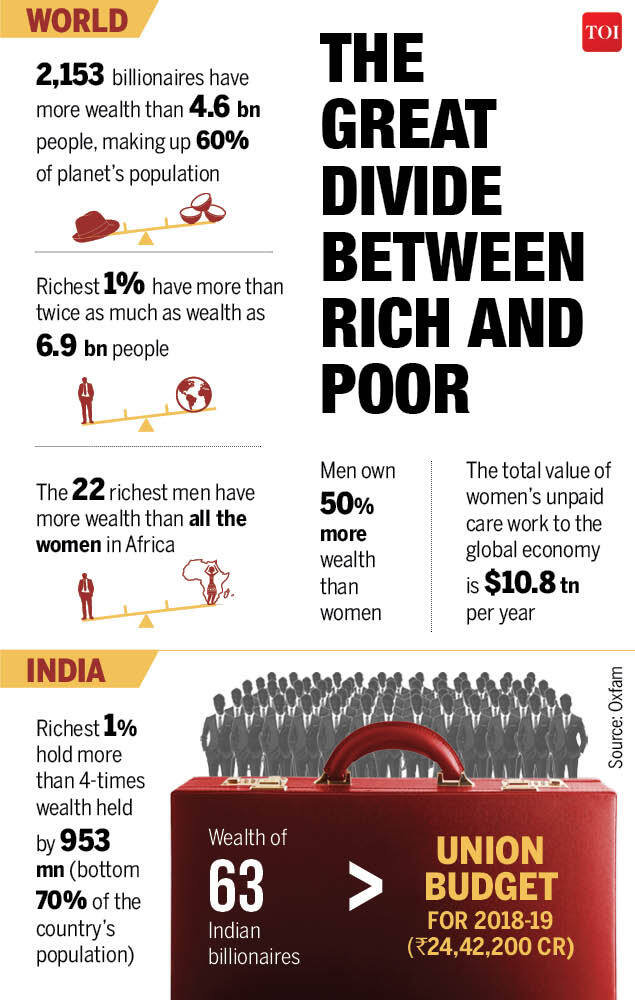
    • The report said that the world’s 2,153 billionaires have more wealth than the 4.6 billion people who make up 60 per cent of the planet’s population.
    • The report flagged that global inequality is shockingly entrenched and vast and the number of billionaires has doubled in the last decade, despite their combined wealth having declined in the last year.
    • The Oxfam report further said “sexist” economies are fuelling the inequality crisis by enabling a wealthy elite to accumulate vast fortunes at the expense of ordinary people and particularly poor women and girls.

    Income inequality in India

    • India’s richest 1 per cent hold more than four-times the wealth held by 953 million people who make up for the bottom 70 per cent of the country’s population.
    • The total wealth of all Indian billionaires is more than its full-year budget.
    • Regarding India, Oxfam said the combined total wealth of 63 Indian billionaires is higher than the total Union Budget of India for the fiscal year 2018-19 which was at Rs 24,42,200 crore.
    • It further said women and girls put in 3.26 billion hours of unpaid care work each and every day — a contribution to the Indian economy of at least Rs 19 lakh crore a year, which is 20 times the entire education budget of India in 2019 (Rs 93,000 crore).
    • He said women and girls are among those who benefit the least from today’s economic system.
    • They spend billions of hours cooking, cleaning and caring for children and the elderly. Unpaid care work is the ‘hidden engine’ that keeps the wheels of our economies, businesses and societies moving.

    Data on earnings

    • Oxfam said governments are massively under-taxing the wealthiest individuals and corporations and failing to collect revenues that could help lift the responsibility of care and tackle poverty and inequality.
    • As per the report, it would take a female domestic worker 22,277 years to earn what a top CEO of a technology company makes in one year.
    • With earnings pegged at Rs 106 per second, a tech CEO would make more in 10 minutes than what a domestic worker would make in one year.
    • Besides, direct public investments in the care economy of 2 per cent of GDP would potentially create 11 million new jobs and make up for the 11 million jobs lost in 2018, the report said.
  • Air Pollution

    Carbon Disclosure Project Report 2019

    Note4Students

    From UPSC perspective, the following things are important:

    Prelims level: Carbon Disclosure Project

    Mains level: India's various moves for curbing carbon emissions

    The Carbon Disclosure Project (CDP) 2019 report was recently published.

    Carbon Disclosure Project

    • CDP is published by the Global Reporting Initiative.
    • It is aimed at measuring the carbon reduction activities undertaken by different companies and firms operating in various countries across the globe.
    • The report surveys corporate commitments to science-based targets (SBT) and evaluates the climate change risk that they are exposed to.

    India’s performance

    • India secured the 5th spot on the project report.
    • The CDP Report 2019 said that a total of 58 companies shared details about the environment-related activities undertaken by them in this year.
    • The report also claims that over 98 percent of top Indian companies have formed some type or committee or group within its organization to drive and address climate-related issues.
    • The report also showcased the changing mind-set of India Inc with nearly all major companies setting up some form of oversight to evaluate climate risk.

    Global scenario

    • The US topped the annual CDP report with 135 companies disclosing their climate-related activities, followed by Japan in the second position with 83 companies and the UK in the third position with 78 countries.
    • While France was placed fourth with 51 companies disclosing their details, India was placed fifth with 38 companies committing to the science-based targets.
    • In 2018, India had only 25 companies committing to the SBTs.
    • India is followed by Germany and Sweden with 30 and 27 companies respectively, while Switzerland and Spain had 23 and 22 companies respectively.
    • Netherlands was listed 10th on the list with 18 companies committing to SBT initiatives.

    Importance

    • India was ranked 5th, ahead of Germany and Sweden.
    • India is the first developing economy with a maximum number of companies committing to the science-based targets.
  • Poverty Eradication – Definition, Debates, etc.

    Global Social Mobility Report 2020

    Note4Students

    From UPSC perspective, the following things are important:

    Prelims level: Global Social Mobility Report 2020 and its highlights

    Mains level: Social Mobility


    The Global Social Mobility Report was recently released at the ongoing World Economic Forum at Davos, Switzerland.

    Global Social Mobility Report

    • The World Economic Forum organizes the well-known annual gathering of the world’s most influential business and political decision-makers at Davos.
    • It has come out with its first-ever Global Social Mobility Report, which has ranked India a lowly 72 out of the 82 countries profiled.
    • According to the report, the Nordic economies such as Denmark and Finland top the social mobility rankings while countries like India, Pakistan, Bangladesh and South Africa languish at the bottom (see Table 1).

    Table 1: WEF’s Global Social Mobility Rankings

    Country Rank (out of 82)
    Denmark 1
    Germany 11
    United Kingdom 21
    United States 27
    Russia 39
    China 45
    Saudi Arabia 52
    Brazil 60
    India 76
    Pakistan 79


    What is the context for this report?

    • Notwithstanding fast global growth, inequalities have been growing across the world.
    • The rise of inequality has not only created massive social unrest but also adversely affected the global consensus on the kind of economic policies that countries follow.
    • A good example of this is the rise of trade protectionism across the world over the past few years.
    • Be it US or the UK several countries have started looking inwards in the hope that greater trade protectionism will help allay the fears and apprehensions of domestic workers.

    What is Social Mobility?

    • Typically, inequalities are measured in income terms. And this measure has been found inadequate.
    • As the report states, “many situations exist where, despite high levels of absolute income mobility, relative social mobility remains low.
    • For example, in economies such as China and India, economic growth can lift entire populations upward in terms of absolute income, but an individual’s status in society relative to others remains the same”.
    • The report states: “The notion of relative social mobility is more closely related to the social and economic status of an individual relative to their parents. I
    • n a country with a society with perfect relative mobility, a child born in a low-income family would have as much chance to earn a high income as a child born to parents who earn a high income”.

    Thus, the concept of social mobility is much broader than just looking at income inequality. It encompasses several concerns such as:

    • Intragenerational mobility: The ability for an individual to move between socio-economic classes within their own lifetime.
    • Intergenerational mobility: The ability for a family group to move up or down the socio-economic ladder across the span of one or more generations.
    • Absolute income mobility: The ability for an individual to earn, in real terms, as much as or more than their parents at the same age.
    • Absolute educational mobility: The ability for an individual to attain higher education levels than their parents.
    • Relative income mobility: How much of an individual’s income is determined by their parents’ income.
    • Relative educational mobility: How much of an individual’s educational attainment is determined by their parents’ educational attainment.

    Why does social mobility matter?

    • How far an individual can move up in the society determines a lot whether one is closer to the income “floor” (or poor) or “ceiling” (or rich).
    • Social mobility levels, then, can help us understand both the speed – that is, how long it takes for individuals at the bottom of the scale to catch up with those at the top – and the intensity – that is, how many steps it takes for an individual to move up the ladder in a given period – of social mobility.
    • Research also shows that countries with high levels of relative social mobility—such as Finland, Norway or Denmark— exhibit lower levels of income inequality.
    • Conversely, countries with low relative social mobility—such as India, South Africa or Brazil—also exhibit high levels of economic inequality.
    • That’s why it matters for countries like India to increase social mobility.


    As shown in Table 2, it would take a whopping 7 generations for someone born in a low-income family in India to approach mean income level; in Denmark, it would only take 2 generations.


    Table 2: Income Mobility across Generations

    Country Number of generations required by a poor family member to achieve mean income level
    Denmark 2
    United States/ United Kingdom 5
    Germany/ France 6
    India/China 7
    Brazil/South Africa 9


    So, how is social mobility calculated?

    The WEF’s Global Social Mobility Index assesses the 82 economies on “10 pillars” spread across the following five key dimensions of social mobility:

    1. Health;
    2. Education (access, quality and equity, lifelong learning);
    3. Technology;
    4. Work (opportunities, wages, conditions);
    5. Protection and Institutions (social protection and inclusive institutions).

    How did India perform on each of the 10 pillars of social mobility?

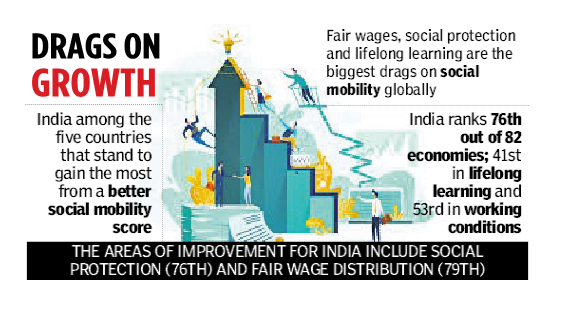
    India’s overall ranking is a poor 76 out of the 82 countries considered. Thus it should not come as any surprise that India ranks lowly in individual parameters as well.

    Table 3 below provides the detailed breakup.

    Table 3: Where India ranks on the 10 Pillars of Social Mobility

    Parameter Rank (out of 82 countries)
    Health 73
    Access to Education 66
    Quality and Equity in Education 77
    Lifelong learning 41
    Access to Technology 73
    Work Opportunities 75
    Fair Wage Distribution 79
    Working Conditions 53
    Social Protection 76
    Inclusive Institutions 67


    Back2Basics

    World Economic Forum (WEF)

    • The WEF based in Cologny-Geneva, Switzerland, is an NGO founded in 1971.
    • The WEF’s mission is cited as “committed to improving the state of the world by engaging business, political, academic, and other leaders of society to shape global, regional, and industry agendas”.
    • It is a membership-based organization, and membership is made up of the world’s largest corporations.
    • The WEF hosts an annual meeting at the end of January in Davos, a mountain resort in Graubünden, in the eastern Alps region of Switzerland.

    Various reports published by WEF:

    [Tikdam: Most (Not all) reports titled with ‘Global’ are released by WEF.]

    1. Global Competitiveness Report
    2. Global Information Technology Report
    3. Global Gender Gap Report
    4. Global Travel and Tourism Report
    5. Global Enabling Trade Report etc.
  • Telecom and Postal Sector – Spectrum Allocation, Call Drops, Predatory Pricing, etc

    [pib] UNCITRAL

    Note4Students

    From UPSC perspective, the following things are important:

    Prelims level: UNCITRAL

    Mains level: Not Much


    An International Arbitration Tribunal has dismissed all claims brought against  India in entirety. The arbitration arose out of the cancellation of Letters of Intent for the issuance of telecom licences to provide 2G services in five telecommunications circles by reason of India’s essential security interests.

    UNCITRAL

    • The UN Commission on International Trade Law (UNCITRAL) is a subsidiary body of the U.N. General Assembly responsible for helping to facilitate international trade and investment.
    • Established by the UNGA in 1966, UNCITRAL’s official mandate is “to promote the progressive harmonization and unification of international trade law” through conventions, model laws, and other instruments that address key areas of commerce, from dispute resolution to the procurement and sale of goods.
    • UNCITRAL carries out its work at annual sessions held alternately in New York City and Vienna, where it is headquartered.
    • The Tribunal constituted in accordance with the UNCITRAL Arbitration Rules 1976 is seated at the Hague, Netherlands, and proceedings are administered by the Permanent Court of Arbitration.
  • Women empowerment issues – Jobs,Reservation and education

    Women Business and the Law (WBL) Index 2020

    Note4Students

    From UPSC perspective, the following things are important:

    Prelims level: WBL index

    Mains level: India's poor performance and reasons behind


    The Women Business and the Law (WBL) 2020 index to measure the economic empowerment of women was recently published.

    WBL Index

    • The WBL report released by the World Bank.
    • It is based on the countries’ formal laws and regulations that have a bearing on women’s economic participation, covering eight areas (eg, parenthood, equality of pay).
    • It tracks how laws affect women at different stages in their working lives and focusing on those laws applicable in the main business city.

    India’s poor performance

    • India placed 117th among 190 countries on the index.
    • India, the world’s most populous democracy scored 74.4 on a par with Benin and Gambia and way below least developed countries like Rwanda and Lesotho.
    • The global average was 75.2 — a slight increase from 73.9 in the previous index released in 2017.

    Global Performance

    • Only eight economies scored a perfect 100 — Belgium, Canada, Denmark, France, Iceland, Latvia, Luxembourg, and Sweden.
    • Those countries have ensured equal legal standing to men and women on all the eight indicators of the index.
    • No economy in ‘East Asia and the Pacific’, ‘Europe and Central Asia’, or ‘Latin America and the Caribbean’ were among top reformers, the report claimed.
    • Countries in ‘Middle East and North Africa’ and ‘Sub-Saharan Africa’ accounted for nine of the 10 top progressing countries on the WBL Index:
    1. Saudi Arabia
    2. The United Arab Emirates
    3. Nepal
    4. South Sudan
    5. São Tomé and Príncipe
    6. Bahrain
    7. The Democratic Republic of Congo
    8. Djibouti
    9. Jordan
    10. Tunisia

    Significance of the Index

    • Legal rights for women are both the right thing to do and good from an economic perspective.
    • When women can move more freely, work outside the home and manage assets, they are more likely to join the workforce and help strengthen their country’s economies.
  • Tourism Sector

    Henley Passport Index 2020

    Note4Students

    From UPSC perspective, the following things are important:

    Prelims level: About the Index

    Mains level: Global visa policies for Indians

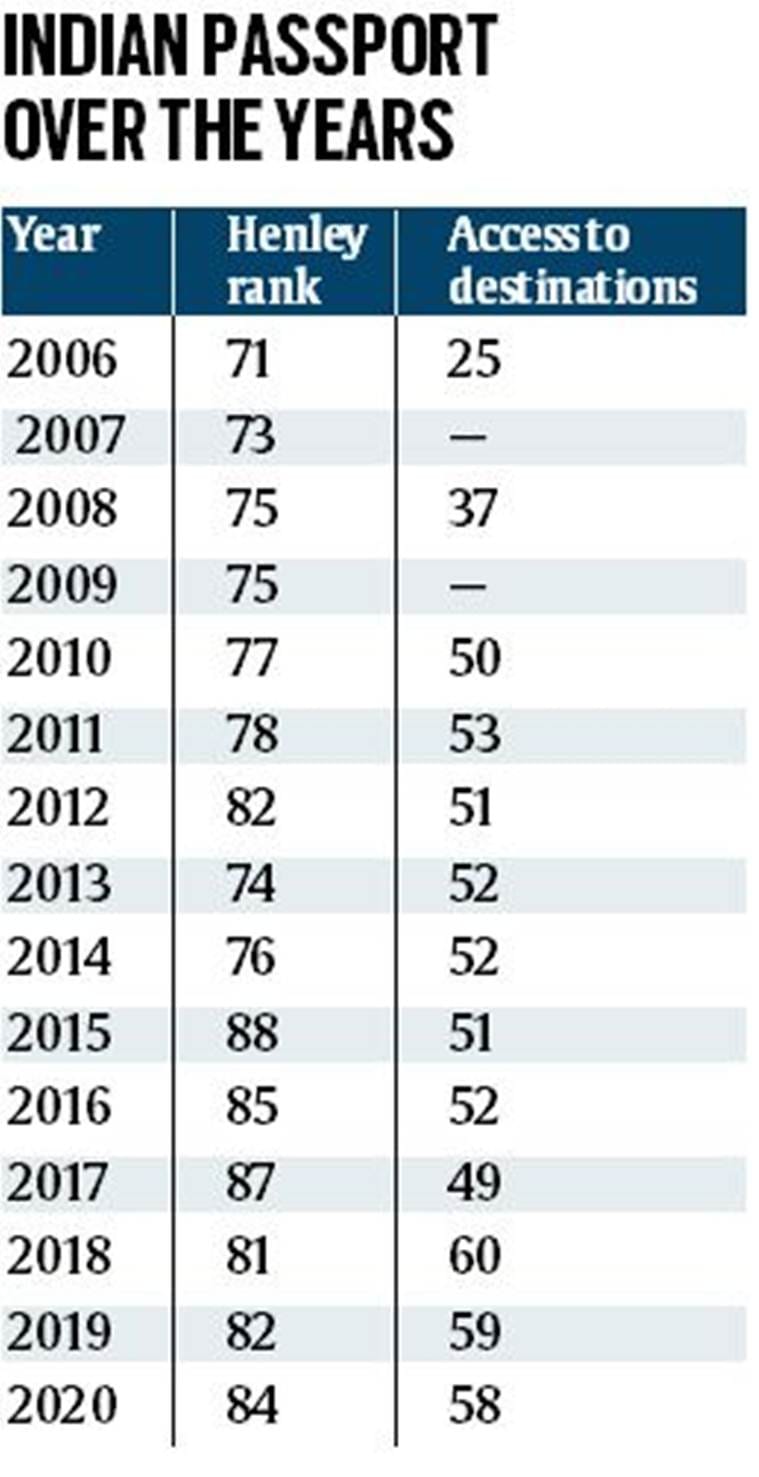
    The Indian passport is closer to the bottom, ranked 84th in the world, according to the 2020 edition of the Henley Passport Index.

    Henley Passport Index

    • According to Henley & Partners publishes the ranking and the Index of the world’s passports “according to the number of destinations their holders can access without a prior visa”.
    • The ranking is based on data from the International Air Transport Association (IATA), a trade association of some 290 airlines, including all major carriers.
    • The index includes 199 different passports and 227 different travel destinations.
    • The data are updated in real time as and when visa policy changes come into effect.

    India’s performance

    • Since the index began in 2006, the Indian passport has ranked in a band of 71st to 88th. (The number of passports ranked has, however, varied from year to year.)
    • The Indian passport’s 2020 ranking of 84th translates into visa-free access to 58 destinations, including 33 which give Indians visas on arrival.
    • It ranked higher in both 2019 (82, with visa-free access to 59 destinations) and 2018 (81, with visa-free access to 60 destinations).
    • Twenty of the 58 visa-free access destinations in the 2020 list are in Africa, and 11 each in Asia and the Caribbean.
    • Serbia is the only European country to which Indian passport holders can travel visa-free. There is no major or developed country to which Indian passport holders have visa-free access.

    Global performance

    • The top 10 most powerful passports this year are ranked in this order: Japan, Singapore, South Korea, Germany, Italy, Finland, Spain, Luxembourg and Denmark.
    • Japan has been topping the Index for three straight years; according to the 2020 index, its citizens are able to access 191 destinations without having to obtain a visa in advance.
    • Afghanistan at rank 107 is the weakest.
    • Singapore, in second place (same as in 2019), has a visa-free/visa-on-arrival score of 190.
    • Germany is No. 3 (same position as in 2019), with access to 189 destinations; it shares this position with South Korea, which dropped from the second place it held a year ago.
    • The US and the UK have been falling consistently over successive Indices.
  • Six degrees of Endangerment of a Language

    Note4Students

    From UPSC perspective, the following things are important:

    Prelims level: Endangered languages

    Mains level: Not Much

    Recently, The NY Times reported that the “near-extinct” Nepalese language Seke has just 700 speakers around the world. As per the Endangered Languages Project (ELP), there are roughly 201 endangered languages in India and about 70 in Nepal.

    The last year, 2019, was the International Year of Indigenous Languages, mandated by the UN.

    Nepal’s Seke language

    • According to the Endangered Language Alliance (ELA), Seke is one of the over 100 indigenous languages of Nepal.
    • The dialects from these villages differ substantially and are believed to have varying degrees of mutual intelligibility.
    • In recent years, Seke has been retreating in the face of Nepali, which is Nepal’s official language and is considered to be crucial for getting educational and employment opportunities outside villages.

    Degrees of endangerment

    UNESCO has six degrees of endangerment. These are:

    1. Safe, which are the languages spoken by all generations and their intergenerational transmission is uninterrupted;
    2. Vulnerable languages, which are spoken by most children but may be restricted to certain domains;
    3. Definitely endangered languages, which are no longer being learnt by children as their mother tongue.
    4. Severely endangered are languages spoken by grandparents and older generations, and while the parent generation may understand it, they may not speak it with the children or among themselves.
    5. Critically endangered languages are those of which the youngest speakers are the grandparents or older family members who may speak the language partially or infrequently and lastly,
    6. Extinct languages, of which no speakers are left.