💥UPSC 2026, 2027, 2028 UAP Mentorship (March Batch) + Access XFactor Notes & Microthemes PDF

Type: PIB

  • Blockchain Technology: Prospects and Challenges

    [pib] National Blockchain Framework

    Why in the News?

    This newscard is an excerpt from the original article published in the PIB Explainers.

    About National Blockchain Framework (NBF):

    • Launched: September 2024 by the Ministry of Electronics and Information Technology (MeitY) with a ₹64.76 crore budget.
    • Objective: Establish a unified, secure, and scalable blockchain architecture for governance and public service delivery.
    • Purpose: Promote trust, transparency, and interoperability across digital systems through a permissioned blockchain network deployed at NIC data centres in Bhubaneswar, Pune, and Hyderabad.
    • Impact: Enables ministries, regulators, and state governments to develop Blockchain-as-a-Service (BaaS) solutions for faster, tamper-proof, and verifiable transactions.

    Core Components of the NBF Ecosystem:

    1. Vishvasya Blockchain Stack:
      1. Indigenous modular platform serving as NBF’s backbone.
      2. Offers Blockchain-as-a-Service, distributed infrastructure, and open APIs for seamless e-Governance integration.
      3. Ensures permissioned, secure, and scalable operations across departments.
    2. NBFLite (Blockchain Sandbox):
      1. A testing environment for startups, academia, and innovators to build and validate blockchain prototypes.
      2. Preloaded with smart contract templates for governance and supply chain applications.
    3. Praamaanik:
      1. A blockchain-based mobile app verification system to authenticate legitimate applications and curb fake or malicious software.
      2. Enhances digital trust and cybersecurity in app ecosystems.
    4. National Blockchain Portal:
      1. A unified digital interface for blockchain adoption across government and industry.
      2. Acts as a repository of standards, policies, and interoperability guidelines under MeitY’s blockchain strategy.

    Applications in India’s Governance:

    • Certificate & Document Chain: Digitally secures government-issued documents (e.g., birth, caste, CBSE certificates) to prevent forgery; 34 crore+ verifications completed on blockchain platforms.
    • Property Chain: Records and verifies land and property transactions transparently, enabling instant ownership validation; Aims to reduce litigation and expedite land record updates.
    • Judiciary Chain: Provides immutable records of judicial data, facilitating e-delivery of notices, bail orders, and summons; 665 judiciary documents verified as of October 2025.
    • Inter-Operable Criminal Justice System (ICJS): Links police, prosecution, and judiciary databases on blockchain for seamless evidence and case management; 39,000+ documents verified on the blockchain.
    • Logistics Chain (Aushada): Tracks pharmaceutical supply chains in Karnataka from production to hospital delivery, ensuring drug authenticity and quality.
    • TRAI’s Blockchain for Telecom: Uses Distributed Ledger Technology (DLT) for tracking SMS transmissions and combating spam; covers 1.13 lakh registered entities.
    • RBI’s Digital Rupee Pilot: Demonstrates blockchain-based Central Bank Digital Currency (CBDC) for traceable and real-time retail transactions.
    • NSDL’s Blockchain Platform: Introduces Debenture Covenant Monitoring for capital markets, ensuring real-time compliance and investor protection.
    • CoE for Blockchain Technology (NIC): Acts as a consulting and training hub for ministries to pilot and scale blockchain applications using open-source systems like Hyperledger Fabric and Ethereum.
    [UPSC 2020] With reference to “Blockchain Technology” consider the following statements:
    1. It is a public ledger that everyone can inspect, but which no single user controls.
    2. The structure and design of blockchain is such that all the data in it are about cryptocurrency only.
    3. Applications that depend on basic features of blockchain can be developed without anybody’s permission.
    Which of the statements given above is/are correct?
    Options: (a) 1 only (b) 1 and 2 only (c) 2 only (d) 1 and 3 only*


  • Digital India Initiatives

    [pib] Bharat Taxi Initiative

    Why in the News?

    India is launching Bharat Taxi, a cooperative-based national ride-hailing platform under Digital India, with NeGD partnering Sahakar Taxi Cooperative for technical and advisory support.

    About the Bharat Taxi Initiative:

    • Objective: To create a citizen-centric alternative to global ride-hailing corporations, ensuring fair wages, cooperative governance, and local ownership.
    • Nature: A cooperative-owned, technology-driven national ride-hailing platform designed to provide affordable, secure, and transparent mobility solutions.
    • Timeline: Expected by December 2025, targeting both urban and rural transport needs.
    • Promoters: Supported by leading cooperative and financial institutions NCDC, IFFCO, AMUL, KRIBHCO, NAFED, NABARD, NDDB, and NCEL.

    Key Features:

    • Cooperative Ownership Model: Operated and governed by driver cooperatives, ensuring profit-sharing, fair pricing, and collective decision-making.
    • Digital Integration: Linked with national platforms such as DigiLocker, UMANG, and API Setu, allowing seamless identity verification, license validation, and service delivery.
    • Inclusive Design: Provides multilingual UI, accessibility for differently-abled users, and equal participation for women drivers.
    • Transparent Fare System: Uses open-source algorithms for real-time fare calculation to prevent overcharging or surge pricing manipulation.
    • Integration with Digital Public Infrastructure: Aligned with Aadhaar, UPI, and DigiLocker, facilitating digital payments and paperless onboarding.
  • Port Infrastructure and Shipping Industry – Sagarmala Project, SDC, CEZ, etc.

    [pib] The Indian Ports Act, 2025

    Why in the News?

    The Indian Ports Act, 2025 enacted in August, repealing the age-old Indian Ports Act of 1908 seeks to establish a more modern legal and institutional framework for India’s port sector.

    About Indian Ports Act, 2025:

    • Overview: Enacted in August 2025, replacing the Indian Ports Act of 1908 to modernize India’s port governance.
    • Aim: To integrate port law, tariff regulation, safety, environmental standards, and Centre–State cooperation into one comprehensive legal framework.
    • Vision: Aligns with broader maritime reforms alongside the Merchant Shipping Act, 2025 and Carriage of Goods by Sea Act, 2025.
    • Seeks to position India’s port sector for global competitiveness through transparency, sustainability, and efficient regulation.

    Key Features:

    • Maritime State Development Council (MSDC): Becomes a statutory consultative body to coordinate between Centre and States, advise on national port strategy, tariff transparency, data standards, and connectivity planning.
    • State Maritime Boards: Each coastal state must establish or recognize a board within 6 months to regulate non-major ports, manage licensing, tariffs, development, safety, and environmental compliance.
    • Tariff Setting:
      • Major Ports: Tariffs fixed by Port Authority Boards or Boards of Directors.
      • Non-Major Ports: Tariffs fixed by State Maritime Boards or concessionaires.
      • All tariffs must be electronically published for transparency.
    • Dispute Resolution: States must create Dispute Resolution Committees; appeals go directly to High Courts. Arbitration and ADR allowed.
    • Environmental Norms: Mandates waste management, pollution control, disaster preparedness, ballast water restrictions, and penalties for violations.
    • Applicability: Covers all existing and future ports, navigable channels, and vessels within port limits, except those serving armed forces, Coast Guard, or customs.
    [UPSC 2023] With reference to India, consider the following pairs:

    Port : Well Known as

    1. Kamarajar Port : First major port in India registered as a company

    2. Mundra Port : Largest privately owned port in India

    3. Visakhapatnam Port : Largest container port in India

    How many of the above pairs are correctly matched?

    (a) Only one pair (b) Only two pairs* (c) All three pairs (d) None of the pairs


  • Food Procurement and Distribution – PDS & NFSA, Shanta Kumar Committee, FCI restructuring, Buffer stock, etc.

    [pib] “Anna-Chakra” Supply Chain Optimisation Tool for PDS 

    Why in the News?

    The Union Minister of State for the Ministry of Consumer Affairs, Food and Public Distribution has provided crucial information regarding the Anna-Chakra Tool to the Parliament.

    About Anna-Chakra:

    • Purpose: Digital tool to optimise supply chain of the Public Distribution System (PDS).
    • Developed by: World Food Programme (WFP) and Foundation for Innovation and Technology Transfer (IIT-Delhi).
    • Implementation: Adopted in 30 States/UTs, except Manipur.
    • Coverage: Supports 4.37 lakh Fair Price Shops and 6,700 warehouses.
    • Savings: Reduces logistics/fuel costs, saving about ₹250 crore annually.
    • Environmental Impact: Route optimisation reduces travel distance by 15–50%, cutting CO emissions.

    Back2Basics: Public Distribution System (PDS) in India:

    • Objective: Provides subsidised food grains to poor households, ensuring food security.
    • History: Originated in inter-war years; expanded after 1960s food shortages.
    • Reforms: Revamped PDS (1992) extended coverage to rural and poverty-prone areas.
    • Structure:
      • Centre (FCI) – procurement, storage, transportation, bulk allocation.
      • States – distribute food grains to families via Fair Price Shops.
    • Coverage: Serves ~800 million people through 5 lakh+ Fair Price Shops.
    • Items Distributed: Wheat, rice, sugar, kerosene; some states add pulses and oils.
    • Significance: Shields poor households from food price shocks and economic distress.


    [UPSC 2008] Consider the following statements:

    1. Regarding the procurement of food grains, Government of India follows a procurement target rather than an open-ended procurement policy.

    2. Government of India announces minimum support prices only for cereals.

    3. For distribution under Targeted Public Distribution System (TPDS), wheat and rice are issued by the Government of India at uniform Central issue prices to the States/Union Territories.

    Which of the statements given above is/are correct?”

    Options: (a) 1 and 2 (b) 2 only (c) 1 and 3* (d) 3 only


  • Health Sector – UHC, National Health Policy, Family Planning, Health Insurance, etc.

    [pib] State Health Regulatory Excellence Index (SHRESTH)

    Why in the News?

    The Union Health Ministry has launched the State Health Regulatory Excellence Index (SHRESTH), a first-of-its-kind national framework to benchmark and strengthen state drug regulatory systems.

    About State Health Regulatory Excellence Index (SHRESTH):

    • Purpose: National initiative by Union Health Ministry to benchmark and strengthen state drug regulatory systems.
    • Developer: Designed by Central Drugs Standard Control Organization (CDSCO).
    • Objective:  To benchmark and improve the performance of state-level drug regulatory authorities across India through a transparent, data-driven framework.
    • Method: Uses a transparent, data-driven framework and acts as a virtual gap assessment tool for maturity certification.

    Key Features:

    • State Categories: Manufacturing states assessed on 27 indices; distribution-focused states/UTs assessed on 23 indices.
    • Evaluation Themes: Human resources, infrastructure, licensing, surveillance, and responsiveness.
    • Data Submission: Monthly metric data submitted by the 25th; scores shared on the 1st of the next month.
    • Performance Benchmarking: Rankings encourage cross-learning and adoption of best practices.
    • Capacity Building: Workshops, joint trainings, and regulatory audits to strengthen state systems.
    • Digital Integration: Dashboards like Not of Standard Quality (NSQ) for real-time monitoring.
    • Global Standards: Supports India’s goal to meet WHO-equivalent medicine quality norms, building on WHO Maturity Level-3 vaccine status.
    [UPSC 2023] Consider the following statements:

    Statement-I: India’s public sector health care system largely focuses on curative care with limited preventive, promotive and rehabiliative care.

    Statement-II: Under India’s decentralized approach to health care delivery, the States are primarily responsible for organizing health services.

    Which one of the following is correct in respect of the above statements?

    Options: (a) Both Statement-I and Statement-II are correct and Statement-II is the correct explanation for Statement-I

    (b) Both Statement-I and Statement-II are correct and Statement-II is not the correct explanation for Statement-I *

    (c) Statement-I is correct but Statement-II is incorrect

    (d) Statement-I is incorrect but Statement-II is correct


  • Electric and Hybrid Cars – FAME, National Electric Mobility Mission, etc.

    [pib] E-Truck Incentive Scheme

    Why in the News?

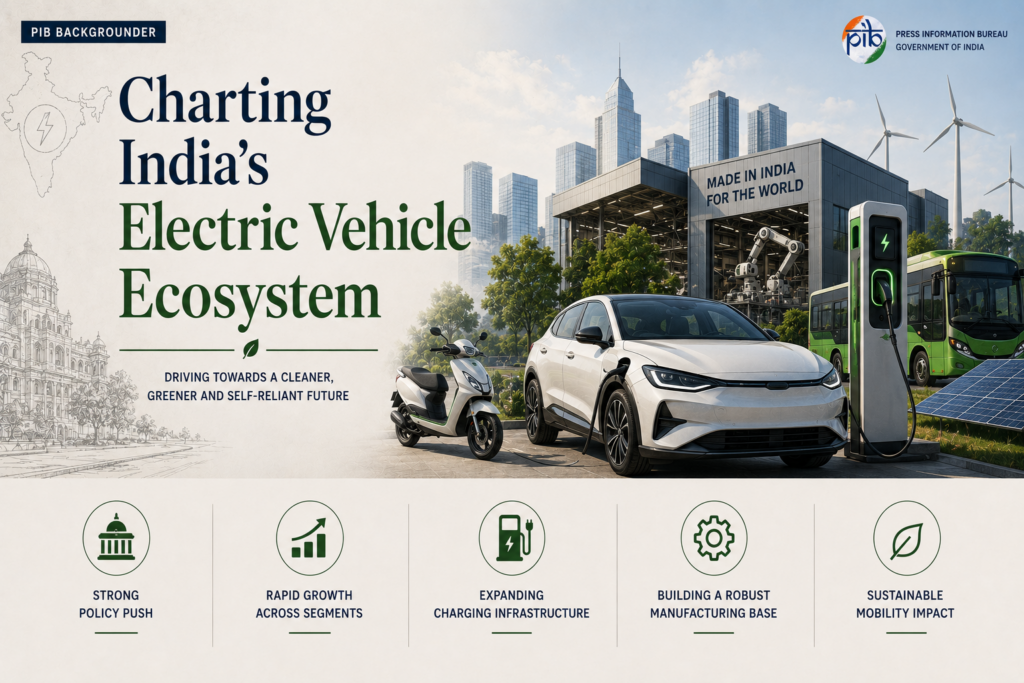
    The Ministry of Heavy Industries (MHI) has launched E-Truck Incentive Scheme to provide financial incentives for electric trucks (e-trucks) under the PM E-DRIVE initiative.

    What is E-Truck Incentive Scheme?

    • Overview: It is a dedicated scheme to provide financial incentives for electric trucks under the broader PM E-DRIVE initiative.
    • First-of-its-Kind Support: This is the first direct government support specifically for electric trucks to promote clean, efficient, and sustainable freight mobility.
    • Target Vehicle Categories: It targets N2 and N3 category trucks, as per Central Motor Vehicle Rules (CMVR):
      • N2: GVW above 3.5 tonnes up to 12 tonnes
      • N3: GVW above 12 tonnes up to 55 tonnes
    • Incentive for Articulated Vehicles: For articulated vehicles, the incentive applies only to the puller tractor of the N3 category, not the trailer.
    • Warranty Requirements:
      • Battery: 5 years or 5 lakh km, whichever comes first
      • Motor & Vehicle: 5 years or 2.5 lakh km
    • Incentive Details:
      • Based on Gross Vehicle Weight (GVW)
      • Maximum support capped at ₹9.6 lakh per e-truck
      • Incentives are given as upfront discounts, reimbursed to Original Equipment Manufacturers (OEMs) through the PM E-DRIVE portal
    • Deployment Goal: It aims to support the deployment of 5,600 electric trucks across India.
      • 1,100 trucks reserved for Delhi, with ₹100 crore allocated due to high pollution levels
    • Mandatory Scrappage Clause: To qualify, applicants must scrap an old diesel truck via scrappage centres approved by the Ministry of Road Transport and Highways (MoRTH).
    • Sectoral Impact: It is expected to benefit sectors like steel, ports, cement, and logistics by reducing fuel costs and improving air quality.

    About PM E-DRIVE Scheme:

    • Overview: It stands for Prime Minister’s Electric Drive Revolution in Innovative Vehicle Enhancement, launched by the Ministry of Heavy Industries in September 2024.
    • Long-Term Goal: To to foster an EV ecosystem, reduce carbon emissions, and help India achieve Net Zero emissions by 2070.
    • Budget Allocation: It has a total outlay of ₹10,900 crore for two years, aimed at accelerating India’s electric mobility transition.
    • Scope and Coverage: It supports multiple vehicle categories: Two-wheelers; Three-wheelers; Electric trucks; Electric buses and Electric ambulances.
    • Demand Incentive: It provides direct demand incentives to buyers through OEMs, lowering the upfront cost of EVs.
    • Category-wise Allocation:
      • 3,679 crore: For two-wheelers, three-wheelers, ambulances, and trucks
      • 500 crore: Specifically for electric ambulance procurement
      • 4,391 crore: To procure 14,028 electric buses in 9 major cities (Delhi, Mumbai, Kolkata, Chennai, Ahmedabad, Surat, Bangalore, Pune, Hyderabad)
    • Charging Infrastructure: ₹2,000 crore allocated to build 72,300 public charging stations nationwide, including:
      • Fast chargers for four-wheelers, buses, two-wheelers, and three-wheelers
    • Digital E-Voucher System:
      • Incentives claimed through Aadhaar-authenticated e-vouchers
      • Signed digitally by both buyer and dealer for transparency
    • Vehicle Scrappage Mandate: Scrapping of old vehicles is mandatory to claim certain incentives, especially for electric trucks, promoting fleet modernization.


    [UPSC 2025] Consider the following types of vehicles:

    I. Full battery electric vehicles II. Hydrogen fuel cell vehicles III. Fuel cell electric hybrid vehicles

    How many of the above are considered as alternative (powertrain) vehicles?

    Options: (a) Only one (b) Only two (c) All the three* (d) None


  • Innovations in Sciences, IT, Computers, Robotics and Nanotechnology

    [pib] Indian Scientists created high-performance Supercapacitor Material

    Why in the News?

    Scientists from Bengaluru, in collaboration with Aligarh Muslim University, have developed an advanced material that significantly improves supercapacitor performance.

    What are Supercapacitors?

    • Fast-Charging Energy Devices: Supercapacitors are special tools that store and release energy very quickly, much faster than regular batteries.
    • Used in Modern Technology: They are found in phones, electric vehicles, and solar systems where fast energy delivery is needed.
    • Trade-Off in Storage: While they charge faster, they generally hold less energy than traditional batteries.
    • Ongoing Scientific Efforts: Researchers are trying to increase energy capacity without sacrificing their quick-charging abilities.

    About Lanthanum-Doped Silver Niobate:

    • New Material from Indian Scientists: A research team from Bengaluru and Aligarh Muslim University created a better material for supercapacitors.
    • Silver Niobate as Base: They used silver niobate, which is non-toxic and eco-friendly, as the base material.
    • Improved by Lanthanum Doping: They added lanthanum, a rare metal, to help enhance electrical performance — a method called doping.
    • Smaller Particles, Bigger Surface: The particles became smaller, increasing the surface area for energy storage.

    What makes this material special?

    • Better with Use: The material retained 118% of its capacity after repeated use, showing it improved over time.
    • 100% Energy Efficiency: It wasted no energy during charge or discharge, making it highly efficient.
    • Quick and Smooth Performance: It delivered energy faster and more steadily than previous materials.
    • Proven in Real-World Test: A test device using this material could power an LCD screen, proving practical use.
    • Eco-Friendly Choice: It is lead-free and safe for the environment.
    • Future Potential: Scientists hope to apply this method to other materials and scale up for commercial use in electronics, EVs, and solar tech.
    [UPSC 2022] With reference to India, consider the following statements:

    1. Monazite is a source of rare

    earths. 2. Monazite contains thorium. 3. Monazite occurs naturally in the entire Indian coastal sands in India. 4. In India, Government bodies only can process or export monazite.

    Which of the statements given above are correct ?

    Options: (a) 1, 2 and 3 only (b) 1, 2 and 4 only* (c) 3 and 4 only (d) 1, 2, 3 and 4


  • Innovations in Sciences, IT, Computers, Robotics and Nanotechnology

    [pib] Breakthrough in Altermagnets Study

    Why in the News?

    Researchers at S N Bose National Centre for Basic Sciences (SNBNCBS) have discovered a novel transport behaviour in chromium antimonide (CrSb), a member of the emerging class of magnetic materials called altermagnets.

    What are Altermagnets?

    • Definition: Altermagnets are a new class of magnetic materials that combine properties of ferromagnets (which show external magnetism) and antiferromagnets (which don’t).
    • Unique Feature: They don’t attract metals like fridge magnets but still have active internal magnetic behavior, useful in advanced technology.
    • Use in Spintronics: These materials are ideal for spintronics, a technology that uses electron spin (not just charge) to make faster and energy-efficient devices.
    • No Magnetic Interference: Altermagnets do not create external magnetic fields, so they are stable and safe for nearby electronics.
    • Energy Efficient: Their structure helps reduce heat and energy loss, which is perfect for modern low-power gadgets.
    • Scientific Rarity: Very few altermagnets are known, making each discovery important for materials science.
    • Potential Applications: They could help build smaller memory chips, faster processors, and even support quantum computing.
    • Internal Action: Think of them as “quiet magnets” — they work inside devices without magnetic noise.

    Recent Discovery- Chromium Antimonide (CrSb):

    • Indian Breakthrough: Indian scientists found CrSb, a new altermagnet, showing rare direction-dependent conduction.
    • Directional Behavior: CrSb acts as an n-type material when current flows along its layers, and as a p-type when current flows across them.
    • First of its Kind: This is the first time an altermagnet has shown such dual conduction behavior in different directions.
    • Device Simplification: Since CrSb can behave as both p-type and n-type, it can reduce circuit size and eliminate the need for doping.
    • Eco-friendly Material: CrSb is made from non-toxic, common elements, making it ideal for sustainable electronics.
    • Potential Applications:
      • Future Potential: CrSb could be used in solar cells, batteries, and processors to make them greener and more efficient.
      • Environment-Friendly Tech: CrSb enables low-cost and eco-friendly electronics without sacrificing performance.
    [UPSC 2021] Magnetite particles, suspected to cause neurodegenerative problems, are generated as environmental pollutants from which of the following? 1. Brakes of motor vehicles 2. Engines of motor vehicles 3. Microwave stoves within homes 4. Power plants 5. Telephone lines Select the correct answer using the code given below.

    Options: (a) 1, 2, 3 and 5 only (b) 1, 2 and 4 only* (c) 3, 4 and 5 only (d) 1, 2, 3, 4 and 5


  • Innovations in Biotechnology and Medical Sciences

    [pib] Researchers validate Optical Properties of Teak Leaf Extracts

    Why in the News?

    In a breakthrough, scientists at the Raman Research Institute (RRI) have found that teak leaf extract (Tectona grandis) could offer a natural, sustainable solution for laser protection.

    About Optical Properties of Teak Leaf:

    • Natural Composition: Teak leaves (Tectona grandis) contain natural compounds that can interact with strong laser light.
    • Laser Blocking Ability: These compounds can block harmful laser rays while allowing normal light to pass, making them suitable for selective light filtering.
    • Nonlinear Optics: This unique behaviour is called a nonlinear optical property, where a material responds differently to high-intensity light.
    • Linear vs Nonlinear: In linear optics, the material’s response is directly proportional to the light’s intensity. In nonlinear optics, the response becomes non-proportional, especially under laser exposure.

    Back2Basics: Teak as Timber in India

    • Teak (Tectona grandis) is a large deciduous hardwood tree native to India and Southeast Asia, mainly found in tropical dry and moist deciduous forests.
    • It is highly valued for its durable, strong, and water- and pest-resistant wood, making it the “King of Timbers”.
    • India manages 35% of the world’s planted teak forests, with major natural habitats in Madhya Pradesh, Maharashtra, Karnataka, Tamil Nadu, and Kerala.
    • Teak is listed as Endangered on the IUCN Red List but is not under CITES; private plantations are crucial for meeting demand due to restrictions on commercial felling in government forests.
    • Green felling is prohibited in government forests under the Forest Conservation Act, 1980, and National Forest Policy, 1988, with timber supply to be met mainly from dead/diseased trees or private plantations.

    Recent Breakthrough:

    • New Discovery: Scientists discovered that teak leaf extract can function as a natural laser shield.
    • Protection Potential: The extract can block high-intensity laser beams, offering protection to human eyes and sensitive optical devices.
    • First of Its Kind: This marks the first known instance of a natural material exhibiting such laser-blocking properties.

    Significance for Humans:

    • Practical Applications: It can be used in laser safety goggles, optical sensors, and other light-sensitive technologies.
    • Safe Alternative: It offers a non-toxic, eco-friendly substitute to chemical-based laser protection materials.
    • Sustainability Impact: The use of plant-based materials supports cost reduction and promotes sustainable innovation in science and optics.
    [UPSC 2015] In India, in which one of the following types of forests is teak a dominant tree species?

    Options: (a) Tropical moist deciduous forest* (b) Tropical rain forest (c) Tropical thorn scrub forest (d) Temperate Forest with grasslands


  • Climate Change Negotiations – UNFCCC, COP, Other Conventions and Protocols

    [pib] Third United Nations Ocean Conference (UNOC3)

    Why in the News?

    At the Third United Nations Ocean Conference (UNOC3) in Nice, co-hosted by France and Costa Rica, India made a powerful case for urgent international cooperation to protect the world’s oceans.

    About United Nations Ocean Conference (UNOC)

    • What is it: The UNOC is a major international forum dedicated to supporting Sustainable Development Goal 14 (SDG 14): Life Below Water.
    • Primary Focus: It promotes the conservation and sustainable use of oceans, seas, and marine resources.
    • Multi-Stakeholder Participation: UNOC brings together governments, NGOs, academia, intergovernmental organizations, private companies, and Indigenous communities to address ocean-related challenges.
    • Key Themes: The conference tackles issues like marine pollution, overfishing, climate change, and habitat degradation, and encourages policy coordination and financial pledges.
    • Timeline of Conferences:
      • 2017: First conference in New York, co-hosted by Fiji and Sweden
      • 2022: Second in Lisbon, co-hosted by Portugal and Kenya
      • 2025: Third in Nice, co-hosted by France and Costa Rica
      • 2028: Fourth conference to be hosted by Chile and South Korea (yet to be announced officially)
    • Legal Framework: UNOC operates within the UN Convention on the Law of the Sea (UNCLOS).
    • Financial and Policy Impact: Since 2014, UNOC has mobilized over $130 billion and generated 2,160+ voluntary commitments toward protecting ocean health.

    Major Indian Initiatives Showcased at UNOC3 (2025):

    • Deep Ocean Mission: India showcased progress on the ‘Samudrayaan’ mission, a deep-sea manned submersible targeting 6,000-meter depth by 2026.
    • Plastic Pollution Action: India emphasized the national ban on single-use plastics and the Swachh Sagar, Surakshit Sagar’ campaign, which has cleaned 1,000+ km of coastline and removed over 50,000 tonnes of plastic waste. A draft Marine Litter Policy has been prepared and India strongly supports a Global Plastics Treaty.
    • Blue Economy Development: Under the Sagarmala Programme, $80 billion has been invested in port-led infrastructure. An additional $2.5 billion has been deployed under PM Matsya Sampada Yojana, leading to a 10% rise in fish production and creation of 1,000+ fish farmer producer organizations.
    • Marine Biodiversity Efforts: India expanded Marine Protected Areas to 6.6% of its Exclusive Economic Zone and restored over 10,000 hectares of mangroves.
    • Marine Data Transparency: India launched the SAHAV Portal, a digital ocean governance platform for science-based and transparent decision-making.
    • International Leadership: India co-led the ‘Blue Talks’ with France and Costa Rica, participated in high-level panels, and advocated for equitable ocean data access and capacity-building in developing nations.

    Back2Basics: United Nations Convention on the Law of the Sea (UNCLOS)

    • UNCLOS is a global treaty that regulates all maritime activities and ocean space.
    • It defines maritime zones such as: Internal Waters (within the baseline), Territorial Sea (up to 12 nautical miles), Contiguous Zone (up to 24 nautical miles), Exclusive Economic Zone (EEZ) (up to 200 nautical miles), High Seas, which lie beyond national jurisdiction.
    • It came into force in 1994 and has 169 parties (as of 2024), including India, but not the U.S.
    • It established the International Seabed Authority and declared the deep seabed as the “common heritage of mankind.”
    • India ratified UNCLOS in 1995 and uses it to claim maritime rights, including its extended continental shelf.
    • It supports freedom of navigation and advocates for a rules-based maritime order under UNCLOS.


    [UPSC 2022] With reference to the United Nations Convention on the Law of Sea, consider the following statements:

    1. A coastal state has the right to establish the breadth of its territorial sea up to a limit not exceeding 12 nautical miles, measured from baseline determined in accordance with the convention.

    2. Ships of all states, whether coastal or land-locked, enjoy the right of innocent passage through the territorial sea.

    3. The Exclusive Economic Zone shall not extend beyond 200 nautical miles from the baseline from which the breadth of the territorial sea is measured.

    Which of the statements given above are correct?

    Options: (a) 1 and 2 only (b) 2 and 3 only (c) 1 and 3 only (d) 1, 2 and 3*