💥UPSC 2026, 2027, 2028 UAP Mentorship (March Batch) + Access XFactor Notes & Microthemes PDF

Type: PIB

  • Renewable Energy – Wind, Tidal, Geothermal, etc.

    National Programme on Advanced Chemistry Cell Battery Storage

    Note4Students

    From UPSC perspective, the following things are important:

    Prelims level: Advance Chemical Cell batter

    Mains level: Paper 3- PLI scheme for ACC battery

    About the scheme

    • The Cabinet, chaired by Prime Minister has approved the proposal of Department of Heavy Industry for implementation of the Production Linked Incentive (PLI) Scheme ‘National Programme on Advanced Chemistry Cell (ACC) Battery Storage’.
    • Each selected ACC battery Storage manufacturer would have to commit to set-up an ACC manufacturing facility of minimum five (5) GWh capacity and ensure a minimum 60% domestic value addition at the Project level within five years.
    • Furthermore, the beneficiary firms have to achieve a domestic value addition of at least 25% and incur the mandatory investment Rs.225 crore /GWh within 2 Years (at the Mother Unit Level) and raise it to 60% domestic value addition within 5 Years, either at Mother Unit, in-case of an Integrated Unit, or at the Project Level, in-case of “Hub & Spoke” structure.
    • The scheme will help in achieving manufacturing capacity of Fifty (50) Giga Watt Hour (GWh) of ACC and 5 GWh of “Niche” ACC with an outlay of Rs.18,100 crore.

    About ACC

    • ACCs are the new generation of advanced storage technologies that can store electric energy either as electrochemical or as chemical energy and convert it back to electric energy as and when required.

    Benefits of the scheme

    • Setup a cumulative 50 GWh of ACC manufacturing facilities in India under the Programme.
    • Direct investment of around Rs.45,000 crore in ACC Battery storage manufacturing projects.
    • Facilitate demand creation for battery storage in India.
    • Facilitate Make-ln-lndia: Greater emphasis upon domestic value-capture and therefore reduction in import dependence.
    • Net savings of Indian Rs. 2,00,000 crore to Rs.2,50,000 crore on account of oil import bill reduction during the period of this Programme due to EV adoption as ACCs manufactured under the Programme is expected to accelerate EV adoption.
    • The manufacturing of ACCs will facilitate demand for EVs, which are proven to be significantly less polluting.
    • As India pursues an ambitious renewable energy agenda, the ACC program will be a key contributing factor to reduce India’s Green House Gas (GHG) emissions which will be in line with India’s commitment to combat climate change.
    • Import substitution of around Rs.20,000 crore every year.
    • The impetus to Research & Development to achieve higher specific energy density and cycles in ACC.
    • Promote newer and niche cell technologies.

  • Water Management – Institutional Reforms, Conservation Efforts, etc.

    [pib] Kerala presents its Annual Action plan under Jal Jeevan Mission

    Note4Students

    From UPSC perspective, the following things are important:

    Prelims level: Jal Jeevan Mission

    Mains level: Paper 2- Annual Action Plan submitted by Kerala for Jal Jeevan Mission

    Annual Action Plan presented

    • Annual Action Plan (AAP) on planning and implementation of Jal Jeevan Mission (JJM) in Kerala was presented.
    • Kerala State officials outlined the roadmap of the financial year 2021-2022 to the national committee via video conferencing.
    • The State plans to achieve the target of ‘Har Ghar Jal’ by 2024.
    • The State also plans to provide potable water in all quality-affected habitations by June 2021 through piped water supply or Community Water Purification Plants (CWPP).
    • The national committee analysed and advised on the plan presented by the State.
    • The committee emphasized the preparation of Village Action Plans and the constitution of Village Water &Sanitation Committee/ Pani Samiti as a sub-committee of Gram Panchayat with a minimum 50% of women members.
    • Also, emphasis is required on Water Quality Monitoring & Surveillance (WQM&S) activities to ensure Field Test Kit testing at Gram Panchayat level, Aanganwadi centres and schools.

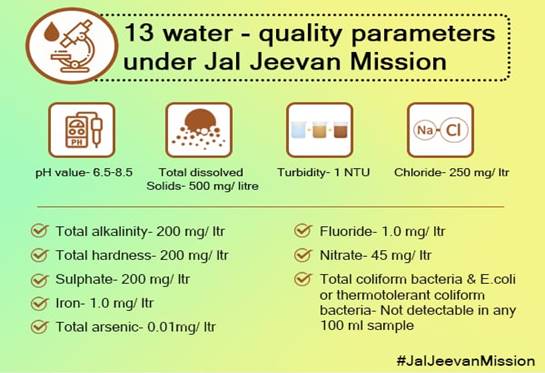
    About Jal Jeevan Mission

    • Jal Jeevan Mission is the flagship programme of Government of India, which aims to provide household tap water connection to every rural household by 2024.
    • Since announcement of the mission in August 2019, 4.17 Core new tap connections have been provided in the rural areas of the country during this period.
    • As a result, 7.40 Crore (38.56%) rural households have tap water supply vis-à-vis 3.23 Crore (17%) in 2019.
    •  Efforts are made to dovetail all available resources by convergence of different programmes viz. MGNREGS, SBM, 15th Finance Commission Grants to PRIs, CAMPA funds, Local Area Development Funds, etc.

    Allocation for the JJM

    •  In 2021-22, Rs. 50,000 Crore budgetary allocation has been made for Jal Jeevan Mission.
    • In addition to this, there is also Rs. 26,940 Crore assured fund available under the 15th Finance Commission tied grants to RLBs/ PRIs for water & sanitation, matching State share and externally aided projects.
    • Thus, in 2021-22, more than Rs. 1 lakh Crore is planned to be invested in the country on ensuring tap water supply to rural homes.
    • This huge investment will give a boost to manufacturing activities, create employment opportunities in rural areas as well boost the rural economy.
  • [pib] India-UK virtual summit strengthens STI cooperation

    Note4Students

    From UPSC perspective, the following things are important:

    Prelims level: IICEP

    Mains level: Paper 2- India-UK cooperation in STI

    Enhance partnership in science, education, research and innovation

    • The Prime Minister of India and the UK  met virtually on 4 May 2021 and emphasised their shared commitment to an enhanced partnership in science, education, research and innovation.
    • In keeping with this commitment, both the leaders welcomed the following:
    • The new MoU on Telecommunications/ICT and the Joint Declaration of Intent on Digital and Technology.
    • There was also the establishment of new high-level dialogues on tech.
    • A new joint rapid research investment into Covid19.
    • A new partnership to support zoonotic research,
    • New investment to advance understanding of weather and climate science.
    • There will be continuation of the UK-India Education and Research Initiative (UKIERI).

    Key points to strengthen STI cooperation

    • Enhance cooperation between India and the UK on strengthening the role of women in STEM at schools, universities, and research institutions through initiatives like Gender Advancement for Transforming Institutions (GATI) project.
    • Develop collaborations between Industry, Academia and the Government to foster innovation among school students by focusing on teacher training, mentoring and sharing of global best practices through initiatives like the India Innovation Competency Enhancement Program (IICEP)
    • Build on the two countries’ existing bilateral research, science and innovation infrastructure and governmental relationships to continue to support high-quality, high-impact research and innovation through joint processes.
    • Forge partnership across the pipeline of research and innovation activity, from basic research to applied and interdisciplinary research.
    • Leverage and build on existing, long-standing bilateral partnerships such as on education, research and innovation, to stimulate a joint pipeline of talent, excellent researchers and early-career innovators.
    • Work together to share knowledge and expertise regarding artificial intelligence, scientific support to policies and regulatory aspects including ethics, and promote a dialogue in research and innovation.
    • Through Tech Summits, bring together tech innovators, scientists, entrepreneurs and policy makers to work together on challenges including the norms and governance of future tech under the cross-cutting theme of ‘data’.
    •  Grow programmes such as the Fast Track Start-Up Fund to nurture innovation-led, sustainable growth and jobs, and tech solutions that benefit both countries.
  • [pib] Cabinet approval to MoU between India and UK on Global Innovation Partnership

    Note4Students

    From UPSC perspective, the following things are important:

    Prelims level: GIP

    Mains level: Paper 2- India-UK Global Innovation Partnership

    Cabinet approval to GIP

    • The Union Cabinet gave ex-post facto approval to the signing of Memorandum of Understanding (MoU) India and Foreign, Commonwealth and Development Office (FCDO) of the United Kingdom on Global Innovation Partnership (GIP).
    • GIP will support Indian innovators to scale up their innovations in third countries thereby helping them explore new markets and become self-sustainable.

    How GIP will help India

    • It will also foster an innovative ecosystem in India.
    • GIP innovations will focus on Sustainable Development Goals (SDG) related sectors thereby assisting recipient countries achieve their SDGs.
    • Through seed funding, grants, investments and technical assistance, the Partnership will support Indian entrepreneurs and innovators to test, scale-up and take their innovative development solutions to select developing countries.
    • GIP will also develop an open and inclusive e-marketplace (E-BAAZAR) for cross-border innovation transfer and will focus on results-based impact assessment thereby promoting transparency and accountability.
  • [pib] India-UK Virtual Summit

    Note4Students

    From UPSC perspective, the following things are important:

    Prelims level: Global Innovation Partnership

    Mains level: Paper 2- India-UK virtual summit

    India-UK Virtual Summit

    • Prime Minister Shri Narendra Modi and The Rt Hon’ble Boris Johnson, Prime Minister of the United Kingdom held a Virtual Summit today.
    • An ambitious ‘Roadmap 2030’ was adopted at the Summit to elevate bilateral ties to a ‘Comprehensive Strategic Partnership’.
    • The two Prime Ministers launched an ‘Enhanced Trade Partnership’ (ETP) by setting an ambitious target of more than doubling bilateral trade by 2030.
    • As part of the ETP, India and the UK agreed on a roadmap to negotiate a comprehensive and balanced FTA, including consideration of an Interim Trade Agreement for delivering early gains.
    • The enhanced trade partnership between India and UK will generate several thousands of direct and indirect jobs in both the countries.

    Collaboration and partnerships

    • The UK is India’s second-largest partner in research and innovation collaborations.
    • A new India-UK ‘Global Innovation Partnership’ was announced at the Virtual Summit that aims to support the transfer of inclusive Indian innovations to select developing countries, starting with Africa.
    • Both sides agreed to enhance cooperation on new and emerging technologies, including Digital and ICT products, and work on supply chain resilience.
    • They also agreed to strengthen defence and security ties, including in the maritime, counter-terrorism and cyberspace domains.
  • Biofuel Policy

    [pib] First supply of UCO-based Biodiesel flagged off

    Note4Students

    From UPSC perspective, the following things are important:

    Prelims level: Generations of biofuels

    Mains level: Paper 3- Used Cooking Oil based biofuel

    Eco-system for collection and conversion of UCO into Biodiesel

    • Minister of Petroleum & Natural Gas flagged off the first supply of UCO (Used Cooking Oil) based Biodiesel blended Diesel under the EOI Scheme.
    • To create an eco-system for collection and conversion of UCO, Expressions of Interest had been initiated for “Procurement of Bio-diesel produced from Used Cooking Oil” on the occasion of World Biofuel Day on 10th August 2019.
    • Under this initiative, Oil Marketing Companies (OMC) offer periodically incremental price guarantees for five years and extend off-take guarantees for ten years to prospective entrepreneurs.

    Advantages

    • This is a landmark in India’s pursuance of Biofuels and will have a positive impact on the environment.
    • This initiative will garner substantial economic benefits for the nation by shoring up indigenous Biodiesel supply, reducing import dependence, and generating rural employment.
  • Indian Navy Updates

    [pib] Seven Indian Navy Ships Deployed for Op Samudra Setu II

    Note4Students

    From UPSC perspective, the following things are important:

    Prelims level: Operation Samudra Setu

    Mains level: Paper 3- Operation Samudra Setu II

    Operation Samudra Setu II

    • In support of the nation’s fight against Covid-19 and as part of operation ‘Samudra Setu II’,  seven Indian Naval ships have been deployed for shipment of liquid medical oxygen-filled cryogenic containers and associated medical equipment from various countries.
    • Indian Navy also has the surge capability, to deploy more ships when the need arises to further nation’s fight against COVID-19.
    • It is pertinent that the ships are combat ready and capable of meeting any contingency in keeping with the attributes of versatility of sea power.

    Operation Samudra Setu I

    • It may be recalled that Operation Samudra Setu was launched last year by the Navy and around 4000 Indian citizens stranded in neighbouring countries, amidst COVID 19 outbreak, were successfully repatriated back to India.
  • Indian Missile Program Updates

    [pib] DRDO conducts maiden trial of Python-5 Air to Air Missile

    Note4Students

    From UPSC perspective, the following things are important:

    Prelims level: Python-5 missile

    Mains level: Paper 3- Python-5 missile

    Tejas adds Python-5 in its capacity

    • Tejas, India’s indigenous Light Combat Aircraft, added the 5th generation Python-5 Air-to-Air Missile (AAM) in its air-to-air weapons capability on April 27, 2021.
    • Trials were also aimed to validate enhanced capability of already integrated Derby Beyond Visual Range (BVR) AAM on Tejas.
    • The test firing at Goa completed a series of missile trials to validate its performance under extremely challenging scenarios.
    • The trials met all their planned objectives.
    • The missiles were fired from Tejas aircraft of Aeronautical Development Agency (ADA) flown by Indian Air Force (IAF) Test pilots.
    • The successful conduct was made possible with years of hard work by the team of scientists, engineers and technicians from ADA and HAL-ARDC along with admirable support from CEMILAC, DG-AQA, IAF PMT, NPO (LCA Navy) and INS HANSA.
  • BREXIT

    [pib] Agreement between India and UK on custom cooperation approved

    Note4Students

    From UPSC perspective, the following things are important:

    Prelims level: Not much

    Mains level: Paper 2- Agreement on assistance in customs matters

    Background of the agreement

    • The Cabinet, chaired by Prime Minister has approved the signing and ratification of an Agreement with the UK on Customs Cooperation and Mutual Administrative Assistance in Customs Matters.
    • The Agreement would provide a legal framework for sharing of information and intelligence between the Customs authorities of the two countries.
    • It will also help in the proper application of Customs laws, prevention and investigation of Customs offences and the facilitation of legitimate trade.
    • The Agreement takes care of Indian Customs’ concerns and requirements, particularly in the area of exchange of information on the correctness of the Customs value, tariff classification and origin of the goods traded between the two countries.

    Impact

    • The Agreement will help in the availability of relevant information for the prevention and investigation of Customs offences.
    • The Agreement is also expected to facilitate trade and ensure efficient clearance of goods traded between the countries.
  • [pib] PM launches distribution of e-property cards under SWAMITVA scheme

    Note4Students

    From UPSC perspective, the following things are important:

    Prelims level: About SWAMITVA Scheme

    Mains level: Paper 3- SWAMITVA Scheme

    e-Property cards under SWAMITVA scheme

    • The Prime Minister launched the distribution of e-property cards under the SWAMITVA scheme on National Panchayati Raj Day (24 April).
    • 4.09 lakh property owners were given their e-property cards on this occasion, which also marked the rolling out of the SVAMITVA scheme for implementation across the country.
    • Under the scheme, the entire village properties are surveyed by drone and property card are distributed to the owners.
    • The Scheme has infused a new confidence in the villages  as property documents remove uncertainty and reduce the chances of property disputes while protecting the poor from exploitation and corruption.
    • This eases credit possibility also.

    About SWAMITVA Scheme

    • SVAMITVA (Survey of Villages and Mapping with Improvised Technology in Village Areas) was launched by Prime Minister on 24th April 2020.
    • It is a Central Sector Scheme to promote a socio-economically empowered and self-reliant rural India.
    • The Scheme has the potential to transform rural India using modern technical tools of mapping and surveying.
    • It paves the way for using the property as a financial asset by villagers for availing loans and other financial benefits.
    • The Scheme will cover around 6.62 Lakh villages of the entire country during 2021-2025.