💥UPSC 2026, 2027, 2028 UAP Mentorship (March Batch) + Access XFactor Notes & Microthemes PDF

Type: Species

  • Wildlife Conservation Efforts

    Species in news: Indian Peafowl

    Note4Students

    From UPSC perspective, the following things are important:

    Prelims level: Indian Peafowl

    Mains level: Wildlife conservation and various policy efforts

    This newscard is an excerpt from the original article published in the D2E.

    Try this PYQ:

    Q.Which one of the following is the national aquatic animal of India? (CSP 2015)

    (a) Saltwater crocodile

    (b) Olive ridley turtle

    (c) Gangetic dolphin

    (d) Gharial

    Indian Peafowl

    • The Indian peafowl is a native of India and some parts of Pakistan and Sri Lanka.
    • The Arakan hills prevented their spread further east while the Himalayas and the Karakoram did so northwards.
    • As our national bird, the peacock has the utmost level of legal protection.

    Peacock vs. Peafowl

    • Only the males of the species are peacocks.
    • The females are properly called peahens, while young birds less than a year old are known as peachicks.
    • Collectively they are known as peafowl, regardless of age or gender.
    • Peacocks are male Indian peafowl (Pavo cristatus) belonging to the Phasianidae family

    Various protections

    • It comes under Section 51 (1-A) of Schedule I of the Wild (Life) (Protection) Act, 1972, with imprisonment that may be extended up to seven years, along with a fine that shall not be less than Rs 10,000.
    • Since 2014, Indian Peafowl has been protected under Appendix III of the CITES.
    • They are listed under the ‘Least Concern’ (LC) category of the IUCN Red Data List.

    Threats

    • Despite this, these birds experienced dwindling populations for many decades due to habitat loss, poaching and contamination of their food sources.
    • In 1991, the peafowl population census conducted by the WWF  revealed that 50 per cent of the species had declined, compared to their number at the time of independence.
  • Wildlife Conservation Efforts

    Species in news: Dhole

    Note4Students

    From UPSC perspective, the following things are important:

    Prelims level: Dhole and thier significance

    Mains level: Wildlife conservation and various policy efforts

    Karnataka, Maharashtra and Madhya Pradesh rank high in the conservation of dhole in India, according to a new study.

    Dhole

    • The dhole is a canid native to Central, South, East Asia, and Southeast Asia.
    • India perhaps supports the largest number of dholes, with key populations found in three landscapes — Western Ghats, Central India and Northeast India.
    • It is a highly social animal, living in large clans without rigid dominance hierarchies and containing multiple breeding females.
    • It is listed as ‘Endangered’ by the IUCN as populations are decreasing and are estimated at fewer than 2,500 adults.
    • Factors contributing to this decline include habitat loss, loss of prey, competition with other species, persecution due to livestock predation and disease transfer from domestic dogs.

    Their significance

    • Dholes play an important role as apex predators in forest ecosystems.
    • Besides the tiger, the dhole is the only large carnivore in India that is under IUCN’s ‘endangered’ category.
  • Wildlife Conservation Efforts

    Species in news: Hoolock Gibbons

    Note4Students

    From UPSC perspective, the following things are important:

    Prelims level: Hoolock Gibbons

    Mains level: Wildlife conservation and various policy efforts

    Hoolock Gibbons, the only species of apes found in India, are threatened with extinction in the Ukhrul and Kamjong districts of Manipur, a report has claimed.

    Try this PYQ from CSP2013:

    Q.Consider the following pairs:

    Protected area:: Well-known for

    1. Bhitarkanika, Orissa:: Salt Water Crocodile
    2. Desert National Park, Rajasthan:: Great Indian Bustard
    3. Eravikulam, Kerala:: Hoolock Gibbon

    Which of the above pairs is/are correctly matched?

    (a) 1 only

    (b) 1 and 2 only

    (c) 2 only

    (d) 1, 2 and 3

    Hoolock Gibbons

    • The two districts used to be covered with dense, tropical rainforests, which provided ideal tree canopies for the arboreal, brachiating ape species.
    • Rampant deforestation for timber, forest fires and indiscriminate hunting had led to the decline in their population.
    • Without the tree canopies, the gibbons cannot swing from branch to branch and stake out their territories.
    • They also cannot adapt to living on the ground and cannot bear the high temperatures brought about by the loss of green cover.

    Conservation status (a/c to WWF India)

    • The gibbon has a much wider range, as it is found in all the states of the north-east, restricted between the south of the Brahmaputra River and east of the Dibang River.
    • Outside India, it is found in eastern Bangladesh and north-west Myanmar.
    • The eastern hoolock gibbon inhabits specific pockets of Arunachal Pradesh and Assam in India, and southern China and north-east Myanmar.
    • Of the two, the western hoolock is listed as Endangered in the IUCN Redlist, while the eastern hoolock is listed as Vulnerable.
  • Wildlife Conservation Efforts

    Bats and their Ecological Significance

    Note4Students

    From UPSC perspective, the following things are important:

    Prelims level: Bats and thier natural role

    Mains level: Illict wildlife trade and its prevention

    The COVID pandemic has magnified our fear of bats, but their conservation is crucial to prevent such events from arising again.

    Try this PYQ from CSP 2014:

    Q.Consider the following:

    1. Bats
    2. Bears
    3. Rodents

    The phenomenon of hibernation can be observed in which of the above kinds of animals?

    (a) 1 and 2 only

    (b) 2 only

    (c) 1, 2 and 3

    (d) Hibernation cannot be observed in any of the above

    Bats

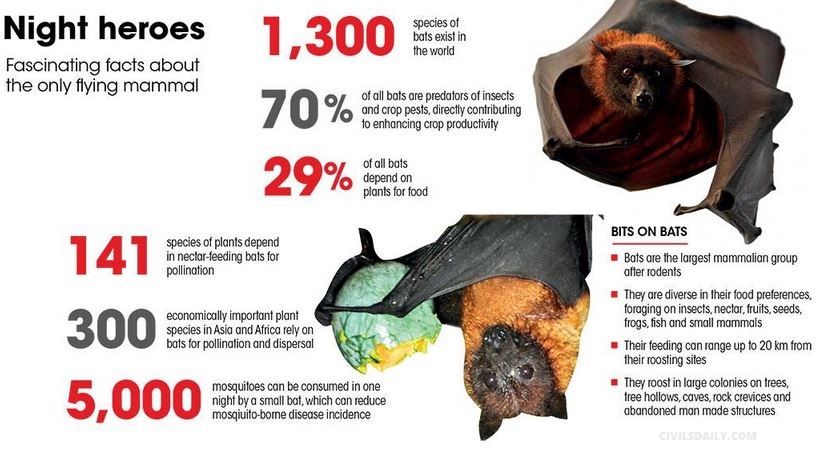
    • Bats are the largest mammalian group after rodents, with over 1,300 species making up a quarter of all mammals.
    • They occur on all continents except Antarctica and are particularly diverse in South Asia, with 114 species of insect-eating bats and 14 fruit bats, also known as “flying foxes”, occurring in India.
    • They roost in large colonies on trees, tree hollows, caves, rock crevices and abandoned manmade structures.
    • They play a unique role in maintaining ecosystem structure, making a singular contribution to our food production, economy and well-being.
    • They are the only mammals capable of true flight and have a unique sonar-based echolocation mechanism to capture prey at night.

    Their significance

    1) Seed dispersal

    • About 29 per cent of all bats depend upon plants for food.
    • The diet of fruit-eating bats consists largely of flowers and fruits such as mangoes, bananas, guavas, custard apples, figs, tamarind and many species of forest trees.
    • Therefore, bats play a vital role in seed dispersal and forest regeneration. Studies have shown that seedlings raised from bat dispersed seeds show higher germination and vigorous growth.

    2) Pollination

    • Studies have found that bats play a vital role in pollination, mainly of large-flowered plants, and in crop protection.
    • Fruit bats (Megachiroptera) being large, require big flowers with copious amounts of nectar.
    • Bats are major pollinators for many species of mangroves which are important for coastal ecosystems and local livelihoods.

    3) Production boost

    • Insects are a major problem for agriculture, destroying up to 26 per cent of the annual production of crops worldwide every year, roughly amounting to $470 billion.
    • Insectivorous bats, which make up 70 per cent of all bat species, are voracious predators of nocturnal insects and crop pests.
    • Some large insectivorous bats are also reported to feed on small rodents. Thus they contribute directly to enhancing the crop productivity with tremendous economic impact.

    4) Soil fertility

    • Bats contribute significantly to soil fertility and nutrient distribution due to their large numbers, high mobility and varied habitats for roosting and foraging.
    • Bat droppings provide organic input to soil and facilitate nutrient transfer, contributing to soil fertility and agricultural productivity. The practice is harmless vis-a-vis human health.

    5) Health benefits

    • Several species of bats, in fact, contribute to human health by reducing populations of mosquitoes and other insect vectors that spread malaria, dengue, chikungunya and other diseases.
    • It is reported that a small bat may feed on almost 5,000 mosquitoes each and every feeding night far more than other measures adopted to eliminate them.

    Their conservation

    • According to the IUCN, about 5 per cent of bats are categorised as endangered and another 11 per cent are data deficient.
    • Further, some species of fruit bats are categorised under Schedule 5 of the Wildlife (Protection) Act, 1973, along with other vermin species like rats, making it difficult to legally conserve them.

    Conclusion

    • The pandemic has demonstrated that conservation of biodiversity and natural habitats is absolutely essential to prevent such events from arising again.
    • Understanding the role played by bats helps us appreciate how their absence can greatly affect all facets of our lives.
    • Viruses don’t jump directly from bats or other animals to humans.
    • Rather, illicit trade in wildlife, high levels of hunting for the consumption of wild meat, and destruction of natural habitats are responsible for this.
  • New Species of Plants and Animals Discovered

    Species in news: Raksasa Cockroach

    Note4Students

    From UPSC perspective, the following things are important:

    Prelims level: Bathynomus Raksasa

    Mains level: NA

    A team of researchers has discovered a supergiant cockroach when they explored waters of the Indian Ocean in Bantan, off the southern coast of West Java in Indonesia.

    Try this MCQ:

    Q.The ‘Bathynomus Raksasa’, a species recently discovered is basically a:

    a) Mollusc

    b) Annelid

    c) Arthropod

    d) Flagella

    Bathynomus Raksasa

    • The Bathynomus raksasa is a giant isopod (phylum: Arthropoda) in the genus Bathynomus.
    • It is described as the “cockroach of the sea”. The epithet is the Indonesian word “raksasa” for giant, alluding to its enormous size.
    • The giant isopods are distantly related to crabs, lobsters, and shrimps (which belong to the order of decapods), and are found in the cold depths of the Pacific, Atlantic, and Indian Oceans.
    • It has 14 legs but uses these only to crawl along the bed of oceans in search of food.
    • As a scavenger, Bathynomus raksasa eats the remains of dead marine animals, such as whales and fish, but can also go for long periods without food, a trait that it shares with the cockroach.

    Why this cockroach matters?

    • Bathynomus raksasa is the sixth ‘supergiant’ species from the Indo-West Pacific and is one of the largest known members of the genus.
    • The discovery takes the number of known giant isopods to 20.
    • As the Bathynomus raksasa reveals its secrets, it will contribute towards increasing knowledge about the deep.
  • Wildlife Conservation Efforts

    Species in news: Pied Cuckoo

    Note4Students

    From UPSC perspective, the following things are important:

    Prelims level: Migration of Pied Cuckoo and its association with Indian monsoon onset

    Mains level: NA

    A new project by a number of agencies is using advancements in nanotechnology to study migratory patterns of the Pied Cuckoo.

    This specie carries an unusual importance compared to other IUCN species. Go through this newscard to read more about it.

    Pied Cuckoo

    • There are basically three subspecies of the Pied Cuckoo of which one is resident in Africa while another is resident in South.
    • The third is a migrant moving between India and Africa.
    • The Pied Cuckoo is famous in North Indian folklore as ‘chatak’, a bird that quenches its thirst only with raindrops.
    • From Southern Africa, it comes to the Himalayan foothills stretching from Jammu to Assam to breed every year. The birds come to the same localities every year.
    • It is also a brood parasite in that it does not make its own nest and instead lays its egg in the nest of other birds, particularly the Jungle Babbler.

    About the Study

    • The project is a joint effort by the Wildlife Institute of India, Dehradun and the Indian Institute of Remote Sensing (IIRS), which comes under the Indian Space Research Organisation or ISRO.
    • The Pied Cuckoo migration study is part of a larger project — Indian Bioresource Information portal (IBIN) funded by the Department of Biotechnology under the Union Ministry of Science and Technology.
    • It aims to deliver relevant bioresources (plant, animal and other biological organisms) information of India through a web portal.
    • The project aims to assess the likely impacts of projected climate change on the potential distribution of Pied Cuckoo in the altered climate change scenarios.

    Why study Pied Cuckoo?

    • It is closely linked with the arrival of the south-west monsoon in India.
    • It moves to India during the summer.
    • Being a small, terrestrial bird, a sea crossing holds a lot of risk for this cuckoo.
    • Before it migrates back to its home in the southern African region, by flying over the Arabian Sea and the Indian Ocean, it must be stopping somewhere.
    • It is these stopovers that researchers want to find out about.
  • Forest Conservation Efforts – NFP, Western Ghats, etc.

    Species in news: Cestrum nocturnum

    Note4Students

    From UPSC perspective, the following things are important:

    Prelims level: Cestrum nocturnum

    Mains level: Invasive alien species

    Nilgiris forest officials are restoring native Shola habitats in places overrun by the invasive species ‘Cestrum nocturnum’.

    Try this PYQ from CSP 2018:

    Q.Why is a plant called Prosopis juliflora often mentioned in the news?

    (a) Its extract is widely used in cosmetics.

    (b) It tends to reduce the biodiversity in the area in which it grows

    (c) Its extract is used in the pesticides.

    (d) None of the above

    Cestrum nocturnum

    • Cestrum nocturnum is commonly known by the names night-blooming jasmine and raatrani.
    • It is native to the West Indies but naturalized in South Asia.
    • Its spread is a threat to all Shola and grassland habitats as it does not allow any native flora to thrive.
    • The plants unless completely removed with their roots, keep sprouting and keep taking over Shola and native grasslands.
  • New Species of Plants and Animals Discovered

    Species in news: Golden Birdwing

    Note4Students

    From UPSC perspective, the following things are important:

    Prelims level: Golden Birdwing

    Mains level: NA

    A Himalayan butterfly named golden birdwing is now India’s largest recorded butterfly.

    Try this MCQ:

    Q.The Himalayan Golden Birdwing recently seen in news is a:

    a)Biggest butterfly

    b)Smallest avian specie

    c)Biggest freshwater fish

    d)Honeybee

    Golden Birdwing

    • A Himalayan butterfly named golden birdwing is now India’s largest, a record the southern birdwing held for 88 years.
    • The male golden birdwing is much smaller at 106 mm.
    • With a wingspan of 194 mm, the female of the species is marginally larger than the southern birdwing (190 mm) that Brigadier William Harry Evans, a British military officer and lepidopterist, recorded in 1932.
    • It was an individual of the southern birdwing which was then treated as a subspecies of the common birdwing.

    Other butterflies in news

    • The Malabar Banded Peacock or the Buddha Mayoori which was recently declared the ‘State Butterfly’ of Kerala will have a dedicated butterfly park in Kochi.
    • Tamil Nadu has also recently declared Tamil Yeoman (Cirrochroa Thais)as its state butterfly to symbolise its rich natural and cultural heritage, in a move aimed at boosting the conservation efforts of the attractive insects.
    • Other states to have state butterflies are Maharashtra (Blue Mormon), Uttarakhand (Common peacock), Karnataka (Southern birdwings).
  • New Species of Plants and Animals Discovered

    Species in news: Globba Andersonii Plant

    Note4Students

    From UPSC perspective, the following things are important:

    Prelims level: Species in news: Globba Andersonii Plant

    Mains level: NA

    A team of researchers have “rediscovered” a rare species called Globba andersonii from the Sikkim Himalayas near the Teesta River valley region after a gap of nearly 136 years.

    Try this question from CSP 2016:

    Q.With reference to ‘Red Sanders’, sometimes seen in the news, consider the following statements:

    1. It is a tree species found in a part of South India.
    2. It is one of the most important trees in the tropical rain forest areas of South India.

    Which of the above statements is/are correct?

    (a) 1 only

    (b) 2 only

    (c) Both 1 and 2

    (d) Neither 1 nor 2

    Globba Andersonii

    IUCN status: Critically Endangered

    • Globba andersonii is characterised by white flowers, non-appendaged anthers (the part of a stamen that contains the pollen) and a “yellowish lip”.
    • The plant, known commonly as ‘dancing ladies’ or ‘swan flowers’ was thought to have been extinct until its “re-collection”, for the first time since 1875.
    • The earliest records of the collection of this plant were dated between the period 1862-70 when it was collected by Scottish botanist Thomas Anderson from Sikkim and Darjeeling.
    • Then, in 1875, the British botanist Sir George King, had collected this taxon from the Sikkim Himalayas.
  • Wildlife Conservation Efforts

    Species in news: Golden Langurs

    Note4Students

    From UPSC perspective, the following things are important:

    Prelims level: Golden Langur

    Mains level: NA

    Primatologists have observed that the Gee’s golden langur (Trachypithecus geei) induce stillbirth of babies killed inside the womb of females, besides practising infanticide.

    Try this question from CSP 2013:

    Q. In which of the following States is lion-tailed macaque found in its natural habitat?

    1. Tamil Nadu
    2. Kerala
    3. Karnataka
    4. Andhra Pradesh

    Select the correct answer using the codes given below.

    a) 1, 2 and 3 only

    b) 2 only

    c) 1, 3 and 4 only

    d) 1, 2, 3 and 4

    Golden Langurs

    IUCN status: Endangered

    • It is an Old World monkey found in a small region of western Assam, and in the neighbouring foothills of the Black Mountains of Bhutan.
    • Long considered sacred by many Himalayan people, the golden langur was first brought to the attention of the western world by the naturalist E. P. Gee in the 1950s.
    • Their habitat lies in the region, south of the Brahmaputra River, on the east by the Manas River, on the west by the Sankosh River, all in Assam, India, and on the north by the Black Mountains of Bhutan
    • Chakrashila WLS in Assam is India’s first wildlife sanctuary with golden langur as the primary species.
    • They are listed in Appendix I of CITES and Schedule I of Wildlife Protection Act, 1972.