💥UPSC 2026, 2027, 2028 UAP Mentorship (March Batch) + Access XFactor Notes & Microthemes PDF

Archives: News

  • Indian Navy Updates

    Exercise Sea Dragon 22

    India is among the six Indo-Pacific nations participating in Exercise Sea Dragon 22.

    Sea Dragon 22

    • It is a multi-lateral anti-submarine warfare exercise in the Pacific Ocean hosted by the US.
    • The exercise includes the navies of India, Australia, Canada, Japan, the US and South Korea.
    • India, Japan, Australia and America are also part of the Quad, and also participate in the Malabar exercise.
    • It includes in-flight training, ranging from tracking simulated targets to the final problem of tracking a live US Navy submarine.

    Significance of the exercise

    • The exercise is significant as almost all of the participating countries have strained relations with China.
    • China is expanding its prowess in the Indo-Pacific under its Look West Policy.

    Also, take time to read about all major exercises:

    Various Defence Exercises in News


    UPSC 2022 countdown has begun! Get your personal guidance plan now! (Click here)

  • Health Sector – UHC, National Health Policy, Family Planning, Health Insurance, etc.

    Extinguishing the tobacco industry’s main narrative

    Context

    There is no doubt that tobacco use is highly detrimental to public health. We have to find the ways and the means to reduce the demand for tobacco among existing as well as aspiring users.

    Impact of tobacco

    • Tobacco is a product that kills more than 13 lakh Indians every year.
    • Annual burden: The annual economic burden from tobacco use is estimated to be ₹177,340 crore which is more than 1% of India’s GDP.
    • About 27 crore people above the age of 15 years and 8.5% of school-going children in the age group 13-15 years use tobacco in some form in India.

    Are price and tax measures effective against tobacco use?

    • When tobacco products become more expensive, people either quit using them or use them less, and it incentivises many to not initiate the habit.
    • Because it hurts both revenue and profits, the tobacco industry, globally, is always devising tactics and narratives that will pre-empt any kind of tax increases on tobacco products.
    • The narrative of “increasing illicit trade” is something the tobacco industry has historically used to pre-empt potential tax increases on tobacco products in most countries around the world.
    • The story is no different in India.
    • In a recent report by the Tobacco Institute of India, it was said that the illicit cigarette volume in India has grown by 44% from 2011 to 2019 while adding that high and increasing tax rates provide a profitable opportunity for tax evasion and encourage growth in illegal trade.
    • A study published in 2018 which used a survey of empty cigarette packs collected from retail outlets across different cities in India estimated that illicit cigarettes constitute 2.7% of the market.
    • The second study published in 2020 used tax-gap analysis to estimate that the percentage of illicit cigarettes was 5.1% in 2009-10 and 6.6% in 2016-17.

    Are taxes and prices key determinants of illicit trade?

    • It is to be noted that taxes and prices are not the key determinants of illicit trade.
    • There is sufficient evidence in the literature on illicit trade in cigarettes that shows tax increases only have a minimal impact, if at all, on illicit trade.
    • There are several countries where tobacco taxes are quite high and yet have low levels of illicit trade, while there are also countries with high levels of illicit trade despite having relatively low tax rates.
    • Several factors such as the quality of tax administration, the strength of the regulatory framework, government commitment to control illicit trade, the strength of governance, social acceptance, and the presence of informal distribution networks are known to play a larger role in determining the scale and the extent of an illicit market.

    Way forward

    • WHO protocol: Eliminating all forms of illicit trade in tobacco products through a package of measures is one of the major objectives of the Protocol to Eliminate Illicit Trade in Tobacco Products under the World Health Organization’s Framework Convention on Tobacco Control.
    • The Protocol provides the tools and the measures to eliminate or minimise illicit trade which includes strong governance, establishing an international track and trace system, and securing supply chains.
    • India has already ratified the World Health Organization Protocol and it should now show leadership in implementing these measures to effectively address even the relatively lower levels of illicit trade.

    Conclusion

    There is no scientific or public health rationale not to increase tax on tobacco products for unfounded fear of increasing illicit trade.

    UPSC 2022 countdown has begun! Get your personal guidance plan now! (Click here)

  • Health Sector – UHC, National Health Policy, Family Planning, Health Insurance, etc.

    Worrying trends in nutrition indicators in NFHS-5 data

    Context

    The NFHS-5 factsheets for India and all states and Union territories are now out. At first glance, it appears to be a mixed bag — much to cheer about, but concern areas remain.

    Positives from the NFHS-5 survey

    • Change in demographic trends: For the first time since the NFHS 1992-93 survey, the sex ratio is slightly higher among the adult population.
    • Improvement in sex ratio at birth: For the first time in 15 years that the sex ratio at birth has reached 929 (it was 919 for 1,000 males in 2015-16).
    • The total fertility rate has also dropped from 2.2 per cent to a replacement rate of 2 per cent, albeit with not much change in the huge fertility divide between the high and low fertility states.
    • Improvement in literacy level of women: There has been an appreciable improvement in general literacy levels and in the percentage of women and men who have completed 10 years or more of schooling, which has reached 41 per cent and 50.2 per cent respectively.
    • Improvements in health indicators: The health sector deserves credit for achieving a significant improvement in the percentage of institutional births, antenatal care, and children’s immunisation rates.
    • There has also been a consistent drop in neonatal, infant and child mortality rates — a decrease of around 1 per cent per year for neonatal and infant mortality and a 1.6 per cent decrease per year for under five mortality rate.

    Nutrition: Area of concern

    • Increase in anaemic people: India has become a country with more anaemic people since NFHS-4 (2015-16), with anaemia rates rising significantly across age groups, ranging from children below six years, adolescent girls and boys, pregnant women, and women between 15 to 49 years.
    • Why anaemia is a concern? Adverse effects of anaemia affect all age groups — lower physical and cognitive growth and alertness among children and adolescents, and lesser capacity to learn and play, directly impacting their future potential as productive citizens.
    •  Further, anaemia among adolescent girls (59.1 per cent) advances to maternal anaemia and is a major cause of maternal and infant mortality and general morbidity and ill health in a community.
    • The detailed report will explain why a dedicated programme like Anaemia Mukt Bharat which focused on IFA consumption failed to gain impetus.
    • Slow pace of improvement in nutritional indicators: Between NFHS 4 and NFHS 5, the percentage of children below five years who are moderately underweight has reduced from 35.8 per cent to 32.1 per cent.
    • Moderately stunted children have fallen from 38.4 per cent to 35.5 per cent, moderately wasted from 21 per cent to 19.3 per cent and severely wasted have increased slightly from 7.5 per cent to 7.7 per cent.
    • Inadequate diet: The root cause for this is that the percentage of children below two years receiving an adequate diet is a mere 11.3 per cent, increasing marginally from 9.6 per cent in NFHS-4.

    Way forward

    • India’s nutrition programmes must undergo a periodic review.
    • The Integrated Child Development Services (ICDS), which is perceived as the guardian of the nation’s nutritional well-being must reassess itself and address critical intervention gaps, both conceptually and programmatically, and produce rapid outcomes.

    Conclusion

    The nutritional deficit which ought to be considered an indicator of great concern is generally ignored by policymakers and experts. Unless this is addressed, rapid improvement in nutritional indicators cannot happen.

    UPSC 2022 countdown has begun! Get your personal guidance plan now! (Click here)

  • Foreign Policy Watch: India-Russia

    CSTO troops deployed in Kazakhstan

    A Moscow-led military alliance called Collective Security Treaty Organization (CSTO) dispatched troops to help quell mounting unrest in Kazakhstan.

    Ongoing situation in Kazakhstan

    • Long seen as one the most stable of the ex-Soviet republics of Central Asia, energy-rich Kazakhstan is facing its biggest crisis.
    • There are ongoing protests over rising fuel prices escalated into widespread unrest.
    • The nationwide protests are also signifying a wider, region-wide longing for political change.
    • Under increasing pressure, Kazakh President appealed to the Russia for CSTO army to be deployed in Kazakhstan.

    Concerns over CTSO troop’s deployment

    • It is argued that domestic turmoil could be utilized by Russian nationalists for asserting their claims in Northern Kazakhstan.

    What is CSTO?

    • The CSTO is a Russia-led military alliance of seven former Soviet states that was created in 2002.
    • Current CSTO members are Armenia, Belarus, Kazakhstan, Kyrgyzstan, the Russian Federation and Tajikistan.
    • Afghanistan and Serbia hold observer status in the CSTO.
    • Its purpose is to ensure the collective defence of any member that faces external aggression.

    Outlined functions of CSTO

    • Version of NATO: It has been described by political scientists as the Eurasian counterpart of NATO, which has 29 member states, while the CSTO has just six.
    • Arms trade and mutual defense: CSTO supports arms sales and manufacturing as well as military training and exercises, making the CSTO the most important multilateral defence organization in the former Soviet Union.
    • Non- proliferation of weapons:  CSTO also coordinates efforts in fighting the illegal circulation of weapons among member states and has developed law enforcement training for its members in pursuit of these aims.

    What does CSTO membership provide?

    • Barring relations with NATO: While CSTO membership means that member states are barred from joining other military alliances, limiting, for example, their relationship with NATO.
    • Benefits in arms import from Russia: Its members receive discounts, subsidies, and other incentives to buy Russian arms, facilitating military cooperation.
    • Assurance against military conquest: In the CSTO, aggression against one signatory is perceived as aggression against all. It however remains unclear whether this feature works in practice.


    UPSC 2022 countdown has begun! Get your personal guidance plan now! (Click here)

  • Banking Sector Reforms

    What are Scheduled Banks?

    The Reserve Bank of India (RBI) has informed that Airtel Payments Bank Ltd. has been categorized as a Scheduled Bank.

    Why such a move?

    • With this, the bank can now pitch for government-issued Requests for Proposals (RFP) and primary auctions.
    • It can undertake both Central and State Government businesses participating in government-operated welfare schemes.

    What are Scheduled Banks?

    • Scheduled Banks refer to those banks which have been included in the Second Schedule of Reserve Bank of India Act, 1934.
    • Reserve Bank of India (RBI) in turn includes only those banks in this Schedule which satisfy the criteria laid down vide section 42(6)(a) of the said Act.
    • Every Scheduled bank enjoys two types of principal facilities: it becomes eligible for debts/loans at the bank rate from the RBI; and, it automatically acquires the membership of clearing house.
    • Banks not under this Schedule are called Non-Scheduled Banks

    Types of Scheduled Banks

    There are two main categories of commercial banks in India namely:

    1. Scheduled Commercial banks
    2. Scheduled Co-operative banks

    Scheduled commercial Banks are further divided into 5 types as below:

    1. Nationalised Banks
    2. Development Banks
    3. Regional Rural Banks
    4. Foreign Banks
    5. Private sector Banks

    Payment bank (currently four banks Airtel Payments Bank, Fino Payments Bank, India Post Payments Bank, Paytm Payments Bank have been granted Scheduled bank status).

    Scheduled Co-operative banks are further divided into 2 types namely:

    1. Scheduled State Co-operative banks
    2. Scheduled Urban Co-operative banks


    UPSC 2022 countdown has begun! Get your personal guidance plan now! (Click here)

  • Global Geological And Climatic Events

    India’s first open Rock Museum in Hyderabad

    The Ministry of Science & Technology has inaugurated India’s first open rock museum displaying different types of rocks gathered from different States of ages ranging from 3.3 billion years to around 55 million years.

    Rock System in India

    Based on this complex and varied geological history, the Geological Survey of India has classified rock systems of the country into 4 major divisions:

    1. Archaean Rock System
    2. Dravidian Rock System
    3. Purana Rock System
    4. Aryan Rock System

    [I] Archaean Rock System:

    The Archaean group of rocks consists of two systems-(a) Achaean granites and gneisses, and (b) Dharwarian sedimentary:

    Archaean Gneisses and Schists (pre-2500 million years)

    • The Archean System contains the first formed rocks of the earth.
    • The rocks are primarily gneisses and granites, having no marks of fossils.
    • They often underlie the strata formed subsequently and the system is generally known as the basement complex or fundamental gneisses.
    • The Archaean rocks cover two-thirds of peninsular India. They also occur in the roots of the mountain peaks all along the Greater Himalayas, trans-Himalayan ranges of Zaskar, Ladakh and Karakoram.

    Dharwar System (2500-1800 million years ago)

    • The weathering of the Archaean rocks yielded the earliest sediments and formed the oldest sedimentary strata, the Dharwar system.
    • These are found today in metamorphic forms and do not contain fossils.
    • These rocks occur in scattered patches in parts of Karnataka, Tamil Nadu, central and eastern parts of Chotanagpur plateau, Meghalaya plateau, Aravalis, Himalayan region etc

    Mineral contents:

    • They contain gneisses (which range from granite to gabbro) and schists (crystalline rocks such as mica, talc etc.).
    • These rocks have metallic and non-metallic minerals like copper, tin, graphite, lead, zinc, etc.

    [II] Dravidian Rock System:

    • This is also known as carboniferous rock system and formed during the Paleozoic era, i.e., from 600- 300 million years ago.
    • They are not much abundant in India.
    • They have plentiful fossils and beginning of coal formation can be seen in this period. The quality of carboniferous coal is high.
    • They are found in extra- Peninsular regions of the Himalayas and the Gangetic plains.

    Mineral content

    • This type of rock system comprises of limestones, shale and quartzite and Mount Everest is formed of upper Carboniferous limestones.
    • Most of the coal is not of the Carboniferous period, which is found in India.
    • The meaning of Carboniferous in geology is coal-bearing.

    [III] Purana Rock System:

    The Purana rock system has two divisions: Cuddapah system and Vindhyan system. The word ‘Purana’ was used in place of a Proterozoic era in India.

    Cuddapah Rock system:

    • They are observed in Cuddapah districts of Andhra Pradesh.
    • The non-fossiliferous clay, slates, sandstones and limestones were accumulated in the depression between two-fold mountains which is known as synclinal basins.
    • They also have a large accumulation of building purpose cement grade limestones and quartzites.
    • This type of rock contains ore of iron, cobalt, nickel, manganese etc.

    Vindhya Rock System:

    • This type of rock system is also ancient or old sedimentary rocks which are superimposed on the Archaean rock base and derived its name from Vindhya mountains.
    • The recognition of fossils is negligible, only traces of few animal and plant life were found.
    • This rock system has diamond-bearing regions from which Golconda and Panna diamond mined.

    [IV] Aryan Rock System

    The Aryan rock system in India has the following four subsystems:

    1. Gondwana rock system
    2. Jurassic Rock System
    3. Cretaceous system/ Deccan Trap
    4. Tertiary rock system

    (1) Gondwana Rock System:

    • These are found mainly in Raniganj, Jharia regions of Jharkhand, Damodar valley, Pench valley in Chhattisgarh and Madhya Pradesh.
    • They are called so after the name of Gondwana tribe (indigenous people especially residing in Telangana and Andhra Pradesh region).
    • In this type of rock system, you found metallic minerals like iron, manganese, uranium etc. other than coal.
    • They have low carbon content as it is much younger than Carboniferous coal. These rocks have nearly 98% of India’s coal reserve.

    (2) Jurassic Rock System

    • During the latter part of Jurrasic when sea level rises as compared to land and shoreline moves towards ground or land which result in a flood. In geology, this phenomenon is called marine transgression.
    • This gives rise to a thick series of shallow-water deposits kin Rajasthan and Kutch. Between the Guntur and Rajamundry, another transgression in the east coast of Peninsula.
    • In Kuchchh, coral limestone, shales and conglomerates are found.

    (3) Deccan traps

    • These are formed by the flow of magma over the solidified rock system in layers.
    • Deccan trap gets rise due to volcanic outburst over a major area of Peninsular India from the end of Cretaceous till the beginning of Eocene.
    • The meaning of trap is “stair” or “step” in Swedish and called due to deposition of the volcanic outburst which has a flat top and steep sides.
    • It is mainly found in parts of Kuchchh, Saurashtra, Maharashtra, the Malwa plateau and Northern Karnataka and presently cover near 5 lakh sq. Km.
    • Regur, which is black soil, is formed due to the weathering of these rocks for a long time.

    (4) Tertiary rock system

    • The formation of this type of rock system occurs from 60 to 7 million years ago.
    • It is the most noteworthy period in India’s geological history as the Himalayas were born and recent form came in this period.

    Also read:

    The Geological Structure of India


    UPSC 2022 countdown has begun! Get your personal guidance plan now! (Click here)

  • Cyber Security – CERTs, Policy, etc

    How to control cyber crime against women

    Context

    The open-source app, Bulli Bai, hosted on the web platform GitHub for “auctioning Muslim women” has laid bare the harassment women face online.

    Cybercrimes against women

    • As per the Telecom Regulatory Authority of India (TRAI) there were around 825 million internet users in India at the end of March 2021.
    • The minuscule amount of rogue elements among these internet users have the lethal capability to create havoc in the nation, its polity, economy and the personal and professional lives of citizens.
    • Reluctance to file case: Many times, police officers are approached by anxious parents, days before marriage, seeking help about fake profiles or morphed photographs of their daughters on the internet.
    • A formal police case is thus never lodged.
    • The stark reality is that cyber blackmailing, stalking and bullying is a humongous issue, causing a lot of stress to women and their families.
    •  NCRB statistics show that total cyber crimes in India during 2020 were 50,035, and those specifically against women were only 10,405.

    Steps need to be taken

    • Promt reporting and registration: To find out the true magnitude of cyber crime, prompt reporting and registration are the only options.
    • International cooperation through treaties: There are many international gangs which successfully avoid detection as “servers” used by them are located outside India.
    • International cooperation through formal treaties and informal channels has to be pursued.
    • CERT-IN has been doing commendable work in this regard.
    • Registering a criminal case is the first crucial step as it sets the law into motion, leading to tracing, arresting and prosecuting the rogues even if they are located outside the country.
    • Increase awareness:  There is need to increase awareness about cyber safety and security so that youth, especially young girls and women, take proper precautions while surfing the virtual world.
    • Better policing: As for the police, we do need better infrastructure, more special cyber cells and police stations, regular training, and collaboration with cyber experts on a continuous basis.
    • Strengthening the capability of forensic laboratories can lead to timely collection of evidence of cyber bullying, threatening, morphing and profiling.
    • Many state labs do not have sufficient numbers of cyber experts to seize, preserve and store images of digital evidence essential for securing conviction in courts.
    • The central government has given funds to states and Union territories under the Cyber Crime Prevention Against Women and Children (CCPWC) scheme to start “cyber forensic-cum-training laboratories”.
    • Fast trial: Fast trial of cyber crimes would indeed help. As per the NCRB, during 2020, court trials were completed in only nine cases of cyber blackmailing and threatening with a 66.7 per cent conviction rate — 393 such cases are pending in courts.
    • Systematic training of prosecutors and judicial officers in dealing with cyber crimes would definitely speed up trials.

    Conclusion

    Prompt reporting of cyber crime by citizens, technically proficient investigation by police adequately supported by forensics, and time-bound completion of court trials are essential for catching cyber offenders who are terrorising people, especially women, in the virtual as well as the real world.

    UPSC 2022 countdown has begun! Get your personal guidance plan now! (Click here)

  • Industrial Sector Updates – Industrial Policy, Ease of Doing Business, etc.

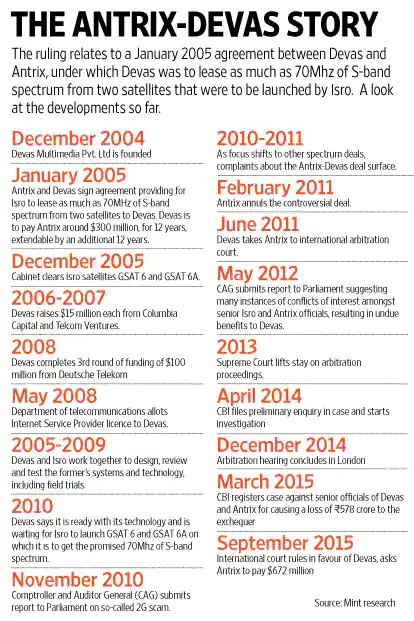
    What is Antrix- Devas Multimedia Deal?

    A Canadian court has ordered the seizure of more than $30 million worth of Airport Authority of India’s assets.

    Background

    • In 2005, Devas Multimedia signed an agreement with Antrix —a commercial arm of the IISRO —to provide multimedia services to mobile users using the leased S-band satellite spectrum to be provided by Antrix.
    • In 2011, the UPA-2 government canceled this agreement on the ground that it needed the S-band satellite spectrum for national security and other social purposes.
    • This led to arbitration between Antrix and Devas at the International Chambers of Commerce (ICC) and two bilateral investment treaty (BIT) arbitrations. India lost all three disputes.

    India’s non-compliance

    • AAI and Air India are being targeted because they are Indian public sector entities with overseas assets and serve as a proxy for the government of India.
    • The Canada court can do so through the concept of restrictive immunity.
    • In the meanwhile, the National Company Law Tribunal (India) ordered the liquidation of Devas Multimedia on the ground that the affairs of the company were being carried on fraudulently.

    Why did India cancel the deal?

    • The scandal first came to light when in 2011, the news reported that there were some irregularities in the agreement between Antrix and Devas.
    • They reported the findings of a draft audit report and pointed out discrepancies including financial mismanagement, conflict of interest, non-compliance of rules, and favoritism.
    • This revelation came at the heel of the 2G spectrum scam which was condemned for the high level of corruption.

    How can a Canadian court order the attachment of Indian assets?

    • State immunity — a well-established principle of international law — shields a state and its property against legal proceedings in the courts of other countries.
    • This covers immunity from both jurisdiction and execution.
    • However, there is no international legal instrument in force dealing with state immunity in the municipal legal systems of different countries, which has created an international void.
    • Consequently, countries have filled this void through their national legislations and domestic judicial practices on state immunity.
    • Typically, prominent jurisdictions such as Canada follow the concept of restrictive immunity (a foreign State is immune only for sovereign functions) and not absolute immunity.

    How can assets of AAI be seized when the claim is against India?

    • In execution proceedings, assets of an entity can be seized if that entity is an alter ego of the State that fails to comply with the arbitral award.
    • In other words, if the foreign sovereign exercises such extensive control over the entity, then the presumption that the entity has a separate corporate character is set aside.
    • Thus, the Canadian court must have concluded that the Indian government extensively controls AAI.

    What options does India have?

    • The first option is to comply with the two adverse BIT awards. However, it is highly unlikely that India would do so.
    • The second option is to challenge this decision in an appellate court in Canada as per Canadian law where India can try proving that the ‘extensive control requirement’ is not met in the case of AAI.
    • However, state immunity from execution is purely a procedural hurdle to the enforcement of the BIT award.
    • It cannot justify India’s breach of its international law obligations enshrined in the two BITs and the continued failure to comply with the arbitral awards.

    Back2Basics: New Space India Limited (NSIL)

    • It functions under the administrative control of the Department of Space (DOS).
    • It aims to commercially exploit the research and development work of ISRO Centres and constituent units of DOS.
    • The NSIL would enable Indian Industries to scale up high-technology manufacturing and production base for meeting the growing needs of the Indian space program.
    • It would further spur the growth of Indian Industries in the space sector.

    ANTRIX

    • Antrix Corporation Limited (ACL), Bengaluru is a wholly-owned Government of India Company under the administrative control of the Department of Space.
    • It is as a marketing arm of ISRO for promotion and commercial exploitation of space products, technical consultancy services and transfer of technologies developed by ISRO.
    • Antrix is engaged in providing Space products and services to international customers worldwide.


    UPSC 2022 countdown has begun! Get your personal guidance plan now! (Click here)
  • Languages and Eighth Schedule

    English is the language of Court: Gujarat HC

    A Division Bench of the Gujarat High Court has asked a convict to speak only in English as that was the language in the higher judiciary referring to Article 348 of the Constitution which mandates that the language of the High Court would be English.

    What is Article 348?

    • It provides for languages to be used in the Supreme Court and in the High Courts and for Acts, Bills, etc
    • Article 348 (1) provides that all proceedings in the Supreme Court and in every High court shall be in English Language until Parliament by law otherwise provides.
    • Under Article 348 (2), the Governor of the State may, with the previous consent of the President, authorize the use of the Hindi language or any other language used for any official purpose of the State.
    • It states that in the proceedings of the High Court having its principal seat in that State provided that decrees, judgments or orders passed by such High Courts shall be in English.

    When is use of other languages permitted?

    • Section 7 of the Official Languages Act, 1963, provides that the use of Hindi or official language of a State in addition to the English language may be authorized.
    • This has to be done with the consent of the President of India, by the Governor of the State for purpose of judgments etc. made by the High Court for that State.


    UPSC 2022 countdown has begun! Get your personal guidance plan now! (Click here)

  • Modern Indian History-Events and Personalities

    Significance of Delhi government’s recognition to fifth Sikh Takht

    The Delhi Assembly has passed an amendment Bill to the Delhi Sikh Gurdwara Act, 1971, recognizing Takht Damdama Sahib as the fifth Takht of Sikhs.

    What is a Sikh Takht?

    • A Takht, which means a throne, is a seat of temporal authority for Sikhs.
    • There are five Sikh Takhts, three in Punjab and one each in Maharashtra and Bihar.

    (1) Akal Takht

    • Located in Amritsar, it is the oldest of the Takhts, and considered supreme among the five.
    • It was set up in 1606 by Guru Hargobind, whose succession as the sixth Guru after the execution of his father, Guru Arjan Dev, is considered a turning point in Sikh history.
    • The Akal Takht, a raised platform that he built in front of the causeway leading to the sanctum sanctorum of the Harmandir Sahib (Golden Temple).
    • It symbolised the coming together of the temporal authority and the political sovereignty of the Sikh community (miri) with the spiritual authority (piri).
    • It is seen as the first marker of Sikh nationalism.

    The other four Takhts are linked to Guru Gobind Singh, the tenth Sikh Guru.

    (2) Takht Keshgarh Sahib

    • Located in Anandpur Sahib in Punjab. It was here that Guru Gobind Singh raised Khalsa, the initiated Sikh warriors, in 1699.

    (3) Takht Patna Sahib

    • Guru Gobind Singh was born here in 1666.

    (4) Takht Hazur Sahib

    • In Nanded, where Guru Gobin Singh spent time and where he was cremated in 1708.

    (5) Takht Damdama Sahib

    • In Talwandi Sabo of Bathinda. Guru Gobind Singh spent several months here.

    What does the amendment to the Delhi Sikh Gurdwara Act mean?

    • Simply put, it adds one more ex officio member in the Delhi Sikh Gurdwara Managament Committee (DSGMC) house.
    • Earlier, there were four ex officio members in the house — the chiefs (jathedars) of the other four Sikh Takhts.

    Is it the first time it has been recognised as the fifth Takht?

    • It was back in 1999 that Takht Damdama Sahib was recognised as the fifth Sikh Takht by the Union Home Ministry.
    • It included it as such in the Sikh Gurdwaras Act, 1925 (Punjab Act VIII of 1925) with a notification dated April 23, 1999.
    • Before that, an SGPC sub-committee had declared it the fifth Takht of Sikhs back in November 1966 after Punjab was carved out as a separate state through the Punjab Reorganisation Act, 1966.

    How politically significant is the move?

    • It comes ahead of the Punjab Assembly elections, where the, Delhi’s ruling party, has high stakes.

    What is the role of the Sikh Takhts?

    • The Takhts are known to issue hukumnamas (morality orders) from time to time on issues that concern the Sikh community.
    • Akal Takht is supreme among them because it is the oldest and was created by a Sikh Guru himself, say Sikh scholars.
    • Any edict or order concerning the entire community is issued only from Akal Takht.
    • It is from Akal Takht that Sikhs found to be violating the Sikh doctrine and code of conduct are awarded religious punishment (declared tankhaiya).

    Who appoints the jathedars of the Takhts?

    • The three Takhts in Punjab are directly controlled by the SGPC, which appoints the jathedars.
    • The SGPC is dominated by SAD members.
    • It is widely understood that SAD puts the final seal on the appointment of these three jathedars.
    • The two Takhts outside Punjab have their own trusts and boards.


    UPSC 2022 countdown has begun! Get your personal guidance plan now! (Click here)

Join the Community

Join us across Social Media platforms.