💥UPSC 2027,2028 Mentorship (May Batch) + Access XFactor Notes & Microthemes PDF

Archives: News

  • Foreign Policy Watch: India-China

    Bhutan-China Border Agreement

    In a step towards resolving their boundary disputes, Bhutan and China signed an agreement on a three-Step roadmap to help speed up talks to “break the deadlock” in negotiations.

    Bhutan-China Border Issues

    Bhutan shares an over 400-km-long border with China.

    • Doklam: China wants to exchange the valleys to the north of Bhutan with the pasture land to the west (including Doklam), totalling 269 square kilometres.
    • Jakarlung and Pasamlung valleys: located near Tibet to Bhutan’s North, which measure 495 sq. kms.
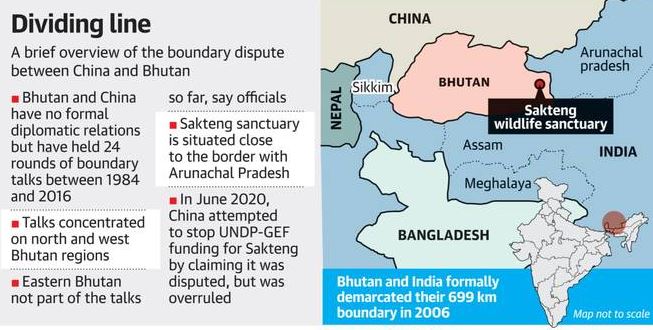
    • Sakteng Wildlife Sanctuary Project: China claims this area (near to Arunachal Pradesh) in eastern Bhutan as its own.

    What is the recent agreement?

    • The roadmap “for Expediting the Bhutan-China Boundary Negotiations”, is expected to progress on the boundary talks process that has been delayed for five years.
    • It was stalled due to the Doklam standoff in 2017, and then by the Covid Pandemic.
    • Although China and Bhutan do not have official diplomatic relations they have engaged in 24 rounds of ministerial-level talks to resolve their border dispute.

    Implications for India

    The boundary issue between China and Bhutan is special because it not only relates to Bhutan but also has become a negative factor for China-India ties.

    • China control much of the Doklam: Since the 2017 stand-off with India, Beijing has already strengthened its de facto control over much of the Doklam plateau, located strategically along the India-China-Bhutan trijunction.
    • Bhutan supports it: This agreement has been equally endorsed and appreciated by Bhutan and China.
    • Deadlock at LAC talks: Its timing is particularly significant New, given India-China border talks on their 17-month-old standoff at the Line of Actual Control appear to have hit an deadlock.
    • India’s strategic risks: This has big implications for India, since the Doklam swap would have given China access to the strategically sensitive “chicken neck” of the Siliguri corridor.

    India’s interest

    (a) Doklam

    • The Doklam plateau remains hugely critical for India due to the Siliguri Corridor that lies to the south of Doklam.
    • The corridor, also known as the ‘Chicken’s Neck’, is a 22-km wide major arterial road connecting mainland India with its northeastern states and thus it is a highly sensitive area for China.

    (b) Sakteng: the hotspot

    • The Sakteng sanctuary adjoins West Kameng district and Tawang disticts in India’s Arunachal Pradesh state.
    • Its strategic value lies in its proximity to Arunachal Pradesh, where China claims around 90,000 sq km of Indian territory.
    • Tawang, the major bone of contention between India and China in the eastern sector of their border dispute, lies to the northeast of the Sakteng.

    Conclusion

    • Bhutan has to balance its ties with India as well as China.
    • We need to explore channels that India can activate with Bhutan when it comes to the highly sensitive matter of settling the boundary dispute between them and China.


    UPSC 2022 countdown has begun! Get your personal guidance plan now! (Click here)

  • Climate Change Negotiations – UNFCCC, COP, Other Conventions and Protocols

    COP26 Climate Conference and Why it is important

    The UK will host the COP 26 UN Climate Change Conference from October 31 to November 12.

    Conference of Parties (CoP): A Backgrounder

    • The CoP comes under the United Nations Climate Change Framework Convention (UNFCCC) which was formed in 1994.
    • The UNFCCC was established to work towards “stabilisation of greenhouse gas concentrations in the atmosphere.”
    • It laid out a list of responsibilities for the member states which included:
    1. Formulating measures to mitigate climate change
    2. Cooperating in preparing for adaptation to the impact of climate change
    3. Promoting education, training and public awareness related to climate change
    • The UNFCCC has 198 parties including India, China and the USA. COP members have been meeting every year since 1995.

    COP1 to COP25: Key takeaways

    COP1: The first conference was held in 1995 in Berlin.

    COP3: It was held in Kyoto, Japan, in 1997, the famous Kyoto Protocol (w.e.f. 2005) was adopted. It commits the member states to pursue limitation or reduction of greenhouse gas emissions.

    COP8: India hosted the eighth COP in 2002 in New Delhi. It laid out several measures including, ‘strengthening of technology transfer… in all relevant sectors, including energy, transport and R&D,  and the strengthening of institutions for sustainable development.

    COP21: it is one of the most important that took place in 2015, in Paris, France. Here countries agreed to work together to ‘limit global warming to well below 2, preferably at 1.5 degrees Celsius, compared to pre-industrial levels.’

    Significance of COP26

    • The event will see leaders from more than 190 countries, thousands of negotiators, researchers and citizens coming together to strengthen a global response to the threat of climate change.
    • It is a pivotal movement for the world to come together and accelerate the climate action plan after the COVID pandemic.

    COP26 goals

    According to the UNFCCC, COP26 will work towards four goals:

    1. Secure global net-zero by mid-century and keep 1.5 degrees within reach
    • The UNFCCC recommends that countries ‘accelerate the phase-out of coal, curtail deforestation, speed up the switch to electric vehicles and encourage investment in renewables’ to meet this goal.
    1. Adapt to protect communities and natural habitats
    • Countries will work together to ‘protect and restore ecosystems and build defences, warning systems and resilient infrastructure and agriculture to avoid loss of homes, livelihoods and even lives.’
    1. Mobilise finance
    • To deliver on first two goals, developed countries must make good on their promise to mobilise at least $100bn in climate finance per year by 2020.
    1. Work together to deliver
    • Another important task at the COP26 is to ‘finalise the Paris Rulebook’. Leaders will work together to frame a list of detailed rules that will help fulfil the Paris Agreement.

    What India could do to reach its targets?

    • Update NDCs: It is time for India to update its Nationally Determined Contributions or NDCs. (NDCs detail the various efforts taken by each country to reduce the national emissions)
    • Effective planning: Sector by sector plans are needed to bring about development. We need to decarbonise the electricity, transport sector and start looking at carbon per passenger mile.
    • Energy transition: Aggressively figure out how to transition our coal sector
    • Robust legal framework: India also needs to ramp up the legal and institutional framework of climate change.

    Try answering this PYQ:

    With reference to the Agreement at the UNFCCC Meeting in Paris in 2015, which of the following statements is/are correct?

    1. The Agreement was signed by all the member countries of the UN and it will go into effect in 2017.
    2. The Agreement aims to limit the greenhouse gas emissions so that the rise in average global temperature by the end of this century does not exceed 2 degree Centigrade or even 5 degree Centigrade above pre-industrial levels.
    3. Developed countries acknowledged their historical responsibility in global warming and committed to donate dollar 1000 billion a year from 2020 to help developing countries to cope with climate change.

    Select the correct answer using the code given below:

    (a) 1 and 3 only

    (b) 2 only

    (c) 2 and 3 only

    (d) 1, 2 and 3


    Post your answers here.


    UPSC 2022 countdown has begun! Get your personal guidance plan now! (Click here)
  • Innovations in Biotechnology and Medical Sciences

    Zeolite Oxygen Concentrators: Chemistry in 3-D

    To meet the demand of oxygen supply in the country during the peak of pandemic, the Defence Research and Development Organisation (DRDO) had chartered the Air India to import ‘Zeolite’ from different countries.

    What are Zeolites?

    • Zeolites are highly porous, 3-dimensional meshes of silica and alumina.
    • In nature, they occur where volcanic outflows have met water.
    • Synthetic zeolites have proven to be a big and low-cost boon.

    Uses in Oxygen Concentrator

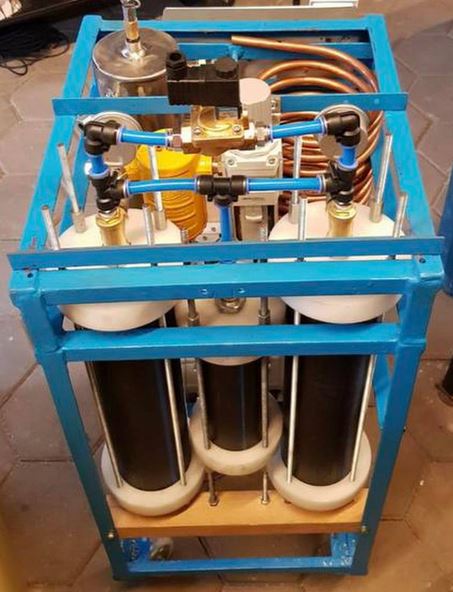
    • One biomedical device that has entered our lexicon during the pandemic is the oxygen concentrator.
    • This device has brought down the scale of oxygen purification from industrial-size plants to the volumes needed for a single person.
    • At the heart of this technology are synthetic frameworks of silica and alumina with nanometer-sized pores that are rigid and inflexible.
    • Beads of one such material, zeolite 13X, about a millimeter in diameter, are packed into two cylindrical columns in an oxygen concentrator.

    How does it work?

    • Zeolite performs the chemistry of separating oxygen from nitrogen in air.
    • Being highly porous, zeolite beads have a surface area of about 500 square meters per gram.
    • At high pressures in the column, nitrogen is in a tight embrace, chemically speaking, with the zeolite.
    • Interaction between the negatively charged zeolite and the asymmetric nucleus (quadrupole moment) of nitrogen causes it to be preferentially adsorbed on the surface of the zeolite.
    • Oxygen remains free, and is thus enriched.
    • Once nitrogen is captured, what flows out from the column is 90%-plus oxygen.
    • After this, lowering the pressure in the column releases the nitrogen, which is flushed out, and the cycle is repeated with fresh air.


    UPSC 2022 countdown has begun! Get your personal guidance plan now! (Click here)

  • Indian Army Updates

    Exercise Yudh Abhyas 2021

    The 17th edition of the India-U.S. bilateral exercise, Yudh Abhyas 2021, got underway in mountainous terrain and cold climate conditions of Alaska, US.

    Yudh Abhyas 2021

    • Exercise Yudh Abhyas is the largest running joint military training and defence cooperation endeavour between India and USA.
    • The exercise aims at enhancing understanding, cooperation and interoperability between the two armies.

    Why it is significant?

    • Interestingly, this is the only India-U.S. service exercise continuing in bilateral format.
    • The India-U.S. Malabar naval exercise became trilateral with the addition of Japan in 2015 and further brought in all the Quad partners together with the inclusion of Australia in 2020.
    • Similarly, Japan joined the India-U.S. bilateral air exercise, Cope India, as an Observer in 2018 and the plan is to make it trilateral in phases.
    • Other than the Malabar, Japan had sent observers for the first time during Cope India 2018 as an Observer in 2018. s


    UPSC 2022 countdown has begun! Get your personal guidance plan now! (Click here)

  • Medical Education Governance in India

    NEET hasn’t created the equality of opportunity

    Context

    The Tamil Nadu government has passed an Act seeking an exemption from treating NEET as the sole and mandatory requirement for medical admission in the state. The Act, which is yet to get approval from the President.

    NEET issue in Tamil Nadu

    • The Justice A K Rajan committee was appointed by the state government of Tamil Nadu to examine whether NEET is an equitable method of selection.
    • Its report lends credence to the belief that NEET tends to give an advantage to students from privileged backgrounds.
    • It also observed that NEET, in terms of orientation, is biased towards the Central Board of Secondary Education (CBSE).
    • In the section titled ‘Size of coaching market’, the report brings out two poignant facts.
    • One, by inadvertently creating a “market for coaching”, NEET has helped to create an “extractive industry of coaching” as an essential condition for clearing it.
    • Two, the coaching fees are not only high, but are beyond the reach of many, especially the poor and marginalised.
    • Acting upon the committee’s recommendation, the Tamil Nadu government has passed an Act seeking an exemption from treating NEET.
    • The Act, which is yet to get approval from the President.
    •  An educational intervention which was introduced as a solution to foster equality of opportunity has turned out to be the primary cause of deepening inequality of participation and opportunity.

    Important questions

    • There are at least two important questions.
    • Equality of opportunity: First, does NEET help foster equality of opportunity for everyone without unduly advantaging or disadvantaging anyone?
    • Second, is NEET’s bias towards CBSE justifiable in an immensely diverse country like ours, where varied school curricula coexist with a highly unequal access to financial and educational resources and opportunities?
    • The question here is: How can NEET promote parity of participation when aspiring first-generation students from marginalised and poor households participate from a highly unequal position in the first place?
    • NEET disregards the fact that the terms and conditions of participation are highly unequal and biased.

    Way forward

    • The National Education Policy (NEP 2020) envisions a curriculum and pedagogy which will promote holistic learning, social responsibility and multilingualism, among other things.
    • It is important, therefore, to significantly restructure the focus of NEET keeping in mind the spirit of NEP and varied school curricula in regional languages.

    Conclusion

    A restructured NEET, which does not require intensive and repeated coaching as a prerequisite and is not biased towards any board, can go a long way in promoting the parity of participation and nourishing the capacity to aspire, especially of the poor and marginalised.

    UPSC 2022 countdown has begun! Get your personal guidance plan now! (Click here)

  • India-Central Asia relations

    In his speech at the Shanghai Cooperation Organization (SCO) meet last month, PM Modi stressed on commitment for increasing its connectivity with land-locked Central Asia.

    What is the Central Asia Region?

    • Central Asia is a region in Asia which stretches from the Caspian Sea in the west to China and Mongolia in the east, and from Afghanistan and Iran in the south to Russia in the north.
    • It includes the former Soviet republics of Kazakhstan, Kyrgyzstan, Tajikistan, Turkmenistan, and Uzbekistan.

    India-Central Asia Ties

    • India has decades-old wish to connect with the resource and fuel-rich Central Asian nations.
    • Since the emergence of the Central Asian Republics as independent countries in the early 1990s, New Delhi has been trying to establish ties with them.

    Trade and collaboration

    • India’s trade with the five Central Asian Republics—Kazakhstan, Uzbekistan, Turkmenistan, Kyrgyzstan and Tajikistan—was below $ 2 billion in 2018.
    • The potential areas for collaboration include construction, sericulture and pharmaceuticals to IT and tourism.
    • Much of this trade was routed through Iran, Russia or the United Arab Emirates (UAE).

    Efforts for connectivity


    1. Turkmenistan–Afghanistan–Pakistan–India (TAPI) Gas Pipeline
    2. Development of Iran’s Chabahar Port
    3. Zaranj-Delaram Highway
    4. International North-South (Transit) Corridor (INSTC)

    About INSTC

    • In 2000, India, Iran and Russia agreed on a new route for trade that later came to be known as INSTC.
    • It was aimed at cutting the costs and time in moving cargo between Russia and India.
    • The pact was ratified in 2002 and the original multi-modal route linked Mumbai in India to Bandar Abbas and Bandar-e-Anzali in Iran, then across the Caspian Sea to Astrakhan, Moscow and St. Petersburg in Russia.
    • Over the years, more countries joined the INSTC.
    • In 2003, India and Iran announced the development of the Chabahar port in the Sistan-Balochistan province.

    China’s opportunism: Based on proximity

    • China’s trade with Central Asia was $50 billion-$60 billion in the same period.
    • The obvious advantage in China’s favour is geographical proximity.

    Hurdles for India

    • Lack of mutual trust: Unfortunately, many connectivity options are not open to them today due to the lack of mutual trust.
    • Pakistan factor: Tensions with Pakistan mean there is no viable land route towards Central Asia.
    • Iran and the US sanctions: Efforts to look for a circuitous route via Iran (and Afghanistan) have stalled due to US sanctions on Iran.

    Issues in Iran-Afghanistan bypass route

    Recent events acquire broader geopolitical relevance for India in this route:

    • Taliban takeover of Afghanistan: The takeover of Afghanistan by the Pakistan-backed Taliban has severely set back India’s plans in Central Asia.
    • Iran’s bypassing of India: Iran’s overtures has been clearly visible after itself allocating Farzad-B Gas exploration contract to another company bypassing India.

    Central Asia’s importance for India

    • Fossil fuels: While Central Asia is seen as fuel-rich and, hence, important for an energy-starved India.
    • Mineral richness: Central Asian states are also mineral-rich, and Kazakhstan, for one, has been a source of uranium for India’s nuclear power plants.
    • Market for India: A country like India which is seen as a major economy has to have a presence in these markets. INSTC also offers a safe and cost-effective route to the EU (European Union) market.
    • Convergence against Terrorism: India can forge a common position on terrorism and radicalization, which is a matter of concern to the region as much as it is to India.

    India’s recent engagement

    • Defence collaboration: In recent years, New Delhi has engaged with Central Asian Republics in the defence sphere through military exercises (say Ex Kazind).
    • Engagement at UN: Political and economic engagement is also important, given the imperatives of working together at a body such as the United Nations (UN).
    • Technological ties: India has set up universities there—Sharda and Amity are examples.

    Scope for expansion

    • Dairy Sector: There is scope for collaboration in the dairy sector.
    • Pharma: Indian firms have been setting up pharmaceutical units in Russia that can serve these countries as well.
    • Info Technology: IT and IT-enabled services are two other areas.
    • Cultural connect: Bollywood movies are quite famous in these countries.

    Way forward

    • India needs to develop into stronger bonds of trade and commercial bonds which will be possible once the INSTC crystallizes.

    Conclusion

    • The road ahead in the short term is difficult as India doesn’t seem to have any real leverage to get the connectivity projects with Central Asia going.
    • India has been negotiating with individual bilateral partners though.


    UPSC 2022 countdown has begun! Get your personal guidance plan now! (Click here)

    Also read:

    [Burning Issue] Ashgabat Agreement

  • Roads, Highways, Cargo, Air-Cargo and Logistics infrastructure – Bharatmala, LEEP, SetuBharatam, etc.

    PM GatiShakti — National Master Plan

    The PM has inaugurated the GatiShakti — National Master Plan for infrastructure development aimed at boosting multimodal connectivity and driving down logistics costs.

    GatiShakti — National Master Plan

    • PM GatiShakti is a digital platform that connects 16 ministries — including Roads and Highways, Railways, Shipping, Petroleum and Gas, Power, Telecom, Shipping, and Aviation.
    • It aims to ensure holistic planning and execution of infrastructure projects.
    • The objective is to ensure that every department now has visibility of each other’s activities providing critical data while planning and execution of projects.
    • Through this, different departments will be able to prioritize their projects through cross-sectoral interactions.

    Notable features

    • Geospatial data: The portal will offer 200 layers of geospatial data, including on existing infrastructure such as roads, highways, railways, and toll plazas.
    • Protected areas management: It would also geographic information about forests, rivers, and district boundaries to aid in planning and obtaining clearances.
    • Realtime monitoring: The portal will also allow various government departments to track, in real-time and at one centralized place, the progress of various projects.

    Monitoring mechanism

    • The National Master Plan has set targets for all infrastructure ministries.
    • A project monitoring group under the Department for Promotion of Industry and Internal Trade (DPIIT) will monitor the progress of key projects in real-time.
    • It would report any inter-ministerial issues to an empowered group of ministers, who will then aim to resolve these.

    Need for such Project

    • Avoiding poor infrastructure planning: Examples of poor infrastructure planning included newly-built roads being dug up by the water department to lay pipes.
    • Creating a multi-modal network: The government expects the platform to enable various government departments to synchronize their efforts into a multi-modal network.
    • Timely completion of infra projects: It is also expected to help state governments give commitments to investors regarding timeframes for the creation of infrastructure.
    • Inefficient connectivity: Currently, a number of economic zones and industrial parks are not able to reach their full productive potential due to inefficient multi-modal connectivity.
    • Easy clearance: The portal allows stakeholders to apply for these clearances from the relevant authority directly.

    Logistics costs in India

    • Studies estimate that logistics costs in India are about 13-14% of GDP as against about 7-8% of GDP in developed economies.
    • High logistics costs impact cost structures within the economy by making it more expensive for exporters to ship merchandise to buyers.

    Benefits offered by PM-GatiShakti

    • Collaborative planning: It would incorporate infrastructure schemes under various ministries and state governments, including the Bharatmala and inland waterways schemes, and economic zones.
    • Logistics boost: It would boost last-mile connectivity and thus bring down logistics costs with integrated planning and reducing implementation overlaps.


    UPSC 2022 countdown has begun! Get your personal guidance plan now! (Click here)

  • Policy Wise: India’s Power Sector

    [pib] Maharatna status accorded to Power Finance Corporation Ltd (PFC)

    The Centre has accorded ‘Maharatna’ status to the state-owned Power Finance Corporation Ltd (PFC), thus giving PFC greater operational and financial autonomy.

    About PFC Ltd.

    • Power Finance Corporation Ltd. (PFC) is an Indian financial institution under the ownership of Ministry of Power.
    • Established in 1986, it is the financial backbone of Indian Power Sector.
    • PFC is the 8th highest profit making Central Public Sector Enterprise (CPSE) as per the Department of Public Enterprises Survey for FY 2017–18.
    • It is India’s largest NBFC and also India’s largest infrastructure finance company.

    Benefits of Maharatna Status

    • This new status will enable PFC to offer competitive financing for the power sector, which will go a long way in making available affordable & reliable ‘Power For All 24×7’.
    • This will also impart enhanced powers to the PFC Board while taking financial decisions.
    • It can make equity investments to undertake financial joint ventures and wholly-owned subsidiaries and undertake mergers and acquisitions in India and abroad.
    • It can also structure and implement schemes relating to personnel and Human Resource Management and Training.
    • It can also enter into technology Joint Ventures or other strategic alliances among others.

    Back2Basics: Central Public Sector Enterprises

    • The CPSEs are run by the Government under the Department of Public Enterprises of Ministry of Heavy Industries and Public Enterprises.
    • The government grants the status of Navratna, Miniratna and Maharatna to them based upon the profit made by these CPSEs.
    • The Maharatna category has been the most recent one since 2009, other two have been in function since 1997.


    Maharatna Navratna Miniratna Category-I Miniratna Category-II
    Eligibility Three years with an average annual net profit of over ₹2,500 crore

    OR

    Average annual Net worth of ₹10,000 crore for 3 years

    OR

    Average annual Turnover of ₹20,000 crore for 3 years


    A score of 60 (out of 100), based on six parameters which include net profit, net worth, total manpower cost, total cost of production, cost of services, PBDIT (Profit Before Depreciation, Interest and Taxes), capital employed, etc.,

    AND

    A company must first be a Miniratna and have 4 independent directors on its board before it can be made a Navratna

    Have made profits continuously for the last three years or earned a net profit of ₹30 crore or more in one of the three years Have made profits continuously for the last three years and should have a positive net worth.
    Benefits for investment ₹1,000 crore – ₹5,000 crore, or free to decide on investments up to 15% of their net worth in a project  

    Up to ₹1,000 crore or 15% of their net worth on a single project or 30% of their net worth in the whole year

    Up to ₹500 crore or equal to their net worth, whichever is lower Up to ₹300 crore or up to 50% of their net worth, whichever is lower


    UPSC 2022 countdown has begun! Get your personal guidance plan now! (Click here)

  • Tiger Conservation Efforts – Project Tiger, etc.

    Places in news: Mudumalai Tiger Reserve

    P

    PC: MapsOfIndia

    A tiger believed to have been responsible for the death of two herders in the Mudumalai Tiger Reserve was finally captured.

    Read all the tiger reserves in India through this map. Put more focus on South Indian states and the NE region.

    Mudumalai Tiger Reserve

    • Mudumalai National Park is a national park in the Nilgiri Mountains in Tamil Nadu.
    • It is located in the Nilgiri District and shares boundaries with the states of Karnataka and Kerala.
    • It is part of the Nilgiri Biosphere Reserve and was declared a tiger reserve in 2007.
    • It harbours several endangered and vulnerable species including Bengal tiger, Indian leopard, Indian elephant and gaur.

    Try this PYQ:

    Q. Recently there was a proposal to translocate some of the lions from their natural habitat in Gujarat to which one of the following sites?

    (a) Corbett National Park

    (b) Kuno Palpur Wildlife Sanctuary

    (c) Mudumalai Wildlife Sanctuary

    (d) Sariska National Park


    Post your answers here.


    UPSC 2022 countdown has begun! Get your personal guidance plan now! (Click here)

  • Defence Sector – DPP, Missions, Schemes, Security Forces, etc.

    Securing the States

    Context

    The Ministry of Home Affairs recently issued a notification extending the jurisdiction of the Border Security Force from 15 km to a depth of 50 km along the international borders in three states — Punjab, Assam and West Bengal.

    Background of the notification about jurisdiction of BSF

    • The last notification of the MHA (July 3, 2014), which defined the jurisdiction of the BSF, stated that the force could operate in the entire states of Nagaland, Manipur, Mizoram, Tripura and Meghalaya without any restrictions whatsoever.
    • In Gujarat, it had jurisdiction up to a depth of 80 km and in Rajasthan up to 50 km.
    • In Punjab, Assam and West Bengal, the BSF jurisdiction was up to a depth of 15 km only.
    • Under the latest notification issued on October 11, 2021, there is no change in the northeastern states and Rajasthan.
    • In Gujarat, jurisdiction has been reduced from 80 km to 50 km.
    • The controversial change is in Assam, West Bengal and Punjab, where the BSF jurisdiction has been extended from 15 km to 50 km.
    • It is this part of the notification which has generated controversy, though the criticism has been made by leaders of Punjab and West Bengal.

    Why the government of India decided to extend the jurisdiction of BSF?

    • Assam, West Bengal and Punjab have international borders.
    • Changed threat perception: The threat perception from across the international borders has undergone a sea change in the context of recent developments in the Af-Pak region.
    • Efforts to destabilise Punjab: Radical groups of different shades are feeling emboldened and are going to make a determined attempt to destabilise Punjab.
    • Pakistan-sponsored terrorist groups, particularly the Lashkar-e-Toiba and Jaish-e-Muhammad, will almost certainly renew their onslaught in the border states.
    • West Bengal has already undergone a huge demographic change.
    • Assam faces multiple problems of ethnic insurgencies, smuggling, counterfeit currency, drug trafficking, etc.
    • Police need assistance: The police across the country are in a state of atrophy and they need the assistance of central armed police forces even for maintaining normal law and order.
    • As such, their effectiveness against the emerging trans-border threats is suspect.

    Implications for powers of police and federalism

    • The home ministry’s latest notification only seeks to reinforce the capabilities of the state police in securing the states under section 139 of the BSF Act, which empowers the members of the force to discharge certain powers and duties within local limits of the areas specified in the schedule.
    •  The jurisdiction of the state police has neither been curtailed nor its powers reduced in any manner.
    • It is just that the BSF will also be exercising powers of search, seizure and arrest in respect of only the Passport Act 1967, Passport (Entry into India) Act 1920 and specified sections of the Criminal Procedure code.
    • The power to register FIR and investigate the case remains with the state police.
    • The Indian Constitution, no doubt, fulfils some conditions of a federation, but it leans towards a strong Centre.

    Conclusion

    National security is a paramount consideration. It is unfortunate that the BSF is being dragged into political controversy when it would actually be over-stretching itself to strengthen national security.

    UPSC 2022 countdown has begun! Get your personal guidance plan now! (Click here)

Join the Community

Join us across Social Media platforms.