💥UPSC 2026, 2027, 2028 UAP Mentorship (March Batch) + Access XFactor Notes & Microthemes PDF

Archives: News

  • Minority Issues – SC, ST, Dalits, OBC, Reservations, etc.

    Supreme Court directive on Quota in Promotions

    The Supreme Court has asked Attorney General to compile the various issues being raised by States with regard to the 2006 M. Nagaraj case, which had upheld the application of creamy layer principle to members of the SC/ST communities in promotions.

    Must read edition: Reservation not a Fundamental Right

    What is the case about?

    • The Centre’s plea came despite the Supreme Court, in September 2018, in Jarnail Singh case, reiterating the Nagaraj judgment of 2006.
    • The 2006 judgment required the States to show quantifiable data to prove the ‘backwardness’ of a community to provide quota in promotion in public employment,
    • The 2018 judgment, which was authored by Justice Rohinton F. Nariman, had refused the government’s plea to refer the 2006 Nagaraj judgment to a seven-judge Bench.
    • It had while modifying the part of the Nagaraj verdict, rejected the Centre’s argument that Nagaraj misread the creamy layer concept by applying it to SC/ST.

    Nagaraj Case

    • In Jarnail Singh vs Lachhmi Narain Gupta (2018), the court dealt with a batch of appeals on the correctness of the Supreme Court’s judgment in M Nagaraj & Others vs Union of India (2006).
    • The Nagaraj case, in turn, had arisen out of a challenge to the validity of four Constitution amendments, which the court eventually upheld.

    What were the amendments?

    • 77th Amendment: It introduced Clause 4A to the Constitution, empowering the state to make provisions for reservation in matters of promotion to SC/ST employees if the state feels they are not adequately represented.
    • 81st Amendment: It introduced Clause 4B, which says unfilled SC/ST quota of a particular year, when carried forward to the next year, will be treated separately and not clubbed with the regular vacancies of that year to find out whether the total quota has breached the 50% limit set by the Supreme Court.
    • 82nd Amendment: It inserted a proviso at the end of Article 335 to enable the state to make any provision for SC/STs “for relaxation in qualifying marks in any examination or lowering the standards of evaluation, for reservation in matters of promotion to any class or classes of services or posts in connection with the affairs of the Union or of a State”.
    • 85th Amendment: It said reservation in the promotion can be applied with consequential seniority for the SC/ST employee.

    What is Art.335 about?

    • Article 335 of the Constitution relates to claims of SCs and STs to services and posts.
    • It reads: “The claims of the members of the SC’s and ST’s shall be taken into consideration, consistently with the maintenance of efficiency of administration, in the making of appointments to services and posts in connection with the affairs of the Union or of a State.”

  • Women empowerment issues – Jobs,Reservation and education

    Task force on Age of Marriage for Women submits its report

    The task force set up to take a re-look at the age of marriage for women has submitted its report to the Prime Minister’s Office and the Ministry of Women and Child Development.

    Try this question for mains:

    Q.The different minimum age of marriage for women and men is a discriminatory provision. Analyse.

    What is the issue?

    • PM in his I-Day speech last year spoke about a panel formed to decide on the “right age of marriage” for women.
    • The minimum age of marriage, especially for women, has been a contentious issue.
    • The law evolved in the face of much resistance from religious and social conservatives.
    • Currently, the law prescribes that the minimum age of marriage is 21 years and 18 years for men and women respectively.

    Invoking ‘Majority’

    • The minimum age of marriage is distinct from the age of majority which is gender-neutral.
    • An individual attains the age of majority at 18 as per the Indian Majority Act, 1875.
    • The law prescribes a minimum age of marriage to essentially outlaw child marriages and prevents the abuse of minors.

    About the Committee

    • The Union Ministry for WCD had set up a task force to examine matters pertaining to the age of motherhood, imperatives of lowering Maternal Mortality Ratio and the improvement of nutritional levels among women.
    • The task force would examine the correlation of age of marriage and motherhood with health, medical well-being, and nutritional status of the mother and neonate, infant or child, during pregnancy, birth and thereafter.
    • It will also examine the possibility of increasing the age of marriage for women from the present 18 years to 21 years.

    How common are child marriages in India?

    • UNICEF estimates suggest that each year, at least 1.5 million girls under the age of 18 are married in India.
    • It makes our country home to the largest number of child brides in the world — accounting for a third of the global total.
    • Nearly 16 per cent adolescent girls aged 15-19 are currently married.

    Provisions for the minimum age for marriage

    • Personal laws of various religions that deal with marriage have their own standards, often reflecting custom.
    • For Hindus, Section 5(iii) of The Hindu Marriage Act, 1955, sets 18 years as the minimum age for the bride and 21 years as the minimum age for the groom.
    • However, child marriages are not illegal — even though they can be declared void at the request of the minor in the marriage.
    • In Islam, the marriage of a minor who has attained puberty is considered valid.
    • The Special Marriage Act, 1954 and the Prohibition of Child Marriage Act, 2006 also prescribe 18 and 21 years as the minimum age of consent for marriage for women and men respectively.
    • Additionally, sexual intercourse with a minor is rape, and the ‘consent’ of a minor is regarded as invalid since she is deemed incapable of giving consent at that age.

    Evolution of the law

    • The IPC enacted in 1860 criminalised sexual intercourse with a girl below the age of 10.
    • The provision of rape was amended in 1927 through The Age of Consent Bill, 1927, which declared that marriage with a girl under 12 would be invalid.
    • The law faced opposition from conservative leaders of the Indian National Movement, who saw the British intervention as an attack on Hindu customs.
    • A legal framework for the age of consent for marriage in India only began in the 1880s.

    Comes in: The Sarda Act

    • In 1929, The Child Marriage Restraint Act set 16 and 18 years as the minimum age of marriage for girls and boys respectively.
    • The law, popularly known as the Sarda Act after its sponsor Harbilas Sarda, a judge and a member of Arya Samaj, was eventually amended in 1978 to prescribe 18 and 21 years as the age of marriage for a woman and a man respectively.

    Contention over different legal standards

    • There is no reasoning in the law for having different legal standards of age for men and women to marry. The laws are a codification of custom and religious practices.
    • The Law Commission consultation paper has argued that having different legal standards “contributes to the stereotype that wives must be younger than their husbands”.
    • Women’s rights activists have argued that the law also perpetuates the stereotype that women are more mature than men of the same age and, therefore, can be allowed to marry sooner.
    • The international treaty Committee on the Elimination of Discrimination against Women (CEDAW), also calls for the abolition of laws that assume women have a different physical or intellectual rate of growth than men.

    Why is the law being relooked at?

    • Despite laws mandating minimum age and criminalizing sexual intercourse with a minor, child marriages are very prevalent in the country.
    • From bringing in gender-neutrality to reduce the risks of early pregnancy among women, there are many arguments in favour of increasing the minimum age of marriage of women.
    • Early pregnancy is associated with increased child mortality rates and affects the health of the mother.

    Upholding the Constitution

    • Petitioners, in this case, had challenged the law on the grounds of discrimination.
    • It is argued that Articles 14 and 21 of the Constitution, which guarantee the right to equality and the right to live with dignity, were violated by having different legal ages for men and women to marry.
    • Two significant Supreme Court rulings can act as precedents to support the petitioner’s claim.
    • In 2014, in the ‘NALSA v Union of India’ case, the Supreme Court, while recognising transgenders as the third gender, said that justice is delivered with the “assumption that humans have equal value and should, therefore, be treated as equal, as well as by equal laws”.
    • In 2019, in ‘Joseph Shine v Union of India’, the Supreme Court decriminalized adultery, and said that “a law that treats women differently based on gender stereotypes is an affront to women’s dignity”.
  • Innovation Ecosystem in India

    [pib] Second edition of India Innovation Index 2020

    NITI Aayog is set to release the second edition of the India Innovation Index 2020 tomorrow.

    *Statewise rankings will be updated tomorrow.

    Updated on 21st Jan, Thursday.

    India Innovation Index (III)

    • The release of the second edition of the index—the first was launched in October 2019—demonstrates the Government’s continued commitment towards transforming the country into an innovation-driven economy.
    • The index attempts to create an extensive framework for the continual evaluation of the innovation environment of 29 states and seven UTs in India.
    • It intends to perform the following three functions-
    1. Ranking of states and UTs based on their index scores
    2. Recognizing opportunities and challenges, and
    3. Assisting in tailoring governmental policies to foster innovation
    • The India Innovation Index 2019 is calculated as the average of the scores of its two dimensions – Enablers and Performance.
    • The states have been bifurcated into three categories: major states, north-east and hill states, and union territories/city-states/small states.

    Significance

    • The study examines the innovation ecosystem of Indian states and union territories.
    • The aim is to create a holistic tool which can be used by policymakers across the country to identify the challenges to be addressed and strengths to build on when designing policies.
  • Wetland Conservation

    Places in news: Harike Wetland

    Winter migratory waterbirds using the central Asian flyway have started making a beeline to Punjab’s Harike wetland, offering a delight for bird lovers.

    Try this PYQ:

    Q.In which one among the following categories of protected areas in India are local people not allowed to collect and use the biomass?

    (a) Biosphere reserves

    (b) National parks

    (c) Wetlands declared under Ramsar convention

    (d) Wildlife sanctuaries

    Harike Wetland

    • Harike Wetland also is the largest wetland in northern India in the border of Tarn Taran Sahib district and Ferozepur district of Punjab.
    • The wetland and the lake were formed by constructing the headworks across the Sutlej River in 1953.
    • The headworks is located downstream of the confluence of the Beas and Sutlej rivers just south of Harike village.
    • The rich biodiversity of the wetland which plays a vital role in maintaining the precious hydrological balance in the catchment with its vast concentration of migratory fauna.
    • It was accorded as a wetland in 1990, by the Ramsar Convention, as one of the Ramsar sites in India, for conservation, development and preservation of the ecosystem.

    Back2Basics: Ramsar Convention

    • The Convention on Wetlands of International Importance (better known as the Ramsar Convention) is an international agreement promoting the conservation and wise use of wetlands.
    • It is the only global treaty to focus on a single ecosystem.
    • The convention was adopted in the Iranian city of Ramsar in 1971 and came into force in 1975.
    • Traditionally viewed as a wasteland or breeding ground of disease, wetlands actually provide fresh water and food and serve as nature’s shock absorber.
    • Wetlands, critical for biodiversity, are disappearing rapidly, with recent estimates showing that 64% or more of the world’s wetlands have vanished since 1900.
    • Major changes in land use for agriculture and grazing, water diversion for dams and canals and infrastructure development are considered to be some of the main causes of loss and degradation of wetlands.
  • Economic Indicators and Various Reports On It- GDP, FD, EODB, WIR etc

    Why Financial boom at a time of economic stagnation?

    Divergence in the financial sector and the overall economy

    • India’s major secondary stock market, the Sensex has been found tracking an upward path, from 40,817 on January 8, 2020, to 48,569 a year later, on January 8, 2021.
    • The trend indicates that GDP in India has been subdued while the financial sector has continued moving up.
    • This paradox has been found to be replicated in other developing as well as advanced economies.
    • These include the major emerging economies such as Brazil and Argentina along with advanced economies such as the United States and the United Kingdom.
    •  It remains an open question whether this paradox can sustain itself.
    • If this cannot sustain, it poses risk for those having large exposures in the financial market and also for the economy as a whole.

    Let’s understand the financial flows beyond the real economy

    • Finance as above, having no counterpart in the productive sector, was identified, first by Karl Marx, as fictitious capital.
    • Earnings from fictitious capital include interests, dividends, and capital gains as well as profits on derivatives.
    • All the above come in the category of unearned or rentier capital.
    • Financial assets, sold with capital gains at higher prices, are met with a rising rather than with the usual declines in demand.
    • Evidently, possibilities of accumulating assets turn even brighter with the high-value assets (used as collaterals), fetching credit for further business.
    • As for the stock prices, which reflect the stream of dividends over time discounted by interest rates, lower rates can help pitch stock prices higher.
    • Cuts in interest rates are often preferred as tools under mainstream prescriptions limiting expansionary policies, which evidently helps stock prices.
    • A journey as above for the financial circuit continues, is subject to market confidence.

    Role of state

    • To look at how finance has attained its present status we need to look at the evolving alliances between finance and the ruling state.
    • The path started with the financial deregulation in the late-1990s when banks were allowed to profit by dealing with securities and with the emergence of hedging devices such as futures and options in the market.
    • It also reflects the rise of non-bank financial institutions as well as shadow banks operating beyond regulations even at cost for the regular banks which had large exposures to the non-banks.
    • The state’s close proximity to big finance is also evident in the revamping of downhill finance, even with bailouts in the name of restoring financial stability.
    • It speaks even more of the pro-finance stance of the government in the neglect of upswings in the financial sector despite the continuing downslides in the real economy.

    Consider the question “What explains the apparent paradox in the India economy with evident divergence in its booming financial sector and subdued economy. What are the risks involved in such situations? Suggest the measures to deal with such situations.

    Conclusion

    Catastrophes, that comes with the sudden collapse of confidence in the financial sector, highlight the need for alternative policies on the part of the state as well as a bit of caution on part of individual investors — in a bid to usher in a sustainable and equitable path of growth for the economy as a whole.


  • Cyber Security – CERTs, Policy, etc

    New ideas needed for online privacy policies

    The article discusses challenges posed by online privacy policies and suggests some ideas to make them more user friendly.

    Issues with online privacy policies

    • Such policies are not designed for easy reading.
    • These policies are full of legal jargon and most are difficult to read.
    • Most policies are exclusively in English, which is clearly inadequate in a country where no more than 12 per cent are comfortable with the language.
    • A human-centric study across India found that even people who couldn’t read or write, when made aware of what they were consenting to, cared deeply about it.
    • Online consent is, therefore, a false choice for most Indians.

    Importance of consent in data ecosystem

    • Consent is also the fulcrum of India’s fast-growing data ecosystem.
    • The Data Protection Bill under consideration by Parliament lists consent as a legal ground for data processing.
    • Last year, NITI Aayog sought public comments on the Data Empowerment and Protection Architecture (DEPA), a system that will connect an individual’s financial, health, telecom and other data so that it can be moved from one provider to another.
    • DEPA intends to use consent to ensure that users remain in control of their data.

    New ideas needed to give users greater control

    1) Business as steward of consumer trust

    • Businesses need to become more responsible stewards of consumer trust.
    • Experiments suggest that making consumers read privacy policies by getting them to stay on the “privacy policy” page for a few minutes, led to increased trust in businesses and greater data sharing.
    • Businesses can adopt such ideas to make users trust them more.

    2) Regulatory bodies need to guide consumers

    • Consumers do not have the time or knowledge to go through privacy policies.
    • The food regulator’s food safety certifications and the Bureau of Energy Efficiency (BEE)’s rating guides have become part of our everyday lives.
    • Similarly, a “privacy rating” for apps can help individuals make more informed choices about their data.
    • Such “rule of thumbs” can help them cut through the jargon, trust businesses more and share more data.

    3) Running awareness campaign

    • Governments and industry associations can play an enabling role by running innovative awareness campaigns that leverage local contexts, and relatable narrative styles.
    • The campaign should include awareness about messages logging off from public computers, and not sharing phone numbers easily.

    4) Some other ideas

    • The “burden of proof” on privacy should rest with providers rather than consumers.
    • Businesses should act as fiduciaries of user data and act in the best interest of the user than simply maximising profits.
    • Regulators can create a new class of intermediaries that warn consumers about dangerous practices, represent them, and seek recourse on their behalf.

    Consider the question “What are the issues with the consent to the online privacy policies? Suggest the measures to give users greater control over their digital destinies.

    Conclusion

    By educating and empowering every Indian, we will enable her to participate fully in India’s digital economy, and thereby create a meaningful digital life for every Indian. Only then will the true potential of Digital India be realised.

  • Agricultural Sector and Marketing Reforms – eNAM, Model APMC Act, Eco Survey Reco, etc.

    Changes needed in India’s agri-food policy

    Basic parameters to design optimal agri-food policy

    • UN population projections (2019) indicate that India is likely to be the most populous country by 2027.
    • By 2030, the country is likely to have almost 600 million people living in urban areas, who would need safe food.
    • Indian agriculture has an average holding size of 1.08 hectares (2015-16 data) while engaging 42 percent of the country’s workforce.
    • Cultivable land and water for agriculture are limited and already under severe pressure.

    What should be the basic features of agri-policy

    • 1) It should be able to produce enough food, feed, and fibre for its large population.
    • 2) It should do so in a manner that protects the environment — soil, water, air, and biodiversity and achieves higher production with global competitiveness.
    • 3) It should enable seamless movement of food, keeping marketing costs low, save on food losses in supply chains and provide safe and fresh food to consumers.
    • 4) Consumers should get safe and nutritious food at affordable prices.

    Need to change from sub-optimal to optimal policies

    • Free electricity and highly subsidized fertilizers, especially urea, are damaging groundwater levels, especially in the Green Revolution states.
    • Sugar and wheat are being produced at prices higher than global prices, and these crops can’t be exported unless they are heavily subsidized.
    • Excessive stocks of wheat and rice with the Food Corporation of India (FCI) are putting pressure on the agency’s finances.
    • Rice remains globally competitive, but it should be remembered that in exporting rice we are also exporting massive amounts of precious water — almost 25-30 billion cubic meters, annually.
    • This is the water that is pumped for rice cultivation, enabled by the subsidized power supply.
    • In the marketing segment also, for most of our agri-commodities, our costs remain high compared to several other developing countries due to poor logistics, low investments in supply lines, and high margins of intermediaries.
    • All these are signs of sub-optimal agri-food policies.

    Policy changes required: On the production level

    • Green Revolution states of Punjab, Haryana, and western Uttar Pradesh require crop diversification.
    • This can be done by switching from the highly subsidized input price policy (power, water, fertilizers) and MSP/FRP policy for paddy, wheat, and sugarcane, to more income support policies linked to saving water, soil, and air quality.
    • The Agri-marketing segment is also in the need of reforms especially with respect to bringing about efficiency in agri-marketing and lowering transaction costs.
    • It is believed that developing countries should invest at least one percent of their agri-GDP in agri-R&D and extension.
    • India invests about half.
    • It needs to double with commensurate accountability of R&D organizations, especially the ICAR and state agriculture universities to deliver.

    Policy changes required: On the consumption level

    • The biggest challenge for the next 10 years is that of malnutrition, especially amongst children.
    • The public distribution of food, through PDS, that relies on rice and wheat, and that too at more than 90 percent subsidy over costs of procurement, stocking, and distribution, is not helping much.
    • It is increasing the finances of FCI, whose borrowings have touched Rs 3 lakh crore.
    • To address that, beneficiaries of subsidized rice and wheat need to be given a choice to opt for cash equivalent to MSP plus 25 percent.
    • The FCI adds about 40 percent cost over the MSP while procuring, storing, and distributing food.
    • This cash option will save some money and also lead to supplies of more diversified and nutritious food to the beneficiaries.

    Consider the question “What are the issues with India’s agri-food policies? Suggest the changes in agri-food policies so as to make them optimal.

    Conclusion

    What we need is to set agri-food policies on a demand-driven approach, protecting sustainability and efficiency in production and marketing, and giving consumers more choices for nutritious food at affordable prices.

  • Judicial Reforms

    Can courts stay laws made by the legislature?

    The Supreme Court’s recent order staying the implementation of three farm laws has been criticised and is seen as violative of the doctrine of Separation of Powers.

    Q. Discuss the role of judicial activism in parliamentary democracy in India.

    What is the issue?

    • In particular, many have questioned the suspension of action under the laws as such interim orders are extremely rare.
    • The court did not accept the Attorney General’s argument that laws made by the legislature should not be ordinarily stayed, as there is a presumption of constitutionality in favour of the laws.

    SC’s justification

    • This court cannot be said to be completely powerless to grant stay of any executive action under a statutory enactment, the Bench observed in its order.
    • This means that it was apparently making a distinction between staying a law and staying its implementation or any action under it.
    • Some may argue, however, that the effect remains the same, as the order operates as a stay on the government invoking its provisions.

    Previous such orders

    • The court also cited an order passed by another Bench of the Supreme Court in September 2020 on the Maratha reservation issue.
    • It directed that admissions to educational institutions for 2020-21 and appointments to posts under the government shall be made without reference to the reservation provided under the relevant legislation.

    Farms laws case is different

    • In the Maratha reservation case, the Bench said interim orders could be passed if an enactment is ex facie unconstitutional or contrary to the law laid down by the Supreme Court.
    • It noted that the quota violated the 50% ceiling mentioned in the Indra Sawhney case (1992) and that the Maharashtra government had not shown any extraordinary situation to justify exceeding the limit.
    • Here, the Court observed that a stay on the farm laws’ implementation may assuage the hurt feelings of farmers and encourage them to come to the negotiating table.

    What are the court’s powers in regard to staying enacted law?

    • Under the broad framework of judicial review, the Supreme Court and High Courts have the power to declare any law unconstitutional.
    • This is on grounds if a law is contrary to any provision of the Constitution or it violates any of the fundamental rights.
    • Another ground is invalidity if the law is repugnant to a central law on the same subject or has been enacted without legislative jurisdiction.

    Criticisms of the move

    • The main criticism is that suspending a law made by the legislature goes against the concept of separation of powers.
    • Courts are expected to defer to the legislature’s wisdom at the threshold of a legal challenge to the validity of a law.
    • The validity of law ought to be considered normally only at the time of final adjudication, and not at the initial stage.
    • The second principle is that there is a presumption that every law enacted by any legislature is constitutional and valid.
    • The onus is on those challenging it to prove that it is not. Therefore, courts are circumspect when hearing petitions seeking suspension of law pending a detailed adjudication.

    Various precedents cited by the Court

    • Case law suggests that in some cases, High Courts indeed stayed the operation of some laws. However, the Supreme Court took a dim view.
    • In 1984, the top court set aside an interim stay granted against the operation of a municipal tax (Siliguri Municipality & Others vs Amalendu Das & Others).
    • In 2013, it removed the stay on some provisions of and regulations under the Cigarettes and Other Tobacco Products Act, 2003 (Health for Millions Trust vs Union of India).
    • It then held that the rules were ex facie unconstitutional and the factors, like, the balance of convenience, irreparable injury and public interest are in favour of passing an interim order.

    Back2Basics: Judicial Activism

    • The term “Judicial Activism” refers to the court’s decision, based on the wisdom that does not go rigidly within the text of the statute passed by the legislature.
    • It goes in favour of the use of judicial power broadly to provide remedies to the wide range of social wrongs for ensuring proper justice.
    • The judiciary performs an active role to uphold constitutional values and ethics under the constitutional pattern.
    • For addressing civic dilemmas, the judiciary applies its intellect and creativity to fill the gap between the positive and normative aspects of legislations.
    • For this reason, judicial activism has emerged.
  • G20 : Economic Cooperation ahead

    UK invites India to attend G7 Summit

    The United Kingdom has invited PM Modi to attend the G7 summit that is scheduled to be held in June.

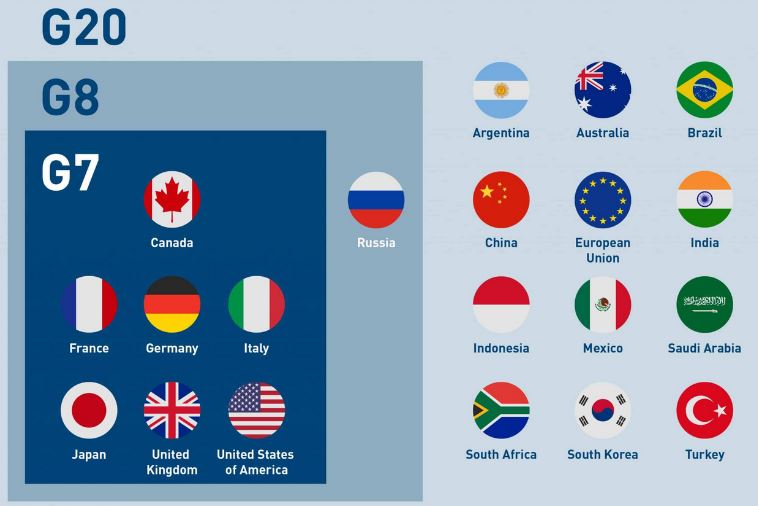
    Note the members of G7 and G20. UPSC may puzzle you asking which G20 nation isn’t a member of G7.

    G7 Countries

    • The G-7 or ‘Group of Seven’ includes Canada, France, Germany, Italy, Japan, the United Kingdom, and the United States.
    • It is an intergovernmental organisation that was formed in 1975 by the top economies of the time as an informal forum to discuss pressing world issues.
    • Initially, it was formed as an effort by the US and its allies to discuss economic issues.
    • The G-7 forum now discusses several challenges such as oil prices and many pressing issues such as financial crises, terrorism, arms control, and drug trafficking.
    • It does not have a formal constitution or a fixed headquarters. The decisions taken by leaders during annual summits are non-binding.
    • Canada joined the group in 1976, and the European Union began attending in 1977.

    Evolution of the G-7

    • When it started in 1975—with six members, Canada joining a year later—it represented about 70% of the world economy.
    • And it was a cozy club for tackling issues such as the response to oil shocks.
    • Now it accounts for about 40% of global GDP.
    • Since the global financial crisis of 2007-09, it has sometimes been overshadowed by the broader g20.
    • The G-7 became the G-8 in 1997 when Russia was invited to join.
    • In 2014, Russia was debarred after it took over Crimea.

    Significance of G7 for India

    • India will get more voice, more influence, and more power by entering the G7.
    • After the UN Security Council (UNSC), this is the most influential grouping.
    • If the group is expanded it will collectively address the humongous issues created by the Wuhan virus,
    • Diplomatically, a seat at the high table could help India further its security and foreign policy interests, especially at the nuclear club and UN Security Council reform as well as protecting its interests in the Indian Ocean.

    Back2Basics: The G-20

    • The G-20 is a larger group of countries, which also includes G7 members.
    • The G-20 was formed in 1999, in response to a felt need to bring more countries on board to address global economic concerns.
    • Apart from the G-7 countries, the G-20 comprises Argentina, Australia, Brazil, China, India, Indonesia, Mexico, Russia, Saudi Arabia, South Africa, South Korea, and Turkey.
    • Together, the G-20 countries make up around 80% of the world’s economy.
    • As opposed to the G-7, which discusses a broad range of issues, deliberations at the G-20 are confined to those concerning the global economy and financial markets.
    • India is slated to host a G-20 summit in 2022.
  • Climate Change Impact on India and World – International Reports, Key Observations, etc.

    UN Adaptation Gap Report, 2020

    The United Nations Adaptation Gap Report, 2020 was recently released by the UNEP.

    Must read edition: Five years of Paris Agreement

    UN Adaptation Gap Report

    • UN Environment Programme (UNEP) has managed the production of UN Environment’s Adaptation Gap Report series since its first edition in 2014.
    • The aim of the reports is to inform national and international efforts to advance climate change adaptation.

    Behind the concept: Adaptation Cost

    • Adaptation Cost includes costs of planning, preparing for, facilitating and implementing the climate change adaptation measures.
    • It thus derives benefits as the avoided damage costs or the accrued benefits following the adoption and implementation of adaptation measures.

    Highlights of the 2020 report

    • The annual cost of adaptation to the effects of climate change for developing countries is estimated to at least quadruple by 2050, according to the United Nations Adaptation Gap Report, 2020.
    • The current cost for developing countries is in the range of $70 billion (Rs 5.1 lakh crore) and may rise to $140-300 billion in 2030 and $280-500 billion in 2050.

    Funding gaps

    • The ever-increasing adaptation cost has also outpaced the growth in adaptation finance that refers to the flow of funds to developing countries to help them tide over the damages caused by climate change.
    • This, in turn, has kept the adaptation finance gap from closing with the current efforts, although the fund flow has increased, the report said.
    • Adaptation costs, in actual terms, are higher in developed countries but the burden of adaptation is greater for developing countries in relation to their gross domestic product.
    • These countries, especially in Africa and Asia, which are least equipped to tackle climate change will also, be the most impacted by it, the report noted.

Join the Community

Join us across Social Media platforms.