💥UPSC 2026, 2027, 2028 UAP Mentorship (March Batch) + Access XFactor Notes & Microthemes PDF

Archives: News

  • Foreign Policy Watch: India-Iran

    India should not jump to conclusion in dealing with Iran

    Two events which happened in quick succession raised concern in India. Iran’s decision to continue the railway project on its own and the reports of deal with China, both the events weighs heavily on India’s interests. This article examines the future course of action which India must adopt in such a situation.

    Context

    • Iran and China are close to concluding a 25-year strategic partnership.
    • This is being linked to reports that Iran has decided to undertake the construction of the Chabahar-Zahedan railway line on its own.
    • The project has not been handed over to China — at least not yet — so the “India loses, China wins” narrative is premature.

    What does the China-Iran deal indicate?

    • China attaches importance to Iran, which is a key source of energy supplies, a part of Belt and Road Initiative, and a potentially lucrative market.
    • However, like India, China has also in parallel cultivated closer relations with Saudi Arabia and the UAE.
    • China continues to have a strong relationship with Israel.
    • As China’s economic, military and technological capabilities have increased, its profile in this strategically important region has also expanded.

    What should be India foreign policy approach towards Iran

    • While acknowledging changed regional geopolitical landscape, India should pursue continue the policy of maintaining positive relations with Iran, the Arab states and Israel.
    • India will have more room for manoeuvring in the region by continuing to maintain a strong and friendly relationship with Iran.
    • One should also not exclude the possibility of a Democratic US President reviving the Iran nuclear deal.
    •  The revival of the deal will open the door for US and European companies to resume business with Iran.
    • It is the reinstatement of severe economic sanctions that has led Iran to turn to China, but the latter has remained cautious.
    • The pursuit of a closer security partnership with the US does not mean that India should follow the US lead on its other important relationships.

    Concerns for India

    • While maintaining the relations, India should not monitor closely the development of relations between China and Iran, which could complicate our security interests on our western flank. 
    • Of particular concern is a reference to China constructing a new port at Jask at the mouth of the Hormuz strait.
    •  If the port were operated by China, India’s maritime security would be at further risk.
    • It would also be of deep concern to the Arab states who will suffer from any closing of the Hormuz Strait while Iran remains less affected.
    • This is an issue on which the Arab states may well react adversely to China.
    • India, too, should press its concerns on Iran while working on a counter-strategy.

    Consider the question “Balancing the contrasts has been the basis of India’s relations with Iran. Comment.”

    Conclusion

    India should continue its engagement with Iran while pressing for its concerns at the same time in particular when it comes to Iran’s relations with China endangering India’s interest.

  • Anti Defection Law

    Time to revisit the practice of floor test

    The growing trend of the toppling of the government by luring the MLAs of ruling party. The SC needs to reconsider the floor test usually ordered in such cases. The article analyses this issue here.

    Reading Article 191(2) and 10th Schedule

    • Article 191(2) declares that a person shall be disqualified from being a member of the legislative assembly or legislative council of a state if he is so disqualified under the Tenth Schedule.
    • The Tenth Schedule to the Constitution contains “provisions as to disqualification on ground of defection”.
    • Tenth Schedule also fixes the relationship between a member and a political party which selected him as a candidate.
    • It also provides one of the grounds for disqualification: “If he voluntarily gives up his membership of such political party”.
    • The decision as to disqualification is left to the absolute discretion of the Speaker.

    Constitutional morality and 10th Schedule

    • Tenth Schedule brings to the fore the need to emphasise “constitutional morality”.
    • Constitutional morality means “strict adherence to the core principles of constitutional democracy”.
    • So, Constitutional transgressions by MLAs coming through a “party platform” to serve the people for five years (Article 172), cannot be accepted.
    • In so doing, these MLAs forget the oath, taken under Article 188 of the Constitution to bear true faith and allegiance to the Constitution of India as established by law.
    • Legislators do not have absolute freedom to behave in any way they like.

    Issues with the floor test

    • When ruling party MLAs are lured with rewards, political or otherwise, then the “floor test” becomes constitutionally immoral and unjust.
    • This will amount to circumventing the Tenth Schedule through engineered defections through the judicial process.
    • It is high time the judiciary revisited the use of a “floor test” to prove a majority in a legislature.

    Consider the question “Examine the ways in which a member of the house is deemed to have given up his membership under the 10th Schedule as interpreted in the various judgements. Also, analyse the implications of conducting a floor test in a situation when members of the ruling party are lured with rewards.”

    Conclusion

    Judiciary must take note of the toppling of the majority government through luring of the MLAs and subsequent floor test by the courts. The floor test in such a situation needs reconsideration.

  • Industrial Sector Updates – Industrial Policy, Ease of Doing Business, etc.

    What are Strategic and Non-strategic Sectors of Industries?

    The government will soon come out with a policy on strategic sectors and simultaneously kick into motion a process of complete privatization for companies in the non-strategic sectors.

    Try this question for mains:

    Q. “Privatisation of CPSEs can lead to the conversion of public monopoly to a private monopoly.” Analyse.

    What are Strategic and Non-strategic Sectors of India?

    • An industry is considered strategic if it has large innovative spillovers and if it provides a substantial infrastructure for other firms in the same or related industries.
    • Earlier, the strategic sectors were defined on the basis of industrial policy.
    • The government classified Central Public Sector Enterprises (CPSEs) as ‘strategic’ and ‘non-strategic’ on the basis of industrial policy that keeps on changing from time-to-time.

    According to this, the Strategic sector PSUs are:

    • Arms & Ammunition of defence equipment
    • Defence aircraft & warships
    • Atomic energy
    • Applications of radiation to agriculture, medicine and non-strategic industry
    • Railways

    Banking, insurance, defence, and energy are likely to be part of the strategic sector list. All other PSUs apart from the strategic sectors fall under Non-strategic Sector including Power Discoms.

    A change in policy post-Atmanirbhar

    • Under the Self-sufficiency move, the proposed policy would notify the list of strategic sectors requiring the presence of at least one state-owned company along with the private sector.
    • In all other sectors, the government plans to privatize public sector enterprises, depending upon the feasibility.
    • The number of enterprises in strategic sectors will be only one to four, and others would be privatized/merged/brought under a holding company structure.

    Will it help privatization?

    • The government has already set in motion privatization plans for large PSU companies BPCL, Air India, Container Corporation of India, and Shipping Corporation of India.
    • Budget 2020-21 had announced plans to sell part of the Centre’s stake in LIC through an initial public offer (IPO), and the sale of equity in IDBI Bank to private, retail and institutional investors.
    • The emphasis on privatization could see companies in chemicals and infrastructure space being privatized, while the government has stated its intent to reduce the number of state-owned banks.
    • This could see some smaller banks being privatized in due course.
  • Anti Defection Law

    Judicial intervention in Anti-defection Proceedings

    A Supreme Court Bench is scheduled to hear an appeal filed by the Rajasthan Assembly Speaker’s office challenging the State High Court order to defer anti-defection proceedings against former Deputy CM.

    Try these questions:

    Q. “The anti-defection law works best as an insurance against violation of the people’s mandate for a party, but it cannot be made a tool to stifle all dissent.” Discuss.

    —–

    Q.Which one of the following Schedules of the Constitution of India contains provisions regarding anti-defection? (CSP 2014)

    (a) Second Schedule

    (b) Fifth Schedule

    (c) Eighth Schedule

    (d) Tenth Schedule

    What is the issue?

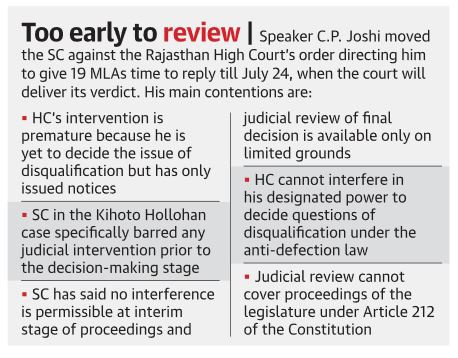
    • The petition said the HC has crossed its jurisdiction by asking the Speaker to put off his decision on the disqualification notices issued to dissident MLAs.
    • The HC order was an affront to the powers of the Speaker.
    • The High Court’s interim order granting extended time to rebel MLAs to file their replies to anti-defection notices amounted to a violation of Article 212 (courts not to inquire into the proceedings of the legislature).

    Backed by Tenth Schedule

    • The petition said that judicial review of ongoing anti-defection proceedings was limited.
    • Notice is much prior to any final determination or decision on disqualification.
    • The proceedings, including the notice, are in the realm of the legislative proceedings under Paragraph 6(2) of the Tenth Schedule, the Speaker’s office argued.

    Citing the Kihoto Hollohan case

    • The petition referred to the Constitution Bench judgment of the top court in the Kihoto Hollohan case in 1992 in this context.
    • Judicial review cannot be available at a stage prior to the making of a decision by the Speaker/Chairman and a prior action would not be permissible.
    • Nor would interference be permissible at an interlocutory stage of the proceedings, the verdict says.

    Must read:

    https://www.civilsdaily.com/news/kihoto-hollohan-order-1992/

    What does the dissident MLAs have to say?

    • The dissident MLAs had challenged the constitutionality of Paragraph 2(1)(a) of the Tenth Schedule which makes “voluntarily giving up membership of a political party” liable for disqualification.
    • The MLAs had argued that the provision infringed their right to dissent.
    • But the Speaker’s office countered that Paragraph 2 (1)(a) of the Tenth Schedule was the law of the land.
    • A mere challenge to its constitutionality cannot efface it from the statute book.


    Back2Basics

    https://www.civilsdaily.com/news/explained-anti-defection-law-and-its-evolution/

  • Nuclear Energy

    [pib] Kakrapar Atomic Power Project (KAPP-3) in Gujarat

    The indigenously designed 700 MWe reactor at the Kakrapar Atomic Power Project has achieved Criticality.

    Try this PYQ from CSP 2013:

    Q. The known forces of nature can be divided into four classes, viz, gravity, electromagnetism, weak nuclear force and strong nuclear force. With reference to them, which one of the following statements is not correct?

    (a) Gravity is the strongest of the four

    (b) Electromagnetism act only on particles with an electric charge

    (c) Weak nuclear force causes radioactivity

    (d) Strong nuclear force holds protons and neutrons inside the nuclear of an atom.

    What is ‘Criticality’ in Atomic/Nuclear Power Plants?

    • Reactors are the heart of an atomic power plant, where a controlled nuclear fission reaction takes place that produces heat, which is used to generate steam that then spins a turbine to create electricity.
    • Fission is a process in which the nucleus of an atom splits into two or smaller nuclei, and usually some by-product particles.
    • When the nucleus splits, the kinetic energy of the fission fragments is transferred to other atoms in the fuel as heat energy, which is eventually used to produce steam to drive the turbines.
    • For every fission event, if at least one of the emitted neutrons on average causes fission, a self-sustaining chain reaction will take place.
    • A nuclear reactor achieves criticality when each fission event releases a sufficient number of neutrons to sustain an ongoing series of reactions.

    Controlling Criticality

    • When a reactor is starting up, the number of neutrons is increased slowly in a controlled manner. Neutron-absorbing control rods in the reactor core are used to calibrate neutron production.
    • The control rods are made from neutron-absorbing elements such as cadmium, boron, or hafnium.
    • The deeper the rods are lowered into the reactor core, the more neutrons the rods absorb and the less fission occurs.
    • Technicians pull up or lower down the control rods into the reactor core depending on whether more or less fission, neutron production, and power are desired.
    • If a malfunction occurs, technicians can remotely plunge control rods into the reactor core to quickly soak up neutrons and shut down the nuclear reaction.

    Why is this achievement significant?

    • It is the biggest indigenously developed variant of the Pressurized Heavy Water Reactor (PHWR).
    • The PHWRs, which use natural uranium as fuel and heavy water as moderator, is the mainstay of India’s nuclear reactor fleet.
    • Until now, the biggest reactor size of the indigenous design was the 540 MWe PHWR, two of which have been deployed in Tarapur, Maharashtra.
    • India works to ramp up its existing nuclear power capacity of 6,780 MWe to 22,480 MWe by 2031.
    • The 700MWe capacity constitutes the biggest component of the expansion plan.

    Back2Basics: India’s PHWR technology

    • PHWR technology started in India in the late 1960s with the construction of the first 220 MWe reactor, Rajasthan Atomic Power Station, RAPS-1 under the joint Indo-Canadian nuclear co-operation.
    • Canada supplied all the main equipment for this first unit, while India retained responsibility for construction, installation, and commissioning.
    • For the second unit (RAPS-2), import content was reduced considerably, and indigenization was undertaken for major equipment.
    • Following the withdrawal of Canadian support in 1974 after Pokhran-1, Indian nuclear engineers completed the construction, and the plant was made operational with a majority of components being made in India.
  • Festivals, Dances, Theatre, Literature, Art in News

    In news: Madhubani/Mithila Paintings

    An artist known as the ‘mask man’ of Bihar dispatches masks with hand-painted Madhubani motifs all over India.

    Also read:

    [Prelims Spotlight] Indian Paintings and Handicrafts

    Madhubani Paintings

    • Madhubani art (or Mithila painting) is a style of Indian painting, practised in the Mithila region of Bihar.
    • This painting is done with a variety of tools, including fingers, twigs, brushes, nib-pens, and matchsticks and using natural dyes and pigments.
    • It is characterized by its eye-catching geometrical patterns.
    • It was traditionally created by the women of various communities in the Mithila region of the Indian subcontinent.
    • This painting as a form of wall art was practised widely throughout the region; the more recent development of painting on paper and canvas mainly originated among the villages around Madhubani.
    • It is these latter developments that led to the term “Madhubani art” being used alongside “Mithila Painting.”

    Its features

    • It uses two-dimensional imagery, and the colours used are derived from plants. Ochre, Lampblack and Red are used for reddish-brown and black, respectively.
    • It mostly depicts people and their association with nature and scenes and deities from the ancient epics.
    • Natural objects like the sun, the moon, and religious plants like tulsi are also widely painted, along with scenes from the royal court and social events like weddings.
    • Generally, no space is left empty; the gaps are filled by paintings of flowers, animals, birds, and even geometric designs.
    • Madhubani art has five distinctive styles: Bharni, Kachni, Tantrik, Godna and Kohbar.
    • This painting has also received a GI (Geographical Indication) status.
  • Global Geological And Climatic Events

    Lonar Lake turned pink due to ‘Haloarchaea’ microbes

    The colour of Lonar lake water in Maharashtra’s Buldhana district turned pink due to a large presence of the salt-loving ‘Haloarchaea’ microbes, a probe carried out by a Pune-based institute has concluded.

    Make a note of all saltwater lakes in India. Few of them are Pulicat, Pangong Tso, Chilika, and Sambhar Lakes etc.

    Haloarchaea’ microbes

    • Haloarchaea or halophilic archaea is a bacteria culture which produces pink pigment and is found in water saturated with salt.
    • The increased salinity and pH facilitated the growth of halophilic microbes, mainly Haloarchaea.
    • Basically, it is the biomass of these microbes and because of that, the surface of the water turned red or pink and as soon as the biomass subsided, the colour disappeared.
    • The scientist said the colour of the lake is now returning to original as the rainy season has kicked in, allowing dilution of the water.
    • Initially, it was thought for the red-pigmented Dunaliella algae due to which the water might have turned pink.
    • Because of that, the salinity and pH/alkalinity levels have also come down and green algae have started growing in the water body.

    About Lonar Lake

    • Lonar Lake, also known as Lonar crater, is a notified National Geo-heritage Monument, saline (pH of 10.5), Soda Lake, located at Lonar in Buldhana district, Maharashtra.
    • It was created by an asteroid collision with earth impact during the Pleistocene Epoch.
    • It is one of the four known, hyper-velocity, impact craters in basaltic rock anywhere on Earth.
    • It sits inside the Deccan Plateau—a massive plain of volcanic basalt rock created by eruptions some 65 million years ago.
    • Its location in this basalt field suggested to some geologists that it was a volcanic crater.
  • Digital India Initiatives

    Key stakeholders in data regulation

    The article examines the structures and role of key stakeholders in regulation of Non-Personal Data as per the report submitted by the committee headed by Kris Gopalakrishnan.

    Context

    • There is a realisation that data should be unlocked in public interest beyond the use by a few large companies
    • Data, in many cases, are not just a subject of individual decision-making but that of communities, such as in the case of ecological information.
    • Therefore, it is critical that communities are empowered to exercise some control over how the data are used.
    • Recently the Non-Personal Data committee released a governance framework, which raises many concerns.

    Following are the key stakeholder as defined in the report

    1)Data principals

    • As per the report, the first keyholders are data principals, who/ which can be individuals, companies or communities.
    • The idea of communities as data principals is introduced ambiguously by the report.
    • The report does not address the translation of offline inequalities and power structures to data rights.

    2) Data custodians

    • Data custodian is the one who undertake collection, storage, processing, and use of data in a manner that is in the best interest of the data principal.
    • The details in this section are unclear.
    • It is not specified if the data custodian can be the government or private companies only.
    • It is also not clear what best interest is, especially when several already vague and possibly conflicting principal communities are involved.
    • It is also not clear how communities engage with the custodian.
    • Suggestion that data custodians can monetise the data they hold is especially problematic as this presents a conflict of interest with those of the data principal communities.

    3) Data trustees

    • The report talks about data trustees as a way for communities to exercise data rights.
    • Trustees can be governments, citizen groups, or universities.
    • There is no clarity on how “trust” is extended and fructified with the community, and how trustees are empowered to act on behalf of the community.
    • The principles of a legal trust and the fiduciary responsibility that come with role of trustees are critical.
    • Trustees, by definition, are bound by a duty of care and loyalty towards the principal and thus work in their best interests.
    • Trustee has to negotiate on behalf of Data Principals’ data rights with technology companies and regulators.
    • This thinking is not reflected in the report.
    •  Also, the relationship between the data principal communities and the trustees is not clear.

    How will the ‘Trust’ function?

    • The report explains data trusts comprising specific rules and protocols for containing and sharing a given set of data.
    • Trusts can hold data from multiple custodians and will be managed by public authority.
    • But the power, composition and functions of the trust are not established.
    • One possible way to simplify the ecosystem would be to consider data trusts as a type of custodian.
    •  So that trustees can represent the community and act on behalf of the data principals.

    Consider the question “What do you understand by Non-Personal Data. Examine its utility and need to treat as a public good.”

    Conclusion

    The committee should organise broader consultations to ensure that the objective of unlocking data in public interest and through collective consent does not end up creating structures that exacerbate the problems of the data economy and are susceptible to regulatory capture.

  • Foreign Policy Watch: India-China

    Exploring options to tackle China

    There are several options which India could explore in dealing with China with less cost but significant effectiveness. Diplomacy is one of them. What are the other options? Read the article to know…

    Context

    • China’s aggression and Galwan valley incident dismantles the Border Agreements of 1993, 1996, 2005 and 2013.
    • Understanding China’s objectives become critical in this situation.

    Analysing China’s objectives

    • Humbling India in the eyes of Asia and the world was all important for China.
    • Despite China’s territorial aggression, it would be a mistake to think that China is preparing for a conflict over territory.
    • China is well aware that it cannot be certain whether it will emerge a victor from an all-out conflict with India.
    •  China cannot afford to jeopardise its future for the present.
    • China has been intent on transforming the Asian region in its own image, and, simultaneously, seeking to become a continental and a maritime power.

    What are the options to deal with China

    • India may well find non-military tools not only more cost-effective but also less risky.
    • 1)  Exploiting the current widespread opposition to China, India must try to create international opinion in its support regarding border violations.
    • 2) Cultivation of foreign leaders with a view to draw their specific attention to China’s aggressive policies and designs is the second option.
    • India’s involvement with the Non-Aligned Movement (NAM) should prove invaluable in this respect.
    • 3) India must also overhaul its ‘messaging’ capacity.
    • It should make greater use of technology to send across its message and ideas in its vicinity and across the globe, highlighting its peaceful intentions in stark contrast to China’s aggressive policies and tactics.
    • 4)  India must pay particular attention to relations with countries in its neighbourhood, such as Nepal and Bangladesh, and allies such as Iran and Vietnam.
    • Relationship with these countries seems to have frayed at the edges, with India being more intent on strengthening relations with the West.
    • Smaller countries of Asia, which constantly face China’s aggressive interference in their internal affairs, have not received much support from India, and this needs India’s attention.
    • 5) India’s true strength is its unity in diversity. A truly united and resilient India is the best antidote to China’s attempts to humble India.
    • China has never been able to properly understand, the strength India seems to derive from its spiritual, religious and cultural attributes, which are a part of its civilisational heritage.
    • 6) India would do well to take pole position in propagating ‘Himalayan Buddhism’ which China has been seeking to subvert to achieve its ends.

    Consider the question “To counter the challenges manifested by China through recent events India needs to explore along with other options the subtler tools of power available to it. Examine the other tools available with India.”

    Conclusion

    Military no doubt project the country’s power but there are other options with less cost and significant benefits. India should focus on these options as well while dealing with China.

  • [pib] RAISE Initiative

    The Ministry of Power has launches Retrofit of Air-conditioning to improve Indoor Air Quality for Safety and Efficiency (RAISE) – a joint initiative of EESL and USAID.

    Possible prelims question:
    Q. The MAITREE programme recently seen in news is related to:
    Trade/Energy Efficiency/Climate Change/ Strategic Relations

    RAISE Initiative

    • It aims to ensure cleaner and greener office spaces in the country.
    • This is a part of the larger initiative developed for healthy and energy-efficient buildings, in partnership with US Agency for International Development’s (USAID) MAITREE programme.

    Why RAISE?

    • Poor air quality has been a concern in India for quite some time and has become more important in light of COVID pandemic.
    • As people return to their offices and public spaces, maintaining good indoor air quality is essential for occupant comfort, well-being, productivity and overall public health, the statement noted.

    About MAITREE programme

    • The Market Integration and Transformation Program for Energy Efficiency (MAITREE) is a part of the US-India bilateral Partnership between the Ministry of Power and USAID.
    • It is aimed at accelerating the adoption of cost-effective energy efficiency as a standard practice within buildings and specifically focuses on cooling.

    Back2Basics: EESL

    • Energy Efficiency Services Limited (EESL), under the administration of Ministry of Power, is working towards mainstreaming energy efficiency.
    • It is implementing the world’s largest energy efficiency portfolio in the country.
    • EESL aims to create market access for efficient and future-ready transformative solutions that create a win-win situation for every stakeholder.

    About USAID:

    • USAID is the world’s premier international development agency and a catalytic actor driving development results.

Join the Community

Join us across Social Media platforms.
