💥UPSC 2026, 2027, 2028 UAP Mentorship (March Batch) + Access XFactor Notes & Microthemes PDF

Archives: News

  • Contention over South China Sea

    U.S.-Asia coordination to preserve global order

    The focus of this article is on the U.S. policy in the Indo-Pacific and its relations with its allies there in countering China.

    Instances of China’s aggression

    • Galwan Valley is not an exception in Beijing’s recent behaviour in Asia.
    • China has also engaged in a tense geopolitical confrontation with its other neighbours.
    • Stand-offs with Vietnam and Malaysia in the South China Sea and threatening Australia with boycotts are a few examples.

    Response to China

    • Beijing’s aggressiveness is fueling debates about the underlying costs of reliance on China.
    • China’s aggression is also increasing support for closer coordination between other Indo-Pacific partners.
    • Indian, Japan, Malaysia, and Australia have all taken concrete steps to reduce their economic exposure to Beijing.
    •  India and Australia recently inked a new military logistics agreement in the “virtual summit”.
    • A similar agreement between Delhi and Tokyo may follow.
    • The Quadrilateral Dialogue between Australia, India, Japan, and the United States is growing stronger and even expanding.
    • And recently Association of Southeast Asian Nations (ASEAN) issued one of their strongest statements to date on the South China Sea.
    • The ASEAN statement insisted that maritime disputes must be resolved in accordance with the UN Law of the Sea treaty.

    Asian multilateralism: Born out of crises

    • Recently the “Milk Tea Alliance”, reaction of people, born to forge solidarity between Taiwanese, Hong Kongers, and Southeast Asians online to deal with Chinese cyberbullying.
    • The Chiang Mai Initiative — a financial swap mechanism between China, Japan, South Korea, and Southeast Asia — emerged in the aftermath of the late 1990s financial crisis.
    • ASEAN, created in 1967, did not convene its first heads of state meeting until fall of Saigon in 1976 in the Vietnam War.

    Role of the U.S.

    • The COVID-19 crisis is remaking the geopolitics of the Indo-Pacific.
    • The ongoing crisis has made countries aware of seriousness of Chinese dominance.
    • This situation has given the U.S. opportunity it has long sought: 1) More credible multilateral coordination among allies, 2) Pushback against online disinformation. 3) The desire to better integrate like-minded economies and supply chains.
    • But the crisis is also raising renewed questions about the American leadership.
    • The question now facing the U.S. is whether or not it can harness this new regional momentum.

    Alienating allies

    • U.S. continues to make unforced errors that create distance with U.S. allies and partners.
    • For example, its focus on cutting support for the WHO and asserting that COVID-19 originated in a Wuhan lab alienated Canberra.
    • Similarly, the administration’s suspension of various worker visas will almost certainly have serious repercussions in India.

    What should be the U.S. approach to Asia?

    • The U.S. needs to make two major shifts.
    • First, U.S. policy needs to start supporting, rather than attempting to commandeer, regional efforts to build a less China-centric future for the Indo-Pacific.
    • While Chinese aggression provides powerful motivation for coordination, U.S. partners are seeking an agenda that is framed in broader terms than simply rallying to counter Beijing.
    • If the U.S. wants to reduce reliance on Beijing and “re-couple” investments and supply chains among allied nations, it is going to have to make compromises.
    • U.S. should work with Indo-Pacific partners on the issues that they prioritise and provided them with space for independent action.
    • Second, Washington should avoid repeating Beijing’s mistakes of bullying.
    • U.S. should offer a clear alternative in word and deed to China’s “Wolf Warrior” diplomacy.
    • Moves such as demanding that a G-7 communiqué refer to COVID-19 as the “Wuhan virus” and blocking mask shipments to close allies are the kind of counterproductive bullying.

    Options for Asian countries

    • Beijing’s recent aggression is not an aberration but part of a growing pattern.
    • As Beijing’s confidence in its growing material and military power solidifies, its neighbours will need to think carefully about the long-term decisions necessary to preserve an open regional order.
    • Facing the unprecedented health and economic crises spawned by COVID-19, the U.S. and Asian partners will need to coordinate more closely.
    • Asian countries should strengthen their own regional networks.
    • This Asian network will challenge the views of those in both Washington and Beijing who would see the region only as a sparring ground.

    Conclusion

    For American and Asian leaders, the choice is stark: encourage and foster this trend, recognising that stronger regional coordination will require more compromises as well as tougher choices, or resist it and risk being left behind.

  • Foreign Policy Watch: India – EU

    India should believe in the EU

    India and the EU have many things in common. And there are many areas in which both can expand the cooperation. This article explores commonalities and the areas which offer the scope for enhancing the cooperation. 

    Common interests

    • Both aim to enhance strategic autonomy and their global standing.
    • Diversifying strategic value chains is also a common interest.
    • Both seek to address the issue of climate change on an urgent basis.

    Economic ties with the EU

    • The EU is India’s largest trading partner accounting for €80 billion worth of trade in goods in 2019.
    • This is equal to 11.1% of total Indian trade.
    • The EU is also the biggest foreign investor, with €67.7 billion worth of investments made in 2018.
    • Which is equal to 22% of total FDI inflows.

    Scope for improving the economic ties

    • The EU’s investments in China amounted to €175.3 billion (2018).
    • So, India could succeed in attracting EU investment that might be moving out of China.
    • To attract this outflowing investment, India must address the mutual trust deficit.
    • Enhanced business cooperation can help both the EU and India diversify their strategic value chains.
    • Increasing people’s mobility and connectivity is another area that can create opportunities for innovation and growth.

    Talks on FTA

    • Both sides need to move further on the Free Trade Agreement.
    • A new study from the European Parliament estimates the impact of an EU-India trade agreement between €8 billion and €8.5 billion.
    • The study also mentions additional potential gains from enhanced coordination on the provision of global public goods, such as environmental standards.

    Cooperation on climate change

    • Under the new industrial strategy, the Green Deal, the EU has set an ambitious target to be carbon-emission neutral by 2050.
    • If the EU and India succeed in transforming into carbon-neutral economies by 2050, we all would gain from the investment.

    Strategic partnership with EU

    • The Indo-Pacific region is becoming contentious, so India should capitalise on its geopolitical leverage there.
    • Cooperation with like-minded, democratic powers can support this effort, especially towards assertive competitors like China.
    • The EU as a whole offers more to India than the strongest bilateral relations with individual EU member state.
    • New Delhi must learn how to maximise benefits from this strategic partnership.
    • The disruption caused by COVID-19 has been the occasion for the EU to prove its worth.
    • “Next-generation EU proposal” submitted by the European Commission has economic as well as geopolitical implications.
    • The proposal shows that the ties that bind the EU extend well beyond treaties and individual members’ self-interest.
    • The EU champions the rules-based international order, so the EU and India must act to promote sustainable reform of multilateral institutions starting from the WTO.

    Consider the question “India-EU ties with many common interests assume significance as rule-based order is being challenged by the rise of exceptionalism. Comment.”

    Conclusion

    A strong partnership would help both the EU and India become global decision-makers and tackle the challenges caused by the disruption of global order collectively.

  • Skilling India – Skill India Mission,PMKVY, NSDC, etc.

    Skill India For Atmanirbhar Bharat

    As India embarks on the path of self-reliance through Atmanirbhar Bharat Abhiyan, it has to nurture the skilled workforce. This article highlights the need to upgrade the skills or upskill the youth to meet the employment needs of technology-driven 21st century.

    Context

    • The effects of the pandemic are expected to have a lasting impact on every sphere of activity.
    • Considering this impact, India announced the Atmanirbhar Bharat Abhiyan to propel the country on the path of self-sustenance.

    Objectives

    • Atmanirbhar Bharat has twin objectives- short term and long term.
    • 1) Reviving different spheres of the economy in the short term.
    • 2) Insulating India from any future global economic downturn, by making it robust in the long run.
    • The Abhiyan seeks to build capacities across sectors and promote local products.
    • Further, it would focus on scaling up manufacturing, accelerating infrastructure development, attracting investments and promoting a consumption-led growth.

    Youth: Strength of India

    • About 65 per cent of India’s population is below 35 years and 50 per cent is below 25 years.
    • With a huge, educated young population, India is uniquely poised to realise its demographic potential.
    • The fact that Indians are heading several MNCs shows that there is no dearth of knowledge and talent in the country.
    • However, we need to upgrade the skills or upskill the youth to meet the employment needs of technology-driven 21st century.

    Opportunities and challenges

    • Pandemic and is being seen by many as an opportunity to upgrade their knowledge and acquire new skills.
    • The fourth industrial revolution has triggered a paradigm change in which digital technology drives the job market.
    • Remote working with increasing adoption of digital technology might continue to be dominant mode of working for the near future.
    • It is estimated that nearly 70 per cent of the world’s learners are affected by school closures due to pandemic across education levels.
    • Artificial intelligence, machine learning, data science, cloud computing and Internet of Things will be area of interest for companies.
    • With people opting to online buying, companies will seek to adopt new online marketing strategies.
    • Another important issue that needs to be addressed is ensuring equitable employment through higher participation of women in the workforce.

    Way forward for Atmanirbhar Bharat

    1) Local to glocal

    • There have been some reassuring developments with an accent on “local to glocal”
    • The production of several lakh PPE kits, a collaboration of automobile industries to produce ventilators, manufacture of more than 70 Made in India products by the DRDO are just a few examples of the capability of Indian scientists, IT professionals and technocrats.

    2) Reducing import

    • We must aim to gradually reduce imports in every sector from crude oil to heavy machinery.
    • This reduction should be based on the locally available resources, talent, and skills of the human capital.

    3) Globally competitive product

    • While remaining vocal about local, we must aim at making Indian products to be globally competitive. 
    • We should try to stay ahead in the innovation-led knowledge economy.
    • PSUs and the private sector should not only complement but collaborate wherever feasible.
    • The private sector must massively step up investments R&D. PSUs too need to modernise in terms of technology.

    Consider the question “Atmanirbhar Bharat Abhiyan has the aim of reviving the Indian economy. Examine its objective and how it seeks to revive the economy”

    Conclusion

    To remain globally competitive with a well-assured future, we need to focus on “skills, scale and speed”. India has the potential to emerge as the global hub for providing skilled manpower to other nations.

  • Right To Privacy

    What is Non-Personal Data?

    A government committee headed by Infosys co-founder has suggested that non-personal data generated in the country be allowed to be harnessed by various domestic companies and entities.

    Practice question for mains:

    Q.What is Non-Personal Data? Discuss its utility and various privacy concerns associated with it.

    What is non-personal data?

    • In its most basic form, non-personal data is any set of data which does not contain personally identifiable information.
    • This, in essence, means that no individual or living person can be identified by looking at such data.
    • For example, while order details collected by a food delivery service will become non-personal data if the identifiers such as name and contact information are taken out.
    • The government committee, which submitted its report, has classified non-personal data into three main categories, namely public non-personal data, community non-personal data and private non-personal data.

    Types of non-personal data

    Depending on the source of the data and whether it is anonymised in a way that no individual can be re-identified from the data set, the three categories have been divided:

    1) Public

    All the data collected by government and its agencies such as census, data collected by municipal corporations on the total tax receipts in a particular period or any information collected during execution of all publicly funded works have been kept under the umbrella of public non-personal data.

    2) Community

    Any data identifiers about a set of people who have the same geographic location, religion, job, or other common social interests will form the community non-personal data. For example, the metadata collected by ride-hailing apps, telecom companies, electricity distribution companies among others have been put under the community non-personal data category by the committee.

    3) Private

    Private non-personal data can be defined as those which are produced by individuals which can be derived from the application of proprietary software or knowledge.

    How sensitive can non-personal data be?

    • Unlike personal data, which contains explicit information about a person’s name, age, gender, sexual orientation, biometrics and other genetic details, non-personal data is more likely to be in an anonymised form.
    • However, in certain categories such as data related to national security or strategic interests such as locations of government laboratories or research facilities, even if provided in anonymised form can be dangerous.
    • Similarly, even if the data is about the health of a community or a group of communities, though it may be in anonymised form, it can still be dangerous, the committee opined.
    • Possibilities of such harm are obviously much higher if the original personal data is of a sensitive nature.
    • Therefore, the non-personal data arising from such sensitive personal data may be considered as sensitive non-personal data.

    What are the global standards on non-personal data?

    • In May 2019, the EU came out with a regulatory framework for the free flow of non-personal data.
    • It suggested that member states of the union would cooperate with each other when it came to data sharing.
    • Such data, the EU had then ruled would be shared by member states without any hindrances.
    • The authorities must inform the commission of any draft act which introduces a new data localisation requirement or makes changes to an existing data localisation requirement.
    • The regulation, however, had not defined what non-personal data constituted of and had simply said all data which is not personal would be under its category.

    What areas does India’s non-personal data draft miss?

    • Though the non-personal data draft is a pioneer in identifying the power, role, and usage of anonymised data, there are certain aspects such as community non-personal data, where the draft could have been clearer.
    • Non-personal data often constitute protected trade secrets and often raises significant privacy concerns.
    • The paper proposes the nebulous concept of community data while failing to adequately provide for community rights.
    • Other experts also believe that the final draft of the non-personal data governance framework must clearly define the roles for all participants, such as the data principal, the data custodian, and data trustees.

    Conclusion

    • Regulation must be clear, and concise to provide certainty to its market participants, and must demarcate the roles and responsibilities of participants in the regulatory framework.
    • The report is unclear on these counts and requires public consultation and more deliberation.
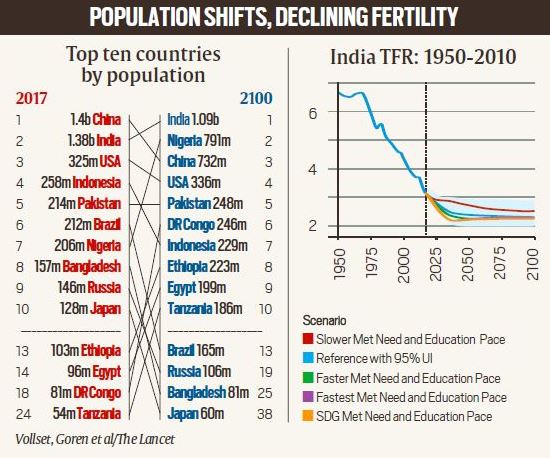
  • Lancet’s analysis of population trends for 2017-2100

    When this century ends, India may no longer be a country of a billion, says a projection that appears in the online edition of the Lancet. The reference forecasts for China and India peaked before 2050 and both countries thereafter had steep declining trajectories.

    Try this question from CSP 2011:

    Q.India is regarded as a country with ‘Demographic Dividend’. This is due to

    (a) Its high population in the age group below 15 years

    (b) Its high population in the age group of 15-64 years

    (c) Its high population in the age group above 65 years

    (d) Its high total population

    World to see the peak

    • A new analysis published in The Lancet has projected that the world population will peak much earlier than previously estimated.
    • It projects the peak at 9.73 billion in 2064, which is 36 years earlier than the 11 billion peaks projected for 2100 by last year’s UN report World Population Prospects.
    • For 2100, the new report projects a decline to 8.79 billion from the 2064 peak.

    5 most populated countries

    • The five largest countries in 2100 are projected to be India, Nigeria, China, the U.S. and Pakistan.
    • However, these forecasts showed different future trajectories between countries.
    • Nigeria is forecast to have continued population growth through 2100 and was expected to be the second-most populous country by then.

    Predictions on India’s population

    • For India, the report projects a peak population of 1.6 billion in 2048, up from 1.38 billion in 2017.
    • By 2100, the population is projected to decline by 32% to 1.09 billion.
    • However, meeting UN Sustainable Goal Development targets, the peak would be earlier and see a population decline to 929 million.
    • Conventional wisdom is that though a decline in population is expected, it is expected to begin only around 2046.
    • The fall according to the latest 2019 assessment by the UNDP calculation, is expected to see India’s population settle at a little over 1.4 billion.

    Reasons for fall

    • The sharper fall is due to the assumption that all women globally will have much higher access to contraception and education.
    • This scenario will lead to a sharper reduction in the Total Fertility Rate, a metric that shows on average how many children a woman must have to keep replenishing the population.
    • A TFR is lower than 2.1leads to a decline in a country’s population.
  • LGBT Rights – Transgender Bill, Sec. 377, etc.

    No medical examination for Trans Persons

    After facing flak from the transgender community, the Centre has done away with the requirement of a medical examination for trans persons applying for a certificate of identity in its latest draft rules framed under the Transgender Persons (Protection of Rights) Act, 2019.

    Practice question for mains:

    Q.What are the salient features of the Transgender Persons (Protection of Rights) Act, 2019? Also, discuss the loopholes.

    What are the new rules?

    • The draft of the Transgender Persons (Protection of Rights) Rules, 2020, published stated that a District Magistrate would issue a transgender identity certificate and card based on an affidavit by the applicant, but without any medical examination.

    Issue with the earlier draft

    • An earlier draft of the rules had mandated a report from a psychologist along with the affidavit for the application.
    • The transgender rights movement had opposed this, as it was seen as going against a trans person’s right to self-identification, which was upheld by the Supreme Court in 2014.

    Change of gender is permissible

    • In case of change of gender, the application for new identification would require a certificate from the medical superintendent or chief medical officer of the medical institution where the applicant the surgery.
    • For this, the Centre has proposed a series of welfare schemes, including making at least one hospital in each State equipped to provide safe and free gender-affirming surgery and counselling and hormone replacement therapy among others.

    Back2Basics: The 2014 Judgement on Trans-persons Rights

    • The Supreme Court in 2014 recognized transgenders as the third gender in a landmark ruling, saying it was addressing a “human rights issue”.
    • The ruling came after it heard a PIL filed by National Legal Services Authority (Nalsa) demanding equal rights.
    • The judgements said that non-recognition of gender identity amounts to discrimination under Article 15, which prohibits discrimination on the basis of sex.
    • The spirit of the constitution is to provide equal opportunity to every citizen to grow and attain their potential, irrespective of caste, religion or gender said justices K.S. Radhakrishnan and A.K. Sikri in their ruling.
    • Self-identification as man or woman, irrespective of sexual reassignment surgery, was now protected by law.
    • The judges said rights such as the right to vote, own property, marry and to “claim a formal identity” would be made available “more meaningfully” to the transgender community as a result of the ruling.

    Transgender Persons (Protection of Rights) Bill, 2019

    The Parliament passed the Transgender Persons (Protection of Rights) Bill, 2019.

    Key Features

    • Definition of a transgender person: The Bill defines a transgender person as one whose gender does not match the gender assigned at birth. It includes transmen and trans-women, persons with intersex variations, gender-queers, and persons with socio-cultural identities, such as kinnar and hijra.
    • Certificate of identity: A transgender person may make an application to the District Magistrate for a certificate of identity, indicating the gender as ‘transgender’.
    • Prohibition against discrimination: The Bill prohibits discrimination against a transgender person, including denial of service or unfair treatment in relation to:
      • Education, employment, healthcare.
      • Access to or enjoyment of goods, facilities, opportunities available to the public.
      • Right to movement, right to reside, rent, or otherwise occupy property.
      • Opportunity to hold public or private office.
      • Access to a government or private establishment in whose care or custody a transgender person is.
    • Health care
      • The Bill also seeks to provide rights of health facilities to transgender persons including separate HIV surveillance centres, and sex reassignment surgeries.
      • It also states that the government shall review medical curriculum to address health issues of transgender persons, and provide comprehensive medical insurance schemes for them.
    • It calls for establishing a National Council for Transgender persons (NCT).
    • Punishment: It states that the offences against transgender persons will attract imprisonment between six months and two years, in addition to a fine.

  • International Space Agencies – Missions and Discoveries

    Hope:  UAE’s first mission to Mars

    The launch of the United Arab Emirates’ (UAE) first mission to Mars has been delayed by two days due to bad weather conditions which were scheduled to take off from its launch site, Tanegashima Space Center, in Japan.

    Try this question from CSP 2014:

    Q.Which of the following pair is/are correctly matched?

    Spacecraft Purpose
    1. Cassini-Huygens Orbiting the Venus and transmitting data to the Earth
    2. Messenger Mapping and investigating the Mercury
    3. Voyager 1 and 2 Exploring the outer solar system

    Select the correct answer using the code given below.

    a) 1 only

    b) 2 and 3 only

    c) 1 and 3 only

    d) 1, 2 and 3

    Hope Mission

    • The Emirates Mars Mission called “Hope” was announced in 2015 with the aim of creating mankind’s first integrated model of the Red planet’s atmosphere.
    • Hope weighs over 1500 kg and will carry scientific instruments mounted on one side of the spacecraft, including the Emirates exploration Imager (EXI), which is a high-resolution camera among others.
    • The spacecraft will orbit Mars to study the Martian atmosphere and its interaction with outer space and solar winds.
    • Hope will collect data on Martian climate dynamics, which should help scientists understand why Mars’ atmosphere is decaying into space.

    Objectives of the mission

    • Once it launches, Hope will orbit Mars for around 200 days, after which it will enter the Red planet’s orbit by 2021, coinciding with the 50th anniversary of the founding of UAE.
    • The mission is being executed by the Mohammed bin Rashid Space Centre, UAE’s space agency.
    • It will help answer key questions about the global Martian atmosphere and the loss of hydrogen and oxygen gases into space over the span of one Martian year.

    Back2Basics: Mars Orbiter Mission (MOM)

    • The MOM also called Mangalyaan is a space probe orbiting Mars since 24 September 2014. It was launched on 5 November 2013 by the Indian Space Research Organisation (ISRO).
    • It aims at studying the Martian surface and mineral composition as well as scans its atmosphere for methane (an indicator of life on Mars).
    • It is India’s first interplanetary mission and it made it the fourth space agency to reach Mars, after Roscosmos, NASA, and the European Space Agency.
    • It made India the first Asian nation to reach Martian orbit and the first nation in the world to do so on its maiden attempt.
    • It was initially meant to last six months, but subsequently, ISRO had said it had enough fuel for it to last “many years.”
  • Forest Conservation Efforts – NFP, Western Ghats, etc.

    Species in news: Cestrum nocturnum

    Nilgiris forest officials are restoring native Shola habitats in places overrun by the invasive species ‘Cestrum nocturnum’.

    Try this PYQ from CSP 2018:

    Q.Why is a plant called Prosopis juliflora often mentioned in the news?

    (a) Its extract is widely used in cosmetics.

    (b) It tends to reduce the biodiversity in the area in which it grows

    (c) Its extract is used in the pesticides.

    (d) None of the above

    Cestrum nocturnum

    • Cestrum nocturnum is commonly known by the names night-blooming jasmine and raatrani.
    • It is native to the West Indies but naturalized in South Asia.
    • Its spread is a threat to all Shola and grassland habitats as it does not allow any native flora to thrive.
    • The plants unless completely removed with their roots, keep sprouting and keep taking over Shola and native grasslands.
  • Tiger Conservation Efforts – Project Tiger, etc.

    Mapping: Melghat Tiger Reserve

    Maharashtra CM has sought alternative routes for the proposed broad gauge conversion of a railway line passing through the Melghat Tiger Reserve in Amravati district.

    Try this question from CSP 2012:

    Consider the following protected areas:

    1. Bandipur 2. Bhitarkanika 3. Manas 4. Sunderbans

    Which of the above are declared Tiger Reserves?

    (a) 1 and 2 only

    (b) 1, 3 and 4 only

    (c) 2, 3 and 4 only

    (d) 1, 2, 3 and 4

    Melghat Tiger Reserve

    • Melghat, part of the Satpura-Maikal landscape was among the first nine tiger reserves notified in 1973-74 under the Project Tiger.
    • The Tapti River and the Gawilgadh ridge of the Satpura Range form the boundary of the reserve.
    • The forest is tropical dry deciduous in nature, dominated by teak.
    • The reserve is a catchment area for five major rivers: the Khandu, Khapra, Sipna, Gadga and Dolar. These all rivers are tributaries of the river Tapti.

    Back2Basics: Project Tiger

    • Project Tiger is a tiger conservation programme launched in April 1973 during PM Indira Gandhi’s tenure.
    • In 1970 India had only 1800 tigers and Project Tiger was launched in Jim Corbett National Park.
    • The project is administrated by the National Tiger Conservation Authority (NTCA).
    • It aims at ensuring a viable population of Bengal tigers in their natural habitats, protecting them from extinction etc.
    • Under this project the govt. has set up a Tiger Protection Force to combat poachers and funded relocation of villagers to minimize human-tiger conflicts.
  • Foreign Policy Watch: India-Pakistan

    Azad Pattan Hydel Project

    Pakistan and China have signed an agreement for the 700 MW Azad Pattan hydel power project on the Jhelum River in Sudhoti district of PoK.

    Try this question from CSP 2019:

    Q.What is common to the places known as Aliyar, Isapur and Kangsabati?

    (a) Recently discovered uranium deposits

    (b) Tropical rain forests

    (c) Underground cave systems

    (d) Water reservoirs

    Azad Pattan hydel project

    • The project is a run-of-the-river scheme with a reservoir located near Muslimabad village, 7 km upstream from the Azad Pattan bridge, in district Sudhnoti, one of the eight districts of PoK.
    • It is one of five hydropower schemes on the Jhelum.
    • Upstream from Azad Pattan are the Mahl, Kohala, and Chakothi Hattian projects; Karot is downstream. Like Kohala and Azad Pattan, Karot too is being developed under the CPEC framework.
    • The project will comprise a 90-metre-high dam, with a 3.8 sq km reservoir.
    • The $ 1.5-billion project is the second power project under the China Pakistan Economic Corridor (CPEC).

    Other projects in PoK

    • Kohala project is a 1,124 MW hydel project that will come upon the Jhelum near Muzaffarabad. This project is one of the biggest investments by China in PoK.
    • The Karot Hydropower station, the third project being executed by China on the Jhelum is on the boundaries of Kotli district in PoK and Rawalpindi district in Pakistan’s Punjab province.
    • Two hydel projects are planned in Gilgit Baltistan – Phandar Hydro Power, and Gilgit KIU.
    • Most recent in the news was Diamer-Bhasha dam in the PoK.

Join the Community

Join us across Social Media platforms.
