💥UPSC 2027,2028 Mentorship (April Batch) + Access XFactor Notes & Microthemes PDF

Archives: News

  • Swachh Bharat Mission

    The next mission

    Context

    After the success of the SBM, government is looking for the next mission in the form of Jal Jeevan Mission.

    Investment in Sanitation

    • Investment of over 1 lakh crore: The central and state governments have invested in excess of one lakh crore on sanitation over the past five years.
    • Where the fund was used? A majority of these funds have gone towards-
      • Incentivising the poor and marginalised households to construct and use household toilets.
      • Bringing about behaviour change, and-
      • Building capacities of field functionaries.
    • The success of the mission: Over 10 crore toilets have been built in rural India and nearly 55 crore people have stopped defecating in the open, all in just five years.
      • This has contributed in bringing down global open defecation by more than half.
    • Return on the investment in sanitation: The returns on these investments have been manifold, and their effects on the broader economy, markets and employment have been significant.
      • 400 % return: The UNICEF recently estimated that investments in sanitation in India are yielding a 400 per cent return with each rural household in an open-defecation-free village saving Rs 50,000 on account of avoided medical costs and time savings.
    • Future prospects for the sanitation infrastructure: The Toilet Board Coalition has estimated that the sanitation infrastructure and services market in India will be worth over $60 billion by 2021.
      • Many new jobs, even in the most rural areas of the country, apart from reducing health and environmental costs and generating savings for households.
    • Growth in the sanitation-related business: The business of manufacturing toilet-related hardware accessories have reported huge growth in sales during the SBM period.
      • They project a continued uptrend through retrofitting and upgrades.
      • This has been corroborated by another recent study by UNICEF in which they have estimated that SBM has resulted in creating over 75 lakh full-time equivalent jobs over the past five years, giving the rural economy a major boost.

    A milestone, not a finish-line

    • Sustaining the success: The government is committed to ensuring that this success is sustained.
    • On October 2, 2019, the prime minister said that we must all ensure that people continue to use toilets and that no one is left behind.
    • Allocation of 10,000 crores in the Budget: This has been backed up by the finance minister in the budget for 2020-21.
      • In the budget, she announced about Rs 10,000 crore for rural sanitation to focus on-
      • ODF sustainability.
      • Bio-degradable waste management.
      • Greywater management.
      • Sludge management and-
      • Plastic waste management for all villages by 2024.

    Next Mission- Piped Water Supply

    • Jal Jeevan Mission: The next critical basic service, is piped water supply. On Independence day this year, the prime minister announced the Jal Jeevan Mission (JJM).
      • With the goal of ensuring piped water supply for all households of India by 2024 and with a commitment of Rs 3.6 lakh crore of central and state funds for the scheme.
      • The budgetary allocation of 12,000 crores: In the Union budget for 2020-2021, the government has already allocated Rs 11,500 crore for JJM, with an additional Rs 12,000 crore being made available through extra-budgetary resources.
    • Earmarking 50% grants for drinking water and sanitation: In addition, a huge impetus to the rural water supply and sanitation sector is the earmarking of 50 per cent of the Rs 60,750 crore grant for rural local bodies provided under the Fifteenth Finance Commission for drinking water and sanitation.
      • Making local bodies more responsible: This will ensure that the gram panchayats and local communities are responsible for the upkeep of their water and sanitation infrastructure, providing a boost to the sustainability of service delivery to people.
      • Making sanitation and water supply everyone’s business: This approach will ensure that just like sanitation, provision of water supply and its upkeep will also become everyone’s business.

    Conclusion

    It is fairly clear now that investment in sanitation is actually a facilitator for broader economic, health and social gains. The government should ensure the sustainability of SBM and replicate its success in implementing the JJM.


     

  • Foreign Policy Watch: India-United States

    Forging a new India-U.S. modus vivendi

    Context

    It is clearer than perhaps ever before in recent times, that New Delhi needs the continued support of the U.S. government on almost everything substantial that matters to India in its quest to be a power of substance in the international system.

    Preparing for Trump 2.0

    • The world may have to deal with Mr Trump for four more years after the end of his present term this year.
    • Where India can benefit from constructive ties with the US?
      • A fairer trade regime.
      • Accessing cutting-edge technology.
      • The fight against terrorism.
      • Stabilising our region.
      • New Delhi stands to benefit from constructive ties on all issues, given a more sensitive United States.
    • India must, therefore, seek greater understanding and engagement should there be a Trump 2.0.
    • Understanding the asymmetrical partnership: Asymmetrical partnerships, as we know from history, are rarely easy.
      • Partnership with the superpowers: Partnerships with superpowers are even more difficult; in international politics, as in life, even the best of unequal relationships results in a loss of some dignity and autonomy. 

    Why the partnership with the US matters for India?

    • The growing influence of China in Indo-Pacific: Without the United States, the region could become willy-nilly part of a new Chinese tributary system.
      • Chance of more organic rule-based order: With a fully engaged United States, the region has at least the chance of creating a more organic rules-based order.
    • Past consequences for India: the history of “estrangement” with the United States, during the Cold War, has had consequences for vital national interests that continue to cast their shadow on the present.
      • Jammu and Kashmir (J&K).
      • Nuclear non-proliferation.
      • Festering of the Pakistan “problem”.
      • The Chinese humiliation of 1962, are just a few examples.
    • Change in the perception over the US: But much of course has changed today.
    • AntiAmericanism is outdate: Anti-Americanism, once the conventional wisdom of the Indian elite, seems outdated.
      • Close alignment with the US: New Delhi has, over the decades, gone on to align itself more closely with Washington.
      • Opinion in favour of the stronger ties: More important, both within India and in the U.S., the consensus across the mainstream of political opinion favours stronger relations between the two countries.

    Pro-US tilt of the Indian Foreign policy

    • A survey suggests support for Trump: According to the latest Pew Surveys of Global Opinion, support for Mr Trump in India is high enough to suggest a great deal of public affection for the American President.
      • That itself is a marker of the way India and Indians now see the world.
    • Reason for the change in geo-strategic change: The reason for the change in New Delhi’s geostrategic outlook can be summarised quickly.
      • If the 1971 Friendship Treaty with the Soviet Union was a response to the continuing U.S. tilt towards Pakistan and the beginnings of a Washington-Beijing entente.
      • China factor: At present, it is the prospect of a potentially hegemonic China in the Indo-Pacific region is helping to cement the relationship.
      • Beijing has managed to alienate nearly all its neighbours and allies, except North Korea and Pakistan.
    • Gains made in bilateral ties in the last 3 years:
      • COMCASA– A foundational military agreement that allows for the sharing of encrypted communications and equipment.
      • Export control law relaxation: A change in U.S. export control laws that places India in a privileged category of NATO and non-NATO U.S. allies;
      • 2+2 dialogue: New ‘2+2’ foreign and defence ministers dialogue.
      • Oil export to India: An exponential increase in U.S. oil exports to India.
      • Tri-lateral military exercise: The inauguration of the first India-U.S. tri-service military exercise and expansion of existing military exercises.
      • The signing of Industrial Security Annex: The signing of an Industrial Security Annex that will allow for greater collaboration among the two countries’ private defence industries.
      • Inclusion of India in a U.S. security Initiative: The inclusion of India and South Asia in a U.S. Maritime Security Initiative.

    Preparing for the President from Democratic Party

    • There is, of course, a chance that we may have a Democratic President next year.
    • Bipartisan support in the US: In those circumstances, we can only hope that the bipartisan consensus on engaging India will prevail.
      • To be sure, however, a new President will seek to put his/her own imprimatur on the relationship.
      • Democrats and the Human Right issue: The Democrats will clearly be more proactive on human rights and on issues of inclusion and diversity, which would make a greater demand on India and test its capacity and creativity.
    • Indian diaspora: India, of course, continue engaging with its strongest source of support in the United States: the Indian diaspora.
      • Fortunately, there is a near consensus on the need to strengthen this constituency.

    Conclusion

    In any case, there is little doubt that whoever is the next occupant of the White House, a retreat from multilateralism (especially on trade-related issues) and concern about China will continue to be the two main pillars of contemporary American foreign policy. If for only those reasons, Mr Trump’s reason has undeniable significance.


  • International Space Agencies – Missions and Discoveries

    Habitable-zone Planet Finder (HPF)


    At 100 light-years from Earth, a low-mass star was sending signals in a pattern that suggested that an exoplanet was orbiting the star confirmed the Habitable-zone Planet Finder (HPF).

    Habitable-zone Planet Finder

    • NASA’s Kepler mission observed a dip in the host star’s light, suggesting that the planet was crossing in front of the star during its orbit.
    • To confirm, researchers turned to an instrument called Habitable-zone Planet Finder (HPF). It has confirmed that there is indeed an exoplanet.
    • HPF is an astronomical spectrograph, built by Penn State University scientists, and recently installed on the 10m Hobby-Eberly Telescope at McDonald Observatory in Texas.
    • The instrument is designed to detect and characterize planets in the habitable zone — the region around the star where a planet could sustain liquid water on its surface — around nearby low-mass stars.
    • The newly confirmed planet, called G 9-40b, is the first one validated by HPF. It is about twice the size of Earth and orbits its star once every six Earth-days.

    How it works

    • A spectrograph is an instrument that splits light into its component wavelengths.
    • Scientists then measure the properties of light over a specific portion of the spectrum and draw conclusions on what is responsible for the trends they observe.

    Why need HPF?

    • Kepler’s observations alone were not enough to confirm a planet. It was possible that a close stellar companion was responsible for the dip in the star’s light.
    • Precision spectroscopic observations from HPF ruled out this possibility.
    • Shooting a high-power laser into the air, researchers generated a “laser guide star”, and subsequent observations found no evidence of blending of light or other stellar companions.
    • Finally, using HPF, an analysis of a set of radial velocities helped provide estimates for the planet’s mass.
  • Higher Education – RUSA, NIRF, HEFA, etc.

    Worldwide Educating for the Future Index (WEFFI) 2019


    India has jumped five ranks in the Worldwide Educating for the Future Index (WEFFI) 2019.

    About WEFFI

    • The report is published by The Economist Intelligence Unit. The report and index were commissioned by the Yidan Prize Foundation.
    • The index ranks countries based on their abilities to equip students with skill-based education.
    • The report analyses the education system from the perspective of skill-based education “in areas such as critical thinking, problem-solving, leadership, collaboration, creativity and entrepreneurship, as well as digital and technical skills.”

    Global scenario

    • Among the world’s largest economies, the US, UK, France and Russia all fell back in the index, while China, India and Indonesia took steps forward.
    • Finland was at the apex of the index, with strengths across each category followed by Sweden.

    India’s performance

    • India ranked 35th on the overall index in 2019 with a total score of 53, based on three categories – policy environment, teaching environment and overall socio-economic environment.
    • India scored 56.3 in policy environment falling from a 61.5 score in 2018.
    • India’s score of 52.2 in the teaching environment category and 50.1 in the socio-economic environment category increased significantly from 32.2 and 33.3 in 2018 respectively.
    • Earlier, India ranked 40th with an overall score of 41.2 across categories in 2018.

    What made India progress?

    • The report attributed India’s growth to the new education policy introduced by the government.
    • India’s Finance Minister Nirmala Sitharaman, in the Union Budget 2020, had highlighted a
    • The New Education Policy announced in this year budget under ‘Aspirational India’ will focus on “greater inflow of finance to attract talented teachers, innovate and build better labs.
    • The policy will focus further on skill-based education.

    Various shortcomings highlighted

    • The 2018 WEFFI report had highlighted the shortcomings in India’s education system emphasizing upon its inability to utilise the opportunity of internationalizing its higher education system.
    • A decentralized education system is another shortcoming of India’s education policy according to the 2019 report.
    • Well-intentioned policy goals relating to future skills development often do not get filtered downward, a hazard in economies such as the US and India that have large, decentralized education systems, the report said.
  • Agricultural Sector and Marketing Reforms – eNAM, Model APMC Act, Eco Survey Reco, etc.

    Tilhan Mission

    The government will launch Tilhan Mission to make the country self-reliant in oilseed production.

    Why such mission?

    • India is the fourth largest vegetable oil economy in the world after the USA, China and Brazil.
    • Today, the oilseeds account for 13% of the cropped area in the country.
    • Still, India is the largest importer of palm oil in the world.

    Oilseed production in India

    • Total Oilseeds production in the country during 2019-20 is estimated at 34.19 million tonnes which is higher by 2.67 million tonnes than the production of 31.52 million tonnes during 2018-19.
    • Further, the production of oilseeds during 2019-20 is higher by 4.54 million tonnes than the average oilseeds production.
  • Digital India Initiatives

    [pib] ASKDISHA Chatbot


    In order to resolve queries of railway passengers over the internet pertaining to various services offered, Indian Railways had introduced the services of Artificial Intelligence-based ASKDISHA chatbot in October 2018 for the benefit of the users.

    ASKDISHA Chatbot

    • IRCTC had launched this chat bot to answer various queries about ticket booking, cancellation and various value-added services.
    • The chatbot is a special computer programme designed to simulate conversation with users, especially over the internet.
    • It was jointly developed by IRCTC and CoRover Private Limited, a Bangalore-based startup.
    • The first-of-its-kind initiative by IRCTC is aimed at facilitating accessibility by answering users’ queries pertaining to various services offered to railway passengers.

    What is the new update?

    • The ASKDISHA Chatbot was initially launched in English language but in order to further enhance the customer services rendered.
    • To further strengthen the services of the chatbot, IRCTC has now powered voice-enabled ASKDISHA to converse with customers in Hindi language also in the e-ticketing site irctc.co.in.
    • The customers can now ask queries to ASKDISHA in Hindi language by voice as well as text.
    • On an average, around three thousand enquiries are being handled by ASKDISHA in Hindi language on daily basis and the figure is increasing day by day which also shows the acceptability of the new feature by the customer.
    • IRCTC plans to launch ASKDISHA in more languages along with many other additional features in the near future.
  • International Mother Language Day


    Friday, February 21 was International Mother Language Day.

    International Mother Language Day

    • It has been observed since 1999 to promote “linguistic and cultural diversity and multilingualism”, according to the UN.
    • Of the world’s 6,000 languages, 43% are estimated as endangered, according to the UN.
    • On the other hand, just 10 languages account for as many as 4.8 billion speakers — over 60% of the world population.
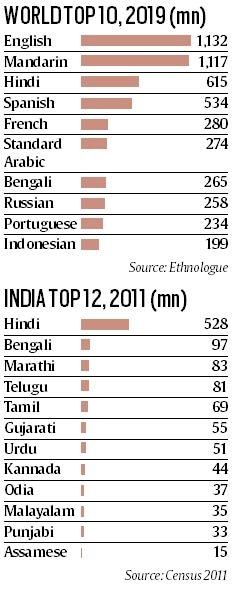
    • Globally, English remains the most widely spoken language with 1.13 billion speakers in 2019, followed by Mandarin with 1.17 billion, according to the online database Ethnologue.

    Why February 21?

    • UNESCO declared International Mother Language Day in 1999, to commemorate a 1952 protest against West Pakistan’s imposition of Urdu as the official language of East Pakistan (present-day Bangladesh).
    • According to a report, police opened fire on demonstrating Dhaka University students and “some people were killed”.
    • When thousands thronged the university the next day, police fired again, killing more people.
    • In Bangladesh, since 1953, February 21 is observed as Ekushe Day, after the Bengali word for twenty-one.
    • According to the South Asia Democratic Forum, five among those killed were recognised as “language martyrs — Abul Barkat, Abdul Jabbar, Rafiquddin Ahmad, Abdus Salman and Shafiur Rahman.

    Data on Indian languages

    • Hindi is third with 615 million speakers while Bengali is seventh with 265 million.
    • In India, Hindi is the most spoken language with over 528 million speakers in 2011, as per the Census.
    • Bengali had 97.2 million speakers in 2011, followed by Marathi (83 million), while other languages with over 50 million speakers are Telugu (81 million), Tamil (69 million), Gujarati (55.5 million) and Urdu (50.8 million).
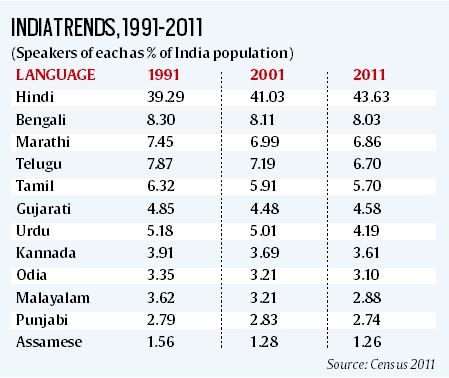
    • Percentage trends from 1991 to 2011 underline the growth of the most widely spoken language, Hindi, which was spoken by 39.29% of the Indian population in 1991, and whose share grew to 43.63% in 2011.
    • For other languages in India’s top 12, the 2011 percentage share has fallen when compared to that in 1991.
  • Coronavirus – Health and Governance Issues

    Gearing up to fight the next big viral outbreak

    Context

    India is ill-prepared to deal with the new strain of coronavirus (SARS-CoV-2) that is causing worldwide panic. Policymakers must take forceful action to prevent the spread of the new virus and heed the urgent warnings of global public health professionals about new pathogens.

    No country is adequately prepared

    • Finding of the Global Health Security Index: The World Health Organization (WHO)’s Global Health Security Index finds that no country is adequately prepared.
    • It assesses 195 countries across six categories
      • Prevention
      • Early detection.
      • Rapid response.
      • Health system quality.
      • Standards.
      • Risk environment.
    • India’s dismal rank: India is ranked 57th.
      • That the country scores around the global average is no comfort, because the global average is a low 40.2 out of 100, and India’s score is 46.5. (For the record, the U.S. is ranked first and China 51st).

    Four-point health agenda

    • The prospect of new outbreaks puts four items on the health agenda in the spotlight that require both immediate and longer-term action:
      • Early detection and prevention.
      • Better collaboration across health service providers.
      • More investment in health systems; outcomes, and education; and-
      • Better care of the environment and biodiversity, which directly affects people’s health safety.

    Thailand’s outstanding example

    • Sixth rank on Health Security Index: That Thailand is ranked sixth in the Health Security Index- the highest ranking for an Asian country.
      • The rank says a great deal about the country’s track record in disease prevention, early detection, and rapid response linked to investments in its public health system.
      • When the deadly Middle East Respiratory Syndrome (MERS), also caused by a coronavirus, broke out in 2015, Thailand quickly notified the WHO of its first confirmed case and acted transparently to arrest the spread.
      • This is in stark contrast to delayed notification by China’s officials of the recent outbreak.

    India’s record in past outbreaks

    • Underscoring inadequacies: The influenza A (H1N1) outbreaks since 2009 in Rajasthan, Maharashtra, Tamil Nadu and other States have acutely underscored the need for better detection, awareness of symptoms and quarantining.
    • Protocols for surveillance: Clearer protocols for all three types of surveillance are needed in all States.
      • And these protocols need to be communicated to health professionals at all levels and the public in local languages.

    Conducting stress tests on health system

    • Countries need to do the stress tests for their preparedness to deal with health emergencies.
    • Exposing the crucial gap: Each State in India should do this to expose crucial gaps in areas such as-
      • Adequacy and supply of diagnostic equipment.
      • Health facilities.
      • Hygienic practices, and-
      • Prevention and treatment protocols.
    • Ensuring strong supply chains: Queues of desperate shoppers trying to buy hand sanitizer, face masks and other protective products in Hong Kong and China highlight the need for strong supply chains for products that people need during health emergencies.

    The partnership between countries and with the private sector

    • Partnership to ensure supply chains: Partnerships between private and public sectors, and between countries– that can sustain supply chains and bolster the medical capacity of countries struggling to cope.
      • Collaborative approach in Asia: In Asia, collaborative approaches exist, for example, for combating tuberculosis, AIDS and malaria.
    • Need to do more: More is needed to tackle health emergencies on the scale of recent outbreak, particularly on funding.
      • Emergency loan option: There could be an emergency loan facility, with a “deferred drawdown option” as the World Bank uses for disasters, natural or health.
      • The loan option can help augment own resources in times of a public health catastrophe.
    • Investment is the best defence: But the best defence of all is to invest more, and more efficiently, in health and education to prepare populations and strengthen health services.
      • Low health expenditure: Health expenditure by the government in India is less than 5% of Gross Domestic Product, which is low for a middle-income country.
      • Spending at that level limits, among other things, the availability of health professionals during crises.
      • According to WHO, India has only 80 doctors per 1,00,000 people.

    Investment in health, education

    • Kerala’s experience: Kerala’s experience in 2018 with the deadly Nipah virus showed the value of investing in education and health over the long term.
    • What measures were taken in Kerala? The availability of equipment for-
      • Quick diagnosis.
      • Measures to prevent diseases from spreading and-
      • Public information campaigns- all helped to keep the mortality rate from the Nipah virus relatively low.
      • Having capable public health professionals helped in the information exchange with WHO and other international bodies.

    The relation between environmental degradation and health

    • A new dimension of new pathogens: One of the many dimensions of new pathogens that is getting increased attention is the link with environmental degradation.
    • The relation between pollution and viral respiratory infection: The interaction between particulate matter from pollution and viral respiratory tract infections, especially in the young and the elderly, as well as the malnourished, has been increasingly noted in epidemiological studies.
      • Many of the highest air pollution readings are being recorded in Indian cities.
    • Most vulnerable country: An HSBC study of 67 countries ranks India as the most climate-vulnerable one because of the impact of severe temperature increases and declines in rainfalls.
      • Reasons for vulnerability: The effects of such occurrences are magnified by the high density of the country’s population, the sheer number of people in harm’s way, and the high incidence of poverty.
      • Research is increasingly connecting global warming to vector-borne viruses.

    Conclusion

    The dangerous trend for disease spillovers from animals to humans can be traced to increased human encroachment on wildlife territory; land-use changes that increase the rate of human-wildlife and wildlife-livestock interactions; and climate change. Protecting the precious biodiversity should be a priority.


  • Issues related to Economic growth

    Conquering the green frontier

    Context

    India has to forge a different development model -one that will shift India’s workforce from agriculture to globally leading, resource-efficient businesses.

     How India can deliver sustainable prosperity?

    • The two intertwined forces: Just as liberalisation and globalisation transformed the economy in the past, two different yet intertwined forces will likely transform the economy in the future.
    • FirstHigh competitiveness: India must have globally leading companies across a range of key sectors such as financial services and manufacturing.
      • Global productivity frontier: These super competitive businesses should define the global productivity frontier so that they can surpass the production processes of the best companies in the world.
    • Second-Long term sustainability: India must also adopt a resource-efficient, low-carbon development pathway to utilise scarce natural resources effectively. There is no other way.
      • Apocalyptic air pollution.
      • Dire water shortages.
      • Rising temperatures and-
      • Extreme climate events- have already brought us to the brink of an environmental crisis.
      • The need for India’s leadership for achieving the target: Moreover, note that the world needs India’s leadership to achieve the 2 degree Celsius global warming target.
      • In short, India’s growth has to be green.
    • What is the problem in achieving these goals?
      • No nation has ever attempted these twin transformations — high competitiveness and long-term sustainability — simultaneously.
      • The traditional development model: The traditional development model has been a farm-to-factory development model with economies transitioning from traditional agriculture to resource-intensive, urban manufacturing.
      • India has to forge a different development model — one that will shift India’s workforce from agriculture to globally leading, resource-efficient businesses.
      • Also, these companies must use the most advanced green technologies and business models.
      • India’s development model will, therefore, need to take the Indian economy from “the farm-to-green frontier”.

    Three focus area for green transformation

    • The productivity transformation driven by super competitive businesses is well underway.
      • We now need to consider a comprehensive policy package that will enable us to simultaneously undertake a green transformation.
      • Global best practices and India’s own experiences suggest three focus areas for such a transformation.
    • India has the third-largest start-up ecosystem in the world and our larger companies are also pursuing innovation-driven growth.
    • Specific and stable policy goals
      • Specific and stable policy goals need to be established to set detailed green targets for various sectors.
      • A macro-economic model that factors in-
      • Current skills.
      • Sectoral connections.
      • Relative emission and-
      • Financial constraints are necessary to inform such targets going forward.
      • Such a model can then be used to evaluate various green growth scenarios.
      • Decarbonisation approaches in the green frontier scenario will drive the growth of green industries, green jobs, green skills, green entrepreneurs and green finance.
    • Pursuing the policy goals: Global and Indian experience highlights that green targets will have to be pursued in a stable manner across decades.
      • Most large emitters and pollutants are associated with long-lived (20-30 plus years useful life) assets.
      • The basic requirement for investment in green assets: Investments in green assets will only be possible if there is the sanctity of contracts, pricing stability, and consistent policies that are backed up by the full force of law.
      • Implementation: Finally, these specific and stable policy goals need to be implemented urgently to avoid lock-in with high-carbon assets.
    • Revamp the institutional framework: India may need to revamp its existing institutional framework for environmental governance in order to align it with the country’s green transformation.
      • Four levels of institutional structure: As demonstrated by global best practices, a comprehensive institutional framework could include four levels — super sovereign, sovereign, state/province and city.
      • Council for monitoring: An independent council or board may also be required to monitor, report, and verify green targets.
    • Appropriate financing capacity: Indian policymakers and entrepreneurs will unleash market forces that will drive the growth of waste management, solar panels, electric vehicles, super-efficient appliances, recyclable food packaging, clean coal, etc.
      • These green industries will require massive investments and appropriate financing capacity will have to be created to support their growth.
      • Preliminary estimates suggest that India’s green transformation may require an average investment of $95 billion to $125 billion per year, aggregating over $1 trillion in the next decade.
      • A “green super fund” could be established to jumpstart green investments by pooling together international and domestic capital.
      • Dual roles of financial institution: Such a financial institution could play a dual role in mediating and mitigating risk for global capital, as well as identifying sectoral project pipelines.
      • The success of financial institution: Indian financial institutions have been very successful in building up new industries such as microfinance, EdTech, and affordable healthcare, which have delivered both financial and social returns; however, financial support for green industries will have to be orders of magnitude larger.
      • Moreover, the “green super fund” may have to be able to invest across the capital structure (debt plus equity) as well as across the company lifecycle (early stage, growth capital, infrastructure investments, and so on).

    Conclusion

    Our future depends on how we resolve our environmental challenges. Further, we are the world’s third-largest carbon emitter and will play a crucial role in getting the planet to a low-carbon trajectory. Simply put, we must urgently transform our economy to get to the green frontier.

  • Foreign Policy Watch: India-SAARC Nations

    Putting neighbours first

    Context

    India has promoted regional cooperation in South Asia in a spirit of generosity, without insisting on reciprocity.

    Relations with Sri Lanka

    • Beginning of new chapter in ties: The visit of Sri Lankan Prime Minister Mahinda Rajapaksa to India in February marked the beginning of a new chapter in ties with a friendly neighbour.
      • The neighbour with which India has close historical bonds straddling culture, religion, spirituality, art and language.
    • Growing convergence against terrorism: More relevantly, there is a growing convergence against terrorism following the Easter attacks in Sri Lanka last April.
    • There is deep appreciation in Sri Lanka for the free emergency services provided through 280 ambulances gifted by India, now operational in eight of the country’s nine provinces.
    • Prospects for tri-lateral cooperation: There are much better prospects today for tri-lateral cooperation between India, Japan and Sri Lanka in the development of the East Container Terminal at Colombo port and the proposed joint development of the Trincomalee oil storage tanks.
    • Indicators of a new warmth in relations:
      • Several infrastructure projects.
      • Direct flights between Chennai and Jaffna.
      • Resumption of ferry services.
      • India’s new lines of credit and construction of houses for the internally displaced.
      • Homeless and landless people are indicative of a new warmth in relations.
    • First visit to India: That both Mahinda Rajapaksa and his brother President Gotabaya chose India as the destination for their first overseas visits after assuming office bodes well.

    Relations with Maldives

    • First visit by PM Modi: After the general elections last year, PM Modi’s first foreign visit was to the Maldives in June 2019.
      • India first: The visit was to establish warm and friendly relations with President Ibrahim Solih, who has done much to promote closer relations with India through his “India First Policy”.
    • First visit to India: India was the first country that Solih had visited in December 2018, a far cry from his predecessor’s brazen anti-India slant.
      • Soon after assuming office, Solih’s government annulled a controversial 2015 law that was meant to allow foreigners, particularly from China, to arbitrarily own islands.
    • Projects worth 180 crores inaugurated: The inauguration during Modi’s visit of two projects worth Rs 180 crore-the Coastal Surveillance Radar System and the Composite Training Center of the Maldivian National Defence Forces-has deep significance for the success of India’s neighbourhood policy.
    • $800 million worth lines of credit: India’s offer of lines of credit worth about $800 million and other capacity-building projects for water supply and sewerage are strong planks in our economic ties.
    • Terrorism and radicalisation are subjects of common concern.
    • DOSTI exercise: The agreement to restart the tri-lateral DOSTI naval exercise as also the tri-lateral NSA-level dialogue between India, Maldives and Sri Lanka lay the ghost of the Yameen era to rest.

    Relations with Nepal

    • Inauguration of first cross-border petroleum pipeline: In September last year, India and Nepal jointly inaugurated South Asia’s first cross-border petroleum products pipeline from Motihari in India to Amlekhgunj in Nepal.
    • Prioritising the rebuilding of houses: India is also prioritising the rebuilding of houses in Gorkha and Nuwakot districts, with “Build Back Better” as the guiding principle in keeping with Modi’s clarion call for a Coalition for Disaster Resilient Infrastructure (CDRI).
    • Role played by geography: Geography plays a determining role in creating inter-dependence.
      • Even as Nepal, like other South Asian countries, seeks closer ties with China, there is a much better appreciation today that India’s role as a key economic and developmental partner is unique and indispensable.

    Relations with Bangladesh

    • Model partnership: India’s relations with Bangladesh under Modi and Sheikh Hasina have evolved into a model partnership, consolidated by-
      • High-level exchanges.
      • Mutual trust and-
      • Enhanced cooperation on security matters.
    • Border firing incidents: Incidents of border firing, though rare, have an adverse fall-out on public perception and need to be handled with sensitivity.

    Relations with Bhutan

    • The India-Bhutan friendship runs deep, with growing cooperation in the vital hydro-power sector providing it a fresh impetus.
      • Notably, the centrepiece Mangdechhu project (750 MW) was completed on schedule last year.
    • RuPay card in Bhutan: The introduction of the RuPay card in Bhutan and elsewhere in the neighbourhood will further cement economic and people-to-people ties.

    Relations with Myanmar

    • Security cooperation: When India shortly hands over to Myanmar the INS Sindhuvir, a Kilo Class submarine, it will propel security cooperation to a higher pedestal.
      • Cross-border strike in Myanmar: Close coordination with Myanmar was evident earlier in the cross-border strike on insurgents by Indian forces in 2015.

    Unrealised potential of South Asia

    • South Asiasome figures: has 1.8 billion people and a combined GDP of nearly $3.47 trillion, with India’s economy the largest by far.
    • South Asia has great potential but has been held back by Pakistan.
      • Hindrance for cooperation with Afghanistan: Pakistan has not only denied India and Afghanistan the overland transit route for trade, but has also thwarted Modi’s efforts to place at centre stage the common struggle against poverty, illiteracy and natural disasters.

    Cooperation within SAARC: Pakistan has held to ransom cooperation within SAARC by raising extraneous matters, perpetuating terrorism and rejecting the ineluctable logic of intra-South Asian trade, which remains abysmally poor.

    • Pakistan opt-out of satellite project: Islamabad decided to opt-out of the SAARC satellite project proposed by India, and it was finally launched in 2017 without Pakistan’s participation.
    • Motor Vehicle Agreement: Pakistan also played the role of a spoiler at the 18th SAARC Summit in November 2014, preventing progress on the proposed Motor Vehicle Agreement for the regulation of passenger and cargo vehicular traffic amongst SAARC member states.
    • Implications for Afghanistan: Pakistan’s intransigence on connectivity impairs Afghanistan’s ability to link up with other countries in South Asia.
      • The air corridor between India and Afghanistan cannot cater to the full potential of trade ties.
      • Sustainability of Chabahar port: Recent tensions between the US and Iran have cast a shadow on the sustainability of Chabahar port as an alternative maritime supply route to Afghanistan at a crucial juncture in its history.
      • India’s role in Afghanistan: India’s proactive role in recent years in building much-needed infrastructure and capacities in Afghanistan is widely recognised.
      • Deepened defence cooperation: Defence cooperation too has deepened under Modi, with India dropping its traditional coyness in such matters.
      • Much more may have to be done, though, to help Afghanistan achieve stability through economic prosperity.
      • Afghanistan’s true destiny lies with South Asia.

    Key aspects of Neighbourhood First Policy

    • Response to security challenges: Neighbourhood First involves India’s willingness to respond to security challenges with new grit.
    • Humanitarian assistance: It also involves for India to be an enthusiastic responder in providing humanitarian assistance and conducting disaster relief operations in Nepal, Sri Lanka, the Maldives and the extended neighbourhood.
    • Developmental assistance: Even more important is the steady progress made by India to expand developmental assistance and improve project execution based on collaborative partnerships.
      • India’s developmental assistance to six South Asian countries was over Rs 21,100 crore. 

    Progress on BIMSTEC

    • BIMSTEC, the other regional grouping, has done well.
    • Participation in disaster Management Exercise: In February this year, delegates and rescue teams from India, Bangladesh, Nepal, Sri Lanka and Myanmar enthusiastically participated in disaster management exercises conducted at Ramachandi Beach at Puri in Odisha.
    • Cross-border electricity grid: The signing of the MoU on BIMSTEC Grid Interconnection at the fourth BIMSTEC Summit, attended by all seven nations in Kathmandu in August 2018, provides a fillip to cross-border electricity trade.
    • India’s focus on BIMSTEC and its Act East Policy have served to highlight India’s key role in promoting cooperative growth and development in several parts of South Asia.

    Conclusion

    In a world increasingly characterised by a “my country first” approach, India has endeavoured to harness the impulse for regional cooperation in a spirit of generosity, without insisting on reciprocity, to realise the motto of Security And Growth For All In The Region (SAGAR).


Join the Community

Join us across Social Media platforms.