💥UPSC 2027,2028 Mentorship (April Batch) + Access XFactor Notes & Microthemes PDF

Archives: News

  • Foreign Policy Watch: India – EU

    Explained: The EU data strategy

    The European Commission has recently released a “European strategy for data… to ensure the human-centric development of Artificial Intelligence” and a white paper on artificial intelligence.

    EU data strategy

    • The new documents present a timeline for various projects, legislative frameworks, and initiatives by the European Union, and represent its recognition that it is slipping behind American and Chinese innovation.
    • The strategy lays out “why the EU should act now”.
    • The blueprint hopes to strengthen Europe’s local technology market by creating a “data single market” by 2030 to allow the free flow of data within the EU.
    • To aid a “data-agile economy”, the Commission hopes to implement an “enabling legislative framework for the governance of common European data spaces” by the latter half of the year.
    • By the beginning of 2021, the Commission will make high-value public sector data available free through Application Programming Interfaces (APIs) — a pathway for two different applications to speak to each other.
    • Between 2021 and 2027, the Commission will invest in a High Impact Project to jump-start data infrastructure. Several other initiatives are laid out, including a cloud services marketplace.

    Why such strategy?

    • The EU has the potential to be successful in the data-agile economy. It has the technology, the know-how and a highly skilled workforce.
    • However, competitors such as China and the US are already innovating quickly and projecting their concepts of data access and use across the globe, the strategy states.
    • With American and Chinese companies taking the lead on technological innovation, Europe is keen to up its own competitiveness.

    What does the EU move mean for legislation?

    • Europe has been a frontrunner when it comes to technology regulation.
    • Its General Data Protection Regulation (GDPR) released in 2018 was a game-changer across the industry. In the recent strategy, the GDPR is seen as giving the “solid framework for digital trust.”
    • Parliamentarians are discussing India’s current Personal Data Protection (PDP) Bill in a Joint Select Committee.
    • The recent draft of the PDP introduced a clause on non-personal data, mandating entities to hand over such data to the government on command.
    • This was not included in the draft proposed by the Justice B N Sri Krishna Committee in October 2018.
    • Some of the movement around the PDP Bill comes from a desire to strengthen India’s own data economy, similar to the EU’s desire.

    Has India done anything similar?

    • The Union Cabinet approved the National Data Sharing and Accessibility Policy (NDSAP) in 2012.
    • As part of the initiative, the government worked with the US government to release data.gov.in, a site of government data for public use.
    • The Economic Survey of 2018 envisioned a similar use of non-personal data.
    • Just as the EU’s strategy discusses “data for public good”, the chapter titled “Data ‘Of the People, By the People, For the People’” advocated that the government step in to sectors that private players ignore, marking the first time India’s Economic Survey has isolated “data” as a strategic focus.
    • Other data integration efforts have been announced or implemented by NITI Aayog (the National Data & Analytics Platform), the Smart Cities Mission (India Urban Data Exchange), and the Ministry of Rural Development (DISHA dashboard).
    • In 2018, the National Informatics Centre worked with PwC and other vendors to create a Centre of Excellence for Data Analytics aimed at providing data analysis help to government departments.

  • Crop Insurance – PMFBY, etc.

    Changes in Crop Insurance Scheme

    The Centre has decided to restrict its premium subsidy in its flagship crop insurance schemes to 30% for unirrigated areas and 25% for irrigated areas (from the existing unlimited), and to make enrolment of farmers in the Pradhan Mantri Fasal Bima Yojana (PMFBY) and Restructured Weather Based Crop Insurance Scheme (RWBCIS) voluntary from the 2020 Kharif season.

     Other changes in crop insurance schemes

    • The government has given flexibility to states/UTs to implement PMFBY and RWBCIS, and given them the option to select any number of additional risk covers/features like prevented sowing, localised calamity, mid-season adversity, and post-harvest losses.
    • Earlier, these risk covers were mandatory.

    Why such a move?

    By capping the subsidy for premium rates up to 30%, the Centre wants to dis-incentivize certain crops in such areas where growing these crops involve high risks in terms of crop insurance premiums.

    What were the schemes?

    • At present, under PMFBY and RWBCIS, farmers pay a premium of 2% of the sum insured for all foodgrains and oilseeds crops of Kharif; 1.5% for all foodgrains and oilseeds crops of Rabi; and 5% for all horticultural crops.
    • The difference between actual premium rate and the rate of insurance premium payable by farmers, which is called the Rate of Normal Premium Subsidy, is shared equally between the Centre and the states.
    • However, states and UTs are free to extend additional subsidy over and above the normal subsidy from their budgets.
    • Until now, there was no upper limit for the central subsidy.
    • The Cabinet decided to cap the Centre’s premium subsidy under these schemes for premium rates up to 30% for unirrigated areas/crops and 25% for irrigated areas/crops.

    How many farmers are covered under these two schemes?

    • During 2018-19, about 5.64 crore farmers are enrolled with PMFBY for an insured sum of Rs 2,35,277 crore, and 30% of the gross cropped is insured.
    • When the government approved PMFBY four years ago, it was described as a path-breaking scheme for farmers’ welfare” under which there was no upper limit on government subsidy.
    • Even if balance premium was 90%, it was to be borne by the Government
    • While PMFBY is based on yield, RWBCIS is based on proxies and farmers are provided insurance protection against adverse weather conditions such as excess rainfall, wind and temperature.
    • The number of insured farmers under RWBCIS is relatively low.

    Impact of the move

    This change will have two main implications.

    • First, it may bring down the rates of overall premium as the state governments now will not be required to invite bids factoring these risks.
    • Second, it will make these schemes less attractive for farmers.
    • However, states/UTs can offer specific single peril risk/insurance covers like hailstorm etc under PMFBY.

    Burden of premium

    • One interpretation of this decision is that the burden of premium subsidy will go up for the states.
    • Example: In the old regime, if a farmer’s Kharif crop was insured for Rs 1,00,000 and the rate of actuarial premium was 40%, then the premium paid by the farmer was 2% (Rs 2,000), and the remaining premium was shared by the Centre and the state equally (19% or Rs 19,000).
    • In the new regime, for the same sum insured (Rs 1,00,000) and the same rate of premium (40%), the Centre will give subsidy for premium rates up to 30%.
    • This means that from the Kharif 2020 season , the Centre will have to pay premium at the rate of 14% (out of 30%, the farmer’s share is 2%, and the Centre’s and state’s 14% each).
    • The state has to bear the entire burden of the premium subsidy in cases where the rate of premium goes beyond the threshold of 30%.

    No insurance of certain crops

    • Another interpretation is that the Centre may stop supporting insurance of certain crops in certain areas where the rate of premium is more than 30%.
    • The Department of Agriculture, Cooperation and Farmers Welfare in consultation with other stakeholders/agencies will have to prepare State specific, alternative risk mitigation programme for crops/areas having high rate of premium.
    • While the average premium rate under PMFBY and RWBCIS at the national level was 12.32% for 2018-19, for some crops in certain districts, the rate of premium has been higher than 30% in recent years.
    • For instance, the rate of premium for Kharif groundnut has reached 49% in Rajkot of Gujarat, and the rate for Rabi paddy crop Ramnathapuram (Tamil Nadu) has reached 42%.

    Impact on states

    • The states are already defaulting on their share, and the Centre’s new cap will put an additional financial burden on them.
    • Madhya Pradesh has not paid its share of premium even for Kharif 2018, which comes to Rs 1,500 crore. As a result, farmers have not got their claims.
    • In fact, most states have delayed the payment of their share of premium.
    • Sources said that in some states, the expenditure on premium of PMFBY is more than 50% of their budget for agriculture.

    Immediate implications

    • That move will lead to a rise in the rates of premium, as the area covered under insurance and the number of enrolled farmers is expected to come down significantly.
    • As of now the schemes are compulsory for all loanee farmers and optional for other farmers.
    • Non-loanee farmers under the crop insurance schemes are much fewer than loanee farmers.
    • If the latter opt out of the schemes, the number of insured farmers will drastically come down.
    • In such a scenario the rate of premium of certain crops in some areas may go beyond 30%.

    Back2Basics

    Pradhan Mantri Fasal Bima Yojana – Min Premium, Max Insurance

  • Wildlife Conservation Efforts

    [pib] International protection for Great Indian Bustard, Bengal Florican and Asian Elephant

    India’s proposal to include Great Indian Bustard, Asian Elephant and Bengal Florican in Appendix I of UN Convention on migratory species was unanimously accepted at the undergoing CMS CoP in Gandhinagar.

    Great Indian Bustard

    • The Great Indian Bustard, an iconic, critically endangered and conservation dependent species, exhibits transboundary movements, and its migration exposes it to threats such as hunting in the boundary area of Pakistan-India and power-line collisions in India.
    • Inclusion of the species in Appendix I of CMS will aide in transboundary conservation efforts facilitated by International conservation bodies and existing international laws and agreement.

    Asian Elephant

    • The Government of India has declared Indian elephant as National Heritage Animal. It is also provided with the highest degree of legal protection by listing it in Schedule I of the Wildlife (Protection) Act, 1972.
    • The Great Indian Bustard is a Critically Endangered species with a small population of about 100–150 individuals that is largely restricted to Thar desert in Rajasthan, India.
    • The species has disappeared from 90% of this range; their population has reduced by 90% within 50 years (six generations), and their threats are expected to increase in future.

    Bengal Florican

    • The Bengal Florican an iconic, critically endangered species of topmost conservation priority, exhibits transboundary movements, and its migration exposes it to threats such as land-use changes, collision with power transmission line at the boundary area of India-Nepal and probable power-line collisions.
    • Inclusion of the species in Appendix I of CMS will aid in transboundary conservation efforts facilitated by International conservation bodies and existing international laws and agreement.
    • It populations has declined as a result of habitat loss, hunting and the species no longer breeds outside Protected Areas in the Indian subcontinent, except in a few areas of Assam.
  • Historical and Archaeological Findings in News

    What did Harappan people eat?

    The National Museum in New Delhi has hosted “The Indus dining experience” a food event based on the food pattern of Indus valley civilization.

    Food of Harappans

    • Archaeological evidence from Indus Valley sites (c. 3300 BC to 1300 BC) in present-day India and Pakistan suggests that a purely vegetarian meal will not provide a complete picture of what the Harappan people ate.
    • To judge from the quantity of bones left behind, animal foods were consumed in abundance: beef, buffalo, mutton, turtles, tortoises, gharials, and river and sea fish.
    • Apart from meat, the people of the Indus Valley Civilisation grew and ate a variety of cereals and pulses.
    • There is archaeological evidence for cultivation of pea (matar), chickpea (chana), pigeon pea (tur/arhar), horse gram (chana dal) and green gram (moong).
    • Several varieties of wheat have been found at Harappan sites, as well as barley of the two-rowed and six-rowed kinds.
    • There is evidence that the Harappans cultivated Italian millet, ragi and amaranth, as well as sorghum and rice.
    • Oilseeds such as sesame, linseed, and mustard were also grown.
  • Irrigation In India – PMKSY, AIBP, Watershed Management, Neeranchan, etc.

    Buddah Nullah

    The Punjab govt. has approved ₹650 crore in the first phase for rejuvenation of the highly polluting Buddah Nullah — a seasonal tributary of Sutlej in Ludhiana.

    Buddah Nullah

    • Buddah Nullah or Budha Nala is a seasonal water stream that runs through the Malwa region of Punjab.
    • It passes through highly populated Ludhiana and drains into Sutlej River, a tributary of the Indus river.
    • It has also become a major source of pollution in the region as well the main Sutlej river, as it gets polluted after entering the highly populated and industrialized Ludhiana city, turning it into an open drain.
    • Also, since a large area in south-western Punjab solely depend on the canal water for irrigation, and water from Buddha Nullah enters various canals after Harike waterworks.

    Why such move?

    • The pollution in the Buddah Nullah is a major threat to public health and environment and the main sources of pollution in the nullah are direct flow of pollutants by industries and dairies.
    • Also, treated effluents from existing STPs, based on UASB technology, does not meet the required quality and overflow from sewer lines add to the problem.
    • The NGT has already directed the government to take proactive steps to immediately address the problem.
  • Health Sector – UHC, National Health Policy, Family Planning, Health Insurance, etc.

    Spontaneous Regression

    Patients sometimes make ‘miraculous’ recoveries from severe ailments. This is called spontaneous healing or spontaneous regression.

    Spontaneous healing/regression

    • A patient improves unexpectedly from a disease that usually progresses, such as cancer, and at times is even cured.
    • Such cases notwithstanding, the medical fraternity is often sceptical and takes “miraculous” recoveries as flukes.
    • A research explores patterns behind healing illnesses such as the deadliest kinds of cancers, and lays out physical and mental principles associated with recovery.
    • These include physically healing diets and immune systems, and mentally healing stress responses and identities.

    How does it occur?

    • The research states that much of our physical reality is created in our minds and perception changes our experiences, sometimes to the point of changing our bodies.
    • Therefore it argues that healing our identities may be a key tool to recovery.
  • US policy wise : Visa, Free Trade and WTO

    Trading with America

    Context

    Trump has made India’s trade headache more acute. But he has also opened up opportunities.

    Political polarisation in both countries

    • Impeachment attempt: The Democrats in the US have struggled to oust Trump from the White House and rarely find anything they can agree with their President on.
    • The deeper political divide in India: While ousting Narendra Modi through a legal process of impeachment is not an option in India, the political divide is even deeper.
    • No consensus on foreign policy
      • Under Trump, consensus on foreign policy in Washington has broken down.
      • In Delhi, the Opposition has never been willing to acknowledge the diplomatic successes of the government.
      • But the usually bipartisan support for foreign policy in the strategic community has eroded.
      • Many leading voices of the establishment who have a long and distinguished service have become major critics of foreign policy.

    Comparison of India’s trade with the US and China

    • Trade with the US: In 1995, total two-way trade, including goods and services, between India and the US was $11 billion.
      • In 2018, it crossed $140 billion.
      • It is reported to be around $150 billion in 2019.
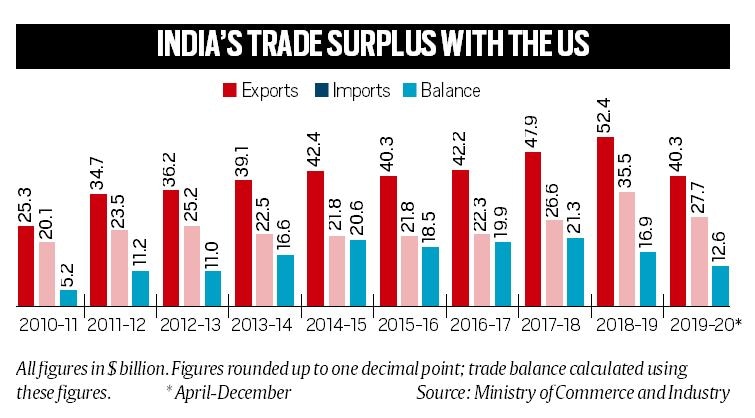
      • In trade with the US, India enjoys a surplus of nearly $23 billion.
      • A 14-fold increase in trade turnover in 25 years is certainly not something to sneer at.
      • Can India and the US do better on trade? Yes, of course.
      • Only a few years ago, the two sides were looking at an annual trade target of $500 billion. That looks rather ambitious amidst the current disputes
    • Trade with China: India’s China trade too has risen, even more rapidly.
      • From a couple of hundred million dollars in the mid-1990s to nearly $90 billion in 2019.
      • India has a deficit of nearly $57 billion with China.

    Trade disputes between India-US

    • Trade has long been a contentious issue between Delhi and Washington.
    • There had been enduring tension since the late 1980s between the US demand for-
      • Greater market access.
      • Intellectual property protection.
      • And a host of other demands and India’s own cautious approach to economic liberalisation.
    • Rise in pressure under Trump administration: All recent US administrations have applied continuous pressure on India for trade agreements.
      • The pressure has significantly risen under President Trump.
    • Trade dispute at the centre of the relationship: If his predecessors were willing to cut some slack for India by citing larger political and strategic considerations in the bilateral ties, Trump has put trade disputes at the front and centre of the relationship.
      • Officials in the Department of Commerce and the US Trade Representative’s office have adopted extremely aggressive tactics in the negotiation with India.
    • Result of a radical reorientation of US trade policy: Trump has undertaken a radical reorientation of US trade policy.
      • For Trump, this is a matter of long-standing ideological conviction as well as a political convenience.
      • He has bet that the anti-free-trade White working classes in the American rust belt are the key to his re-election.
    • No option but to deal with it: Given America’s pole position in the global trading system, you have no option but to deal with it.
      • Trump is getting away with his demand for the restructuring of trade relations with key economic partners.
      • He has renegotiated the NAFTA with neighbours Canada and Mexico and has compelled China to start reducing the massive trade deficit with the US.
    • The difference in India and China’s response to the US: In response to Trump’s pressure, Xi reaffirmed his commitment to economic globalisation and domestic liberalisation and wooed American investors with even greater vigour than before.
      • India embracing protectionism: India appears to be sending the opposite signal — of a definitive drift towards protectionism. India’s trade troubles are certainly not limited to the engagement with the US.

    Problem with India’s trade policies

    • India walking away from RCEP: Delhi walked away at the very last minute from signing the RCEP agreement last year to deep disappointment among its partners including the ASEAN, Australia, Japan and New Zealand.
      • The trade deficit with China: One of the main arguments cited by India was the massive trade deficit with China and the potential danger of it widening further under RCEP.
    • Failure in negotiations with the EU: The European Union is reluctant so far to restart trade negotiations that ended in great frustration for Brussels some years ago.
    • No deal with Australia and New Zealand: Australia and New Zealand have given up.
    • Neighbours complaint: India’s immediate neighbours complain that India’s rhetoric on connectivity and regionalism is matched by the multiple non-tariff barriers that continue to constrain commerce across the South Asian frontiers.
    • Why so many deals are pending? It is certainly probable, statistically, one in a million, that the fault lies, always, with India’s partners. But one would think there might be a real problem with Delhi’s own trade policies.

    Conclusion

    • New opportunity: Trump has certainly made India’s trade headache more acute. But he has also opened up opportunities.
      • His trade war on China has put pressure on the global supply chains centred around China.
      • India not the beneficiary of the US-China trade war: Many companies are moving their production out of China, but only a few are turning towards India.
      • While Delhi has talked the talk on taking advantage of the US-China trade war, it is yet to get its act together.
    • No opposition against protectionism at home: What makes Delhi’s devaluation of trade as a key instrument of economic growth potentially irreversible is the fact that there is little domestic political opposition to it.
    • Time to take a hard look at trade policy: For now, though, India’s partnership with the US might not only survive the current trade tensions but advance during Trump’s visit.
      • There is so much happening elsewhere in the relationship — especially in the defence and security domain.
      • But the time has come for Delhi to take a hard look at its current trade policy that threatens to undermine India’s regional and international prospects.


  • Foreign Policy Watch: India-China

    The missing piece in India’s defence jigsaw puzzle

    Context

    The country needs a clearly articulated white paper on its defence needs which sets out its strategic concerns.

    India’s defence deals in the pipeline

    • The first lot of Rafale fighter jets are expected shortly.
    • The final deal on the 200 Kamov Ka-226 light utility helicopters from Russia is in advanced stages and expected to be signed soon.
    • In October 2018, India and Russia had signed a $5.4-billion mega-deal for the S-400 Triumf Air Defence System.
    • Under contemplation today are yet another set of high-value U.S. defence deals, including additional purchases of P-8I Maritime Reconnaissance Aircraft and Apache Attack Helicopters.
    • NASAMS-II: Speculation is rife that India and the U.S. would sign a deal for the National Advanced Surface to Air Missile System (NASAMS-II).
      • Which is intended as part of a multi-layered missile shield to protect Delhi.
    • The U.S. side is also hoping for two more mega defence deals, worth $3.5-billion to be signed for 24 MH-60 Romeo Multi-Mission Helicopters for the Navy and an additional six AH-64E Apache Attack Helicopters for the Army.

    Need for the white paper

    • Given India’s rising global profile, and with two major adversaries on its borders, India needs to be fully prepared.
    • A missing piece: What is lacking in the defence jigsaw puzzle is a well-considered and clearly articulated white paper on India’s defence needs.
      • The white paper would deal with?
      • It sets out its strategic concerns.
      • How it is positioning itself to meet these challenges.
      • The putative costs of meeting the country’s defence needs.
    • Explain the Pakistan threat: In the case of Pakistan, the threat motif is, no doubt, obvious.
    • India’s political and defence establishment are on record that India can easily defeat Pakistan, even if a “weaker” Pakistan possesses “nuclear teeth”.
      • What is needed? A great deal of effort is called for to-
      • Explain to the public, the true nature of the threat posed by Pakistan.
      • And why India is so confident of beating back the Pakistani challenge.
    • Explaining the China threat: Meeting the military, strategic and economic challenge from China is an entirely different matter.
      • Understanding the nature of the threat: China is not Pakistan.
      • While China and Pakistan may have established an axis to keep India in check, explaining the nature of the threat posed by China to India is a complex task that needs to be undertaken with care and caution.

    The China threat

    • Is China an existential threat for India?: There are many experts who express doubts as to whether China intends today to pursue its 19th Century agenda, or revert to its belief in ‘Tian Xia’.
      • Undoubtedly China aims to be a great power and an assertive one at that.
      • India’s defence planners should, however, carefully assess whether there are degrees of “assertiveness” in China’s behavioural patterns.
      • There is little doubt that regarding its claim to areas falling within the ‘nine-dash lines’ (the first island chain), China is unwilling to make compromises.
      • Whether this applies to other regions of Asia and the Indo-Pacific, calls for an in-depth study.
    • The analysis is needed: It would be premature for India without undertaking such an analysis, to adhere to a common perception that China is intent on enforcing a Sino-centric world order in which India and other countries would necessarily have to play a secondary role.
    • What after analysis? If after undertaking such an “analysis”, it appears that China does not pose a direct threat to India’s existence, strategic and military planners need to come up with a different set of alternatives.
    • Western influence over thinking about China: In recent years, much of India’s strategic thinking regarding China’s aggressive behaviour has been coloured by that of the U.S. and the West.
      • Though it is a proven fact that China has not used lethal military force abroad since the 1980s.
    • Concerns over BRI: China’s Belt and Road Initiative (BRI) does convey an impression that China seeks to put itself at the centre of the world.
      • The speed with which many of the steps to progress the BRI are being taken again conveys an impression that China is intent on shrinking the physical and psychological distance between Europe and East Asia.
      • No intention of confrontation: This does not, however, necessarily mean that China is preparing to confront individual countries in Asia, such as India, which do not subscribe to the BRI.

    What would the white paper explain?

    • Answer to whether China is a threat to India? A defence white paper would provide a more definitive answer to such issues.
      • A detailed exercise to assess whether China is indeed a threat, rather than a challenge, to India should prove invaluable.
      • It is possible that a detailed study may indicate that China understands that there are limits to its strength and capabilities.
    • China’s weaknesses: Several instances of late have shown the frailties in China’s policies –Hong Kong, Taiwan, and even Xinjiang are instances that indicate that China has its own Achilles heel.
      • Consequently, China may not be ready, for quite some time at least, to seek a direct confrontation with India.
    • Conflict or furthering the influence? A defence white paper may also indicate that rather than a “conflict-prone” role, China is more intent on an “influence-peddling” one.
      • This is important from India’s point of view.
      • Converting economic heft into strategic influence: Already there is one school of thought that believes that Beijing is better at converting its economic heft into strategic influence, rather than employing force beyond certain prescribed areas.
    • Coming to understanding over the respective sphere of influence: If the above view is espoused by a defence white paper then, despite the vexed border dispute between India and China, the two countries could try and arrive at a subliminal understanding about respective spheres of influence.
      • What is India’s major concern? Today, one of India’s major concerns is that China is attempting to intrude into its sphere of influence in South Asia, and the first and second concentric circles of India’s interest areas, such as Afghanistan and parts of West Asia.
      • The peaceful co-existence: The defence white paper might well provide a strategic paradigm, in which India and China agree to peacefully co-exist in many areas, leaving aside conflict zones of critical importance to either, thus ensuring a more durable peace between them.
    • Is geo-economics is the primary arena of competition: One other outcome that the defence white paper could attempt is: whether China views geo-economics as the primary arena of competition today.
      • Avenue for cooperation: China has invested heavily in artificial intelligence, robotics and biotechnology, and perhaps, India needs to recognise that rather than blacklisting Chinese technology Tech firms, (which could prove counter-productive) there exist avenues for cooperation, paving the way for better state-to-state relations.

    Conclusion

    The defence white paper needs to underscore that a country’s domestic politics are an important pointer to a stable foreign policy. There could be different schools of thoughts within a nation, but equilibrium needs to be maintained if it is not to adversely impact a nation’s foreign policy imperatives. An impression that the country is facing internal strains could encourage an adversary, to exploit our weaknesses. This is a critical point that the defence white paper needs to lay stress on.

  • Foreign Policy Watch: India-United States

    Why trade with the US matters to India?


    Context

    • US President Trump arrives in India months after he went on stage with PM Modi at the ‘Howdy Modi’ event in Texas.
    • Both countries have repeatedly resolved to strengthen trade ties — however, attempts at working out a short-term agreement have fallen apart in the past, and tensions have risen over tariffs.
    • The US often accuses India of taking decisions over the previous few years that prevented “equitable and reasonable access” for Americans to its markets.
    • Let’s have a look at the current state of play:

    Why trade with the US matters to India?

    • India’s existing and stalled bilateral free trade agreements (FTAs) started to receive attention from the government last year, even as the country worked to conclude the seven-year negotiations to join the RCEP, the world’s “largest” regional trade pact.
    • But by backing out of the RCEP in November, India shut the door on the large “integrated market” that the deal was offering.
    • Instead, it increased the pressure on itself to strengthen existing separate trade agreements with each member of the RCEP bloc.
    • Without these, it may not be able to tap a sizeable portion of the global market; also, it may not be able to easily access the products and services of these countries.

    Need for more bilateral activities

    • In the backdrop of the global economic slowdown, where India’s global exports have fallen consistently, it is important for the country to diversify and strengthen bilateral relations with other markets.
    • It has set its sights on “large developed markets”, improved access to which would help its industry and services sectors.
    • These include the US, which has, over the last two decades, become a crucial trading partner in terms of both goods and services.

    Trump’s advent

    • In March 2017, soon after taking office with election campaign focussing on “making America great again”, Trump ordered “first-ever comprehensive review” of trade deficits of the United States.
    • India was among the countries that exported more to the United States than it imported, and the latter was left with a trade deficit of over $21 billion in 2017-18.
    • While the US’s deficit with India is only a fraction of its deficit with China (over $340 billion in 2019), American officials have repeatedly targeted the “unfair” trade practices followed by India.
    • These include the tariffs that India imposes, which the Trump administration feels are too high — and over which the President has personally called New Delhi out on several occasions.

    Locating the main sticking points

    • Negotiations on an India-US trade deal have been ongoing since 2018, but have been slowed by “fundamental” disagreements over tariffs subsidies, intellectual property, data protection, and access for agricultural and dairy produce.
    • The office of the US Trade Representative (USTR) has underlined India’s measures to restrict companies from sending personal data of its citizens outside the country as a “key” barrier to digital trade.
    • The US wants India to strengthen patent regulations, and to ease the limitations American companies investing in India face.

    India’s tariffs

    • India is a “tariff king” that imposes “tremendously high” import duties, Trump has complained repeatedly.
    • The health cess on imported medical devices announced in the Budget for 2020-21 too, is seen as a negative for the American side, as the US is among the top three exporters of these categories of products to India.
    • However, India is working to finalise a proposal to move from caps on prices of medical devices to limiting the margins of those involved in the supply of the products.

    Agri sector

    • The US has long demanded greater access for American agriculture and dairy products.
    • For India, protecting its domestic agriculture and dairy interests was a major reason to walk out of the RCEP agreement.

    US retaliation

    1) Tariff on steel

    • In 2018, the US imposed additional tariffs of 25% on steel and 10% on aluminum imports from various countries, including India.
    • While India’s government claims the impact is “limited”, they brought down the US share in India’s steel exports to 2.5% in 2018-19 from 3.3% in 2017-18.
    • In March 2018, India challenged the US decision at the World Trade Organization (WTO).
    • India held off on imposing retaliatory tariffs until the US struck again — by removing it from a scheme of preferential access to the American market.

    2) GSP axe and response 

    • In June 2019, the US decided to terminate India’s benefits under the Generalized System of Preferences (GSP) scheme, which provides preferential, duty-free access for over $6 billion worth of products exported from this country to the US.
    • The decision followed a warning earlier that year, after negotiations on a potential trade agreement had broken down.

    3) Labelling India as developed country

    • India was the largest beneficiary of the US GSP programme.
    • While duty-free benefits accrued to only around $200 million for the billions of dollars worth of exports, India is understood to have asked for restoration of these benefits in the ongoing trade negotiations.
    • Most recently, the USTR classified India as a “developed” country based on certain metrics. It is not clear whether the upgrade from “developing” will impact the restoration of benefits under the GSP scheme.

    The WTO tussle

    • India is one of the largest importers of almonds from the US, having imported fresh or dried shelled almonds worth $615.12 million in 2018-19.
    • Imports from the US of fresh apples stood at $145.20 million, of phosphoric acid at $155.48 million, and of diagnostic reagents at nearly $145 million that year.
    • Removal from the GSP list amidst rising trade tensions prompted India to finally impose retaliatory tariffs on several American imports, including almonds, fresh apples, and phosphoric acid.
    • This was a significant move — and the US approached the WTO against India.

    Whats’ next?

    • US administration appeared to suggest that while no deal was imminent, work on a longer-term agreement was progressing well, and that his personal chemistry with Prime Minister Narendra Modi might help.
    • India and the US could begin with some “low-hanging fruit” to indicate their willingness for a deeper economic commitment.
    • This includes the US reinstating India’s benefits under the GSP programme, and India doing away with duties on motorcycles.
  • Surrogacy in India

    Assisted Reproductive Technology Regulation Bill, 2020


    The Union Cabinet has approved the Assisted Reproductive Technology Regulation Bill, 2020 to monitor medical procedures used to assist people to achieve pregnancy.

    What is ART?

    • Assisted reproductive technology (ART) is used to treat infertility.
    • Assisted reproductive technology includes medical procedures used primarily to address infertility.
    • This subject involves procedures such as in vitro fertilization, intracytoplasmic sperm injection, cryopreservation of gametes or embryos, and/or the use of fertility medication.

    Highlights of the bill

    • National Board: The Bill provides for a national Board which will lay down a code of conduct to be observed by those operating clinics.
    • Standardization: It will also formulate minimum standards for laboratory and diagnostic equipment and practices to be followed by human resources employed by clinics and banks.
    • National registry: Under the proposed law, a national registry and registration authority will maintain a database to assist the national Board to perform its functions.
    • Confidentiality clause: The Bill will also ensure confidentiality of intending couples and protect the rights of the child.

    Strict punishment:

    • India has one of the highest growths in the number of ART centres and ART cycles performed every year.
    • India has become one of the major centres of this global fertility industry, with reproductive medical tourism becoming a significant activity.
    • This has also introduced a plethora of legal, ethical and social issues; yet, there is no standardisation of protocols and reporting is still very inadequate.
    • The Bill thus proposes stringent punishment for those who practise sex selection; indulge in sale of human embryos or gametes and those who operate rackets.

    Other such Bills

    Taken together, theses proposed legislations create an environment of safeguards for women’s reproductive rights, addressing changing social contexts and technological advances.

    Surrogacy Regulation Bill 2020

    • The Surrogacy (Regulation) Bill, 2020 proposes to regulate surrogacy in India by establishing National Board at the central level and State Boards and Appropriate Authorities in the States and Union Territories.
    • The major benefit of the Act would be that it will regulate the surrogacy services in the country.
    • While commercial surrogacy will be prohibited including sale and purchase of human embryos and gametes, ethical surrogacy to the Indian Married couple, Indian Origin Married Couple and Indian Single Woman (only widow or Divorcee) will be allowed on fulfillment of certain conditions.
    • As such, it will control the unethical practices in surrogacy, prevent commercialization of surrogacy and will prohibit potential exploitation of surrogate mothers and children born through surrogacy.

    Medical Termination Pregnancy Amendment Bill 2020

    • The Medical Termination of Pregnancy Act, 1971 (34 of 1971) was enacted to provide for the termination of certain pregnancies by registered medical practitioners and for matters connected therewith or incidental thereto.
    • The said Act recognised the importance of safe, affordable, accessible abortion services to women who need to terminate pregnancy under certain specified conditions.
    • Besides this, several Writ Petitions have been filed before the Supreme Court and various High Courts seeking permission for aborting pregnancies at gestational age beyond the present permissible limit on the grounds of foetal abnormalities or pregnancies due to sexual violence faced by women.

Join the Community

Join us across Social Media platforms.