💥UPSC 2027,2028 Mentorship (April Batch) + Access XFactor Notes & Microthemes PDF

Archives: News

  • Internal Security Architecture Shortcomings – Key Forces, NIA, IB, CCTNS, etc.

    [26th July 2025] The Hindu Op-ed: Kargil, Pahalgam and a revamp of the security strategy

    PYQ Relevance:

    [UPSC 2016] The terms ‘Hot Pursuit’ and ‘Surgical Strikes’ are often used in connection with armed action against terrorist attacks. Discuss the strategic impact of such actions.

    Linkage: The article explicitly talks about the India’s shift in counter-terrorism strategy, mentioning the surgical strikes after the Uri attack (2016) and the Balakot strikes (2019) following Pulwama as “a strong reply” and “statement of intent”. The article culminates in discussing Operation Sindoor after the Pahalgam attack (2025), which involved striking terror bases and military air-bases deep in Pakistan, setting a “new threshold” for India’s response to terror.


    Mentor’s Comment: This year, in light of the recent Operation Sindoor (May 7–10, 2025), launched by India in response to the Pahalgam terror attack. The operation demonstrated India’s enhanced conventional military strength and shift in counter-terrorism doctrine, drawing parallels with the Kargil War’s legacy of structural reforms, military modernisation, and strategic assertiveness.

    Today’s editorial analyses the Indian Military strength. This topic is important for GS Paper III (Internal Security) in the UPSC mains exam.

    _

    Let’s learn!

    Why in the News?

    July 26, 2025, marks the 26th anniversary of the Kargil War, a key moment in India’s military history.

    What key shortcomings did Kargil expose?

    • Intelligence Failure: There was a complete lack of actionable intelligence about Pakistani infiltration. Eg: Neither RAW nor military intelligence anticipated the large-scale intrusion in the Kargil sector, resulting in delayed response.
    • Lack of Real-time Surveillance and Reconnaissance: India lacked advanced aerial and satellite surveillance capabilities. Eg: Absence of drone surveillance led to Pakistani troops occupying key heights undetected.
    • Operational Unpreparedness in High-altitude Warfare: Indian troops were not fully equipped or trained for fighting in extreme mountain conditions. Eg: Soldiers lacked snow boots, high-altitude tents, and artillery support during initial engagements.
    • Inadequate Military Modernisation and Logistics: Outdated weaponry and logistical weaknesses slowed the military’s response. Eg: Lack of precision-guided munitions and night-vision equipment hampered operations in the early phase of the conflict.

    How did they influence India’s military reforms?

    • Revamp of the Intelligence Infrastructure: The intelligence failure in Kargil led to the creation of dedicated and tech-enabled intelligence agencies. Eg: Establishment of the Defence Intelligence Agency (DIA) in 2002 and the National Technical Research Organisation (NTRO) in 2004 improved surveillance and early warning systems.
    • Modernisation and Capability Building: Recognising operational gaps, India focused on military modernisation and indigenous defence production. Eg: Induction of Rafale fighters, Apache helicopters, and BrahMos missiles, along with enhanced focus on ‘Make in India’ defence projects.
    • Structural and Doctrinal Reforms: The need for faster, joint response led to organisational restructuring and new doctrines. Eg: Appointment of the Chief of Defence Staff (CDS) in 2019 and development of the Cold Start Doctrineenabled swift, coordinated operations across services.

    How has India’s counter-terror strategy evolved from Kargil to Operation Sindoor?

    • Shift from Strategic Restraint to Active Retaliation: Initially, India responded passively to terror attacks, but now adopts swift and punitive action. Eg: In Operation Sindoor (2025), India launched precision strikes on nine terror bases and eleven military airbases inside Pakistan within 96 hours of the Pahalgam attack.
    • Use of Air Power and Missile Strikes: India has moved beyond surgical ground raids to deep-strike capabilities using air and missile assets. Eg: The BrahMos missile strike on Nur Khan Base in Pakistan reportedly crippled a nuclear weapons storage facility, sending a strong strategic signal.
    • Preemptive and Coordinated Operations: Focus has shifted to pre-empting terror threats through real-time intelligence and coordinated special operations. Eg: In 2023, India conducted a pre-emptive operation in Kashmir’s Gurez sector, dismantling a terror launchpad before infiltration.
    • Internationalising the Terror Narrative: India increasingly leverages diplomacy and global platforms to isolate Pakistan as a state sponsor of terror. Eg: Following the Pulwama attack (2019), India worked with global powers to get Masood Azhar designated as a global terrorist by the UN Security Council.
    • Integration of Technology and Intelligence Networks: There is now enhanced use of surveillance drones, cyber intelligence, and inter-agency coordination. Eg: Operation Black Thunder II (2024) used real-time intelligence sharing between NTRO, RAW, and special forces to eliminate a high-value terrorist in less than two days.

    What are the challenges for India? 

    • Persistent Cross-border Terrorism: Despite reforms, Pakistan-based terror groups continue to pose a threat, using proxy warfare and non-state actors to destabilize regions like Jammu & Kashmir.
    • Cybersecurity Vulnerabilities: India is increasingly vulnerable to cyberattacks on its military, energy, and communication infrastructure by hostile state and non-state actors. Eg: In 2023, a suspected Chinese-origin cyberattack targeted the power grid in Ladakh, exposing gaps in cyber defence preparedness.
    • Delays in Defence Modernisation: The slow pace of procurement, bureaucratic hurdles, and over-dependence on imports affect India’s combat readiness. Eg: Delays in acquiring high-altitude drones and next-generation tanks have impacted operational planning in sensitive border areas like Eastern Ladakh.

    Way forward: 

    • Promote Jointness and Modernisation: Implement integrated theatre commands and upgrade military technology to ensure faster, coordinated responses.
    • Strengthen Border and Cyber Security: Deploy smart surveillance systems and enhance cyber defence to counter both conventional and hybrid threats.

  • Manipur Crisis

    Healing Manipur Fragile peace demands political actors pursue genuine reconciliation

    Why in the News?

    Recently, President’s Rule in Manipur has been extended by another six months from August 13, 2025, amid an ongoing ethnic conflict between the Kuki-Zo and Meitei communities.

    What led to the decline in misuse of the President’s Rule?

    • S.R. Bommai Judgment (1994) – Judicial Review Introduced: The Supreme Court ruled that the President’s decision under Article 356 is subject to judicial review. Eg: This judgment set a precedent for checking arbitrary dismissals of State governments.
    • Rise of Coalition Politics and Regional Parties: Since the 1990s, strong regional parties became key players in national coalitions, reducing the Centre’s dominance. Eg: Parties like TDP, DMK, and TMC gained influence during UPA and NDA regimes, deterring misuse.
    • Increased Public Awareness and Media Scrutiny: Growing media vigilance and civil society activism led to public opposition against politically motivated President’s Rule. Eg: Protests and legal action followed the controversial imposition of President’s Rule in Uttarakhand (2016).
    • Strengthening of Federal Values and Political Maturity: A maturing democracy and greater respect for federalism encouraged restraint in using Article 356. Eg: Even in politically complex States like Tamil Nadu or Maharashtra, elected governments were allowed to continue despite crises.
    • Legal and Political Repercussions of Misuse: Judicial reversals and reputational damage have made misuse risky for ruling parties at the Centre. Eg: Arunachal Pradesh (2016)SC restored the dismissed government, exposing the misuse of President’s Rule.

    Why was President’s Rule extended in Manipur?

    • Continued Ethnic Conflict and Fragile Peace: The deep-rooted ethnic tensions between the Kuki-Zo and Meitei communities remain unresolved. Though violence has reduced, the situation is still fragile, and buffer zones continue to segregate communities.
    • Political Vacuum after Resignation of N. Biren Singh: The resignation of the Chief Minister and collapse of the elected BJP government led to a governance void, necessitating central intervention.
    • Need for Security and Rule of Law: Despite some return of displaced families, the situation requires de-weaponisation and control of militant groups. President’s Rule enables stronger administrative and security measures to restore normalcy.

    What is the background history of the Manipur Crisis?

    • Ethnic Composition and Historical Tensions: Manipur is divided between Meiteis (majority, valley-based) and Kuki-Zo tribes (minority, hill-based). Ethnic fault lines have persisted due to political underrepresentation and land ownership issues.
    • Trigger: Meitei Demand for ST Status: In April 2023, the Manipur High Court asked the state to consider granting Scheduled Tribe (ST) status to Meiteis. Tribal communities opposed it, fearing erosion of constitutional protections in hill areas.
    • Outbreak of Violence – May 2023: The “Tribal Solidarity March” on May 3 turned violent, leading to clashes, displacement, and destruction of homes and churches. Over 60,000 people were displaced and more than 200 killed.
    • Governance Failure and Communal Polarisation: The state government, led by CM N. Biren Singh, was accused of ethnic bias and failure to act impartially. Security forces struggled to maintain order amid growing militia activity and creation of buffer zones.
    • Central Intervention and Stalemate: The Centre imposed President’s Rule in 2024, but a political solution remains elusive. The Kuki-Zo community is now demanding a separate administration, while tensions continue.

    What role should the Centre play in resolving Manipur’s crisis? (Way forward)

    • Foster Political Dialogue and Reconciliation: The Centre must take proactive political initiatives to bridge the ethnic divide and not leave the crisis entirely to bureaucracy and security forces. Eg: A central-led peace process involving both Meitei and Kuki-Zo groups can build trust and prevent hardliner dominance.
    • Ensure Rule of Law and Demilitarisation: Continued action is needed to de-weaponise the region and curb militant groups that promote ethnic violence. Eg: The crackdown on armed groups since President’s Rule helped reduce open violence and enabled the return of displaced families.
    • Support Inclusive Civil Society Engagement: The Centre should empower moderate voices and civil society organisations that seek peace and reconciliation.

    Mains PYQ:

    [UPSC 2023] Account for the legal and political factors responsible for the reduced frequency of using Article 356 by the Union Governments since mid 1990s.

    Linkage: This question directly relates to President’s Rule, which is explicitly mentioned in the Manipur source as being extended due to the severe internal security challenges, despite its general decline since the 1990s due to factors like the S.R. Bommai judgment and the rising influence of regional parties. The Manipur situation is a contemporary example of Article 356’s application in a crisis.

  • Climate Change Impact on India and World – International Reports, Key Observations, etc.

    The scientist who made ‘mangroves’ a buzzword

    Why in the News?

    World Mangrove Day was observed on July 26. The occasion also recalled the pioneering role of M.S. Swaminathan in promoting mangrove conservation through initiatives like the International Society for Mangrove Ecosystems (ISME), GLOMIS, and the fishbone canal method of restoration.

    Role of M.S. Swaminathan in mangrove conservation

    • As early as 1989, he advocated using mangroves for climate resilience in coastal areas.
    • Proposed developing salinity-tolerant crops (e.g., rice) using mangrove genes.
    • Played a key role in founding the International Society for Mangrove Ecosystems (ISME) in 1990, promoting global knowledge exchange.
    • Co-authored the Charter for Mangroves, which was later included in the World Charter for Nature (1992) by the UN.
    • Led Community-Based Restoration in India through the M.S. Swaminathan Research Foundation (MSSRF).

    What is the ‘fishbone canal’ method? What are its advantages?

    The method mimics the natural branching pattern of rivers. It allows tidal waters to penetrate deep into degraded mangrove areas. Eg: In Tamil Nadu’s Pichavaram, fishbone canals revived previously stagnant mangrove zones, promoting natural seed dispersal.

    Advantages of the method

    1. Facilitates Natural Regeneration: By improving hydrology, it creates conditions suitable for natural mangrove seedling establishment without extensive manual planting. Eg: In Odisha’s Bhitarkanika, the method led to spontaneous growth of native mangrove species.
    2. Cost-Effective: Compared to large-scale planting, this method is less resource-intensive 
    3. It preserves ecosystem integrity.

    How have global and national initiatives reshaped mangrove management?

    • Shift Towards Community-Based Conservation: Focus has moved from government-led to community-driven models, recognising local knowledge and stakeholder participation. Eg: Eg: Sundarbans’ Joint Forest Committees empower villagers in conservation.
    • Integration with Climate Resilience Strategies: Mangroves are now seen as vital for disaster risk reduction and carbon sequestration. Eg: Indonesia’s “Mangroves for Coastal Resilience” project links mangrove conservation with coastal protection and blue carbon goals.
    • Technological Interventions and Scientific Planning: Use of GIS mapping, remote sensing, and hydrological modelling has made restoration more precise and scalable. Eg: In Andhra Pradesh, the Integrated Coastal Zone Management Project used satellite data to identify degraded mangrove areas for targeted restoration.

    How did India’s mangrove policy evolve post-1980 ?

    • CRZ Inclusion (1991): Mangroves declared ecologically sensitive under CRZ Rules, restricting commercial activity.
    • Post-Tsunami Shift (2004): Indian Ocean Tsunami highlighted mangroves as bio-shields, leading to their inclusion in disaster risk and coastal zone policies.
    • Boost in Support (Post-2005): Initiatives like the National Coastal Mission and remote sensing-based mapping promoted monitoring and restoration.

    What are ISME and GLOMIS?

    • ISME (International Society for Mangrove Ecosystems) is a global non-profit organization founded in 1990 to promote the conservation, restoration, and sustainable use of mangrove ecosystems through research, training, and international cooperation. It also offers technical support and capacity building for sustainable mangrove management.
    • GLOMIS (Global Mangrove Database and Information System), developed by ISME, is a centralized database that provides scientific data, GIS mapping, and case studies to support effective mangrove management and policymaking worldwide. GLOMIS serves as a database for mangrove species, restoration efforts, and GIS data.

    Way forward: 

    • Strengthen Community-Based Restoration: Empower local communities through training, sustainable livelihood support, and participation in restoration using techniques like the ‘fishbone canal’ method for greater ecological success.
    • Leverage Technology and Global Networks: Use remote sensing, GIS, and platforms like GLOMIS for monitoring mangrove health, while collaborating with international bodies like ISME to adopt best global practices.

    Mains PYQ:

    [UPSC 2019] Discuss the causes of depletion of mangroves and explain their importance in maintaining coastal ecology.

    Linkage: This question is directly and explicitly about mangroves, focusing on two key aspects: their depletion and their importance in maintaining coastal ecology. The fact that such a detailed question appeared in the examination signifies the recognized environmental importance and public awareness surrounding mangroves. A scientist’s work to popularize mangroves would logically contribute to this level of public and academic interest.

  • Corruption Challenges – Lokpal, POCA, etc

    [pib] Lokpal of India

    Why in the News?

    The Lokpal of India, India’s central anti-corruption ombudsman, is moving forward to fill 81 approved posts on a deputation basis.

    Historical Context of the Lokpal:

    • Initial Proposal (1966): First proposed by the First Administrative Reforms Commission to tackle high-level corruption.
    • Legislative Failures (1971–2008): Multiple Lokpal Bills introduced in Parliament but none were passed.
    • Jan Lokpal Movement (2011): Nationwide agitation led by Anna Hazare demanded a powerful and independent anti-corruption body, catalyzing public and political support.
    • Enactment of Law (2013): The Lokpal and Lokayuktas Act was passed in 2013, providing for:
      • A Lokpal at the central level.
      • Lokayuktas in states.
    • Formal Establishment (2014): Lokpal of India was notified on January 16, 2014 under Section 3 of the Act.
    • Initial Functioning: Operated with encadred staff (mostly Central Secretariat Service); became functionally active only in 2019.
    • Organisational Restructuring (2024):
      • Due to rising complaints and staffing gaps, a new Organogram was approved in August–September 2024.
      • The Full Bench of Lokpal, using powers under Section 34, sanctioned 81 deputation posts.
      • These are stop-gap until regular recruitment begins under the upcoming Service Regulations, 2024.

    About Lokpal [vs. Lokayukta, A Comparative Overview]:

    Lokpal (Central) Lokayukta (State)
    Legal Basis Established under the Lokpal and Lokayuktas Act, 2013 Also mandated under the Lokpal and Lokayuktas Act, 2013 (Section 63); specifics vary by state
    Jurisdiction Covers central public servants, including the Prime Minister (with some exceptions), Ministers, MPs, and officials in Groups A–D Handles cases involving state public servants, such as Chief Ministers, Ministers, MLAs, and state officials
    Appointment Appointed by the President based on recommendations of a Selection Committee (PM, LoP, CJI, jurist) Appointed by the Governor; appointment process defined by state legislation
    Composition Chairperson (former CJI/SC judge/eminent person) + up to 8 members (50% from SC/ST/OBC/Women/Minorities) Composition varies by state; usually includes a Chairperson and members with similar qualifications
    Tenure 5 years or until the age of 70, whichever is earlier Defined by respective state laws
    Salary & Removal Chairperson = salary of CJI;

    Members = salary of SC Judges;

    Removal by President after SC inquiry

    Modelled on Lokpal Act; removal by Governor based on state-specific processes
    Powers
    • Investigates corruption under Prevention of Corruption Act
    • Can confiscate illegal assets
    • Can refer cases to CBI
    • Jurisdiction over NGOs receiving significant foreign or govt. funds
    • Submits reports to President, tabled in Parliament
    • Investigates under state anti-corruption laws
    • Can recommend prosecution/disciplinary actions
    • Handles complaints related to state schemes, contracts
    • Submits reports to Governor, tabled in State Legislature
    Recent Institutional Reform
    • In 2024, Lokpal approved a new Organogram and framed Service Regulations, 2024 for structured staffing.
    • As a stopgap, 81 posts are being filled via deputation.
    Varies across states; no uniform push for staff standardization as seen at the central level.


    [UPSC 2025] Consider the following statements about Lokpal:

    I. The power of Lokpal applies to public servants of India, but not to the Indian public servants posted outside India. II. The Chairperson or a Member shall not be a Member of the Parliament or a Member of the Legislature of any State or Union Territory, and only the Chief Justice of India, whether incumbent or retired, has to be its Chairperson. III. The Chairperson or a Member shall not be a person of less than forty-five years of age on the date of assuming office. IV. Lokpal cannot inquire into the allegations of corruption against a sitting Prime Minister of India.

    Which of the statements given above is/are correct?

    Options: (a) III only* (b) II and III (c) I and IV (d) None of the above statements is correct

    [2013] ‘A national Lokpal, however strong it may be, cannot resolve the problems of immorality in public affairs’. Discuss.


  • Labour, Jobs and Employment – Harmonization of labour laws, gender gap, unemployment, etc.

    [pib] PM Viksit Bharat Rozgar Yojana (PM-VBRY)

    Why in the News?

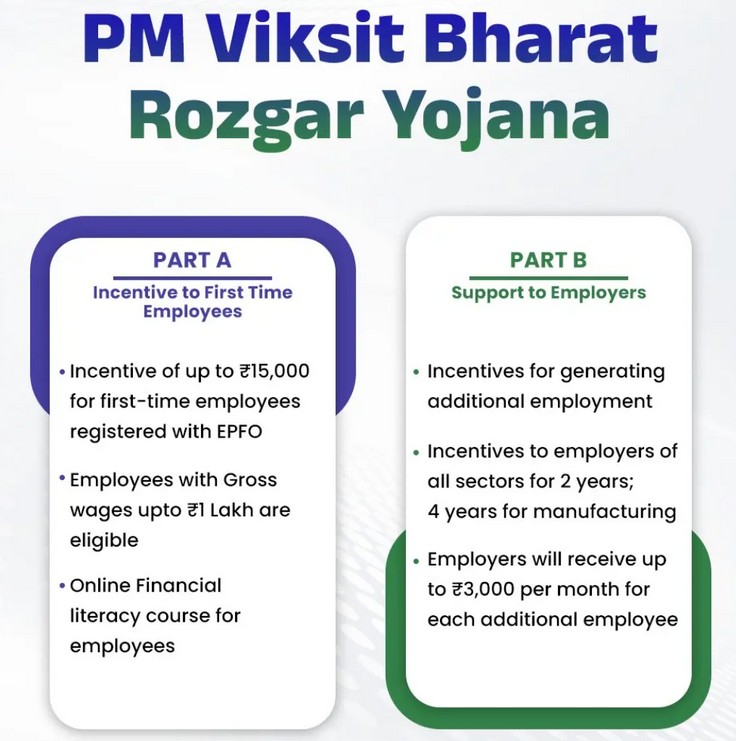
    The Employment Linked Incentive (ELI) Scheme has been officially launched as the PM Viksit Bharat Rozgar Yojana (PM-VBRY), effective from 1st August 2025.

    About PM Viksit Bharat Rozgar Yojana (PM-VBRY):

    • Objective: Promote formal employment and inclusive job creation.
    • Outlay: ₹99,446 crore (Aug 2025 – July 2027).
    • Aim:  3.5 crore new jobs, including 1.92 crore first-time entrants into the workforce.
    • Focus: Expanding EPFO coverage and supporting Viksit Bharat vision.
    • Sectoral Coverage: Open to all sectors, with special focus on manufacturing for long-term growth.

    PM Viksit Bharat Rozgar Yojana (PM-VBRY)

    Key Features:

    1. Incentives for Employees
      • Eligible: First-time EPFO-registered workers earning ≤ ₹1 lakh/month.
      • Benefit: 1-month EPF wage (max ₹15,000) in two parts — after 6 and 12 months.
      • Condition: Completion of a financial literacy programme; Part of the amount is locked in a savings scheme.
    1. Incentives for Employers
      • Applies to: New hires with salary ≤ ₹1 lakh/month.
      • Minimum hires: 2 (if firm <50 employees), 5 (if ≥50).
    • Incentive per employee/month:
      • ₹1,000 (wages ≤ ₹10,000)
      • ₹2,000 (₹10,001–₹20,000)
      • ₹3,000 (₹20,001–₹1 lakh)
    • Manufacturing sector: Extended benefits for 3rd & 4th years.
    1. Payment Mechanism
    • To employees: Direct Benefit Transfer via Aadhaar-based system.
    • To employers: Paid to PAN-linked bank accounts.
    [UPSC 2024] With reference to the Pradhan Mantri Shram Yogi Maan-dhan (PM-SYM) Yojana, consider the following statements:

    1. The entry age group for enrolment in the scheme is 21 to 40 years

    2. Age specific contribution shall be made by the beneficiary

    3. Each subscriber under the scheme shall receive a minimum pension of ₹ 3,000 per month after attaining the age of 60 years

    4. Family pension is applicable to the spouse and unmarried daughters

    Options: (a) 1 and 4 (b) 2 and 3* (c) 2 only (d) 1,2 and 4


  • Wetland Conservation

    Ramsar COP15 opens in Zimbabwe

    Why in the News?

    Delegates from 172 countries convened in Victoria Falls, Zimbabwe, for the 15th Meeting of the Conference of the Contracting Parties (COP15) to the Ramsar Convention on Wetlands.

    Highlights of Ramsar COP15

    • Theme: Protecting Wetlands for Our Common Future
    • Host Nation: Zimbabwe (holds presidency of the Ramsar Convention for 3 years)
    • Expected Outcome: Adoption of the Victoria Falls Declaration, a global framework to protect wetlands

    About the Ramsar Convention:

    • Adopted on: 2 February 1971, in Ramsar, Iran.
    • Objective: Conserve and ensure the wise use of wetlands globally.
    • Key Functions:
      • Identify wetlands of international importance.
      • Promote sustainable management practices.
      • Foster international cooperation in wetland conservation.
    • Governing Body:
      • Conference of the Contracting Parties (COP) meets every 3 years.
      • Reviews implementation, adopts site designations, budgets, and policy actions.
      • Includes member + non-member states, IGOs, and NGOs as observers.

    Criteria for Ramsar Site Designation:

    A wetland must meet at least one of the following 9 criteria:

    1. Unique or rare wetland type.
    2. Habitat for endangered, vulnerable, or endemic species.
    3. Crucial for migratory waterbirds.
    4. High ecological, hydrological, or biodiversity value.
    5. Supports ecosystem services (e.g., flood control, water purification).
    6. Provides cultural or spiritual value.
    7. Serves sustainable community livelihoods.
    8. Holds scientific or educational importance.
    9. Requires global cooperation due to threats.

    India and the Ramsar Convention:

    • Joined on: 1 February 1982.
    • First Ramsar Site: Chilika Lake (Odisha), 1981.
    • As of July 2025:
      • Total sites: 91
      • Total area: ~13.58 lakh hectares
      • % of India’s wetland area under Ramsar: ~10%
    • Top States: Tamil Nadu: 20 sites (highest); Uttar Pradesh: 10 sites
    • Note: India has never chaired a Ramsar COP session.

    Global Snapshot and Other Facts:

    • Total Members: 171 countries.
    • Leading Countries:
      • United Kingdom: 175 sites (most)
      • Mexico: 142 sites
      • Bolivia: Largest area (~1.48 lakh sq. km under protection)
    • World Wetlands Day: Celebrated on 2 February annually.
    • Montreux Record: Register for Ramsar sites under serious threat needing urgent conservation.
    [UPSC 2019] Consider the following statements:

    1. Under Ramsar Convention, it is mandatory on the part of the Government of India to protect and conserve all the wetlands in the territory of India.

    2. The Wetlands (Conservation and Management) Rules, 2010 were framed by the Government of India based on the recommendations of Ramsar Convention.

    3. These Rules also encompass the drainage area or catchment regions of the wetlands as determined by the authority.

    Which of the statements given above is / are correct?

    Options: (a) 1 and 2 only (b) 2 and 3 only (c) 3 only* (d) 1, 2 and 3


  • Wildlife Conservation Efforts

    150 years of Jim Corbett

    Why in the News?

    As India marks Jim Corbett’s 150th birth anniversary (1875–2025), it reflects on his legacy as a hunter, naturalist, author, and conservationist—after whom Corbett National Park is named.

    https://www.downtoearth.org.in/wildlife-biodiversity/150-years-of-jim-corbett-will-the-real-carpet-sahib-please-stand-up 

    Who was Jim Corbett?

    • Full Name: Edward James Corbett (1875–1955), nicknamed Carpet Sahib in Kumaon.
    • Profession: British hunter, naturalist, author, and later a wildlife conservationist.
    • Famous Books: Man-Eaters of Kumaon, The Man-Eating Leopard of Rudraprayag, My India, Jungle Lore, Tree Tops.
    • Hunter Turned Hero:
      • Known for tracking and killing man-eating tigers and leopards in Kumaon and Garhwal.
      • Used patient observation and deep knowledge of terrain and animal behaviour.
    • Shift to Conservation:
      • Grew concerned about dwindling tiger numbers and deforestation.
      • Advocated for wildlife protection and ecological balance.
    • Commemoration: India’s first national park was renamed Jim Corbett National Park in 1957 in his honour.

    Back2Basics: Jim Corbett National Park

    • Established: 1936 as Hailey National Park; later renamed in 1957.
    • Location: Nainital district, Uttarakhand; core of Corbett Tiger Reserve.
    • Historical Importance:
      • Launch site of Project Tiger in 1973, India’s flagship tiger conservation programme.
    • Geography:
      • Lies in Shivalik and Outer Himalayan foothills.
      • Rivers: Ramganga, Sonanadi, Mandal, Palain, and Kosi.
      • Area: Over 500 sq km (includes Sonanadi Wildlife Sanctuary as buffer).
    • Biodiversity:
      • Flora: Moist deciduous forest with Sal, Khair, and Sissoo; 600+ plant species.
      • Fauna: Over 230 tigers (highest density in the world), elephants, leopards, deer (sambar, chital, barking), sloth bears, wild boars, birds, and reptiles.


    [UPSC 2013] Consider the following pairs : National Park River flowing through the Park

    1. Corbett National Park : Ganga

    2. Kaziranga National Park : Manas

    3. Silent Valley National Park : Kaveri

    Which of the above pairs is/are correctly matched?

    (a) 1 and 2 (b) 3 only (c) 1 and 3 (d) None*


  • Indian Missile Program Updates

    UAV Launched Precision Guided Missile (ULPGM)-V3

    Why in the News?

    DRDO has successfully test-fired the UAV-Launched Precision Guided Missile (ULPGM)-V3.

    UAV Launched Precision Guided Missile (ULPGM)-V3

    About ULPGM-V3:

    • Overview: It is a fire-and-forget air-to-surface missile developed by Defence Research and Development Organisation (DRDO).
    • Variants: It is an upgraded version of V1 and V2, with improved range, autonomy, and targeting precision.
    • Development: Collaboration by Adani Defence, Bharat Dynamics, Newspace Research Technologies, and over 30 Indian MSMEs/startups.

    Key Features:

    • Weight: 12.5 kg
    • Range: 10 km (day), 2.5 km (night)
    • Accuracy: Passive homing infrared with HD dual-channel accuracy (~10 cm)
    • Warhead Options: Anti-armour, penetration-cum-blast, pre-fragmentation
    • Guidance: Fully autonomous with two-way datalink for mid-course updates
    • Environment: Operates in plains and high-altitude regions, day and night
    [UPSC 2025] With reference to Unmanned Aerial Vehicles (UAVs), consider the following statements:

    I. All types of UAVs can do vertical landing. II. All types of UAVs can do automated hovering. III. All types of UAVs can use battery only as a source of power supply.

    Which of the statements given above are correct?

    (a) Only one (b) Only two (c) All the three (d) None *


  • Trade Sector Updates – Falling Exports, TIES, MEIS, Foreign Trade Policy, etc.

    [25th July 2025] The Hindu Op-ed: The India-U.K. FTA spells a poor deal for public health

    PYQ Relevance:

    [UPSC 2024] In a crucial domain like the public healthcare system, the Indian State should play a vital role to contain the adverse impact of marketisation of the system. Suggest some measures through which the State can enhance the reach of public health care at the grassroots level.

    Linkage: The article highlights how tariff-free entry of HFSS products leads to “lower prices” and “aggressive marketing,” posing “grave long-term health risks”. The question’s call for the Indian State to play a “vital role to contain the adverse impact” and suggest measures aligns perfectly in the article’s advocacy for “strong measures to regulate the advertising of HFSS” and “mandatory FOPNL” to protect public health.


    Mentor’s Comment:  India and the United Kingdom signed a Free Trade Agreement (FTA) on July 24, 2025, during Prime Minister Narendra Modi’s visit to the UK. While the deal promises economic benefits, it has triggered serious public health concerns due to the likely surge of tariff-free imports of unhealthy, ultra-processed food products from the UK into India.

    Today’s editorial analyses the recently signed Free Trade Agreement (FTA) between India and the United Kingdom. This topic is important for GS Paper II (International Relations) in the UPSC mains exam.

    _

    Let’s learn!

    Why in the News?

    India and the United Kingdom recently signed a Free Trade Agreement (FTA) to boost bilateral trade, reduce tariffs, enhance market access, and strengthen economic and strategic ties between both nations.

    What are the key provisions of the India–UK FTA?

    • Tariff Reductions on Goods: Reduction or elimination of customs duties on products like textiles, leather, and machinery from India and premium liquor, automobiles, and pharma from the UK.
    • Services Sector Access: Easier market access for Indian professionals (e.g., IT experts, nurses, yoga instructors) and UK financial, legal, and education services.
    • Investment and Regulatory Cooperation: Investor protection clauses and liberalised FDI norms to encourage bilateral investments with predictable regulatory environments.
    • Digital Trade and Intellectual Property Rights: Provisions for secure cross-border data flows, IPR enforcement, and e-commerce facilitation, supporting startups and tech trade.
    • Labour Mobility and Social Security Coordination: Allows short-term professionals to avoid double social security payments, benefiting workers on temporary assignments.

    Why has the FTA triggered health concerns in India?

    • Stricter Intellectual Property (IP) Provisions: The UK is pushing for TRIPS-plus measures such as patent term extensions and data exclusivity, which could delay the entry of generic medicines in India. Eg: Cancer or HIV patients in India may face delayed access to affordable generics if extended patents block local production.
    • Threat to Domestic Pharma Industry: Indian generic manufacturers fear reduced competitiveness due to stricter IP norms, which may raise medicine costs and affect public health schemes. Eg: India’s role as the “pharmacy of the Global South” may weaken, affecting exports to Africa and Latin America.
    • Limited Access to Government Procurement: If the FTA includes government procurement commitments, it may restrict India’s ability to prioritise domestic firmsfor health supplies under public schemes. Eg: Public procurement for schemes like Jan Aushadhi may face restrictions, impacting affordable medicine distribution.

    How does Mexico’s NAFTA experience inform India’s approach to FTAs?

    • Uneven Gains Across Sectors: NAFTA boosted Mexico’s manufacturing exports, especially to the US, but agriculture suffered due to competition from heavily subsidised US farms, displacing small farmers. Eg: India should protect its small-scale agriculture and MSMEs in FTAs to avoid rural distress and job losses.
    • Job Creation Without Security: While NAFTA generated employment in export-driven industries, these jobs were often low-paid, lacked labour rights, and offered poor working conditions. Eg: India must ensure FTAs include labour safeguards and social protection for workers, especially in textiles and electronics.
    • Weak Domestic Supply Chains: Mexico became heavily dependent on foreign inputs and technologies, undermining local value chains and domestic innovation. Eg: India should strengthen its Make in India and Atmanirbhar Bharat efforts by ensuring technology transfer and local sourcing mandates in FTAs.

    What are the regulatory differences between India and the UK on unhealthy food products?

    Aspect India United Kingdom (UK)
    Front-of-Pack Labelling Voluntary system; no mandatory warning labels for high fat/sugar/salt Mandatory traffic light system highlighting fat, sugar, and salt levels
    Advertising to Children Limited restrictions; junk food often advertised during kids’ content Strict regulations on TV and online adstargeting children for junk food
    Nutritional Standards in Schools No uniform enforcement across states; junk food in/near schools persists Banned sale of sugary drinks and high-fat snacks in school premises

    Why is Front-of-Pack Nutrition Labelling (FOPNL) important post-FTA?

    • Protects Public Health from Imported Junk Food: With the FTA, imports of ultra-processed and unhealthy foods may rise. FOPNL provides clear warnings (e.g., high in sugar, fat, salt) to help consumers make healthier choices. Eg: Chile introduced warning labels, leading to a drop in sugary drink sales by 25%.
    • Empowers Consumers with Informed Choices: Indian consumers often lack nutritional awareness. FOPNL enables them to understand the health risks of packaged foods at a glance, regardless of foreign branding or marketing. Eg: In Brazil, FOPNL helped rural consumers avoid misleading “natural” claims on unhealthy imported snacks.
    • Counters Aggressive Marketing by Foreign Brands: Post-FTA, multinational food companies may flood the Indian market with aggressive marketing. FOPNL acts as a visual deterrent, discouraging overconsumption, especially among children. Eg: In Mexico, FOPNL helped reduce the purchase of snacks targeted at children despite flashy packaging.

    Way forward: 

    • Implement Mandatory Front-of-Pack Labelling (FOPNL): The Indian government should finalize and enforce strong, interpretive FOPNL regulations (like warning labels) based on WHO guidelines to help consumers easily identify foods high in salt, sugar, and fat.
    • Strengthen Domestic Food Standards and Surveillance: Ensure alignment between imported and domestic food safety regulations, backed by robust monitoring by FSSAI. This will prevent imported unhealthy products from bypassing scrutiny and harming public health.
  • Swachh Bharat Mission

    Clean house: On India’s septic tank desludging

    Why in the News?

    Recently, a social audit tabled in Parliament revealed 150 hazardous cleaning deaths in 2022–23, exposing unsafe outsourcing, poor implementation of safety laws, and inadequate funding under schemes like NAMASTE. Despite Supreme Court orders and successful models in states like Odisha and Tamil Nadu, enforcement and mechanisation remain critically lacking nationwide.

    Why has manual scavenging persisted despite laws and schemes like NAMASTE?

    • Weak Enforcement of Legal Provisions and Court Orders: Despite the Prohibition of Employment as Manual Scavengers and their Rehabilitation Act, 2013 and Supreme Court directions to cancel offending contracts and penalise principal employers, enforcement remains minimal. Eg: In 2024, Parliament revealed that 150 workers died in 2022–23 due to hazardous cleaning.
    • Poor Implementation and Underfunding of Schemes: Schemes like NAMASTE are hindered by insufficient financial support, poor outreach, and lack of protective equipment or training. Eg: Of the 57,758 workers involved in hazardous cleaning, only 16,791 received PPE kits, and a mere ₹14 crore had been released under NAMASTE—inadequate for mechanisation in even one major city.
    • Obscured Employer Liability through Subcontracting: The use of contractual and ‘loaned’ labour allows government and private employers to avoid responsibility for worker safety. Eg: A social audit tabled in Parliament found that out of 54 hazardous cleaning deaths, only five workers were on government payroll, while others were ‘loaned’ to private contractors, making accountability unclear.

    How have Odisha and Tamil Nadu offered viable alternatives to manual scavenging?

    • Odisha has ensured identified sanitation workers are equipped with PPE kits and have access to mechanised desludging vehicles, reducing the need for manual entry.
      Eg: Workers now use vacuum trucks for sewer cleaning instead of entering toxic manholes, improving safety and dignity.
    • Tamil Nadu has piloted robotic interventions to eliminate manual scavenging in urban areas.
      Eg: In Chennai, sewer robots have been deployed to clean over 5,000 manholes, showcasing how technology and political will can prevent hazardous practices.

    How does the lack of rural data hinder sanitation worker reforms?

    • Exclusion from Mechanisation Schemes: Without reliable data on rural sanitation workers, schemes like NAMASTE do not extend their benefits (e.g. robotic cleaning or desludging machines) to villages. Eg: In many gram panchayats of Bihar, manual pit cleaning is still done without equipment as workers remain unregistered and thus unaccounted for in policy rollouts.
    • No Health or Safety Monitoring: The lack of worker enumeration means occupational health risks go unnoticed, and safety training or PPE kitsare not distributed in rural regions. Eg: In Chhattisgarh’s rural blocks, no health cards or protective equipment have been distributed to sanitation workers, exposing them to toxic gases and infections.
    • Obstructs Legal Accountability and Compensation: If workers are not documented, accidental deaths are often unreported or misclassified, preventing compensation to families and accountability for employers. Eg: In a 2023 case in Madhya Pradesh, a worker died while cleaning a septic tank, but due to lack of registration, the case was recorded as a general accident, not as a violation of the Manual Scavenging Act.

    What are the steps taken by the Indian Government?

    • Legislation and Legal Ban: The Prohibition of Employment as Manual Scavengers and their Rehabilitation Act, 2013 bans manual scavenging and mandates identification and rehabilitation of affected workers.
    • NAMASTE Scheme (2023): The National Action for Mechanised Sanitation Ecosystem (NAMASTE) scheme promotes mechanised cleaning, provides training, PPE kits, and financial support to sanitation workers.
    • Welfare and Skill Development Initiatives: The government has launched surveys, provided one-time cash assistance, health insurance under Ayushman Bharat, and livelihood loans to support entrepreneurship among workers.

    What reforms can ensure safety and rehabilitation for workers?

    • Mandatory Mechanisation and Licensing: Urban local bodies should mandate mechanised sewer cleaning, make it a licensed profession, and classify manual cleaning without valid certification as a cognisable offence. This will ensure accountability and eliminate unsafe practices.
    • Rehabilitation Through Financial and Social Support: Provide sanitation workers with housing, education scholarships, health cards, and loans to operate mechanised equipment. These should be linked to guaranteed municipal contracts, enabling long-term economic and social upliftment.

    Mains PYQ:

    [UPSC 2024] Poverty and malnutrition create a vicious cycle, adversely affecting human capital formation. What steps can be taken to break the cycle?

    Linkage: Manual scavenging represents an extreme form of poverty and human capital degradation. This article mentions that “Two-thirds of validated workers are also Dalits, yet rehabilitation packages rarely include housing or scholarships that might help families exit contemptible occupations”. This question allows for a discussion of how ending such hazardous labor and providing meaningful rehabilitation can break this vicious cycle.

Join the Community

Join us across Social Media platforms.