💥UPSC 2026, 2027, 2028 UAP Mentorship (March Batch) + Access XFactor Notes & Microthemes PDF

Archives: News

  • Modern Indian History-Events and Personalities

    [pib] Maharaja Bir Bikram Kishore Manikya Bahadur

    Why in the News?

    The Prime Minister has paid homage to the great Maharaja of Tripura Bir Bikram Kishore Manikya Bahadur on his birth anniversary.

    Who was Maharaja Bir Bikram Kishore Manikya Bahadur?

    Details
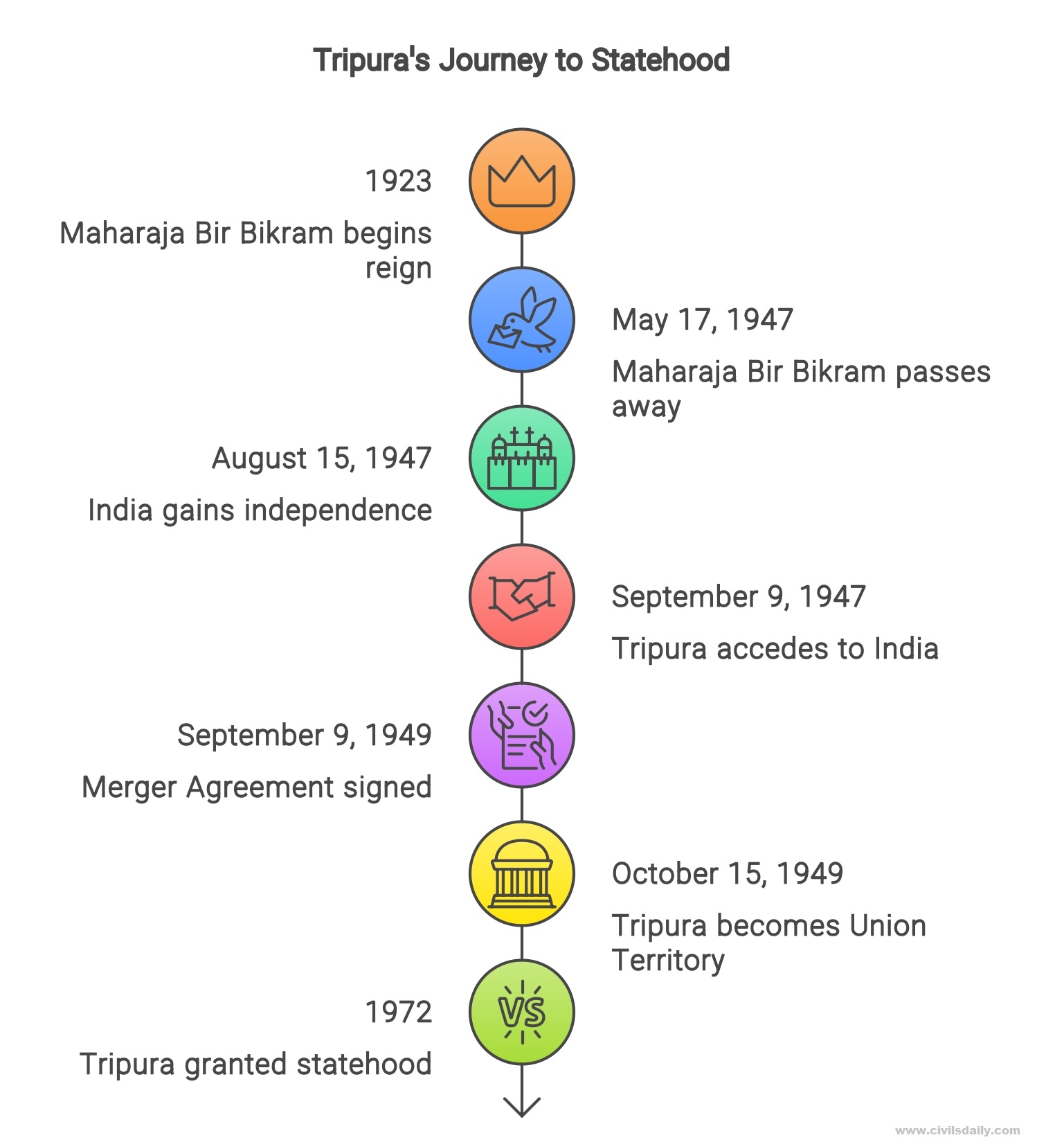
    Reign 1923 – 1947
    Birth August 19, 1908
    Contributions to Tripura – Modernized Tripura with infrastructure and educational reforms.
    – Planned and designed the city of Agartala, earning the title “Architect of Modern Tripura.”-He took initiatives to explore tea cultivation and established several tea estates in Tripura.
    Education and Infrastructure – Established schools, colleges, and hospitals.
    – He was instrumental in establishing the first airport in Tripura, the Maharaja Bir Bikram Airport, which greatly improved connectivity and facilitated economic growth
    Social Reforms Introduced land reforms, granted land rights to indigenous people, and worked to abolish untouchability.

    Maharaja Bir Bikram was a patron of the arts and culture, supporting various cultural activities and institutions.

    Military Role Supported the British during World War II.
    Legacy Died on May 17, 1947

    Remembered as a visionary ruler who played a crucial role in shaping modern Tripura.

    PYQ:

    [2022] The political and administrative reorganization of states and territories has been a continuous ongoing process since the mid-nineteenth century. Discuss with examples. (250 words, 15 marks)

    [2007] Which one of the following is the correct chronological order of the formation of the following states as full states of the Indian Union?

    (a) Sikkim, Arunachal Pradesh, Nagaland, Haryana

    (b) Nagaland , Haryana, Sikkim, Arunachal Pradesh

    (c) Sikkim, Haryana, Nagaland, Arunachal Pradesh

    (d) Nagaland, Arunachal Pradesh, Sikkim, Haryana

  • Forest Conservation Efforts – NFP, Western Ghats, etc.

    Banni Grasslands of Kachchh

    Why in the News?

    A study conducted by researchers at Kachchh University assessed the suitability of different areas in Banni for sustainable grassland restoration, with ecological value being the primary criterion.

    Restoration of Banni Grasslands: Highlights of the Study

    Recent Study:

    • Objective: A study conducted by researchers at KSKV Kachchh University assessed the suitability of different areas in Banni for sustainable grassland restoration, with ecological value being the primary criterion.
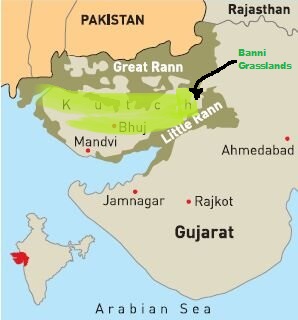
    • Need for restoration: Originally covering about 3,800 sq. km, the Banni grasslands have shrunk to about 2,600 sq. km.
    • Categories of Restoration Zones: The researchers divided the grassland into five categories based on restoration suitability:
      • Highly Suitable: 937 sq. km (36%)
      • Suitable: 728 sq. km (28%)
      • Moderately Suitable: 714 sq. km (27%)
      • Marginally Suitable: 182 sq. km (7%)
      • Not Suitable: 61 sq. km (2%)
    • Restoration Potential: The “highly suitable” and “suitable” zones, making up nearly two-thirds of the Banni grasslands, can be restored easily by providing adequate water sources.

    About Banni Grasslands:

    • The Banni Grassland is a salt-tolerant ecosystem located in the Kutch district of Gujarat, covering around 3,847 square km.
    • It is said to be Asia’s largest grassland (TOI).
    • The climate is arid and semi-arid, with extremely hot summers (temperatures above 45°C) and mild winters (12°C to 25°C), receiving 300-400 mm of annual rainfall mainly during the monsoon.
    • It is inhabited by pastoral communities like the Maldharis, who rely on livestock grazing (cattle, buffalo, and sheep) for their livelihood.
    • Agriculture is limited due to arid conditions, with some areas used for salt production.
    • Flora: Grasses such as Dichanthium, Sporobolus, and Cenchrus species, with salt-tolerant plants, shrubs, and trees like Acacia and the invasive Prosopis juliflora.
    • Fauna: Indian wolf, hyena, chinkara, Great Indian Bustard, flamingos, and various raptors, reptiles, and invertebrates.

    PYQ:

    [2021] The vegetation of Savannah consists of grassland with scattered small trees, but extensive areas have no trees. The forest development in such areas is generally kept in check by one or more or a combination of some conditions. Which of the following are such conditions?​

    1. Burrowing animals and termites​

    2. Fire​

    3. Grazing herbivores​

    4. Seasonal rainfall​

    5. Soil properties​

    Select the correct answer using the code given below.​

    (a) 1 and 2

    (b) 4 and 5​

    (c) 2, 3 and 4

    (d) 1, 3 and 5​

  • Foreign Policy Watch: India-Japan

    [pib] 2+2 Ministerial Dialogue

    Why in the News?

    Japanese foreign and defence ministers have arrived in India to participate in the India-Japan 2+2 ministerial meeting.

    About 2+2 Ministerial Dialogue

    • The 2+2 Ministerial Dialogue is a diplomatic summit held annually since 2018, initially between India and the US.
    • It later expanded to include Japan, Australia, Russia, and the United Kingdom.
    • This dialogue involves the Foreign and Defense Ministers of participating countries and focuses on strengthening bilateral relations and addressing common concerns.
    • The dialogue replaced the Strategic and Commercial Dialogue during a 2017 agreement between PM Narendra Modi and President Donald Trump.
    • First Summit was held on September 6, 2018, between India and the US in New Delhi, involving discussions on defense partnerships and strategic cooperation.

    Key Milestones:

    What are the key priorities of the Indo-Japan 2+2 Dialogue?

    • Update Security Cooperation: Revising the 2008 security agreement to reflect current strategic needs.
    • Promote a Free Indo-Pacific: Collaborating to ensure a free, open, and stable Indo-Pacific region.
    • Engage in Strategic Talks: Holding strategic discussions between foreign and defense ministers to boost bilateral ties.
    • Address Regional Security: Discussing key issues like Chinese assertiveness, the Russia-Ukraine war, and the Gaza crisis.
    • Coordinate Quad Efforts: Exploring cooperation within the Quad framework, including a potential summit.

    PYQ:

    [2020] Quadrilateral Security Dialogue (Quad) is transforming itself into a trade bloc from a military alliance, in present times Discuss.

  • Innovations in Biotechnology and Medical Sciences

    Waggle Dance of Bees

    Why in the News?

    Two scientists have raised concerns about “problematic behaviour” in papers on honeybee communication co-authored by Dr. Mandyam Srinivasan, a highly honoured neuroscientist.

    About Waggle Dance of Bees

    Details
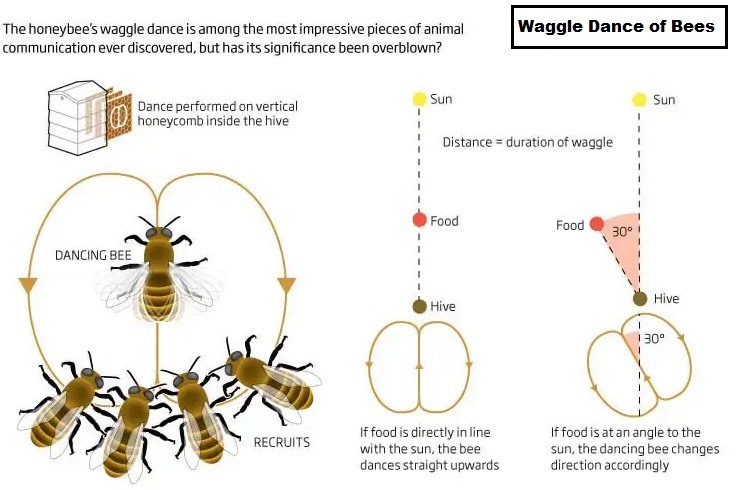
    Purpose Communicates location of food sources to other bees.
    Dance Pattern Figure-eight (8) movement with a waggle run in the middle.
    Direction Indication Angle of waggle run shows direction relative to the sun.
    Distance Indication Duration of waggle run indicates distance to the food source.
    Efficiency Enhances foraging efficiency by guiding bees directly to food sources.
    Environmental Impact Accuracy affected by Sun position, wind, and landscape.
    Scientific Importance Decoded by Nobel laureate Karl von Frisch; an example of advanced insect communication.


    PYQ:

    [2023] Which of the following organisms perform waggle dance for others of their kin to indicate the direction and the distance to a source of their food?

    (a) Butterflies

    (b) Dragonflies

    (c) Honey Bees

    (d) Wasps

  • Labour, Jobs and Employment – Harmonization of labour laws, gender gap, unemployment, etc.

    Labor conditions in southern states  

    Why in the News?

    Migrant workers from various parts of India are gradually becoming a noticeable presence in the agricultural fields of Tamil Nadu’s Cauvery delta, often called the granary of South India.

    Migrants in Tamil Nadu’s Cauvery Delta

    • Labour Shortage in Agriculture: The Cauvery Delta, known as the granary of South India, is experiencing a significant shortage of farmhands as the younger generation moves away from agriculture. This has led to a reliance on migrant workers, particularly from states like West Bengal and Bihar, who are skilled in paddy transplanting and harvesting.
    • Economic Dynamics: Migrant labourers are filling the labour gap during agricultural seasons, working in groups and completing tasks more quickly than local labourers. They charge around ₹4,500 to ₹5,000 per acre, compared to local workers who earn ₹600 per day.
    • Sociocultural Integration: While there hasn’t been significant tension between migrant workers and local labourers, the integration of migrants into the agricultural workforce is still evolving.
      • Local labour unions acknowledge the presence of migrant workers but do not see it as a widespread issue yet, partly due to the ongoing mechanization of agriculture and changing job preferences among the local youth.

    Dependence on Migrant Workers in Kerala

    • Shift in Labor Sources: Kerala has seen a growing dependence on migrant workers from northern and eastern states, including West Bengal and Bihar, to fill labour shortages in various sectors, including agriculture.
      • A recent study by the Gulati Institute of Finance and Taxation estimated the number of inter-state migrant workers in Kerala at 2.5 million, equivalent to 7% of the state’s population.
    • Economic Factors: High wage differentials between Kerala and the migrants’ home states, along with a robust urban economy, have made Kerala an attractive destination for migrant labourers.

    External Migration from Uttar Pradesh to Maharashtra

    • High Migration Rate: Uttar Pradesh tops the list for inter-state job-related migration to Maharashtra, with over 5.7% of migrants moving for employment purposes between 2020 and 2021.
    • Concentration of Migrants: Within Maharashtra, districts such as Mumbai and Thane have the highest concentrations of migrants from Uttar Pradesh.

    How does the proposed ‘quota-for-local’ Bill impact migrant workers?

    • uction in the already precarious employment options available to migrants, who often fill lower-skilled positions.
    • Increased Competition: The migrant workers might face intensified competition for fewer available roles, particularly in sectors where they have traditionally been employed, such as delivery services and hospitality.
    • Economic Migration: The bill could lead to a demographic shift in the labor market. Migrants may choose to relocate to states with more inclusive hiring practices, impacting the state’s economy and workforce diversity.
    • Exploitation Risks: The present Bill could make migrants more vulnerable to exploitation, as companies may feel less inclined to hire them, leading to further marginalization of these workers.
    • Industry Concerns: Business leaders and industry representatives have expressed concerns that the bill could deter investment and talent from flowing into Karnataka, potentially leading to job losses and reduced economic growth. The focus should be on skills rather than reservations.

    What measures can be taken to protect migrant workers from exploitation?

    • Right to Change Employers: States need to ensure that migrant workers have the freedom to change employers without facing penalties, which can reduce their vulnerability to abuse and exploitation.
    • Empower Migrant workers: The government/ Private sector needs to provide comprehensive information regarding workers’ rights, including recruitment processes, legal protections, and avenues for reporting abuse.
      • Strengthening labor laws and legal assistance with counseling services that protect migrant workers and ensure strict enforcement through regular inspections of workplaces is a need of the hour.
    • Social Security and Housing Access: States need to ensure that migrant workers have access to social services, housing, and healthcare, which can help mitigate their vulnerabilities.
      • NITI Aayog in its report ”India’s Booming Gig and Platform Economy” has said that fiscal incentives such as tax breaks or startup grants may be provided for businesses that provide livelihood opportunities where women constitute a substantial portion of their workers.
    • International Cooperation: Encourage countries to adopt and implement international standards and conventions that protect the rights of migrant workers, promoting safe and ethical recruitment practices.

    Lack of Proper Data and Registration

    • Historical Data Gaps: The last comprehensive survey on internal migration was conducted as part of the National Sample Survey in 2007-08, with the Census 2011 data only partially released in 2020.
    • Absence of Real-Time Data: During the COVID-19 lockdown, the Indian government did not collect data on the deaths or job losses of internal migrants. The Ministry of Labour and Employment confirmed that it maintained no records of migrant workers who lost their jobs or lives during this period.

    Legislation: 

    The Inter-State Migrant Workmen (Regulation of Employment and Conditions of Service) Act, 1979 was enacted to protect the rights and regulate the conditions of service for migrant workers who move between states in India for employment.

    Implementation Challenges

    • Lack of Awareness: Many migrant workers are unaware of their rights under the Act, leading to exploitation and poor working conditions.
    • Inadequate Enforcement: There is often insufficient enforcement of the Act by state governments, resulting in widespread violations and the continued presence of migrant workers in informal and unregulated sectors.
    • Data Gaps: The absence of accurate data on the number of inter-state migrant workers complicates enforcement and the provision of services.

    Way forward: 

    • Promote Sustainable Employment and Skill Development in Source Regions: To reduce the over-reliance on migrant labour and address labour shortages in sectors like agriculture, the government should focus on creating sustainable employment opportunities in the migrants’ home states.
    • Promote Sustainable Employment and Skill Development in Source Regions: The government should create a real-time migrant data system linked with Aadhaar, enabling targeted policies, social security, and effective crisis response for internal migrants.

    Mains PYQ:

    Q Discuss the changes in the trends of labour migration within and outside India in the last four decades. (UPSC IAS/2015)

  • Health Sector – UHC, National Health Policy, Family Planning, Health Insurance, etc.

    Do doctors need a Central protection Act?     

    Why in the News?

    Resident doctors across India are on strike, demanding safety laws after a young doctor was tragically raped and murdered at R.G. Kar Medical College in Kolkata on August 9.

    Why are Healthcare Workers Protesting?

    • Response to Violence: The protests were triggered by the brutal rape and murder of a young doctor at R.G. Kar Medical College and Hospital in Kolkata on August 9, 2024.
    • Demand for Safety: Healthcare workers are demanding laws and measures that ensure their safety while on duty.
    • Historical Context: Violence against healthcare workers is not a new issue in India. Previous incidents, such as the case of Aruna Shanbaug, a nurse who was sexually assaulted in 1973, underscore a long-standing pattern of violence in healthcare settings.

    Working Conditions of Junior Doctors, Interns, and Nurses

    • Poor Working Environment: Junior doctors, interns, and nurses often work in ill-lit and poorly secured hospital environments.
    • Long Shifts and Exhaustion: Many healthcare workers, including the victim of the recent incident, are subjected to excessively long shifts—in this case, a 36-hour duty shift—without adequate rest or safe spaces to recuperate.
    • Mental Health Concerns: The stressful working conditions, combined with the threat of violence, have raised significant concerns about the mental health and well-being of healthcare workers.

    Key Demands of the Protesters

    • Central Protection Act: The Indian Medical Association (IMA) is advocating for a Central protection law specifically for healthcare workers, similar to measures in other countries that classify assaults on medical staff as serious offenses.
    • Enhanced Security Measures: Protesters are calling for hospital security protocols that match those of airports, including the installation of CCTV cameras, deployment of security personnel, and improved lighting in hospital corridors and wards.
    • Safe Work Environment: There is a demand for immediate systemic reforms to improve working conditions, including better security arrangements and the establishment of healthcare facilities as safe zones.
    • Accountability and Justice: The IMA has requested a thorough investigation into incidents of violence against healthcare workers, with a focus on timely and professional handling of cases and ensuring that perpetrators face exemplary punishment.
      • Government Response: Following the protests, the Ministry of Health and Family Welfare issued an order mandating that any violence against healthcare workers must be reported and acted upon swiftly, with institutional FIRs to be filed within six hours of an incident.

    Sole responsible for the safety of Health workers:

    • State Governments: Health and law enforcement are primarily state subjects in India, meaning that state governments are primarily responsible for ensuring the safety of healthcare professionals. They are tasked with implementing laws, providing adequate security in hospitals, and ensuring a safe working environment for medical staff.
    • Central Government: The central government plays a role in formulating national policies and frameworks that support the safety of healthcare workers. 
      • Recent initiatives include the Ministry of Health and Family Welfare’s order mandating the filing of FIRs within six hours of any violence against healthcare workers, indicating a push for accountability and swift action.

    Way forward: 

    • Implement a Central Protection Law for Healthcare Workers: The government should fast-track the enactment of a Central law specifically designed to protect healthcare workers from violence.
    • Improve Working Conditions and Mental Health Support: Hospitals should prioritize creating safe and well-secured environments for healthcare workers, including reasonable shift hours, adequate rest periods, mental health support, and robust security protocols to prevent future incidents of violence.
  • Zoopharmacognosy: the study of how animals self-medicate

    Why in the News?

    Researchers highlighted the zoopharmacognosy (practice of self-medication) by a Sumatran orangutan using the plant Fibraurea tinctoria to treat a facial wound.

    What is Zoopharmacognosy?

    • Zoopharmacognosy is the study of how animals use natural substances like plants, soils, and insects to treat their own illnesses. 
    • The term was coined by ecologist D.H. Janzen from the University of Pennsylvania.
    • It shows that animals have an instinctive ability to find and use natural remedies. 

    Key Studies and Observations

    • Neanderthals: In 2012, a Nature publication found that Neanderthals in Northern Spain used plants like yarrow and chamomile to treat infections.

    Other Animal Species:

    • Primates: Chimpanzees eat bitter leaves, like Vernonia amygdalina, to get rid of intestinal worms.
      • Pregnant lemurs nibbling on tamarind leaves to aid milk production.
    • Reindeer: Reindeer eat mushrooms like Amanita muscaria, possibly to fight off parasites.
    • Birds: Starlings line their nests with antimicrobial plants to protect their young from diseases.
    • Elephants: Pregnant elephants in Kenya eat specific plants to help induce labor.
    • Dogs: Dogs chew grass and then vomit to clear their stomachs of infections.

    PYQ:

    [2019] Recently, there was a growing awareness in our country about the importance of Himalayan nettle (Girardinia diversifolia) because it is found to be a sustainable source of:

    (a) Anti-malarial drug

    (b) Biodiesel

    (c) Pulp for paper industry

    (d) Textile fibre

  • Innovation Ecosystem in India

    [pib] REACHOUT Scheme

    Why in the News?

    The Indian student team, supported by the REACHOUT (Research, Education, Training and Outreach) scheme, achieved remarkable success at the 17th edition of the International Earth Sciences Olympiad (IESO) held in Beijing, China.

    What is the REACHOUT Scheme?

    • It is an initiative by the Ministry of Earth Sciences (MoES) under the broader PRITHVI (PRITHvi Vigyan) program. 
    • The scheme aims to enhance the understanding and dissemination of Earth system sciences through research, education, and outreach activities.

    About the International Earth Sciences Olympiad (IESO)

    • The IESO was established in 2003 during the International Geoscience Education Organization Council Meeting in Calgary, Canada.
    • The competition focuses on promoting interest in earth system sciences, particularly in addressing climate change, environmental challenges, and natural disasters.

    India’s Participation:

    • India has participated in the IESO since 2007 and hosted the 10th edition in Mysore.
    • The Indian National Earth Science Olympiad (INESO) serves as a national-level prelude to the IESO, held across schools in India.
    • Top-performing students from INESO represent India at the IESO, with support from MoES and the Geological Society of India.

    PYQ:

    [2019] Atal Innovation Mission is set up under the

    (a) Department of Science and Technology

    (b) Ministry of Labour and Employment

    (c) NITI Aayog

    (d) Ministry of Skill Development and Entrepreneurship

  • Festivals, Dances, Theatre, Literature, Art in News

    In news: Namdhari Sect

    Why in the News?

    Recently, followers of the two rival groups within the Namdhari religious sect clashed violently in Haryana.

    About Namdhari Sect

    Details
    Founder Satguru Ram Singh in 1857 (on Baisakhi)

    Also known as Kuka Movement

    Primary Beliefs Belief in a living human Guru; Also known as Kuka/Kukaism
    – Guru Granth Sahib is considered the Supreme Gurbani
    Strict vegetarianism and teetotalism (alcohol is forbidden)
    Key Practices – Wearing white attire as a sign of mourning
    Rejection of caste distinctions
    – Promotion of widow remarriage
    Non-violent resistance Cow is the sacred animal
    Headquarters Bhaini Sahib, Ludhiana, Punjab
    Global Presence Deras across Punjab and Haryana
    – Presence in countries such as the UK, Canada, and Kenya
    Role in Independence – Early opposition to British rule
    – Adoption of non-cooperation and boycott of British goods
    – Victims of severe British reprisals
    Notable Historical Event Malerkotla Massacre (1872) – 66 Namdharis executed by the British
    Leadership Succession – After Ram Singh: His brother Satguru Hari Singh
    – Later Successors: Satguru Partap Singh, Satguru Jagjit Singh
    – Current leaders: Uday Singh and Dalip Singh (factional dispute)


    PYQ:

    [2013] Consider the following Bhakti Saints :

    1. Dadu Dayal

    2. Guru Nanak

    3. Tyagaraja

    Who among the above was/were preaching when the Lodi dynasty fell and Babur took over?

    (a) 1 and 3

    (b) 2 only

    (c) 2 and 3

    (d) 1 and 2

  • Parliament – Sessions, Procedures, Motions, Committees etc

    Lok Sabha Speaker constitutes 6 new Parliamentary Committees 

    Why in the News?

    Lok Sabha Speaker has constituted six new Parliamentary Committees, for a tenure of 1year:

    Origin Composition Functions
    Public Accounts Committee (PAC) Established in 1921 under the Government of India Act, 1919
    • 22 members: 15 Lok Sabha + 7 Rajya Sabha;
    • Chairman from the Opposition,
    • Appointed by the LS Speaker.
    Examines public expenditure, scrutinizes CAG reports, and ensures efficient use of public funds.
    Committee on Estimates Traces back to 1921; reconstituted in 1950 (recommended by John Mathai)
    • 30 members,
    • All from Lok Sabha;
    • Elected annually through proportional representation.
    • Minister CANNOT be a member.
    Examines budget estimates, suggests economic efficiencies, and recommends alternative policies.
    Committee on Public Undertakings Established in 1964 based on the Krishna Menon Committee
    • 22 members: 15 Lok Sabha + 7 Rajya Sabha;
    • Chairman appointed by the Speaker,
    • Chosen from Lok Sabha members
    Examines accounts and reports of PSUs, and provides recommendations without interfering in operations.
    Committee on Welfare of OBCs The committee was constituted in June 2012 It comprises 30 members, with 20 from the Lok Sabha and 10 from the Rajya Sabha Focuses on the implementation of policies for OBC welfare, evaluates reservations, and suggests improvements.
    Committee on Welfare of SC/ST N/A The committee consists of 30 members, with 20 elected from the Lok Sabha and 10 from the Rajya Sabha. Ensures implementation of safeguards for SCs and STs, reviews welfare programs, and suggests enhancements.
    Joint Committee on Office of Profit Joint Committee on Office of Profit was established by the Lok Sabha on July 23, 2019 15 members; 10 Lok + 5 from Rajya Sabha. Examines cases of MPs/MLAs holding offices of profit, determine qualification, and maintains legislative integrity.


    PYQ:

    [2018] With reference to the Parliament of India, which of the following Parliamentary Committees scrutinizes and reports to the house whether the powers to make regulations, rules, sub-rules, by-laws, etc., conferred by the Constitution or delegated by the Parliament are being properly exercised by the Executive within the scope of such delegation?

    (a) Committee on Government Assurances

    (b) Committee on Subordinate Legislation

    (c) Rules Committee

    (d) Business Advisory Committee

Join the Community

Join us across Social Media platforms.