💥UPSC 2026, 2027, 2028 UAP Mentorship (March Batch) + Access XFactor Notes & Microthemes PDF

Archives: News

  • Foreign Policy Watch: India – EU

    How a trade deal with EU could shape up?

    After signing comprehensive economic and trade agreements with the United Arab Emirates (UAE) and Australia, India has stepped up efforts to negotiate a free trade agreement (FTA) with the European Union (EU).

    What is a Free Trade Agreement (FTA)?

    • A FTA is a pact between two or more nations to reduce barriers to imports and exports among them.
    • Under a free trade policy, goods and services can be bought and sold across international borders with little or no government tariffs, quotas, subsidies, or prohibitions to inhibit their exchange.
    • The concept of free trade is the opposite of trade protectionism or economic isolationism.
    • Countries often agree to FTAs if their economic structures are complementary, not competitive.

    India-EU Trade Ties

    • The EU is India’s third largest trading partner, accounting for 11.8% of India’s total trade in 2020-21, after the US (12.61%) and China (12.59%).
    • It is India’s second-largest export destination after the US.
    • India is the EU’s tenth largest trading partner, accounting for 1.8% of the EU’s total trade in goods in 2020.
    • The EU is also a major source of FDI in India. Between April 2000 and March 2021, FDI flows from the EU to India totalled $88.32 billion.

    How would the FTA help India?

    • It will help Indian exporters gain competitive advantage in the EU markets while helping domestic manufacturers get cheaper access to imports from the EU.
    • India’s major exports to the EU include mineral fuels, mechanical appliances, electrical and electronic machineries, organic chemicals, automobiles and auto components, pharmaceuticals, precious stones, and iron and steel products.
    • The untapped export potential for India in the seven major markets of the EU—Germany, France, Italy, the Netherlands, Spain, Belgium, and Switzerland—is around $26.8 billion.

    Why is the FTA important for the EU?

    • After Brexit, the EU is trying to clinch trade deals to diversify supply chains and find profitable exporting destinations for European companies.
    • The EU is looking for a large market as intra-EU trade remains stagnant and trade with the UK shrinks because of new institutional trade barriers.
    • The FTA with India will also help the EU reduce trade ties with Russia.

    What are the key stumbling blocks?

    • A major point of contention has been the EU’s demand for  reduction in India’s tariff rate.
    • Earlier talks did not resolve issues involving trade in agriculture and services, digital trade, intellectual property rights, and commitments on sustainable development issues such as environmental, social, and labour rights.
    • Visa requirements and work permits for Indian workers to the EU have been a major bone of contention.
    • Restrictions on transfer of personal data from the EU to other countries is a barrier for trade in digital services.

    What is the likelihood of an agreement?

    • The two sides have set the ball rolling on the FTA.
    • The president of the European Commission recently agreed to establish a trade and technology council to deliberate on data protection regulations and strengthening digital trade between India and the EU.
    • PM Modi’s recent visit to three key EU member countries is expected to further reinvigorate the FTA talks.

    Also read

    [Burning Issue] India-EU Relations


    UPSC 2023 countdown has begun! Get your personal guidance plan now! (Click here)

  • Freedom of Speech – Defamation, Sedition, etc.

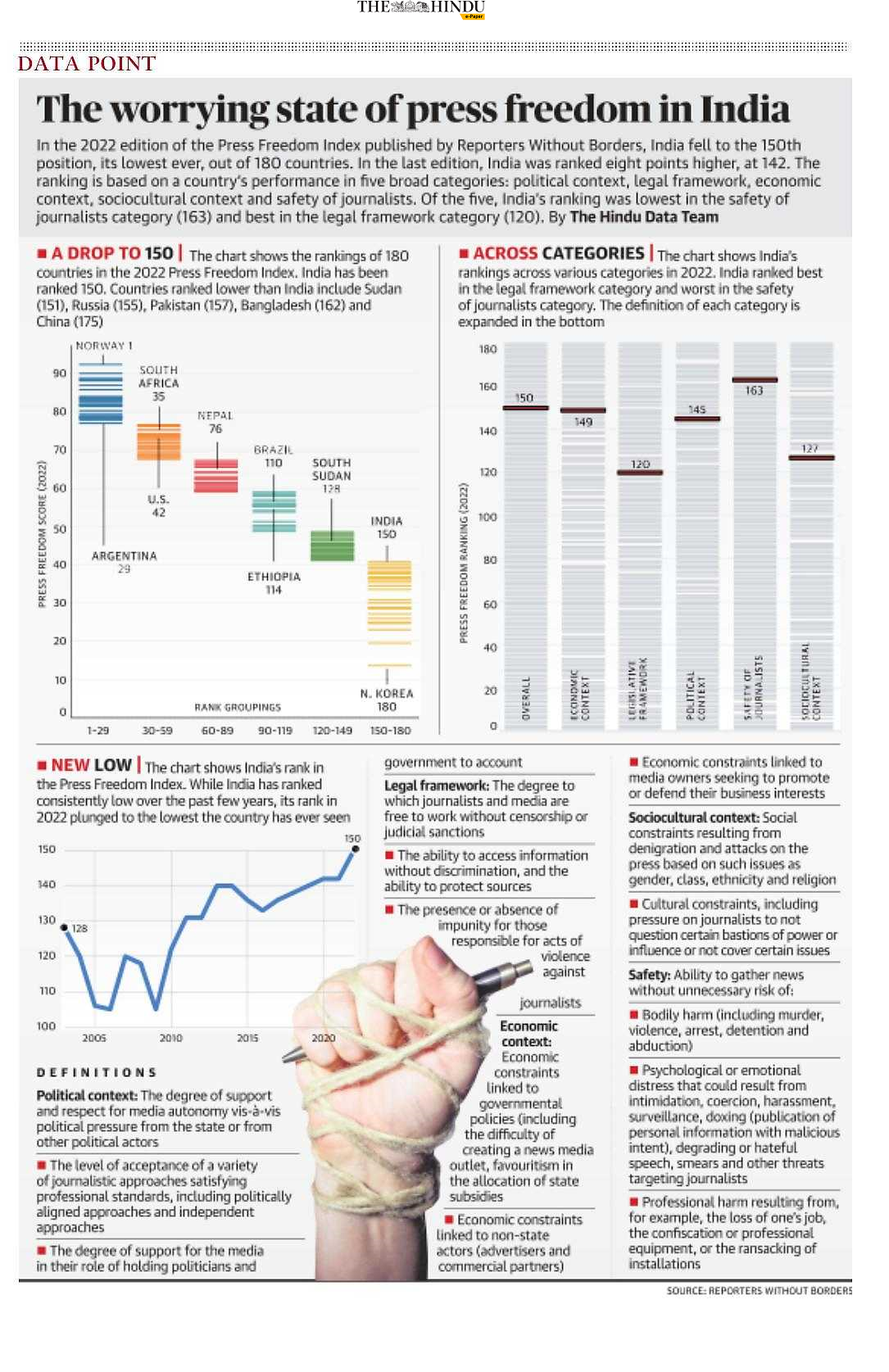
    India slips to 150 in Press Freedom Index

    India has reached 150th position in the World Press Freedom Index, dropping further from its last year’s 142nd rank out of 180 countries.

    What is Press Freedom Index?

    • The PFI is an annual ranking of countries compiled and published by Reporters Without Borders since 2002.
    • It is based upon the organisation’s own assessment of the countries’ press freedom records in the previous year.
    • It intends to reflect the degree of freedom that journalists, news organisations, and netizens have in each country, and the efforts made by authorities to respect this freedom.
    • It does not measure the quality of journalism in the countries it assesses, nor does it look at human rights violations in general.

    Highlights of the 2022 report

    (a) Best performing countries

    • Norway– 1st
    • Denmark– 2nd
    • Sweden– 3rd
    • Estonia– 4th
    • Finland– 5th

    (b) Worst performers

    • North Korea remained at the bottom of the list, while Russia was placed at 155th position, slipping from 150th last year.
    • As per the global media watchdog, China climbed up by two positions ranking at 175th position, as compared to 177th position last year.

     (c) Performance in our neighbourhood

    • Besides India, its neighbours except Nepal have also slid down.
    • While Pakistan is at 157th position, Sri Lanka ranks at 146th, Bangladesh at 162nd and Maynmar at 176th position.

    Back2Basics: Freedom of Press and Constitutional Provisions

    • The Supreme Court in Romesh Thappar v. the State of Madras, 1950 observed that freedom of the press lay at the foundation of all democratic organisations.
    • It is guaranteed under the freedom of speech and expression under Article 19, which deals with ‘Protection of certain rights regarding freedom of speech, etc.
    • Freedom of the press is not expressly protected by the Indian legal system but it is impliedly protected under article 19(1) (a) of the constitution.
    • The freedom of the press is also not absolute.

    Reasonable restrictions

    • A law could impose only those restrictions on the exercise of this right, it faces certain restrictions under article 19(2), which is as follows:
    1. Sovereignty and integrity of India
    2. Security of the State,
    3. Friendly relations with foreign States
    4. Public order, decency or morality
    5. Contempt of court
    6. Defamation
    7. Incitement to an offence


    UPSC 2023 countdown has begun! Get your personal guidance plan now! (Click here)

  • Indian Navy Updates

    France pulls out of P-75I Project

    Ahead of PM Modi’s scheduled visit, France has denounced its participation in the P-75 India (P-75I) project under which six conventional submarines are to be built in India for the Indian Navy.

    Why did France pull out?

    • The reason was that the Request for Proposal (RFP) requires that the fuel cell AIP be sea proven, which not the case is for us yet since the French Navy does not use such a propulsion system.
    • AIP refers to Air-Independent Propulsion, a technology for conventional — that is, non-nuclear — submarines.

    Backgrounder: Project 75

    • Project 75 India is a part of India’s thirty-year-old submarine building plan by which all the six submarines which are under the project should already be sailing and it should have been followed by the submarines now for which the RFP has been issued.
    • It is a long-awaited and long-overdue project.
    • This should have happened way back but it got delayed because it was difficult to find a strategic partnership model.

    What is P-75I?

    • The Project 75I-class submarine is a follow-on of the Project 75 Kalvari-class submarine for the Indian Navy.
    • In the late 1990s, around the time of Kargil war, a three-decade plan took shape for indigenous construction of submarines.
    • It was known to have two separate series of submarine building lines – codenamed Project 75 and Project 75I — in collaboration with foreign entities.
    • Under this project, the Indian Navy intends to acquire six diesel-electric submarines, which will also feature advanced air-independent propulsion systems.
    • This is for enabling them to stay submerged for longer duration and substantially increase their operational range.

    What is the status of the project?

    • The navy is slightly behind the curve on P-75I.
    • The project faces choppy waters; the Naval Group has already announced it is pulling out, and sources said the Russian and Spanish companies might also not proceed with their bids.
    • Among the concerns, is the requirement to demonstrate a sea-proven fuel cell AIP.
    • While some manufacturers may have the technology, it may not have been proven at sea yet.
    • Another problem for the OEMs is the transfer of technology, which is built into the process.

    Why does the Navy want AIP subs?

    • Simply put, AIP technology allows a conventional submarine to remain submerged for much longer than ordinary diesel-electric submarines.
    • All conventional submarines have to surface to run their generators that recharge the batteries that allow the boat to function under water.
    • However, the more frequently a submarine surfaces, the higher the chances of it being detected.
    • AIP allows a submarine to remain submerged for more than a fortnight, compared to two to three days for diesel-electric boats.
    • IP has a force multiplier effect on lethality of a diesel electric submarine as it enhances the submerged endurance of the boat several folds.

    What submarines does India have now?

    • India has 16 conventional diesel-electric submarines, which are classified as SSKs.
    • After the last two Kalvari Class subs are commissioned under P-75, this number will go up to 18.
    • India also has two nuclear ballistic submarines, classified SSBN.

    Strategic importance of submarines development

    • Ageing arsenal: Currently, India has less number of submarines than what is required with some more of those from both types being at various stages of construction.
    • Combat roles in near future: The nuclear powered and diesel-electric submarines have their designated roles in the Carrier Battle Groups, which are formations of ships and submarines with Aircraft Carriers at the lead role.
    • Strategic deterrence: As per the basic principles of submarine deployment and the minimum requirement for India to create a strategic deterrence, there is a specific number of submarines of both types that India needs to have in active service.

    Significance of P-75 I

    • ‘Make in India’ Projects: It will serve to facilitate faster and more significant absorption of technology and create a tiered industrial ecosystem for submarine construction in India.
    • Self-Reliance: From a strategic perspective, this will help reduce current dependence on imports and gradually ensure greater self-reliance and dependability of supplies from indigenous sources.
    • Securing Indo-Pacific: China is increasing its presence in the Indian Ocean Region (IOR) and this is creating pressure on the Indian Navy in sprucing up the submarine arm.


    UPSC 2023 countdown has begun! Get your personal guidance plan now! (Click here)

  • Russian Invasion of Ukraine: Global Implications

    Russia officially quits the International Space Station (ISS)

    Russia is responding to the Western sanctions. It has decided to walk out of the International Space Station.

    International Space Station

    • The ISS was launched in 1998 as part of joint efforts by the U.S., Russia, Japan, Canada and Europe.
    • The idea of a space station originated in the 1984 State of the Union address by former U.S. President Ronald Reagan.
    • The space station was assembled over many years, and it operates in low-earth orbit.
    • Since its inception, it has served as a laboratory suspended in space and has aided multiple scientific and technological developments.
    • The ISS was originally built to operate for 15 years.

    Why was ISS launched?

    • A space station permits quantum leaps in research in science, communications, and in metals and lifesaving medicines which could be manufactured only in space.
    • ISS has consistently maintained human presence for the past 21 years, providing astronauts with sophisticated technologies for scientific research.

    What is Russia’s role in maintaining the ISS?

    • The ISS is built with the co-operation of scientists from five international space agencies — NASA of the U.S., Roscosmos of Russia, JAXA of Japan, Canadian Space Agency and the European Space Agency.
    • Each agency has a role to play and a share in the upkeep of the ISS.
    • Both in terms of expense and effort, it is not a feat that a single country can support.
    • Russia’s part in the collaboration is the module responsible for making course corrections to the orbit of the ISS.
    • They also ferry astronauts to the ISS from the Earth and back.
    • Until SpaceX’s dragon spacecraft came into the picture the Russian spacecrafts were the only way of reaching the ISS and returning.


    UPSC 2023 countdown has begun! Get your personal guidance plan now! (Click here)

  • Indian Army Updates

    Advanced Towed Artillery Gun System (ATAGS) passes validation trials

    The indigenous Advanced Towed Artillery Gun System (ATAGS) developed by the Defence Research and Development Organisation (DRDO) successfully completed the validation trials.

    Why in news?

    • The ATAGS has demonstrated a range of over 45 km, making it the “most consistent and accurate gun in the world”.

    ATAG System

    • The ATAGS is a 155-mm, 52-calibre artillery gun jointly developed by the DRDO in partnership with Bharat Forge of the Kalyani Group and the Tata Power SED.
    • ATAGS has greater than 95% of indigenous content. It set a world record for the longest unassisted projectile range of 48 kilometres.

    Its features

    • The gun consists of a barrel, breech mechanism, muzzle brake and recoil mechanism to fire 155 mm calibre ammunition with a firing range of 48 km.
    • It has an all-electric drive to ensure reliability and minimum maintenance over a long period of time.
    • It has advanced features like high mobility, quick deployability, auxiliary power mode, advanced communication system, automatic command and control system with night capability in direct fire mode.


    UPSC 2023 countdown has begun! Get your personal guidance plan now! (Click here)


  • Foreign Policy Watch: India – EU

    India-Denmark relations

    Context

    As Russia, isolated by unprecedented Western sanctions, deepens its alliance with China, Europe has begun to loom larger than ever before in India’s strategic calculus. Prime Minister Narendra Modi’s visit to Berlin, Copenhagen, and Paris this week could give us a glimpse of India’s post-Russian strategic future in Europe.

    Engagement with collective Europe

    • In her visit to Delhi, the president of the European Commission, Ursula von Der Leyn, unveiled the new contours of the EU’s strategic partnership with India by launching the India-Europe Trade and Technology Council. 
    • This week, the focus is on India’s key bilateral partnerships with European majors — Germany and France — as well as a critical northern corner of Europe, the so-called Norden.
    • Having built up a significant engagement with Moscow over the decades, India and Germany are under pressure to disentangle from the Russian connection.
    • Modi and Scholz could also exchange notes on how their long-standing illusions about China came crashing down.
    • Macron’s return to power in France offers a good moment for Modi to imagine the next phase in bilateral relations.
    • For some time now it has been said that France is India’s “new Russia” — Delhi’s most important strategic partner.
    • In recent years, France has emerged as a strong defender of India’s interests in the United Nations Security Council and a regional ally in the vast Indo-Pacific theatre.
    • France has also been a major supplier of advanced arms to India.
    • But Delhi and Paris have been some distance away from demonstrating full possibilities of their defence partnership.
    • There is no doubt that Western Europe has moved from the margins to the centre of India’s foreign and security policies.
    • The crisis in Ukraine, which has shattered the regional order that emerged in 1991, intensifies the imperatives for deeper strategic cooperation between India and its European partners.

    India’s engagement with smaller European countries

    • In Copenhagen, the bilateral talks with Danish leadership are about Delhi finally finding time for the smaller European countries.
    • The Nordic summit hosted by Denmark underlines India’s discovery of the various sub-regions of Europe — from the Baltics to the Balkans and from Iberia to Mittleuropa.
    • The Nordic Five — Denmark, Finland, Iceland, Norway, and Sweden — have a population of barely 25 million but their GDP at $1.8 trillion is greater than that of Russia.
    • Two members of the Nordic five — Sweden and Finland — are now rushing to end their long-standing neutral status and join NATO.
    • The other three — Denmark, Iceland, and Norway — have been founding members of NATO, set up in 1949.
    • Listening to the Nordic leaders might help Delhi appreciate the deeply-held fears about Russia among Moscow’s smaller neighbours.
    • In Copenhagen, Modi would want to build on the unique bilateral green strategic partnership with Denmark.

    Germany and India’s engagement with Russia

    • Berlin is tied far more deeply to Russia than India.
    • Germany’s annual trade with Russia is about $60 billion while India’s is at $10 bn.
    • Germany relies heavily on Russian natural gas, while Russian arms dominate India’s weaponry.
    • Irrespective of their Russian preferences, Germany and India have no option but to live with circumstances over which they have no control.
    • Opportunity for India: Making India an attractive new destination for German capital, now under pressure to reduce its exposure to Russian and Chinese markets, should be the highest priority for PM Modi.
    • Germany is one of India’s oldest economic partners, but the full potential of the commercial relationship has never been realised.
    • If there ever was a moment to think big about the future of German trade and investment in India, it is now.

    Conclusion

    A new paradigm is beckoning India — strong commercial and security partnerships with Europe that stand on their own merit and bring the many synergies between them into active play.

    UPSC 2023 countdown has begun! Get your personal guidance plan now! (Click here)

  • Policy Wise: India’s Power Sector

    The supply bottlenecks causing power shortages

    Context

    The power sector in India is going through a crisis. Peak shortages in some states have reached double digits.

    Chronology of the crisis

    • First, with summer approaching before time, power demand has shot up to record levels.
    • The second reason for the rise in power demand is that the economy is recovering, and demand from the industrial sector is going up.
    • All things put together, power demand crossed 207 GW on April 29, which is about 14 per cent higher than what it was a year ago.
    • Experts feel that the peak demand may even touch 215 GW in the coming months.

    Coal shortage crisis

    • On average, coal stocks available are only good enough for about eight days’ generation against a norm of 24 days.
    • In some plants, the stocks available are just about enough to run the plant for a day or two more.
    • Part of the problem of poor coal stock is also rumoured to be on account of the non-payment of dues of coal companies.
    • But this is not the major cause of the shortage.

    Reasons for coal shortage and fall in generation

    • The fall in coal stock in power stations is because of two main reasons.
    • 1] Rise in international price of coal: The first is that due to a rise in the international price of coal on account of the Ukraine crisis, all plants that were importing coal have either stopped generating completely or are generating at much lower levels.
    • We have a sizeable generating capacity based on imported coal, estimated at about 16 GW to 17 GW.
    • All these plants after stopping imports are now looking for domestic coal, creating pressure on domestic coal.
    • 2] Non-availability of rakes with Indian railways for transporting coal: Though about 22 MT of coal may be available in power stations, if one includes the stocks available with mining companies, the figure is well over 70 MT.
    • So, it is all a question of transporting the coal to the power stations.
    • 3] Fall in generation from gas-based plants: To make matters worse, generation from gas-based plants has also fallen due to high gas prices in the world market.
    • 4] Impact on hydro generation: Reservoirs, too, are drying up due to intense heat which will adversely affect hydro generation.

    Transportation problem faced by Indian railways

    • The railways have about 2,500 rakes which can be used for coal transportation.
    • With a turn-around time of about four-and-a-half days which goes up to nine days for coastal regions, the railways can provide only about 525 rakes on any single day. 
    • Of this, about 100 rakes are used for transporting imported coal and therefore, only about 425 rakes are available on a daily basis for transporting domestic coal.
    • But only 380 rakes were being provided in the first half of April this year, though efforts are on to increase this to about 415 rakes.
    • The railways prefer to transport coal over short distances in order to save on the turn-around time.
    • There is also the issue of availability of tracks since they are being used on a back-to-back basis.
    • Thus production has to be enhanced so that the replenishment rate is higher than consumption.
    • Unless we do that, the total stock of coal in the country will deplete further and it will no longer be a mere transportation problem as it is now, but a general lack of supply of coal.

    Conclusion

    This is the right time to enhance coal production and build adequate stocks because once the monsoon sets in, production will fall.

    UPSC 2023 countdown has begun! Get your personal guidance plan now! (Click here)

  • Languages and Eighth Schedule

    The Debate on National Language

    Remarks by a Hindi actor to the effect that Hindi is the national language of India has sparked controversy recently over the status of the language under the Constitution.

    What is the status of Hindi?

    • Under Article 343 of the Constitution, the official language of the Union shall be Hindi in Devanagari script.
    • The international form of Indian numerals will be used for official purposes.

    The debate

    • Inherent opposition to Hindi: The Constituent Assembly was bitterly divided on the question, with members from States that did not speak Hindi initially opposing the declaration of Hindi as a national language.
    • Colonial footprints of English: Proponents of Hindi were insistent that English was the language of enslavement and that it should be eliminated as early as possible.
    • Fear of Hindi imposition: Opponents were against English being done away with, fearing that it may lead to Hindi domination in regions that did not speak the language.
    • Inefficacy of Sanskrit: There were demands to make Sanskrit the official language, while some argued in favour of ‘Hindustani’.
    • Issue over Script: There were differences of opinion over the script too. When opinion veered towards accepting Hindi, proponents of the language wanted the ‘Devanagari’ script to be adopted both for words and numerals.

    Major outcome: No national language

    • It was decided that the Constitution will only speak of an ‘official language’.
    • And that English would continue to be used for a period of 15 years.
    • The Constitution said that after 15 years, Parliament may by law decide on the use of English and the use of the Devanagari form of numbers for specified purposes.

    What is the Eighth Schedule?

    • The Eighth Schedule contains a list of languages in the country. Initially, there were 14 languages in the schedule, but now there are 22 languages.
    • There is no description of the sort of languages that are included or will be included in the Eighth Schedule.

    Constitutional position of Eighth Schedule

    There are only two references to these languages in the text of the Constitution.

    (i) Article 344(1):

    • It provides for the formation of a Commission by the President, which should have a Chairman and members representing these scheduled languages.
    • The purpose of the Commission is to make recommendations for the progressive use of Hindi for official purposes of the Union and for restricting the use of English.

    (ii) Article 351:

    • It says it is the Union government’s duty to promote the spread of Hindi so that it becomes “a medium of expression for all elements of the composite culture of India”.
    • It also aims to assimilate elements of forms and expressions from Hindustani and languages listed in the Eighth Schedule.

    What were the 1965 protests about?

    • The Official Languages Act, 1963 was passed in anticipation of the expiry of the 15-year period during which the Constitution originally allowed the use of English for official purposes.
    • Its operative section provided for the continuing use of English, notwithstanding the expiry of the 15-year period.
    • Jawaharlal Nehru had given an assurance in 1959 that English would remain in official use and as the language of communication between the Centre and the States.
    • The Official Languages Act, 1963, did not explicitly incorporate this assurance, causing apprehensions in some States as the January 1965 deadline neared.
    • At that time, PM Lal Bahadur Shastri reiterated the government’s commitment to move towards making Hindi the official language for all purposes.

    TN loops in the agitation

    • In Tamil Nadu, then known as Madras, the prospect of the use of Hindi as the medium of examination came due to recruitment examination of union.
    • It created an apprehension that Hindi would be imposed in such a way that the future employment prospects of those who do not speak Hindi will be bleak.

    Creating an exception for Tamil Nadu

    • With the Congress government in the State taking the view that the people had nothing to fear about, protests broke out in January 1965.
    • It took a violent turn after more and more student activists joined the protest, and continued even after key Dravida Munnetra Kazhagam (DMK) leaders were arrested.
    • More than 60 people died in police firing and other incidents as the protests went on for days.
    • The agitation died down later, but by then the Congress at the Centre realised the sensitivity of the language issue among Tamil-speaking people.
    • When the Official Language Rules were framed in 1976, it was made clear that the Rules apply to the whole of India, except Tamil Nadu.

    What is the three-language formula?

    • Since the 1960s, the Centre’s education policy documents speak of teaching three languages — Hindi, English and one regional language in Hindi-speaking States, and Hindi, English and the official regional language in other States.
    • In practice, however, only some States teach both their predominant language and Hindi, besides English.
    • In States where Hindi is the official language, a third language is rarely taught as a compulsory subject.
    • Tamil Nadu has been steadfastly opposing the three-language formula and sticks to teaching Tamil and English.
    • It argues that those who need to know Hindi can learn on their own.


    UPSC 2023 countdown has begun! Get your personal guidance plan now! (Click here)

  • Parliament – Sessions, Procedures, Motions, Committees etc

    Quasi-Federalism in India

    This newscard is an excerpt from the original article published in the TH.

    Why in news?

    • The contemporary discourse on federalism in India is moving on a discursive across multiple dimensions, be it economic, political and cultural,
    • It is argued that India is at an inflection point vis-a-vis Centre-State relations owing to increasing asymmetry.

    What is Federalism?

    • Federalism is a system of government in which the power is divided between a central authority and various constituent units of the country.
    • This vertical division of power among different levels of governments is referred to as federalism.
    • Federalism is one of the major forms of power-sharing in modem democracies.

    Indian case: Federal, quasi-federal or hybrid?

    • India consciously adopted a version of federalism that made the Union government and State governments interdependent on each other (latter more vis-a-vis the former).

    The federal features of the Constitution of India are:

    • Written Constitution: Features of the Indian Constitution is not only a written document but also the longest constitution in the world. Originally, it included a Preamble, 395 articles (22 parts), and 8 schedules.
    • Dual Polity: The constitution establishes a dual polity that includes the union at the periphery. Each is endowed with sovereign powers to be exercised in the field assigned to them respectively by the Constitution.
    • Bicameralism: The constitution provides for a bicameral legislature in which an upper house (Rajya Sabha) and a lower house (Lok Sabha). Rajya Sabha represents the states of the Indian Union, whereas The Lok Sabha represents the people of India as a whole.
    • Division of Powers: The Constitution divided the powers between the Center and the states in terms of the Union List, State List, and Concurrent List in the Seventh Schedule.
    • Supremacy of the Constitution: The Constitution is the supreme law of the country. The laws made by the Center and the states should be in conformity with Provision. Otherwise, they may be declared invalid by the Supreme or High Court through its power of judicial review.
    • Rigid Constitution: The division of powers established by the Constitution as well as supremacy of the constitution can be maintained only if the method of its amendment is rigid. It is necessary for both houses to agree to amend the constitution.
    • Independent judiciary: The constitution establishes an independent judiciary headed by the Supreme Court for two purposes: one, to protect the supremacy of the constitution, and two, to settle the disputes between the Centre and states or between the states.

    Besides the above federal features, the Indian constitution also possesses the following unitary features:

    • Strong Centre: The division of powers is in favour of the centre and unequal from a federal point of view. Firstly, the Union list contains more subjects than the state list, secondly, the more important subjects have been included in the union list and the Centre has overriding authority over the concurrent list.
    • Single constitution: The constitution of India embodies not only the constitution of the Centre but also those of the states. Both the Centre and the States must operate within this single frame.
    • Destructible nature of states: Unlike in other federations, the states in India have no right to territorial integrity. The parliament can change the area, boundaries, or name of any state.
    • Emergency provisions: The emergency provisions are contained in Part XVIII of the Constitution of India, from Articles 352 to 360. In the emergency provisions, the central government becomes all-powerful and the states go into total control of the Centre.
    • Single citizenship: Single citizenship means one person is the citizenship of the whole country. The constitution deals with citizenship from Articles 5 and 11 under Part 2.
    • All India services: In India, there are all India services (IAS, IPS and IFS) which are common to both the Centre and the states. These services violate the principle of federalism under the constitution.
    • Appointment of governor: The governor is appointed by the president. He also acts as an agent of the Centre. Through him, the Centre exercises control over the states.
    • Integrated election machinery: The election commission conducts elections for central and state legislatures. But the Election commission is constituted by the president and the states have no say in this matter.
    • Equality (= Equity) of representation: The states are given representation in the upper house on the basis of population. Hence, the membership varies from 1 to 31.
    • Integrated Judiciary: The term Integrated Judiciary refers to the fact that rulings made by higher courts bind lower courts. The Supreme Court of India incorporates all lower courts, from the Gram Panchayat to the High Courts. The Supreme Court is at the very top.
    • Union veto over State Bills:  The governor has the authority to hold certain sorts of laws passed by the state legislature for presidential consideration. The President has the authority to refuse to sign such bills not only in the first instance but also in the second.

    Reasons for a centralised federal structure

    There are at following reasons that informed India’s choice of a centralised federal structure.

    1. Partition of India and the concomitant concerns: The 1946 Objectives Resolution introduced by Nehru in the Assembly were inclined towards a decentralised federal structure wherein States would wield residuary powers.
    2. Reconstitution of social relations in a highly hierarchical and discriminatory society: The centralised structure would unsettle prevalent trends of social dominance, help fight poverty better and therefore yield liberating outcomes.
    3. Building of a welfare state: In a decentralised federal setup, redistributive policies could be structurally thwarted by organised (small and dominant) groups. Instead, a centralised federal set-up can prevent such issues and further a universal rights-based system.
    4. Alleviation of inter-regional economic inequality: Provincial interventions seemed to exacerbate inequalities. India’s membership in the International Labour Organization, the Nehru Report (1928), and the Bombay Plan (1944) pushed for a centralised system to foster socio-economic rights and safeguards for the working and entrepreneurial classes.
    5. Linguistic reorganization: It would not have been possible if India followed a rigid or conventional federal system. In other words, the current form of federalism in the Indian context is largely a function of the intent of the government of the day and the objectives it seeks to achieve.
    • From the above, it is clear that India has deviated from the traditional federal systems like the USA   and incorporated a large number of unitary features, tilting the balance of power in favor of the Centre.
    • Hence K C Wheare described the constitution of India as “quasi-federal”.

    Conclusion

    • The majoritarian tendencies sometimes are subverting the unique and indigenised set-up into an asymmetrical one.
    • Inter alia, delayed disbursal of resources and tax proceeds, bias towards electorally unfavourable States, evasion of accountability, imposition of language, weakening institutions, proliferation of political ideologies all signal towards the diminishing of India’s plurality or regionalisation of the nation.
    • While it would be safe to argue that our federal set-up is a conscious choice, its furthering or undoing, will depend on the collective will of the citizenry and the representatives they vote to power.


    UPSC 2023 countdown has begun! Get your personal guidance plan now! (Click here)

  • Anti Defection Law

    What is Office-of-Profit?

    The Election Commission (EC) has sent a notice to Jharkhand CM over an office-of-profit charge against him for allotment of a mining lease in his name last year.

    Why in news?

    • Under Section 9A of the Representation of the People Act, 1951, the CM could face disqualification for entering into a government contract.
    • The Constitution of India does not define the Office of Profit. It has only mentioned it under Article 102 (1) and Article 191 (1).

    What is ‘Office of Profit’?

    • MPs and MLAs, as members of the legislature, hold the government accountable for its work.
    • The essence of disqualification is if legislators hold an ‘office of profit’ under the government, they might be susceptible to government influence, and may not discharge their constitutional mandate fairly.
    • The intent is that there should be no conflict between the duties and interests of an elected member.
    • Hence, the office of profit law simply seeks to enforce a basic feature of the Constitution- the principle of separation of power between the legislature and the executive.

    What governs the term?

    • At present, the Parliament (Prevention of Disqualification) Act, 1959, bars an MP, MLA or an MLC from holding any office of profit under the central or state government unless it is exempted.
    • However, it does not clearly define what constitutes an office of profit.
    • Legislators can face disqualification for holding such positions, which bring them financial or other benefits.
    • Under the provisions of Article 102 (1) and Article 191 (1) of the Constitution, an MP or an MLA (or an MLC) is barred from holding any office of profit under the Central or State government.

    An undefined term

    • The officials of the law ministry are of the view that defining an office of profit could lead to the filing of a number of cases with the Election Commission and the courts.
    • Also, once the definition is changed, one will also have to amend various provisions in the Constitution including Article 102 (1) (a) and Article 109 (1) (a) that deal with the office of profit.
    • It will have an overarching effect on all the other sections of the Constitution.

    Factors constituting an ‘office of profit’

    • The 1959 law does not clearly define what constitutes an office of profit but the definition has evolved over the years with interpretations made in various court judgments.
    • An office of profit has been interpreted to be a position that brings to the office-holder some financial gain, or advantage, or benefit. The amount of such profit is immaterial.
    • In 1964, the Supreme Court ruled that the test for determining whether a person holds an office of profit is the test of appointment.

    What is the ‘test of appointment’?

    Several factors are considered in this determination including factors such as:

    1. whether the government is the appointing authority,
    2. whether the government has the power to terminate the appointment,
    3. whether the government determines the remuneration,
    4. what is the source of remuneration, and
    5. the power that comes with the position.


Join the Community

Join us across Social Media platforms.