Ease of Doing Business is an index of World Bank which inter alia refers to the dispute resolution environment in a country which facilitates the investors in deciding for setting up of and operation of a business.
This index has been created by the World Bank Group and since 2002; it has been evaluating almost all the countries of the world.
A high ease of doing business ranking means the regulatory environment is more conducive to the starting and operation of the business.
India has emerged out as one among top ten improvers and for the first time ever, India has jumped 30 positions.
India reached 100th ranked country in terms of ‘Ease of Doing Business’ amongst 190 countries.
This manifests that India is fast adopting the best practices in regulatory framework for Ease of Doing Business at all fronts.
As a part of revision for Prelims 2018, Here’s a Factoid to brush up your concepts
Key words related to History : Parigraha
Dynasty/era : Mahavira period
Meaning : 1.Parigraha-parimana is one the 12 vratas or vows of a layperson in Jainism. Specifically, it is a vow to limit attachment to worldly possessions. 2.Unlike monks or ascetics who observe such vows more strictly, the layperson may make a vow to limit his or her attachment to certain possessions or a certain number of possessions, or they may vow to limit attachment for a specified period of time.
Link for the test: Click2Attempt (Let us know your score in comments)
We have started our Open SIP program in conjunction with our PAID program (Click2Know all details of the program)
We will be running this special FREE initiative on daily basis providing students with revision questions for static subjects as well as current affairs starting from June 2017
Test 34 as per schedule (Click2View) is Misc Test 10
Liked the test? You can join our FLT program containing more such high-level questions. The module contains 11 FLTs (8 paper 1 TS + 3 CSAT)
Know all details about the program and join here: Click2Join
Want to do quick revision for Prelims? Join our SIP Comprehensive or SIP Mini modules giving you Static & Dynamic subjects coverage through video lectures
The flow of water through well-defined channels is known as ‘drainage’ and the network of such channels is called a ‘drainage system’.
Types of Drainage Patterns
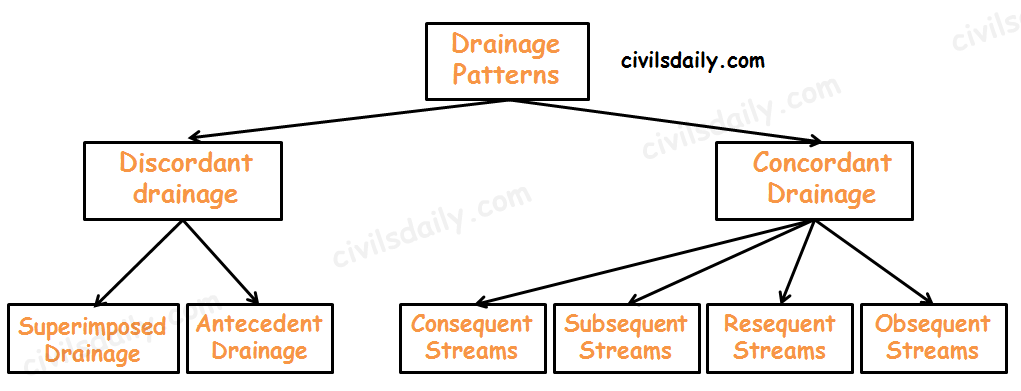
Discordant drainage
A pattern of drainage that bears no relation to the structure of the underlying rock. This may be because:
1. The drainage pattern developed on rock strata that have since been removed by erosion; a process known as superimposition. The drainage pattern thus developed is called superimposed drainage (or Epigenetic or Superinduced Drainage). Examples: The Damodar, the Subarnarekha, the Chambal, the Banas and the rivers flowing at the Rewa Plateau, rivers of eastern USA and southern France.
2. The drainage pattern was already present before a period of uplift and folding that formed the present structure. As the uplift took place, the rivers were able to cut down at approximately the same rate and so maintain their courses. This process is called antecedence and the drainage system thus developed is called antecedent drainage.
Many of the Himalayan rivers have antecedent origin i.e. these rivers existed even before the Himalayan ranges were uplifted. These rivers originate in the Tibetan side beyond the mountain ranges of Himalayas. The Indus, Satluj, Alaknanda, Gandak, Kosi, Brahmaputra all have an antecedent origin. Since these rivers are antecedent, they run transverse to the mountain ranges cutting deep V-shaped, steep-sided valleys (deep gorges).
Concordant Drainage (also called accordant drainage)
The pattern of drainage which arises from and closely follows the trends of the underlying strata is called concordant drainage.
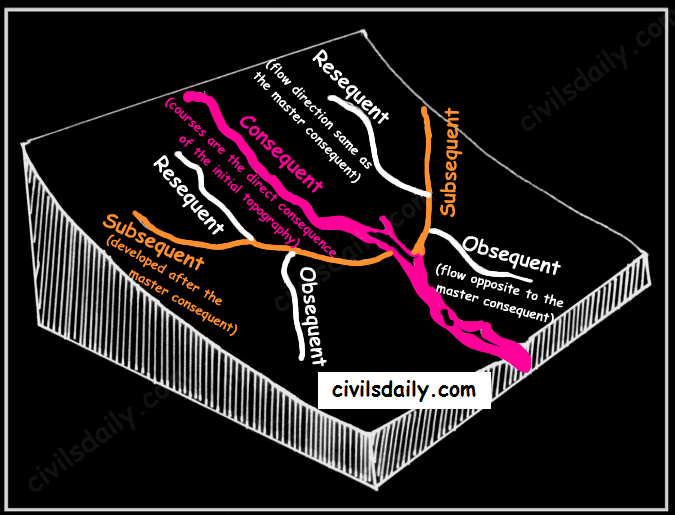
Consequent Streams: Those streams whose courses are the direct consequence of the initial topography are called consequent streams.
Subsequent Streams: These are developed after the master consequent.
Obsequent streams: These flow in opposite direction to the master consequent.
Resequent Streams: A resequent stream flows in the same direction as that of the initial consequent stream, but which develops in response to a new base level formed due to inversion of relief.
Concordant Drainage Patterns
Drainage pattern:
Drainage pattern refers to a design which a river and its tributaries form together from its source to its mouth. The drainage pattern of an area is the outcome of:
The geological time period,
Nature and structure of rocks,
Topography,
Slope,
Amount of water flowing, and
The periodicity of the flow.
Some Important Drainage Patterns:
A combination of several patterns may be found in the same drainage basin.
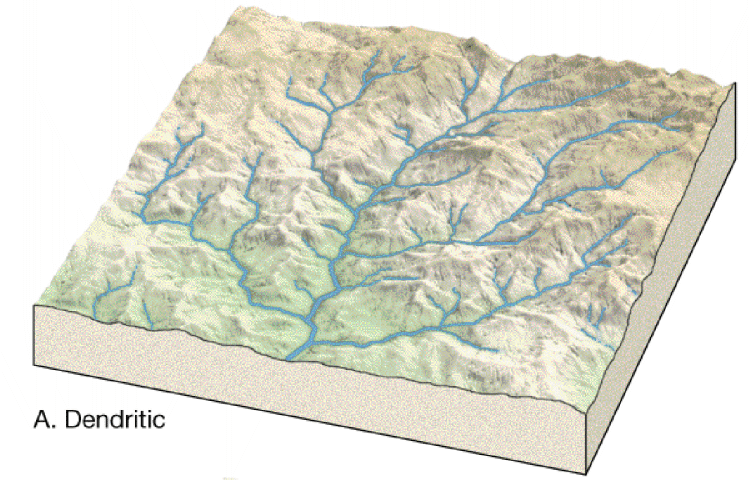
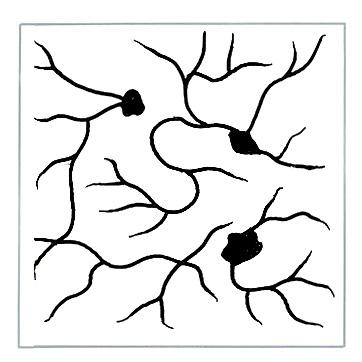
1. Dendritic: The dendritic pattern develops where the river channel follows the slope of the terrain. The drainage pattern resembling the branches of a tree is known as “dendritic” the examples of which are the rivers of northern plain. It is the most common stream pattern. A dendritic pattern develops in a terrain which has uniform lithology, and where faulting and jointing are insignificant.
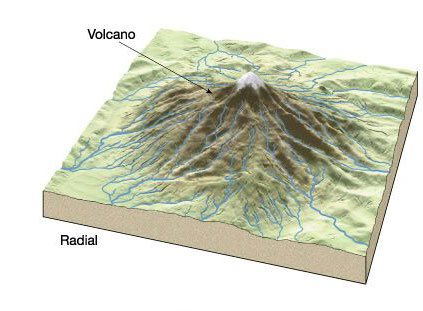
2. Radial: The radial pattern develops when streams flow in different directions from a central peak or a dome-like structure. E.g. the rivers like the Narmada, Son and Mahanadi originating from Maikal Hills flow in different directions and are good examples of a radial pattern.
Radial drainage patterns are also found/in the Girnar Hills (Kathiwar, Gujarat), and Mikir Hills of Assam.
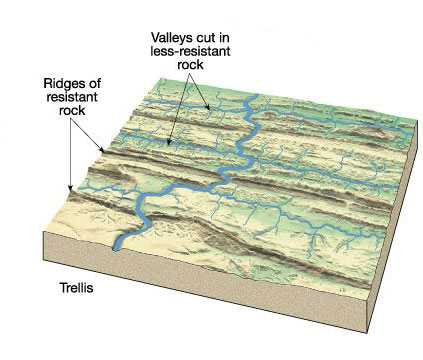
3. Trellis: When the primary tributaries of rivers flow parallel to each other and secondary tributaries join them at right angles, the pattern is known as ‘trellis’. A trellis drainage pattern develops where hard and soft rocks lie parallel to each other. For example, rivers in the upper part of the Himalayan region and in the old folded mountains of the Singhbhum (Chotanagpur Plateau) have drainage of trellis pattern. The trellis drainage pattern can also be seen in the Appalachian region of the U.S.A., where hard and soft rocks occur in parallel bands.
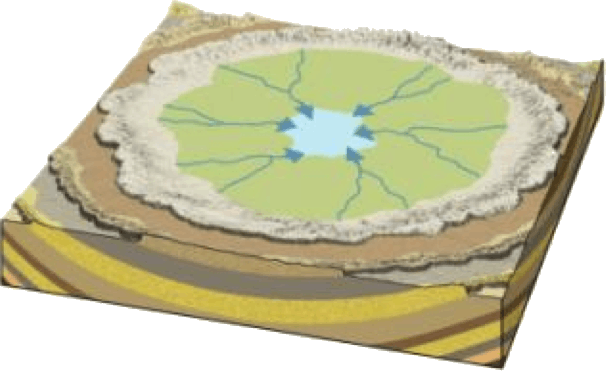
4. Centripetal: When the rivers discharge their waters from all directions in a lake or depression, the pattern is known as ‘centripetal’. This drainage pattern is also called endorheic drainage. For example, Loktak lake in Manipur.
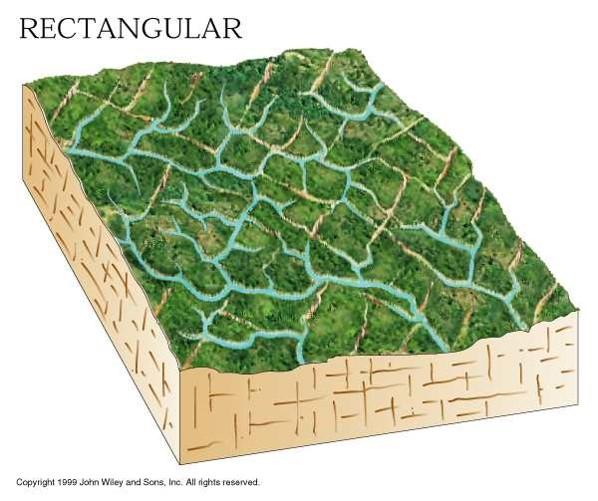
5. Rectangular: In this drainage, both the main stream and its tributaries show right-angled bends. A rectangular drainage pattern develops on a strongly jointed rocky terrain. It differs from trellis pattern drainage, since it is more irregular and its tributary streams are not as long or as parallel as in trellis drainage. Example: Colorado river (USA), streams found is the Vindhyan Mountains of India.
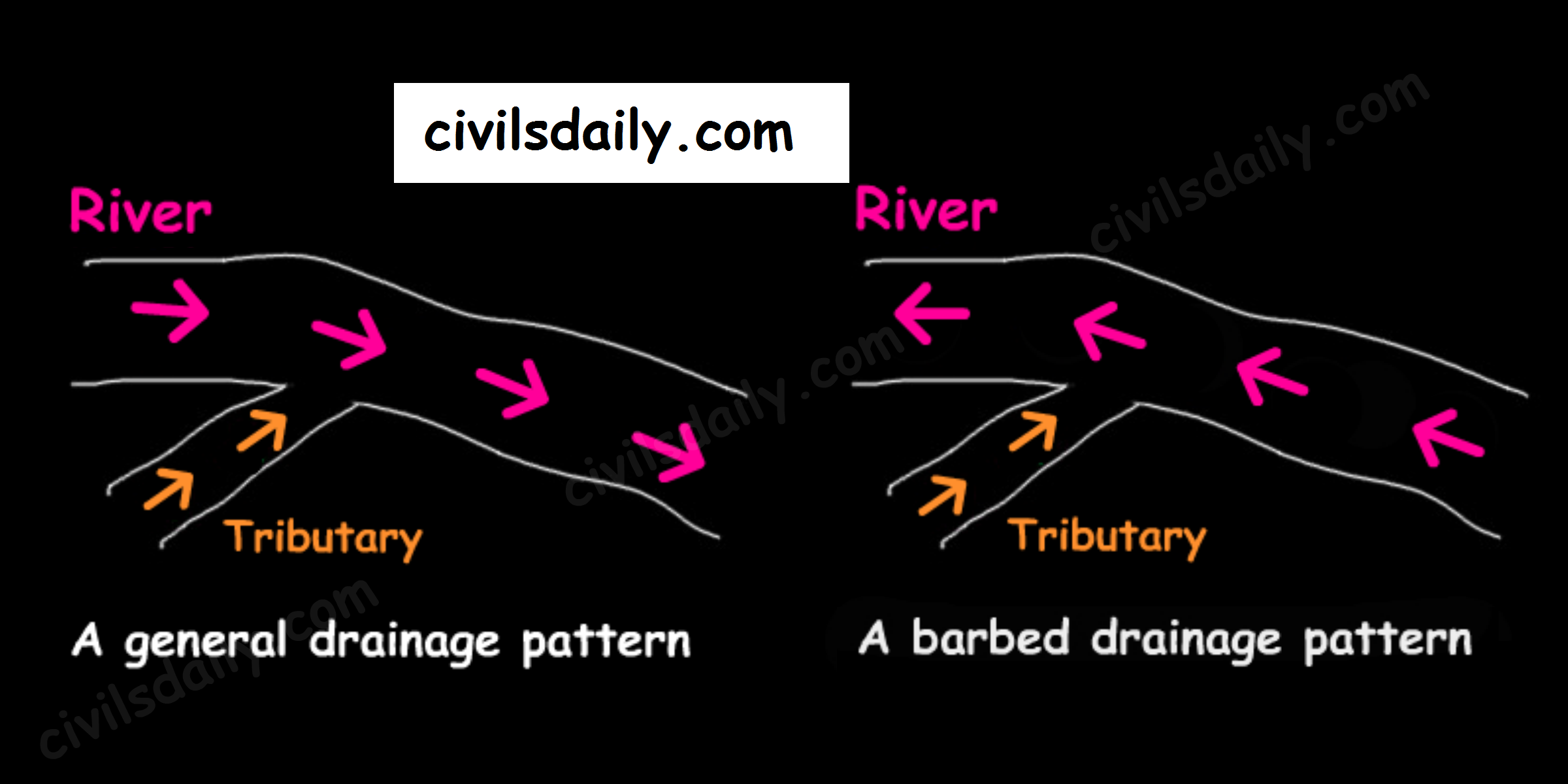
6. Barbed: If you look at the way that tributaries empty into larger rivers, you will notice that most of them flow in the same direction as the rivers they empty into. But quite a large number flow the other way. In fact, you will find stretches of some rivers where every tributary empties into the river in the “wrong” direction! Such an occurrence is known as a barbed drainage pattern.
Most barbed drainage patterns are the result of river-capture which reverses the direction of flow. However, the tributary channels continue to flow in their original direction.
The Arun River (Nepal), a tributary of the Kosi is an interesting example of barbed drainage pattern.
A Barbed Drainage Pattern
7. Annular: Annular pattern represents that part of a drainage pattern in which the subsequent streams follow the curving or arcuate courses before joining the consequent stream. These results from a partial adaptation to an underground circular structure i.e. batholiths. This is not a very common drainage pattern in India. Some examples of this are however found in Pithoragarh (Uttarakhand), Nilgiri Hills in Tamil Nadu and Kerala.
8. Parallel drainage: The drainage pattern in which the rivers flow almost parallel to each other is known as parallel drainage. The small and swift rivers originating in the Western Ghats and discharging their water into the Arabian Sea provide a good example of parallel drainage pattern in India.
9. Deranged pattern: This is an uncoordinated pattern of drainage characteristic of a region recently vacated by an ice-sheet. The picture is one of numerous water courses, lakes and marshes; some inter-connected and some in local drainage basins of their own. This type of drainage is found in the glaciated valleys of Karakoram.
NMCG was registered as a society on 12th August 2011 under the Societies Registration Act 1860.
It acted as implementation arm of National Ganga River Basin Authority(NGRBA) which was constituted under the provisions of the Environment (Protection) Act (EPA),1986.
The Act envisages five tier structure at national, state and district level to take measures for prevention, control and abatement of environmental pollution in river Ganga and to ensure continuous adequate flow of water so as to rejuvenate the river Ganga as below;
National Ganga Council under chairmanship of Hon’ble Prime Minister of India.
Empowered Task Force (ETF) on river Ganga under chairmanship of Hon’ble Union Minister of Water Resources, River Development and Ganga Rejuvenation.
National Mission for Clean Ganga(NMCG).
State Ganga Committees and
District Ganga Committees in every specified district abutting river Ganga and its tributaries in the states.
MCG has a two tier management structure and comprises of Governing Council and Executive Committee.
The Government of India carried out an Amendment to the Government of India (Allocation of Business) Rules, 1961 for the creation of an integrated single umbrella National Authority to be called the Directorate General of Trade Remedies (DGTR) for providing comprehensive and swift trade defense mechanism in India
The amendment of Allocation of Business Rules has also mandated Department of Commerce with work pertaining to the recommendation of Safeguard measures
The DGTR will bring DGAD, DGS and Safeguards (QR) functions of DGFT into its fold by merging them into one single national entity
DGTR will deal with Anti-dumping, CVD and Safeguard measures
The DGTR will function as an attached office of Department of Commerce
The recommendation of DGTR for the imposition of Anti-dumping, countervailing & Safeguard duties would be considered by the Department of Revenue
As a part of revision for Prelims 2018, Here’s a Factoid to brush up your concepts
Name : Joint Polar Satellite System-1
Details : The satellite is the first of four next-generation spacecraft for NASA and the National Oceanic and Atmospheric Administration.
Link for the test: Click2Attempt (Let us know your score in comments)
We have started our Open SIP program in conjunction with our PAID program (Click2Know all details of the program)
We will be running this special FREE initiative on daily basis providing students with revision questions for static subjects as well as current affairs starting from June 2017
Test 32 as per schedule (Click2View) is Misc Test 9
Liked the test? You can join our FLT program containing more such high-level questions. The module contains 11 FLTs (8 paper 1 TS + 3 CSAT)
Know all details about the program and join here: Click2Join
Want to do quick revision for Prelims? Join our SIP Comprehensive or SIP Mini modules giving you Static & Dynamic subjects coverage through video lectures
The United Nations Economic and Social Commission for Asia and the Pacific (ESCAP) is the regional development arm of the United Nations for the Asia-Pacific region.
It is established in 1947 with its headquarters in Bangkok, Thailand.
Parent Organisation: UN ECOSOC
ESCAP works to overcome some of the region’s greatest challenges by providing results-oriented projects, technical assistance, and capacity building to member States in the following areas:
Macroeconomic Policy and Development including the publishing of Asia-Pacific Development Journal (APDJ) twice a year
Trade and Investment
Transport
Social Development
Environment and Sustainable Development
Information and Communications Technology and Disaster Risk Reduction
The pyrogen test is carried out to check impurity or substance that can cause adverse side-effects
For the test, the drug is injected into a rabbit and the animal is closely observed for feverish symptoms
The abnormal toxicity test is carried out to check potential hazardous biological contamination in vaccine formulations
This batch test is done before the product is approved for marketing. In this, mice or guinea pigs are injected with the vaccine. The scientists observe if there is the death of any animal.
As a part of revision for Prelims 2018, Here’s a Factoid to brush up your concepts
Name: AgniII
Defence Forces : Army
Module Type : Missiles
Brief Intro : 1.Agni-II, is a strategic ballistic missile. The Agni missile family is envisaged to be the mainstay of the Indian missile-based strategic nuclear deterrence. 2.The Agni-II is a medium-range ballistic missile (MRBM) with two solid fuel stages and a Post Boost Vehicle (PBV) integrated into the missile’s Re-entry Vehicle (RV). . 3.The Agni-IIA is a more advanced version of Agni-II, albeit with more sophisticated and lighter materials, yielding a better range and operating regime. Agni-IIA was later renamed as Agni-IV plugging the gap between Agni-II and Agni-III. Range: 2000 Km
What if the president appoints it’s chairman and 4 other members through the means of bias?
Does the chairman and members can be reappointed before their tenure, if they misuse their power or fails to do their duties?
Link for the test: Click2Attempt (Let us know your score in comments)
We have started our Open SIP program in conjunction with our PAID program (Click2Know all details of the program)
We will be running this special FREE initiative on daily basis providing students with revision questions for static subjects as well as current affairs starting from June 2017
Test 32 as per schedule (Click2View) is Misc Test 8
Liked the test? You can join our FLT program containing more such high-level questions. The module contains 11 FLTs (8 paper 1 TS + 3 CSAT)
Know all details about the program and join here: Click2Join
Want to do quick revision for Prelims? Join our SIP Comprehensive or SIP Mini modules giving you Static & Dynamic subjects coverage through video lectures
It is also known as Sahyadri (Benevolent Mountains) is a mountain range that runs parallel to the western coast of the Indian peninsula, located entirely in India
It is a UNESCO World Heritage Site and is one of the eight “hottest hot-spots” of biological diversity in the world It is sometimes called the Great Escarpment of India
The range runs north to south along the western edge of the Deccan Plateau, and separates the plateau from a narrow coastal plain, called Konkan, along the Arabian Sea
A total of thirty-nine properties including national parks, wildlife sanctuaries and reserve forests were designated as world heritage sites – twenty in Kerala, ten in Karnataka, five in Tamil Nadu and four in Maharashtra
Machine learning is the science of getting computers to act without being explicitly programmed.
It is an application of artificial intelligence (AI) that provides systems the ability to automatically learn and improve from experience without being explicitly programmed.
Machine learning focuses on the development of computer programsthat can access data and use it learn for themselves.
The process of learning begins with observations or data, such as examples, direct experience, or instruction, in order to look for patterns in data and make better decisions in the future based on the examples that we provide.
In the past decade, machine learning has given us self-driving cars, practical speech recognition, effective web search, etc.
Examples: Google Assistant, Google Allo etc.
As a part of revision for Prelims 2018, Here’s a Factoid to brush up your concepts
Name : International Tribunal for the Law of the Sea (ITLOS)
Recently in News because : Neeru Chadha won a crucial election to the International Tribunal for the Law of the Sea (ITLOS), becoming the first Indian woman to be elected as judge to the tribunal
Objective : To adjudicate disputes arising out of the interpretation and application of the United Nations Convention on the Law of the Sea
Members : The Tribunal is composed of 21 independent members elected by secret ballot by the States Parties to the Convention
Headquarters : Hamburg, Germany
Year Founded : Created by UNCLOS in 1982 (Came in force in 1994)