💥UPSC 2026, 2027, 2028 UAP Mentorship (March Batch) + Access XFactor Notes & Microthemes PDF

Type: DOMR

  • Innovation Ecosystem in India

    Karnataka tops India Innovation Index List

    Note4Students

    From UPSC perspective, the following things are important:

    Prelims level: India Innovation Index

    Mains level: Not Much

    Karnataka has bagged the top rank in NITI Aayog’s India Innovation Index, 2022, which determines innovation capacities and ecosystems at the sub-national level.

    India Innovation Index (III)

    • The release of the second edition of the index—the first was launched in October 2019—demonstrates the Government’s continued commitment to transforming the country into an innovation-driven economy.
    • The index attempts to create an extensive framework for the continual evaluation of the innovation environment of all states and UTs in India.
    • It intends to perform the following three functions-
    1. Ranking of states and UTs based on their index scores
    2. Recognizing opportunities and challenges, and
    3. Assisting in tailoring governmental policies to foster innovation
    • The states have been bifurcated into three categories: major states, northeast and hill states, and union territories/city-states/small states.

    Significance

    • The study examines the innovation ecosystem of Indian states and union territories.
    • The aim is to create a holistic tool that can be used by policymakers across the country to identify the challenges to be addressed and strengths to build on when designing policies.

    Highlights of the 2022 index

    • Karnataka has held this position, under the Major States category, in all three editions of the Index so far.
    • It was followed by Telangana, Haryana, Maharashtra and Tamil Nadu. Chhattisgarh, Odisha, Bihar and Gujarat were at the bottom of the index.
    • In the Index, Manipur secured the lead in the Northeast and Hill States category, while Chandigarh was the top performer in the Union Territories and City States category.


    UPSC 2023 countdown has begun! Get your personal guidance plan now! (Click here)

  • Parliament – Sessions, Procedures, Motions, Committees etc

    How is the Vice-President of India elected?

    Note4Students

    From UPSC perspective, the following things are important:

    Prelims level: Vice President of India

    Mains level: Not Much

    A major political party has declared that West Bengal Governor Jagdeep Dhankhar would be the candidate for the post of Vice-President.

    About Vice President of India

    • The VP is the deputy to the head of state of the Republic of India, the President of India.
    • His/her office is the second-highest constitutional office after the president and ranks second in the order of precedence and first in the line of succession to the presidency.
    • The vice president is also a member of the Parliament as the ex officio Chairman of the Rajya Sabha.

    Qualifications

    • As in the case of the president, to be qualified to be elected as vice president, a person must:
    1. Be a citizen of India
    2. Be at least 35 years of age
    3. Not hold any office of profit
    • Unlike in the case of the president, where a person must be qualified for election as a member of the Lok Sabha, the vice president must be qualified for election as a member of the Rajya Sabha.
    • This difference is because the vice president is to act as the ex officio Chairman of the Rajya Sabha.

    Roles and responsibilities

    • When a bill is introduced in the Rajya Sabha, the vice president decides whether it is a money bill or not.
    • If he is of the opinion that a bill introduced in the Rajya Sabha is a money bill, he shall refer it to the Speaker of the Lok Sabha.
    • The vice president also acts as the chancellor of the central universities of India.

    Election procedure

    • Article 66 of the Constitution of India states the manner of election of the vice president.
    • The vice president is elected indirectly by members of an electoral college consisting of the members of both Houses of Parliament and NOT the members of state legislative assembly.
    • The election is held as per the system of proportional representation using single transferable votes.
    • The voting is conducted by Election Commission of India via secret ballot.
    • The Electoral College for the poll will comprise 233 Rajya Sabha members, 12 nominated Rajya Sabha members and 543 Lok Sabha members.
    • The Lok Sabha Secretary-General would be appointed the Returning Officer.
    • Political parties CANNOT issue any whip to their MPs in the matter of voting in the Vice-Presidential election.

    Removal

    • The Constitution states that the vice president can be removed by a resolution of the Rajya Sabha passed by an Effective majority (majority of all the then members) and agreed by the Lok Sabha with a simple majority( Article 67(b)).
    • But no such resolution may be moved unless at least 14 days’ notice in advance has been given.
    • Notably, the Constitution does not list grounds for removal.
    • No Vice President has ever faced removal or the deputy chairman in the Rajya Sabha cannot be challenged in any court of law per Article 122.


    UPSC 2023 countdown has begun! Get your personal guidance plan now! (Click here)

  • Mother and Child Health – Immunization Program, BPBB, PMJSY, PMMSY, etc.

    Rise in Unvaccinated Children in India

    Note4Students

    From UPSC perspective, the following things are important:

    Prelims level: Mission Indradhanush

    Mains level: Read the attached story

    The number of children in India who were unvaccinated or missed their first dose of diphtheria-tetanus-pertussis (DTP) combined vaccine doubled due to the pandemic, rising from 1.4 million in 2019 to 2.7 million in 2021, according to official data published by the WHO and UNICEF.

    Why in news?

    • This data signifies that the world recorded the largest sustained decline in childhood vaccinations in approximately 30 years.
    • There was an increase in zero dose.
    • This is the first time ever there has been a decline in evaluated coverage in immunisation for India as a whole.

    Vaccination measures in India

    • Intensified Mission Indradhanush (IMI) 4.0: India started IMI 4.0 from February 2022, which is expected to further reduce the number of unvaccinated children.
    • India’s Universal Immunisation Programme (UIP): It provide free vaccines to all children across the country to protect them against Tuberculosis, Diphtheria, Pertussis, Tetanus, Polio, Hepatitis B, Pneumonia and Meningitis due to Haemophilus Influenzae type b (Hib), Measles, Rubella, Japanese Encephalitis (JE) and Rotavirus diarrhoea. (Rubella, JE and Rotavirus vaccine in select states and districts).

    About Intensified Mission Indhradhanush (IMI) 4.0

    • IMI 4.0 aims to fill gaps in the routine immunisation coverage of infants and pregnant women hit by the Covid-19 pandemic and also aims to make lasting gains towards Universal Immunization.
    • It will have three rounds and will be conducted in 416 districts across 33 states.
    • Unlike the past, each round under IMI 4.0 will be conducted for seven days, including Routine Immunization (RI) days, Sundays, and public holidays.

    Mission Indradhanush (MI)

    • Mission Indradhanush (MI) was launched in 2014 with the goal to ensure full immunization with all available vaccines under Universal Immunization Programme (UIP) for children up to two years of age and pregnant women.
    • It targets achieving 90% full immunization coverage in all districts.
    • Under MI, all vaccines under the Universal Immunization Program (UIP) are provided as per National Immunization Schedule.
    • UIP provides free vaccines against 12 life-threatening diseases, mentioned above.

    Back2Basics: Universal Immunisation Programme

    • The Expanded Programme on Immunization was launched in 1978.
    • It was renamed as UIP in 1985 when its reach was expanded beyond urban areas.
    • UIP is one of the largest public health programmes targeting close to 2.67 crore newborns and 2.9 crore pregnant women annually.
    • Under UIP, Immunization is provided free of cost against 12 vaccine-preventable diseases.
    • The two major milestones of UIP have been the elimination of polio in 2014 and maternal and neonatal tetanus elimination in 2015.
    • To speed up the coverage, Mission Indradhanush was planned and implemented to rapidly increase the full coverage to 90%.


    UPSC 2023 countdown has begun! Get your personal guidance plan now! (Click here)
  • Food Procurement and Distribution – PDS & NFSA, Shanta Kumar Committee, FCI restructuring, Buffer stock, etc.

    Odisha tops first-ever NFSA State Ranking Index

    Note4Students

    From UPSC perspective, the following things are important:

    Prelims level: NFSA

    Mains level: Food and nutrition security of India

    Odisha has topped the list of 34 states and Union territories (UTs) in the first-ever NFSA State Ranking Index. Ladakh was ranked last on the index.

    NFSA State Ranking Index

    • The GoI has come up with a first-ever state ranking index to capture the implementation of the Targeted Public Distribution System (TPDS) under the National Food Security Act (NFSA).
    • The states and UTs were ranked for 2022 on the basis of three parameters:
    1. NFSA coverage, rightful targeting and implementation of all provisions under the Act
    2. The delivery platform while considering the allocation of food grains, their movement and last-mile delivery to fair price shops
    3. Nutrition initiatives of the department

    Why need such index?

    • NFSA is a crucial policy instrument to ensure food security. It covers nearly 800 million people.
    • However, NFSA’s implementation through TPDS has not been uniform in the country.
    • While some states and Union territories lead, others are yet to pick up in terms of coverage, beneficiary satisfaction, digitisation and overall system efficiency.
    • The index has been developed to create an environment of competition, cooperation and learning among states while addressing matters of food security and hunger.

    Back2Basics: National Food Security (NFS) Act

    • The NFS Act, 2013 aims to provide subsidized food grains to approximately two-thirds of India’s 1.2 billion people.
    • It converts into legal entitlements for existing food security programs of the GoI.
    • It includes the Midday Meal Scheme, Integrated Child Development Services (ICDS) scheme and the Public Distribution System (PDS).
    • Further, the NFSA 2013 recognizes maternity entitlements.
    • The Midday Meal Scheme and the ICDS are universal in nature whereas the PDS will reach about two-thirds of the population (75% in rural areas and 50% in urban areas).
    • Pregnant women, lactating mothers, and certain categories of children are eligible for daily free cereals.

    Key provisions of NFSA

    • The NFSA provides a legal right to persons belonging to “eligible households” to receive foodgrains at a subsidised price.
    • It includes rice at Rs 3/kg, wheat at Rs 2/kg and coarse grain at Rs 1/kg — under the Targeted Public Distribution System (TPDS). These are called central issue prices (CIPs).


    UPSC 2023 countdown has begun! Get your personal guidance plan now! (Click here)

    https://www.downtoearth.org.in/news/governance/odisha-tops-first-ever-nfsa-state-ranking-index-83549


  • Goods and Services Tax (GST)

    Govt. hikes GST for household items

    Note4Students

    From UPSC perspective, the following things are important:

    Prelims level: New GST slabs

    Mains level: Rationalization of GST

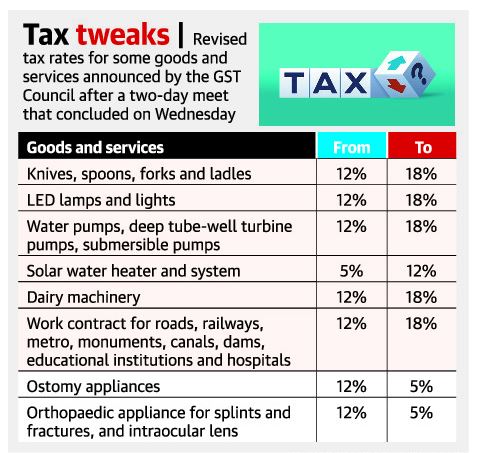
    The Goods and Services Tax (GST) Council has decided to hike and lower GST on certain commodities.

    What is the news?

    • From July 18, tax hikes will kick in for over two dozen goods and services, ranging from unbranded food items, curd and buttermilk to low-cost hotels, cheques and maps.
    • Tax rates will be lowered for about half-a-dozen goods and services, including ropeways and truck rentals where fuel costs are included.
    • It scrapped GST for items imported by private vendors for use by defence forces.

    What is GST?

    • GST launched in India on 1 July 2017 is a comprehensive indirect tax for the entire country.
    • It is charged at the time of supply and depends on the destination of consumption.
    • For instance, if a good is manufactured in state A but consumed in state B, then the revenue generated through GST collection is credited to the state of consumption (state B) and not to the state of production (state A).
    • GST, being a consumption-based tax, resulted in loss of revenue for manufacturing-heavy states.

    What are GST Slabs?

    • In India, almost 500+ services and over 1300 products fall under the 4 major GST slabs.
    • There are five broad tax rates of zero, 5%, 12%, 18% and 28%, plus a cess levied over and above the 28% on some ‘sin’ goods.
    • The GST Council periodically revises the items under each slab rate to adjust them according to industry demands and market trends.
    • The updated structure ensures that the essential items fall under lower tax brackets, while luxury products and services entail higher GST rates.
    • The 28% rate is levied on demerit goods such as tobacco products, automobiles, and aerated drinks, along with an additional GST compensation cess.

    Why rationalize GST slabs?

    • From businesses’ viewpoint, there are just too many tax rate slabs, compounded by aberrations in the duty structure through their supply chains with some inputs are taxed more than the final product.
    • These are far too many rates and do not necessarily constitute a Good and Simple Tax.
    • Multiple rate changes since the introduction of the GST regime in July 2017 have brought the effective GST rate to 11.6% from the original revenue-neutral rate of 15.5%.
    • Merging the 12% and 18% GST rates into any tax rate lower than 18% may result in revenue loss.

    Haven’t GST revenues been hitting new records?

    • Yes, they have – GST revenues have scaled fresh highs in three of the first four months of 2022, going past ₹1.67 lakh crore in April.
    • But there is another key factor — the runaway pace of inflation.
    • Wholesale price inflation, which captures producers’ costs, has been over 10% for over a year and peaked at 15.1% in April.
    • Inflation faced by consumers on the ground has spiked to a near-eight year high of 7.8% in April.
    • The rise in prices was the single most important factor for higher tax inflows along with higher imports.


    UPSC 2023 countdown has begun! Get your personal guidance plan now! (Click here)

  • Primary and Secondary Education – RTE, Education Policy, SEQI, RMSA, Committee Reports, etc.

    Performance Grading Index for Districts (PGI-D)

    Note4Students

    From UPSC perspective, the following things are important:

    Prelims level: PGI-D

    Mains level: Not Much

    The Ministry of Education has released the Performance Grading Index for Districts (PGI-D) for 2019 which studied 83 indicators grouped in six categories.

    What is PGI-D?

    • The 83-indicator-based PGI for District (PGI-D) has been designed to grade the performance of all districts in school education.
    • The data is filled by districts through an online portal.
    • The indicator-wise PGI score shows the areas where a district needs to improve.
    • The PGI-D structure comprises a total weightage of 600 points across 83 indicators.
    • They are grouped under 6 categories, viz., Outcomes, Effective Classroom Transaction, Infrastructure Facilities & Students’ Entitlements, School Safety & Child Protection, Digital Learning, and Governance Process.
    • These categories are outcomes, effective classroom transaction, infrastructure facilities and student’s entitlements, school safety and child protection, digital learning and governance process.

    How does the grading scale works?

    • The PGI-D grades the districts into 10 grades with the highest achievable grade being ‘Daksh’, which is for districts scoring more than 90% of the total points in that category or overall.
    • ‘Utkarsh’ category is for districts with score between 81-90%, followed by ‘Ati-Uttam’ (71-80%), ‘Uttam’ (61-70%), ‘Prachesta-I’ (51-60%), ‘Prachesta-II’ (41-50%) and ‘Pracheshta III’ (31-40%).
    • The lowest grade in PGI-D is called ‘Akanshi-3’ which is for scores up to 10% of the total points.

    Performance of the states

    • Rajasthan’s Sikar is the top performer, followed by Jhunjhunu and Jaipur.
    • The other States whose districts have performed best are Punjab with 14 districts in ‘Ati-uttam’ grade (scoring 71-80% on a scale of 100).
    • It followed by Gujarat and Kerala with each having 13 districts in this category.
    • However, there are 12 States and UTs which do not have even a single district in the ‘Ati-uttam’ and ‘Uttam’ categories and these include seven of the eight States from the North East region.

    Significance

    • The PGI-D will reflect the relative performance of all the districts on a uniform scale which encourages them to perform better.
    • It is expected to help the state education departments to identify gaps at the district level and improve their performance in a decentralized manner.


    UPSC 2023 countdown has begun! Get your personal guidance plan now! (Click here)

  • Food Safety Standards – FSSAI, food fortification, etc.

    Tamil Nadu tops State Food Safety Index (SFSI)

    Note4Students

    From UPSC perspective, the following things are important:

    Prelims level: State Food Safety Index (SFSI)

    Mains level: Food safety

    Tamil Nadu topped the State Food Safety Index (SFSI) this year.

    Food safety has been in news this year quite frequent. Do make a note of following – Recommended Dietary Allowance (RDA), Red Octagon, Eat Right Movement, Food Safety Mitra etc.

    State Food Safety Index (SFSI)

    • FSSAI has developed State Food Safety Index to measure the performance of states on various parameters of Food Safety.
    • This index is based on the performance of State/ UT on five significant parameters set by the Health Ministry, namely
    1. Human Resources and Institutional Data
    2. Compliance
    3. Food Testing – Infrastructure and Surveillance
    4. Training & Capacity Building and
    5. Consumer Empowerment
    • The Index is a dynamic quantitative and qualitative benchmarking model that provides an objective framework for evaluating food safety across all States/UTs.

    Highlights of the 2022 Report

    • Tamil Nadu is followed by Gujarat and Maharashtra. Among the smaller States, Goa stood first, followed by Manipur and Sikkim.
    • Among the Union Territories, Jammu and Kashmir, Delhi and Chandigarh secured the first, second and third ranks.

    Back2Basics: Food Safety and Standards Authority of India (FSSAI)

    • The FSSAI is an autonomous body established under the Ministry of Health & Family Welfare, Government of India.
    • It has been established under the Food Safety and Standards Act, 2006 which is a consolidating statute related to food safety and regulation in India.
    • It is responsible for protecting and promoting public health through the regulation and supervision of food safety.
    • It is headed by a non-executive Chairperson, appointed by the Central Government, either holding or has held the position of not below the rank of Secretary to the Government of India.


    UPSC 2023 countdown has begun! Get your personal guidance plan now! (Click here)
  • Health Sector – UHC, National Health Policy, Family Planning, Health Insurance, etc.

    Highlights of the National Family Health Survey (NFHS) 5 Part: II

    Note4Students

    From UPSC perspective, the following things are important:

    Prelims level: NFHS and other survey mentioned

    Mains level: Read the attached story

    The Total Fertility Rate (TFR), the average number of children per woman, has further declined from 2.2 to 2.0 at the national level between National Family Health Survey (NFHS) 4 and 5.

    What is NFHS?

    • The NFHS is a large-scale, multi-round survey conducted in a representative sample of households throughout India.
    • The IIPS is the nodal agency, responsible for providing coordination and technical guidance for the NFHS.
    • NFHS was funded by the United States Agency for International Development (USAID) with supplementary support from United Nations Children’s Fund (UNICEF).
    • The First National Family Health Survey (NFHS-1) was conducted in 1992-93.

    Objectives of the NFHS

    The survey provides state and national information for India on:

    • Fertility
    • Infant and child mortality
    • The practice of family planning
    • Maternal and child health
    • Reproductive health
    • Nutrition
    • Anaemia
    • Utilization and quality of health and family planning services

    Modifications in NFHS 5

    NFHS-5 includes new focal areas that will give requisite input for strengthening existing programmes and evolving new strategies for policy intervention. The areas are:

    • Expanded domains of child immunization
    • Components of micro-nutrients to children
    • Menstrual hygiene
    • Frequency of alcohol and tobacco use
    • Additional components of non-communicable diseases (NCDs)
    • Expanded age ranges for measuring hypertension and diabetes among all aged 15 years and above.

    Highlights of the NFHS 5 Part-II

    (a) Fertility Rate

    • There are only five States — Bihar (2.98), Meghalaya (2.91), Uttar Pradesh (2.35), Jharkhand (2.26) Manipur (2.17) —which are above replacement level of fertility of 2.1.

    (b) Institutional Births

    • The institutional births increased from 79% to 89% across India and in rural areas around 87% births being delivered in institutions and the same is 94% in urban areas.
    • As per results of the NFHS-5, more than three-fourths (77%) children aged between 12 and 23 months were fully immunised, compared with 62% in NFHS-4.
    • The level of stunting among children under five years has marginally declined from 38% to 36% in the country since the last four years.
    • Stunting is higher among children in rural areas (37%) than urban areas (30%) in 2019-21.

    (c) Decision making

    • The extent to which married women usually participate in three household decisions (about health care for herself; making major household purchases; visit to her family or relatives) indicates that their participation in decision-making is high, ranging from 80% in Ladakh to 99% in Nagaland and Mizoram.
    • Rural (77%) and urban (81%) differences are found to be marginal.
    • The prevalence of women having a bank or savings account has increased from 53% to 79% in the last four years.

    (d) Rise in obesity

    • Compared with NFHS-4, the prevalence of overweight or obesity has increased in most States/UTs in NFHS-5.
    • At the national level, it increased from 21% to 24% among women and 19% to 23% among men.
    • More than a third of women in Kerala, Andaman and Nicobar Islands, AP, Goa, Sikkim, Manipur, Delhi, Tamil Nadu, Puducherry, Punjab, Chandigarh and Lakshadweep (34-46 %) are overweight or obese.


    Also read

    National Family Health Survey- 5 Part: I


    UPSC 2023 countdown has begun! Get your personal guidance plan now! (Click here)

  • Monetary Policy Committee Notifications

    RBI surprises with 40 bps rate increase in Repo Rate

    Note4Students

    From UPSC perspective, the following things are important:

    Prelims level: Repo Rate

    Mains level: Inflation targetting by MPC

    The Reserve Bank of India (RBI), in a sudden move, raised the repo rate by 40 basis points (bps) to 4.4% citing inflation that was globally rising alarmingly and spreading fast.

    Why in news?

    • The repo rate increase was the first since August 2018.
    • The MPC retained its ‘accommodative’ policy stance even as it focuses on withdrawal of accommodation to keep inflation within the target range while supporting growth.
    • Due to Ukraine War, persistent and spreading inflationary pressures are becoming more acute with every passing day.

    Hues over the REPO spike

    • The move — to have such a meeting and to raise the interest rates — is, at two different levels, both surprising and obvious.
    • It is surprising because the RBI’s MPC meets once every two months — and the meeting this week was not scheduled.

    What is Repo Rate?

    • Repo rate is the rate at which the central bank of a country (Reserve Bank of India in case of India) lends money to commercial banks in the event of any shortfall of funds.
    • It is used by monetary authorities to control inflation.
    • In the event of inflation, central banks increase repo rate as this acts as a disincentive for banks to borrow from the central bank.
    • This ultimately reduces the money supply in the economy and thus helps in arresting inflation.

    How does the repo dynamics work?

    • When there is a shortage of funds, commercial banks borrow money from the central bank which is repaid according to the repo rate applicable.
    • The central bank provides these short terms loans against securities such as treasury bills or government bonds.
    • This monetary policy is used by the central bank to control inflation or increase the liquidity of banks.
    • The government increases the repo rate when they need to control prices and restrict borrowings.
    • An increase in repo rate means commercial banks have to pay more interest for the money lent to them and therefore, a change in repo rate eventually affects public borrowings such as home loan, EMIs, etc.
    • From interest charged by commercial banks on loans to the returns from deposits, various financial and investment instruments are indirectly dependent on the repo rate.

    What is accommodative stance of policy?

    • Accommodative monetary policy is when central banks expand the money supply to boost the economy. Monetary policies that are considered accommodative include lowering the Federal funds rate.
    • These measures are meant to make money less expensive to borrow and encourage more spending.

    What triggered the RBI to take sudden decision?

    • Inflation has been rising for over two years: By law, the RBI is supposed to target retail inflation at 4%. Inflation constantly above 4% since last year.
    • Inflation has not been “transitory”: The reasons for high inflation have tended to change over the months due to wide range of reasons like war, crude oil prices rise, taxes on fuels etc.
    • Spike in crude oil prices is not new: The RBI has pointed to high crude oil prices in the wake of the Ukraine war, as one of the key reasons for high inflation in India.
    • High core inflation: The core inflation which is essentially the inflation rate stripped of the effect of fuel and food prices has been rising up. This is more worrisome for RBI since it cannot be altered overnight.
    • Monetary policy has lags. RBI waited too long: If the RBI wanted to contain inflation in May, it should have acted in February or at least in April. Raising rates right now may not bring down the inflation rate immediately.

    Try this PYQ from CSP 2020:

    Q.If the RBI decides to adopt an expansionist monetary policy, which of the following it would NOT do?

    1. Cut and optimize the statutory liquidity ratio
    2. Increase the Marginal Standing Facility Rate
    3. Cut the Bank Rate and Repo Rate

    Select the correct answer using the code given below:

    (a) 1 and 2 only

    (b) 2 only

    (c) 1 and 3 only

    (d) 1, 2 and 3


    Post your answers here:


    Back2Basics: Monetary Policy Committee (MPC)

    • The Monetary Policy Committee (MPC) is a committee of the RBI, which is entrusted with the task of fixing the benchmark policy interest rate (repo rate) to contain inflation within the specified target level.
    • The RBI Act, 1934 was amended by Finance Act (India), 2016 to constitute MPC to bring more transparency and accountability in fixing India’s Monetary Policy.
    • The policy is published after every meeting with each member explaining his opinions.
    • The committee is answerable to the Government of India if the inflation exceeds the range prescribed for three consecutive months.
    • Suggestions for setting up a MPC is not new and goes back to 2002 when YV Reddy committee proposed to establish an MPC, then Tarapore committee in 2006, Percy Mistry committee in 2007, Raghuram Rajan committee in 2009 and then Urjit Patel Committee in 2013.

    Composition and Working

    • The committee comprises six members – three officials of the RBI and three external members nominated by the Government of India.
    • The meetings of the Monetary Policy Committee are held at least 4 times a year and it publishes its decisions after each such meeting.
    • The Governor of RBI is the chairperson ex officio of the committee.
    • Decisions are taken by a majority with the Governor having the casting vote in case of a tie.
    • They need to observe a “silent period” seven days before and after the rate decision for “utmost confidentiality”.


    UPSC 2023 countdown has begun! Get your personal guidance plan now! (Click here)

  • Coronavirus – Health and Governance Issues

    Civil Registration System Report, 2020

    Note4Students

    From UPSC perspective, the following things are important:

    Prelims level: Civil Registration System (CRS)

    Mains level: Total covid related fatality in India

    The Civil Registration System (CRS) report 2020 was released at least a month before its schedule.

    What is Civil Registration System (CRS)?

    • The CRS collates data on all births and deaths registered with local authorities across India.
    • The CRS report is released by the Registrar-General of India.
    • It releases its report around 18 months after a year ends.

    Significance of the 2020 Report

    • The 2020 report was released at least a month before schedule.
    • Such data can be of significance during a pandemic as possible covid-19 deaths may not have been categorized as such in official records.
    • The CRS can help us reach an estimate by using the “excess deaths” approach.
    • It is the difference between the total number of deaths registered in a pandemic year and the number of deaths that normally take place in a year.

    Why was the data released ahead of schedule?

    • India and the WHO are locked in a tussle over the latter’s excess death estimates that would give a sense of pandemic-linked fatalities globally in 2020-21.
    • India has reportedly stalled WHO’s efforts to release the data, claiming flawed methodology.
    • WHO is set to release its estimates today, a possible reason that India released CRS data early.

    Why is India contesting the WHO approach?

    • One key objection by India is that WHO has classified it as a Tier 2 country and hence used a different modelling process to estimate excess deaths from that used for Tier 1 countries.
    • WHO says all countries that made available their full all-cause mortality data for the pandemic period were classified as Tier 1.
    • India is in Tier 2 because it didn’t share official data with WHO.
    • Hence, alternative data and modelling methods had to be adopted, adjusting for factors such as income levels, covid-19 reporting rates, and test positivity rates.

    What does the 2020 data show?

    (a) Covid deaths

    • The CRS report for 2020 has recorded deaths of 8.12 million Indians, 6.2% more than 2019.
    • Normally, an unusual increase in deaths would be linked to the pandemic. However, in India, not all deaths are registered.
    • Thus, a rise could simply be because of more families getting deaths registered.
    • The CRS for 2021, which saw more Covid deaths, may not be out until next year.

    (b) Improvements in sex ratio

    • Highest Sex Ratio at Birth (SRB) based on registered events has been reported by Ladakh (1,104) followed by Arunachal Pradesh (1,011), A&N Islands (984), Tripura (974), and Kerala (969).
    • The lowest sex ratio was reported by Manipur (880), followed by Dadra and Nagar Haveli and Daman and Diu (898), Gujarat (909), Haryana (916) and Madhya Pradesh (921).


    UPSC 2023 countdown has begun! Get your personal guidance plan now! (Click here)