💥UPSC 2026, 2027, 2028 UAP Mentorship (March Batch) + Access XFactor Notes & Microthemes PDF

Type: Explained

  • Trade Sector Updates – Falling Exports, TIES, MEIS, Foreign Trade Policy, etc.

    China’s share in India’s industrial goods imports jump to 30% from 21% in last 15 years: GTRI

    Note4Students

    From UPSC perspective, the following things are important:

    Prelims level: Trends in Bilateral Trades;

    Mains level: India- China Bilateral Trade;

    Why in the News?

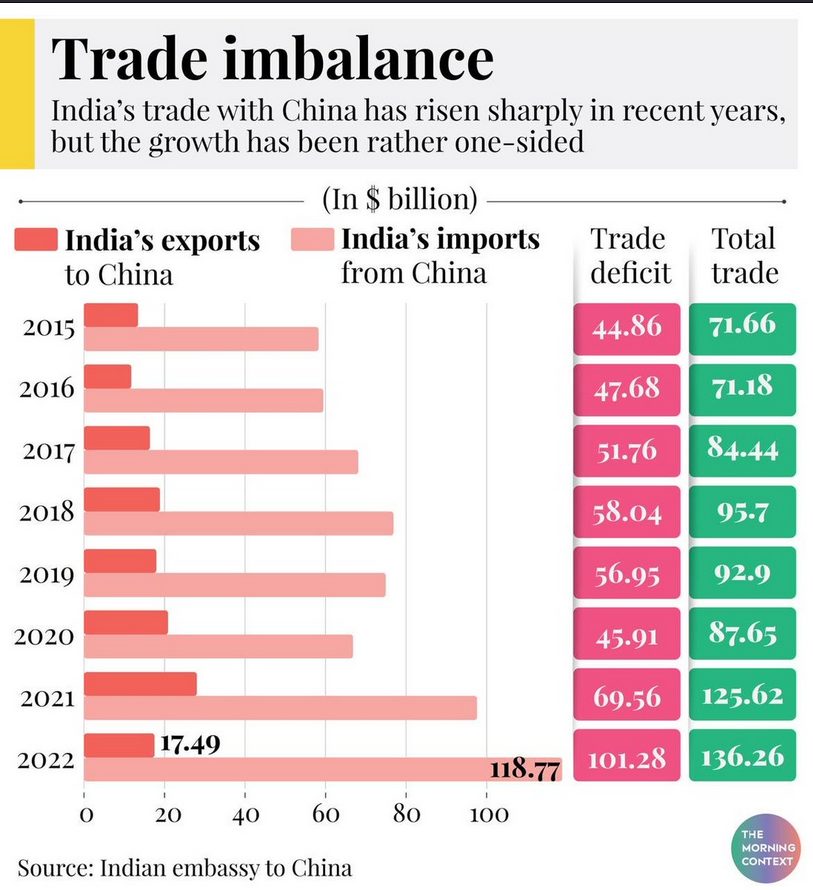
    India’s imports from China crossed $101 billion in 2023-24 from about $70 billion in 2018-19, and the country’s share of India’s industrial goods imports has risen from 21% to 30% over 15 years, according to a report by the Global Trade Research Initiative (GTRI).

    • The data shows, it’s resulting in a cumulative trade deficit exceeding $387 Billion in the last 5 years, which is an alarming situation for the Indian government.
    What is meant by Trade Deficit?

    • A trade deficit refers to a situation where the country’s imports exceed the receipts from its exports. A trade deficit arises in the course of international trade when the payments for imports exceed the receipts from export trade.
    • A trade deficit is also referred to as a negative balance of trade.
    • The concerns arising due to this deficit include pressure on external payments and on the currency value of a country. Countries often alter import and export policies, curbing imports or increasing import duties on certain goods due to this.
    • They also encourage exports and consumption of indigenous goods.

    India’s Industrial Imports from China:

    • Electronics and Telecom Sector: During April-January 2023-24, India’s import value for electronics, telecom, and electrical products was $67.8 billion, with China contributing $26.1 billion. (38.4% of the total imports)
    • Machinery Sector: China contributed 39.6% of India’s imports in this category. This highlights China’s essential role as a supplier of machinery to India.
    • Chemical and Pharmaceutical Sector: India’s chemical and pharmaceutical imports were $54.1 billion, with $15.8 billion coming from China (29.2% of the total).
    • MSMEs sector: Products like mobiles and data processing units, are imported by Indian MSMEs. These imports could potentially be produced domestically, highlighting gaps in India’s industrial capabilities.

    Current Trade Observations concerning China and other countries:

    • Rising Trade Deficit with China: India’s exports to China have stagnated at around $16 billion annually (from 2019 to 2024), while imports from China surged from $70.3 billion in 2018-19 to over $101 billion in 2023-24.
    • Growth Rate of Imports: China’s share in India’s industrial product imports increased from 21% to 30% over the last 15 years. China’s exports to India grew 2.3 times faster than India’s total imports from all other countries.
    • Diverse Product Imports: Chinese firms are increasingly entering the Indian market, which is expected to accelerate the import of industrial products from China. India’s imports span high to low-technology items, like smartphones, electronics, electric vehicles, and solar energy.
    • Strategic Concerns: The growing trade deficit and dependence on China have profound strategic implications, affecting both economic and national security dimensions.

    Way Forward:

    • Supply chain diversification: India must focus on diversifying its supply chains and reducing dependency on single-country imports, especially from geopolitical competitors like China.
    • Boosting R&D: Increase investment in research and development for electronics, semiconductors, and machinery to foster innovation and improve domestic production capabilities.
    • Incentivizing Production: Provide tax incentives, subsidies, and grants to local manufacturers of electronics, data processing units, and semiconductor devices to encourage production and reduce import dependency.

    Mains PYQ:

    Q China is using its economic relations and positive trade surplus as tools to develop potential military power status in Asia’, In the light of this statement, discuss its impact on India as her neighbor. (UPSC IAS/2017)

  • Women empowerment issues – Jobs,Reservation and education

    Menstrual hygiene in Indian prisons | Explained

    Note4Students

    From UPSC perspective, the following things are important:

    Mains level: Issues associated with the Indian Prison System;

    Why in the News?

    Despite improvements in menstrual hygiene, female prisoners in India face neglect, highlighting systemic biases and unmet basic needs like sanitary products and proper facilities.

    About NFHS Recently Conducted Survey:

    • The 5th round of the National Family Health Survey (NFHS 2019-2020) revealed that approximately 80% of young women aged 15-24 years are now using safe menstrual hygiene products.
    • This survey highlights a positive shift in menstrual hygiene management across India, particularly in urban areas and among certain demographics.

    About the NCRB Data:

    • According to the National Crime Records Bureau (NCRB), there are 23,772 women in Indian prisons. Of these, 77% are in the reproductive age group (18-50 years) and are likely to be regular menstruators.
    • The availability of sanitary napkins has been inconsistent across different prisons, and the quality has often been unsatisfactory.
    • Many States have not implemented provisions from “the 2016 Model Prison Manual”, such as supplying adequate water and washroom facilities for female prisoners.
    • Overcrowding and poor socio-economic conditions further exacerbate the struggle of incarcerated women to secure basic necessities during menstruation.

    BACK2BASICS: National Crime Records Bureau (NCRB)

    • NCRB was set up in 1986 to serve as a repository of information on crime and criminals. Its establishment was based on the recommendations of the Tandon Committee, the National Police Commission (1977-1981), and the Ministry of Home Affairs Taskforce (1985).
    • It is part of the Ministry of Home Affairs (MHA) and is headquartered in New Delhi.
    • NCRB acts as a “national warehouse” for the fingerprint records of both Indian and foreign criminals. It assists in locating interstate criminals through fingerprint searches.

    About the National Menstrual Hygiene Policy:

    • In 2023, India formulated this policy to recognize menstruation as a natural process requiring meaningful attention. The policy aims to ensure equity in the safe and dignified management of menstrual hygiene.
    • It prioritises ensuring that all menstruating individuals, regardless of their socioeconomic status and geographical location, have equal opportunities to access and manage their menstruation safely and hygienically.
    • The Ministry of Home Affairs, which influences menstrual hygiene management in prisons, is overlooked as a critical stakeholder in the policy.

    The key challenge of the policy is that it identifies prisoners as a target population with compromised access to menstrual hygiene facilities but lacks a concrete action plan to enhance menstrual hygiene management in prisons.

    Other Government Initiatives to Improve Menstrual Health and Hygiene (MHH) in India

    • Integration of MHH into ASHA’s Role (2005-2010): The government integrated menstrual health and hygiene into the responsibilities of Accredited Social Health Activists (ASHA) as part of the National Rural Health Mission.
    • Menstrual Hygiene Scheme (MHS) Launched (2010): India initiated the Menstrual Hygiene Scheme (MHS) to distribute sanitary napkins to young girls.
    • Rashtriya Kishor Swasthya Karyakram Programme (2010): This program, under the Reproductive, Maternal, Newborn, Child and Adolescent Health scheme, increased awareness and access to sanitary pads.
    • Menstrual Hygiene Management Guidelines Issued (2011-2015): In 2011, the Ministry of Health and Family Welfare issued menstrual hygiene management guidelines. Additional directions were issued by the Ministry of Drinking Water and Sanitation in 2015.
    • Nirmal Bharat Yatra and Samagra Shiksha Abhiyan (2012): The Nirmal Bharat Yatra, a flagship sanitation program, included MHH as an integral aspect of its agenda. Simultaneously, other similar programs under the Samagra Shiksha Abhiyan began, including initiatives to promote sanitary napkin vending machines and incinerators for safe disposal.
    • WASH targets for prisons:

    Way Forward:

    • Ensure Basic Standards of Menstrual Hygiene: The Indian government must guarantee that basic standards of menstrual hygiene for women in captivity are met consistently across all prisons.
    • Implement Model Prison Manual 2016: The government must ensure that all States adhere to the recommendations outlined in the manual, which includes provisions for adequate water and washroom facilities for female prisoners.

    Mains PYQ:

    Q In order to enhance the prospects of social development, sound and adequate health care policies are needed particularly in the fields of geriatric and maternal health care. Discuss. (UPSC IAS/2020)

  • Forest Conservation Efforts – NFP, Western Ghats, etc.

    The controversy over eucalyptus planting in Kerala | Explained

    Note4Students

    From UPSC perspective, the following things are important:

    Prelims level: Species in News; Eucalyptus;

    Mains level: Conservation and Mitigation Strategies;

    Why in the news?

    The Kerala state government permitted Kerala Forest Development Corporation (KFDC) to plant eucalyptus for financial reasons in 2024-2025. Environmentalists objected, citing forest impact and potential human-animal conflicts.

    Reasons for Allowing KFDC to Plant Eucalyptus Trees:

    • Financial Sustenance: KFDC was permitted to plant eucalyptus trees to support its financial viability.
    • Existing Plantations: KFDC manages around 7,000 hectares of plantations, including eucalyptus, which contribute to its revenue generation.
    • Rotation Age: Plantations like eucalyptus have specific rotation ages for harvesting, ensuring a continuous cycle of revenue generation.

    Significance of Eucalyptus

    • Timber and Fuel: Eucalyptus wood is extensively used in Australia as fuel and for building construction, fencing, and other timber applications.
    • Paper and Pulpwood: The bark of many eucalyptus species is used in papermaking and tanning, while the wood is used for pulpwood production.
    • Eucalyptus Oil: The leaves of many eucalyptus species contain aromatic oils, which are used for various purposes such as:
      • Medicinal Uses: Eucalyptus oil is used in expectorants and inhalants to relieve respiratory issues like asthma and bronchitis.
      • Insect Repellent: The oil is used as a natural insect repellent.
      • Antimicrobial Activity: Eucalyptus oil has antimicrobial properties, making it effective against bacteria and fungi

    Why were environmentalists and social activists against the order?

    • Ecological Impact: Environmentalists raised concerns about the adverse effects of eucalyptus plantations on natural forests and ecosystems.
    • Human-Animal Conflicts: The proliferation of invasive species like eucalyptus was linked to increased human-wildlife conflicts, as animals ventured into human habitats in search of food due to habitat depletion.
    • Contravention of Eco-Restoration Policy: Activists argued that permitting eucalyptus plantations contradicted the state’s eco-restoration policy, which aimed to phase out exotic species and replace them with natural forests by 2024.
    • Invasive Species Management: The order was seen as undermining efforts to eradicate invasive species and mitigate their damaging effects on natural habitats and ecosystems.

    Government Initiatives for Plant Conservation:

    • The National Bureau of Plant Genetic Resources (NBPGR) in India operates seed banks to conserve crop diversity and wild plant species.
    • National Afforestation Programme (NAP) has been implemented since 2000 for the afforestation of degraded forest lands. It is being implemented by the MoEFCC.


    Conclusion: The controversy over eucalyptus planting in Kerala reflects the balance between financial sustainability and ecological concerns. While eucalyptus offers economic benefits, it also poses ecological risks and challenges to conservation efforts.

    Mains PYQ: 

    Q Examine the status of forest resources of India and its resultant impact on climate change. (UPSC IAS/2020)

  • Housing for all – PMAY, etc.

    A door to a housing scheme, tribals find hard to open

    Note4Students

    From UPSC perspective, the following things are important:

    Prelims level: PM-JANMAN Scheme

    Mains level: Government initiatives and Programs; Technical Challenges in the implementation; PM JANMAN Housing Scheme;

    Why in the News?

    The PM JANMAN presents a new opportunity to transform the lives of India’s Particularly Vulnerable Tribal Groups.

    About PVTGs:

    India has numerous Adivasi groups, with 75 identified as Particularly Vulnerable Tribal Groups (PVTGs). These comprise around 14.6 lakh households and live in scattered, remote, and often inaccessible areas. Their livelihoods rely on methods and tools that predate agriculture. PVTGs have low literacy rates, economic backwardness, and stagnant populations.

    In 1960-61, the Dhebar Commission identified disparities among Scheduled Tribes, leading to the creation of the “Primitive Tribal Groups” (PTG) category.
    In 2006, this category was renamed Particularly Vulnerable Tribal Groups (PVTGs).

    Government Initiatives:

    • Pradhan Mantri PVTG Development Mission. Announced for the fiscal year 2023-24 to improve socio-economic conditions of PVTGs.
    • Pradhan Mantri Janjati Adivasi Nyaya Maha Abhiyan (PM-JANMAN) launched in November 2023.
    •  Pradhan Mantri Adi Adarsh Gram Yojana, Integrated Tribal Development Project (ITDP) and Tribal Sub-Plan (TSP).

    PM JANMAN Objectives:

    • Provide essential services to PVTGs, including safe housing, clean drinking water, and sanitation.
    • The largest Direct Benefit Transfer (DBT) scheme in the initiative.
    • Aims to reach 4.90 lakh PVTG households by 2026.
    • Households to receive ₹2.39 lakh each in three instalments.

    Technical Challenges in the PM JANMAN Housing Scheme

    App Functionality and Data Gathering:

    • Data Collection Areas: The ‘Awaas+’ app records geographical locations, household profiles with geo-tagging, and bank account details for cash transfers.
    • Mandatory Jobcard: Registration requires a jobcard, but many have been deleted, affecting PVTGs’ eligibility.

    Jobcard Issues:

    • Deletion of Jobcards: Widespread deletion of over eight crore MGNREGA jobcards in the past two years has led to many PVTGs being ineligible for the scheme.
    • Jobcard Misuse: Cases of fraudulent registrations with someone else’s job cards further complicate the registration process.

    Village List Discrepancies:

    • Inconsistent Data: The pre-populated list of villages in the app does not match the MGNREGA Management Information System (MIS). For example, the app lists 22 villages while the MIS lists 31 villages for ‘Vanjari’ Panchayat in Andhra Pradesh, causing confusion.

    Aadhaar-related Issues:

    • Name Matching: The app requires names as per Aadhaar records but does not guide what to do if Aadhaar is absent.
    • PVTG Identification: The app does not explicitly identify PVTGs, using a default ‘ST’ option, leading to non-PVTG registrations.

    Certification Issues:

    • Local Certification: Ineligible registrations prompt local officials to ask PVTGs for certification from sarpanches/mukhiyas.
    • Conflict of Interest: Non-PVTG sarpanches/mukhiyas in mixed communities may act against the interests of PVTGs, complicating the certification process.

    Geo-tagging Problems:

    • Network Issues: Geo-tagging required for planned construction locations faces chaos due to poor network connectivity, hindering accurate data capture.

    Bank Selection Complexity:

    • Overwhelming Options: The app’s dropdown lists for banks are excessively long. For example, selecting ‘Commercial Bank’ shows over 300 options, and choosing ‘State Bank of India’ in Andhra Pradesh presents over 500 branches, adding unnecessary complexity for both PVTGs and officials.

    Opportunity/Way Forward for PM JANMAN Housing Scheme

    • Simplify App Interface: Update the ‘Awaas+’ app to have a more user-friendly interface and reduce unnecessary complexities, such as the long dropdown lists for banks.
    • Clear Guidelines for Aadhaar: Provide explicit instructions on what names to use in the absence of Aadhaar, ensuring all eligible PVTGs can register.
    • Verify Jobcard Authenticity: Introduce robust mechanisms to prevent fraudulent registrations using others’ jobcards.
    • Improve Network Infrastructure: Invest in better network infrastructure in remote areas to support the geo-tagging feature.

    Mains PYQ:

    Q Given the diversities among tribal communities in India, in which specific contexts should they be considered as a single category? (UPSC IAS/2022)

  • Health Sector – UHC, National Health Policy, Family Planning, Health Insurance, etc.

    How close is the World Health Organization to agreeing on pandemic response rules?

    Note4Students

    From UPSC perspective, the following things are important:

    Prelims level: WHO; Healthcare Initiatives;

    Mains level: Health Care; Convention on Tobacco Control; Global Health Rules;

    Why in the News?

    Health officials of the World Health Organization (WHO) aim to finalize over two years of negotiations on new pandemic response rules when they convene in Geneva next week.

    About the ‘Pandemic Treaty’

    • The pandemic treaty is a new legally binding agreement being negotiated to improve the global pandemic response. The treaty aims to address the shortcomings revealed during the COVID-19 pandemic, such as inequitable vaccine distribution.
    • Article 12, a critical and contentious part of the treaty, proposes reserving around 20% of tests, treatments, and vaccines for WHO distribution to poorer countries during emergencies.
    • The treaty would be the second major health accord after the 2003 Framework Convention on Tobacco Control.

    Convention n Tobacco Control

    • Govt. of India ratified the WHO Framework Convention on Tobacco Control (WHO FCTC) in 2004, the first-ever international public health treaty focusing on the global public health issue of tobacco control.
    • The FCTC is a legally binding treaty that requires countries bound by the treaty — or Parties to implement evidence-based measures to reduce tobacco use and exposure to tobacco smoke.

    How will Global Health Rules Change?

    • Updates to the existing International Health Regulations (IHR) include a new alert system for different risk assessments of outbreaks, replacing the current single-level emergency declaration.
    • A new “early action alert” stage will be introduced, along with a potential “pandemic emergency” category for the most severe health threats.
    • Obligations for countries: Strengthened obligations for countries to inform the WHO about public health events, changing the language from “may” to “should”.

    How do the countries view this pact?

    • Developed Countries
        • Wealthy countries are often cautious about sharing resources such as drugs and vaccines.
        • There is significant political pressure, especially from right-wing groups, fearing that the treaty could infringe on national sovereignty.
        • These countries are concerned about the financial implications, debating whether to set up a new fund or use existing resources like the World Bank’s $1 billion pandemic fund.
    • Underdeveloped Countries
      • Poorer countries emphasize the need for equitable access to treatments and vaccines, reflecting experiences of “vaccine apartheid” during the COVID-19 pandemic.
      • They advocate for stronger commitments from wealthier nations to support global health infrastructure and emergency response capabilities.

    Future Scope of the New IHR Rules and the Pandemic Accord (Treaty):

    • More robust framework: The IHR updates and the pandemic treaty has designed to complement each other, creating a more robust framework for global health emergencies.
    • Promotes cooperation: The new rules aim to ensure faster, more transparent information sharing, and better co-operation during health crises.
    • Next steps for treaty negotiations: Next week’s World Health Assembly will focus on planning the next steps for the Treaty Negotiations, with a full agreement unlikely to be reached immediately.
    • Defenses against future pandemics: The successful implementation of both the IHR updates and the pandemic treaty could significantly strengthen the world’s defenses against future pandemics, addressing gaps exposed by COVID-19.

    Conclusion: While there is a shared understanding of the treaty’s importance, countries’ views are shaped by their National interests, Financial concerns, and Political pressures, leading to complex and protracted negotiations.

    Mains PYQ:

    Q Critically examine the role of WHO in providing global health security during the Covid-19 pandemic. (UPSC IAS/2020)

  • Artificial Intelligence (AI) Breakthrough

    How Europe’s AI convention balances innovation and human rights | Explained

    Note4Students

    From UPSC perspective, the following things are important:

    Prelims level: Europe’s AI convention;

    Mains level: What is Europe’s AI convention?

    Why in the News?

    Global AI governance is becoming increasingly intricate, with countries employing diverse approaches. This shows that the Global treaties may face significant challenges despite widespread support.

    About the Council of Europe (COE)

    • The COE is an intergovernmental organization established in 1949. It currently has 46 member states, including the Holy See, Japan, and the U.S., alongside EU countries.
    • Aim: To uphold human rights, democracy, and the rule of law in Europe.

    What is Europe’s AI convention?

    • Europe’s AI convention, officially known as the Framework Convention on Artificial Intelligence and Human Rights, Democracy and the Rule of Law, represents a significant milestone in AI governance.
    • Adopted by the Council of Europe (COE) on May 17, this convention addresses the pressing need for comprehensive regulation of AI, particularly concerning its impact on human rights, democracy, and the rule of law.

    The scope of the Framework Convention on Artificial Intelligence and Human Rights, Democracy, and the Rule of Law encompasses:

    • It ensures that activities throughout the lifecycle of Artificial Intelligence (AI) systems align fully with Human Rights, Democracy, and the Rule of Law.
    • Consistent with the EU AI Act and the OECD’s definition, an AI system is defined as a machine-based system that generates outputs based on input to influence physical or virtual environments.

    Coverage:

    • Application by Parties: The convention applies to activities involving AI systems conducted by both public authorities and private actors acting on their behalf.
    • Addressing Risks: Parties are required to address risks and impacts from AI systems activities by private actors that are not covered under (a) in a manner consistent with the convention’s objectives.

    Difference Between a Framework Convention and a Protocol

    • Framework Convention: A legally binding treaty specifying broad commitments and objectives.Allows parties discretion in achieving objectives, adapting to their capacities and priorities.Example: Convention on Biological Diversity.
    • Protocol: Specific agreements are negotiated under a framework convention. Sets specific targets or detailed measures to achieve the broader objectives of the framework convention.Example: Cartagena Protocol on Biosafety under the Convention on Biological Diversity.

    Addressing National Security in the AI Convention

    • Exemptions for National Security: Articles 3.2, 3.3, and 3.4 provide broad exemptions for national security interests, research, development, testing, and national defense, excluding military AI applications from the convention’s scope.
    • Balancing Flexibility and Regulation: Article 3(b) allows parties some flexibility in applying the convention to the private sector, preventing total exemption but accommodating national security needs.
    • General Obligations: Articles 4 and 5 ensure the protection of human rights, democratic integrity, and the rule of law, requiring parties to address disinformation and deep fakes as part of their national security measures.
    • Scope for Further Action: Article 22 allows parties to exceed specified commitments, enabling additional measures to address national security concerns related to AI.

    Conclusion: The AI convention is essential because it reinforces existing human and fundamental rights within the context of AI applications, rather than creating new rights. It emphasizes the need for governments to uphold these rights and implement effective remedies and procedural safeguards.

    Mains PYQ:

    Q “The emergence of the Fourth Industrial Revolution (Digital Revolution) has initiated e-Governance as an integral part of government”. Discuss.(UPSC IAS/2020)

  • WTO and India

    India fighting pressure at WTO to allow ‘plurilateral pact’ on investment facilitation

    Note4Students

    From UPSC perspective, the following things are important:

    Prelims level: Plurilateral Agreement/Pact and WTO

    Mains level: India's Strong Stand against the IFD at WTO MC13;

    Why in the News?

    An official stated on Tuesday that India opposes a China-led proposal on investment facilitation at the WTO, arguing that it is a ‘non-trade’ issue beyond the global trade body’s mandate.

    About Plurilateral Agreement/Pact:

    • A plurilateral agreement is a trade agreement between more than two countries, but not necessarily encompass all members of a larger organization such as the World Trade Organization (WTO).
    • These agreements are binding only on the signatories and not on the entire membership of the organization under annexure-4 of the WTO.
    • They allow for deeper integration among interested parties without requiring full consensus, which can be difficult to achieve in larger multilateral frameworks.

    What is the China-led Investment Facilitation for Development Agreement (IFD)?

    • The IIFD Agreement is a proposed pact by China, with support from other countries, to streamline and facilitate foreign investment.
    • The main objectives of the IFD Agreement include:
      • Enhancing transparency of investment measures.
      • Streamlining and speeding up investment-related authorization procedures.
      • Promoting international cooperation, information sharing, and exchange of best practices.
      • Encouraging sustainable investment practices.
    • The proponents of the IFD argue that it would bring benefits to all WTO members, especially developing and least-developed countries, by creating a more predictable and transparent investment climate.

    India’s Strong Stand against the IFD at WTO MC13

    India has taken a firm stance against the inclusion of the IFD Agreement in the WTO framework for several reasons:

    • Investment is Not a Trade Issue: India argues that investment does not fall within the traditional purview of the WTO, which primarily focuses on trade issues. It points out that past Ministerial decisions have explicitly kept investment outside the WTO’s scope.
    • Sovereignty Concerns: A significant concern for India is the potential impact on its policy space. The IFD Agreement includes provisions that would require the government to consult with investors on policy matters, which India fears could undermine its ability to make sovereign decisions.
    • Lack of Consensus: India, along with South Africa, has highlighted the absence of a unanimous consensus among WTO members regarding the inclusion of the IFD as a plurilateral agreement. They argue that without exclusive consensus, it should not be brought onto the formal agenda.
    • Policy Autonomy: India is wary that the IFD Agreement’s requirements could constrain its autonomy in regulating investments to align with national development priorities and strategies.
    • Procedural Concerns: India contends that the issue should not have been part of the MC13 agenda and instead, should be discussed at the General Council, given the divisive nature of the proposal among WTO members.

    Conclusion: India’s opposition to the IFD Agreement at the WTO stems from a combination of concerns about preserving national sovereignty, adhering to established WTO boundaries regarding trade versus investment issues, and ensuring that any significant changes in the WTO framework are backed by broad-based consensus.

    Mains PYQ:

    Q The broader aims and objectives of WTO are to manage and promote international trade in the era of globalisation. But the Doha round of negotiations seems doomed due to differences between the developed and the developing countries.” Discuss in the Indian perspective. (UPSC IAS/2016)

  • Electoral Reforms In India

    SC refuses to issue Interim order on Voter data     

    Note4Students

    From UPSC perspective, the following things are important:

    Prelims level: Form 17C

    Mains level: Why did SC Refuse the request?

    Why in the news?

    On May 24, the Supreme Court rejected an [Association for Democratic Reforms (ADR)] NGO’s request for the Election Commission of India to upload authenticated, scanned, and legible copies of Form 17C, which details the booth-wise account of votes recorded after each phase of Lok Sabha elections.

    About the Application Filed by the Association for Democratic Reforms (ADR):

    • ADR sought an order directing the Election Commission of India (ECI) to upload authenticated, scanned, and legible copies of Form 17C, which shows the account of votes recorded booth-wise after each phase of polling in Lok Sabha elections.
    • ADR highlighted concerns regarding the delay in publishing final voter turnout data and the significant revisions in voter turnout percentages, which raised public suspicions and apprehensions about the accuracy of the data.

    Why did the Supreme Court refuse to issue interim order on voter data?

    • Timing of the Elections: The Supreme Court refused the plea on May 24, stating that the nation was in the middle of the General Elections and at the moment of the sixth phase of polling.
    • Diverting the attention: The court acknowledged the mammoth nature of the elections, which require vast human resources. Diverting the attention of the Election Commission during this critical period was not deemed appropriate.
    • Ongoing Petition: The interim relief sought by ADR was already part of a relief sought in a petition pending since 2019. Granting interim relief at this stage would effectively mean providing final relief in the ongoing writ petition.
    • Already decided in previous judgments: Senior advocate Maninder Singh for the EC argued that ADR’s application was unfounded.
      • It aimed at discrediting the EC, invoking the concept of constructive res judicata, implying that issues already decided in previous judgments (like EVM-VVPAT case) cannot be re-litigated in the middle of an election process.

    About the Role of the Judiciary During Election Polls:

    • Non-Interference During Elections: The Supreme Court emphasized that it should not interfere with the conduct of elections, which are managed by the Election Commission, during the polling process.
    • Enhancing Conduct of Polls: The judiciary’s role is to enhance the conduct of elections rather than interrupt or interfere in ongoing electoral processes.
    • Ground Reality Awareness: The judiciary must be conscious of the practical realities and complexities involved in the conduct of elections, ensuring that its actions do not disrupt the democratic process.

    Conclusion: The Supreme Court’s refusal to entertain ADR’s application highlights the judiciary’s cautious approach in intervening in electoral processes, especially during ongoing elections, to maintain the integrity and smooth functioning of the democratic exercise. The court seeks to balance the need for transparency and fairness in elections with the practicalities and operational challenges faced by the Election Commission.

    Mains PYQ: 

    Q To enhance the quality of democracy in India the Election Commission of India has proposed electoral reforms in 2016. What are the suggested reforms and how far are they significant to make democracy successful? (UPSC IAS/2017)

  • Electoral Reforms In India

    Reading the lower voter turnout scenario

    Note4Students

    From UPSC perspective, the following things are important:

    Prelims level: Election process in India;

    Mains level: NA

    Why in the News?

    Low voter turnout has been a notable trend in the initial phases of the ongoing 2024 general elections in India which reflects the shift in dynamics of democratic politics.

    American Scenario during Past Elections:

    • Conventional Wisdom: In the U.S., increased voter turnout is traditionally believed to benefit Democrats. For example, it was argued that higher voter turnout could have altered the outcome in favour of Hillary Clinton in states like Pennsylvania, Michigan, and Wisconsin.
      • According to Daron R. Shaw and John R. Petrocik in “The Turnout Myth” (2020), Hillary Clinton’s support did not significantly vary with voter turnout.
    • Class Cleavages: The advantage Democrats gained from higher turnout has decreased since 1960 due to the erosion of class-based voting patterns.
    • Simulation Studies: Research by Michael D. Martinez and Jeff Gill, and later by Spencer Goidel, Thiago Moreira, and Brenna Armstrong, used simulations to predict how changes in turnout would affect election outcomes. In recent studies, the impact of increased turnout on party advantage has varied over time.

    Perception About the Party’s Prospects:

    • High confidence in a party’s victory can deter voters from participating, thinking their vote is unnecessary.
    • Polls showing Bill Clinton’s like victory during the 1996 US Elections,  led to low voter turnout, with some Clinton supporters abstaining because they believed his win was assured.
    • While both Clinton and Dole supporters showed reluctance to vote due to predicted outcomes, it led to higher abstention to vote for them.

    Indian Scenario:

    • Class and Caste based: The 2019 Indian election saw a significant jump in the SC vote for the BJP, from 24% in 2014 to 34% in 2019, indicating a shift in voting patterns among Scheduled Castes. The Upper Caste Poor voted 49% BJP and 9% Congress, while Poor OBCs and Poor STs also followed a similar pattern. Poor Muslims, however, voted 8% BJP and 30% Congress.
    • Religion and Language-based: Religion is a significant factor, with political parties often indulging in communal propaganda to exploit religious sentiments. Language also plays a role, with parties arousing linguistic feelings to influence voter decisions.
    • Region and Personality based: Regionalism and sub-regionalism are important, with regional parties appealing to regional identities and sentiments. The charismatic personalities of party leaders, such as Jawaharlal Nehru, Indira Gandhi, Rajiv Gandhi, Atal Bihari Vajpayee, and Narendra Modi, have significantly influenced voter decisions.
    • Voter turnout trends in India have fluctuated, with no consistent correlation to incumbent advantage or disadvantage.
    • It is generally believed that higher voter turnout is detrimental to incumbents, though recent elections (2014 and 2019) saw high turnout with incumbent victories.
    • The voting patterns of habitual versus non-habitual voters likely vary significantly, influenced by the diverse and multi-party nature of Indian politics.
    • Decreased turnout in the 2024 general elections could be due to factors like weather, COVID-19, economic issues, and voter apathy, potentially impacting different parties in varied ways.

    Conclusion

    The role of non-habitual voters in Indian elections adds an element of unpredictability, making it difficult to draw firm conclusions until election results are finalised.

    Mains PYQ:

    Q Individual Parliamentarian’s role as the national law maker is on a decline, which in turn, has adversely impacted the quality of debates and their outcome. Discuss. (UPSC IAS/2019)

  • Cyber Security – CERTs, Policy, etc

    Southeast Asia origin of at least 45% cyber frauds targeting Indians

    Note4Students

    From UPSC perspective, the following things are important:

    Prelims level: Budapest Convention

    Mains level: Internal and External Security; Challenges of Cybersecurity in India

    Why in the News?

    Over 5,000 unemployed/employed Indians are reportedly trapped in Cambodia and forced to work into cyber fraud, resulting in an estimated Rs 500 crore loss in India over six months.

    Present Cybersecurity Status of India:

    • India has secured 10th rank in the Global Cybersecurity Index (GCI) 2020 by ITU (International Telecommunication Union) by moving up 37 places.
    • The US topped (1st), followed by the UK (United Kingdom) and Saudi Arabia tied for the second position together.
    • India secured the fourth position in the Asia Pacific region.

    What is the Budapest Convention? Is India a party to it?

    • The Council of Europe’s (CoE) Cybercrime Convention, commonly known as the Budapest Convention, was opened for signature in 2001 and came into force in 2004.
    • It is the only legally binding international multilateral treaty on cybercrime, coordinating investigations between nations and criminalizing specific cybercrime activities.
    • Budapest Convention is supplemented by a Protocol addressing xenophobia and racism committed through computer systems.
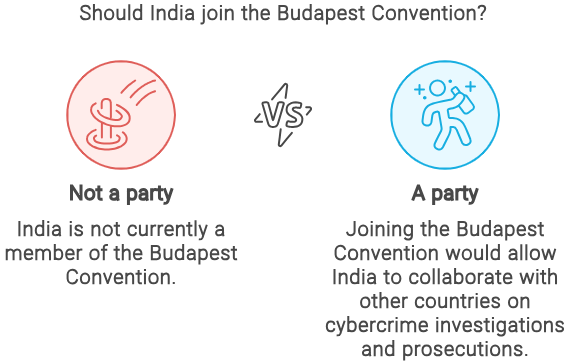
    • As of now, the Convention has 56 member countries, including the US and UK. However, India is not a party to the Budapest Convention.

    Indian Nationals vs. Organised Crimes in the South Asian Region:

    • Most web applications use the Chinese language to perform financial fraud, thereby not ruling out the Chinese connection.
    • Financial crimes such as digital arrest, stock market scams, investment scams, and romance or dating scams account for a loss of over ₹1,776 crores in 89,054 cases in the first four months of the year spurt in organized crime from Southeast Asia.
    • Numerous Indian nationals employed within a suspected fraudulent operation based in Sihanouk City, Cambodia, have voiced their grievances against their employers.

    What are the causes of the increase in Organized Financial Fraud?

    • Weak Prevention Measures:  Online Platforms in India at present account for 89% of all fraud incidents, with 40% of companies losing over $1 million.
    • Rapid Digitization and Payment Systems: After the pandemic, there was a massive shift, with the average Indian company now operating at least more than two online platforms in the normal course of business.
      • This has made it easier for fraudsters to operate anonymously and target a large number of victims.
    • Informal Investigation and Prosecution: India lacks the standardized data formats protocol system from the core banks itself. This makes it difficult to track devices and jurisdictional issues in interstate cases.
    • Lack of Deterrence: With only 26% of victims able to recover lost funds, fraudsters are encouraged to target individuals and organizations. The total value of frauds reported in 2021-22 was a staggering ₹60,414 crore.
    • Lack of Awareness: Sharing sensitive financial details with others or storing them insecurely it makes a common man vulnerable to fraud.

    What are the Initiatives taken by the government to tackle cyber crimes in India?

    • National Cyber Security Strategy 2020: Currently being formulated to enhance cyber awareness and strengthen cybersecurity through more rigorous audits.
    • Draft Personal Data Protection Bill, 2018: Based on the recommendations of the Justice BN Srikrishna Committee, this bill aims to secure citizens’ data.
    • Indian Cyber Crime Coordination Centre (I4C): Approved in October 2018, this initiative addresses all types of cybercrimes in a comprehensive and coordinated manner.
    • National Computer Emergency Response Team (CERT-In): Functions as the nodal agency for coordinating all cybersecurity efforts, emergency responses, and crisis management.
    • National Critical Information Infrastructure Protection Centre (NCIIPC): Established to protect and ensure the resilience of critical information infrastructure.

    Way Forward:

    • Update and Enforce Laws: Regularly update the Information Technology Act and other relevant laws to address emerging cyber threats and ensure strict enforcement.
    • Upgrade Cyber Defense Systems: Invest in advanced cybersecurity technologies and infrastructure to protect critical information systems.
    • Training Law Enforcement: Provide specialized training for law enforcement agencies to equip them with the skills needed to investigate and prosecute cybercrimes.
    • Collaborate with Industry: Foster partnerships between the government and private sector to share threat intelligence and best practices.

    Mains question for practice:

    Q Discuss the current challenges of cybersecurity in India, citing examples of recent trends in cybercrime. What measures have been taken by the Indian government to address these challenges? 15M

    Mains PYQ

    Q What are the different elements of cyber security? Keeping in view the challenges in cyber security, examine the extent to which India has successfully developed a comprehensive National Cyber Security Strategy.(UPSC IAS/2022)
