Why in the News
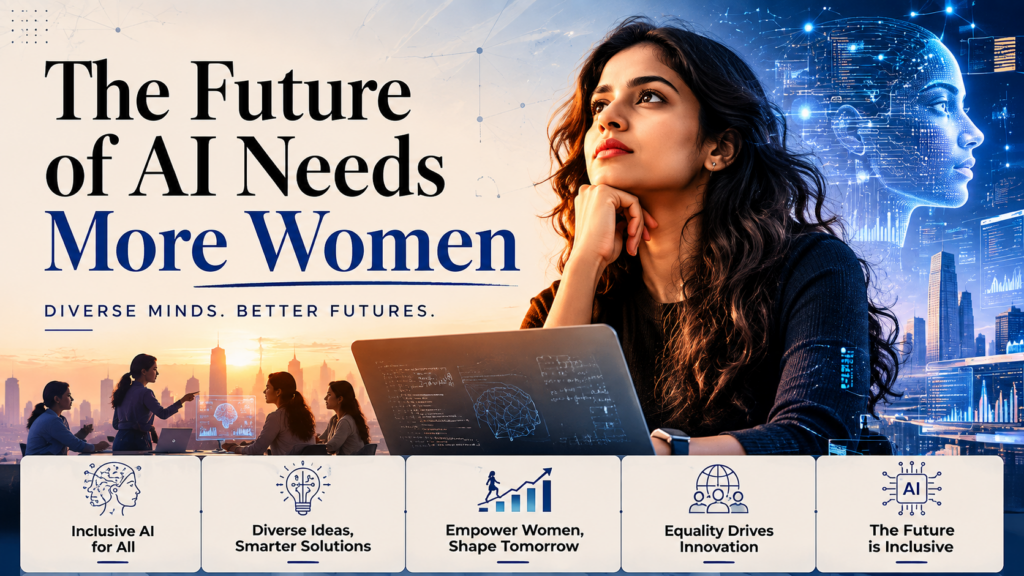
India ranks among the world’s leading artificial intelligence ready nations, powered by Digital Public Infrastructure and a large innovation ecosystem, while women fall from 43 percent of STEM graduates to 10 percent of senior AI leadership. Every artificial intelligence system begins with data and every dataset begins with people, so a pipeline that loses women at each stage produces systems that reproduce the inequality of the society they learn from.
What is the AI pipeline?
- Definition: The AI pipeline is the full sequence from data collection through model training and deployment to the decisions the model produces.
- Not only technical: It is not merely a technological conduit of code, silicon and compute power. It is fundamentally a human pipeline.
- It starts early: The pipeline begins before the first line of code is written, at the point where data about people is collected or not collected.
- Where the consequences land: Its outputs shape decisions affecting millions, from loan sanction to clinical recommendation.
- The failure mode: When people are absent from that data, artificial intelligence inherits those gaps.
What is Digital Public Infrastructure?
- Definition: Digital Public Infrastructure (DPI) is a set of shared, interoperable digital systems, such as digital identity, payments and data exchange layers, built as public utilities on which both government and private services run.
- Why it matters here: India’s artificial intelligence readiness is powered by DPI, which also determines whose transactions and records enter the datasets models are trained on.
What is the India AI Mission?
- Definition: The India AI Mission is the national programme providing compute capacity, datasets, application development support, skilling and startup financing for artificial intelligence in India.
- Relevance here: It is the vehicle through which artificial intelligence in India can be steered onto the same inclusive path that DPI followed for public welfare.
Where does the pipeline leak women?
- STEM foundation: Women account for 43 percent of India’s STEM graduates, one of the world’s largest pools of women STEM graduates.
- Tech workforce: Representation falls to 26 percent in the technology workforce.
- Advanced AI roles: Only 12 percent of professionals in advanced artificial intelligence roles are women.
- Senior AI leadership: Women hold just 10 percent of senior artificial intelligence leadership positions.
- What the sequence shows: At every stage the pipeline leaks talent, lived experience and innovation, so the loss compounds rather than occurring at one bottleneck.
What causes the leakage?
- Access to the network itself: Only 57 percent of women have independent internet access, compared with 72 percent of men.
- Nutrition and education: Unequal nutrition and unequal education set the disparity before any career choice is made.
- Caregiving responsibilities: Unpaid care work removes women from the workforce at the point where advanced technical careers compound.
- Workplace discrimination: Discrimination at work blocks progression from entry level technical roles into advanced ones.
- Language barriers: Artificial intelligence education is dominated by English, which excludes those schooled in other languages.
- School infrastructure: A student cannot pursue robotics where her school lacks the necessary infrastructure, so the exclusion begins well before higher education.
- Influence, not only presence: A woman who becomes an artificial intelligence engineer often remains the only woman in the room, with limited influence in product design.
What happens to systems built without women in the data?
- Credit assessment: A self help group member in rural Bihar applying for a micro-loan is scored by models relying mainly on historical male financial patterns, which may underestimate her creditworthiness.
- Maternal health tools: A community health worker in Gujarat depends on artificial intelligence enabled maternal health tools, and training data that fails to reflect local nutrition and health conditions produces inaccurate recommendations affecting maternal care.
- The general mechanism: Artificial intelligence automates existing inequalities when trained on incomplete or biased data.
- The learning relationship: Artificial intelligence learns from society, so an unequal society produces an artificial intelligence that reflects that inequality.
- Why datasets alone are insufficient: Correcting the output requires more than diverse datasets, because the decisions about what to collect and what to optimise are made by the people in the room.
Does India’s AI readiness conceal an exclusion problem?
- The readiness claim: India ranks among the world’s leading artificial intelligence ready nations, powered by Digital Public Infrastructure and a thriving innovation ecosystem.
- The contradiction beneath it: India produces one of the world’s largest pools of women STEM graduates, and women steadily disappear as the artificial intelligence pipeline advances.
- Formal equality achieved early: When India adopted its Constitution in 1950, it granted women and men universal adult franchise simultaneously, ahead of the sequence followed in several western democracies.
- Substantive access lagging: That simultaneous political inclusion sits alongside a 15 percentage point gap in independent internet access between men and women today.
- What the measure of leadership should be: True artificial intelligence leadership cannot be measured only by models, investments or patents. It must be measured by whether artificial intelligence reflects India’s diversity of languages, cultures, socio-economic realities and lived experiences.
What does the corrective path look like?
- The precedent of scale: India has already shown how technology can advance public welfare at scale, and the India AI Mission offers the opportunity to ensure artificial intelligence follows the same inclusive path.
- Existing women’s institutions: Across rural India, women’s self-help groups have built strong financial ecosystems through collective savings and entrepreneurship, which is usable financial data and an existing delivery network.
- Influence changes output: When women occupy positions of influence, the technology itself shifts.
- Four roles, not one: Women and marginalised communities must participate as researchers, engineers, entrepreneurs and policymakers, not only as subjects in the training data.
- The constitutional foundation: The commitment to simultaneous inclusion continues through Digital Public Infrastructure, which provides the base for building inclusive artificial intelligence.
Challenges to building inclusive AI
- Unpaid care work truncates technical careers: Time available for advanced training and long project cycles is unequal, e.g. the Time Use Survey 2019 recorded women spending 299 minutes a day on unpaid domestic work against 97 minutes for men.
- Device and connectivity gap precedes the skills gap: Independent access, not shared household access, determines who generates data, e.g. the National Family Health Survey 2019 to 2021 found 33.3 percent of women had ever used the internet against 57.1 percent of men.
- Language exclusion in model and curriculum: English dominant material and models exclude most first generation learners, e.g. Bhashini and BharatGen were set up precisely because Indian language coverage in large models was thin.
- Data annotation labour has no design voice: The workers who label training data are outside the decisions the data shapes, e.g. annotation work is outsourced at low wages with no representation in product design.
- No bias audit obligation: Automated decision systems face no statutory fairness testing requirement, e.g. the Digital Personal Data Protection Act, 2023 governs consent and processing of personal data but imposes no algorithmic audit duty.
- Online safety drives women off the platforms that generate data: Harassment reduces sustained participation, e.g. National Crime Records Bureau data has recorded a rising count of cyber crimes against women.
- Absence of sex disaggregated public datasets: Models cannot be checked for differential performance where the data does not record the split, e.g. many administrative datasets used for training carry no reliable gender field.
Conclusion
The central point is that the artificial intelligence pipeline is a human pipeline, and the numbers show it losing women at every stage from 43 percent of STEM graduates to 10 percent of senior AI leadership. Diverse datasets alone will not correct outputs shaped by rooms in which women are absent, so participation must extend to research, engineering, entrepreneurship and policymaking. What remains unresolved is the access gap that precedes all of it, with only 57 percent of women holding independent internet access against 72 percent of men.