These Newscards correspond to the explained section of various newspapers. They become immensely important for both prelims and mains and special attention needs to be paid to them
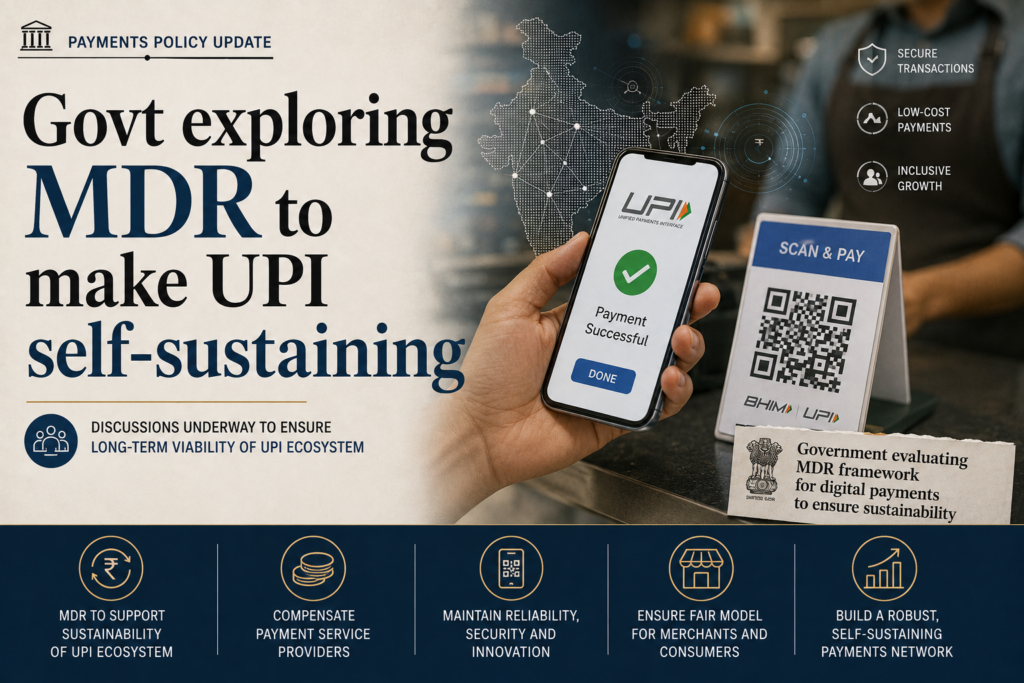
The government told Parliament that the current Unified Payments Interface (UPI) model is financially unsustainable, and that it is examining two routes to make the platform self-supporting without inflating the Budget. The trigger exposes a core tension: the zero-charge design that drove mass adoption now starves the ecosystem of the revenue needed for cybersecurity, fraud prevention and network upkeep.
What is Unified Payments Interface (UPI)?
Definition: UPI is a real-time payment system built by the National Payments Corporation of India (NPCI) and the Indian Banks’ Association that lets money move instantly between two bank accounts through a mobile app. It was launched as a pilot in April 2016 and became fully operational in August 2016.
Scale: More than 55 crore people use UPI and 703 entities, from banks to payment service providers, facilitate its transactions. Of the 28,174 crore digital transactions recorded in 2025-26, 86% ran on UPI.
What is the Merchant Discount Rate (MDR)?
Definition: MDR is the fee that banks, payment processors and gateways levy on a merchant for accepting a digital payment.
Current position:MDR is charged on most debit card and all credit card transactions. UPI and RuPay debit card transactions were exempted in 2020, making them zero-cost for merchants.
What Makes Up MDR?
Interchange fee: Money sent to the customer’s card-issuing bank.
Network fee: Charges paid to card networks like Visa or Mastercard.
Processor fee: Markup kept by the payment gateway or processor for handling the tech
Why is the current UPI model financially unsustainable?
Cost recovery gap: The subsidy scheme reimbursing processors is far short of actual cost. There is a mismatch between the roughly Rs 2,000 crore allocation and the industry’s estimated operational cost of about Rs 20,700 crore a year.
Coverage shortfall: The Standing Committee on Finance found the incentive covers merely 11% of the industry’s actual costs and 14% of potential MDR collections.
Investment risk: The gap threatens critical spending on cybersecurity, fraud prevention and network infrastructure as volumes scale toward a projected 150 billion transactions per month.
What options is the government exploring?
Selective MDR: Restoring MDR on certain high threshold transactions and high turnover merchants, leaving small merchant payments untouched.
Tiered incentives: A tiered incentive structure to phase out government support over the next few years.
Legal enabler: An amendment to the Payment and Settlement Systems Act, 2007 has already removed the bar on charging merchants a fee for receiving UPI payments.
Industry proposal: Payment firms seek an MDR of 0.3% to 0.6% on payments above Rs 2,000 to large merchants, about 4% of person to merchant transactions but 68% of value.
Conclusion
The government has confirmed that UPI cannot indefinitely run on subsidies and is examining selective MDR and a tapering incentive structure to make it self-sustaining. The next milestone is a framework that funds the ecosystem through charges on large merchants while shielding small merchants.
[UPSC 2026] Which one of the following statements about Unified Payments Interface (UPI) and Central Bank Digital Currency (Digital Rupee) is NOT correct?
(a) UPI is a real-time payment system but Digital Rupee is akin to sovereign paper currency
(b) In case of UPI, settlement for end users happens instantly; in case of Digital Rupee, wallet balance gets transferred to another wallet
(c) UPI transactions are recorded by banks and reflected in bank statements; in case of Digital Rupee, no data is captured in bank statements
(d) In both the cases, the liability lies with the users and their respective banks.
A remark by the Prime Minister offering “forgiveness” to young women who protested over examination irregularities has reopened a basic constitutional question. The framing casts the state as a benevolent patriarch and the women as daughters to be corrected, rather than as citizens exercising a right. The dispute is whether women who protest are treated as rights bearing citizens or as wards whose speech must first be polite.
What does the right to free speech under Article 19 protect?
Scope:Article 19(1)(a) of the Constitution guarantees the freedom of speech and expression to every citizen, and this includes the right to protest and to dissent.
Provocative speech included: The right covers expression that is impolite, provocative, or even offensive, not only measured or agreeable speech.
Only reasonable restrictions: The right is limited solely by the reasonable restrictions in Article 19(2), such as public order, decency or morality, and defamation, incitement to an offence and not by a general demand for civility.
Why is the “forgiveness” framing seen as paternalistic?
State as patriarch: Offering forgiveness positions the state as a merciful patriarch dispensing pardon, rather than an authority answerable to its citizens.
Infantilising women: Describing protesting women as “daughters” who spoke wrongly reduces them to misguided children in need of correction.
Agency denied: It treats a woman’s political grievance as an error of conduct, shifting attention from the demand to the manner of its expression.
How does the double standard operate?
Men’s anger normalised: Aggressive language by men in protests, rallies, and legislatures is read as conviction and rarely becomes a national debate.
Women’s anger moralised: The same expression by women is recast as a question of morality and cultural shock, which invalidates the underlying political claim.
Burden shifts to the woman: The pattern mirrors sexual violence cases, where a woman’s character is examined before the offence itself is addressed.
Can free speech protect angry dissent?
Protest is born of frustration: Dissent by its nature arises from anger at the prevailing system, so citizens cannot be required to soften their anger before being heard.
Civility is not a legal test: Politeness is a social norm, not one of the grounds on which Article 19(2) permits the state to restrict speech.
The real offence was elsewhere: At the protests the demonstrable wrong was the assault, doxxing, and harassment of students, not the words some of them used.
What is the current Status of the freedom of speech and expression in India
Who it protects: Article 19(1)(a) extends to all citizens, and its protection of protest and criticism has been repeatedly affirmed by the judiciary.
Settled limits: Speech may be restricted only under the eight grounds in Article 19(2), including the sovereignty and integrity of India, security of the State, public order, decency or morality, defamation, contempt of court, friendly relations with foreign states and incitement to an offence.
Recognised expansions: Courts have read the right to include the right to know, the right to protest peacefully, and expression through diverse media.
What are the constitutional Provisions related to speech, agency, and equality
Article 19(1)(a): Guarantees the freedom of speech and expression.
Article 19(2): Lists the reasonable restrictions that alone may limit that freedom.
Article 21: Protects personal liberty and autonomy, the basis on which courts uphold a woman’s right to choose her partner, faith, and way of life.
Articles 14 and 15: Guarantee equality before the law and bar discrimination on the ground of sex, underpinning equal citizenship for women.
What are the major debates surrounding free speech and women’s agency
Civility versus liberty: Whether provocative or offensive protest speech can be curbed in the name of decorum, or only under Article 19(2).
Paternalism versus autonomy: Whether the state and courts may protect women in ways that override their own choices, as critiqued through the Hadiya case.
Unequal citizenship: The argument, drawn from political theorist Carole Pateman, that the formal citizenship of men counts for more than that of women because of patriarchal privilege.
Conclusion
The central claim is that women who protest are citizens exercising a right, not daughters awaiting pardon. Treating their speech as a question of civility, while men’s aggression passes as conviction, denies them equal citizenship and misreads a right that protects even uncomfortable expression. The remedy is to treat women as full rights bearing individuals and to judge protest speech only against the limits the Constitution actually sets.
Back2Basics:
Hadiya case (2018)
What it was: The Kerala High Court annulled the marriage of an adult woman on the assumption that she was weak and vulnerable.
What the Supreme Court held: It set aside the annulment and restored her fundamental right to make choices about her life, faith, and partner.
Why it matters: It is a leading illustration of courts correcting a paternalistic denial of a woman’s autonomy under Article 21.
Fundamental Rights in India (Foundational Context)
About: Fundamental Rights in Part III of the Constitution are justiciable guarantees that an individual can enforce against the state.
Rationale: They protect individual liberty and dignity and place limits on state power, and form part of the basic structure.
Key concerns: Recurring tensions include balancing liberty against public order, the scope of reasonable restrictions, and the unequal enjoyment of rights across gender and class.
Way Forward
Judge speech by Article 19(2) alone: Restrict protest speech only on the constitutional grounds, not on norms of politeness.
Protect protestors from harassment: Act against the doxxing, assault, and vilification of demonstrators rather than policing their tone.
Recognise women’s agency: Frame women in public life as citizens with political and personal autonomy, not as dependents to be protected.
PYQ Relevance
[UPSC 2014] What do you understand by the concept “freedom of speech and expression”? Does it cover hate speech also? Why do the films in India stand on a slightly different plane from other forms of expression? Discuss.
Linkage: The PYQ is directly relates to the constitutional scope of freedom of speech and expression under Article 19(1)(a). The article extends this debate to angry dissent, provocative speech, reasonable restrictions and women’s right to political expression.
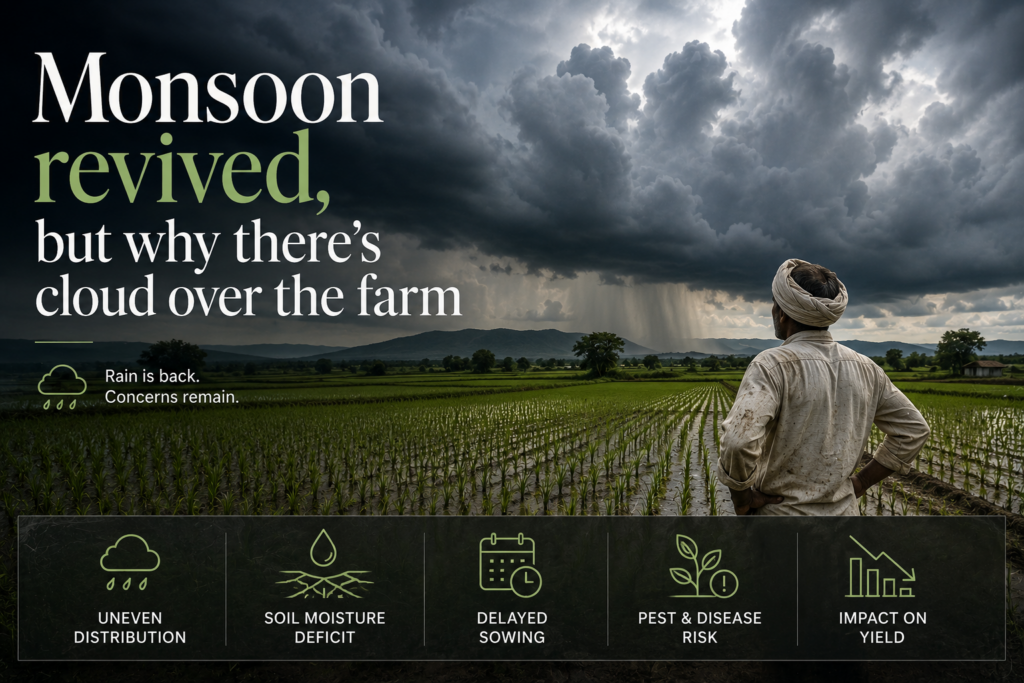
The southwest monsoon’s revival in July, despite a strengthening El Nino, has sharply narrowed the gap in area sown under kharif crops this season. The relief exposes a deeper tension between a recovering kharif and the mounting risks to the rabi season and to food inflation from El Nino’s lagged effect and a surge in global vegetable oil prices.
Why did a sowing gap open and how did July reverse it?
Weak start: Rainfall in June was 38 percent below the long period average, making it the sixth driest June in India since 1901, with not a single low pressure system forming.
Early shortfall: By 6 July farmers had planted only 350.85 lakh hectares, which was 20.8 percent below the 442.80 lakh hectares sown in the same period of 2025.
July turnaround: In July the country recorded four low pressure systems against a normal of three. These moved slowly, producing about 24 affected days against a normal of 14, lifting all India July rainfall to 2.4 percent above the average.
Recovery: By 7 August the 967.92 lakh hectares covered was only 1.8 percent lower than last year, with the pulses gap down to 1.8 percent, cotton to 0.4 percent, and oilseeds exceeding last year’s level.
What is El Nino and why does its effect lag?
Definition: El Nino is the abnormal warming of surface waters in the central and eastern Pacific Ocean off Peru and Ecuador that suppresses monsoon rainfall over India.
Lagged impact: El Nino’s effect on rainfall and temperatures comes with a lag of one to two months and can play out over five to six months or more.
Current phase: It intensified from a weak to moderate phase in June into a moderate to strong event in July, and global agencies expect it to turn very strong during October to December.
Why is the worst not yet over?
Late kharif needs rain:Crops need rainfall during August and early September for flowering and grain formation that determine yields. Meteorological Department has predicted a fresh low pressure system around 12 August.
Delayed hit: Because El Nino’s rainfall suppressing effect lags, its worst impact is still to come.
Rabi at risk: A strengthening El Nino raises temperatures, and a short warm winter harms wheat, mustard and potato yields, so the real threat is to the rabi season.
What does the FAO Food Price Index show?
Index high: The United Nations Food and Agriculture Organization (FAO) food price index touched 131.1 points in July, up 1 percent from July 2025 and the highest since the 131.4 of January 2023, a three and a half year high. This means food prices are now at their highest level in about 3½ years.
Vegetable oils drive it: The vegetable oils index reached 195.7 points, up 17.3 percent year on year and the highest since June 2022.
Mixed components: The cereals index was 113.8 points, up 6.9 percent, while dairy fell 24.8 percent, sugar fell 8 percent, and meat rose just 0.8 percent.
Causes: The rise is attributed to El Nino, heatwave hit crop yields in Europe, and supply disruptions from conflicts in West Asia and Ukraine.
Why are vegetable oils the real concern for India?
Import exposure: The combined value of India’s imports of oilseeds, pulses and cotton was close to 25 billion dollars in 2025-26, which El Nino could push to a new high.
Biofuel diversion: Firming vegetable oil prices stem mainly from diversion of palm, rapeseed and soyabean oil toward biofuel as petroleum prices harden.
Fuel substitution: These oils are used to make fatty acid methyl esters, a substitute for petroleum diesel, linking food and fuel markets.
Buffer available: The government held 92.6 million tonnes of rice and wheat on 1 July against a required minimum of 41.1 million tonnes, plus over 4 million tonnes of pulses, which can be offloaded to contain inflation.
Conclusion
The July monsoon revival has rescued the kharif season, cutting the sowing gap to under 2 percent even as El Nino strengthened. The central worry has shifted to the rabi season and to food inflation, since El Nino’s temperature and rainfall effects lag and global vegetable oil prices are at multi year highs. Ample public grain stocks give the government room to manage food inflation, but the rabi outlook and edible oil import bill remain the open risks.
Back2Basics:
Foundational Context: Climate Change and Food Security
About: Food security means reliable physical and economic access to sufficient, safe and nutritious food, which climate variability directly threatens.
Tropical vulnerability: Tropical countries face greater exposure because agriculture is rain dependent and heat sensitive.
India context: A large share of India’s cropped area is rainfed, tying output to monsoon performance.
Transmission channels: Erratic rainfall, heat stress, pest incidence and global price shocks each transmit climate risk to food systems.
FAO Food Price Index
Convening body: Published by the United Nations Food and Agriculture Organization (FAO).
What it measures: A weighted average of world prices of a basket of food commodities against a base period value taken as 100 for 2014 to 2016.
Components: Tracks separate indices for cereals, vegetable oils, dairy, meat and sugar.
Frequency: Released monthly.
Recent reading: Touched 131.1 points in July, a three and a half year high.
Government Initiatives for Agriculture and Edible Oils
National Mission on Edible Oils Oil Palm: Mission to raise domestic oil palm and edible oil production and cut import dependence.
PM-AASHA: Umbrella scheme assuring remunerative prices to farmers, especially for oilseeds and pulses.
Price Stabilisation Fund: Buffer stock mechanism to moderate volatility in pulses and other commodities.
Minimum Support Price: Price assurance to encourage sowing of pulses and oilseeds.
Key Facts about the Monsoon and Kharif Season
Sixth driest June: June 2026 was the sixth driest June since 1901.
July rainfall: All India July rainfall was 2.4 percent above the long period average.
Import bill: Oilseeds, pulses and cotton imports neared 25 billion dollars in 2025-26.
Grain stocks: 92.6 million tonnes of rice and wheat held on 1 July against a 41.1 million tonne minimum.
Challenges in Indian Agriculture
Rainfall dependence: A large rainfed area leaves output exposed to monsoon swings.
Import reliance: High dependence on imported edible oils and pulses exposes India to global prices.
Climate volatility: El Nino and heatwaves disrupt both kharif and rabi seasons.
Price transmission: Global food and fuel price shocks feed domestic inflation.
Storage and logistics: Post harvest losses and uneven buffer management persist.
Yield gaps: Low productivity in pulses and oilseeds constrains self sufficiency.
Way Forward
Raise oilseed output: Expand area and yields under the edible oils mission to cut imports.
Diversify cropping: Promote pulses and climate resilient varieties in rainfed regions.
Strengthen buffers: Use public grain and pulse stocks proactively to contain inflation.
Improve forecasting: Sharpen monsoon and El Nino forecasting for sowing decisions.
Invest in irrigation: Extend micro irrigation to reduce rainfall dependence.
PYQ Relevance
[UPSC 2023] Discuss the consequences of climate change on the food security in tropical countries.
Linkage: The PYQ directly addresses the impact of climate change and climatic variability on food security in tropical countries. El Niño, erratic monsoons, heat stress and global food prices show how climate risks affect India’s kharif, rabi and food inflation.
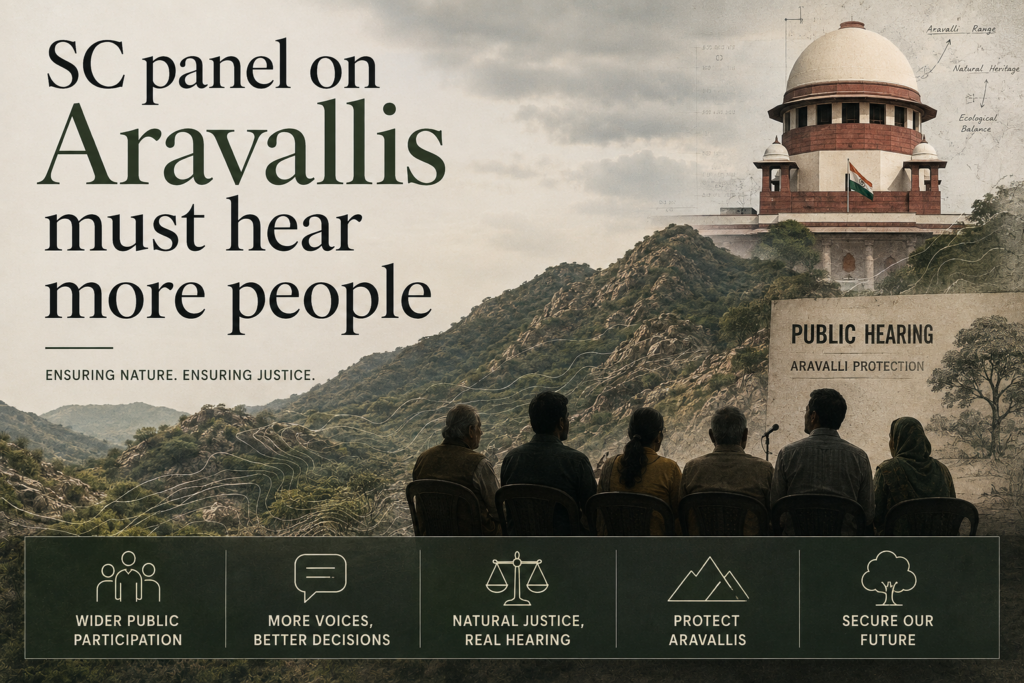
Civil society groups and mining affected communities have alleged that the Supreme Court appointed High Powered Committee (HPC) on the Aravallis left out several districts and did not adequately hear local people during its consultations. The dispute exposes the tension between expert led regulation of mining and genuine participation of the communities whose lands and livelihoods the decision will affect.
What is the High Powered Committee on the Aravallis?
Origin: The Supreme Court of India constituted a high-powered expert committee headed by Kanchan Devi to review the definition and delineation of the Aravalli hill range, guide mining regulations, and protect the fragile ecosystem from continuous environmental degradation.
Mandate: It is to submit a report that will shape decisions on mining and conservation across the range, with an August 31 deadline.
Consultation window: The panel held a 21 day period for stakeholders to submit comments, which has now ended.
Field visits: It conducted field visits in Gurgaon, Alwar, Ajmer and Udaipur between 6 and 10 August.
Why are activists challenging the consultation process?
Villages left out: The Aravalli Virasat Jan Abhiyan claims the HPC did not visit any mining affected villages to understand ground realities.
Urban centric hearings: Public hearings were held at urban centres that affected villagers could not reach, and information was not publicised in local newspapers, on radio, or at panchayat offices.
Lobby dominance: Around 80 percent of representations in Ajmer were pro mining, with a similar pattern elsewhere, and those speaking against mining were allegedly threatened.
Access failures: A scheduled Udaipur meeting for 10 August was moved to the evening of 9 August, making it hard for many to attend, and requested visits to villages hit by limestone mines and stone crushers did not happen.
Central demand: The group wants the HPC to seek an extension of the August 31 deadline and hold meaningful consultations across all 64 districts in Delhi, Haryana, Rajasthan, Uttar Pradesh and Gujarat.
What is an Eco Sensitive Zone?
Definition: An Eco Sensitive Zone is an area notified around protected areas or ecologically fragile landscapes where activities such as mining are regulated or prohibited to act as a shock absorber.
The National Wildlife Action Plan (2002-2016) recommended that State governments identify areas within 10 km of national parks and wildlife sanctuaries for declaration as Eco-Sensitive Zones (ESZs).
The recommendation was to be implemented under the Environment (Protection) Act, 1986, under the framework of the Ministry of Environment, Forest and Climate Change (MoEFCC).
Relevance: Regulation of mining in the Aravallis turns on how such protective boundaries and restrictions are drawn and enforced.
Why does the Aravalli range matter for mining regulation?
Ecological role: The Aravallis are India’s oldest mountain range and act as a barrier against desertification spreading eastward from the Thar.
Mining pressure:Limestone mines, stone crushers and other extraction have degraded stretches of the range.
Legal history: Courts have repeatedly intervened to restrict illegal and unregulated mining in the range.
Livelihood stakes: Rural and Adivasi communities depend on the hills, so decisions affect both ecology and livelihoods.
Why does the mining lobby versus affected communities tension shape the outcome?
Capture risk: Hearings dominated by pro mining representations risk producing a report that understates ground level harm.
Precedent invoked: Activists demand a systematic outreach approach similar to the one adopted a decade ago by the Western Ghats Ecology Expert Panel, which held direct public hearings.
Intimidation: Alleged threats to those opposing mining undermine the credibility of the consultation.
Deadline pressure: A fixed August 31 deadline discourages the fuller consultation the communities are demanding.
Conclusion
The current status is a contested consultation process, with affected communities demanding a deadline extension and direct village level hearings before the HPC finalises its report to the Supreme Court. The dispute turns on whether expert regulation of Aravalli mining can be legitimate without hearing the people most affected by it. The next milestone is whether the committee seeks an extension or submits its report by August 31 as scheduled.
Back2Basics:
Foundational Context: Mining in India
About: Mining is the extraction of minerals from the earth and is regulated as a hazard prone activity with significant environmental impact.
Scale: India produces a range of major and minor minerals, with states such as Rajasthan, Odisha and Jharkhand holding large reserves.
Environmental impact: Mining causes deforestation, dust and air pollution, groundwater depletion, and land degradation.
Governance: Mineral development is regulated under central law with clearances layered across environment, forest and pollution statutes.
Statutory Framework Governing Mining and the Aravallis
Mines and Minerals (Development and Regulation) Act, 1957: The principal law regulating the mining sector and grant of mineral concessions.
Environment (Protection) Act, 1986: Enables environmental clearances and the notification of Eco Sensitive Zones.
Forest (Conservation) Act, 1980: Requires clearance before diverting forest land for mining.
Air (Prevention and Control of Pollution) Act, 1981: Regulates dust and emissions from mining and crushing.
National Green Tribunal Act, 2010: Provides the forum for adjudicating mining and environmental disputes.
The Aravalli Range
Designation: India’s oldest fold mountain range, running across Delhi, Haryana, Rajasthan and Gujarat.
Location and extent: Stretches roughly 690 kilometres from Delhi to Gujarat, with Guru Shikhar as its highest peak.
Ecological function: Acts as a natural barrier checking the eastward spread of the Thar desert and supports groundwater recharge.
Distinguishing feature: Hosts unique biodiversity and forms the watershed for several rivers.
Current concern: Threatened by illegal mining, stone crushing and encroachment.
Government Initiatives for Aravalli and Land Restoration
Aravalli Green Wall Project: Initiative to create a green belt along the range to combat land degradation and desertification.
Compensatory Afforestation Fund: Funds afforestation to offset forest land diverted for mining and other uses.
National Afforestation Programme: Supports regeneration of degraded forest land.
Desertification action: India’s commitments under the United Nations Convention to Combat Desertification guide land restoration.
Key Facts about the Aravallis and Mining
Districts covered: The HPC’s mandate spans 64 districts across five states.
Oldest range: The Aravallis are among the oldest mountain systems in the world.
Deadline: The committee faces an August 31 report deadline.
Precedent: The Western Ghats Ecology Expert Panel is cited as a model of participatory consultation.
Weak consultation: Affected rural and Adivasi communities are inadequately heard.
Enforcement gaps: Overlapping jurisdictions weaken monitoring of mining bans.
Encroachment: Construction and settlement erode the range.
Desertification risk: Degradation of the range threatens its role as a desert barrier.
Intimidation of activists: Reported threats deter local opposition to mining.
Way Forward
Direct village outreach: Hold public hearings in affected villages, not only urban centres.
Extend timelines: Allow adequate consultation before finalising a decision of this scale.
Strengthen enforcement: Deploy satellite monitoring and strict penalties against illegal mining.
Protect participants: Ensure safety for community members opposing mining.
Restore degraded land: Scale up afforestation and green wall efforts across the range.
PYQ Relevance
[UPSC 2025] Mineral resources are fundamental to the country economy and these are exploited by mining. Why is mining considered an environmental hazard? Explain the remedial measures required to reduce the environmental hazard due to mining.
Linkage: The PYQ directly connects with the environmental hazards of mining and remedial measures for sustainable mineral extraction. The Aravalli case highlights illegal mining, ecological degradation, weak enforcement and the need for participatory conservation.
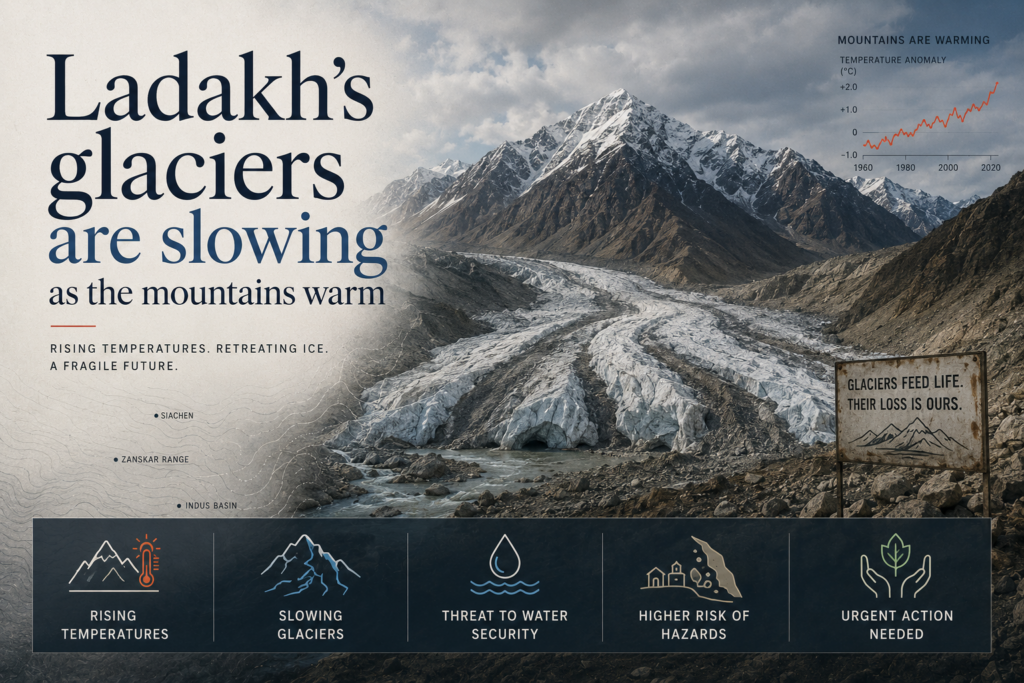
A new study in the journal The Cryosphere reports that glaciers in the Zanskar region of Ladakh are moving more slowly than they did 30 years ago, as sustained warming thins them and reduces their driving force. The slowdown carries long term implications for the Indus basin, where glacier melt sustains river flows during dry summer months.
Why are the Zanskar glaciers slowing down?
Thinning mechanism: When a glacier loses more ice than it gains over many years it becomes thinner, and thinner ice exerts less driving force, causing it to flow more slowly.
Warming link: The study connects mass loss, thinning and reduced flow, showing that thinning is not only a consequence of warming but also weakens the glacier’s ability to move.
Downstream effect: Slower flow means the lower parts of a glacier receive less replenishment from higher elevations, making continued shrinkage more likely.
Local variation: Glacier geometry, debris cover and conditions at the snout influence how quickly each glacier responds.
What is peak water?
Definition:Peak water is the point at which increased melting from a shrinking glacier temporarily raises river runoff before the water supply begins to decline.
Why it matters: More melting may boost flows in the near term, but once glaciers lose a substantial fraction of their stored ice, their meltwater contribution to rivers is expected to drop.
What did the study find?
Study design: The researchers examined how glacier flow changed from 1992 to 2023 across 12 glaciers in the Zanskar Himalaya using satellite derived surface velocities.
Velocity decline: Glaciers slowed by 2.4 metres per year per decade on average.
Faster thinning: The pace of surface thinning increased from around 0.22 metres per year between 2000 and 2005 to around 0.57 metres per year between 2015 and 2020.
Sample caveat: The 12 glaciers studied are representative, but the Zanskar basin hosts around 1,755 glaciers, so caution is needed before extending the findings to all of Ladakh.
What are the implications for the Indus basin?
Summer flows: Glacier melt contributes significantly to Indus river flows during the dry summer months, so long term storage decline threatens that supply.
Multiple dependencies: River flows also depend on snowfall, rainfall, groundwater and water management, so slowing glaciers alone will not immediately cause shortages.
Sectors at risk: Continued thinning and slowdown signal declining long term water storage, with implications for water security, agriculture, hydropower and downstream ecosystems in coming decades.
Why do the study’s own limitations qualify its conclusions?
Sub surface blind spot: Satellite surface velocity observations cannot directly reveal processes beneath the glacier, such as subglacial hydrology or basal sliding, which strongly influence motion.
Data gaps: Long term field measurements of ice thickness, mass balance and bed conditions remain limited in the region, making full attribution of observed changes difficult.
Exceptions to the trend: Some glaciers can temporarily accelerate due to increased meltwater at the bed, glacier surges, or interactions with proglacial lakes.
What does the global comparison show?
European Alps and Alaska: Similar glacier slowdowns have been reported, driven by the same thinning and reduced driving stress mechanism.
Canadian Arctic and Andes: These regions show comparable slowdowns linked to warming.
Tibetan plateau: Parts of the plateau display the same dominant mechanism of thinning leading to slower flow.
Shared lesson: Glacier slowdown is becoming widespread globally, though local glacier characteristics still shape individual behaviour.
Conclusion
The study establishes that Zanskar glaciers are not only losing mass but slowing down, with thinning reducing their capacity to move and replenish lower reaches. This points to a long term decline in stored water that will eventually reduce Indus basin flows after a phase of peak water. The findings underscore the need for sustained ground based monitoring to validate satellite data and to prepare downstream communities for shifting water availability.
Back2Basics:
Foundational Context: The Cryosphere and Himalayan Glaciers
About: The cryosphere comprises the frozen parts of the Earth, including glaciers, snow cover, permafrost and ice, that store and release freshwater.
Third Pole: The Hindu Kush Himalaya holds the largest ice mass outside the polar regions and is often called the Third Pole.
Function: Himalayan glaciers act as natural reservoirs, releasing meltwater in warmer months to sustain rivers, agriculture and ecosystems in otherwise arid areas.
Climate indicator: High altitude glaciers respond distinctly to warming, making them valuable natural indicators of environmental change.
The Zanskar Region and Indus Basin
Location: The Zanskar region lies in Ladakh and hosts some of the largest and most extensive glaciers in the Himalaya.
Climatic setting: Its glaciers receive most of their snowfall from mid latitude westerly disturbances during winter and sit at high altitude.
Indus basin: The Indus rises in the Tibetan plateau and flows through Ladakh, with glacier melt feeding its dry season flows.
Significance: The basin supports water security, agriculture and hydropower across northern India and beyond.
Key Facts about Himalayan Glacier Monitoring
Study journal: The findings appear in the journal The Cryosphere.
Zanskar glacier count: The basin hosts around 1,755 glaciers, of which 12 were studied.
Observation record: The study covers more than 30 years, from 1992 to 2023.
Peak water: A key concept describing the temporary runoff increase before long term decline.
Challenges in Glacier Conservation and Monitoring
Data scarcity: Long term field measurements of ice thickness and mass balance are limited in high altitude terrain.
Warming pace: Rising temperatures accelerate thinning and mass loss.
Black carbon: Soot deposition on ice lowers reflectivity and speeds melting.
Glacial lake hazards: Meltwater expansion raises the risk of glacial lake outburst floods.
Downstream dependence: Millions rely on glacier fed rivers, amplifying the impact of any decline.
Way Forward
Expand ground monitoring: Add measurements of ice thickness, mass balance and meltwater discharge to validate satellite data.
High altitude weather stations: Install continuous observation stations to capture varied mountain climate conditions.
Basin water planning: Prepare Indus basin water management for the eventual decline after peak water.
Reduce black carbon: Cut regional emissions that hasten glacier melt.
Regional cooperation: Share transboundary glacier and river data across the basin.
PYQ Relevance
[UPSC 2020] How will the melting of Himalayan glaciers have a far-reaching impact on the water resources of India?
Linkage: The PYQ directly relates to the impact of Himalayan glacier melt on India’s water resources. Zanskar glacier slowdown and thinning highlight the emerging risks to Indus basin flows, water security and long-term freshwater availability.
PYQ Relevance [UPSC 2017] The question of India’s Energy Security constitutes the most important part of India’s economic progress. Analyze India’s energy policy cooperation with West Asian Countries Linkage: It connects the pact with India’s energy, strategic and security interests in West Asia. It helps analyse India’s response to emerging regional security alignments while safeguarding its strategic autonomy.
Mentor’s Comment
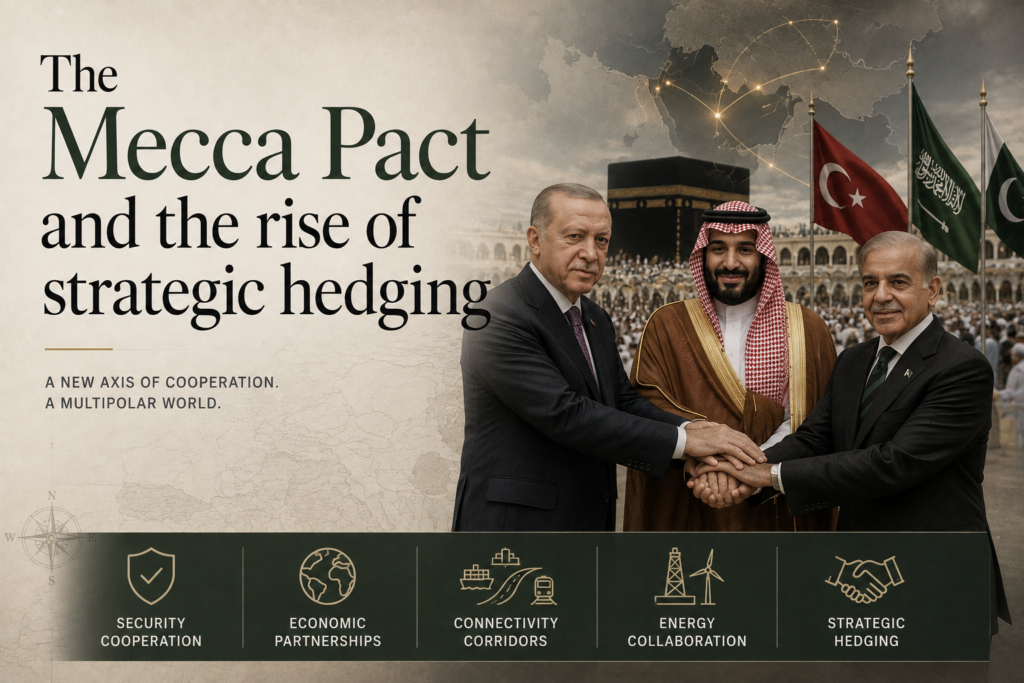
The Mecca Joint Defence Agreement signed on 7 August by Turkiye, Saudi Arabia and Pakistan commits the three states to treat an armed attack on any one of them as an attack on all. The pact exposes a shift in West Asian security away from sole reliance on external guarantors toward arrangements built by regional powers themselves. India, with large economic, energy and strategic stakes in the region, has said it is examining the implications and will safeguard its interests.
What is the Mecca Joint Defence Agreement?
Signing and parties: The mutual defence agreement was signed on 7 August between Saudi Arabia, Turkiye and Pakistan in Mecca.
Core provision: An armed attack against any one of the three states is to be regarded as an attack against all three, aimed at strengthening collective deterrence against aggression.
What it does not do: It does not terminate the three states’ dependence on the United States, since Saudi Arabia remains militarily tied to Washington, Turkiye stays in the North Atlantic Treaty Organization (NATO), and Pakistan retains its own relationship with the United States.
What is strategic hedging?
Definition: Strategic hedging is a policy of supplementing existing external security guarantees with independent arrangements, rather than replacing or breaking from those guarantees.
Why states hedge: It lets a state demonstrate alternative options and reduce exposure to a single unreliable guarantor without provoking an open confrontation with that guarantor.
What complementary strengths do the three partners bring?
Saudi Arabia: It provides financial resources, energy power and political influence across the Arab and Islamic worlds.
Turkiye: It contributes the strongest conventional military among the Muslim states of West Asia and a rapidly expanding indigenous defence industry.
Pakistan: It brings a large professional military and decades of cooperation with Saudi Arabia, and its nuclear weapons force any adversary to factor that capability into an attack on any member.
Why does each participant have distinct reasons to join?
Saudi Arabia: The pact provides strategic insurance after the 2019 attacks on Saudi oil installations and the current confrontation with Iran exposed the risk of depending on a single external guarantor.
Turkiye: It views the arrangement through strategic autonomy, expanding influence into the Gulf and South Asia and creating markets for its defence industry.
Pakistan: The agreement widens its strategic horizons beyond the rivalry with India and converts its military capabilities into greater geopolitical influence.
Why have earlier Arab and pan-Islamic security groupings repeatedly failed?
Baghdad Pact and CENTO: The Baghdad Pact lost Iraq in 1959, became the Central Treaty Organisation (CENTO) and expired in 1979.
United Arab Republic: The Egypt and Syria federation founded in 1958 as the peak of pan Arabism dissolved in 1961.
Regional Cooperation for Development: Launched in 1964 by Iran, Turkiye and Pakistan, it became the Economic Cooperation Organisation in 1985 and achieved little.
Gulf Cooperation Council (GCC): Founded in 1981, it could not stop three members blockading a fourth in 2017 and remains divided on Iran.
Arab League and OIC: The Arab League and the Organisation of Islamic Cooperation (OIC) function as forums for declarations, not instruments of action.
The working alternative: United States led coalitions delivered results, reversing Iraq’s annexation of Kuwait in 1991, intercepting Iranian salvos, and anchoring the current 13 nation Red Sea shipping coalition on United States Central Command.
How should India read the pact?
Not automatically anti Indian: India has cultivated close relations with Saudi Arabia over two decades, and Riyadh has strong economic incentives not to let the pact become an instrument in Pakistan’s disputes with New Delhi.
Pakistan’s leverage: Inclusion in a mutual defense pact as a net security provider could embolden Islamabad, though direct military intervention by Saudi Arabia or Turkey in an India-Pakistan bilateral conflict remains unlikely.
Intelligence and Industrial Sharing: Even without direct combat involvement, Pakistan could benefit from wider intelligence-sharing, diplomatic backing, or defense-industrial cooperation with Middle Eastern partners
Turkiye as the complication: Ankara has repeatedly backed Pakistan on Kashmir and supplied weapons used against India, making it the harder partner to read.
Suggested response: India should seek explicit reassurance from Riyadh that the pact does not apply to an India and Pakistan confrontation, and resist viewing the alignment only through the Pakistan lens.
Official position: The government has said it is examining the pact from the standpoint of national security and regional stability and will take all necessary measures to safeguard national interests.
What are the implications for Iran, Israel and the United States?
Iran: The effect is complicated, since Turkiye and Pakistan share borders with Iran and have reasons to avoid confrontation with Tehran, so it is not a clear anti Iranian coalition.
Israel: The fragmentation of the Muslim world has been a standing Israeli advantage, and a combination of Saudi finance, Turkish conventional strength and Pakistani nuclear capability alters strategic calculations.
United States: The pact presents a paradox, since Washington long sought greater burden sharing by regional partners, but greater responsibility also produces greater autonomy and diminishes American leverage.
Is the Mecca pact genuine security self reliance or another weak grouping?
The sceptical reading:A seven-decade record of collapsed groupings shows that national interest often defeats supranational identity. This is captured in Suhrawardy’s formulation: “zero plus zero plus zero still amounts to zero.”(Suhrawardy’s formulation: It refers to a famous realist maxim coined by Huseyn Shaheed Suhrawardy, the Prime Minister of Pakistan during the 1956 Suez Crisis. He famously dismissed the idea of collective pan-Islamic or regional military alliances among weak developing states by stating that “zero plus zero plus zero still amounts to zero”)
The hedge reading: The accord is best described not as Islamic security self reliance but as a hedge against American unreliability after erratic United States policy.
The cumulative reading: When several major states begin hedging simultaneously, their combined actions can transform the regional order even without a formal realignment.
Structural contradiction: Saudi Arabia and Turkiye both claim leadership of the Islamic world and diverge over the Muslim Brotherhood, so the accord does not dissolve the rivalry between Riyadh and Ankara.
Conclusion
The Mecca pact is an act of strategic hedging by regional powers seeking to supplement, not sever, their external guarantees, and its significance lies in the possibility of a more autonomous West Asian security architecture. Whether it becomes durable or joins the long list of weak groupings will turn on whether regional cooperation can outlast national interest. India cannot remain a spectator to this transformation, and the credible response is to expand its own military and security engagement in the region rather than react with alarm.
Back2Basics:
Foundational Context: India and West Asia
About: West Asia, spanning the Gulf, the Levant and the wider region, is central to India’s energy security, remittances and diaspora, and maritime trade.
Energy and diaspora: The region supplies a large share of India’s crude oil and hosts roughly nine million Indian workers, making stability there a direct national interest.
Strategic posture: India follows a policy of de hyphenated engagement, maintaining ties simultaneously with the Gulf Arab states, Iran and Israel.
Historical footnote: Undivided India was described as the anchor of Persian Gulf security, a role independent India stepped back from after 1947.
Organisation of Islamic Cooperation (OIC)
Type: Intergovernmental organisation of Muslim majority states, the second largest such body after the United Nations.
Formation: Established in 1969.
Headquarters: Jeddah, Saudi Arabia.
Membership: 57 member states across four continents.
Mandate: Safeguards and protects the interests of the Muslim world and coordinates member positions, largely through declarations rather than enforcement.
India context: India is not a member, though it was invited as a guest of honour to the OIC foreign ministers meeting in 2019.
Government Initiatives / Frameworks for India’s West Asia Engagement
I2U2 Grouping: A grouping of India, Israel, the United Arab Emirates and the United States focused on water, energy, food security and technology cooperation.
India Middle East Europe Economic Corridor (IMEC): A connectivity project linking India to Europe through the Gulf, announced on the sidelines of the G20 summit.
Comprehensive Economic Partnership Agreement: India’s trade agreement with the United Arab Emirates deepening economic ties in the Gulf.
Defence diplomacy: Growing military exercises and defence partnerships with Gulf states seeking to diversify their security partners.
Key Facts about India and West Asia
Crude imports: West Asia remains among the largest sources of India’s crude oil imports.
Remittances: The Gulf is a leading source of inward remittances to India.
Strait of Hormuz: A large share of India’s oil imports transit this chokepoint.
Suez crisis reference: The pact debate recalls the 1956 Suez crisis, when Pakistan faced pressure to abandon the Baghdad Pact.
Challenges to India’s West Asia Strategy
Pakistan factor: Turkiye’s consistent support for Pakistan on Kashmir complicates India’s Gulf partnerships.
Regional rivalries: Balancing ties with Saudi Arabia, Iran and Israel simultaneously constrains freedom of action.
Energy exposure: Dependence on Gulf crude leaves India vulnerable to supply and price shocks from regional conflict.
Capability gap: India lacks the power projection capacity to act as a security provider in the region despite being courted.
Great power competition: Rising Chinese economic and diplomatic presence in the Gulf reduces India’s relative influence.
Way Forward
Expand military diplomacy: Deepen exercises, training and defence exports with Gulf states seeking to diversify partners.
Seek bilateral reassurances: Obtain clear assurances from Riyadh that the pact does not apply to an India and Pakistan conflict.
Diversify energy sources: Broaden crude sourcing and strategic reserves to reduce chokepoint exposure.
Build connectivity: Accelerate IMEC and Gulf economic corridors to lock in long term stakes in the region.
Sustain de hyphenated engagement: Maintain simultaneous ties with all regional actors without being drawn into any single bloc.
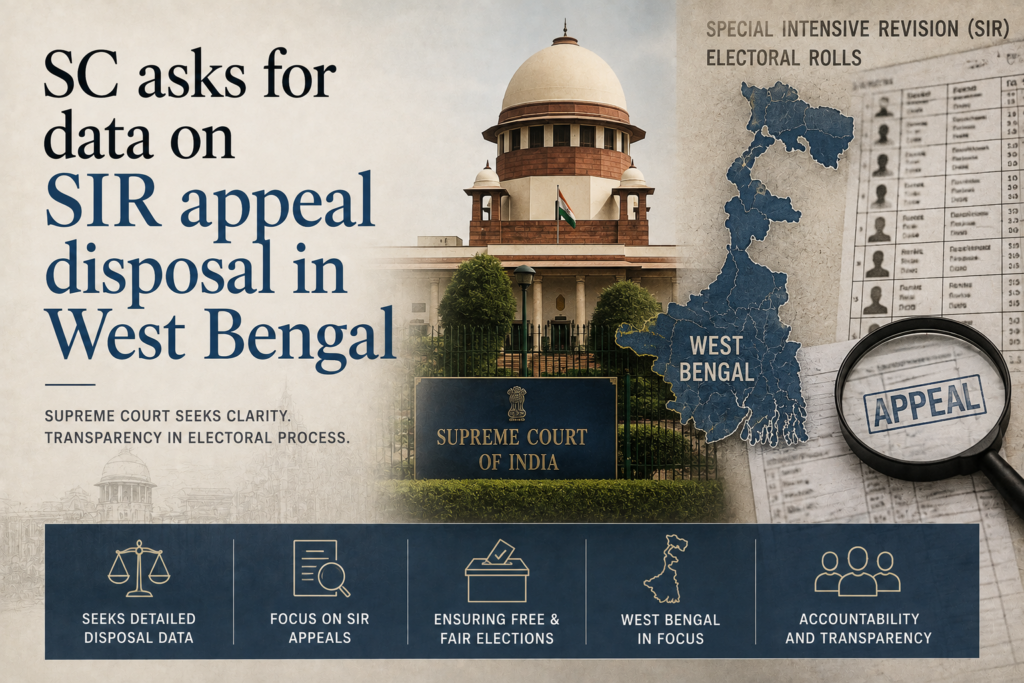
The Supreme Court asked the Election Commission of India to furnish data on the disposal rate of appeals filed by persons excluded from the West Bengal electoral roll during the Special Intensive Revision. The court declined to fix a timeline for the appellate tribunals but signalled it would restructure the disposal architecture if performance is found wanting, exposing the tension between the right to an effective remedy and the slow pace of appeal disposal linked to welfare access.
What is the Special Intensive Revision (SIR) of electoral rolls?
Definition: The Special Intensive Revision (SIR) is an intensive, house to house verification of electoral rolls conducted by the Election Commission of India to add eligible voters and remove ineligible entries.
Object: Its stated aim is that no eligible voter is excluded and no ineligible person is included in the draft electoral roll.
Process: Booth Level Officers collect enumeration forms from households, after which the draft roll is published and objections are heard.
Appeal route: Persons whose names are excluded may appeal before designated appellate tribunals set up following Supreme Court orders.
What did the Supreme Court direct?
Data on disposal: The court asked the Election Commission of India to furnish details on the quantum of appeals disposed by the appellate tribunals.
No fixed timeline: It declined to bind the tribunals to a specific timeline for deciding appeals.
Focus on quantum: The court clarified it is concerned with the volume and speed of disposal, not the outcome of individual appeals.
Restructuring option: It indicated it may revisit and restructure the disposal architecture, including online access for the deciding officer, if performance appears wanting.
Next hearing: The matter was listed for 25 August.
Why does appeal disposal matter beyond the roll?
Under one percent decided: The petitioner submitted that the tribunals had not decided even one percent of the appeals.
Welfare linkage: Counsel argued that the State was denying ration and other benefits to those deleted from the rolls whose appeals were pending.
Access barrier: People from distant areas found it difficult to physically reach the tribunals, prompting the court to examine logistical issues.
Remedy must be effective: The court observed that merely filing an appeal may not satisfy a litigant if the due process does not yield an outcome.
Separate cause of action: On the welfare denial, the court advised the petitioner to approach the Calcutta High Court as it involved a different cause of action.
Where does the genuine tension lie?
Judicial restraint versus effective remedy: The court will not fix a decision timeline for the tribunals, yet insists that an appeal must lead to a real outcome.
Roll purity versus disenfranchisement: Intensive revision seeks accurate rolls, while slow appeal disposal risks keeping eligible voters excluded.
Electoral right versus welfare access: Exclusion from the roll is linked to denial of ration and welfare, widening the stakes beyond voting.
Creator’s duty: As the creator of the tribunals, the court accepts responsibility to ensure the due process it designed actually functions.
About Electoral Roll Management in India
Definition: The electoral roll is the list of eligible voters for a constituency, maintained and periodically revised by the Election Commission of India.
Legal basis: Roll preparation and revision are governed by the Representation of the People Act, 1950, and the Registration of Electors Rules, 1960.
Eligibility: A person may be enrolled only in the constituency where they are ordinarily resident and whose name appears on the roll may contest and vote.
Revision types: Rolls are updated through summary revision and, where needed, intensive or special intensive revision.
Statutory Framework Governing Electoral Rolls
Article 324: Vests superintendence, direction, and control of elections and roll preparation in the Election Commission of India.
Article 326: Provides for adult suffrage as the basis of elections to the Lok Sabha and State Assemblies.
Representation of the People Act, 1950: Governs allocation of seats and preparation of electoral rolls.
Representation of the People Act, 1951: Governs the conduct of elections, qualifications, and disqualifications of candidates.
Registration of Electors Rules, 1960: Prescribes the procedure for enrolment, revision, appeals, and correction of rolls.
Back2Basics: Election Commission of India (ECI)
Constitutional basis: Established under Article 324 as an independent constitutional body.
Composition: A Chief Election Commissioner and such number of Election Commissioners as the President fixes.
Jurisdiction: Conducts elections to Parliament, State legislatures, and the offices of President and Vice President, and maintains electoral rolls.
Tenure and removal: The Chief Election Commissioner can be removed only through the process applicable to a Supreme Court judge.
Function in focus: Preparation and revision of electoral rolls, including intensive revision exercises.
“[2017] For election to the Lok Sabha, a nomination paper can be filed by
(a) Anyone residing in India.
(b) A resident of the constituency from which the election is to be contested.
(c) Any citizen of India whose name appears in the electoral roll of a constituency.
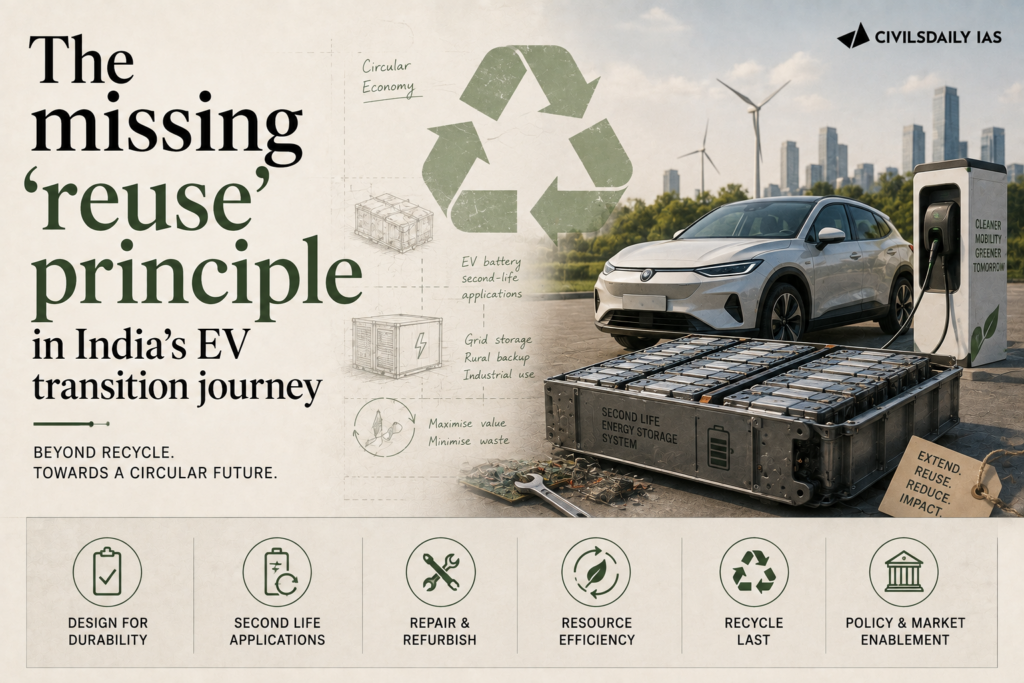
India’s electric mobility transition is gathering momentum as adoption rises and circular economy principles enter industrial policy. India’s policy has advanced the recycling tier of circularity through scrappage but neglected the higher priority reuse tier, exposing a gap where structurally sound vehicles are scrapped rather than retrofitted.
What is the circular economy hierarchy?
Definition: The circular economy is built on a hierarchy that prioritises reducing resource consumption, then reusing existing assets, and only recycling materials once products have genuinely reached the end of their useful life.
Reuse versus recycle: Recycling recovers materials after a product becomes waste, while reuse preserves functionality before the asset becomes waste. Reuse sits higher in the hierarchy.
What is vehicle retrofitment?
What it is: Retrofitment replaces the internal combustion engine, fuel system, and related components of an existing vehicle with an electric powertrain, while retaining the core vehicle structure.
Why it counts as reuse: By keeping a structurally sound chassis and body in service, it preserves and extends the value already embedded in the asset rather than recovering value only after the vehicle becomes waste.
How far has India progressed on recycling?
Rules framework: The Motor Vehicles (Registration and Functions of Vehicle Scrapping Facility) Rules, 2021, and the Environment Protection (End of Life Vehicles) Rules, 2025, strengthened responsible vehicle recycling and material recovery.
Facilities on ground: As of January 2026, 129 Registered Vehicle Scrapping Facilities were operational across 21 States and Union Territories.
Vehicles processed: About 4.3 lakh vehicles had been processed through these facilities, building a formal ecosystem for recycling and resource recovery.
Why does retrofitment matter?
Per vehicle waste: A single two wheeler generates approximately 90 kilograms of recyclable material and 18 kilograms of landfill waste when scrapped.
Fleet scale burden: Scaled across India’s fleet of about 30 crore vehicles, a scrap first approach would generate 2.7 crore tonnes of recyclable material and 0.54 crore tonnes of landfill waste.
SDG alignment: Retrofitment supports United Nations Sustainable Development Goal 12 on responsible consumption and production by reducing material demand and waste.
Old but sound: A vehicle can be old yet retain a strong chassis, intact body, and years of service life, making retrofitting more circular than scrapping.
What is the three pathway vehicle hierarchy?
First pathway, continued use: Vehicles that remain safe, compliant, and efficient should keep operating with routine maintenance, since age alone should not trigger removal.
Second pathway, retrofitment: Vehicles with sound structure but ageing or polluting powertrains can be converted to electric through certified processes, extending life while cutting emissions.
Third pathway, scrappage: Vehicles with compromised safety, severe structural degradation, accident damage, or significant corrosion proceed to scrappage and recycling.
The missing middle path
Not a competition: Retrofitment is not a competing strategy to scrappage but the missing middle path that policy has not focused on yet.
Condition over age: Treating every ageing vehicle as a disposal candidate overlooks the chance to extend asset life while accelerating electrification.
Public acceptance: A condition assessed transition would make scrappage more acceptable, as citizens would see that older vehicles are assessed for transformation rather than dismissed indiscriminately.
What are the challenges to a reuse led EV transition?
Certification gap: Retrofitment needs robust certified conversion technology and testing standards to ensure safety.
Cost and financing: Conversion costs can rival buying a new two wheeler, limiting uptake without incentives.
Battery supply dependence: Electric powertrains depend on imported cells and critical minerals, a supply chain vulnerability.
Policy bias toward scrappage: Existing incentives favour scrappage and new vehicle purchase, leaving reuse unsupported.
Skilled workforce shortage: A trained network of certified retrofit workshops is largely absent at scale.
End of life battery waste: Retrofitted vehicles eventually generate battery waste requiring recycling infrastructure.
Conclusion
India’s transport transition is a question of resource efficiency, not a contest between new electric vehicles and older ones. Adopting an age assessed pathway that distinguishes continued use, retrofitment, and scrappage would align the transition with genuine circular economy principles. This would prevent waste before it is created and confine recycling to vehicles that have truly reached the end of their useful life.
What is Circular Economy? (Foundational Context)
About: A circular economy keeps materials and products in use for as long as possible, extracting maximum value before recovery and regeneration, in contrast to the linear take, make, dispose model.
Rationale: It exists to cut resource extraction, greenhouse gas emissions, and waste while sustaining economic value.
Named hierarchy: It rests on reduce, reuse, and recycle in that order of priority, with reduce and reuse ranked above recycling.
Key Concerns Regarding the Circular Economy
Recycling bias: Policy attention concentrates on recycling while the higher value reduce and reuse tiers are neglected.
Informal sector dominance: Much recycling occurs in the informal sector with poor environmental and safety standards.
Extended producer responsibility gaps: Enforcement of producer take back obligations remains weak.
Data deficits: Weak material flow data limits measurement of circularity outcomes.
Back2Basics: Sustainable Development Goal 12
What it is: SDG 12 is the goal on responsible consumption and production within the 2030 Agenda for Sustainable Development.
Adopted: It was adopted by United Nations member states in 2015.
Focus: It targets sustainable consumption patterns, resource efficiency, and reduced waste generation.
Relevance: Vehicle retrofitment directly advances its call for better resource efficiency and reduced waste.
Government Initiatives for EVs and Circularity
PM E-DRIVE Scheme: Provides demand incentives for electric two and three wheelers and other electric vehicles.
FAME India Scheme: Faster Adoption and Manufacturing of Electric Vehicles, supporting demand and charging infrastructure.
Vehicle Scrappage Policy: Encourages phasing out of unfit and polluting vehicles through registered scrapping facilities.
PLI schemes: Production Linked Incentives for advanced chemistry cell batteries and automobiles.
Way Forward
National vehicle hierarchy: Adopt a framework treating vehicles by condition rather than age alone.
Certified retrofit ecosystem: Standardise conversion technology and expand certified workshops.
Incentivise reuse: Extend fiscal support to retrofitment on par with scrappage and new purchase.
Strengthen battery circularity: Build reverse logistics and recycling for end of life batteries.
Skilling: Train technicians for certified electric powertrain conversion.
“[2025] Consider the following statements:
Statement I: Circular economy reduces the emissions of greenhouse gases.
Statement II: Circular economy reduces the use of raw materials as inputs. Statement III: Circular economy reduces wastage in the production process.
Which one of the following is correct in respect of the above statements?
(a) Both Statement II and Statement III are correct and both of them explain Statement I
(b) Both Statement I and Statement II are correct and Statement I explains Statement II
(c) Only one of the Statements II and III is correct and that explains Statement I
(d) Neither Statement II nor Statement III is correct
Question (2023, GS3): “The adoption of electric vehicles is rapidly growing worldwide. How do electric vehicles contribute to reducing carbon emissions and what are the key benefits they offer compared to traditional combustion engine vehicles?
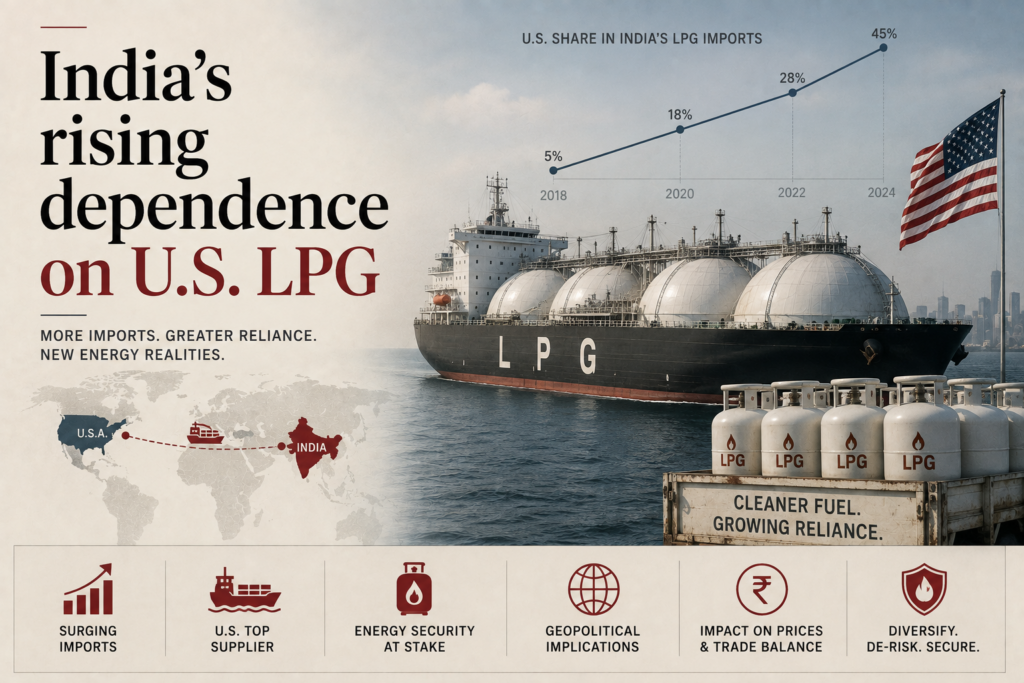
The Union Minister of Petroleum and Natural Gas stated that 67 per cent of India’s liquefied petroleum gas (LPG) now comes from the United States, a drastic shift from an earlier decision to source about 10 per cent of cooking gas there. The pivot, driven by the crisis in the Strait of Hormuz, exposes that LPG security cannot be anchored to a single geography while dependence on the United States carries risks of its own.
What is Liquefied Petroleum Gas (LPG) and how is India’s supply structured?
What it is: LPG is a mix of propane and butane used mainly as cooking gas in India. It is a politically volatile fuel because shortages carry direct social and political consequences.
Import dependence: India, the world’s second largest importer of LPG, imports about 60 per cent of the LPG it consumes, with nearly 90 per cent of that passing through the Strait of Hormuz.
Sourcing shift: State run refiners signed a long term deal for 2.2 million tonnes of United States LPG in 2026, raising the United States share to two thirds of imports.
Why did India pivot to United States LPG?
Hormuz disruption: Disruptions in the narrow Strait of Hormuz threatened the Gulf supply route through which most Indian LPG passes.
Collapse in West Asian flows: India’s LPG imports from West Asia fell almost 85 per cent between February and June 2026.
Partial offset: India replaced the lost flows by lifting imports from other sources, including the United States, from where June imports reached 0.77 million metric tonnes.
Availability over price: Because cooking gas is politically sensitive, the priority is making it available rather than optimising cost, so costlier United States cargoes became attractive during the crisis.
Why is overdependence on the United States risky?
Energy as leverage: Relying more on a partner that views ties through the lens of national interest risks energy being used as a bargaining tool in bilateral trade talks.
History of coercive tools: The United States has historically used financial sanctions, export controls, and technology denial as foreign policy tools, seen in Iran, Iraq, Cuba, North Korea, Syria, Russia, Venezuela, Myanmar, Libya, Sudan, and Afghanistan.
Third country reach:The Lindsey O. Graham Sanctioning Russia and Iran Act of 2026, proposing tariffs of up to 100 per cent on the top five buyers of Russian oil and natural gas, is a non tariff trade barrier that can influence third country transactions.
Monetary spillover: Import dependence complicates monetary policy, as elevated United States inflation could keep the Federal Reserve’s rates higher for longer, strengthening the dollar and raising the rupee cost of each cargo.
Why does proximity pricing matter?
Definition: Proximity pricing is a market benefit where goods cost less when bought from a nearby place. Shorter travel distance means lower shipping costs and faster delivery.
Loss of distance advantage: United States shipments take 25 to 35 days against 5 to 10 days from the Gulf, so India loses the advantage of proximity pricing.
Two price benchmarks: United States LPG is Mont Belvieu propane based, while West Asian supply follows the Saudi Aramco Contract Price, and the Gulf fuel is usually cheaper at the disembarking point due to the shorter distance.
Temporary reversal: Geopolitical risk has temporarily inflated West Asian supply costs, with the Saudi Contract Price rising from about 543 dollars per tonne in February to around 790 dollars in June, making United States cargoes competitive despite the longer voyage.
How does India balance availability with cost optimisation?
The core trade off: For a politically volatile fuel, ensuring supply outweighs cost optimisation, so India accepted higher priced United States cargoes to cut supply risk.
Residual exposure: India may have cut Hormuz risk, but remains exposed to commodity price, dollar, and freight risks.
Under recovery pressure: If domestic prices are held down while global prices rise amid rupee depreciation, oil companies’ under recoveries expand, worsening fiscal and external sector stress.
What are the challenges to India’s LPG security?
Single supplier concentration: Two thirds reliance on one country recreates the concentration risk the pivot was meant to solve.
Stagnant domestic output: LPG production has stayed nearly flat while consumption grows, widening the import gap.
Chokepoint vulnerability: Heavy dependence on the Strait of Hormuz leaves Gulf sourced volumes exposed to any regional conflict.
Fiscal drain: Accumulated under recoveries of state oil marketing companies exceeded Rs 59,000 crore as of 31 July 2026.
Currency and freight risk: Dollar denominated pricing and long shipping routes expose landed costs to exchange rate and freight swings.
Thin strategic reserves: India lacks large dedicated LPG strategic reserves to buffer sudden supply shocks.
Conclusion
Energy security is not about replacing one supplier with another but ensuring no single player holds all the cards. India must strengthen local production, bolster multiple supply chains, and build more strategic reserves. Australia offers a shorter Indo Pacific route outside Hormuz, though its export volumes remain small.
Back2Basics
Energy Security and LPG in India (Foundational Context)
About: Energy security means assured availability of energy at affordable prices with resilience against supply shocks. LPG security is a subset covering cooking gas access for households.
Scale: Public sector oil marketing companies serve 33.14 crore active domestic LPG customers, growing at a compound annual growth rate of 7.6 per cent between 2015 and 2026.
Consumption gap: LPG production was 4.3 million metric tonnes against consumption of 6.5 million metric tonnes in the first quarter of FY27, with the 2026-27 consumption estimate at 34,692 thousand metric tonnes.
Key Facts about India’s LPG Sector
Oil marketing companies: Indian Oil, Bharat Petroleum, and Hindustan Petroleum are the three public sector oil marketing companies distributing LPG.
PPAC: The Petroleum Planning and Analysis Cell tracks LPG consumption, customer base, and pricing data.
Crisis production ramp up: At the peak of the crisis, oil marketing companies raised cumulative daily LPG production from 34,000 metric tonnes to 55,000 metric tonnes.
Output jump: First quarter FY27 LPG production rose 35.73 per cent year on year to 4.26 million metric tonnes after refineries diverted propane and butane streams into the LPG pool.
Government Initiatives for LPG and Energy Security
Pradhan Mantri Ujjwala Yojana: Provides free LPG connections to women from below poverty line households to promote clean cooking.
PAHAL (DBTL): Directly transfers LPG subsidy to beneficiary bank accounts to curb diversion.
Strategic Petroleum Reserves: Underground crude storage to cushion supply disruptions.
Ethanol Blending Programme: Reduces import dependence in the broader energy basket.
Long term supply agreements: State refiner contracts diversifying LPG sourcing across geographies.
Way Forward
Boost domestic output: Maximise refinery LPG yield and invest in production capacity to narrow the import gap.
Diversify suppliers: Spread sourcing across the Gulf, the United States, Australia, and others to avoid single supplier dependence.
Hedge price and currency risk: Use financial instruments to manage commodity, dollar, and freight exposure.
Secure alternate routes: Develop supply chains outside the Strait of Hormuz to reduce chokepoint vulnerability.
PYQ Relevance
[UPSC 2025] “Energy security constitutes the dominant kingpin of India’s foreign policy, and is linked with India’s overarching influence in Middle Eastern countries.” How would you integrate energy security with India’s foreign policy trajectories in the coming years?
Linkage: The PYQ directly relates to energy security as a key driver of India’s foreign policy, especially in West Asia. India’s shift to US LPG highlights the need for supplier diversification, alternate routes and strategic autonomy in energy diplomacy.
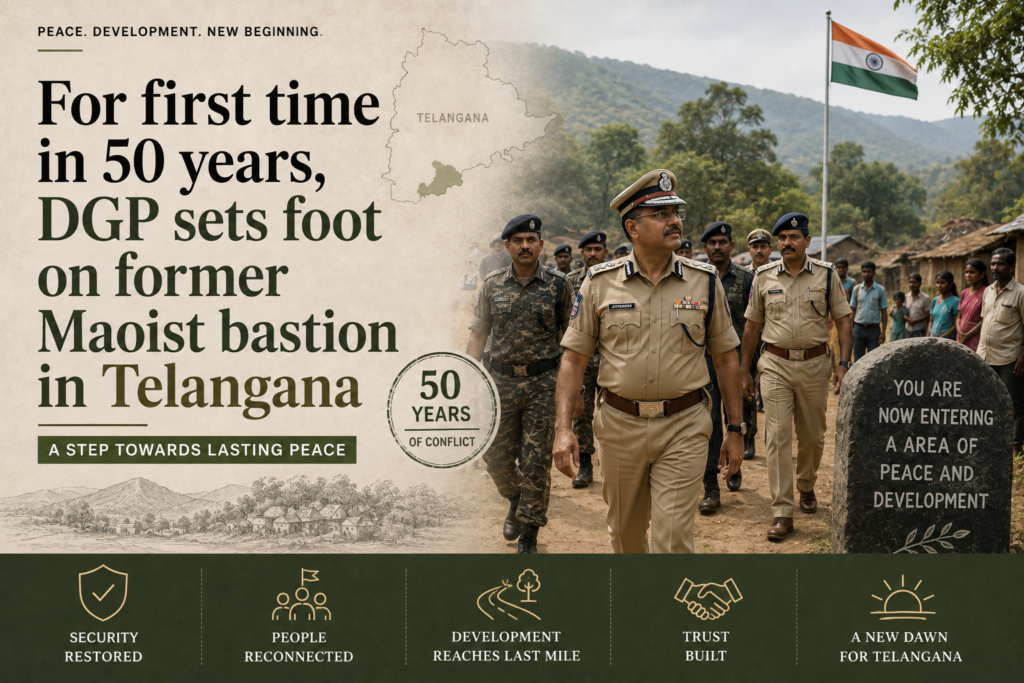
For the first time in 50 years, a Director General of Police set foot on the Telangana side of Karregutta, a hill once used to house Central Committee members of the banned Communist Party of India (Maoist). The visit marks the decline of Left Wing Extremism under Operation Kagar, with around 700 surrenders in Telangana and the top leadership largely killed, arrested, or surrendered.
What is Operation Kagar?
Definition:Operation Kagar is a coordinated anti-Maoist offensive launched by security forces in pursuit of the central government’s deadline for a Naxal-free India.
Scope: It combines intensified security operations with surrender-and-rehabilitation measures across the Maoist-affected belt.
Who are the CPI (Maoist)?
Definition: The Communist Party of India (Maoist), or CPI (Maoist), is a banned Left Wing Extremist organisation that seeks to overthrow the state through armed struggle.
Leadership: Its former General Secretary Muppala Lakshmana Rao, alias Ganapati, was the longest-serving general secretary of the outfit.
What happened at Karregutta?
The DGP’s visit: The Telangana Director General of Police entered the Telangana side of Karregutta accompanied by a large contingent of police and revenue personnel.
The message: The delegation’s size was meant to signal that it is now safe to visit the area, where earlier only specialised forces such as Greyhounds and COBRA units operated briefly during operations.
Tricolour hoisted: The contingent hoisted the national flag at the spot.
Tourism plan: The DGP announced the kaccha road into the forest would be tarred and the area developed into a tourist spot.
Surrender support: Surrendered Maoists are given a lump-sum grant, including the bounty announced on their heads, to start a new life.
What is the current status of the Maoist decline?
Surrenders: Around 700 Maoists surrendered in Telangana alone during the operation.
Leadership losses: By March 31, several Central Committee members of the CPI (Maoist) were killed, arrested, or had surrendered.
Top commander killed: Former General Secretary Nambala Keshava Rao, alias Basavaraju, was killed in a police encounter in May 2025.
Factional split: After Basavaraju’s death the party split into two factions, one led by Mallojula Venugopal Rao, alias Sonu, and another by Thippiri Tirupathi, alias Devuji, who later surrendered.
Few absconding: Only two to three top Maoists remain absconding, chief among them Ganapati.
Conclusion
A DGP entering Karregutta after five decades, followed by the hoisting of the Tricolour, signals the sharp decline of the Maoist movement in Telangana under Operation Kagar. With around 700 surrenders, the top leadership neutralised, and only a handful absconding, the insurgency’s organisational base has collapsed. The next milestone is the government’s deadline for a Naxal-free India and the rehabilitation of surrendered cadres into mainstream society.
Back2Basics:
Left Wing Extremism in India (Foundational Context)
About: Left Wing Extremism (LWE), also called Naxalism, is an armed insurgency by Maoist groups aiming to capture state power through violence.
Geography: It has historically concentrated in a forested tribal belt across Chhattisgarh, Jharkhand, Odisha, Telangana, and neighbouring States.
Nodal ministry: The Ministry of Home Affairs coordinates the national response through security and development measures.
Communist Party of India (Maoist)
Formation: Formed in 2004 through the merger of the People’s War Group and the Maoist Communist Centre of India.
Status: Designated a terrorist organisation under the Unlawful Activities (Prevention) Act, 1967.
Objective: Seeks to overthrow the Indian state through protracted armed struggle.
Armed wing: Operates the People’s Liberation Guerrilla Army.
Government Initiatives against LWE
SAMADHAN doctrine: An overarching strategy covering smart leadership, aggressive strategy, motivation, actionable intelligence, and technology.
Security Related Expenditure Scheme: Reimburses States for security operations, training, and rehabilitation of surrendered cadres.
Aspirational Districts Programme: Targets development in the most backward districts, many of them LWE-affected.
Road connectivity projects: The Road Requirement Plan and RCPLWE scheme build roads to open up affected areas.
Surrender and Rehabilitation Policy: Provides grants, vocational training, and support to those who lay down arms.
Key Facts about LWE
Shrinking footprint: The number of LWE-affected districts has fallen sharply over the past decade.
Declining violence: Incidents and casualties have dropped substantially with intensified operations.
Elite forces: Greyhounds of Telangana and Andhra Pradesh and the CoBRA units of the CRPF are specialised anti-Maoist forces.
Challenges in Countering LWE
Development deficit: Persistent gaps in roads, health, and education sustain grievances in affected areas.
Difficult terrain: Dense forests and hilly terrain aid guerrilla movement and hamper operations.
Tribal alienation: Displacement and land alienation feed recruitment among tribal populations.
Rehabilitation gaps: Surrendered cadres struggle to find a foothold in mainstream society.
Cross-border and inter-State movement: Cadres exploit State boundaries to evade coordinated action.
Way Forward
Sustained development: Extend roads, connectivity, and public services into cleared areas.
Robust rehabilitation: Ensure surrendered cadres receive grants, skills, and livelihoods.
Protect tribal rights: Implement the Forest Rights Act and Fifth Schedule protections effectively.
Consolidate security gains: Hold cleared areas and prevent the movement’s revival across State borders.
UPSC Relevance
[UPSC 2018] Left Wing Extremism (LWE) is showing a downward trend, but still affects many parts of the country. Briefly explain the Government of India’s approach to counter the challenges posed by LWE.
Linkage: The PYQ examines the Government’s approach to tackling Left Wing Extremism. Operation Kagar demonstrates the security and surrender components of this approach. The article also highlights the need for rehabilitation and development after security gains.