💥UPSC 2026, 2027, 2028 UAP Mentorship (March Batch) + Access XFactor Notes & Microthemes PDF

Type: IOCR

  • Foreign Policy Watch: India-China

    Tibetan Policy and Support Act (TPSA)

    Note4Students

    From UPSC perspective, the following things are important:

    Prelims level: Not Much

    Mains level: TIbetan issue

    The US and China sparred over Tibet and the South China Sea over the passing of the Tibetan Policy and Support Act (TPSA).

    Do you think that India’s support for the Tibetan cause is the root cause of all irritants in India-China relations?

    About TPSA

    • The TPSA once signed into law would make it the official policy of the US Government to oppose any effort by the govt. of the People’s Republic of China to select, educate, and venerate Tibetan Buddhist religious leaders in a manner inconsistent with Tibetan Buddhism.
    • The proposed legislation will empower the US Government to impose sanctions on China who might try to interfere in the process of selecting the next incarnation of the Dalai Lama.

    Why such a law?

    • Tibetans were concerned over the possibility of the Chinese Government making an attempt to install someone loyal to it as the 15th Dalai Lama after the death of the incumbent.
    • The PRC could use him as a puppet to fizzle out the global campaign against its occupation of Tibet.
    • The incumbent and the 14th Dalai Lama have been living in exile in India ever since his 1959 escape from Tibet, which had been occupied by the Chinese People’s Liberation Army (PLA) in 1950-51.
    • He has been leading the movement for “genuine autonomy” for Tibet and the Tibetans.

    Significance of TPSA

    • The TPSA acknowledged the legitimacy of the Tibetan Parliament in Exile elected by the exiled community as well as the CTA.
    • It seeks to introduce key provisions aimed at protecting the environment and water resources on the Tibetan Plateau.
    • In an aggressive move, the PRC government has forced resettlement of the nomads from grasslands.
    • TPSA recognizes the importance of traditional Tibetan grassland stewardship in mitigating the negative effects of climate change in the region.
    • In addition, it calls for greater international cooperation to monitor the environment on the Tibetan plateau.
  • WTO and India

    The many challenges for WTO

    Note4Students

    From UPSC perspective, the following things are important:

    Prelims level: WTO

    Mains level: WTO

    The next Director-General of the organization will have to navigate through a slew of thorny issues in WTO.

    WTO to lead by a woman for the first time

    • For the first time in its 25-year history, the World Trade Organization (WTO) will be led by a woman.
    • The D-G’s job will require perseverance and outstanding negotiating skills for balancing the diverse and varied interests of the 164 member countries, and especially, for reconciling competing for multilateral and national visions, for the organization to work efficiently.
    • The next D-G will have to grapple with the global economic fallout of the COVID-19 pandemic and work towards carrying out reforms of the multilateral trading system for reviving the world economy.
    • On all these issues, her non-partisan role will be watched carefully.

    Practice Question: In the wake of the global economic fallout of the COVID-19 pandemic, discuss the challenges ahead of WTO.

    Tussle between developed and developing countries

    • The current impasse in the WTO negotiations has led member countries to believe in the necessity of carrying out urgent reforms, which is likely to throw up some difficult choices for developing countries like India.
    • At the core of the divide within the WTO is the Doha Development Agenda, which the developed countries sought to move in favour of a new agenda that includes, amongst others, e-commerce, investment facilitation, MSMEs and gender.
    • Salvaging the ‘development’-centric agenda is critical for a large number of developing countries as they essentially see trade as a catalyst of development.
    • Restoring the WTO dispute settlement mechanism, especially the revival of its Appellate body, is also crucial for the organization’s efficient functioning.

    Definition of ‘Developing Country’ – a contentious issue

    • The push for a change in the definition of “developing country” under the principle of special and differential treatment (S&DT), aimed at upgrading certain developing countries, will deeply affect the status of emerging economies such as India, China, South Africa, Turkey, Egypt, etc.
    • The assumption that some countries have benefited immensely from the WTO rules since its formation in 1995 is flawed, at least in the case of India. And even if there may be no consensus of views on measuring ‘development’, India will remain a developing country no matter which parameter is used.
    • The way out for India could be to negotiate a longer phase-out period or an acceptable formula based on development indices, etc.

    Fisheries subsidies negotiations

    • Among the current negotiations at the WTO, the fisheries subsidies negotiations command the highest attention.
    • India can lead the way in finding a landing zone by urging others to settle for the lowest common denominator while seeking permanent protection for traditional and artisanal farmers who are at the subsistence level of survival.
    • The danger lies in seeking larger carve-outs, which could result in developed countries ploughing precious fisheries resources in international waters.

    Lessons from COVID-19

    • The COVID-19 crisis has revealed the urgent and enduring need for international cooperation and collaboration, as no country can fight the pandemic alone.
    • The D-G can help mitigate the effects of the pandemic by giving clear directions on ensuring that supply chains remain free and open, recommending a standard harmonized system with classification for vaccines, and by the removal of import/export restrictions.
    • Voluntary sharing and pooling of Intellectual Property Rights (IPR) is required for any global effort to tackle the pandemic, but with the fear of vaccine nationalism looming large, several countries are seeking to secure the future supply of leading COVID-19 vaccines.
    • India’sreiteration that its vaccine production and delivery capacity will help the whole of humanity will require the D-G to play a responsible role in removing barriers to intellectual property and securing a legal framework within the WTO TRIPS Agreement.
    • This can be done by lending salience to the effective interpretation of Articles 8 and 31 of the Agreement, that allow compulsory licensing and agreement of a patent without the authorization of its owner under certain conditions.

    Way Forward

    • The consensus-based decision-making in the WTO, which makes dissension by even one member stop the process in its track, gives developing countries some heft and influence at par with developed countries.
    • The D-G would need to tread cautiously on this front, as some will allude to the successful implementation of the Trade Facilitation Agreement in 2017 that allowed member countries to make commitments in a phased manner in accordance with their domestic preparedness.
    • Most imminently, the next D-G will need to build trust among its members that the WTO needs greater engagement by all countries, to stitch fair rules in the larger interest of all nations and thwart unfair trade practices of a few.
  • Human Development Report by UNDP

    Human Development Index (HDI) 2019

    Note4Students

    From UPSC perspective, the following things are important:

    Prelims level: HDI

    Mains level: Human Development

    India dropped two ranks in the United Nations’ Human Development Index this year, standing at 131 out of 189 countries.

    Try this PYQ:

    Which one of the following is not a sub-index of the World Bank’s ‘Ease of Doing Business Index’?

    (a) Maintenance of law and order

    (b) Paying taxes

    (c) Registering property

    (d) Dealing with construction permits

    Human Development Index (HDI)

    • HDI is a statistical tool used to measure a country’s overall achievement in its social and economic dimensions.
    • It is one of the best tools to keep track of the level of development of a country, as it combines all major social and economic indicators that are responsible for economic development.
    • Pakistani economist Mahbub-ul-Haq created HDI in 1990 which was further used to measure the country’s development by the United Nations Development Program (UNDP).
    • Every year UNDP ranks countries based on the HDI report released in their annual report.

    Various indicators under HDI

    • Calculation of the index combines four major indicators: life expectancy for health, expected years of schooling, mean of years of schooling for education and GNI per capita for the standard of living.

    For the first time: PHDI

    • For the first time, the UNDP introduced a new metric to reflect the impact caused by each country’s per-capita carbon emissions and its material footprint.
    • This is Planetary Pressures-adjusted HDI or PHDI.
    • It measured the amount of fossil fuels, metals and other resources used to make the goods and services it consumes.
    • The report found that no country has yet been able to achieve a very high level of development without putting a huge strain on natural resources.

    Highlights of the 2019 Report

    • Norway, which tops the HDI, falls 15 places if this metric is used, leaving Ireland at the top of the table.
    • In fact, 50 countries would drop entirely out of the “very high human development group” category, using this new metric PHDI.
    • Australia falls 72 places in the ranking, while the US and Canada would fall 45 and 40 places respectively, reflecting their disproportionate impact on natural resources.
    • The oil and the gas-rich Gulf States also fell steeply. China would drop 16 places from its current ranking of 85.

    Indian scenario

    • If the Index were adjusted to assess the planetary pressures caused by each nation’s development, India would move up eight places in the rankings.
    • China’s net emissions (8 gigatonnes) are 34% below its territorial emissions (12.5 gigatonnes) compared with 19% in India and 15% in Sub-Saharan Africa.
  • Climate Change Negotiations – UNFCCC, COP, Other Conventions and Protocols

    India’s Commitment for Paris Agreement

    Note4Students

    From UPSC perspective, the following things are important:

    Prelims level: Paris Agreement

    Mains level: Progress of global climate action

    This week marks the fifth anniversary of the Paris Agreement, where formidable climate diplomacy ushered 196 rich and poor countries into a legally binding treaty seeking to hold global heating below 2°C at this century’s end.

    Try this PYQ first, then head with the news:

    Q.With reference to the Agreement at the UNFCCC Meeting in Paris in 2015, which of the following statements is/are correct?

    1.    The Agreement was signed by all the member countries of the UN and it will go into effect in 2017.
    2.    The Agreement aims to limit the greenhouse gas emissions so that the rise in average global temperature by the end of this century does not exceed 20C or even 1.50C above pre-industrial levels.
    3.    Developed countries acknowledged their historical responsibility in global warming and committed to donate S 1000 billion a year from 2020 to help developing countries to cope with climate change.

    Select the correct answer using the code given below.

    (a)    1 and 3 only

    (b)    2 only

    (c)    2 and 3 only

    (d)    1, 2 and 3

    The Paris Agreement

    • The Paris Agreement is a legally binding international treaty on climate change. It was adopted by 196 Parties at COP 21 in Paris, on 12 December 2015 and entered into force on 4 November 2016.
    • Its goal is to limit global warming to well below 2, preferably to 1.5 degrees Celsius, compared to pre-industrial levels.
    • To achieve this long-term temperature goal, countries aim to reach global peaking of greenhouse gas emissions as soon as possible to achieve a climate-neutral world by mid-century.
    • It is a landmark process because, for the first time, a binding agreement brings all nations into a common cause to undertake ambitious efforts to combat climate change and adapt to its effects.

    How does it function?

    • Implementation of the Paris Agreement requires economic and social transformation, based on the best available science.
    • The Agreement works on a 5- year cycle of increasingly ambitious climate action carried out by countries.
    • By 2020, countries submit their plans for climate action known as nationally determined contributions (NDCs).

    NDCs

    • In their NDCs, countries communicate actions they will take to reduce their Greenhouse Gas emissions in order to reach the goals of the Paris Agreement.
    • Countries also communicate in the NDCs actions they will take to build resilience to adapt to the impacts of rising temperatures.

    Long-Term Strategies

    • To better frame the efforts towards the long-term goal, the Paris Agreement invites countries to formulate and submit by 2020 long-term low greenhouse gas emission development strategies (LT-LEDS).
    • LT-LEDS provide the long-term horizon to the NDCs. Unlike NDCs, they are not mandatory.
    • Nevertheless, they place the NDCs into the context of countries’ long-term planning and development priorities, providing a vision and direction for future development.

    India’s commitment

    In 2015, ahead of the UN significant climate conference in Paris, India announced three major voluntary commitments called the Nationally Determined Contributions (NDC):

    1. Improving the emissions intensity of its GDP by 33–35% by 2030 over 2005 levels
    2. Increasing the share of non-fossil fuels-based electricity to 40% by 2030 and
    3. Enhancing its forest cover, thereby absorbing 2.5 to 3 billion tonnes of carbon dioxide

    A success (?)

    • The Environment Minister said that we have achieved 21% of its emissions intensity reduction target as a proportion of its GDP in line with its pledge to a 33-35% reduction by 2030.
    • India was the only major G20 country that was on track towards keeping to its nationally determined commitments to halt runaway global warming.
  • Wildlife Conservation Efforts

    Voluntary Disclosure of Exotic Pets

    Note4Students

    From UPSC perspective, the following things are important:

    Prelims level: CITES

    Mains level: Exotic species trade

    Last month, the Supreme Court upheld an Allahabad High Court order granting immunity from investigation and prosecution if one declared illegal acquisition or possession of exotic wildlife species.

    Q.What are Zoonotic Diseases? Discuss how the illicit trade in wildlife has resulted in the spread of zoonotic diseases of the scale of the ongoing COVID-19?

    Voluntary disclosure scheme

    • The MoEFCC has come out with an advisory on a one-time voluntary disclosure amnesty scheme.
    • It allows owners of exotic live species that have been acquired illegally, or without documents, to declare their stock to the government between June and December 2020.
    • The scheme aims to address the challenge of zoonotic diseases and regulate their import. In its current form, however.
    • It shall develop an inventory of exotic live species for better compliance under the Convention on International Trade in Endangered Species of Wild Fauna and Flora (CITES).
    • However, the amnesty scheme is just an advisory, not a law

    What kind of exotic wildlife is covered?

    • The advisory has defined exotic live species as animals named under the Appendices I, II and III of the CITES.
    • It does not include species from the Schedules of the Wild Life (Protection) Act 1972.
    • So, a plain reading of the advisory excludes exotic birds from the amnesty scheme.

    Why need such a scheme?

    • The Directorate of Revenue Intelligence (DRI), which enforces anti-smuggling laws, says India has emerged as a big demand centre for exotic birds and animals.
    • There has been an increase in smuggling of endangered species from different parts of the world.
    • Most of these exotic wildlife is imported through Illegal channels and then sold in the domestic market as pets.
    • The long international border and air routes are used to source consignments from Bangkok, Malaysia and other top tourist destinations in South East Asia, as well as from Europe into India.

    Back2Basics: CITES

    • CITES stands for the Convention on International Trade in Endangered Species of Wild Fauna and Flora.
    • It is as an international agreement aimed at ensuring “that international trade in specimens of wild animals and plants does not threaten their survival”.
    • It was drafted after a resolution was adopted at a meeting of the members of the International Union for Conservation of Nature (IUCN) in 1963.
    • It entered into force on July 1, 1975, and now has 183 parties.
    • The Convention is legally binding on the Parties in the sense that they are committed to implementing it; however, it does not take the place of national laws.
    • India is a signatory to and has also ratified CITES convention in 1976.

    CITES Appendices

    • CITES works by subjecting international trade in specimens of selected species to certain controls.
    • All import, export, re-exports and introduction from the sea of species covered by the convention has to be authorized through a licensing system. It has three appendices:
    1. Appendix I includes species threatened with extinction. Trade-in specimens of these species are permitted only in exceptional circumstances.
    2. Appendix II provides a lower level of protection.
    3. Appendix III contains species that are protected in at least one country, which has asked other CITES Parties for assistance in controlling trade.
  • Foreign Policy Watch: United Nations

    UN Population Award for 2020

    Note4Students

    From UPSC perspective, the following things are important:

    Prelims level: UN Population Award

    Mains level: Not Much

    HelpAge India has been presented the UN Population Award for 2020 (institutional category), according to a release issued by UNFPA.

    Try this PYQ:

    Q.The Partnership for Action on Green Economy (PAGE), a UN mechanism to assist countries transition towards a greener and more inclusive economies, emerged at:

    (a) The Earth Summit on Sustainable Development 2002, Johannesburg

    (b) The United Nations Conference on Sustainable Development 2012, Rio de Janeiro

    (c) The United Nations Framework Convention on Climate Change 2015, Paris

    (d) The World Sustainable Development Summit 2016, New Delhi

    UN Population Award

    • Each year, the Committee for the UNPA honours an individual and/or institution in recognition of outstanding contributions to population and reproductive health questions and to their solutions.
    • The Award was established by the General Assembly in 1981, in resolution 36/201, and was first presented in 1983. It consists of a gold medal, a diploma and a monetary prize.
    • The Committee for the Award is comprised of 10 UN Member States, with UN Secretary-General and UNFPA Executive Director serving as ex-officio members.
    • Nominations for the award are accepted through 31 December of each year.

    Whats’ so special this year?

    • For the first time in the history of the UNPA, the honour is being conferred on an Indian institution.
    • HelpAge India, which has been working for ‘the cause and care of disadvantaged older persons to improve their quality of life’ for over four decades, is the first Indian institution to receive this award.
    • The last time the Award came to an Indian was 28 years ago, back in 1992, when it was awarded to Mr J.R.D. Tata as an individual laureate.
  • Climate Change Negotiations – UNFCCC, COP, Other Conventions and Protocols

    A History of Climate Change Negotiations

    Note4Students

    From UPSC perspective, the following things are important:

    Prelims level: Various COPs, UNFCCC

    Mains level: Progress of global climate action

    China’s announcement of achieving net-zero by 2060 is a stepping stone in the fight against climate change. But it means nothing until countries share the goals they intend to follow.

    Why are we reading this news?

    We often get to hear that UPSC suddenly switches to basics after maneuvering over current affairs. This news is a perfect example which strikes the balance between basics and current affairs.

    Climate change: A disaster in making

    • Anthropogenic climate change can be traced back to the industrial revolution.
    • The atmospheric concentration of carbon dioxide equivalent (CO2e) greenhouse gas has increased to 415 parts per million (ppm) from 280 ppm since then.
    • A global momentum, therefore, was required to get all countries on board.

    Realization of climate action: Birth of UNFCCC

    • The idea led to the formation of the United Nations Framework for Climate Change Convention (UNFCCC, also known as ‘The Convention’) in 1992, at the Earth Summit in Rio de Janeiro.
    • The convention divided the countries on the basis of their differing commitments: Annex I and II consisted of industrialized and developed countries and Non-Annex I comprised developing countries.

    Wait! You need not remember everything* in this newscard. But, have walk through the timeline; it will concretize your idea about the global climate action and the possible way forward.

    A timeline

    The Conference of Parties (CoP) is the supreme decision-making body at the convention and comprises states that are party to it.

    COP 1:

    • At CoP1 in Berlin 1995, the Convention highlighted the shortcomings of UNFCCC — the voluntary nature of the agreement.
    • It stressed how no substantive action was taken to address the cause against climate change, which in turn put forward the need for “legally binding” actions.

    COP 2:

    The proposal of legally binding targets was further emphasised upon in COP2 in Geneva in 1996.

    COP 3:

    • In COP3 in Kyoto in 1997, the legally binding targets were approved of by different countries. They came to be known as the Kyoto Protocol.
    • It is considered to be one of the most important steps despite its late acceptance for it paved the way for further negotiations through legally binding targets for Annex I countries and establishment of carbon markets.
    • The mechanisms proposed by Kyoto Protocol to reduce emissions included Joint Implementation, Clean Development Mechanisms (CDM) and Emissions Trading.

    COP 4 and COP 5:

    In COP4 in 1998 and COP5 in 1999, the rulebook for implementing the Kyoto Protocol was on the process with the adoption of the Buenos Aires Plan of Action in COP4, along with continued negotiation efforts in COP5.

    COP 7:

    • In COP7 in Marrakesh in 2001, the guidelines for flexible mechanisms of joint implementation, CDM markets, emissions trading was agreed upon. It came to be known as the Marrakesh Accord.
    • It was particularly important because mitigation efforts had already started and special attention was given to developing countries.
    • It asked them to build their capacities and ensuring technology transfer through least developed countries (LDC) Fund, special climate change fund (SCCF) and adaptation fund.

    COP 8:

    The COP8 in 2002, which was held in “New Delhi”, emphasised on adaptation measures and stressed that poverty alleviation and development were the utmost priority of developing countries.

    COP 10:

    • The future course of action was discussed in COP10 in Montreal in 2005 after Russia ratified the Protocol in 2004 at COP10 in Argentina.
    • A two-track approach was formed, which included the constructive implementation of UNFCCC as well as formation an ad-hoc committee for the Kyoto Protocol.

    COP 15:

    • Copenhagen COP 2009 was set by the ad-hoc working group on Kyoto protocol formed during Montreal COP 2005.
    • The group agreed to have a deal in 2009 regarding a legally binding climate regime from 2012-2020.
    • The discussions lost track when developed countries started advocating for burden-sharing with developing countries.

    COP 16:

    • The disappointment of Copenhagen was turned into an opportunity in Cancun 2010, where the Copenhagen Accord was accepted.
    • It looked forward to a second commitment period for the Kyoto Protocol and established the Cancun Adaptation Framework.
    • For the first time, a temperature target of 2 degrees Celsius was included. The Green climate fund was formed and developed countries agreed to contribute.

    COP 17:

    • Following Cancun, Durban COP 2011 took place wherein the seed of the Paris Agreement was sown.
    • The seed started sprouting in Doha COP 2012, where countries decided to avoid the gap between Kyoto and next legal climate regime.
    • So, the second regime of Kyoto was decided from 2012-2020. The third pillar of loss and damage was incorporated for the first time.

    COP 20:

    In COP in Lima in 2014, countries submitted their own climate ambitions in the form of intended nationally determined contributions (INDCs).

    COP 21: The Pathbreaker

    • In 2015, the Paris agreement was finally adopted and the INDCs were annexed to it.
    • It was agreed that the Paris agreement would start from 2021.
    • 2015 was known as a year of multilateral agreements because, in addition to the Paris agreement, sustainable development goals and Sendai Framework was also adopted.
    • 2015, therefore, came out to be a successful year.

    Post Paris Agreement

    • The retreat of developed countries: In all these post-2020 talks, developed countries tactfully avoided their pre-2020 commitments by not ratifying the Kyoto protocol.
    • Post-Paris discussions for the finalization of the Rulebook began.
    • Most were finalised in 2018, except the market mechanism and measurement, reporting and verification (MRV) of greenhouse gas which are due in COP26 in 2021.

    Agenda for next COP in 2021

    • The next COP will be in 2021 in Glasgow with two sets of agendas for discussion.
    • The first will be to complete the rule-book of Paris Agreement implementation, whose two aspects regarding Sustainable Development Mechanism (SDM) architecture and MRV framework are yet to be completed.
    • The second will be to ensure smooth implementation of the Paris Agreement from 1st January 2021.
    • Countries are expected to revise their NDCs as the present course of activities is projected to cause an increase in temperature of 2.8-3 C rise.

    The situation today: Nothing beyong big promises

    • China’s recent announcement of achieving net-zero by 2060 comes across as the stepping stone of future climate change mitigation efforts.
    • Political announcements, however, mean nothing until countries actually share the goals they intend to follow.
    • On the contrary, India is the only country whose NDCs are in line with the 2 degrees Celsius target.
    • Another substantial happening in the domain of climate change includes Joe Biden’s promise of joining the Paris Agreement; it would bring the US back to the GCF fund.

  • Climate Change Impact on India and World – International Reports, Key Observations, etc.

    Climate Change Performance Index (CCPI) 2020

    Note4Students

    From UPSC perspective, the following things are important:

    Prelims level: Climate Change Performance Index (CCPI)

    Mains level: India's committment for climate action

    India ranked high along with the European Union and the United Kingdom in the latest edition of the Climate Change Performance Index (CCPI) 2020 released by non-profit Germanwatch.

    It’s a very rare feat that India has performed so better in any climate-related index. We can use this data to highlight India’s dedicated efforts for Paris Agreement.

    Climate Change Performance Index (CCPI)

    • The CCPI is an independent monitoring tool for tracking countries’ climate protection performance. It has been published annually since 2005.
    • It evaluates 57 countries and the European Union, which together generate 90%+ of global greenhouse gas emissions.
    • Using standardised criteria, the CCPI looks at four categories, with 14 indicators: Greenhouse Gas Emissions (40% of the overall score), Renewable Energy (20%), Energy Use (20%), and Climate Policy (20%).
    • The CCPI’s unique climate policy section evaluates countries’ progress in implementing policies working towards achieving the Paris Agreement goals.

    Global scenario

    • No country was doing enough to meet the goals of the 2015 Paris Agreement, according to the index.
    • Six G20 countries were ranked among very low performers. The United States, with a rank of 61, was the worst performer.

    India’s performance

    • India, for the second time in a row, continued to remain in the top 10. The country scored 63.98 points out of 100.
    • It received high ratings on all CCPI indicators except ‘renewable energy’, where it was categorised as having a ‘medium’ performance.
    • Last year, India had been ranked at the ninth position, with an overall score of 66.02.
    • India needed to focus more on renewable energy, both, as a mitigation strategy and for its post-novel coronavirus disease (COVID-19) green recovery, the report said.

    Renewable energy

    • No country was rated very high on indicators defining the ‘renewable energy’ category.
    • India has been ranked at 27th out of 57 countries under the category this time. Last year, it was ranked at 26th.
    • India’s performance has been rated as ‘medium’ for its current share of renewable energy. Its performance for the development of renewable energy supply during the last year was rated as ‘high’.

    A positive sign for India

    • India’s improved policy framework has been responsible for the country’s good performance in this global index. However, the report underlined the need for long-term planning.
    • Unlike the other two ‘BASIC’ countries of China and South Africa, India is yet to announce its mitigation strategy.
  • Health Sector – UHC, National Health Policy, Family Planning, Health Insurance, etc.

    UN removes Cannabis from ‘Most Dangerous Drug’ Category

    Note4Students

    From UPSC perspective, the following things are important:

    Prelims level: Cannabis

    Mains level: Cannabis and its de-regulation

    The United Nations Commission on Narcotic Drugs (CND) voted to remove cannabis and cannabis resin from Schedule IV of the 1961 Single Convention on Narcotic Drugs, decades after they were first placed on the list.

    Q. Too much de-regulation of Cannabis could lead to its mass cultivation and a silent economy wreaking havoc through a new culture of substance abuse in India. Critically analyse.

    What is Cannabis?

    • Cannabis, also known as marijuana among other names, is a psychoactive drug from the Cannabis plant used primarily for medical or recreational purposes.
    • The main psychoactive component of cannabis is tetrahydrocannabinol (THC), which is one of the 483 known compounds in the plant, including at least 65 other cannabinoids, including cannabidiol (CBD).
    • It is used by smoking, vaporizing, within the food, or as an extract.

    UN’s decision and India

    • Currently in India, the Narcotic Drugs and Psychotropic Substances (NDPS) Act, 1985, illegalizes any mixture with or without any neutral material, of any of the two forms of cannabis – charas and ganja — or any drink prepared from it.
    • The WHO says that cannabis is by far the most widely cultivated, trafficked and abused illicit drug in the world. But the UN decision could influence the global use of medicinal marijuana,
    • India was part of the voting majority, along with the US and most European nations.
    • China, Pakistan and Russia were among those who voted against, and Ukraine abstained.

    Cannabis in India

    In India, cannabis, also known as bhang, ganja, charas or hashish, is typically eaten (bhang golis, thandai, pakoras, lassi, etc.) or smoked (chillum or cigarette).

    Under international law

    • The Vienna-based CND, founded in 1946, is the UN agency mandated to decide on the scope of control of substances by placing them in the schedules of global drug control conventions.
    • Cannabis has been on Schedule IV–the most dangerous category– of the 1961 Single Convention on Narcotic Drugs for as long as the international treaty has existed.

    Fuss over Cannabis

    • Cannabis has various mental and physical effects, which include euphoria, altered states of mind and sense of time, difficulty concentrating, impaired short-term memory and body movement, relaxation, and an increase in appetite.
    • But global attitudes towards cannabis have changed dramatically, with many jurisdictions permitting cannabis use for recreation, medication or both, despite it remaining on Schedule IV of the UN list.
    • Currently, over 50 countries allow medicinal cannabis programs, and its recreational use has been legalized in Canada, Uruguay and 15 US states.

    Impact of the decision

    • The reclassification of cannabis by the UN agency, although significant, would not immediately change its status worldwide as long as individual countries continue with existing regulations.
    • The decision would add momentum to efforts for decriminalizing cannabis in countries where its use is most restricted, while further legalizing the substance in others.
    • Scientific research into marijuana’s medicinal properties is also expected to grow.
    • Legalising and regulating cannabis will “undermine criminal markets” as well as its smuggling and cultivation.

    Risks of Legalizing Cannabis

    (1) Health risks continue to persist

    • There are many misconceptions about cannabis. First, it is not accurate that cannabis is harmless.
    • Its immediate effects include impairments in memory and in mental processes, including ones that are critical for driving.
    • Long-term use of cannabis may lead to the development of addiction of the substance, persistent cognitive deficits, and of mental health problems like schizophrenia, depression and anxiety.
    • Exposure to cannabis in adolescence can alter brain development.

    (2) A new ‘tobacco’ under casualization

    • A second myth is that if cannabis is legalized and regulated, its harms can be minimized.
    • With legalization comes commercialization. Cannabis is often incorrectly advertised as being “natural” and “healthier than alcohol and tobacco”.
    • Tobacco, too, was initially touted as a natural and harmless plant that had been “safely” used in religious ceremonies for centuries.

    Way ahead

    • It’s important to make a distinction between legalization, decriminalization and commercialization.
    • While legalization and decriminalization are mostly used in a legal context, commercialization relates to the business side of things.
    • For India to liberalise its policy on cannabis, it should ensure that there are enough protections for children, the young, and those with severe mental illnesses, who are most vulnerable to its effects.
  • Wetland Conservation

    World Heritage Irrigation Structure (WHIS) Sites

    Note4Students

    From UPSC perspective, the following things are important:

    Prelims level: World Heritage Irrigation Structure (WHIS)

    Mains level: Old irrigation systems in India

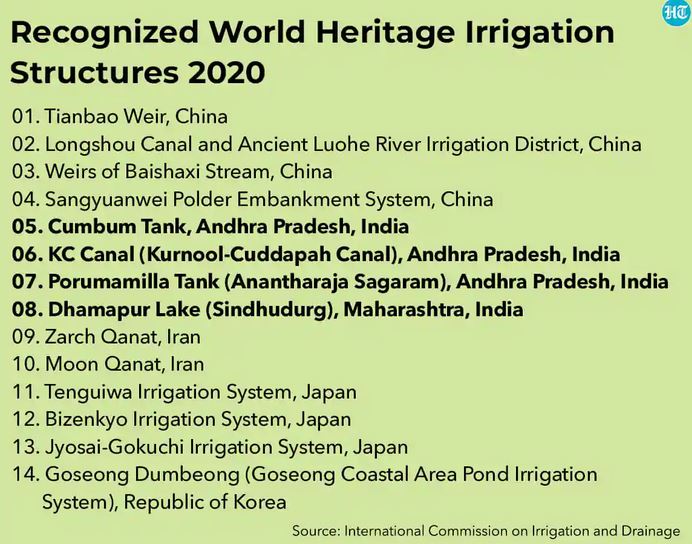
    Four sites in India have received the World Heritage Irrigation Structure (WHIS) tag this year.

    Try this PYQ:

    Q.The FAO accords the status of ‘Globally Important Agricultural Heritage Systems (GIAHS)’ to traditional agricultural systems. What is the overall goal of this initiative?

    1. To provide modern technology, training in modern farming methods and financial support to local communities of identified GIAHS so as to greatly enhance their agricultural productivity.
    2. To identify and safeguard eco-friendly traditional farm practices and their associated landscapes, agricultural biodiversity and knowledge systems of the local communities.
    3. To provide Geographical Indication status to all the varieties of agricultural produce in such identified GIAHS.

    Select the correct answer using the code given below:

    (a) 1 and 3 only

    (b) 2 only

    (c) 2 and 3 only

    (d) 1, 2 and 3

    World Heritage Irrigation Structure (WHIS)

    • The International Commission on Irrigation and Drainage (ICID) annually recognizes irrigation structures of international significance like UNESCO’s World Heritage Sites.
    • The recognition is aimed at recognizing and tracing the history of and understanding the evolution of irrigation in civilizations across the world.
    • It also aims at understanding the philosophy and wisdom on sustainable irrigation from these structures and to preserve them for posterity.

    Criteria for consideration

    • Major criteria for WHIS entail that a structure should be more than 100 years old, should be functional, achieving food security and have archival value.
    • Each site is evaluated based on its merits first by the state government.
    • The proposal is then sent to the Centre and a team from CWC carries out an on-ground survey to verify details.

    Which are the Indian sites?

    • The sites are Cumbum Tank, Kurnool-Cuddapah Canal, Porumamilla Tank (Anantharaja Sagaram) in Andhra Pradesh and 490-year-old Dhamapur Lake in Maharashtra’s Sindhudurg district.
    • In 2018, Pedda Cheru Tank in Kamareddy district and Sadarmat Anicut in Nirmal district, both in Telangana, were named as WHIS sites.

    Other sites

    • The rest include Tianbao Weir in China at number one followed by Longshou Canal and ancient Luohe river irrigation district, China.
    • It also includes Zarch and Moon Qanat both in Iran and Tenguiwa, Bizenkyo and Jyosai Gokuchi irrigation systems in Japan with Goseong Dumbeong in the Republic of Korea.

    About ICID

    • The ICID, established in 1950 is a leading scientific, technical, international not-for-profit, non-governmental organization.
    • It is a professional network of experts from across the world in the field of irrigation, drainage, and flood management.
    • The main mission is to promote ‘Sustainable agriculture water management’ to achieve ‘Water secure world free of poverty and hunger through sustainable rural development’.
    • ICID mission covers the entire spectrum of agricultural water management practices ranging from rainfed agriculture to supplemental irrigation, land drainage, deficit irrigation to full irrigation, etc.