💥UPSC 2026, 2027, 2028 UAP Mentorship (March Batch) + Access XFactor Notes & Microthemes PDF

Type: Prelims Only

  • Tuberculosis Elimination Strategy

    ICMR develops CRISPR Cas-based TB Detection Kit

    Note4Students

    From UPSC perspective, the following things are important:

    Prelims level: TB, CRISPR Cas-based TB Detection Kit

    Why in the News?

    The Indian Council of Medical Research (ICMR) Regional Medical Research Centre for North East has developed the “world’s cheapest CRISPR Cas-based TB testing system”.

    Back2Basics: CRISPR-Cas9 Technology

    • CRISPR-Cas9 stands for Clustered Regularly Interspaced Short Palindromic Repeats and CRISPR-associated protein 9.
    • It is a technology that allows geneticists and researchers to edit parts of the genome by altering sections of the DNA sequence.
    • Emmanuelle Charpentier and Jennifer Doudna’s work on CRISPR-Cas9 as a ‘molecular scissor’ earned them the 2020 Nobel Prize in chemistry.
    • The system consists of two key components:
    1. Cas9: This is the enzyme that acts like a pair of molecular scissors. It is responsible for cutting the DNA strand at a specific location, allowing for the removal, addition, or alteration of DNA at that site.
    2. Guide RNA (gRNA): This is a piece of RNA that is designed to find and bind to a specific sequence of DNA that matches its code. The gRNA guides the Cas9 enzyme to the exact spot in the genome where an edit is desired.
    • Mechanism:
      • The process begins with the design of a gRNA that matches the DNA sequence where an edit is needed.
      • Once inside the cell, the Cas9 enzyme and the gRNA form a complex that can identify and bind to the target DNA sequence.
      • The Cas9 then cuts the DNA at this location.
      • After the DNA is cut, the cell’s natural repair mechanisms can be harnessed to add or remove genetic material, or to make specific changes to the DNA.
    • Applications: Used for gene editing to correct genetic disorders, develop targeted cancer therapies, enhance diagnostics for infectious diseases, and create personalized medicine approaches.

    About the New TB Detection System

    • The system can detect TB bacteria using DNA from a patient’s saliva at a very low cost.
      • Specific DNA sequences unique to Mycobacterium tuberculosis (the bacteria causing TB) are identified.
    • It can identify the bacteria in preliminary stages and test over 1,500 samples simultaneously within approximately two hours.
    • The technology is simple enough to be used in primary health centres in villages.

    TB Situation in India:

    • TB kills an estimated 480,000 Indians annually, or over 1,400 patients every day.
    • India has more than a million ‘missing’ TB cases each year, which remain undiagnosed or inadequately diagnosed and treated in the private sector.

    National Goals for Elimination of TB: 

    • Pradhan Mantri TB Mukt Bharat Abhiyan (2022): It is stipulated to meet the goal of ending the TB epidemic by 2025 from the country, five years ahead of the Sustainable Development Goals (SDG) for 2030.
    • Nikshay Poshan Yojana (2018): Launched in 2018, this scheme provides nutritional support to TB patients. Under this scheme, TB patients receive a direct benefit transfer (DBT) of Rs. 500 per month to purchase food.

    PYQ:

    [2019] What is Cas9 Protein that is often mentioned in news?

    (a) A molecular scissors used in targeted gene editing

    (b) A biosensor used in the accurate detection of pathogens in patients

    (c) A gene that makes plants pest-resistant

    (d) A herbicidal substance synthesized in genetically modified crops

    [2014] Can overuse and free availability of antibiotics without Doctor’s prescription, be contributors to the emergence of drug-resistant diseases in India? What are the available mechanisms for monitoring and control? Critically discuss the various issues involved.

  • Global Geological And Climatic Events

    Typhoon Gaemi 

    Note4Students

    From UPSC perspective, the following things are important:

    Prelims level: Typhoon Gaemi

    Why in the News?

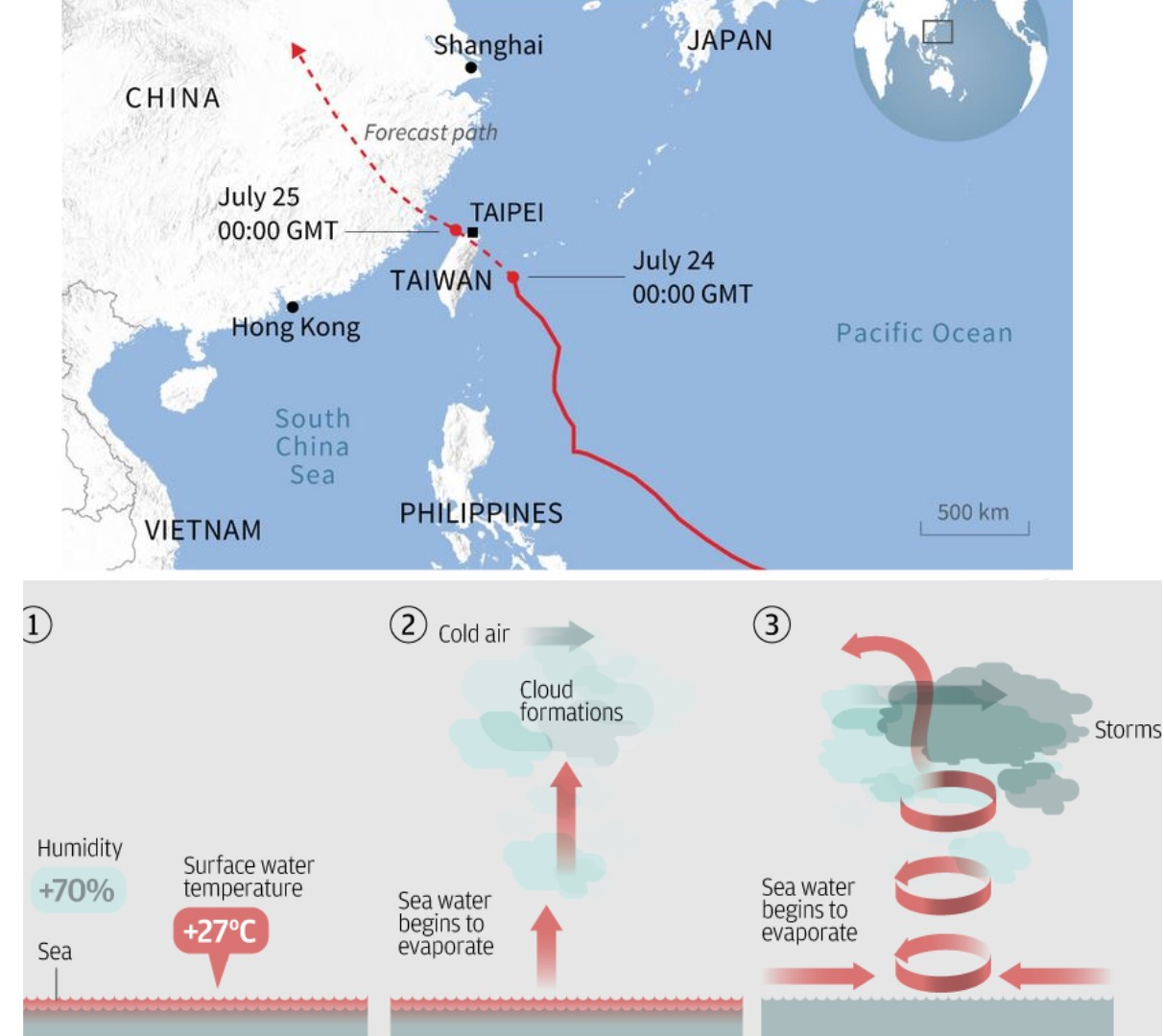
    After making landfall in the Philippines, Typhoon Gaemi is heading towards Taiwan.

    What is a Typhoon?

    • A typhoon is a mature tropical cyclone that forms in the Northwest Pacific Ocean, primarily between 100°E and 180°E.
    • It is characterised by strong winds, and heavy rain, and can cause significant damage due to high wind speeds, storm surges, and flooding.

    Factors causing its formation:

    • It needs sustained ocean temperatures of 26.5°C or higher.
    • High moisture content in the mid-troposphere.
    • Presence of the Coriolis force to initiate rotation.
    • Minimal vertical wind shear to allow for storm growth.
    • Atmospheric instability to promote rising motion and thunderstorm activity.
    • An initial low-pressure area or tropical wave to trigger development.
      • Formation Regions: Northwest Pacific Ocean in areas east of the Philippines, southeast of Japan, and near Taiwan; South China Sea and in Western North Pacific near the Mariana Islands and Guam.
    Note: Typhoons do not form in the South Atlantic Ocean and the southeastern Pacific Ocean because of cooler sea surface temperatures and higher wind shear in those regions.


    PYQ:

    [2015] In the South Atlantic and South-Eastern Pacific regions in tropical latitudes, cyclone does not originate. What is the reason?

    (a) Sea surface temperatures are low
    (b) Inter-Tropical Convergence Zone seldom occurs
    (c) Coriolis force is too weak
    (d) Absence of land in those regions

  • Housing for all – PMAY, etc.

    Right to Shelter is a Fundamental Right: Supreme Court     

    Note4Students

    From UPSC perspective, the following things are important:

    Prelims level: Article 21, Article 19(1)(e), Right to Shelter

    Why in the News?

    The Supreme Court emphasised the need to balance railway infrastructure development in Haldwani, Uttarakhand, with the fundamental right to shelter nearly 50,000 people accused of illegally encroaching on railway land.

    What was the Case?

    • The hearing was based on an application filed by the Railways seeking to modify a January 2023 Supreme Court order.
    • The order had stayed a Uttarakhand HC direction to evict the families within a week, even using paramilitary forces.
    • The application pointed out that the Ghaula River flood has disrupted railway operations in the region and that more land was urgently needed to lay new tracks.

    What is the Right to Shelter?

    • The right to shelter is derived from the Right to Life under Article 21 of the Constitution of India, which guarantees the protection of life and personal liberty.
    • Article 19(1)(e) provides the Right to reside and settle in any part of the territory of India.

    Judicial pronouncements related to it:

    • Olga Tellis v. Bombay Municipal Corporation (1985): The Supreme Court recognized the right to livelihood as a part of the right to life under Article 21.
    • Chameli Singh v. State of Uttar Pradesh (1996): The Supreme Court declared that the right to shelter is a fundamental right under Article 21. It includes adequate living space, safe and decent structures, clean surroundings, light, air, water, electricity, and sanitation.
    • Ahmedabad Municipal Corporation v. Nawab Khan Gulab Khan (1997): The Supreme Court directed the state to construct affordable houses for the poor, reiterating the state’s duty to provide shelter and make the right to life meaningful.

    Various Legislations supporting the Right to Shelter:

    • The Scheduled Tribes and Other Traditional Forest Dwellers (Recognition of Forest Rights) Act, 2006
    • The Right to Fair Compensation and Transparency in Land Acquisition, Rehabilitation and Resettlement Act, 2013
    • The Slum Areas (Improvement and Clearance) Act, 1956


    PYQ:

    [2021] Consider the following statements :​

    1. ‘Right to the City’ is an agreed human right and the UN-Habitat monitors the commitments made by each country in this regard.​
    2. ‘Right to the City’ gives every occupant of the city the right to reclaim public spaces and public participation in the city.​
    3. ‘Right to the City’ means that the State cannot deny any public service or facility to the unauthorized colonies in the city.​

    Which of the statements given above is/are correct?

    (a) 1 only

    (b) 3 only

    (c) 1 and 2

    (d) 2 and 3

  • Modern Indian History-Events and Personalities

    [pib] Birth Anniversary of Chandrashekhar Azad and Lokmanya Tilak  

    Note4Students

    From UPSC perspective, the following things are important:

    Prelims level: Contributions of Chandrashekhar Azad and Lokmanya Tilak

    Why in the News?

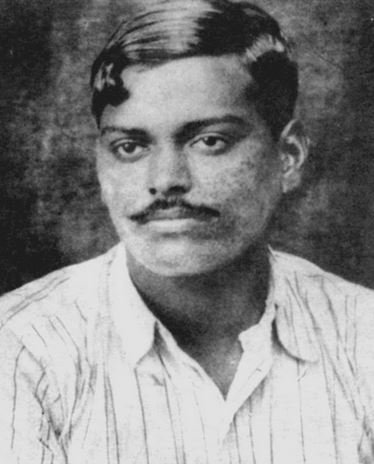
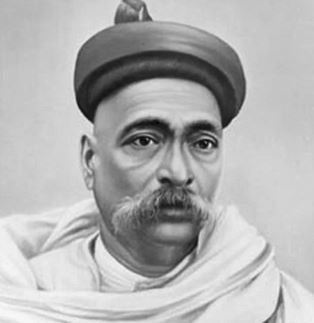
    Prime Minister paid his tributes to legendary freedom fighters Bal Gangadhar Tilak and Chandra Shekhar Azad on their birth anniversaries.

    About Chandrashekhar Azad and Lokmanya Tilak  

    [1] Chandrashekhar Azad:

    Details:
    • Born Chandra Shekhar Tiwari on 23 July 1906;
    • Indian revolutionary leader of HSRA;
    • Died 27 February 1931.
    Early Life
    • From Bardarka, Uttar Pradesh;
    • Joined Non-Cooperation Movement at 15;
    • Famously declared his name as “Azad” when arrested.
    Revolutionary Life
    • Joined Hindustan Republican Association (HRA), participated in Kakori Train Robbery, avenged Lala Lajpat Rai’s death;
    • Reorganized HRA into Hindustan Socialist Republican Association (HSRA);
    • Influenced by socialist literature.
    Support from Congress Financially supported by Motilal Nehru.
    Activities in Jhansi Used Jhansi as a base, practiced shooting, lived as Pandit Harishankar Bramhachari, taught children, connected with local revolutionaries.
    Collaboration with Bhagat Singh Reorganized HRA into HSRA, planned to assassinate James A. Scott, mistakenly killed John P. Saunders.
    Death Surrounded by police in Alfred Park, Allahabad;

    Ensured companion’s escape; shot himself to avoid capture on 27 February 1931.


    [2] Lokmanya Tilak:   

    Details:
    • Born Bal Gangadhar Tilak on 23rd July 1856 in Ratnagiri, Maharashtra;
    • Died on 1st August 1920.
    Education Founded Deccan Education Society (1884) and Fergusson College (1885) in Pune.
    Ideology
    • Devout Hindu using scriptures to inspire resistance;
    • Advocated for self-rule (Swarajya); famous slogan: “Swaraj is my birthright and I shall have it!”;
    • Emphasized cultural and religious revival.
    • Popularized Ganesh Chaturthi and Shiv Jayanti festivals.
    Political Life
    • Early advocate for complete independence;
    • Part of the Lal-Bal-Pal trio; joined Indian National Congress (INC) in 1890.
    Surat Split (1907) Split INC into Extremists (led by Tilak) and Moderates (led by Gopal Krishna Gokhale) due to leadership disputes and differing approaches.
    Contribution to Freedom Movement
    • Promoted swadeshi movements and boycott of foreign goods; co-led Indian Home Rule Movement (1916);
    • Founded All India Home Rule League;
    • Involved in Lucknow Pact (1916) for Hindu-Muslim unity.
    Imprisonment Imprisoned from 1908 to 1914 in Mandalay Prison for defending revolutionaries Khudiram Bose and Prafulla Chaki.
    Publications
    • Edited weekly Kesari (Marathi) and Mahratta (English);
    • Authored books “Gita Rahasya” and “Arctic Home of the Vedas.”


    PYQ:

    [2022] Who among the following is associated with ‘Songs from Prison’, a translation of ancient Indian religious lyrics in English?

    (a) Bal Gangadhar Tilak

    (b) Jawaharlal Nehru

    (c) Mohandas Karamchand Gandhi

    (d) Sarojini Naidu

  • Climate Change Impact on India and World – International Reports, Key Observations, etc.

    What is a Climate Finance Taxonomy, announced by FM Sitharaman?

    Note4Students

    From UPSC perspective, the following things are important:

    Prelims level: Climate Finance Taxonomy

    Why in the News?

    • The 2024 Union Budget, presented by Finance Minister, includes developing a taxonomy for climate finance.
      • The aim is to enhance the availability of capital for climate adaptation and mitigation.

    What is a Climate Finance Taxonomy?

    • A climate finance taxonomy is a classification system that identifies which economic activities can be marketed as sustainable investments.
    • It serves as a guide for investors and financial institutions to direct capital towards projects that contribute to climate adaptation and mitigation, aligning with broader environmental goals.

    Significance of a Climate Finance Taxonomy

    • Net-Zero Economy: With global temperatures rising and the adverse effects of climate change worsening, countries need to transition to a net-zero economy.
    • Alignment with Transition Pathways: Taxonomies help ascertain if economic activities are aligned with credible, science-based transition pathways.
    • Deployment of Climate Capital: They provide an impetus for the deployment of climate capital by directing investments towards sustainable projects.
    • Reduction of Greenwashing Risks: Taxonomies help reduce the risks of greenwashing by providing clear criteria for what constitutes a sustainable investment.

    Why does India need a Green Taxonomy?

    • According to the IFC, India needs an estimated $10.1 trillion to achieve net-zero by 2070.
    • Public investments alone can’t match this goal, calling for standardization in investments.

    Benefits for India

    • For India, a taxonomy could attract more climate funds from international sources.
    • Currently, green finance flows in India are falling short of the country’s needs, accounting for only around 3% of total FDI inflows, according to the Landscape of Green Finance in India 2022 report by the Climate Policy Initiative.
    • A lack of clarity on what constitutes sustainable activity is a significant reason for the low green finance flows. A taxonomy would address this issue.

    India’s Climate Commitments:

    • India aims to achieve a net-zero economy by 2070.
    • The country has pledged to reduce the emissions intensity of its GDP by 45% by 2030, compared to the 2005 level.
    • India has also committed to achieving about 50% of its cumulative electric power installed capacity from non-fossil fuel-based energy resources by 2030.

    Steps taken by India:

    • In January 2021, India established a task force on sustainable finance under the Department of Economic Affairs, Ministry of Finance.
      • The task force’s objectives include creating a framework for sustainable finance, establishing pillars for a sustainable finance roadmap, suggesting a draft taxonomy of sustainable activities, and creating a framework of risk assessment by the financial sector.
    • In April 2021, the RBI joined the Central Banks and Supervisors Network for Greening the Financial System (NGFS) as a member.
    • RBI is also a member of a task force on climate-related financial risks set up by the Basel Committee on Banking Supervision and the International Platform on Sustainable Finance.

    Potential for Green Investments in India

      • According to a report by the International Finance Corporation (IFC), India has a climate-smart investment potential of $3.1 trillion from 2018 to 2030.
      • The largest investment opportunity lies in the electric vehicle segment, with a potential of $667 billion as India aims to electrify all new vehicles by 2030.
    • The renewable energy sector also presents a substantial investment opportunity, estimated at $403.7 billion.

    International Adoption of Taxonomies

    • Many countries have either started developing or have finalized their taxonomies.
    • Countries with developed taxonomies include South Africa, Colombia, South Korea, Thailand, Singapore, Canada, and Mexico.
    • The European Union has also developed its own taxonomy.

    PYQ:

    [2016] With reference to the Agreement at the UNFCCC Meeting in Paris in 2015, which of the following statements is/are correct?

    1. The Agreement was signed by all the member countries of the UN, and it will go into effect in 2017.
    2. The Agreement aims to limit the greenhouse gas emissions so that the rise in average global temperature by the end of this century does not exceed 2ºC or even 1.5ºC above pre-industrial levels.
    3. Developed countries acknowledged their historical responsibility in global warming and committed to donate $ 1000 billion a year from 2020 to help developing countries to cope with climate change.

    Select the correct answer using the code given below:

    (a) 1 and 3 only
    (b) 2 only
    (c) 2 and 3 only
    (d) 1, 2 and 3

  • Tax Reforms

    What is Angel Tax that was scrapped in Budget 2024?

    Note4Students

    From UPSC perspective, the following things are important:

    Prelims level: Angel Tax

    Why in the News?

    Finance Minister announced the abolition of the angel tax, aiming to strengthen the startup ecosystem and support innovation in India.

    What is Angel Investment?

    • An angel investor is an individual who provides financial backing to early-stage startups or entrepreneurs, typically in exchange for equity in the company.
    • Angel investors are typically high-net-worth individuals who invest their own personal funds, rather than investing on behalf of a firm or institution.
    • Features of Angel Investing: Early-stage funding, equity investment, high-risk, high-reward, active involvement,personal investment,f lexible terms and shorter investment horizon.

    What is Angel Tax? 

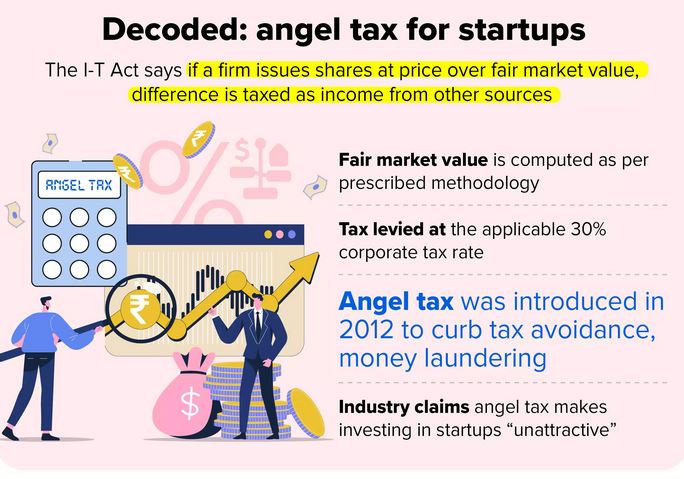
    • Referred to as Angel Tax, this rule is described in Section 56(2)(vii)(b) of the Income Tax Act, 1961.
    • Essentially it’s a tax on capital receipts, unique to India in the global context.
    • This clause was inserted by the Finance Act in 2012 to prevent laundering of black money, round-tripping via investments with a large premium into unlisted companies.
    • The tax covers investment in any private business entity, but only in 2016 was it applied to startups.

    Why was angel tax introduced?

    • The complicated nature of VC fundraising with offshore entities, multiple limited partners and blind pools is contentious.
    • There has been some element of money laundering or round-tripping under guise.

    Details of its levy

    • The Angel Tax is being levied on startups at 9% on net investments in excess of the fair market value.
    • For angel investors, the amount of investment that exceeds the fair market value can be claimed for a 100% tax exemption.
    • However, the investor must have a net worth of ₹2 crores or an income of more than ₹25 Lakh in the past 3 fiscal years.

    Key Issues with Angel Tax

    • Share Valuation: The tax impacted the valuation of shares, causing complications for startups in raising funds.
    • Discounted Cash Flow (DCF) Method: Issues arose with the treatment of estimated figures in the DCF method, leading to disputes.
    • Scrutiny of Funding Sources: The scrutiny of funding sources and investor credibility added another layer of complexity for startups.
    • Retrospective Application: The retrospective application of the tax and its effect on the conversion of convertible instruments into equity were also significant points of dispute.

    Significance for the Startup Community

    • Startups has long advocated for a more supportive and less restrictive environment for fundraising.
    • With this change, the government aims to create a more favourable atmosphere for innovation and investment in India.
    PYQ:

    [2014] What does venture capital mean?

    (a) A short-term capital provided to industries.

    (b) A long-term start-up capital provided to new entrepreneurs.

    (c) Funds provided to industries at times of incurring losses.

    (d) Funds provided for replacement and renovation of industries.

  • Tourism Sector

    Bihar’s Vishnupad and Mahabodhi Temples

    Note4Students

    From UPSC perspective, the following things are important:

    Prelims level: Vishnupad and Mahabodhi Temples; Kashi Vishwanath Temple

    Why in the News?

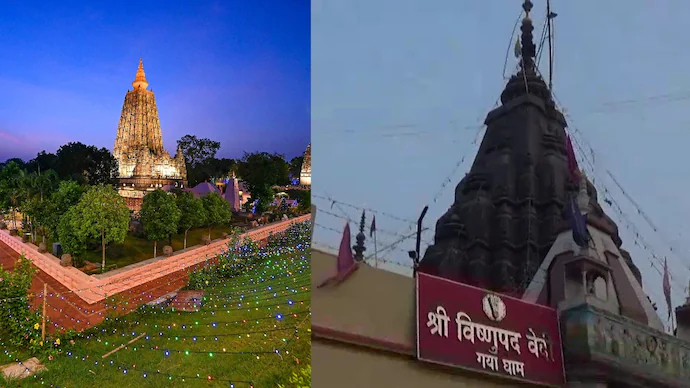
    • Finance Minister announced during her Union Budget speech that corridor projects will be built for the Vishnupad Temple at Gaya and the Mahabodhi Temple at Bodh Gaya in Bihar.

    About the Vishnupad Temple at Gaya

    Details
    Dedicated to Lord Vishnu
    Significance Contains a 40 cm long footprint of Lord Vishnu; considered sacred in Hinduism; attracts pilgrims for “Pind Daan” rituals.
    Historical Importance Believed to be over 1000 years old; associated with various legends and historical references in Hindu texts.
    Architecture
    • Built in Shikhara style;
    • Features intricate carvings and silver-plated flagposts;
    • Constructed of grey granite blocks.
    Built by Queen Ahilyabai Holkar of Indore in 1787.
    Festivals and Rituals
    • Major site for “Pind Daan” rituals during Pitru Paksha;
    • Attracts thousands of pilgrims during this period.
    Mythology The footprint is believed to be where Lord Vishnu placed his foot to subdue the demon Gayasur.
    Associated River Located on the banks of the Phalgu River, considered sacred for ritual offerings.
    Access and Visitation Accessible year-round; major pilgrimage site with facilities for devotees.
    Recent Developments Ongoing efforts for preservation and restoration; improved infrastructure for pilgrims.


    About the Mahabodhi Temple Complex:

    Details
    Location Bodh Gaya, Bihar;
    Significance Marks the location where Buddha attained enlightenment
    UNESCO Status World Heritage Site since 2002
    Historical Importance
    • One of the four holy sites related to Buddha’s life (Enlightenment).
    • Other holy sites: Lumbini (Birth) in Nepal, Sarnath (First Sermon) in Uttar Pradesh, Kushinagar (Death) in Uttar Pradesh
    Original Construction Built by Mauryan Emperor Ashoka around 260 BCE
    Reconstruction Reconstructed in brick during the late Gupta period (5th or 6th centuries)
    Archaeological Finds
    • Indicates site of veneration since the Mauryan period.
    • Vajrasana (Diamond Throne): Located within the temple, dated to the third century BCE
    Main Temple Structure Dates from the 6th century CE, incorporates parts from 2nd or 3rd century CE
    Architectural Features
    • Two large shikhara towers, the largest over 55 meters high
    • Influenced Jain, Hindu, and Buddhist architecture globally
    Materials Made mostly of brick covered with stucco
    Bodhi Tree Direct descendant of the original tree under which Buddha attained enlightenment
    Traditional Accounts Describes 7 weeks Buddha spent meditating after enlightenment at various spots within the complex
    Decline and Revival
    • Declined after Huna invasions and early Islamic invasions.
    • Revived under the Pala Empire (8th-12th century).
    • Declined again after 12th century CE invasions by Turk armies.
  • Mother and Child Health – Immunization Program, BPBB, PMJSY, PMMSY, etc.

    How children win with U-WIN, govt’s new online vaccine portal?

    Note4Students

    From UPSC perspective, the following things are important:

    Prelims level: U-WIN

    Why in the News?

    • The government plans to roll out U-WIN, an online vaccine management portal for childhood vaccination, across the country.
      • Similar to CoWIN used during the Covid-19 pandemic, U-WIN aims to digitize and individualize immunization records from birth.

    What is U-WIN? 

    • Children up to 6 years old and pregnant mothers are registered on U-WIN using government IDs like Aadhaar and their mobile phone numbers.
    • Records of all 25 shots given to a child and the two given to pregnant mothers are added to the platform.
    • It’s Working:
    • The platform generates a color-coded vaccination certificate.
      • The digital vaccine certificate can be downloaded by parents using their registered mobile numbers, eliminating the need for a physical vaccination booklet.
    • After each shot is administered and recorded, the date is added to the card, which also shows the due date for the next set of vaccines.
      • U-WIN sends SMS reminders to parents before their children are due for the next dose.
      • U-WIN helps locate the nearest vaccination center and book available slots.

    Significance:

    1) For providing Immunization:
    • U-WIN’s reminders to parents are likely to improve compliance with vaccination schedules.
    • The platform ensures portability, allowing children to receive their doses anywhere in the country, particularly benefiting children of migrant workers.
    • Registration at birth may help reduce the number of “zero dose” children, those who have not received any vaccinations.
    2) For Health Workers:
    • The platform can automatically generate a due list of children in specific areas for health workers.
    • These data points can be utilized by other government programs and eventually connected through the ABHA (Ayushman Bharat Health Account) ID.

    Integration with Existing Systems

    • U-WIN will link to the government’s existing eVIN platform for inventory management.
    • eVIN tracks all vaccine vials, from central stores to each vaccination site, monitoring doses used, wasted, and returned, and tracks real-time temperature and humidity using sensors.
    • U-WIN runs on the same principles and digital infrastructure as CoWIN, making adoption straightforward.
    • Most vaccinators are familiar with similar platforms, ensuring a smooth transition.

    Zero Dose Children

    • In India, the coverage of the first dose of diphtheria, pertussis, and tetanus (DPT)-containing vaccine is taken as the proxy for zero dose children.
    • Data from WHO and UNICEF showed that while 93% of children received their first vaccine dose, there were still 1.6 million zero dose children in India in 2023.
    • The data also showed that 1.6 million children missed their first measles-containing vaccine in 2023, up from 1.1 million the previous year.
    • This is concerning as in 2022, five states — Bihar, Gujarat, Haryana, Jharkhand, and Maharashtra — reported a rise in the incidence of measles.


    PYQ:

    [2016] ‘Mission Indradhanush’ launched by the Government of India pertains to:

    (a) Immunization of children and pregnant women

    (b) Construction of smart cities across the country

    (c) India’s own search for the Earth-like planets in outer space

    (d) New Educational Policy

  • Global Geological And Climatic Events

    What are Rogue Waves and how can AI help predict them?

    Note4Students

    From UPSC perspective, the following things are important:

    Prelims level: Rogue Waves

    Why in the News?

    • Rogue waves, unusually large waves compared to those before and after them, pose significant threats to ships, coastal and offshore infrastructure, and human lives.
      • Until now, there has been no method to forecast rogue waves.

    What Are Rogue Waves?

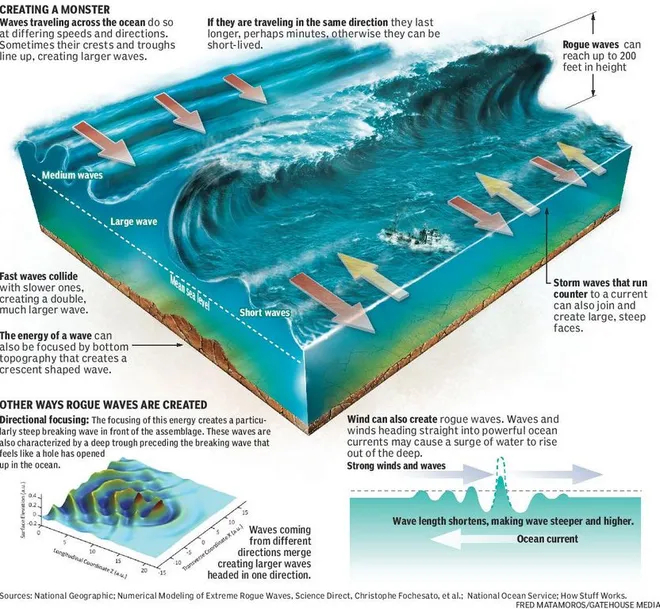
    • Rogue waves are unusually large and unpredictable waves that are much larger than the surrounding waves.
    • They are often defined as waves that are at least twice the height of the surrounding waves.
    • Formation:
      • Rogue waves can form when swells from distant weather systems converge to create a single, amplified wave.
      • They may also form when ocean currents compress swells, creating strong, high waves.
    • Features:
      • Traditionally, rogue waves have been difficult to predict due to their sudden appearance and rare occurrence.
      • The lack of real-time forecasting methods has made it challenging to mitigate their impact effectively.

    What is Sea State?

    • In oceanography, sea state refers to the condition of the surface of a large body of water at a specific location and time.
    • The World Meteorological Organization (WMO) sea state code characterizes sea state based on wave height on a scale of 0 (no waves) to 9 (waves over 14 meters).

    Characteristics:

    • Unlike typical waves, rogue waves can appear suddenly and without warning.
    • They defy the average sea state, making them exceptionally dangerous.

    Threats Posed by Rogue Waves:

    (1) Shipping

    • For Ships and Vessels: Rogue waves pose a significant threat to ships and other vessels at sea. Their unexpected and massive size can lead to capsizing or severe damage.
    • For Offshore Infrastructure: Oil rigs, wind turbines, and other offshore structures can be heavily damaged or destroyed by rogue waves.

    (2) Coastal Threats

    • Coastal Erosion: The sheer force of rogue waves can lead to accelerated coastal erosion, affecting beaches and shorelines.
    • Flooding: Rogue waves can cause sudden and severe coastal flooding, posing risks to coastal communities and ecosystems.

    (3) Human Safety

    • Loss of Life: Rogue waves have been responsible for numerous fatalities. Between 2011 and 2018, rogue waves killed at least 386 people.
    • Property Damage: The impact of rogue waves on ships, coastal areas, and offshore structures can result in significant financial losses.

    Advancements in Forecasting

    • University of Maryland mathematicians Thomas Breunung and Balakumar Balachandran have developed an artificial intelligence program capable of forecasting rogue waves.
    • The AI program was trained using billions of data points collected by a network of 172 ocean buoys.
    • The researchers analyzed 20-minute long samples recorded by ocean buoys.


    PYQ:

    [2017] At one of the places in India, if you stand on the seashore and watch the sea, you will find that the sea water recedes from the shore line a few kilometres and comes back to the shore, twice a day, and you can actually walk on the sea floor when the water recedes. This unique phenomenon is seen at:

    (a) Bhavnagar

    (b) Bheemunipatnam

    (c) Chandipur

    (d) Nagapattinam

  • Parliament – Sessions, Procedures, Motions, Committees etc

    What is Governor’s immunity under Article 361, set to be reviewed by Supreme Court?

    Note4Students

    From UPSC perspective, the following things are important:

    Prelims level: Article 361 and its various sub-sections

    Why in the News?

    • The Supreme Court has agreed to hear a plea seeking to redefine the constitutional immunity of state Governors.
      • Article 361 of the Constitution shields the President and Governors from criminal prosecution and judicial scrutiny.
      • The Supreme Court will interpret whether the immunity includes the registration of an FIR, initiation of a preliminary inquiry, or a magistrate taking cognisance of an offence.

    Origins of Governor’s Immunity

    • The concept of immunity is based on the Latin maximrex non potest peccare” (the king can do no wrong), rooted in English legal traditions.
    • During the Constituent Assembly debates in 1949, member H. V. Kamath questioned whether immunity meant no proceedings could be instituted against the President or Governor during their term or only while they were in office.
      • The article was adopted without further debate on criminal immunity.

    What are immunities under Article 361?

    • According to Article 361(1), the President or a Governor is not answerable to any court for the exercise of their powers and duties.
    • Article 361(2) ensures that NO criminal proceedings can be initiated or continued against the President or Governor during their term.
    • Article 361(3) prohibits the arrest or imprisonment of the President or Governor while they are in office.
    • Article 361(4) states that civil lawsuits for personal acts against the President or Governor cannot be initiated during their term and can only proceed two months after a written notice is given post-term.

    Judicial Interpretations of Article 361:

    • Dr SC Barat and Anr vs. Hari Vinayak Pataskar Case (1961): Distinguished between the Governor’s official and personal actions. While official actions have complete immunity, civil proceedings for personal acts can proceed with prior notice.
    • Rameshwar Prasad vs. Union of India Case (2006): The Supreme Court recognized “complete immunity” for constitutional actions under Article 361(1), but allowed judicial review for actions taken with malicious intent.
    • Vyapam Scam Case (2015): The Madhya Pradesh High Court ruled that Governor Ram Naresh Yadav had absolute protection under Article 361(2), preventing his name from being included in the investigation to avoid undue legal harassment.
    • State of UP vs. Kalyan Singh Case (2017): The Supreme Court upheld that Kalyan Singh, while serving as Governor of Rajasthan, was immune under Article 361. Legal proceedings related to the Babri Masjid demolition were to resume after his term.
    • Telangana High Court Judgment (2024): Observed that the Constitution does not explicitly or implicitly bar judicial review of actions taken by a Governor, and stated that Article 361 immunity is personal and does not exclude judicial review.

    Case for Revisiting Immunity

    The debate on executive immunity is ongoing in other countries as well.

    • The US Supreme Court recently decided that former President Donald Trump is entitled to “absolute immunity” from criminal prosecution for official acts but not for unofficial or personal acts.
    • In India, the discussion is viewed within the larger context of the tension between Governors and opposition-ruled state governments.
    • The Supreme Court has noted instances where Governors acted with political motives.

    PYQ:

    [2018] Consider the following statements:

    1. No criminal proceedings shall be instituted against the Governor of a State in any court during his term of office.
    2. The emoluments and allowances of the Governor of a State shall not be diminished during his term of office.

    Which of the statements given above is/are correct?

    (a) 1 only

    (b) 2 only

    (c) Both 1 and 2

    (d) Neither 1 nor 2

    [2019] Which one of the following suggested that the Governor should be an eminent person from outside the State and should be a detached figure without intense political links or should not have taken part in politics in the recent past?

    (a) First Administrative Reforms Commission (1966)

    (b) Rajamannar Committee (1969)

    (c) Sarkaria Commission (1983)

    (d) National Commission to Review the Working of the Constitution (2000)