💥UPSC 2027,2028 Mentorship (April Batch) + Access XFactor Notes & Microthemes PDF

Type: Prelims Only

  • Promoting Science and Technology – Missions,Policies & Schemes

    National Science Day and CV Raman

    Note4Students

    From UPSC perspective, the following things are important:

    Prelims level: CV Raman, Raman's Effect

    Mains level: Promoting scientific temper in India

    raman

    National Science Day is commemorated on Feb 28 every year to commemorate the bird anniversary of Sir CV Raman.

    National Science Day

    • In 1986, the Government of India, under then PM Rajiv Gandhi, designated February 28 as National Science Day to commemorate the announcement of the discovery of the “Raman Effect”.
    • The Raman Effect was the discovery which won physicist Sir CV Raman his Nobel Prize in 1930.

    Who was CV Raman?

    • Raman conducted his Nobel-prize-winning research at IACS, Calcutta.
    • While he was educated entirely in India, Raman travelled to London for the first time in 1921, where his reputation in the study of optics and acoustics was known to physicists such as JJ Thomson and Lord Rutherford.
    • The Raman Effect won scientist Sir CV Raman the Nobel Prize for physics in 1930.
    • It was also designated as an International Historic Chemical Landmark jointly by the American Chemical Society (ACS) and the Indian Association for the Cultivation of Science (IACS).
    • His speciality was the study of vibrations and sounds of stringed instruments such as the Indian veena and tambura, and Indian percussion instruments such as the tabla and mridangam.

    The Raman Effect

    • In 1928, Raman discovered that when a stream of light passes through a liquid, a fraction of the light scattered by the liquid is of a different colour.
    • While Raman was returning from London in a 15-day voyage, he started thinking about the colour of the deep blue Mediterranean.
    • He wasn’t convinced by the explanation that the colour of the sea was blue due to the reflection of the sky.
    • As the ship docked in Bombay, he sent a letter to the editor of the journal Nature, in which he penned down his thoughts on this.
    • Subsequently, Raman was able to show that the blue colour of the water was due to the scattering of the sunlight by water molecules.
    • By this time he was obsessed with the phenomenon of light scattering.

    Observing the effect

    raman

    • The Raman Effect is when the change in the energy of the light is affected by the vibrations of the molecule or material under observation, leading to a change in its wavelength.
    • Significantly, it notes that the Raman effect is “very weak” — this is because when the object in question is small (smaller than a few nanometres), the light will pass through it undisturbed.
    • But a few times in a billion, light waves may interact with the particle. This could also explain why it was not discovered before.
    • In general, when light interacts with an object, it can either be reflected, refracted or transmitted.
    • One of the things that scientists look at when light is scattered is if the particle it interacts with is able to change its energy.

    Real-life applications

    • Raman spectroscopy is used in many varied fields – in fact, any application where non-destructive, microscopic, chemical analysis and imaging is required.
    • Whether the goal is qualitative or quantitative data, Raman analysis can provide key information easily and quickly.
    • It can be used to rapidly characterize the chemical composition and structure of a sample, whether solid, liquid, gas, gel, slurry or powder.


    Attempt UPSC 2024 Smash Scholarship Test | FLAT* 100% OFF on UPSC Foundation & Mentorship programs

    Get your Rs 10,000 worth of UPSC Strategic Package for FREE | PDFs, Zoom session, Tests, & Mentorship

  • Historical and Archaeological Findings in News

    ASI finds 1,300-yr-old Buddhist Stupa in Odisha

    Note4Students

    From UPSC perspective, the following things are important:

    Prelims level: Stupa Architecture

    Mains level: Ancient Buddhist Architecture

    stupa

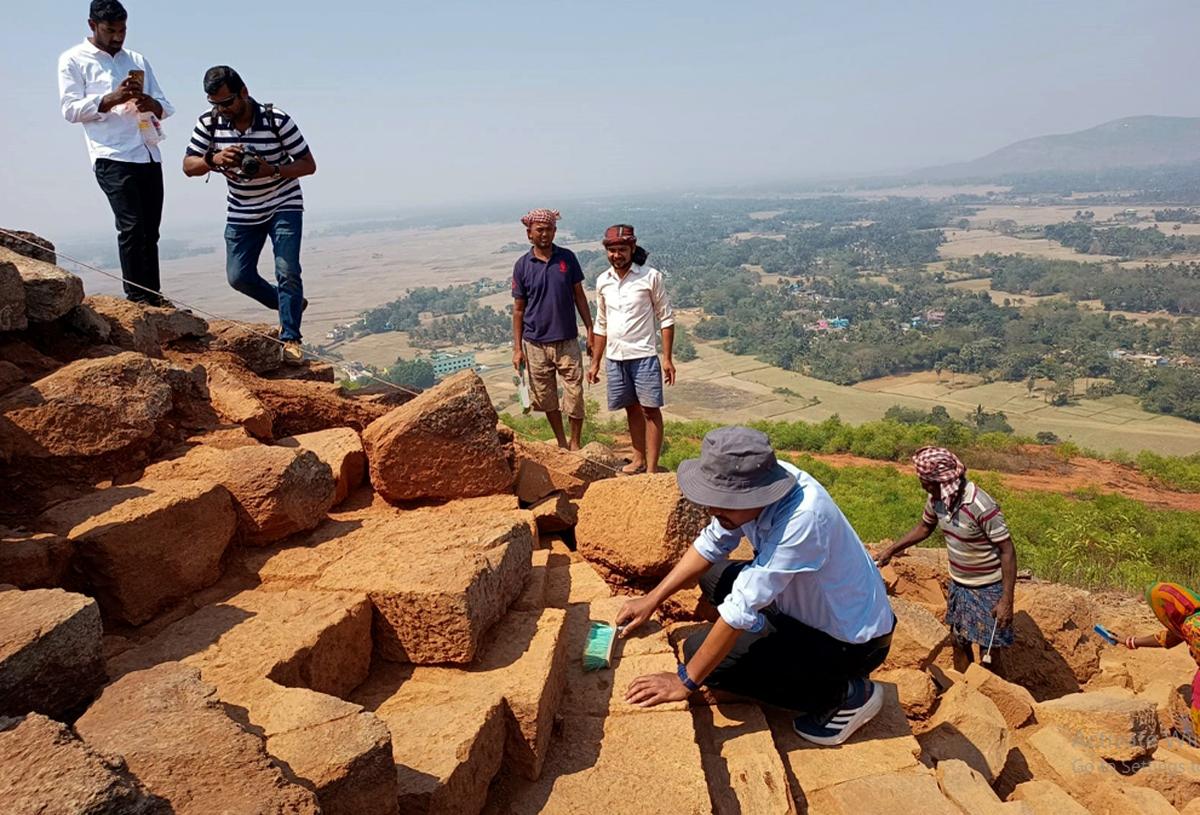
    The Archaeological Survey of India (ASI) stumbled upon a 1,300-year-old stupa right in the middle of a Khondalite mining site in Odisha’s Jajpur district.

    About the Stupa

    • The stupa could be 4.5-meter tall and initial assessment showed it may belong to the 7th or 8th
    • It was found at Parabhadi which is situated near Lalitagiri, a major Buddhist complex, having a large number of stupas and monasteries.
    • The newly discovered stupa was possibly disfigured in an earlier period.

    Khondalite

    stupa

    • Khondalite is a foliated metamorphic rock.
    • It is also called Bezwada Gneiss and Kailasa Gneiss.
    • It was named after the Khond tribe of Odisha and Andhra Pradesh because well-formed examples of the rock were found in the inhabited hills of these regions of eastern India.


    Back2Basics: Lalitagiri Buddhist Complex

    stupa

    • Lalitagiri is a major Buddhist complex in the state of Odisha.
    • The complex is home to stupas, ‘esoteric’ Buddha images, and monasteries (viharas), which is the oldest site in the region.
    • Significant finds at this complex include Buddha’s relics. Tantric Buddhism was practiced at this site.
    • Together with the Ratnagiri and Udayagiri sites a short distance away, Lalitagiri is part of the “Diamond Triangle”.
    • It used to be thought that one or all of these were the large Pushpagiri Vihara known from ancient records, but this has now convincingly located at a different site.

    Stupa Architecture

    stupa

    In the most basic sense, as an architectural representation of a sacred burial site, a stupa — no matter where it is located in the world or when it was built — has three fundamental features.

    • A hemispherical mound (anda) The anda’s domed shape (green highlights) recalls a mound of dirt that was used to cover the Buddha’s remains. As you might expect, it has a solid core and cannot be entered. Consistent with their symbolic associations, the earliest stupas contained actual relics of the Buddha; the relic chamber, buried deep inside the anda, is called the tabena. Over time, this hemispherical mound has taken on an even grander symbolic association: the mountain home of the gods at the center of the universe.
    • A square railing (harmika) The harmika (red highlights) is inspired by a square railing or fence that surrounded the mound of dirt, marking it as a sacred burial site.
    • A central pillar supporting a triple-umbrella form (chattra) The chattra, in turn, was derived from umbrellas that were placed over the mound to protect it from the elements (purple highlights). Just as the anda’s symbolic value expanded over time, the central pillar that holds the umbrellas has come to represent the pivot of the universe, the axis along which the divine descends from heaven and becomes accessible to humanity. And the three circular umbrella-like disks represent the three Jewels, or Triantha, of Buddhism, which are the keys to a true understanding of the faith: (a) Buddha; (b) dharma (Buddhist teachings or religious law); and (c) sangha (monastic community).

    Around these three core building blocks were added secondary features.

    • Enclosure wall with decorated gateways (toranas) at the cardinal directions The wall — with its trademark three horizontal stone bars (in the top image) — surrounds the entire structure. The wall is marked in light blue highlights and the toranas in yellow.
    • A circular terrace (medhi) The terrace — surrounded by a similar three-bar railing — supports the anda and raises it off the ground (black highlights); it likely served as a platform for ritual circumambulation.


    Attempt UPSC 2024 Smash Scholarship Test | FLAT* 100% OFF on UPSC Foundation & Mentorship programs

    Get your Rs 10,000 worth of UPSC Strategic Package for FREE | PDFs, Zoom session, Tests, & Mentorship

  • Intellectual Property Rights in India

    India ranks 42 among 55 countries on International IP Index

    Note4Students

    From UPSC perspective, the following things are important:

    Prelims level: International IP Index

    Mains level: Patenting in India

    ip

    India ranks 42nd among 55 leading global economies on the International Intellectual Property (IP) Index released by the US Chambers of Commerce.

    International IP Index

    • It is released annually by the US Chamber of Commerce.
    • The index evaluates IP rights in 55 global economies across 50 unique indicators.
    • The indicators include patent and copyright policies to commercialization of IP assets, and ratification of international treaties.
    • The index aims to help nations navigate toward a brighter economic future marked by greater innovation, creativity, and competitiveness.

    Key prospects for India

    • India is ripe to become a leader for emerging markets seeking to transform their economy through IP-driven innovation said the report.
    • Successful IP-based businesses in India include pharmaceutical companies, software firms, and creative industries.

    Key factors contributing to India’s score

    • IP laws
    • Efficiency of its judicial system and
    • Level of enforcement of IP rights

    Challenges faced

    • These are some challenges faced by Indian companies in protecting and monetizing their IP include issues such as-
    1. Counterfeiting
    2. Piracy
    3. Weak enforcement of IP laws

    IP regime in India

    Broadly, the following acts deal with the protection of intellectual property:

    • Trade Marks Act, 1999
    • The Patents Act, 1970 (as amended in 2005)
    • The Copyright Act, 1957
    • The Designs Act, 2000
    • The Geographical Indications of Goods (Registration and Protection) Act, 1999
    • The Semiconductor Integrated Circuits Layout Design Act, 2000
    • The Protection of Plant Varieties and Farmers’ Right Act, 2001
    • The Information Technology Act, 2000

    Way forward

    • India must undertake reforms to strengthen IP protection and enforcement, modernizing IP laws, and increasing investment in IP infrastructure.
    • Collaboration between government, industry, and academia is important in improving India’s IP ecosystem/
    • Lessons can be learned from other countries with successful IP regimes, such as the United States, Japan, and South Korea.


    Attempt UPSC 2024 Smash Scholarship Test | FLAT* 100% OFF on UPSC Foundation & Mentorship programs

    Get your Rs 10,000 worth of UPSC Strategic Package for FREE | PDFs, Zoom session, Tests, & Mentorship

  • Innovations in Sciences, IT, Computers, Robotics and Nanotechnology

    Are neutrinos their own anti-particles?

    Note4Students

    From UPSC perspective, the following things are important:

    Prelims level: Neutrino, Ant-particles

    Mains level: Not Much

    neutrino

    Central idea: The article discusses recent research on the idea that neutrinos might be their own antiparticles, a concept that has been debated in the scientific community for many years.

    What are neutrinos?

    • Neutrinos are fundamental particles that are similar to electrons but have no electric charge.
    • They are one of the most abundant particles in the universe, but they are also one of the most difficult to detect because they interact only very weakly with matter.
    • Neutrinos are created in a variety of natural processes, including nuclear reactions in stars, radioactive decay, and cosmic ray interactions.
    • They are also produced in particle accelerators and nuclear reactors.

    Its types

    • Neutrinos come in three different types or “flavors”:
    1. Electron neutrinos
    2. Muon neutrinos, and
    3. Tau neutrinos
    • Each flavor of neutrino is associated with a different charged lepton (electron, muon, or tau).

    Why study neutrinos?

    • Because they are electrically neutral and interact only weakly with matter, neutrinos can pass through enormous amounts of material without being stopped or deflected.
    • This property makes them useful for studying astrophysical phenomena such as supernovae and the sun’s interior, as well as for exploring the fundamental nature of matter.

    Neutrinos as their own antiparticles

    • Particle physics explains that particles and their antiparticles have opposite properties, and they can annihilate each other when they meet.
    • Neutrinos are fundamental particles that are difficult to detect as they have no electric charge and interact only weakly with matter.
    • The idea that neutrinos could be their own antiparticles is supported by the fact that they are electrically neutral, and they could interact with themselves in a process called neutrinoless double beta decay.

    Substantiation of this

    • The Majorana Demonstrator experiment is designed to detect neutrinoless double beta decay.
    • The experiment has reported some promising results that suggest that neutrinos could indeed be their own antiparticles.

    Significance of this theory

    • If confirmed, the idea that neutrinos are their own antiparticles could have important implications for our understanding of the fundamental nature of matter and the universe as a whole.
    • More research will be needed before any definitive conclusions can be drawn, but the results of the Majorana Demonstrator experiment provide some promising evidence for the idea that neutrinos are their own antiparticles.

    Attempt UPSC 2024 Smash Scholarship Test | FLAT* 100% OFF on UPSC Foundation & Mentorship programs

    Get your Rs 10,000 worth of UPSC Strategic Package for FREE | PDFs, Zoom session, Tests, & Mentorship

  • Health Sector – UHC, National Health Policy, Family Planning, Health Insurance, etc.

    What is ‘e-Sanjeevani App’?

    Note4Students

    From UPSC perspective, the following things are important:

    Prelims level: E-Sanjeevani App

    Mains level: Telemedicine

    sanjeevani

    The eSanjeevani app was featured in Prime Minister’s “Mann Ki Baat” address as part of the government’s efforts to promote digital healthcare in the country.

    What is the e-Sanjeevani app?

    • E-Sanjeevani is a browser-based platform-independent application that allows for both ‘doctor-to-doctor’ and ‘patient-to-doctor’ teleconsultations.
    • During the Covid pandemic, the union health ministry launched the e-Sanjeevani telemedicine services to ensure that health consultations reach people even in remote villages.
    • At the time of its launch, the union health ministry stated that it was a doctor-to-doctor telemedicine service that would provide general and specialised health care in rural areas.

    How does e-Sanjeevani work?

    • The e-Sanjeevani service establishes a virtual link between the beneficiary and doctor or specialist at the hub, which will be a tertiary healthcare facility.
    • This network’s spoke would be a paramedic or generalist at a health and wellness centre.
    • It allows for real-time virtual consultations between doctors and specialists at the hub and the beneficiary (via paramedics) at the spoke.
    • The e-prescription generated at the conclusion of the session is used to obtain medications.

    What is the reach of e-Sanjeevani?

    • Sanjeevani HWC is currently operational in approximately 50,000 health and wellness centres across the country.
    • As PM Modi stated in ‘Mann Ki Baat’, the number of tele-consultants using the e-Sanjeevani app has now surpassed 10 crore.
    • Health minister has stated that 100.11 million patients were served at 115,234 Health and Wellness Centres (as spokes) via 15,731 hubs and 1,152 online OPDs staffed by 2,29,057 telemedicine-trained medical specialists and super-specialists.
    • More than 57% of e-Sanjeevani beneficiaries are women, with only about 12% being senior citizens, according to union health ministry.


    Attempt UPSC 2024 Smash Scholarship Test | FLAT* 100% OFF on UPSC Foundation & Mentorship programs

    Get your Rs 10,000 worth of UPSC Strategic Package for FREE | PDFs, Zoom session, Tests, & Mentorship

  • International Space Agencies – Missions and Discoveries

    Upgrades in the ALMA Telescope

    Note4Students

    From UPSC perspective, the following things are important:

    Prelims level: ALMA Telescope

    Mains level: NA

    alma

    The Atacama Large Millimetre/submillimetre Array (ALMA) — a radio telescope in the Atacama Desert of northern Chile is set to get software and hardware upgrades.

    What is ALMA?

    • ALMA is a state-of-the-art telescope that studies celestial objects at millimetre and submillimetre wavelengths which can penetrate through dust clouds.
    • It helps astronomers examine dim and distant galaxies and stars out there.
    • It also has extraordinary sensitivity, which allows it to detect even extremely faint radio signals.
    • The telescope consists of 66 high-precision antennas, spread over a distance of up to 16 km.
    • Each antenna is outfitted with a series of receivers, and each receiver is tuned to a specific range of wavelengths on the electromagnetic spectrum.

    Who operates ALMA?

    • ALMA is operated under a partnership among the United States, 16 countries in Europe, Canada, Japan, South Korea, Taiwan, and Chile.
    • Fully functional since 2013, the radio telescope was designed, planned and constructed by US, Japan and EU.

    Why is ALMA located in Chile’s Atacama Desert?

    • ALMA is situated at an altitude of 16,570 feet (5,050 metres) above sea level on the Chajnantor plateau in Chile’s Atacama Desert.
    • The high altitude and low humidity of the site make it an ideal location for a radio telescope, as there is minimal atmospheric interference.
    • Moreover, the desert is the driest place in the world, meaning most of the nights here are clear of clouds and free of light-distorting moisture — making it a perfect location for examining the universe.

    Significant discoveries

    • One of the earliest findings came in 2013 when it discovered starburst galaxies earlier in the universe’s history than they were previously thought to have existed.
    • These newly discovered galaxies represent what today’s most massive galaxies looked like in their energetic, star-forming youth.
    • In 2015, the telescope helped scientists observe a phenomenon known as the Einstein ring, which occurs when light from a galaxy or star passes by a massive object en route to the Earth, in extraordinary detail.


    Attempt UPSC 2024 Smash Scholarship Test | FLAT* 100% OFF on UPSC Foundation & Mentorship programs

    Get your Rs 10,000 worth of UPSC Strategic Package for FREE | PDFs, Zoom session, Tests, & Mentorship

  • Capital Markets: Challenges and Developments

    SEBI approval to launch Social Stock Exchange

    Note4Students

    From UPSC perspective, the following things are important:

    Prelims level: Social Stock Exchange (SSE)

    Mains level: Not Much

    The National Stock Exchange (NSE) has received final approval from the Securities and Exchange Board of India (SEBI) to set up a Social Stock Exchange (SSE) as a separate segment of the NSE.

    What is a Social Stock Exchange?

    • Social Stock Exchange (SSE) is a platform that connects social enterprises with investors who are looking for social impact along with financial returns.
    • Social enterprises are organizations that prioritize social impact over profits.
    • SSE aims to provide these organizations with access to capital markets and raise awareness about social investment opportunities.

    Who can get listed for SSEs?

    • Any social enterprise, Non-Profit Organisation (NOPs) or For-Profit Social Enterprises (FPEs), that establishes its primacy of social intent can get registered or listed on the Social Stock Exchange segment.
    • Eligible NPOs can begin by registering on the SSE segment.
    • After onboarding, NPOs can initiate the fund mobilization process by issuing instruments such as Zero Coupon Zero Principal (ZCZP) via a public issue or private placement.
    • Currently, the regulations have prescribed a minimum issue size of Rs 1 crore and a minimum application size for the subscription of Rs 2 lakhs for ZCZP issuance.

    How will SSE work?

    • The SSE will be a separate segment on the NSE, where social enterprises can list their securities.
    • These securities will be available for trading to investors who are interested in social impact investing.
    • The SSE will also provide a range of services such as capacity building, impact measurement, and reporting to help social enterprises improve their operations and measure their social impact.

    Benefits of SSE

    • For social enterprises, SSE will provide access to capital markets and help them raise funds for their social projects.
    • For investors, SSE will provide a platform to invest in social enterprises and contribute to social impact.
    • SSE will also create a transparent marketplace where investors can assess the social impact of their investments.


    Attempt UPSC 2024 Smash Scholarship Test | FLAT* 100% OFF on UPSC Foundation & Mentorship programs

    Get your Rs 10,000 worth of UPSC Strategic Package for FREE | PDFs, Zoom session, Tests, & Mentorship

  • Freedom of Speech – Defamation, Sedition, etc.

    Section 153A: its use and misuse

    Note4Students

    From UPSC perspective, the following things are important:

    Prelims level: Section 153A of IPC

    Mains level: Free speech and defamation

    153

    Central idea: A politician was recently arrested under Section 153A of IPC for the alleged use of objectionable words against the Prime Minister.

    Section 153A: What the law says

    • Section 153A of the Indian Penal Code (IPC) penalises “promoting enmity between different groups on grounds of religion, race, place of birth, residence, language, etc., and doing acts prejudicial to maintenance of harmony”.
    • This is punishable with imprisonment up to three years, or with fine, or with both.
    • The provision was enacted in 1898 and was not in the original penal code.
    • At the time of the amendment, promoting class hatred was a part of the English law of sedition, but was not included in the Indian law.

    Charges laid for remarks against PM

    The FIR mentioned the use of Sections-

    • 153B(1) (Making imputations, assertions prejudicial to national integration);
    • 295A (Deliberate and malicious acts, intended to outrage religious feelings of any class by insulting its religion or religious beliefs);
    • 500 (Defamation); and
    • 504 (Intentional insult with intent to provoke breach of the peace).

    Conviction rates under Section 153A

    • Data from the National Crime Records Bureau (NCRB) show that the rate of conviction for Section 153A is very low.
    • In 2020, 1,804 cases were registered, six times higher than the 323 cases in 2014.
    • However, the conviction rate in 2020 was 20.2%, suggesting that the process often becomes the punishment.

    Issues with the law

    • Hate speech laws have been invoked under regimes of all parties to crack down on criticism of public functionaries and to arrest individuals.
    • The invocation of Section 153A is often criticized for restricting free speech and misusing the legal processes for political purposes.

    Safeguards against misuse

    • Given that the provisions are worded broadly, there are safeguards against its misuse.
    • For example, Sections 153A and 153B require prior sanction from the government for initiating prosecution.
    • But this is required before the trial begins, and not at the stage of preliminary investigation.
    • To curb indiscriminate arrests, the Supreme Court laid down a set of guidelines in its 2014 ruling in Arnesh Kumar v State of Bihar.
    • As per the guidelines, for offenses that carry a sentence of fewer than seven years, the police cannot automatically arrest an accused before investigation.


    Attempt UPSC 2024 Smash Scholarship Test | FLAT* 100% OFF on UPSC Foundation & Mentorship programs

    Get your Rs 10,000 worth of UPSC Strategic Package for FREE | PDFs, Zoom session, Tests, & Mentorship

  • Judicial Pendency

    What is a Caveat in Judiciary?

    Note4Students

    From UPSC perspective, the following things are important:

    Prelims level: Caveat

    Mains level: Not Much

    Recently, the Supreme Court bench reprimanded a law student for filing a caveat in a petition seeking menstrual leave for female students and working women across Indian institutions.

    What is a Caveat?

    • In common parlance, a caveat refers to “warning” or “caution”.
    • However, legally it connotes a “formal notice requesting the court to refrain from taking some specified action without giving prior notice to the person lodging the caveat.”
    • The person lodging the caveat is called a “caveator”.
    • The provision was inserted by the Amendment Act of 1976 after the Law Commission’s recommendation by Section 148A of the Civil Procedure Code (CPC).
    • However, the term is not expressly defined anywhere except in the Calcutta High Court’s 1978 ruling.

    Who can fill the Caveat?

    • Any person has a right to lodge a caveat in a Court.
    • Any person claiming a right to appear before the Court on the hearing of such application may lodge a caveat in respect thereof.
    • The caveator or the person lodging is also required to serve a notice of the caveat by “registered post” to the person on whose plea they are lodging the application


    Attempt UPSC 2024 Smash Scholarship Test | FLAT* 100% OFF on UPSC Foundation & Mentorship programs

    Get your Rs 10,000 worth of UPSC Strategic Package for FREE | PDFs, Zoom session, Tests, & Mentorship

  • Innovations in Biotechnology and Medical Sciences

    CCR5-delta 32 Gene Transplant: Permanent cure of HIV

    Note4Students

    From UPSC perspective, the following things are important:

    Prelims level: CCR5-delta 32 mutation

    Mains level: Not Much

    hiv

    Central idea: This article discusses recent developments in the field of HIV research that have led to the possibility of a cure for the disease.

    What is HIV/AIDS?

    • HIV (human immunodeficiency virus) is a virus that attacks cells that help the body fight infection, making a person more vulnerable to other infections and diseases.
    • First identified in 1981, HIV is the cause of one of humanity’s deadliest and most persistent epidemics.
    • It is spread by contact with certain bodily fluids of a person with HIV, most commonly during unprotected sex, or through sharing injection drug equipment.
    • If left untreated, HIV can lead to the disease AIDS (acquired immunodeficiency syndrome).
    • The human body can’t get rid of HIV and no effective HIV cure exists.

    Present treatment of HIV

    • However, by taking HIV medicine (called antiretroviral therapy or ART), people with HIV can live long and healthy lives and prevent transmitting HIV to their sexual partners.
    • In addition, there are effective methods to prevent getting HIV through sex or drug use, including pre-exposure prophylaxis (PrEP) and post-exposure prophylaxis (PEP).

    What is the new breakthrough?

    • Doctors selected a donor carrying two copies of a CCR5-delta 32 genetic mutation – a mutation that is known to make the carriers almost immune to HIV.
    • The CCR5-delta 32 genetic mutation is a rare genetic mutation that affects the CCR5 gene, which is involved in the immune system’s response to infection.
    • The mutation causes a deletion of 32 nucleotides in the gene, resulting in a truncated or shortened version of the CCR5 protein.
    • This truncated protein is not able to function normally, and people with this mutation are largely resistant to HIV infection.

    How has the CCR5-delta 32 mutation been used in HIV research?

    • Researchers have been studying the CCR5-delta 32 mutation as a potential avenue for developing an HIV cure.
    • One approach involves using gene editing technologies like CRISPR to induce the mutation in HIV-positive individuals, effectively making their immune cells resistant to HIV infection.
    • Another approach involves bone marrow transplantation from donors with the CCR5-delta 32 mutation.

    What are the risks associated?

    • Gene editing technologies like CRISPR are still in their early stages, and there are concerns about the safety and effectiveness of these methods.
    • Additionally, bone marrow transplantation is a complex and risky procedure that is not feasible for all HIV-positive individuals.
    • Finally, it is important to note that not all HIV infections are caused by the CCR5 strain of the virus, and therefore the use of the CCR5-delta 32 mutation as an HIV cure would not be effective for all cases of HIV.

    Prevalence of HIV/AIDS in India

    • As per the India HIV Estimation 2019 report, the estimated adult (15 to 49 years) HIV prevalence trend has been declining in India since the epidemic’s peak in the year 2000 and has been stabilizing in recent years.
    • In 2019, HIV prevalence among adult males (15–49 years) was estimated at 0.24% and among adult females at 0.20% of the population.
    • There were 23.48 lakh Indians living with HIV in 2019.
    • Maharashtra had the maximum at 3.96 lakh followed by Andhra Pradesh (3.14 lakh) and Karnataka.
    • ART is freely available to all those who require and there are deputed centres across the country where they can be availed from.


    Attempt UPSC 2024 Smash Scholarship Test | FLAT* 100% OFF on UPSC Foundation & Mentorship programs

    Get your Rs 10,000 worth of UPSC Strategic Package for FREE | PDFs, Zoom session, Tests, & Mentorship
