💥UPSC 2026, 2027, 2028 UAP Mentorship (March Batch) + Access XFactor Notes & Microthemes PDF

Type: Prelims Only

  • Roads, Highways, Cargo, Air-Cargo and Logistics infrastructure – Bharatmala, LEEP, SetuBharatam, etc.

    [pib] MSS+ Technology in Road Construction

    Why in the News?

    The CSIR–Central Road Research Institute, New Delhi, has developed MSS+ (Modified Mix Seal Surfacing Plus) technology for eco-friendly, durable, and low-cost road surfacing.

    About MSS+ Technology:

    • Developer: Council of Scientific & Industrial Research – Central Road Research Institute (CSIR–CRRI), New Delhi.
    • Year of Development: 2021 (in collaboration with J.M.V.D. Industries).
    • Pilot Project: First road in Uttar Pradesh built near Lucknow in 2022; Used for 202 km of roads under Pradhan Mantri Gram Sadak Yojana (PMGSY) in 2025.
    • Composition: Crushed natural aggregate, customised modified bitumen emulsion, mineral admixture.
    • Preparation: Mix made at ambient temperature, eliminating heating of aggregate or bitumen.
    • Laying: 25–30 mm thickness using conventional asphalt pavers.

    Benefits Offered:

    • Eco-Friendly: No thermal process → significantly reduces carbon emissions.
    • Durable: Provides strong wearing course, enhanced skid resistance, and prevents water infiltration.
    • Cost-Effective: Reduced energy requirement lowers construction costs.
    • All-Weather Use: Can be laid in varied weather conditions due to ambient temperature application.
    [UPSC 2020] In rural road construction, the use of which of the following is preferred for ensuring environmental sustainability or to reduce carbon footprint?

    1. Copper slag 2. Cold mix asphalt technology 3. Geotextiles 4. Hot mix asphalt technology 5. Portland cement

    Select the correct answer using the code given below:

    Options: (a) 1, 2 and 3 only * (b) 2, 3 and 4 only (c) 4 and 5 only (d) 1 and 5 only


  • Global Geological And Climatic Events

    In news: Dardanelles Strait

    Why in the News?

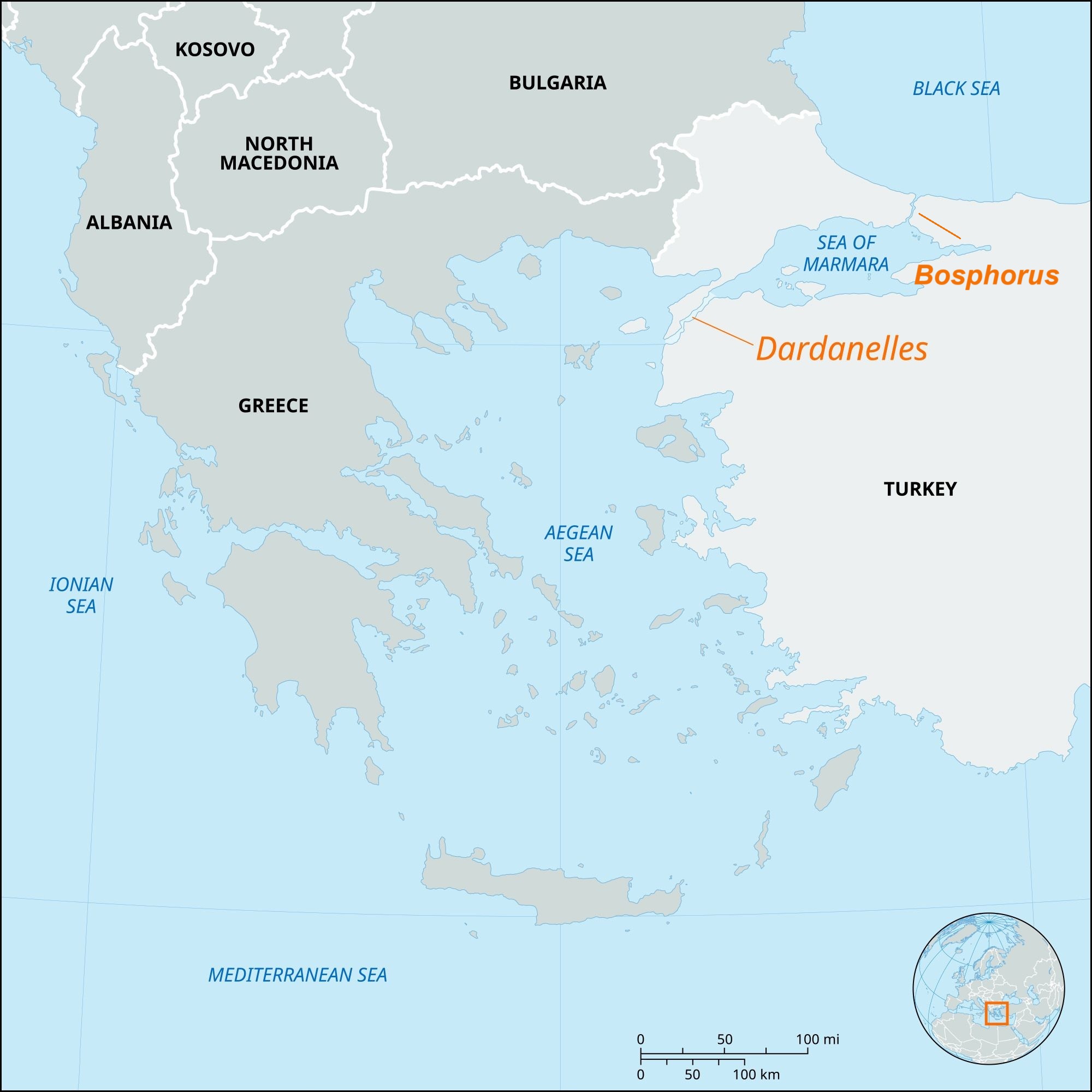
    The Dardanelles Strait in northwestern Turkey has been temporarily closed to maritime traffic due to forest fires near Canakkale, prompting evacuations and firefighting operations.

    About Dardanelles Strait:

    • Location: Northwestern Turkey; separates Gallipoli Peninsula (Europe) from Troad/Biga Peninsula (Asia).
    • Connection: Links Aegean Sea → Sea of Marmara → Bosporus → Black Sea.
    • Dimensions: Length 61 km, width 1.2–6.5 km, average depth 55 m, max depth 103 m.
    • Historical Name: Hellespont, named after mythical princess Helle; current name from ancient city of Dardanus.
    • Currents: Surface current flows from Sea of Marmara to Aegean; saline undercurrent in reverse.
    • Ports: Gallipoli, Eceabat, Çanakkale.

    Strategic & Economic Importance:

    • Part of Turkish Straits system with Bosporus; only maritime link between Black Sea and Mediterranean.
    • Critical for Black Sea nations’ trade (Russia, Ukraine, Bulgaria, etc.).
    • Major route for grain, oil, energy shipments from Black Sea region to global markets.
    • Governed by Montreux Convention (1936) for warship passage.
    • Vital for NATO naval strategy and maritime security.
    [UPSC 2008] Through which one of the following Straits does a tunnel connect the United Kingdom and France?

    Options: (a) Davis Strait (b) Denmark Strait (c) Strait of Dover* (d) Strait of Gibraltar


  • Tribes in News

    In news: Kerala’s Muthuvan Tribe

    Why in the News?

    The Muthuvan Adivasi Samudaya Sangam organised a convention on the International Day of the World’s Indigenous Peoples.

    In news: Kerala’s Muthuvan Tribe

    About Muthuvan Tribe:

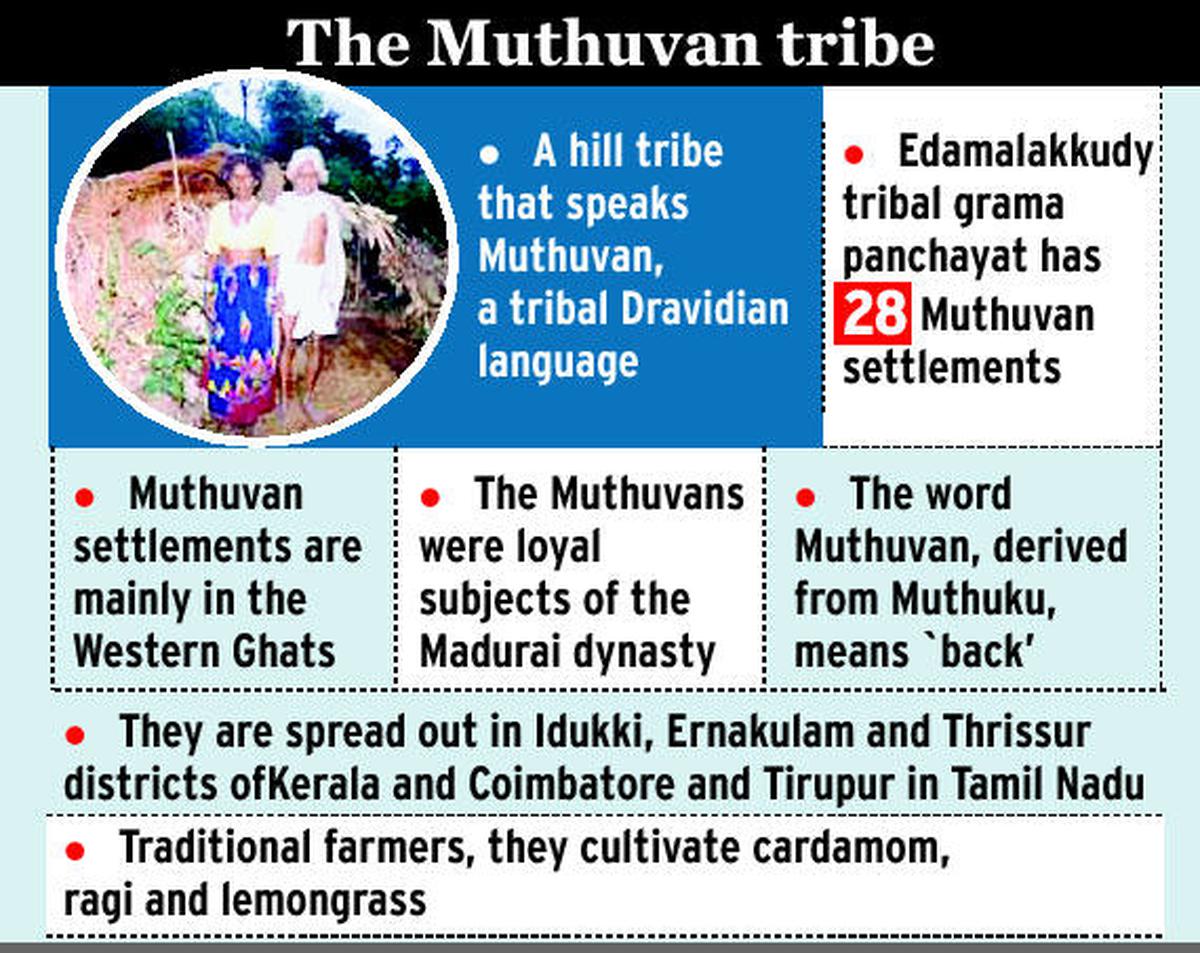
    • Location: Indigenous tribe recognized as STs of the Anaimalai Hills (Kerala & Tamil Nadu); concentrated in Idukki, Ernakulam, Thrissur districts.
    • Etymology: Name means “one who carries weight on the back”, linked to migration from Madurai carrying children and the king.
    • Origins: Traced to the Pandya Kingdom; divided into Malayalam Muthuvan and Pandi Muthuvan dialect groups.
    • Settlements: “Kudis” deep in hill forests; houses made from reeds, leaves, mud.
    • Population: Around 15,000–25,000; among Kerala’s least educated tribes.
    • Governance: Kani System (village headman) and Chavadis (dormitory for unmarried youth).

    Distinct Features:

    • Language: Tamil-related dialect; endangered; preservation efforts underway.
    • Livelihood: Traditionally shifting cultivation (“Virippukrishi”); now grow cardamom, ginger, pepper, lemongrass.
    • Religion: Animism & spirit worship; reverence for Subramanya, Hindu deities, and Kannagi tradition.
    • Customs: Matrilineal descent, tribe endogamy & clan exogamy; collective eating (“koodithinnuthu”); herbal medicine knowledge kept within tribe.
    • Culture: Distinct attire; strong ecological ethics, harmonious forest–wildlife coexistence.
    • Festivals: Thai Pongal is main religious & harvest festival.
    [UPSC 2014] Which one of the following statements is not correct about Scheduled Tribes in India?

    (a) There is no definition of the Scheduled Tribe in the Constitution of India. (b) North-East India accounts for a little over half of the country’s tribal population. (c) The people known as Todas live in the Nilgiri area. (d) Lotha is a language spoken in Nagaland


  • Nuclear Energy

    COCO 4.9 Ocean Circulation Model

    Why in the News?

    Researchers used the COCO (Center for Climate System Research Ocean Component) 4.9 ocean model to predict how tritium from Fukushima’s 30-year wastewater release will spread across the Pacific under current and future climates.

    Tap to read more about the Fukushima Disaster.

    About COCO 4.9 Ocean Circulation Model:

    • Purpose: Computer-based ocean simulator to study how seawater moves, mixes, and changes over time.
    • Method: Divides oceans into layers and grids; calculates current flows and mixing patterns.
    • Resolution: Can run in low detail (large grid blocks) or high detail (small swirling eddies).
    • Climate Link: Can model impacts of warming oceans, altered currents, and changing circulation.
    • Fukushima Application: Created a “virtual Pacific Ocean” to track tritium spread over decades.

    Utility in Nuclear Waste Disposal:

    • Predicts where, how fast, and how much nuclear contaminants will disperse.
    • Maps dispersion pathways for radioactive materials like tritium.
    • Estimates arrival times to different ocean regions.
    • Models long-term concentrations under various climate scenarios.

    Key Findings – Fukushima Study

    • Tritium levels projected well below natural background radiation across the Pacific.
    • Global warming may speed up some currents, but levels remain undetectable.
    • Tritium’s natural 12-year half-life ensures minimal long-term impact.


    [UPSC 2024] With reference to radioisotope thermoelectric generators (RTGs), consider the following statements:

    1. RTGs are miniature fission reactors. 2. RTGs are used for powering the onboard systems of spacecrafts. 3. RTGs can use Plutonium-238, which is a by-product of weapons development.

    Which of the statements given above are correct?

    Options: (a) 1 and 2 only (b) 2 and 3 only* (c) 1 and 3 only (d) 1, 2 and 3


  • Innovations in Biotechnology and Medical Sciences

    Kauzmann’s Hypothesis on Protein Core Structure

    Why in the News?

    Walter Kauzmann’s 1959 idea that protein folding relies on water-loving and water-avoiding parts has now been challenged by new research showing protein cores are more flexible than once believed.

    Protein and Protein Folding – Overview

    • Proteins: Biological macromolecules made of 20 amino acids in specific sequences.
    • Folding: Sequence dictates 3D shape, essential for function.
    • Water Interaction:
      • Hydrophilic (e.g., lysine) → outer surface.
      • Hydrophobic (e.g., tryptophan) → buried in core.
    • Kauzmann Hypothesis (1959): Proteins have a hydrophobic core and hydrophilic surface, guiding folding.
    • 1960s X-ray Evidence: Confirmed hydrophobic residues inside, hydrophilic outside.
    • Earlier Belief: Core was highly sensitive—small changes could destabilize protein.

    Recent Research:

    • Study Design: Tested 78,125 amino acid combos at 7 sites in cores of 3 proteins:
      • Human SH3 domain (FYN tyrosine kinase)
      • Barley CI-2A protein
      • E. coli CspA protein
    • Findings:
      • Many changes harmful, but thousands stable (e.g., SH3-FYN had 12,000+ stable conformations).
      • Machine learning accurately predicted stability even with <25% sequence similarity.

    Implications:

    • Protein Engineering: Core modifications may be possible without losing stability—beneficial for therapeutics.
    • Evolutionary Insight: Protein cores may have been more adaptable during evolution than once thought.
    [UPSC 2010] Which one of the following processes in the bodies of living organisms is a digestive process?

    (a) Breakdown of proteins into amino acids * (b) Breakdown of glucose into CO2 and H2O (c) Conversion of glucose into glycogen (d) Conversion of amino acids into proteins.


  • Wildlife Conservation Efforts

    India’s Lion Population rises to 891

    Why in the News?

    In 2025, India reported a 32.2% rise in its Asiatic lion population, from 674 in 2020 to 891 in 2025, as per the 16th Lion Population Estimation.

    World Lion Day is observed annually on August 10 to promote awareness and action for the conservation of lions worldwide.

    About Asiatic Lion:

    • Scientific Name: Panthera leo leo — subspecies found only in India.
    • Historical Range: Once across West Asia & Middle East; now extinct outside India.
    • Physical Trait: Slightly smaller than African lions; has a unique belly fold.
    • Current Range: Gir National Park & surrounding Saurashtra areas, Gujarat.
    • Past Range in India: Extended to West Bengal and central India (Rewa, Madhya Pradesh).
    • Conservation Status:
      • IUCN –Vulnerable
      • CITES – Appendix I
      • Wildlife (Protection) Act, 1972 – Schedule I

    2025 Census Highlights:

    • Population: 891 lions (+32.2% from 2020).
    • Decadal Growth: +70.36% since 2015 (from 523 lions).
    • Adult Females: 330 (+26.9% from 2020).
    • Satellite Populations: 497 lions in 9 locations — new groups in Barda WLS, Jetpur, Babra-Jasdan.
    • Corridor Records: 22 lions sighted for the first time.
    • Regional Growth: Mitiyala WLS (+100%), Bhavnagar Mainland (+84%), South Eastern Coast (+40%).
    • Declines: Girnar WLS (-4%), Bhavnagar Coast (-12%).
    [UPSC 2019] Consider the following statements:

    1. Asiatic lion is naturally found In India only.

    2. Double-humped camel is naturally found in India only.

    Which of the statements given above is/are correct?

    Options: (a) 1 only *  (b) 2 only (c) 1 and 3 only (d) 1, 2 and 3


  • J&K – The issues around the state

    Nominations to J&K Assembly

    Why in the News?

    The Union Ministry of Home Affairs (MHA) informed the J&K High Court that the Lieutenant-Governor (L-G) can nominate five members to the J&K Legislative Assembly without the aid and advice of the elected government.

    About Nominations in State Assemblies:

    • Election Mode: Members are mainly directly elected from single-member constituencies.
    • Assembly Size: Ranges from 60–500 members; smaller States/UTs like Sikkim, Goa, Mizoram, and Puducherry have fewer by parliamentary approval.
    • Anglo-Indian Nomination (Abolished): Governors earlier nominated 1 Anglo-Indian member if under-represented; abolished by 104th Constitutional Amendment Act, 2019 (effective Jan 2020).
    • Rights of Nominated Members: Same rights/duties as elected members, except in matters needing a direct electoral mandate.
    • Prevalence: Most States have no nominated members; allowed only under special constitutional/legal provisions.
    • Parliamentary Nomination Abolition: Anglo-Indian nomination in Lok Sabha (2) and State Assemblies (1) also removed by the 104th Amendment.
    • Legislative Council Difference: In Vidhan Parishads, Governors nominate 1/6th members from literature, science, art, co-operatives, and social service.

    Exceptions for Jammu & Kashmir:

    • Special Provision: Under J&K Reorganisation Act, 2019 (amended 2023), the Lieutenant-Governor can nominate:
      • Women: 2 women if under-represented.
      • Migrants: 2 Kashmiri migrants (including 1 woman).
      • PoJK Community: 1 member from Pakistan-occupied J&K community.
    • Seat Structure: Nominated members are in addition to elected members; Assembly = 114 elected + nominated (24 PoJK seats vacant).

    Legal Basis in J&K:

    • Statutory Provision: Sections 15, 15A, 15B of J&K Reorganisation Act, 2019 (amended 2023) grant L-G nomination powers.
    • MHA Clarification:
      • Nature of Power: Statutory function at L-G’s discretion, without elected government’s aid/advice.
      • Precedent: Similar powers under Union Territories Act, 1963 (e.g., Puducherry).
      • Counting Rule: Nominated members are part of sanctioned Assembly strength.
    • Purpose: To ensure representation for displaced communities, marginalized groups, and women.
    [UPSC 2023] Consider the following statements in respect of election to the President of India:

    1. The members nominated to either House of the Parliament or the Legislative Assemblies of States are also eligible to be included in the Electoral College.

    2. Higher the number of elective Assembly seats, higher is the value of vote of each MLA of that State.

    3. The value of vote of each MLA of Madhya Pradesh is greater than that of Kerala.

    4. The value of of vote of each MLA of Puducherry is higher than that of Arunachal Pradesh because the ratio of total population to total number of elective seats in Puducherry is greater as compared to Arunachal Pradesh.

    How many of the above statements are correct?

    Options: (a) Only one* (b) Only two (c) Only three (d) All four


  • Tribes in News

    In news: Dard-Shin Tribe

    Why in the News?

    In recent years, community member few activists have emerged documenting and preserving Dard-Shin heritage.

    About the Dard-Shin Tribe:

    • Origin: Ancient Indo-Aryan group from migrations (2000–1500 BCE).
    • Historical Mentions: Herodotus, Pliny, Ptolemy, Kalhana’s Rajatarangini.
    • Homeland: Dardistan – Chitral, Yasin, Gilgit, Chilas, Bunji, Gurez Valley, Ladakh, N. Afghanistan.
    • Political History: Chak dynasty ruled Kashmir for 25+ years in the 16th century before Mughal takeover.
    • Current Location: Gurez (Bandipora, J&K), smaller clusters in Drass, Tulail, Chanderkote.
    • Status & Language: Scheduled Tribe; speak Shina, distinct from Kashmiri.
    • Population: ~48,440 (2011 Census).
    • Livelihood: Farming, pastoralism, forest produce, handicrafts; tourism rising.

    Cultural Significance:

    • Heritage: Among the last Indo-Aryan groups in the Himalayas, preserving language and traditions.
    • Historic Role: Gurez Valley – Silk Route link between Kashmir, Central Asia, Tibet.
    • Traditions: Rich marriage customs, wool attire, juniper leaf burning for land purification.
    • Architecture: Mix of ancient wooden style and modern influences; tools suited for mountain climate.
    • Oral History: Migration legends, e.g., families from Gilgit to Ladakh.
    • Religion: Islam, Buddhism, remnants of animism from cultural exchanges.
    [UPSC 2014] With reference to ‘Changpa’ community of India, consider the following statements:

    1. They live mainly in the State of Uttarakhand.

    2. They rear the Pashmina goats that yield a fine wool.

    3. They are kept in the category of Scheduled Tribes.

    Which of the statements given above is/are correct?

    Options: (a) 1 only (b) 2 and 3 only* (c) 3 only (d) 1, 2 and 3 only


  • Innovations in Biotechnology and Medical Sciences

    WHO classifies Hepatitis D as Carcinogenic

    Why in the News?

    The World Health Organization (WHO) has reclassified hepatitis D virus (HDV) as carcinogenic, following the International Agency for Research on Cancer (IARC) assessment based on data from The Lancet Oncology.

    About Hepatitis D:

    • What is it: Hepatitis D is a serious liver infection caused by the hepatitis D virus (HDV).
    • Cause: Hepatitis D virus (HDV), an incomplete virus needing hepatitis B virus (HBV) for replication.
    • Infection Types:
      • Co-infection – HDV + HBV at the same time.
      • Superinfection – HDV infects someone already with HBV.
    • Transmission: Parenteral exposure (injections, transfusions), mother-to-child, sexual contact.
    • Diagnosis: Blood tests for HDV antibodies and HDV-RNA.
    • Prevention: HBV vaccination, safe blood practices, safe sex, screening, avoid needle sharing.

    Why Hepatitis D is Carcinogenic?

    • Causes more severe liver damage than HBV alone.
    • HBV–HDV co-infection raises liver cancer risk 2–6 times compared to HBV-only cases.
    • Up to 75% develop cirrhosis within 15 years.
    • Can cause cancer even without cirrhosis due to HBV DNA integration + HDV-induced damage.

    Back2Basics: Hepatitis

    • Definition: Liver inflammation from viruses, alcohol, toxins, drugs, autoimmune disorders, or metabolic issues.
    • Viral Types:
      • A – Fecal-oral; acute; vaccine available.
      • B – Blood/body fluids; chronic risk; vaccine available.
      • C – Blood-to-blood; often chronic; no vaccine; treatable with antivirals.
      • D – Discussed above.
      • E – Fecal-oral; usually acute.
    • Chronic B, C, D: Major drivers of cirrhosis and liver cancer.
    • Prevention: Vaccination (A, B), safe injections, screened blood, safe sex, good hygiene.


    [UPSC 2019] Which one of the following statements is not correct?

    (a) Hepatitis B virus is transmitted much like HIV. (b) Hepatitis B, unlike Hepatitis C, does not have a vaccine. * (c) Globally, the number of people infected with Hepatitis B and C viruses are several times more than those infected with HIV. (d) Some of those infected with Hepatitis B and C viruses do not show the symptoms for many years.


  • Historical and Archaeological Findings in News

    Mauryan-Era archaeological discoveries at Topra Kalan, Haryana

    Why in the News?

    A Ground Penetrating Radar survey in Topra Kalan, Haryana, has uncovered signs of a 1,500 BCE settlement, with painted grey ware (PGW), stamped pottery, moulded bricks, and a possible Buddhist stupa.

    About Topra Kalan Excavation:

    • Agencies: Haryana Archaeology and Museums Department with Indian Institute of Technology Kanpur.
    • Method: Ground Penetrating Radar survey in January 2025 to map subsurface features without extensive digging.
    • Purpose: Assess archaeological significance and preserve ancient heritage sites in Haryana.
    • Location: Topra Kalan, Yamunanagar district — believed to be the original site of the Delhi-Topra Ashokan pillar moved by Firoz Shah Tughlaq in the 14th century.
    • Estimated Age: ~1,500 BCE, indicating continuous habitation and possible Buddhist presence.

    Key Findings:

    • Structures: Buried walls, platforms, and room-like enclosures at 4–5 m depth.
    • Religious Feature: Dome-like structure possibly a Buddhist stupa.
    • Material Culture: Painted grey ware, black-and-red ware, black-on-red ware, black ware, stamped pottery, moulded bricks, beads.
    • Discovery Sources: Both official surveys and artifacts unearthed by locals during construction.
    • Historical Links: Accounts by Sir Alexander Cunningham and Hiuen Tsang identify the site as a Buddhist centre.
    [UPSC 2024] Consider the following information:

    Archaeological Site :: State :: Description

    1. Chandraketugarh : Odisha : Trading Port town

    2. Inamgaon : Maharashtra : Chalcolithic site

    3. Mangadu : Kerala : Megalithic site

    4. Salihundam : Andhra Pradesh : Rock-cut cave shrines

    In which of the above rows is the given information correctly matched?

    Options: (a) 1 and 2 only  (b) 2 and 3 only* (c) 3 and 4 (d) 1 and 4