💥UPSC 2027,2028 Mentorship (April Batch) + Access XFactor Notes & Microthemes PDF

Type: World Mapping

  • Disasters and Disaster Management – Sendai Framework, Floods, Cyclones, etc.

    In news: Sudan’s Darfur Region

    Why in the News?

    A landslide in Sudan’s western Darfur region reportedly wiped out a village, killing an estimated 1,000 people.

    In news: Sudan’s Darfur Region

    About Darfur Region:

    • Location & Size: Western Sudan; borders Chad, Libya, CAR; spans about 493,000 sq. km (nearly France-sized).
    • Geography: Predominantly arid/semi-arid; desert north, fertile south. Highly vulnerable to drought, desertification, and climate change.
    • Administrative Units: Divided into five states — North, South, West, Central, East Darfur.
    • Demographics: Mixed ethnic groups — Arab pastoralists and non-Arab farming communities.
    • Capital: El Fasher, main hub for administration, economy, and humanitarian operations.

    Ongoing Conflict & Crisis:

    • Origins of Uprising: Armed rebellion began in 2003 (SLM, JEM) against political and economic marginalization.
    • Janjaweed & RSF: Janjaweed militias, accused of genocide and ethnic cleansing, later evolved into Rapid Support Forces (RSF), now central to instability.
    • Humanitarian Crisis: Since 2003, region has seen mass killings, displacement, refugee flows, ranked among the worst global humanitarian crises.
    • Current Instability: Renewed 2023 violence between RSF and rival groups worsened agriculture, aid, and governance.
    • Regional Impact: Conflict spills into Chad and CAR, destabilizing the Sahel region.
    • Natural Disasters: Alongside conflict, disasters like the 2025 Darfur landslide (~1,000 deaths) add to human suffering.
    [UPSC 2024] Consider the following statements:

    Statement-I: There is instability and worsening security situation in the Sahel region.

    Statement-II: There have been military takeovers/coups d’état in several countries of the Sahel region in the recent past.

    Which one of the following is correct in respect of the above statement?

    a) Both Statement-I and Statement-II are correct and Statement-II explains Statement-I

    b) Bothe Statement-I and Statement-II are correct, but Statement-II does not explain Statement-I

    c) Statement-I is correct, but Statement-II is incorrect

    d) Statement-I is incorrect, but Statement-II is correct


  • Global Geological And Climatic Events

    Mount Etna Eruption

    Why in the News?

    Mount Etna has erupted again after its recent eruption in June.

    About Mount Etna:

    • Location: Situated on the east coast of Sicily, Italy, near the city of Catania.
    • Type: Mount Etna is a stratovolcano (also called a composite volcano), which is formed from layers of hardened lava, volcanic ash, and rocks.
    • Height: It stands at approximately 3,300 meters, making it the tallest volcano in Europe south of the Alps.
    • Recognition: Declared a UNESCO World Heritage Site in 2013, with documented volcanic activity for at least 2,700 years.
    • Eruption Record: Etna is almost constantly active. Notable eruptions have occurred in 1400 B.C., 1669, 2001, 2018, 2021, 2024, and 2025.
    • Volcanic Activity Style: Known for Strombolian and effusive eruptions, with occasional Plinian eruptions (rare and more explosive).

    Reasons Behind the Eruption:

    • Nature of Eruption: The eruption is classified as either Strombolian or possibly Plinian, depending on interpretation:
      • Strombolian Eruption: Characterized by moderate explosive bursts, caused by gas bubbles in magma suddenly bursting at the surface.
      • Plinian Eruption: Some volcanologists suggest this classification due to the large ash column that may have reached the stratosphere.
    • Eruption Trigger: The eruption likely began due to pressure buildup from gas within the magma chamber, leading to collapse of the southeast crater and lava flows.
    [UPSC 2014] Consider the following geological phenomena:

    1. Development of a fault

    2. Movement along a fault

    3. Impact produced by a volcanic eruption

    4. Folding of rocks Which of the above cause earthquakes?

    Options: (a) 1, 2 and 3 (b) 2 and 4 (c) 1, 3 and 4 (d) 1, 2, 3 and 4*


  • Russian Invasion of Ukraine: Global Implications

    In news: Donbas Region

    Why in the News?

    The mineral-rich Donbas region remains central to future of Russia-Ukraine peace talks.

    About Donbas Region:

    • Constituent Areas: Includes Donetsk and Luhansk oblasts in eastern Ukraine.
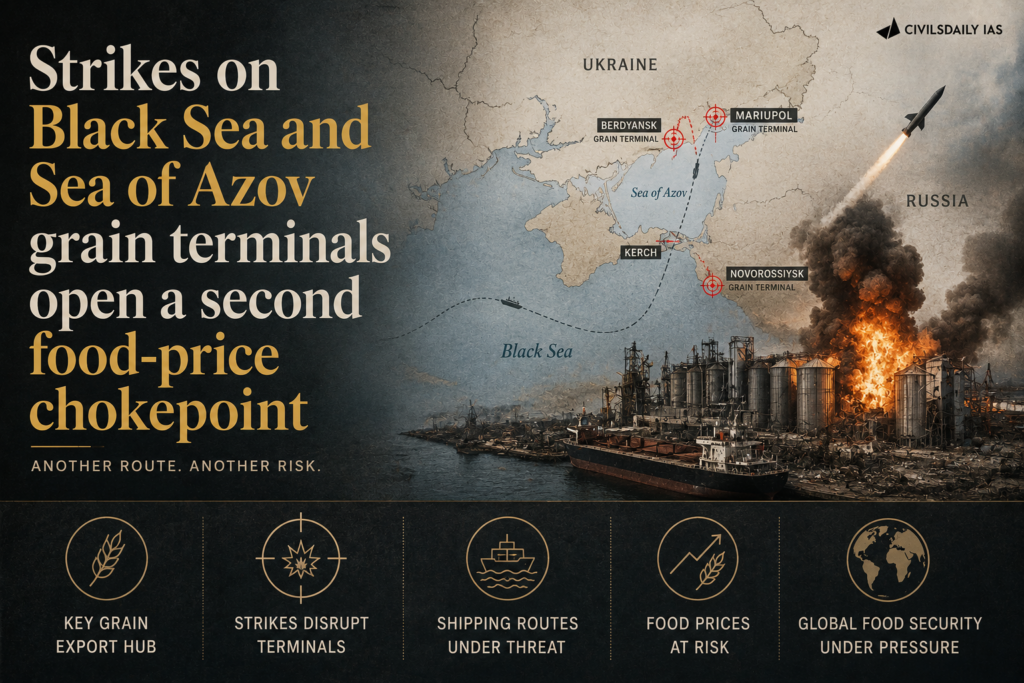
    • Geographical Position: Bordered by the Sea of Azov in the south, which connects to the Black Sea via the Strait of Kerch.
    • Industrial Hub: Known as Ukraine’s industrial heartland due to large mineral and energy resources.
    • Coal Reserves: Ukraine possesses ~32 gigatonnes of hard coal, most concentrated in Donbas (IEA estimate).
    • Shale Gas Potential: Yuzivska shale gas field (Donetsk–Kharkiv) holds 1.2–2 trillion cubic metres of gas in place, one of Europe’s largest untapped reserves.
    • Salt Production: Home to Artemsil, once among Europe’s largest salt mines, producing ~2 million tonnes annually until closed in 2022 due to conflict.

    Strategic Significance of the Region:

    • For Russia:
      • Resources: Rich in coal, shale gas, salt, and coal bed methane, enhancing its resource security.
      • Geography: Provides land link to Crimea and direct access to the Sea of Azov.
      • Demographics: Large Russian-speaking population offers political and cultural leverage.
    • For Ukraine:
      • Economy: Core to industrial base, especially steel production.
      • Energy Security: Control of Yuzivska shale gas could reduce reliance on imports.
      • Sovereignty: Represents a vital part of national unity and territorial integrity.
    • Geopolitical Dimension: Sea of Azov crucial for connecting Donbas resources to Black Sea trade routes.
    • Conflict Relevance: Since Crimea’s annexation (2014) and escalation in 2022, control of Azov and Kerch Strait vital for Russia’s naval dominance.
    [UPSC 2023] Consider the following pairs: Area of conflict mentioned in news : Country where it is located

    1. North Kivu and Ituri : War between Armenia and Azerbaijan

    2. Nagorno-Karabakh : Insurgency in Mozambique

    3. Kherson and Zaporizhzhia : Dispute between Israel and Lebanon

    How many of the above pairs are correctly matched?

    Options: (a) Only one (b) Only two (c) All three (d) None*


  • Foreign Policy Watch: India-Africa

    African Union (AU) and the Mercator Map Debate

    Why in the News?

    The African Union (AU) has endorsed the Correct the Map campaign to replace the 16th-century Mercator projection with more accurate maps.

    African Union (AU) and the Mercator Map Debate

    About the African Union (AU):

    • Establishment: Formed in 2002, replacing the Organisation of African Unity (1963).
    • Membership: 55 African countries.
    • Headquarters: Addis Ababa, Ethiopia.
    • Vision: “An Integrated, Prosperous, and Peaceful Africa, driven by its own citizens.”
    • Agenda 2063: Blueprint for socio-economic growth and continental unity.
    • Main Organs: Assembly, Executive Council, AU Commission, Peace and Security Council.

    What is a Mercator Map?

    • Creation: Designed in 1569 by Gerardus Mercator.
    • Projection: Cylindrical map with straight longitude and latitude lines intersecting at 90°.
    • Purpose: Enabled sailors to plot straight-line courses for compass navigation.
    • Adoption: Became the standard map in schools, atlases, and wall charts by the 19th century.

    Issues with the Mercator Map:

    • Distortion: Enlarges high-latitude regions (Europe, Russia, North America) while shrinking Africa and South America.
    • Example: Greenland appears equal to Africa, though Africa is ~14 times larger.
    • Colonial Bias: Reinforced Western dominance narratives and downplayed Africa’s size and importance.
    • Impact: Supported marginalisation and exploitation during colonialism.
    • Alternatives: Gall-Peters (1970s) and Equal Earth (2018) projections show continents in correct proportion.
    • AU Stand: Advocates replacing Mercator maps to restore Africa’s rightful global image.
    [UPSC 2024] The longest border between any two countries in the world is between:

    Options: (a) Canada and the USA * (b) Chile and Argentina (c) China and India (d) Kazakhstan and Russian Federation


  • Russian Invasion of Ukraine: Global Implications

    Russia’s Sale of Alaska to US

    Why in the News?

    United States President Donald Trump and his Russian counterpart Vladimir Putin are set to meet in Anchorage, Alaska to discuss how to end the war in Ukraine.

    Russia's Sale of Alaska to US

    About Alaska:

    • Acquisition: Largest U.S. state; Purchased from Russia in 1867 for $7.2 million.
    • Mountains: Includes Alaska Range with Mount Denali (20,310 ft), the highest peak in North America.
    • Geography: Brooks Range separates central Alaska from the Arctic far north.
    • Tundra: Northern regions feature vast tundra, permafrost, and Arctic coastal plains.
    • Glaciers: Hosts 100,000+ glaciers, including Bering Glacier, the largest in North America.
    • Forests: About 5% glacier ice, with extensive boreal and temperate rainforests in the south.
    • Volcanoes: More than 70 active volcanoes in Aleutians and Alaska Peninsula.
    • Seismic Activity: Located on the circum-Pacific seismic belt, prone to powerful quakes (e.g., 1964 Alaska earthquake).
    • Water Resources: Contains 3 million+ lakes and 3,000+ rivers, among the most water-rich regions globally.
    • Peninsulas: Includes Alaska Peninsula, Kenai Peninsula, and Seward Peninsula (linked to ancient Bering land bridge).

    Why did Russia sell Alaska to the US?

    • After the Crimean War (1853–56), Russia was financially strained and needed funds.
    • Alaska was seen as a remote, unprofitable liability with declining fur trade.
    • Russia feared Britain might seize Alaska easily from nearby Canada in a future war.
    • Selling it to the United States ensured goodwill and balanced British power.
    • The $7.2 million sale (1867) turned a weakly defended outpost into cash for reforms.

    Geopolitical Significance of Alaska:

    • Natural Resources: Rich in oil, gas (e.g., Prudhoe Bay discovery, 1968), fisheries, and minerals vital for U.S. energy security.
    • Shipping Routes: Offers access to Arctic Sea routes, increasingly navigable due to climate change.
    • Strategic Gateway: Provides access to the Arctic and Pacific, enhancing U.S. naval and air capabilities.
    • Defense Value: Proximity to Russia made it critical in the Cold War and remains vital in Arctic competition.
    • Military Presence: Hosts major U.S. bases and radar systems for missile defense and surveillance.
    • Arctic Council Role: Strengthens U.S. claims in polar governance and Arctic Council negotiations.
    • Scientific Hub: Serves as a center for climate, seismic, and polar ecosystem research.
    [UPSC 2025] Consider the following statements:

    I. Anadyr in Siberia and Nome in Alaska are a few kilometers from each other, but when people are waking up and getting set for breakfast in these cities, it would be different days.

    II. When it is Monday in Anadyr, it is Tuesday in Nome.

    Which of the statements given above is/are correct?

    (a) I only * (b) II only (c) Both I and II (d) Neither I nor II


  • Foreign Policy Watch: United Nations

    Third United Nations Conference on Landlocked Developing Countries (LLDC3)

    Why in the News?

    The 3rd UN Conference on Landlocked Developing Countries (LLDC3) in Awaza, Turkmenistan, adopted the Awaza Declaration to boost investment, address challenges, and promote sustainable growth in 32 landlocked nations.

    Third United Nations Conference on Landlocked Developing Countries (LLDC3)

    About Landlocked Developing Countries (LLDCs):

    • Overview: 32 UN-recognized countries with no direct access to the sea, collectively home to over 600 million people.
    • List of LLDCs:
      1. Africa: Botswana, Burkina Faso, Burundi, Central African Republic, Chad, Eswatini, Ethiopia, Lesotho, Malawi, Mali, Niger, Rwanda, South Sudan, Uganda, Zambia, Zimbabwe.
      2. Asia: Afghanistan, Bhutan, Kazakhstan, Kyrgyzstan, Lao People’s Democratic Republic, Mongolia, Nepal, Tajikistan, Turkmenistan, Uzbekistan.
      3. Europe: Armenia, Azerbaijan, North Macedonia, Moldova, Serbia.
      4. South America: Bolivia, Paraguay.
    • Challenges:
      • Dependence on transit countries for global market access.
      • Higher trade and transport costs (often twice those of coastal countries).
      • Limited connectivity, slower growth, and vulnerability to climate impacts.
    • Past Conferences:
      • 2003 (Almaty) – Almaty Programme of Action.
      • 2014 (Vienna) – Vienna Programme of Action (2014–2024).
      • 2025 (Awaza) – Awaza Programme of Action (2024–2034).

    Structure and Functioning:

    • LLDC Conferences: Held every 10 years to review progress and set a new action framework.
    • Awaza Programme of Action (2024–2034) – Priority Areas:
      • Structural transformation, science, technology, and innovation.
      • Trade facilitation and regional integration.
      • Transit, transport, and connectivity.
      • Climate resilience and adaptation.
      • Monitoring and implementation.
    • Stakeholder Participation:
      • UN member states, transit countries, donor agencies, NGOs, private sector, and academia.
    • Mechanisms:
      • UN-wide monitoring framework covering 323 initiatives.
      • Partnerships for infrastructure and digital connectivity.
      • Climate Negotiating Group under UNFCCC for LLDC-specific challenges.
    [UPSC 2013] Which one of the following countries is landlocked?

    Options:  (a) Bolivia* (b) Peru (c) Suriname (d) Uruguay


  • Global Geological And Climatic Events

    In news: Dardanelles Strait

    Why in the News?

    The Dardanelles Strait in northwestern Turkey has been temporarily closed to maritime traffic due to forest fires near Canakkale, prompting evacuations and firefighting operations.

    About Dardanelles Strait:

    • Location: Northwestern Turkey; separates Gallipoli Peninsula (Europe) from Troad/Biga Peninsula (Asia).
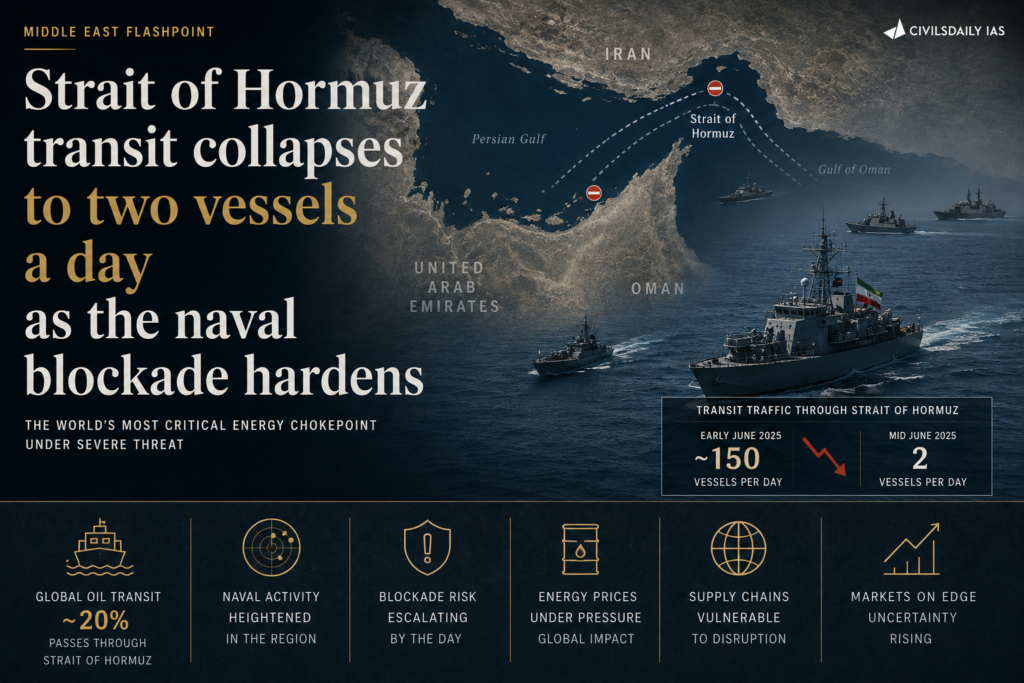
    • Connection: Links Aegean Sea → Sea of Marmara → Bosporus → Black Sea.
    • Dimensions: Length 61 km, width 1.2–6.5 km, average depth 55 m, max depth 103 m.
    • Historical Name: Hellespont, named after mythical princess Helle; current name from ancient city of Dardanus.
    • Currents: Surface current flows from Sea of Marmara to Aegean; saline undercurrent in reverse.
    • Ports: Gallipoli, Eceabat, Çanakkale.

    Strategic & Economic Importance:

    • Part of Turkish Straits system with Bosporus; only maritime link between Black Sea and Mediterranean.
    • Critical for Black Sea nations’ trade (Russia, Ukraine, Bulgaria, etc.).
    • Major route for grain, oil, energy shipments from Black Sea region to global markets.
    • Governed by Montreux Convention (1936) for warship passage.
    • Vital for NATO naval strategy and maritime security.
    [UPSC 2008] Through which one of the following Straits does a tunnel connect the United Kingdom and France?

    Options: (a) Davis Strait (b) Denmark Strait (c) Strait of Dover* (d) Strait of Gibraltar


  • The Crisis In The Middle East

    Gaza War Impact on IMEC

    Why in the News?

    India’s National Security Council Secretariat recently hosted envoys from the US, UAE, Saudi Arabia, France, Italy, Germany, Israel, Jordan, and the EU to review progress on the India–Middle East–Europe Economic Corridor (IMEC).

    Gaza War Impact on IMEC

    About IMEC Project:

    • Part of the Partnership for Global Infrastructure and Investment (PGII) for developing connectivity in emerging regions.
    • MoU signed on 10 September 2023 at the G20 New Delhi Summit.
    • Members: India, US, UAE, Saudi Arabia, France, Germany, Italy, European Union.
    • Aim: Integrate Asia, Middle East, and Europe to boost transport efficiency, reduce costs, create jobs, cut greenhouse gas emissions, and strengthen economic unity.
    • Structure:
      • East Corridor: India to Arabian Gulf.
      • Northern Corridor: Gulf region to Europe.
    • Key Ports:
      • India – Mundra, Kandla, Jawaharlal Nehru Port (Mumbai).
      • Middle East – Fujairah, Jebel Ali, Abu Dhabi, Dammam, Ras Al Khair.
      • Israel – Haifa.
      • Europe – Piraeus, Messina, Marseille.
    • Infrastructure includes: Railway links, ship-to-rail hubs, roads, electricity cables, hydrogen pipelines, and high-speed data cables.

    Impact of Gaza War:

    • Derailed work: Conflict from late 2023 halted stakeholder meetings and derailed western leg (Middle East–Europe) progress.
    • Jordan–Israel relations at historic low; Saudi–Israel normalisation stalled.
    • Regional rivalries (e.g., Saudi–UAE trade competition) hinder unified operational planning.

    Significance:

    • Economic: EU is India’s largest trading partner; corridor promises faster, cheaper trade with reduced emissions.
    • Strategic: Strengthens India’s role in West Asia and positions it as a connector between Europe and the Middle East.
    • Energy & Technology: Potential for clean hydrogen pipelines, electricity and data cable links.
    • Resilience: Provides alternative to Red Sea shipping routes vulnerable to disruptions.
    [UPSC 2025] India is one of the founding members of the International North-South Transport Corridor (INSTC), a multimodal transportation corridor, which will connect:

    Options: (a) India to Central Asia to Europe via Iran* (b) India to Central Asia via China (c) India to South-East Asia through Bangladesh and Myanmar (d) India to Europe through Azerbaijan


  • Climate Change Impact on India and World – International Reports, Key Observations, etc.

    In News: Great Barrier Reef

    Why in the News?

    The Great Barrier Reef is facing its sharpest coral decline in 40 years, with the 2024 mass bleaching—driven by climate change, cyclones, and coral predators—severely damaging large reef areas.

    In News: Great Barrier Reef

    About Great Barrier Reef:

    • Location: Coral Sea, off the northeast coast of Queensland, Australia.
    • Length & Area: Extends ~2,300 km; comprises ~3,000 reefs and 900 islands, covering ~350,000 square kilometers (about 10% of global coral reef ecosystems).
    • Biodiversity:
      • Hosts 400 coral species, 1,500 fish species, and 4,000 mollusk species.
      • Habitat for endangered species like the dugong and green turtle.
    • Reef Types: Includes platform reefs, wall reefs, and fringing reefs.
    • Protection Status:
      • Managed by the Great Barrier Reef Marine Park Authority.
      • Declared a United Nations Educational, Scientific and Cultural Organization (UNESCO) World Heritage Site in 1981.
    • Mass Bleaching Years: Notable events occurred in 1998, 2002, 2016, 2017, 2020, 2022, 2024, and 2025.

    Coral Decline and Bleaching Events:

    • Main Cause: Heat stress due to climate change, particularly during marine heatwaves.
    • 2024 Event: Fifth major bleaching since 2016; had the widest spatial impact recorded in the Australian Institute of Marine Science’s 39-year monitoring program.
    • Additional Damage: Cyclones (e.g., Cyclone Jasper) and flood plumes caused physical damage and freshwater stress.
    • Biological Threats: Crown-of-thorns starfish (COTS) outbreaks intensified coral predation, especially in the Swains sector.
    • 2025 Survey Findings:
      • 48% of 124 surveyed reefs showed coral decline.
      • Only 10% recorded an increase in coral cover.
    • Regional Impact: Southern Great Barrier Reef saw a 30.6% drop in hard coral cover—the sharpest annual decline ever recorded in that zone.
    [UPSC 2014] The scientific view is that the increase in global temperature should not exceed 2 0 C above pre-industrial level. If the global temperature increases beyond 30 C above the pre-industrial level, what can be its possible impact/impacts on the world?

    1. Terrestrial biosphere tends toward a net carbon source. 2. Widespread coral mortality will occur. 3. All the global wetlands will permanently disappear.  4. Cultivation of cereals will not be possible anywhere in the world. Select the correct answer using the code given below:

    Options: (a) 1 only (b) 1 and 2 only* (c) 2, 3 and 4 only (d) 1, 2, 3 and 4 only


  • Global Geological And Climatic Events

    Tsunami Waves triggered by quakes in Kamchatka Peninsula

    Why in the News?

    An 8.8 magnitude earthquake hit off Russia’s Kamchatka Peninsula, triggering 16-foot tsunamis that reached Hawaii and northern California in the US.

    About Earthquakes:

    • Overview: Sudden ground shaking caused by release of stored energy in Earth’s crust due to tectonic stress.
    • Cause: Occurs when tectonic plates slip at fault lines where stress had built up due to friction.
    • Seismic Waves: Energy travels as:
      • Primary Waves (P-waves): Fastest, compressional.
      • Secondary Waves (S-waves): Slower, shear motion.
    • Key Terms:
      • Focus (Hypocenter): Underground origin point.
      • Epicenter: Surface point directly above the focus.
    • Measurement:
      • Magnitude: Energy released (Richter Scale, logarithmic).
      • Intensity: Observed ground shaking (varies by location).
      • Seismograph: Records seismic wave activity.

    How Earthquakes Trigger Tsunamis?

    • Underwater Epicenter: Must occur beneath oceans to displace water.
    • Shallow Depth: Quakes at <70 km transfer energy more efficiently to water surface.
    • Reverse Faulting: One tectonic plate pushes over another, vertically shifting the seafloor.
    • Rapid Displacement: Sudden seafloor uplift/downthrust generates massive water waves.
    • High Magnitude: Quakes >7.0 (especially >8.0) likely to trigger tsunamis.

    About the Kamchatka Region:

    • Overview: Russian Far East; borders the North Pacific Ocean.
    • Tectonic Zone: Sits on the Kuril-Kamchatka Trench—Pacific Plate subducting under Okhotsk Plate at ~86 mm/year.
    • Seismic Hotspot: Historical major quakes in 1841, 1923, 1952, 2006, and 2020.
    • Ring of Fire: Part of the 40,000 km Pacific Ring of Fire , known for quakes and volcanoes.
    • 2025 Earthquake:
      • Depth:3 km (shallow)
      • Impact: Triggered tsunami waves up to 16 ft—one of the strongest earthquakes since 1900.
    [UPSC 2004] Consider the following geological phenomena:

    1. Development of a fault 2. Movement along a fault 3. Impact produced by a volcanic eruption 4. Folding of rocks

    Which of the above cause earthquakes?

    Options: (a) 1, 2 and 3 (b) 2 and 4 (c) 1, 3 and 4 (d) 1, 2, 3 and 4*