💥UPSC 2027,2028 Mentorship (April Batch) + Access XFactor Notes & Microthemes PDF

Type: World Mapping

  • Cuvette Centrale: World’s Largest Tropical Peatland Complex

    Why in the News?

    The Democratic Republic of the Congo (DRC) has launched oil exploration over 124 million hectares of the Cuvette Centrale peatlands raising global ecological risk.

    About the Cuvette Centrale Peatland Complex:

    • Location: Central Congo Basin, spanning the Democratic Republic of the Congo and the Republic of Congo.
    • Size: Covers approximately 145,000–167,600 sq. km—larger than England and about 10% of the Congo Basin.
    • Peat Coverage: Around 40% of the region is underlain by peat—formed over 10,000 years due to flat terrain, rainforest climate, and slow-moving water.
    • Landscape: Features a mosaic of seasonal lakes, floating prairies, swamp forests, rivers, and grasslands.
    • Global Status: The world’s largest near-contiguous tropical peatland complex.

    Ecological Significance:

    • Carbon Storage: Holds about 30–30.6 gigatonnes of carbon—
      • Equal to 3 years of global fossil fuel emissions.
      • Nearly 15 years of U.S. emissions.
      • About 28% of global tropical peat carbon stock.
    • Climate Impact: Acts as a major carbon sink, critical for regulating global temperatures and mitigating climate change.
    • Biodiversity: Habitat for forest elephants, lowland gorillas, and rare plant species.
    • Local Importance: Sustains indigenous livelihoods and maintains regional water cycles.
    • Conservation Status: Recognized as a transnational Ramsar wetland site, highlighting its international ecological value.
    [UPSC 2024] One of the following regions has the world’s largest tropical peatland, which holds about three years’ worth of global carbon emissions from fossil fuels, and the possible destruction of which can exert a detrimental effect on the global climate. Which one of the following denotes that region?

    Options: (a) Amazon Basin (b) Congo Basin* (c) Kikori basin (d) Rio De La Plata Basin


  • Global Geological And Climatic Events

    In news: Kamchatka Peninsula

    Why in the News?

    Five strong offshore earthquakes hit Russia’s Kamchatka Peninsula, the strongest measuring 7.4 in magnitude.

    Kamchatka Peninsula

    About Kamchatka Peninsula:

    • Location: Situated in Far Eastern Russia, bordered by the Sea of Okhotsk (west) and the Pacific Ocean and Bering Sea (east).
    • Size and Shape: Stretches about 1,200 km north to south and 480 km at its widest point.
    • Area: Covers approximately 370,000 square kilometers—comparable in size to New Zealand.
    • Ethnic Composition: Majority are ethnic Russians; around 13,000 belong to the indigenous Koryak community.
    • Climate: Harsh with long, snowy winters and wet, cool summers.
    • Topography: Highest peak is Klyuchevskaya Sopka, an active volcano in the Eastern Mountain Range.
    • Global Recognition: Hosts the “Volcanoes of Kamchatka,” a UNESCO World Heritage Site.

    Tectonic Significance:

    • Geological Setting: Lies on the Pacific Ring of Fire, making it a global hotspot for seismic and volcanic activity.
    • Volcanic Density: Contains over 150 volcanoes, 29 of which are currently active.
    • Kuril–Kamchatka Trench: Located just offshore, reaches depths of about 10,500 meters and drives regional seismicity.
    • Tectonic Cause: Caused by subduction of the Pacific Plate beneath the Eurasian Plate.
    [UPSC 2004] Consider the following geological phenomena:

    1. Development of a fault 2. Movement along a fault

    3. Impact produced by a volcanic eruption 4. Folding of rocks

    Which of the above cause earthquakes?

    Options: (a) 1, 2 and 3 (b) 2 and 4 (c) 1, 3 and 4 (d) 1, 2, 3 and 4*


  • Disputes over Grand Ethiopian Renaissance Dam (GERD)

    Why in the News?

    The completion of Ethiopia’s Grand Ethiopian Renaissance Dam (GERD) has reignited tensions over Nile water rights, with Egypt and Sudan fearing reduced water flows.

    Disputes over Grand Ethiopian Renaissance Dam (GERD)

    About Grand Ethiopian Renaissance Dam (GERD):

    • Overview: Gravity dam on the Blue Nile near Ethiopia–Sudan border.
    • Construction Timeline: Under construction since 2011, led by Ethiopian Electric Power Corporation.
    • Capacity: Set to become Africa’s largest hydropower plant with 6.45 GW output.
    • Reservoir Size: Holds 74 billion cubic metres; filling may take 5–15 years.
    • Key Features: 145 m tall dam, 16 turbines, and a supporting saddle dam.
    • Purpose: Aims to power Ethiopia (65% population lacks electricity) and export surplus to neighbouring countries.
    • Disputes Around GERD:
      • Egypt’s Concern: Fears reduced water flow; Relies 90% on Nile; demands a binding filling agreement.
      • Sudan’s Worry: Concerns over flood risks and water regulation.
      • Ethiopia’s Stand: Asserts sovereign rights; began filling without consensus.
      • Stalled Talks: Tripartite negotiations have failed; Egypt warns of possible conflict.

    Back2Basics: Nile River

    • Overview: North-flowing, longest river in Africa at ~6,650 km.
    • Drainage Basin: Covers 11 countries—Tanzania, Uganda, Rwanda, Burundi, DRC, Kenya, Ethiopia, Eritrea, South Sudan, Sudan, and Egypt.
    • Main Tributaries:
      • White Nile: Recognized as the headstream, its most remote source is the Kagera River in Burundi, flowing through Rwanda into Lake Victoria. It officially begins at Jinja, Uganda, where it exits Lake Victoria.
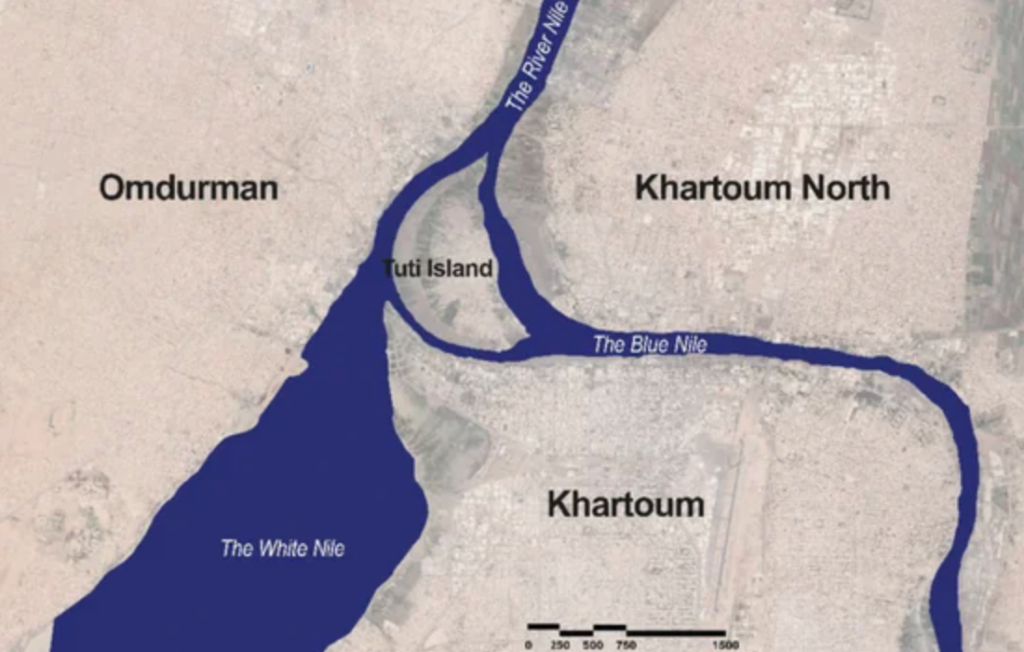
      • Blue Nile: Originates from Lake Tana in Ethiopia and merges with the White Nile at Khartoum, Sudan.  Supplies over 80% of total Nile flow by the time it reaches Egypt.
    • Lifeline Status: Vital for Egypt and Sudan’s drinking water, irrigation, and energy needs.


    [UPSC 2008] Ogaden region has been a source of conflict between which countries?

    Options: (a) Morocco and Algeria (b) Nigeria and Cameroon (c) Angola and Zambia (d) Ethiopia and Somalia*


  • Global Geological And Climatic Events

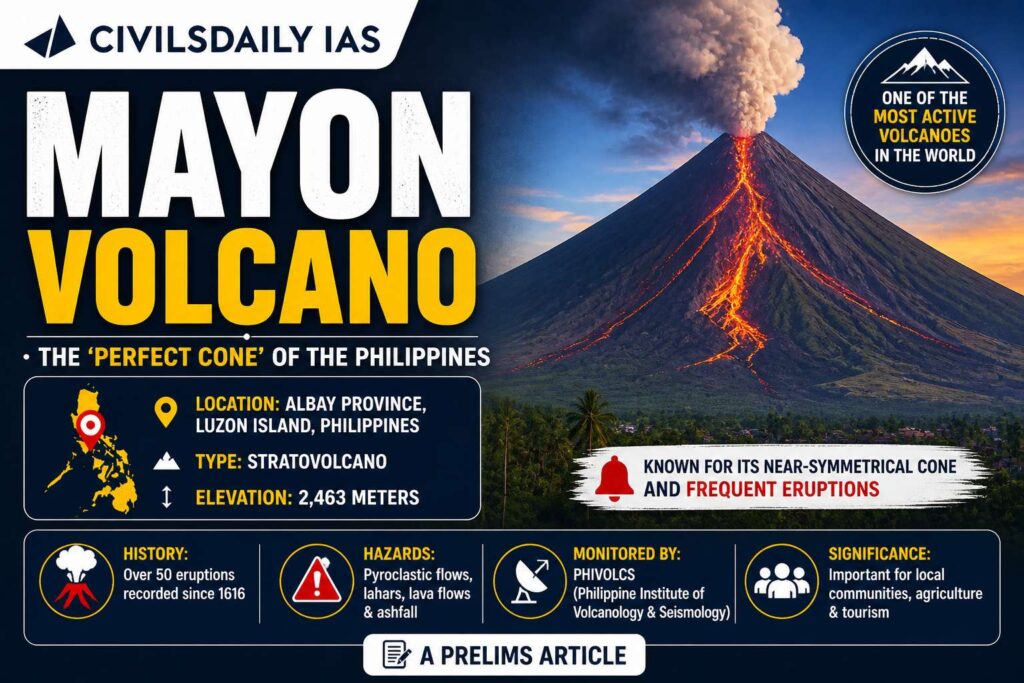
    Indonesia’s Mount Lewotobi erupts

    Why in the News?

    Mount Lewotobi Laki Laki in eastern Indonesia has erupted violently, spreading ash up to 18 kilometers into the sky.

    About Mount Lewotobi: Key Features

    • Overview: Mount Lewotobi is a twin volcano located in East Nusa Tenggara province, consisting of Lewotobi Laki Laki (“Male”) and Lewotobi Perempuan (“Female”).
    • Elevation and Activity: Lewotobi Laki Laki stands at 1,584 meters and is more frequently active. Lewotobi Perempuan is taller at 1,703 meters but less active historically.
    • Volcanic Type: Both mountains are stratovolcanoes, formed by successive layers of lava, ash, and volcanic debris.
    • Lava Domes: During the 20th century, both volcanoes developed small lava domes within their summit craters.
    • Magma Composition: The primary eruptive material from both volcanoes is andesite, a type of intermediate volcanic rock.
    • Tectonic Location: The volcanoes lie on the Pacific Ring of Fire, a seismically active belt known for frequent earthquakes and volcanic eruptions.

    Back2Basics: The Pacific Ring of Fire

    • Overview: The Pacific Ring of Fire is a 40,000-km-long horseshoe-shaped zone encircling much of the Pacific Ocean, known for intense geological activity.
    • Volcanic Density: This region contains around 75 percent of the world’s volcanoes—more than 450 in total.
    • Seismic Activity: Approximately 90 percent of the world’s earthquakes occur within this zone.
    • Geographic Spread: It extends from New Zealand through Indonesia, the Philippines, and Japan, across to the Aleutian Islands, and then down the western coasts of North and South America.
    • Tectonic Plates Involved: Several major tectonic plates intersect here, including the Pacific, Philippine, Juan de Fuca, Cocos, Nazca, and North American plates.
    • Subduction Zones: Much of the Ring features subduction zones, where one tectonic plate slides beneath another, generating magma and leading to volcanic eruptions.
    • Plate Movement: The movement of these plates is slow—typically just one to two inches per year—but it results in significant geological events over time.


    [UPSC 2018] Consider the following statements:

    1. The Barren Island volcano is an active volcano located in the Indian territory.

    2. Barren Island lies about 140 km east of Great Nicobar.

    3. The last time the Barren Island volcano erupted was in 1991 and it has remained inactive since then. Which of the statements given above is/are correct?

    Options: (a) 1 only (b) 2 and 3 (c) 3 only (d) 1 and 3


  • Global Geological And Climatic Events

    1000 quakes rattle Japan’s Tokara Islands

    Why in the News?

    Japan has recorded over 1,000 tremors in two weeks near the Tokara Islands, signalling a surge in seismic activity.

    Why is Japan so prone to earthquakes?

    • Tectonic Plate Convergence: Japan lies at the junction of four major tectonic plates—the Pacific, Philippine Sea, Eurasian, and North American—which constantly collide and shift.
    • Subduction Zones: Oceanic plates (Pacific and Philippine Sea) are being pushed under continental plates, creating intense geological stress that is released as earthquakes.
    • Pacific Ring of Fire: Japan is part of this highly active seismic zone that surrounds the Pacific Ocean and accounts for about 90% of the world’s earthquakes.
    • Volcanic and Fault Line Density: The country has about 10% of the world’s active volcanoes and numerous fault lines, increasing its seismic vulnerability.

    About Tokara Islands:

    • Overview: They are a small volcanic island chain in the Ryukyu archipelago, forming part of Kagoshima Prefecture in southern Japan:
    • Geographical Location: Between Kyushu and the Amami Islands, in the East China Sea.
    • Composition: Includes 12 islands, of which 7 are inhabited, such as Nakanoshima, Takarajima, and Kodakarajima.
    • Volcanic Origin: Part of the Ryukyu Arc, a highly seismically active zone. Mount Otake, an active volcano, is located on Nakanoshima.
    • Geopolitical Relevance: The islands are gaining strategic significance due to rising tensions in the East China Sea, particularly involving China and Taiwan. Recent defense policies have called for fortification of the Tokara and Nansei Islands to enhance surveillance.
    [UPSC 2008] In the year 2007, an earthquake led to massive radioactive water leakage in the largest nuclear plant in the world. In which country did it occur?

    Options: (a) Germany (b) Canada (c) Japan* (d) USA


  • Iran’s Nuclear Program & Western Sanctions

    Places in news: Strait of Hormuz

    Why in the News?

    Iran’s Parliament has approved a motion to block the Strait of Hormuz, raising concerns worldwide.

    Strait of Hormuz

    About the Strait of Hormuz:

    • Geographic Location: The Strait of Hormuz is a narrow waterway that connects the Persian Gulf to the Gulf of Oman and eventually to the Arabian Sea.
    • Dimensions: It is about 167 km long and 33 km wide at its narrowest, making it one of the world’s most strategic maritime chokepoints.
    • Bordering Countries: The strait lies between Iran (north) and Oman (south), with nearby cities such as Bandar Abbas, Khasab, and Dubai.
    • Shipping Lanes: It contains designated lanes just 3 km wide in each direction to manage heavy oil tanker traffic.
    • Key Islands: Important islands include Qeshm, Hormuz, and Hengam (controlled by Iran) and disputed ones like Abu Musa and the Tunbs, claimed by both Iran and the UAE.
    • Naval Depth Advantage: Waters near the Musandam Peninsula reach depths over 650 feet, ideal for deep-draft oil tankers.
    • Security Risks: Due to its narrowness, the strait is vulnerable to disruption from mining, military action, or cyber interference.
    • Historical Tensions: It has witnessed frequent maritime tensions, especially during Iran–West conflicts but has never been fully blocked.

    Its significance:

    • Global Oil Flow: Over 20 million barrels of crude oil per day pass through the strait, accounting for 25% of seaborne oil trade and 20% of global consumption.
    • Gas Exports: It is vital for LNG exports, especially from Qatar, reaching markets across the globe.
    • Asian Dependence: Countries like India, China, Japan, and South Korea import 69% of the oil that flows through the strait.
    • Market Sensitivity: Any disruption can spike global oil prices, increasing fuel and commodity costs worldwide.
    • Limited Alternatives: Overland pipelines like Saudi Arabia’s East-West (5 million bpd) and UAE’s Habshan-Fujairah (1.8 million bpd) offer only partial alternatives.

    Implications of Blockade:

    • Shipping Costs: During geopolitical tensions, insurance and freight charges for using the strait surge significantly.
    • India’s Vulnerability: India relies heavily on the region for oil imports, so instability could raise inflation, disrupt energy supplies, and impact the trade balance.
    • Strategic Response: A full blockade could trigger direct military action, particularly from the US 5th Fleet based in Bahrain.
    • Mutual Economic Impact: Disruption would affect both exporters and importers, including Iran and its major customer, China.
    [UPSC 2010] Which one of the following can one come across if one travels through the Strait of Malacca?

    Options: (a) Bali (b) Brunei (c) Java (d) Singapore*


  • Global Geological And Climatic Events

    Massive eruption of Italy’s Mount Etna

    Why in the News?

    Mount Etna, Europe’s largest active volcano, has erupted sending ash, smoke, and rock fragments several kilometres into the sky.

    Why do Volcanoes Erupt?

    • Magma Formation: Deep within Earth, high temperature and pressure melt rocks into magma.
    • Gas Expansion: Magma contains gases like water vapor, CO, and SO. As magma rises, the pressure drops, allowing these gases to form bubbles, increasing internal pressure.
    • Crustal Weaknesses: At tectonic boundaries or mantle plumes, cracks and faults in Earth’s crust provide pathways for magma to escape.
    • Eruption Mechanism:
      • As pressure builds, magma is pushed upwards.
      • If blocked, the gas expansion can explode through the crust, ejecting lava, ash, and gases.
    • Signals: If magma flow is suddenly stopped by solid rock, it may create low-frequency seismic waves (pre-eruption tremors).

    Next Census to conclude by March 2027

    About Mount Etna:

    • Location: Situated on the east coast of Sicily, Italy, near the city of Catania.
    • Type: Mount Etna is a stratovolcano (also called a composite volcano), which is formed from layers of hardened lava, volcanic ash, and rocks.
    • Height: It stands at approximately 3,300 meters, making it the tallest volcano in Europe south of the Alps.
    • Recognition: Declared a UNESCO World Heritage Site in 2013, with documented volcanic activity for at least 2,700 years.
    • Eruption Record: Etna is almost constantly active. Notable eruptions have occurred in 1400 B.C., 1669, 2001, 2018, 2021, 2024, and 2025.
    • Volcanic Activity Style: Known for Strombolian and effusive eruptions, with occasional Plinian eruptions (rare and more explosive).

    Reasons Behind the June 2025 Eruption:

    • Nature of Eruption: The eruption is classified as either Strombolian or possibly Plinian, depending on interpretation:
      • Strombolian Eruption: Characterized by moderate explosive bursts, caused by gas bubbles in magma suddenly bursting at the surface.
      • Plinian Eruption: Some volcanologists suggest this classification due to the large ash column that may have reached the stratosphere.
    • Eruption Trigger: The eruption likely began due to pressure buildup from gas within the magma chamber, leading to collapse of the southeast crater and lava flows.
    [UPSC 2024] Consider the following:

    1. Pyroclastic debris

    2. Ash and dust

    3. Nitrogen compounds

    4. Sulphur compounds

    How many of the above are products of volcanic eruptions?

    Options: (a) Only one (b) Only two (c) Only three (d) Only four*


  • The Crisis In The Middle East

    Places in News: Zangezur Corridor

    Why in the News?

    The aftermath of Operation Sindoor highlights India’s strategic concerns over the proposed Zangezur Corridor in Armenia backed by Azerbaijan and Turkiye.

    Zangezur Corridor

    About the Zangezur Corridor:

    • What it is: The Zangezur Corridor is a proposed land route through Armenia’s Syunik Province that would connect Azerbaijan to its Nakhchivan region, cutting across Armenian land.
    • Who supports it: Azerbaijan and Turkiye back the project. They want a direct link without Armenian border checks or customs interference.
    • Route Details: The corridor would be about 43–44 km long and pass near the Iran-Armenia border, giving it high geopolitical value.
    • Why it’s controversial:
      • Azerbaijan sees it as a post-war right after its win in the 2020 Nagorno-Karabakh conflict.
      • Armenia insists it must have full control and sovereignty over any transport through its territory.
    • Turkiye’s Interest: It wants to use this corridor as part of its Middle Corridor project to connect with Central Asia and Europe via land routes.
    • Opposition: Iran and Armenia oppose the corridor, fearing it could:
      • Isolate Armenia,
      • Weaken Iranian access, and
      • Threaten Armenia’s territorial integrity.

    How it concerns India?

    • Strategic Ties: India is a key defence partner for Armenia and supports regional stability in the South Caucasus.
    • Trade Ambitions: India is:
      • Developing Chabahar Port in Iran,
      • Working on a transport route via Iran–Armenia–Georgia to Europe, bypassing Pakistan and the Suez Canal.
    • Concerns: If the Zangezur Corridor bypasses Armenian control, it could:
      • Disrupt India’s land trade route to Europe,
      • Reduce Iran’s regional access,
      • Weaken India’s strategic reach.
    • Larger Geo-Politics: Turkiye and Azerbaijan’s growing influence in the region is worrying for India, especially since Turkiye opposes India’s IMEC (India-Middle East-Europe Corridor).
    • India’s Stand: India supports Armenia’s sovereignty and opposes unilateral moves, aiming to:
      • Protect its trade routes,
      • Preserve strategic balance, and
      • Counter regional encirclement.
    [UPSC 2023] Consider the following pairs:

    Regions often mentioned in news : Reason for being in news

    1. North Kivu and Ituri : War between Armenia an Azerbaijan

    2. Nagorno-Karabakh : Insurgency in Mozambique

    3. Kherson and Zaporizhzhia : Dispute between Israel and Lebanon How many of the above pairs are correctly matched?

    Options: (a) Only one (b) Only two (c) All three (d) None *


  • The Crisis In The Middle East

    Persian Gulf to be renamed as ‘Arabian Gulf’

    Why in the News?

    Donald Trump plans to announce that the US will officially refer to the Persian Gulf as the “Arabian Gulf” or “Gulf of Arabia”, aligning with the preferences of Arab nations.

    Persian Gulf to be renamed as 'Arabian Gulf'

    About Persian Gulf

    • The Persian Gulf is a marginal sea of the Indian Ocean, located in Western Asia.
    • It is connected to the Arabian Sea through the Strait of Hormuz, a critical maritime chokepoint for global oil shipments.
    • The gulf spans an area of approximately 251,000 km².
    • Its average depth is around 50 meters, with a maximum depth of about 90 meters.
    • The total coastline is roughly 5,117 km, with Iran possessing the longest share (~1,536 km).
    • The gulf is bordered by:
      • North: Iran
      • Southwest: Saudi Arabia, Qatar, UAE
      • Northwest: Iraq, Kuwait, Bahrain
    • Key islands:
      • Qeshm Island (Iran) — the largest island in the Persian Gulf (~1,491 km²), nearly 2.5 times the size of Bahrain.
      • Bahrain — a sovereign archipelago state with over 50 islands, and home to a major US naval base.
    • It is recognized officially by the International Hydrographic Organisation (IHO) as the “Persian Gulf”.
    [UPSC 2024] Consider the following statements:

    Statement-I: Sumed pipeline is a strategic route for Persian Gulf oil and natural gas shipments to Europe.

    Statement-II: Sumed pipeline connects the Red Sea with the Mediterranean Sea.

    Which one of the following is correct in respect of the above statements?

    Options: (a) Both Statement-I and Statement-II are correct and Statement-II explains Statement-I* (b) Both Statement-I and Statement-II are correct, but Statement-II does not explain Statement-I (c) Statement-I is correct, but Statement-II is incorrect (d) Statement-I is incorrect, but Statement-II is correct


  • Heard and McDonald Islands

    Note4Students

    From UPSC perspective, the following things are important:

    Prelims level: Heard and McDonald Islands

    Why in the News?

    Donald Trump imposed a 10% tariff on imports from the Heard and McDonald Islands, despite no human presence there for nearly a decade.

    About the Heard and McDonald Islands

    • The Heard and McDonald Islands are located in the Southern Ocean, approximately 4,100 km south-west of Perth, Australia, and 1,600 km to the north of the Antarctic coast.
    • The islands are unincorporated external territories of Australia, meaning they are not part of any Australian state but are directly administered by the Australian government.
    • The islands are home to seals, penguins, and albatrosses, and serve as crucial breeding grounds for these species.
    • The islands have been designated as UNESCO World Heritage Sites due to their ecological significance, particularly their rich biodiversity.
    • Heard Island:
      • Heard Island spans an area of approximately 368 square kilometers.
      • The island’s highest point is Mawson Peak, an active volcano standing 2,745 meters (9,006 feet) above sea level.
      • Mawson Peak is one of the most active volcanoes in the southern hemisphere, with eruptions as recent as 2016.
    • McDonald Islands:
      • It is much smaller, covering only 2.5 square kilometers.
      • Geological Nature: These islands are volcanic and part of the same volcanic chain as Heard Island.
      • Climate
      • Both islands experience an extremely cold subantarctic climate, with heavy winds, snow, and ice for much of the year.
      • Temperatures rarely exceed 5°C (41°F) even in summer.

    Strategic Significance

    • The islands are strategically located between Australia and Antarctica, important for monitoring the Southern Ocean, vital for global biodiversity and climate studies.
    • They play a key role in scientific research, particularly in volcanology, glaciology, and climate change, with Australia operating a research station on Heard Island.
    • The islands are protected under the Antarctic Treaty System, ensuring no military activity or commercial exploitation in the region.
    • Rich in marine resources, the surrounding waters are also safeguarded to prevent overfishing and environmental harm.
    • Their geopolitical importance grows as international competition and territorial claims around Antarctica and the Southern Ocean increase.