💥UPSC 2026, 2027, 2028 UAP Mentorship (March Batch) + Access XFactor Notes & Microthemes PDF

Archives: News

  • India’s geospatial sector

    Context

    Last year new guidelines took effect to completely de-regulate the geospatial sector for Indians.

    Potential of India’s geospatial sector

    • India has a robust ecosystem in geospatial, with the Survey of India (SoI), the Indian Space Research Organisation (ISRO), remote sensing application centres (RSAC)s, and the National Informatics Centre (NIC) in particular, and all ministries and departments, in general, using geospatial technology.
    • However, the full benefits have yet to percolate to the public; neither is there much contribution to the nation’s GDP.
    • The Prime Minister’s speech during Independence Day and mention of geospatial in the Union Budget have created the necessary buzz.
    • The last year has also witnessed some activity on the ground.
    • The most noticeable was the over subscription of the initial public offering of MapmyIndia.
    • The other noticeable activity was the launching of a city mapping programme by Genesys International in India.
    • Such an aggressive stance by investors for geospatial was not seen in the earlier regime; it is certain that the new guidelines have played a role.

    Challenges

    • Lack of demand: There is no demand for geospatial services and products on a scale linked to India’s potential and size.
    • This is mainly due to the lack of awareness among potential users in government and private.
    • Lack of skilled manpower: The other hurdle has been the lack of skilled manpower across the entire pyramid.
    • Unavailability of foundation data: The unavailability of foundation data, especially at high-resolution, is also a constraint.
    • Lack of clarity on data sharing: The lack of clarity on data sharing and collaboration prevents co-creation and asset maximisation.
    • Lastly, barring a few cases, there are still no ready-to-use solutions especially built to solve the problems of India.

    Suggestions

    •  Despite one year since the new guidelines came into effect, users are still not fully aware of things.
    • Publish policy document: First and foremost is the need to publish the entire policy document and make government and private users aware of things.
    • Data sharing protocol: The data available with government departments should be unlocked, and data sharing should be encouraged and facilitated.
    • Standards: The Government needs to invest in developing standards and must mandate the adoption of standards
    • Foundation data: While different types of data will be produced on a project-to-project basis, there is a need to generate foundation data across India.
    • This should include the Indian national digital elevation model (InDEM), data layers for cities, and data of natural resources.
    • Local technology and solutions should be promoted, and competition should be encouraged for quality output.
    • As the new guidelines prevent high-accuracy data being stored in overseas clouds, there is a need to develop a geospatial data cloud locally and facilitate a solution as service.
    • Professionals: Unlike the West, India lacks a strata of core professionals who understand geospatial end-to-end. India should start a bachelor’s programme in geospatial also in the Indian Institutes of Technology and the National Institutes of Technology.
    • Besides these, there should be a dedicated geospatial university.

    Conclusion

    The geospatial sector in the country is rightly positioned for investment. However, clarity on the issues discussed and the creation of an enabling ecosystem are essential.

    UPSC 2022 countdown has begun! Get your personal guidance plan now! (Click here)

  • Corruption Challenges – Lokpal, POCA, etc

    Prevention of Money Laundering Act (PMLA)

    The Supreme Court is looking into allegations of the metamorphosis of the Prevention of Money Laundering Act (PMLA), brought to sniff out drug money, into a potent weapon to raid rivals and deny rights.

    What is meant by money laundering?

    • Money laundering is the process of making significant amounts of money obtained through criminal activities, such as drug trafficking or terrorist funding, appear to have come from a legitimate source.
    • Large profits are made by illegal arms sales, drug trafficking, smuggling and prostitution rings, insider trading, bribery, and computer fraud schemes.
    • As a result, it provides an incentive for money launderers to “legitimize” their ill-gotten gains through money laundering.
    • The money generated is referred to as ‘dirty money,’ and money laundering is the act of converting ‘dirty money’ into ‘legitimate’ money.

    Money Laundering Procedure:

    It is a 3-stage process. They are:

    • Placement: The first stage involves the injection of crime money into the formal financial system.
    • Layering is the second stage, money injected into the system is layered and spread over various transactions in order to conceal the money’s tainted origin.
    • Integration: In the third and final stage, money enters the financial system in such a way that the initial association with the crime is sought to be erased, and the money can then be utilized as clean money by the offender.

    Some of the most Common Money Laundering Methods:

    • Bulk cash smuggling, cash-intensive businesses, round-tripping,trade-based laundering, shell companies and trusts, bank capture, gambling, real estate, black salaries, fictional loans, hawala, and false invoicing

    Prevention of Money Laundering Act (PMLA)

    • PMLA, 2002 is an Act of the Parliament of India enacted by the NDA government to prevent money laundering and to provide for confiscation of property derived from money laundering.
    • It was enacted in response to India’s global commitment (including the Vienna Convention) to combat the menace of money laundering.
    • PMLA and the Rules notified there under came into force with effect from July 1, 2005.
    • The act was amended in the year 2005, 2009 and 2012.

    Objectives of PMLA

    The PMLA seeks to combat money laundering in India and has three main objectives:

    1. To prevent and control money laundering.
    2. To confiscate and seize the property obtained from the laundered money; and
    3. To deal with any other issue connected with money laundering in India.

    Key definitions

    • Payment System: A system that enables payment to be effected between a payer and a beneficiary, involving clearing, payment or settlement service or all of them. It includes the systems enabling credit card, debit card, smart card, money transfer or similar operations.
    • Money-laundering: Whosoever directly or indirectly attempts to indulge or assist other person or actually involved in any activity connected with the proceeds of crime and projecting it as untainted property.
    • Attachment: Prohibition of transfer, conversion, disposition or movement of property by an appropriate legal order.
    • Proceeds of crime: Any property derived or obtained, directly or indirectly, by any person as a result of criminal activity relating to a scheduled offence.

    Salient features

    • Punishment and Jail term: The Act prescribes that any person found guilty of money laundering shall be punishable with rigorous imprisonment from three years to seven years. The maximum punishment may extend to 10 years instead of 7 years.
    • Powers of attachment of tainted property: The Director or officer above the rank of Deputy Director with the authority of the Director, can provisionally attach property believed to be “proceeds of crime”.
    • Adjudicating Authority: It is the authority appointed by the central government which decides whether any of the property attached or seized is involved in money laundering.
    • Presumption in inter-connected transactions: Where money laundering involves two or more inter-connected transactions. It is presumed that the remaining transactions form part of such inter-connected transactions.
    • Burden of proof: A person, who is accused of having committed the offense of money laundering, has to prove that alleged proceeds of crime are in fact lawful property.
    • Appellate Tribunal: It is given the power to hear appeals against the orders of the Adjudicating Authority and any other authority under the Act. Its orders are not final and can be challenged.
    • Establishment of Special Court: To ensure speedy trial.

    Issues with PMLA

    • Misuse of central agencies: PMLA is being pulled into the investigation of even ordinary crimes by the Enforcement Directorate.
    • Seizing of assets: Assets of genuine victims have been attached. The ED could just walk into anybody’s house.
    • Politically motivated raids: In all this, the fundamental purpose of PMLA to investigate the conversion of “illegitimate money into legitimate money” was lost.
    • Opacity of charges: Petitioners pointed out that even the Enforcement Case Information Report (ECIR) – an equivalent of the FIR – is considered an “internal document” and not given to the accused.
    • Vagueness over evidences: The accused is called upon to make statements that are treated as admissible in evidence.
    • Harassment: The ED begins to summon accused persons and seeks details of all their financial transactions and of their family members.
    • Against individual liberty: The initiation of an investigation by the ED has consequences that have the potential of curtailing the liberty of an individual.

    Way ahead

    • It is unlikely that corruption can be substantially reduced without modifying the way government agencies operate.
    • The fight against corruption is intimately linked with the reform of the investigations.
    • Therefore the adjudicating authorities must work in cooperation and ensure the highest standards of transparency and fairness.


  • Cyber Security – CERTs, Policy, etc

    MHA recommends ban on 54 Chinese Apps

    The Ministry of Home Affairs has recommended a ban on 54 Chinese mobile applications that pose a threat to the country’s security.

    Legal basis of app ban

    • The ban has been enforced under Section 69A of the Information Technology Act, 2000.
    • This act empowers to issue directions for blocking for public access of any information through any computer resource.
    • This is done in the interest of –
      1. sovereignty and integrity of India
      2. defense of India, security of the State
      3. friendly relations with foreign states
      4. public order (or)
      5. for preventing incitement to the commission of any cognizable offense relating to above

    Why MHA has put such a ban?

    • Most of these apps were operating as clones or shadow apps of the apps that had earlier been banned by the government.
    • There was stealing and secretly transmitting users’ data in an unauthorized manner to servers that have locations outside India.
    • These apps largely impact the psychosocial abilities of the users.
    • The immediate decision has been taken in a specific strategic and national security

    Implications of the ban

    • India’s offensive: The move comes as an exercise of coercive diplomacy with China amid the heated exchange of words during the diplomatic boycott on the winter Olympics.
    • Hurting china’s ambitions: The ban may affect one of China’s most ambitious goals, namely to become the digital superpower of the 21st century.
    • Data nationalization: The ban is also based on the recognition that data streams and digital technology are a new currency of global power.

    Issues with the ban

    • Not only China: Data privacy and data security concerns are not limited only to Chinese apps.
    • Harm already caused: The apps that were banned were very popular in India and the move to block them comes after these apps had already amassed hundreds of millions of users in India.
    • Further dependency on China: The ban on Chinese mobile apps is a relatively soft target, as India remains reliant on Chinese products in several critical and strategically sensitive sectors.

    Way Forward

    • There is a strong case to revise the key legislations and sync them to change the digital environment.
    • Data privacy and security remain to be major challenges emanating from the ongoing digital revolution.
    • Thus, a data protection law is long overdue.
    • India must speed up indigenization, research, and development, and frame up a regulatory architecture to claim data sovereignty.


    UPSC 2022 countdown has begun! Get your personal guidance plan now! (Click here)

  • Medical Education Governance in India

    Medical Ethics of Charaka

    The National Medical Commission (NMC), the regulator for medical education and practices that replaced the Medical Council of India in 2020, has suggested to medical colleges that the traditional Hippocratic Oath should be replaced by a “Charak Shapath”.

    Who was Hippocrates?

    • The Hippocratic Oath is attributed to Hippocrates of the island of Kos, a Greek physician of the classical period (4th-5th centuries BC, until the death of Alexander the Great in 323 BC).
    • It broadly corresponds to the period from the death of the Buddha (486 BC) to the rise of the Mauryas (321 BC) in India.
    • Among the great contemporaries of Hippocrates were the Athenian philosopher Plato and his teacher Socrates, and Plato’s student and Alexander’s tutor, the polymath Aristotle.
    • He is regarded as the “father of modern medicine”.

    What is the Hippocratic Oath?

    • Basically, the Hippocratic Oath is a charter of ethical principles that physicians over the ages have sworn to uphold in the practice of their profession.
    • The earliest available fragments of what is understood to be the original oath date back to the late 3rd century AD, and a millennium-old version is now in the library of the Holy See.

    What are general outlines of a Medical Oath?

    • Always exercise his/her independent professional judgment and maintain the highest standards of professional conduct
    • Respect a competent patient’s right to accept or refuse treatment
    • Not allow his/her judgment to be influenced by personal profit or unfair discrimination
    • Be dedicated to providing competent medical service in full professional and moral independence, with compassion and respect for human dignity
    • Deal honestly with patients and colleagues, and report to the appropriate authorities those physicians who practice unethically or incompetently or who engage in fraud or deception
    • Certify only that which he/she has personally verified
    • Respect the local and national codes of ethics

    About Charaka and Charak Samhita

    • The Charak Samhita is a medical pharmacopeia and collection of commentaries and discussions on medical practices that is dated to the 1st-2nd centuries AD.
    • Along with the compendium of Susruta (c. 4th century AD), which is about surgery, the Charak Samhita is considered the foundational text of ancient Indian medicine,.
    • It is an evolved system of understanding and treating disease that resembled that of Hippocrates and Galen (2nd century AD), and was in some ways ahead of the Greeks.
    • In theory and praxis, ayurvedic medicine today remains broadly unchanged from these ancient Indian principles.

    The medical ethics of Charaka

    • The physician was an important and respected member of ancient Indian society, and medical practice followed rules of professional conduct and ethical principles. It goes on to say that-
    1. You must strive with all your soul for the health of the sick.
    2. You must not betray your patients, even at the cost of your own life.
    3. You must not get drunk, or commit evil, or have evil companions.
    4. You must be pleasant of speech…and thoughtful, always striving to improve your knowledge.
    5. When you go to the home of a patient you should direct your words, mind, intellect, and senses nowhere but to your patient and his treatment.
    6. Nothing that happens in the house of the sick man must be told outside, nor must the patient’s condition be told to anyone who might do harm by that knowledge to the patient or to another.
    • This ethical code is universal, and remains just as relevant and applicable today.

    Arguments in favour of Charaka Oath

    • There is no universally accepted version of the physician’s oath.
    • Many medical schools around the world hold a ceremony in which graduating doctors swear to a broad charter of ethics that are sometimes customised by individual institutions.
    • A version of the ‘physician’s code of ethics’ is commonly displayed in hospitals or clinics in most places, including India.

    Issues with this oath

    • The opposition has criticised the proposal as an attempt to saffronise medical education.
    • Introducing Indian elements into Indian education is necessary, but not at the expense of universal values and standards.
    • Like several other sages mentioned in the literature of ancient India, the historicity of Charaka is still uncertain.


    UPSC 2022 countdown has begun! Get your personal guidance plan now! (Click here)

  • Climate Change Impact on India and World – International Reports, Key Observations, etc.

    Places in news: Erra Matti Dibbalu

    Citizens join hands to preserve the geological marvel of Erra Matti Dibbalu in Visakhapatnam.

    What is Erra Matti Dibbalu?

    • Located between Visakhapatnam and Bheemunipatnam, the Erra Matti Dibbalu are rare red sand dunes that are a reminder of the million years of geological processes.
    • Its towering red sand dunes with patches of greenery is like a meandering maze.
    • The width of the dunes, which runs for five kilometres along the coast, varies from 200 metres to two kilometres.
    • It is listed among the 34 notified National Geological Heritage Monument Sites of India by the Geological Survey of India.

    (Don’t they resemble to Ravines of Chambal?)

    Its formation

    • Studies indicate that the area was tectonically active between 2.5 million years and 11,000 years ago.
    • The sediments are mainly derived from the Khondalite rocks from the hinterland of the Eastern Ghats.
    • Geologically these red sand dune sediments particularly hold significance.
    • They are the result of the combined effect of numerous factors including global climatic changes, sea-level variations, monsoonal variability and as a result serves as valuable paleo-environment indicators.


    UPSC 2022 countdown has begun! Get your personal guidance plan now! (Click here)

  • Modern Indian History-Events and Personalities

    Who was Tilka Manjhi?

    The Nation is remembering revolutionary freedom fighter and tribal leader Tilka Manjhi on his 272nd birth anniversary.

    Tilka Manjhi (1750-1785)

    • He organized Adivasis into an army and led the famous Santhal Hool in 1784 against the exploitative British.
    • In 1770, there was a severe famine in the Santhal region and people were dying of hunger.
    • Tilka Manjhi looted the treasury of the East India Company and distributed it among the poor and needy.
    • Inspired by this noble act of Tilka, many other tribals also joined the rebellion.
    • With this began his Santhal Hool, the revolt of the Santhals.
    • He continued to attack the British and their sycophantic allies.
    • From 1771 to 1784, Tilka Manjhi never surrendered.

    Offensive with the colonists

    • Tilka Majhi attacked Augustus Cleveland, an East India Company administrator and fatally wounded him.
    • The British surrounded the Tilapore forest from which he operated but he and his men held them at bay for several weeks.
    • When he was finally caught in 1784, he was tied to the tail of a horse and dragged all the way to the Collector’s residence at Bhagalpur, Bihar, India.
    • There, his deeply wounded body was hung from a Banyan tree.

    Try this question from CSP 2018:

    Q.After the Santhal uprising subsided, what was/ were the measure/measures taken by the colonial government?

    1. The territories called ‘Santhal Paraganas’ were created.
    2. It became illegal for a Santhal to transfer land to a non Santhal.

    Select the correct answer using the code given below:

    (a) 1 only

    (b) 2 only

    (c) Both 1 and 2

    (d) Neither 1 nor 2


    Post your answers here.


    UPSC 2022 countdown has begun! Get your personal guidance plan now! (Click here)
  • Labour, Jobs and Employment – Harmonization of labour laws, gender gap, unemployment, etc.

    Local job laws that raise constitutional questions

    Context

    Last week, the Punjab and Haryana High Court admitted a petition challenging the constitutionality of the Act, and stayed the implementation until it heard the case.

    Laws raises constitutional questions

    • There are at least three important constitutional questions that arise from this Act.

    [1] Violation of Article 19(1)(g)

    • Article 19(1)(g) of the Constitution guarantees freedom to carry out any occupation, trade or business.
    • There may be reasonable restrictions “in the interests of the general public”, and in particular related to specifying any professional or technical qualifications, or to reserve a sector for government monopoly.
    • This Act, by requiring private businesses to reserve 75% of lower end jobs for locals, encroaches upon their right to carry out any occupation.
    • In 2005, in the P.A. Inamdar case, Supreme Court said that reservation cannot be mandated on educational institutions that do not receive financial aid from the state, as that would affect the freedom of occupation.

    [2] Violation of Article 16

    • The provision of reservation by virtue of domicile or residence may be unconstitutional.
    • Article 16 of the Constitution specifically provides for equality of opportunity for all citizens in public employment.
    • It prohibits discrimination on several grounds including place of birth and residence.
    • However, it permits Parliament to make law that requires residence within a State for appointment to a public office.
    • This enabling provision is for public employment and not for private sector jobs.
    • And the law needs to be made by Parliament, and not by a State legislature.

    [3] Breaching of 50% limit

    • In the Indra Sawhney case in 1992, the Supreme Court capped reservations in public services at 50%.
    • It however said that there may be extraordinary situations which may need a relaxation in this rule.
    • It also specified that “in doing so, extreme caution is to be exercised and a special case made out”.
    • That is, the onus is on the State to make a special case of exceptional circumstances, for the 50% upper limit on reservations to be relaxed.
    • It stated that the 50% limit is “to fulfil the objective of equality”, and that to breach the limit “is to have a society which is not founded on equality but on caste rule”.
    • The Haryana Act does not further “caste rule” as it is for all residents of the State irrespective of caste but it breaches the notion of equality of all citizens of India.

    [4] Against the conception of India as a one nation

    •  The Constitution conceptualises India as one nation with all citizens having equal rights to live, travel and work anywhere in the country.
    • These State laws go against this vision by restricting the right of out-of-State citizens to find employment in the State.
    • This restriction may also indirectly affect the right to reside across India as finding employment becomes difficult.
    • If more States follow similar policies, it would be difficult for citizens to migrate from their State to other States to find work.

    [5] Economic implications

    • The move may potentially increase the costs for companies.
    • There may also be an increase in income inequality across States as citizens of poorer States with fewer job opportunities are trapped within their States.

    Conclusion

    The courts, while looking at the narrow questions of whether these laws violate fundamental rights, should also examine whether they breach the basic structure of the Constitution that views India as one nation which is a union of States, and not as a conglomeration of independent States.

    UPSC 2022 countdown has begun! Get your personal guidance plan now! (Click here)

  • Agricultural Sector and Marketing Reforms – eNAM, Model APMC Act, Eco Survey Reco, etc.

    ‘climate smart’ agriculture

    Context

    In the backdrop of the 2070 carbon neutrality target set by India at the CoP26 in Glasgow, the Union Budget for 2022-23 has listed “climate action” and “energy transition” as one of the four priorities for the Amrit Kaal.

    Climate related announcement in Budget 2022-23

    • An additional allocation of Rs 19,500 crore for solar PV modules has been made.
    • The finance minister also talked of co-firing of 5-7 per cent of biomass pellets in thermal power plants, “sovereign green bonds” and a “battery-swapping policy”.
    • These are positive steps towards making the energy and transport sectors less polluting.

    How agriculture impact environement

    • Agriculture contributes 73 per cent of the country’s methane emissions. 
    • Third largest emitter: India has kept away from the recent EU-US pledge to slash methane emissions by 30 per cent by 2030, despite the country being the world’s third largest emitter of methane.
    • As per the national GHG inventory, the agriculture sector emits 408 MMT of carbon-dioxide equivalent and rice cultivation is the third highest source (17.5 per cent) of GHG emissions in Indian agriculture after enteric fermentation (54.6 per cent) and fertiliser use (19 per cent).
    • Paddy fields are anthropogenic sources of atmospheric nitrous oxide and methane, which have been reckoned as 273 and 80-83 times more powerful than carbon dioxide in driving temperature increase in 20 years’ (Sixth Assessment Report IPCC 2021).
    • Moreover, paddy fields require about 4,000 cubic metres of water per tonne of rice for irrigation.
    •  There is scientific evidence that intermittent flooding reduces water and methane emissions but increases nitrous oxide emissions.
    • Thus, lowering of methane emissions through controlled irrigation does not necessarily mean net low emissions. 
    • Role of subsidies and procurement policies: The environmental damage caused by agriculture is largely a result of the various kinds of subsidies — on urea, canal irrigation and power for irrigation — as well as the minimum support prices (MSP) and procurement policies concentrated on a few states and largely on two crops, rice, and wheat.

    Excess rice and wheat stock

    • As of January 1, the stocks of wheat and rice in the country’s central pool were four times higher than the buffer stocking requirement.
    • Rice stocks with the Food Corporation of India (FCI) are seven times the buffer norms for rice.
    • The financial value of these excessive grain stocks is Rs 2.14 lakh crore, of which Rs 1.66 lakh crore is because of excess rice stocks — as per the economic cost of rice and wheat given by the FCI.
    • All this does not just reflect inefficient use of scarce capital, the amount of greenhouse gases (GHG) embedded in these stocks is also large.

    Way forward

    • Carbon tax: According to the IMF, the world needs a carbon tax of $ 75 per tonne by 2030 to reduce emissions to a level consistent with a 2 degree Celsius warming target.
    • India does not have an explicit carbon-price yet, but many countries have begun to implement carbon pricing.
    • Revisiting policies: The Economic Survey 2021-22 points out that the country is over-exploiting its ground water resource (see map), particularly in the northwest and some parts of south India.
    • This calls for revisiting policies to subsidise power and fertilisers, MSP and procurement and reorient them towards minimising GHG emissions.
    • Farmer groups and the private sector can be mobilised to develop carbon markets in agriculture, both at the national and international levels, which can reward farmers in cash for switching from carbon-intensive crops to lower GHG emissions.

    Consider the question “Elaborate on the impact of agriculture on the environment. Suggest the changes needed in Indian agriculture policies to reduce the impact.”

    Conclusion

    Such a move towards “net-zero” agriculture will give India a “climate smart” agriculture in Amrit Kaal. And, if we can protect productivity levels with a low-carbon footprint, it will help India to access global markets too.

    UPSC 2022 countdown has begun! Get your personal guidance plan now! (Click here)

  • Capital Markets: Challenges and Developments

    Back in news: LIC Disinvestment

    The Union government has filed a draft document with the stock market regulator for selling 5% of its shares in the Life Insurance Corporation (LIC) of India.

    Details of the IPO

    • The IPO is a 100% OFS [offer for sale] by the Government of India and entails no fresh issue of shares by LIC.
    • 6 Crore shares are on offer representing 5% of the government’s equity in the firm.
    • As much as 10% of the offer could be reserved for LIC policyholders, as per the regulatory filing, and another 5% of the shares may be reserved for employees.

    About Life Insurance Corporation of India (LIC)

    • LIC is an Indian state-owned insurance group and investment corporation owned by the Government of India.
    • It was founded in 1956 when the Parliament of India passed the Life Insurance of India Act that nationalized the insurance industry in India.
    • Over 245 insurance companies and provident societies were merged to create the state-owned LIC.

    Why LIC?

    • LIC is India’s largest financial institution.
    • When listed on stock exchanges, it could easily emerge as the country’s top listed company in terms of market valuation, overtaking current leaders Reliance and TCS.
    • It is also the largest investor in government securities and stock markets every year.
    • On average, LIC invests Rs 55,000 crore to Rs 65,000 crore in stock markets every year and emerges as the largest investor in Indian stocks.
    • LIC also has huge investments in debentures and bonds besides providing funding for many infrastructure projects.

    Impacts of listing of LICs

    • Profit-making for govt: The government is trying to make the most of the brand value of LIC, given that it is one of the few remaining profit-making entities owned by the state.
    • Better returns: Listing will boost LIC’s efficiency and thereby policy returns.
    • Reforming the insurance sector: LIC will also become more competitive. This will put pressure on its peers to innovate, benefitting policyholders in terms of pricing, product features, and services.
    • Better financial position: Less govt interference will be a positive for LIC’s financial health.
    • Risk-free: As long as a sovereign guarantee over the maturity proceeds and the sum assured to continue, policyholders won’t perceive any risk.

    Various challenges

    • Structural challenges: LIC can even evolve into a bank like many of its global peers like Axa, Berkshire, and Munich Re.
    • Market hurdles: LIC’s own issues are not the only challenge the company would face in going public. It also remains to be seen if the Indian share market is ready to absorb such a large public issue.
    • Impact on growth: The size of the IPO will determine the extent of liquidity it will suck out, but Indian markets do not have the depth to take the issue of a very size.
    • Fears of disclosure: The Company’s books and operations have been opaque for far too long but it is trusted by 250 million policyholders.
    • Investors trust at risk: Being one of the biggest financial institutions of the country, the move to privatize LIC will shake the confidence of the common man and will be an affront to our financial sovereignty.

    Way Forward

    • Over the years, LIC has become the lender of last resort to the Government of India.
    • Confronted with an unprecedented fiscal deficit and worried by an economy in crisis, the government has to find resources.
    • This disinvestment is also a preferred option for ideological and practical reasons.
    • The government could utilize the money gained by selling off its stakes to improve services in public goods like infrastructure, health, and education.


    UPSC 2022 countdown has begun! Get your personal guidance plan now! (Click here)

  • Uniform Civil Code: Triple Talaq debate, Polygamy issue, etc.

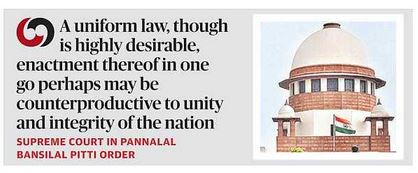
    Back in debate: Uniform Civil Code

    Poll-bound Uttarakhand CM’s announcement to prepare a draft of the Uniform Civil Code (UCC) in the State, raises questions over whether an individual State can bring its own family law code.

    What is a Uniform Civil Code?

    • A Uniform Civil Code is one that would provide for one law for the entire country, applicable to all religious communities in their personal matters such as marriage, divorce, inheritance, adoption, etc.
    • Article 44, one of the directive principles of the Constitution lays down that the state shall endeavor to secure a Uniform Civil Code for the citizens throughout the territory of India.
    • These, as defined in Article 37, are not justiciable (not enforceable by any court) but the principles laid down therein are fundamental in governance.

    Why need UCC?

    • UCC would provide equal status to all citizens
    • It would promote gender parity in Indian society.
    • UCC would accommodate the aspirations of the young population who imbibe liberal ideology.
    • Its implementation would thus support the national integration.

    Hurdles to UCC implementation

    • There are practical difficulties due to religious and cultural diversity in India.
    • The UCC is often perceived by the minorities as an encroachment on religious freedom.
    • It is often regarded as interference of the state in personal matters of the minorities.
    • Experts often argue that the time is not ripe for Indian society to embrace such UCC.

     UCC vs. Right to Freedom of Religion

    • Article 25 lays down an individual’s fundamental right to religion;
    • Article 26(b) upholds the right of each religious denomination or any section thereof to “manage its own affairs in matters of religion”;
    • Article 29 defines the right to conserve distinctive culture.
    • An individual’s freedom of religion under Article 25 is subject to “public order, health, morality” and other provisions relating to FRs, but a group’s freedom under Article 26 has not been subjected to other FRs.
    • In the Constituent Assembly, there was division on the issue of putting UCC in the fundamental rights chapter. The matter was settled by a vote.
    • By a 5:4 majority, the fundamental rights sub-committee headed by Sardar Patel held that the provision was outside the scope of FRs and therefore the UCC was made less important.

    Enacting and Enforcing UCC: A reality check

    • Fundamental rights are enforceable in a court of law.
    • While Article 44 uses the words “the state shall endeavor”, other Articles in the ‘Directive Principles’ chapter use words such as “in particular strive”; “shall, in particular, direct its policy”; “shall be an obligation of the state” etc.
    • Article 43 mentions “state shall endeavor by suitable legislation” while the phrase “by suitable legislation” is absent in Article 44.
    • All this implies that the duty of the state is greater in other directive principles than in Article 44.

    What are more important — fundamental rights or directive principles?

    • There is no doubt that fundamental rights are more important.
    • The Supreme Court held in Minerva Mills (1980): Indian Constitution is founded on the bedrock of the balance between Parts III (Fundamental Rights) and IV (Directive Principles).
    • To give absolute primacy to one over the other is to disturb the harmony of the Constitution.
    • Article 31C inserted by the 42nd Amendment in 1976, however, lays down that if a law is made to implement any directive principle, it cannot be challenged on the ground of being violative of the FRs under Articles 14 and 19.

    What about Personal Laws?

    • Citizens belonging to different religions and denominations follow different property and matrimonial laws which are an affront to the nation’s unity.
    • If the framers of the Constitution had intended to have a UCC, they would have given exclusive jurisdiction to Parliament in respect of personal laws, by including this subject in the Union List.
    • But “personal laws” are mentioned in the Concurrent List.

    Various customary laws

    • All Hindus of the country are not governed by one law, nor are all Muslims or all Christians.
    • Muslims of Kashmir were governed by a customary law, which in many ways was at variance with Muslim Personal Law in the rest of the country and was, in fact, closer to Hindu law.
    • Even on registration of marriage among Muslims, laws differ from place to place.
    • In the Northeast, there are more than 200 tribes with their own varied customary laws.
    • The Constitution itself protects local customs in Nagaland. Similar protections are enjoyed by Meghalaya and Mizoram.
    • Even reformed Hindu law, in spite of codification, protects customary practices.

    Minority opinion in the Constituent Assembly

    • Some members sought to immunize Muslim Personal Law from state regulation.
    • Mohammed Ismail, who thrice tried unsuccessfully to get Muslim Personal Law exempted from Article 44, said a secular state should not interfere with the personal law of people.
    • B Pocker Saheb said he had received representations against a common civil code from various organizations, including Hindu organizations.
    • Hussain Imam questioned whether there could ever be uniformity of personal laws in a diverse country like India.
    • B R Ambedkar said, “no government can use its provisions in a way that would force the Muslims to revolt”.
    • Alladi Krishnaswami, who was in favor of a UCC, conceded that it would be unwise to enact UCC ignoring strong opposition from any community.
    • Gender justice was never discussed in these debates.

     Conclusion

    • Article 44 of the Constitution creates an obligation upon the State to endeavour to secure for citizens a Uniform Civil Code throughout the country.
    • The purpose behind UCC is to strengthen the object of “Secular Democratic Republic” as enshrined in the Preamble of the Constitution.
    • This provision is provided to effect the integration of India by bringing communities on the common platform on matters which are at present governed by diverse personal laws.
    • Hence UCC should be enforced taking into confidence all the sections of Indian society.
    • Goa’s Portuguese Civil Code of 1867 is an example of a common family law existing in harmony.


    UPSC 2022 countdown has begun! Get your personal guidance plan now! (Click here)

Join the Community

Join us across Social Media platforms.