💥UPSC 2027,2028 Mentorship (April Batch) + Access XFactor Notes & Microthemes PDF

Archives: News

  • Climate Change Impact on India and World – International Reports, Key Observations, etc.

    What is a Heatwave?

    The Konkan region, including Mumbai, has been experiencing sweltering heat in recent days, with the maximum temperatures touching the 40 degrees mark.

    What is a Heatwave and when is it declared?

    • Heatwaves occur over India between March and June.
    • IMD declares a heatwave event when the maximum (day) temperature for a location in the plains crosses 40 degrees Celsius.
    • Over the hills, the threshold temperature is 30 degrees Celsius.

    Following criteria are used to declare heatwave:

    To declare heatwave, the below criteria should be met at least in 2 stations in a Meteorological subdivision for at least two consecutive days and it will be declared on the second day.

    a) Based on Departure from Normal

    • Heat Wave: Departure from normal is 4.5°C to 6.4°C
    • Severe Heat Wave: Departure from normal is >6.4°C

    b) Based on Actual Maximum Temperature (for plains only)

    • Heat Wave: When actual maximum temperature ≥ 45°C
    • Severe Heat Wave: When actual maximum temperature ≥47°C

    How long can a heatwave spell last?

    • A heatwave spell generally lasts for a minimum of four days. On some occasions, it can extend up to seven or ten days.
    • The longest recorded heatwave spell, in recent years, was between 18 – 31 May 2015.


    UPSC 2022 countdown has begun! Get your personal guidance plan now! (Click here)

  • Russian Invasion of Ukraine: Global Implications

    Fragmenting world order, untied nations

    Context

    The outcome that should worry us apart from the devastating consequences for the Ukrainian nation, is the impact the Ukraine crisis is having on the global world order, which is fragmenting in every respect of global interconnectedness — in terms of international cooperation, security, military use, economic order, and even cultural ties.

    Implications of war for global order

    1] Question mark on the relevance of the UN and Security Council

    • Russia’s actions in Ukraine may, in terms of refusing to seek an international mandate, seem no different from the war by the United States in Iraq in 2003, Israel’s bombing of Lebanon in 2006 and the Saudi-coalition’s attacks of Yemen in 2015.
    • But Ukraine is in fact a bigger blow to the post-World War order than any other.
    • It run counter to the UN Charter preamble, i.e. “to save succeeding generations from the scourge of war…”, “to practice tolerance and live together in peace with one another as good neighbours”, as well as Articles 1 and 2 of the ‘Purposes and Principles’ of the United Nations (Chapter 1).
    • Meanwhile, in their responses, other P-5 members such as the United States, the United Kingdom and France did not seek to strengthen the global order either, imposing sanctions unilaterally rather than attempting to bring them to the UN.

    2] Declining nuclear safeguards

    • Russian military’s moves to target areas near Chernobyl and shell buildings near the Zaporizhzhia nuclear power plant show an alarming nonchalance towards safeguards in place over several decades.
    • The world must also consider the cost to the nuclear non-proliferation regime’s credibility: Ukraine and Libya that willingly gave up nuclear programmes have been invaded, while regimes such as Iran and North Korea can defy the global order because they have held on to their nuclear deterrents.

    3] Use of non-state actors

    • There are also the covenants agreed upon during the global war on terrorism, which have been degraded, with the use of non-state actors in the Ukraine crisis.
    • For years, pro-Russia armed militia operated in the Donbas regions, challenging the writ of the government in Kyiv.
    • With the arrival of Russian troops, the Ukrainian President, Volodymyr Zelensky, has invited all foreign fighters to support his forces to the country.

    4] Fragmentation of global financial order

    • While analysts have pointed out that the sanctions announced so far do not include some of Russia’s biggest banks in order to avoid the disruption of oil and gas from Russia, the intent to cut Russia out of all monetary and financial systems remains.
    • The arbitrary and unilateral nature of western sanctions rub against the international financial order set up under the World Trade Organization (that replaced the General Agreement on Tariffs and Trade, or GATT).
    • The obvious fallout of this “economic cancel culture” will, without doubt, be a reaction — a pushback from Russia and an exploration of alternative trading arrangements with countries such as China, India and much of the Eastern Hemisphere which continue to trade with Moscow.
    • For the S-400 missile defence deal, for example, New Delhi used a rupee-rouble mechanism and banks that were immunised from the U.S.’s CAATSA sanctions (or Countering America’s Adversaries Through Sanctions Act) for advance payments.

    5] Isolation of Russia

    • While several governments including the U.S., the U.K. and Germany have persistently said that their quarrel is not with Russian citizens but with their leadership, it is clear that most of their actions will hurt the average Russian citizen.
    • Some of this isolation of its citizens will work to the favour of an increasingly authoritarian Kremlin.
    • Mr. Putin’s response to the banning of Russian channels in Europe and its allies has been to use the western media ban as a pretext to ban opposition-friendly Russian channels as well.

    Takeaways for India

    • India’s abstentionist responses and its desire not to be critical of any of the actions taken by the big powers might keep Indians safe in the short term.
    • But in the long term, it is only those nations that move proactively to uphold, strengthen and reinvent the global order that will make the world a safer place.

    Conclusion

    The events over the past two weeks, set in motion by Russia’s declaration of war on Ukraine, have no doubt reversed many of the ideas of 1945 and 1990, fragmenting the international order established with the UN, ushering in an era of deglobalisation and bringing down another Iron Curtain.

    UPSC 2022 countdown has begun! Get your personal guidance plan now! (Click here)

  • Russian Invasion of Ukraine: Global Implications

    Ukraine invasion and the great geopolitical reset

    Context

    Major wars have significant consequences for the internal and international politics of the combatant nations. Wars between great powers are far more consequential.

    Geopolitical changes triggered by Russia’s invasion of Ukraine

    1] New dynamism in great power triangle

    •  Biden hoped to distance Russia from China and focus all of America’s energies on the Indo-Pacific.
    • But Putin chose to align with China and confront the US and Europe with an impossible set of demands including a sphere of influence in Central Europe and turning Ukraine into Moscow’s protectorate.
    • China’s public articulation has underlined “rock-solid” support for Moscow but it is under some pressure to balance between its Russian alliance “without limits” and its deep economic interdependence with the US and Europe.
    • Whichever way this plays out, the current crisis has revealed America’s pole position in the great strategic triangle.

    2] Reinforced US primacy amongst the great powers

    • The US primacy amongst the great powers has been reinforced by the restoration of strategic unity within the West.
    • While many trans-Atlantic differences remain on the nature and extent of sanctions against Russia, the crisis has revealed the enduring sources of Western unity.

    3] Disciplining of Europe

    • Third is the American disciplining of Europe, especially Germany, where illusions of normative soft power and the faith in mercantilism had blinded the continent to geopolitical challenges presented by Russia and China.
    • Europe’s belief that it can enrich itself in the Russian and Chinese markets while expecting Washington to do all the heavy lifting on security is no longer sustainable.
    • The German decision on rearmament announced in the wake of the Russian aggression marks a definitive geopolitical turn in Europe.

    4] EU’s dilemma in energy domain

    • Nowhere is the EU’s Russian dilemma more visible than in the energy domain where Europe is deeply tied to Russian imports of oil, natural gas, and coal.
    • The EU pays $110 billion a year to Moscow for these imports.
    • While stepping up pressure on Europe to drastically reduce energy imports from Russia, Washington is reaching out to Venezuela, Saudi Arabia, and Iran to fill the gap created by the planned blockade of Russian energy supplies.

    5] Asia is adapting to the change

    • Sensing the dangers from a Sino-Russian axis and fearing that Europe could distract America, Japan is rethinking its nuclear abstinence.
    • South Korea’s president-elect, Yoon Suk-Yeol wants to strengthen ties with the US, and explore potential cooperation with the Quad.
    •  While the ASEAN remains torn between the US and China, many in the region are waking up to the dangers of betting that Beijing’s rise is irreversible, and that the Western decline is terminal.

    Lessons for India

    • The first major conflict amongst the great powers in the 21st century has presented India with multiple challenges, including its long-standing reliance on Russian military supplies.
    •  More immediately, the crisis in Ukraine demands that Delhi move on a war-footing towards a rapid modernisation and expansion of its domestic defence industrial base that is so critical for sustaining India’s strategic autonomy.

    Conclusion

    Unless there is an early diplomatic breakthrough, the conflict between Russia and the West is likely to sharpen in the coming days. But this hinge moment in world politics is also an opportunity for Delhi to increase its heft in the changing global balance.

    UPSC 2022 countdown has begun! Get your personal guidance plan now! (Click here)

  • Citizenship and Related Issues

    Government seeks law on Rights of Foreigners

    The Union government has urged the Supreme Court to help lay down a law with a “long–lasting” implication for the country on the subject of Foreigners’ Right to approach local courts for relief after violating their visa conditions.

    Why in news?

    • The government’s request came during the hearing of petitions filed by foreign nationals who were charged with violating COVID-19 guidelines by participating in a religious congregation in New Delhi during peak COVID outbreak.

    Citizens vs. Foreigners Rights

    Fundamental Rights available to both Citizens and Foreigners (except enemy aliens)

    Fundamental Rights Available Only to Citizens of India

    • Article 14 – Equality before the law and equal protection of laws
    • Article 20 – Protection in respect of conviction for offences
    • Article 21 – Protection of life and personal liberty
    • Article 21A – Right to elementary education
    • Article 22 – Protection against arrest and detention in certain cases
    • Article 23 – Prohibition of traffic in human beings and forced labour
    • Article 24 – Prohibition of employment of children in factories etc
    • Article 25 – Freedom of conscience and free profession, practice and propagation of religion
    • Article 26 – Freedom to manage religious affairs
    • Article 27 – Freedom from payment of taxes for promotion of any religion
    • Article 28 – Freedom from attending religious instruction or worship in certain educational institutions
    • Article 15 – Prohibition of discrimination on grounds of religion, race, caste, sex or place of birth
    • Article 16 – Equality of opportunity in matters of public employment
    • Article 19 – Protection of six rights related to freedom – (a) of speech and expression; (b) to assemble peaceably and without arms; (c) to form associations or unions; (d) to move freely throughout the territory of India; (e) to reside and settle in any part of the territory of India; and (f) to practice any profession, or to carry on any occupation, trade or business
    • Article 29 – Protection of language, script and culture of minorities
    • Article 30 – Right of minorities to establish and administer educational institutions


    UPSC 2022 countdown has begun! Get your personal guidance plan now! (Click here)

  • Mother and Child Health – Immunization Program, BPBB, PMJSY, PMMSY, etc.

    Maternal Mortality in India

    Kerala has yet again emerged on top when it comes to maternal and child health, with the State recording the lowest Maternal Mortality Ratio (MMR) of 30 (per one lakh live births) in the country.

    What is Maternal Mortality?

    • Maternal mortality refers to deaths due to complications from pregnancy or childbirth.
    • The maternal mortality ratio (MMR) is defined as the number of maternal deaths during a given time period per 100,000 live births during the same time period.
    • It depicts the risk of maternal death relative to the number of live births and essentially captures the risk of death in a single pregnancy or a single live birth.

    Trends in India

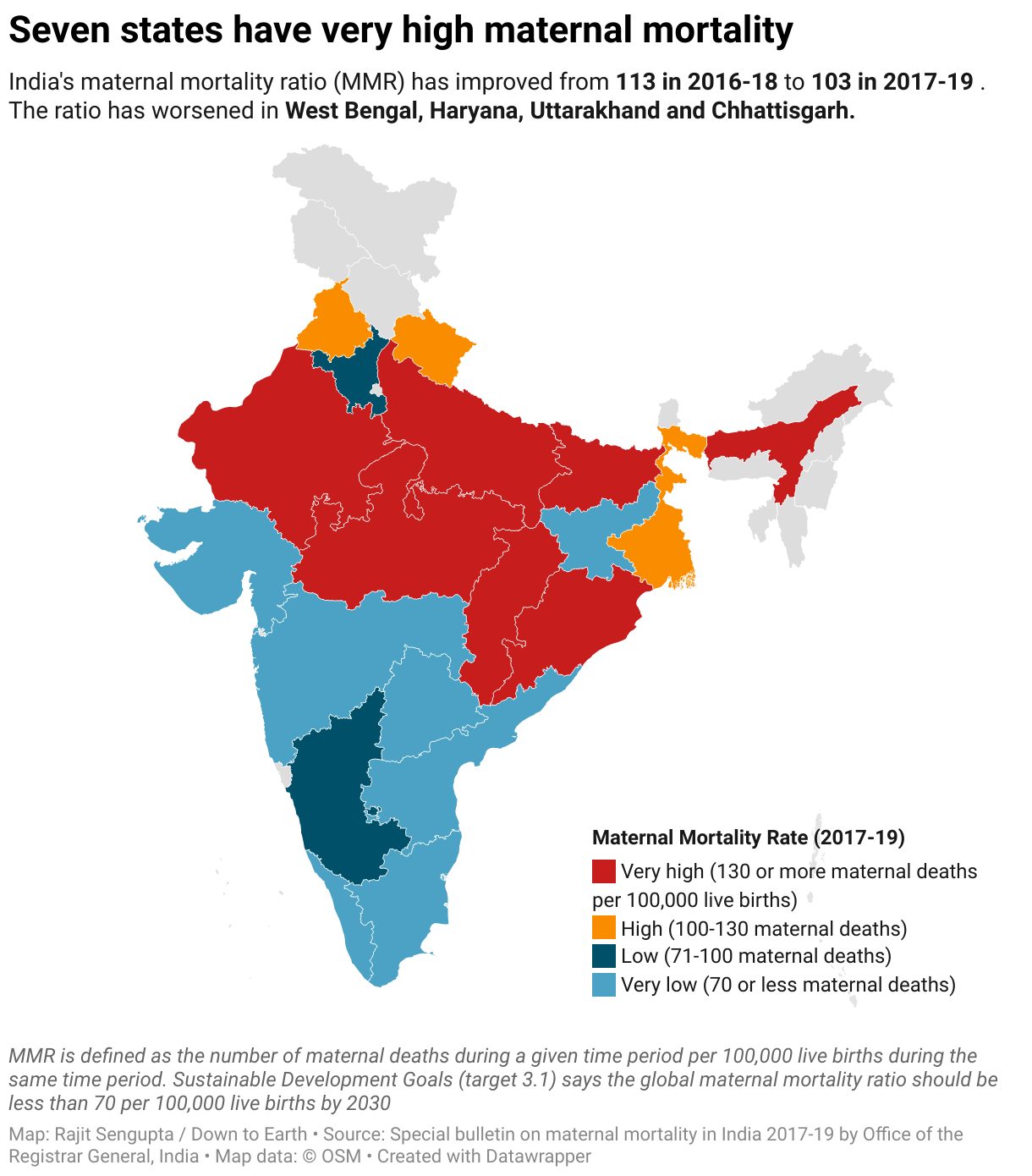
    • India’s maternal mortality ratio (MMR) has improved to 103 in 2017-19, from 113 in 2016-18.
    • Seven Indian states have very high maternal mortality. These are Rajasthan, Uttar Pradesh, Madhya Pradesh, Chhattisgarh, Bihar, Odisha and Assam.
    • The MMR is ‘high’ in Punjab, Uttarakhand and West Bengal. This means 100-130 maternal deaths per 100,000 live births.
    • It is ‘low’ in Haryana and Karnataka.
    • The states of Uttar Pradesh, Rajasthan and Bihar have seen the most drop in MMR.
    • West Bengal, Haryana, Uttarakhand and Chhattisgarh have recorded an increase in MMR over the last survey.

    Various determinants of maternal health in India

    UPSC 2022 countdown has begun! Get your personal guidance plan now! (Click here)

  • Climate Change Impact on India and World – International Reports, Key Observations, etc.

    Mumbai Climate Action Plan

    The Mumbai Climate Action Plan (MCAP) has laid down a 30-year road map for the city to tackle the challenges of climate change by adopting inclusive and robust mitigation and adaptation strategies.

    What is MCAP ?

    • The MCAP has set short-, medium- and long-term climate goals aimed towards zero emission of greenhouse gas or a net-zero target for 2050.
    • It focuses on priority across six strategic areas:
    1. Sustainable waste management
    2. Urban greening and biodiversity
    3. Urban flooding and water resource management,
    4. Energy and buildings
    5. Air quality and
    6. Sustainable mobility

    Features of the plan

    • The Brihanmumbai Municipal Corporation (BMC) prepared the plan with technical support from the World Resources Institute (WRI), India and the C40 Cities network.
    • It concentrates on the city, its ecological, cultural and economical landscapes.
    • The plan throws light on the current climate of the city called Baseline Assessment—climate and air pollution risks, greenhouse gas inventory.
    • The plan then assesses future trajectories in the business-as-usual scenarios and assesses future emission reduction scenarios to make Mumbai net-zero by 2050.

    Why does Mumbai need a climate action plan?

    • As per a study conducted by WRI India on Mumbai’s vulnerability assessment, the city will face two major challenges—temperature rise, and extreme rain events which lead to flooding.
    • The city is already witnessing a warming trend.
    • The analysis has revealed a warming trend over 47 years (1973-2020) with an increase of 0.25°C per decade for the city.

    What is the current greenhouse gas emission?

    • In 2019, which is taken as a base year, Mumbai’s GHG emissions were 23.42 million tonnes of carbon dioxide emission, which is 1.8 tonnes CO2e per person.
    • Out of which, 16.9 million tonnes or 72 per cent is from the energy sector, followed by 4.56 million tonnes of CO2 e or 20 per cent from the transportation sector.
    • The city’s waste sector contributes to a total of eight per cent of the total emissions.
    • Most of the city’s emissions come from energy use in residential buildings followed by commercial buildings and transport.
    • Electricity consumption contributes significantly to total emissions (64.3%), due to the city’s predominantly coal-based grid.


    UPSC 2022 countdown has begun! Get your personal guidance plan now! (Click here)

  • Innovations in Sciences, IT, Computers, Robotics and Nanotechnology

    What are Man-Portable Air-Defence Systems (MANPADS)?

    The United States has approved a $200-million arms package for Ukraine, which would include US made Stinger Missiles, which are a type of shoulder-fired Man-Portable Air-Defence Systems (MANPADS).

    What are MANPADS?

    • Man-Portable Air-Defence Systems are short-range, lightweight and portable surface-to-air missiles that can be fired by individuals or small groups to destroy aircraft or helicopters.
    • They help shield troops from aerial attacks and are most effective in targeting low-flying aircrafts.
    • MANPATs or Man-Portable Anti-Tank Systems work in a similar manner but are used to destroy or incapacitate military tanks.

    Uniqueness of MANPADS

    • MANPADS can be shoulder-fired, launched from atop a ground-vehicle, fired from a tripod or stand, and from a helicopter or boat.
    • They weigh anywhere between 10 to 20 kilograms and not being longer than 1.8 metres.
    • They are fairly lightweight as compared to other elaborate weapon systems, making them easy to operate by individual soldiers.
    • Operating MANPADS requires substantially less training.
    • MANPADS have a maximum range of 8 kilometres and can engage targets at altitudes of 4.5 km.

    Stealth features

    • They have passive or ‘fire and forget’ guidance systems, meaning that the operator is not required to guide the missile to its target, enabling them to run and relocate immediately after firing.
    • The missile stays locked-on to the targeted object, not requiring active guidance from the soldier.
    • The missiles are fitted with infrared (IR) seekers that identify and target the airborne vehicle through heat radiation being emitted by the latter.


    UPSC 2022 countdown has begun! Get your personal guidance plan now! (Click here)

  • Economic Indicators and Various Reports On It- GDP, FD, EODB, WIR etc

    Retail Inflation climbs to 6.07%

    India’s retail inflation inched up to an eight-month high of 6.07% in February from 6.01% in January, with rural India experiencing a sharper price rise at 6.38%.

    What is Retail Inflation?

    • When we generally talk about retail inflation, it often refers to the rate of inflation based on the consumer price index (CPI).
    • The CPI tracks the change in retail prices of goods and services which households purchase for their daily consumption.
    • The CPI monitors retail prices at a certain level for a particular commodity; price movement of goods and services at rural, urban and all-India levels.
    • The change in the price index over a period of time is referred to as CPI-based inflation, or retail inflation.

    What is Consumer Price Index (CPI)?

    • It is an index measuring retail inflation in the economy by collecting the change in prices of most common goods and services used by consumers.
    • In India, there are four consumer price index numbers, which are calculated, and these are as follows:
      1. CPI for Industrial Workers (IW)
      2. CPI for Agricultural Labourers (AL)
      3. CPI for Rural Labourers (RL) and
      4. CPI for Urban Non-Manual Employees (UNME).
    • While the Ministry of Statistics and Program Implementation collects CPI (UNME) data and compiles it, the remaining three are collected by the Labour Bureau in the Ministry of Labour.
    • The base year for CPI is 2012.
    • To calculate CPI, multiply 100 to the fraction of the cost price of the current period and the base period.

    Significance of CPI

    • Generally, CPI is used as a macroeconomic indicator of inflation, as a tool by the central bank and government for inflation targeting and for inspecting price stability, and as deflator in the national accounts.
    • CPI also helps understand the real value of salaries, wages, and pensions, the purchasing power of the nation’s currency, and regulating rates.
    • CPI, one of the most important statistics to ascertain economic health, is generally based on the weighted average of the prices of commodities.
    • It basically gives an idea of the cost of the standard of living.


    UPSC 2022 countdown has begun! Get your personal guidance plan now! (Click here)

  • Russian Invasion of Ukraine: Global Implications

    Analysing India’s stand on the war on Ukraine

    Context

    Russia’s invasion of Ukraine has placed considerable moral responsibility on India. However, at the United Nations (UN), India has refused to condemn the violation of the rights of the Ukrainians.

    Issues involved in India’s vote

    1] Commitment to principles

    • National interest: One of the arguments justifying India’s stance is that in international affairs, a country must be guided by its national interest and not some abstract principles.
    • It is pointed out that due to the very high dependence of India on the Soviet Union for defence equipment and the likely need of support on the Pakistan issue in the Security Council, India must not offend Russia by condemning the invasion.
    • Why India should condemn Russia: If a people’s principles are their most deeply held beliefs about how the world must be ordered, then their interest lies in ensuring that their principles prevail in international relations.
    • Thus, if India does not want to see itself to be the victim of territorial aggression in the future, it must communicate strongly on the world stage that it condemns the Russian invasion of Ukraine.

    2] India-West relations

    • In the 1950s the West was clearly unsympathetic to India, playing its card openly on the Kashmir issue at the UN as early as 1947.
    • On the other hand, the Soviet Union, the precursor to the present-day Russian state, had rescued India several times by exercising its veto in the UN Security Council.
    • Now, close to 75 years later, the situation has changed.
    • Public opinion in the West does not favour unconditional support of Pakistan vis-à-vis India while Russia encourages Pakistan.
    • Moreover, we know by now that some limited support at the UN matters little, as taking the Kashmir issue to the UN Security Council has not got Pakistan to withdraw from the territory it occupied.

    3] India’s dependence on Russia for defence supplies

    •  It is indeed correct that India relies on the Russians for such equipment and their spare parts.
    • At the same time there is a global market for arms. It is not evident that anything withheld by the Russians cannot be sourced from that market.
    •  For India to base its public stance on the Russian invasion of Ukraine on the assured supply of armaments is to really drag ourselves down to the bottom of the pit in terms of ethics.

    4] East-West conflict argument

    • Another argument is that this is a conflict between the east and the west, and India should stay out of it.
    • To say that this is just another east-west conflict from which India should stay out is tantamount to seeing the Russian invasion and the brave defence of their country by the Ukrainians as a mere marital squabble.
    • India had refused in 1956 to condemn the Soviet invasion of Hungary, its action today is much worse.

    Conclusion

    India must take a long view of how it wants to engage with it. Its actions so far leave it in the company of Russia and China.

    UPSC 2022 countdown has begun! Get your personal guidance plan now! (Click here)

  • Russian Invasion of Ukraine: Global Implications

    Geneva Conventions and the Russia-Ukraine War

    As the evidence of casualties in the civilian population continues to mount, the world will increasingly look to the Geneva Conventions in the Russia-Ukraine conflict.

    Geneva Conventions Guidelines for Wartime

    • These are a set of four treaties, formalized in 1949, and three additional protocols, which codify widely accepted ethical and legal international standards for humanitarian treatment of those impacted by war.
    • The focus of the Conventions is the:
    1. Treatment of non-combatants and prisoners of war, and
    2. Not the use of conventional or biological and chemical weapons

    What are the four Geneva Conventions?

    (1) First Geneva Convention: Health and Medical Issues

    • It protects wounded and sick soldiers on land during war.
    • This convention extends to medical and religious personnel, medical units, and medical transport.
    • It has two annexes containing a draft agreement relating to hospital zones and a model identity card for medical and religious personnel.

    (2) Second Geneva Convention:  Offshore Protection

    • It protects wounded, sick and shipwrecked military personnel at sea during war.
    • This convention also extends to hospital ships and medical transports by sea, with specific commentary on the treatment and protections for their personnel.

    (3) Third Geneva Convention: Treatment of Prisoners of War (PoW)

    It applies to prisoners of war, including a wide range of general protections such as humane treatment, maintenance and equality across prisoners, conditions of captivity, questioning and evacuation of prisoners, transit camps, food, clothing, medicines, hygiene and right to religious, intellectual, and physical activities of prisoners.

    (4) Fourth Geneva Convention: Civilian protection of occupied territory ***

    • It particularly applies to the invasion of Ukraine by Russian military forces.
    • It protects civilians, including those in occupied territory.
    • Comprising 159 articles, it outlines the norms for this critical dimension of conflict.

    Extent of the Fourth Geneva Convention amid the Ukraine-Russia War

    • Along with the Additional Protocols of 1977, the Fourth Convention expounds upon the:
    1. General protection of populations against certain consequences of war
    2. Conduct of hostilities and the status and
    3. Treatment of protected persons
    4. Distinguishing between the situation of foreigners on the territory of one of the parties to the conflict and that of civilians in occupied territory
    • This convention also spells out the obligations of the occupying power vis-à-vis the civilian population and outlines detailed provisions on humanitarian relief for populations in occupied territory.

    Which countries are signatories?

    • The Geneva Conventions have been ratified by 196 states, including all UN member states.
    • The three Protocols have been ratified by 174, 169 and 79 states respectively.

    Russia and these conventions

    • In 2019, perhaps anticipating the possibility of its invading Ukraine in the near future, Russia withdrew its declaration under Article 90 of Protocol 1.
    • By withdrawing this declaration, Russia has pre-emptively left itself with the option to refuse access by any international fact-finding missions to Russian entities.
    • Not withdrawing could have find Russia responsible for violations of the Geneva Conventions standards.
    • Further, the four conventions and first two protocols of the Geneva Conventions were ratified by the Soviet Union, not Russia.
    • Hence there is a risk of the Russian government of the day disavowing any responsibility under the Conventions.

    What would be the steps for potential prosecution under the Conventions?

    • Under Article 8 of the Rome Statute of the ICC, it is the ICC that has jurisdiction in respect of war crimes, in particular “when committed as part of a plan or policy or as part of a large-scale commission of such crimes.”

    To what extent have Geneva Conventions been upheld worldwide in recent years?

    • Amnesty International notes that there has been a blatant disregard for civilian protection and international humanitarian law in armed conflicts where four of the five permanent members of the UN Security Council are parties.
    • Specifically, Amnesty cited:
    1. US-led coalition’s bombing of Raqqa in Syria, which left more than 1,600 civilians dead
    2. Destruction of civilian infrastructure and lives in Aleppo and Idlib by Russian forces
    3. Leading to mass displacement of millions
    4. War in Yemen where the Saudi Arabia and the UAE-led coalition, backed by the West, killed and injured thousands of civilians, fuelling a full-blown humanitarian crisis


    UPSC 2022 countdown has begun! Get your personal guidance plan now! (Click here)

Join the Community

Join us across Social Media platforms.