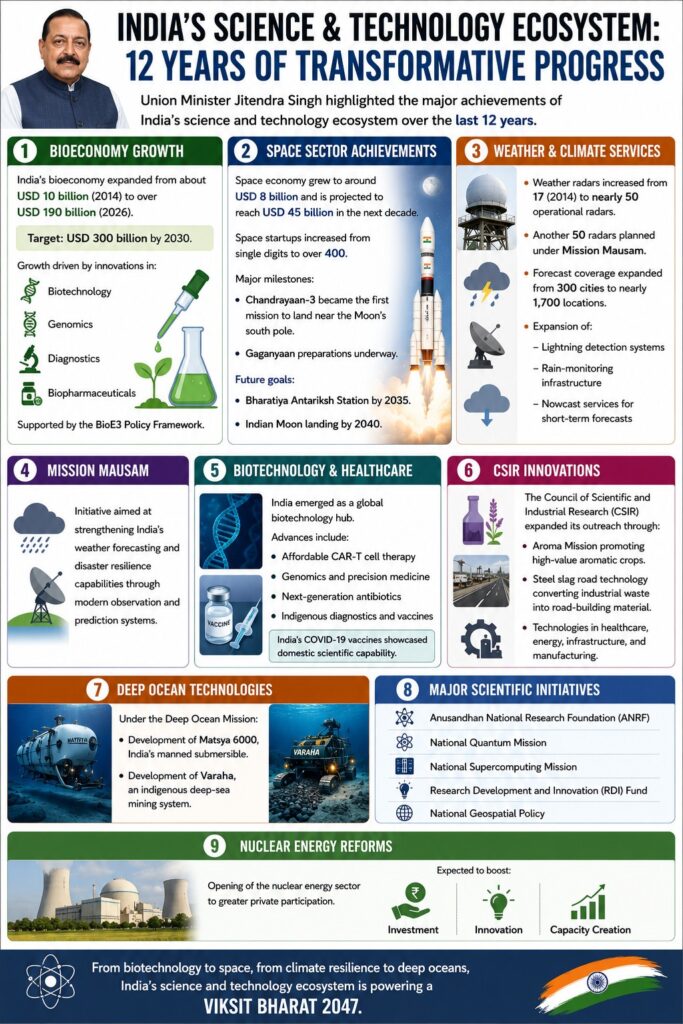
Union Minister Jitendra Singh highlighted the major achievements of India’s science and technology ecosystem over the last 12 years.
Bioeconomy Growth
India’s bioeconomy expanded from about USD 10 billion (2014) to over USD 190 billion (2026).
Target: USD 300 billion by 2030.
Growth driven by innovations in Biotechnology, Genomics, Diagnostics, and Biopharmaceuticals.
Supported by the BioE3 Policy Framework.
Space Sector Achievements
Space economy grew to around USD 8 billion and is projected to reach USD 45 billion in the next decade.
Space startups increased from single digits to over 400.
Major milestones: Chandrayaan-3 became the first mission to land near the Moon’s south pole. Gaganyaan preparations underway.
Future goals: Bharatiya Antariksh Station by 2035. Indian Moon landing by 2040.
Weather and Climate Services
Weather radars increased from 17 (2014) to nearly 50 operational radars.
Another 50 radars planned under Mission Mausam.
Forecast coverage expanded from 300 cities to nearly 1,700 locations.
Expansion of Lightning detection systems, Rain-monitoring infrastructure, and Nowcast services for short-term forecasts.
Mission Mausam: Initiative aimed at strengthening India’s weather forecasting and disaster resilience capabilities through modern observation and prediction systems.
Biotechnology and Healthcare
India emerged as a global biotechnology hub.
Advances include Affordable CAR-T cell therapy, Genomics and precision medicine, Next-generation antibiotics, and Indigenous diagnostics and vaccines.
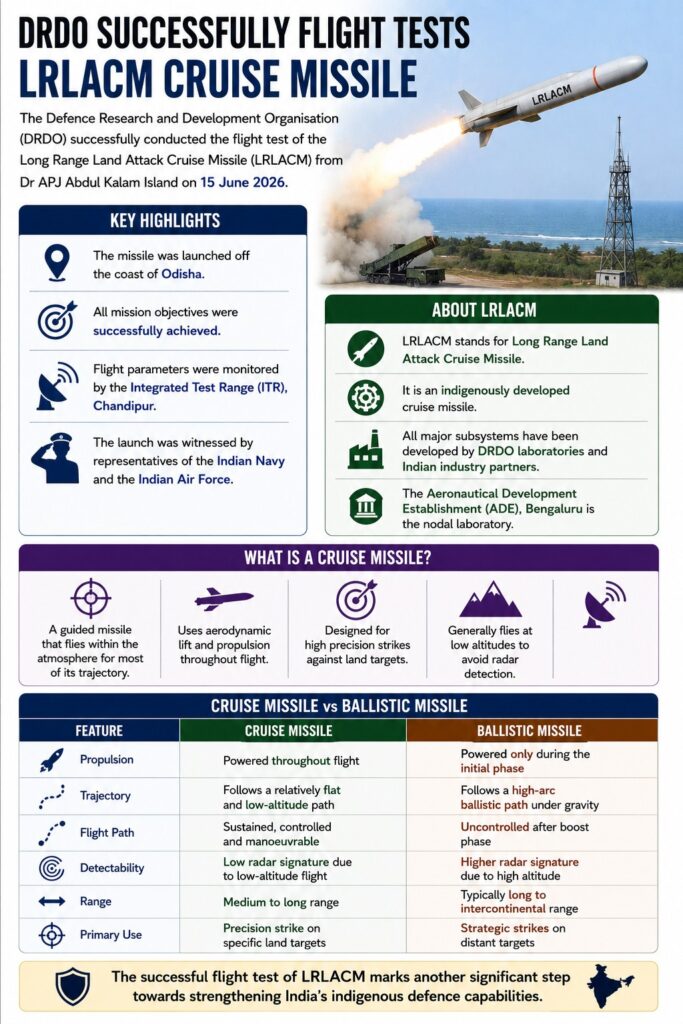
The Defence Research and Development Organisation (DRDO) successfully conducted the flight test of the Long Range Land Attack Cruise Missile (LRLACM) from Dr APJ Abdul Kalam Island on 15 June 2026
About LRLACM
LRLACM stands for Long Range Land Attack Cruise Missile.
It is an indigenously developed cruise missile.
All major subsystems have been developed by DRDO laboratories and Indian industry partners.
The Aeronautical Development Establishment (ADE), Bengaluru is the nodal laboratory.
What is a Cruise Missile?
A guided missile that flies within the atmosphere for most of its trajectory.
Uses aerodynamic lift and propulsion throughout flight.
Designed for high precision strikes against land targets.
Generally flies at low altitudes to avoid radar detection.
Cruise Missile vs Ballistic Missile
Cruise missiles: Powered throughout flight and follow a relatively flat trajectory.
Ballistic missiles: Powered only during the initial phase and then follow a ballistic path under gravity.
[2023] Consider the following statements 1. Ballistic missiles are jet-propelled at subsonic speeds throughout their fights, while cruise missiles are rocket-powered only in the initial phase of fight. 2. Agni-V is a medium-range supersonic cruise missile, while BrahMos is a solid-fuelled intercontinental ballistic missile. Which of the statements given above is/are correct?
June 15 marks the 84th anniversary of a historic meeting in Bangkok that laid the institutional foundation for the Indian National Army (INA). Thailand acted as a strategic, cultural, and organisational hub for Indian nationalists that ultimately contributed to the formation of the Indian National Army (INA).
How did cultural diplomacy lay the foundations of the Thai-Bharat connection?
Civilisational Linkages
Ancient Cultural Bonds: India and Thailand shared long-standing civilisational connections rooted in religion, philosophy, literature, and cultural traditions.
Ramayana Influence: The Thai epic Ramakien draws significant inspiration from the Indian Ramayana.
Shared Heritage: Cultural interaction preceded political cooperation and provided a foundation for later nationalist mobilisation.
Tagore’s Historic Visit (1927)
Rabindranath Tagore’s Engagement: Gurudev Rabindranath Tagore visited Siam (Thailand) and met King Prajadhipok (Rama VII).
Intellectual Exchange: Discussions centred on deep historical and cultural ties between India and Thailand.
Inspirational Legacy: The visit inspired efforts to institutionalise India-Thailand cultural cooperation.
Role of Swami Satyananda Puri
Arrival in Bangkok (1932): Bengali scholar Prafulla Kumar Sen, later known as Swami Satyananda Puri, settled in Bangkok.
Academic Contribution: Taught at Chulalongkorn University and mastered the Thai language within six months.
Cultural Institution Building: Established the Dharm Ashram in 1939 as a centre for spiritual and cultural exchange.
Why did the Thai-Bharat Cultural Lodge become crucial to the freedom movement?
Transformation into TBCL
Institutional Evolution: Dharm Ashram evolved into the Thai-Bharat Cultural Lodge (TBCL) in December 1940.
Diaspora Hub: Became a focal point for the growing Indian community in Bangkok.
Political Shift: Transitioned from cultural engagement to nationalist mobilisation during World War II.
Symbolic Assertion
Tricolour Hoisting: The Indian national flag was hoisted at the Lodge shortly after its formation.
Political Significance: Demonstrated support for Indian independence on foreign soil.
British Opposition: The act reportedly triggered strong protests from the British Ambassador.
Strategic Importance During WWII
Japanese Advance: As Japan expanded into Southeast Asia in 1941, Bangkok gained strategic importance.
Nationalist Convergence: TBCL emerged as a meeting point for Indian revolutionaries, activists, and diaspora leaders.
Political Infrastructure: Provided organisational support for the independence movement.
How did Indian revolutionaries and the diaspora organise resistance from Thailand?
Role of Sardar Pritam Singh
Revolutionary Leadership: Sikh missionary and former Ghadar Party activist.
Diaspora Mobilisation: Spread nationalist ideas among overseas Indians.
Intelligence Links: Worked closely with Major Iwaichi Fujiwara, head of Japanese intelligence unit F-Kikan.
Indian National Council (INC) Formation
Established in December 1941: Created at Silpakorn Theatre, Bangkok.
Leadership Structure: Swami Satyananda Puri served as President and Debnath Das as Secretary.
Political Coordination: Linked civilian nationalist efforts with military mobilisation initiatives.
Indian Independence League (IIL)
Institutional Bridge: Connected civilian aspirations with armed resistance.
Political Legitimacy: Became the representative organisation of Indians outside India.
Coordination Role: Facilitated cooperation among Indian communities across Southeast Asia.
Why was the Bangkok Conference of 1942 a turning point?
Historic Gathering
Dates: June 15-23, 1942.
Venue: Silpakorn Theatre, Bangkok.
Participation: More than 100 representatives from Burma, Malaya, Singapore, and other Southeast Asian regions.
Political Consolidation
Unified Leadership: Brought together multiple nationalist factions under a common framework.
Recognition of IIL: Established the Indian Independence League as the central organisation of overseas Indians.
Strategic Coordination: Strengthened political and military planning.
The 34-Point Resolution
Blueprint for INA: Served as the foundational framework for establishing the Indian National Army.
Volunteer-Based Force: Proposed recruitment from civilians and former prisoners of war.
Japanese Supervision: Military operations to be coordinated with Japanese support.
Political Safeguard: Sought formal recognition of India’s independence and legitimacy of the IIL.
How did leadership transitions shape the INA movement?
Loss of Early Leaders
March 1942 Air Crash: Swami Satyananda Puri and Sardar Pritam Singh died while travelling to Tokyo.
Strategic Setback: Movement lost key organisers and ideological leaders.
Mobilisation Impact: Their sacrifice strengthened resolve among remaining nationalists.
Arrival of Subhas Chandra Bose
Leadership Change (1943): Bose assumed leadership of the IIL and INA.
Centralised Command: Shifted the movement from dispersed regional leadership to unified military direction.
Charismatic Mobilisation: Expanded support through disciplined organisational structures.
Total Mobilisation Strategy
Mass Participation: Mobilised civilians, volunteers, and former prisoners of war.
Diplomatic Objective: Sought recognition of the Provisional Government of Free India.
Military Expansion: Increased scale and effectiveness of INA operations.
How did the TBCL sustain the independence movement beyond military mobilisation?
Civilian-Military Interface
Institutional Continuity: Continued operating even as INA activities became militarised.
Support Functions: Provided administrative, cultural, and social support.
Community Cohesion: Maintained links among Indian diaspora communities.
Asian Solidarity
Shared Liberation Vision: Promoted the idea that Indian independence was linked to broader Asian emancipation.
Regional Cooperation: Fostered connections across Southeast Asian nationalist networks.
Anti-Colonial Platform: Functioned as a centre of intellectual and political engagement.
Sanctuary Function
Safe Space: Offered refuge to independence supporters.
Ideological Preservation: Sustained the original vision articulated by Swami Satyananda Puri.
Movement Resilience: Helped maintain continuity despite wartime disruptions.
How was the legacy of the Thai-Bharat Cultural Lodge preserved after World War II?
Post-War Repression
Allied Action (1945): TBCL was banned and its leaders imprisoned.
INA Dissolution: Formal military structures were dismantled.
Leadership Vacuum: Nationalist networks faced severe disruption.
Revival in 1946
Restoration Efforts: Pandit Raghunath Sharma played a key role in reviving the institution.
Historical Continuity: Preserved memories of overseas contributions to India’s freedom struggle.
Living Archive
Unique Status: Remains the only surviving institution from that period.
Historical Collection: Houses rare texts, photographs, and archival documents.
Educational Value: Provides insights into the lives of Indian diaspora families involved in the freedom movement.
Conclusion
The Thai-Bharat connection reveals the global dimensions of India’s freedom struggle, where diaspora networks, cultural institutions, and revolutionary movements converged to advance the cause of independence. The legacy of the TBCL underscores the enduring role of cultural diplomacy, diaspora engagement, and Asian solidarity in shaping both India’s past and its contemporary foreign policy.
India’s growth story is increasingly being shaped by logistics efficiency rather than income growth alone. There is a structural shift from a “hard-to-serve” economy to a “reachable” economy, where reliable logistics determines whether demand can actually translate into consumption. Also, India has improved from 44th rank in 2018 to 38th rank in 2023 in the World Bank’s Logistics Performance Index (LPI).
What does the shift from a “Hard-to-Serve” to a “Reachable” Economy signify?
Hard-to-Serve Markets: Consumers possess purchasing power but remain disconnected from efficient supply chains.
Reachability: Logistics networks ensure reliable movement of goods irrespective of geographic distance.
Demand Realisation: Consumption materialises only when products are physically available.
Economic Inclusion: Smaller towns and rural markets become part of mainstream consumption networks.
Structural Shift: Market access increasingly matters as much as income growth.
How is India’s Growth Narrative Shifting from Income to Reachability?
Traditional Growth Drivers: Wages, remittances, rural credit, and consumption expenditure have historically dominated macroeconomic discussions.
Emerging Constraint: Distribution efficiency rather than production capacity increasingly determines consumption expansion.
Distance Economics: Physical distance now affects demand realization more than production availability.
Consumption Geography: Growth increasingly depends on whether products can reliably reach underserved markets.
Reachability Paradigm: Economic opportunity is shifting from income availability to market accessibility.
How Have Logistics Reforms Reduced Internal Market Frictions?
Reduced Friction: Policy reforms have steadily lowered internal trade barriers.
Economic Corridors: Strengthen movement of goods across regions.
Line-Haul Predictability: Improves consistency of long-distance freight movement.
Digital Systems: Enhance shipment tracking and visibility.
Supply-Chain Transparency: Reduces uncertainty in inventory planning and replenishment.
Market Integration: Creates a more unified national market.
What Does India’s Logistics Performance Reveal?
World Bank LPI Improvement: India improved from 44th rank (2018) to 38th rank (2023) among 139 countries.
Competitiveness Gains: Reflects improvements in logistics infrastructure and service quality.
Infrastructure Modernization: Indicates gradual strengthening of transport and supply-chain ecosystems.
Expressway Connectivity: Supports reliable movement between production and consumption centres.
Competitive Inclusion: Small firms can participate in national markets.
Example: A farm-gate producer operating on thin margins can now serve distant markets with greater confidence due to predictable transportation schedules and reduced delivery uncertainty.
Why Does the Last-Mile Gap Remain India’s Biggest Logistics Challenge?
Operational Reality: Infrastructure efficiency on paper does not always translate into service quality.
Urban Congestion: Causes delays despite improved transport corridors.
Land Constraints: Limit logistics facility expansion.
India’s growth increasingly depends on converting purchasing power into actual consumption through efficient logistics. By improving market reachability and reducing supply-chain frictions, logistics is emerging as a key enabler of demand growth, economic integration, and inclusive development.
Value Addition
The National Logistics Policy (NLP)
It is a comprehensive, cross-sectoral framework launched in 2022, to reduce domestic logistics costs and enhance the global competitiveness of Indian goods.
Managed by the Department for Promotion of Industry and Internal Trade (DPIIT), the policy optimizes the “soft infrastructure” (processes, digital integration, and regulatory systems) to complement the hard infrastructure built under the PM GatiShakti National Master Plan.
Core Targets (To be Achieved by 2030)
Reduce Costs: Lower India’s logistics cost from 13-14% of GDP to a single-digit global benchmark (under 10%).
Improve Global Ranking: Propel India into the top 25 nations on the World Bank’s Logistics Performance Index (LPI).
Data-Driven Infrastructure: Build automated Decision Support Systems (DSS) for data-backed logistics planning.
Comprehensive Logistics Action Plan (CLAP)
The NLP executes its objectives through eight critical action areas outlined in the Comprehensive Logistics Action Plan:
Integrated Digital Logistics Systems: Merging multiple ministry platforms into one central gateway.
Physical Asset Standardization: Standardizing containers, trucks, and warehouses to improve service quality.
Human Resource Development: Building unified training modules to skill India’s massive logistics workforce.
State Engagement: Aligning central targets with state-level logistics actions and local city plans.
EXIM Logistics: Addressing structural bottlenecks to ease Export-Import container movement.
Service Improvement Framework: Setting up quick-response cells to clear regulatory and industry roadblocks.
Sectoral Efficiency Plans: Designing specialized movement plans for primary commodities like coal, steel, and grains.
Logistics Park Facilitation: Accelerating the development of Multi-Modal Logistics Parks (MMLPs).
PYQ Relevance
[UPSC 2021] “Investment in infrastructure is essential for more rapid and inclusive economic growth. Discuss in the light of India’s experience.”
Linkage: The question examines the role of infrastructure as a catalyst for economic growth, market integration, and inclusive development. The article demonstrates how logistics infrastructure, through Dedicated Freight Corridors, PM Gati Shakti, Bharatmala, digital logistics platforms, and supply-chain reforms, is reducing market frictions and improving reachability
India has announced measures to facilitate ethanol-petrol blends beyond E20, including the decision to permit ethanol blends ranging from 22% to 30% at retail outlets and proposed amendments to recognize E85 and higher blends under the Central Motor Vehicles Rules. This is the first major policy move toward creating a flex-fuel vehicle ecosystem in India.
What is E20 Fuel and Why is it Important?
Definition: E20 is a fuel blend containing 20% ethanol and 80% petrol by volume.
Ethanol: Ethyl alcohol produced primarily from sugarcane molasses, sugar syrup, maize, damaged food grains, and agricultural biomass.
National Standard: E20 has become India’s standard petrol blend under the Ethanol Blended Petrol (EBP) Programme.
Target Achievement: India advanced its E20 target from 2030 to 2025 and achieved rollout in several regions ahead of schedule.
Strategic Objective: Reduces crude oil imports, improves energy security, lowers carbon emissions, and provides additional income opportunities for farmers.
Supply Diversification: Expands use of domestically produced biofuels.
Agricultural Economy
Farmer Support: Creates stable demand for sugarcane and other ethanol feedstocks.
Regional Benefits: Strong support from agricultural regions, particularly Maharashtra and Uttar Pradesh, major sugarcane-producing states.
Climate and Decarbonization Goals
Cleaner Fuel: Ethanol blending reduces lifecycle carbon emissions compared with pure petrol.
Biofuel Expansion: Supports India’s National Biofuel Policy objectives.
Why is the E20 transition itself still incomplete?
Recent Transition: E20 became the nationwide standard only recently.
Limited Adaptation Time: Many vehicle owners have had insufficient time to assess long-term impacts.
Legacy Fleet: Large numbers of older vehicles remain on roads.
How can higher ethanol blends affect vehicle performance?
Engine Damage Concerns
Water Absorption: Ethanol attracts moisture and is corrosive in nature.
Material Degradation: May affect engine components not designed for higher ethanol content.
Vulnerable Components: Rubber parts, valves, piston heads and fuel-system components may experience wear.
Two-Wheeler Concerns: Older two-wheelers may face greater compatibility challenges.
Mileage Reduction
Lower Energy Density: Ethanol contains less energy than petrol.
Fuel Efficiency Impact: Consumers may experience lower mileage.
Estimated Loss: Mileage reduction could range between 5% and 12%, depending on vehicle design and model year.
Cold Start Problems
Ignition Issues: Higher ethanol content burns at a higher temperature.
Winter Performance: Vehicles may experience difficulty starting during cold mornings.
Are concerns regarding engine damage scientifically established?
Scientific Uncertainty
Government Position: Petroleum Ministry maintains that concerns regarding higher ethanol blends are not fully supported by conclusive scientific evidence.
Industry Assessment: Automobile experts acknowledge that long-term impacts require more extensive studies.
Vehicle Variation: Effects may differ across manufacturers, engine designs and vehicle age.
Long-Term Wear
Potential Risks: Accelerated wear of rubber parts, valves and piston heads remains a concern raised by industry stakeholders.
Data Gap: Long-duration field studies remain limited.
Material Compatibility: Fuel-system components require redesign for higher ethanol concentrations.
Corrosion Resistance: Manufacturers must improve resistance to ethanol-induced corrosion.
Durability Standards: Vehicle endurance testing requirements will increase.
Certification Challenges
Homologation Requirement: New fuel blends require fresh certification.
Current Approval Base: Existing vehicles are largely certified only for E20 compatibility.
Regulatory Delays: Industry seeks greater clarity before implementation.
Cost Implications
Higher Manufacturing Costs: Vehicle redesign increases production costs.
Consumer Burden: Additional costs likely to be passed on to consumers.
What fuel availability and market challenges remain?
Limited Consumer Choice
Single Blend Availability: Oil Marketing Companies (OMCs) currently indicate that only one ethanol blend may be available at a given fuel station.
No Fuel Selection: Consumers may not have freedom to choose between multiple blends.
Infrastructure Readiness
Distribution Constraints: Fuel stations require storage and dispensing adjustments.
Supply Chain Adaptation: OMCs must ensure uninterrupted supply of multiple blends.
Pricing Concerns
Vehicle-Fuel Compatibility: Consumers may need to consider both vehicle type and fuel availability.
Market Uncertainty: Pricing structure for higher blends remains unclear.
How has Brazil successfully implemented high ethanol blending?
Oil Shock Origins: Brazil’s ethanol programme began during the 1970s oil crisis.
Integrated Ecosystem: Ethanol production and automobile manufacturing evolved together.
Consumer Choice: Nearly every fuel station offers both petrol and ethanol options.
Flexible Fuel Market: Consumers can choose fuel based on price and availability.
Current Brazilian System
Blended Petrol: Contains approximately 27-32% ethanol.
Pure Ethanol Option: Availability of E100 (hydrous ethanol).
Flex-Fuel Dominance: Majority of vehicles can operate on multiple fuel blends.
Key Difference from India
Consumer Flexibility: Brazil offers fuel choice, whereas India currently lacks such flexibility.
Ecosystem Maturity: Brazil’s transition evolved over decades.
Value Addition
Ethanol Blending Programme (EBP)
Launch: Initiated in 2003, Accelerated under National Biofuel Policy.
Targets
E10 achieved nationwide.
E20 target achieved ahead of schedule in many regions.
Long-term movement toward higher blends and flex-fuel systems.
Conclusion
India’s transition beyond E20 marks the next phase of its energy security and biofuel strategy. Higher ethanol blends and flex-fuel vehicles can reduce crude oil dependence, strengthen farmer incomes, and support climate goals. However, the success of this transition will depend on a calibrated rollout, scientific validation of engine compatibility, adequate fuel infrastructure, consumer choice, and industry preparedness. The challenge is not merely increasing ethanol content but creating a reliable and economically viable flex-fuel ecosystem, as demonstrated by Brazil’s experience.
PYQ Relevance
[UUPSC 2018] Access to affordable, reliable, sustainable and modern energy is the sine qua non to achieve Sustainable Development Goals (SDGs). Comment on the progress made in India in this regard.
Linkage: The question examines India’s efforts towards achieving energy security through sustainable and alternative energy sources. India’s transition from E20 to higher ethanol blends (E25, E85 and flex-fuel vehicles) represents a major component of its clean energy and energy security strategy. Ethanol blending reduces crude oil imports, supports decarbonisation of the transport sector, and contributes to SDG 7 (Affordable and Clean Energy), SDG 12 (Responsible Consumption and Production), and SDG 13 (Climate Action).
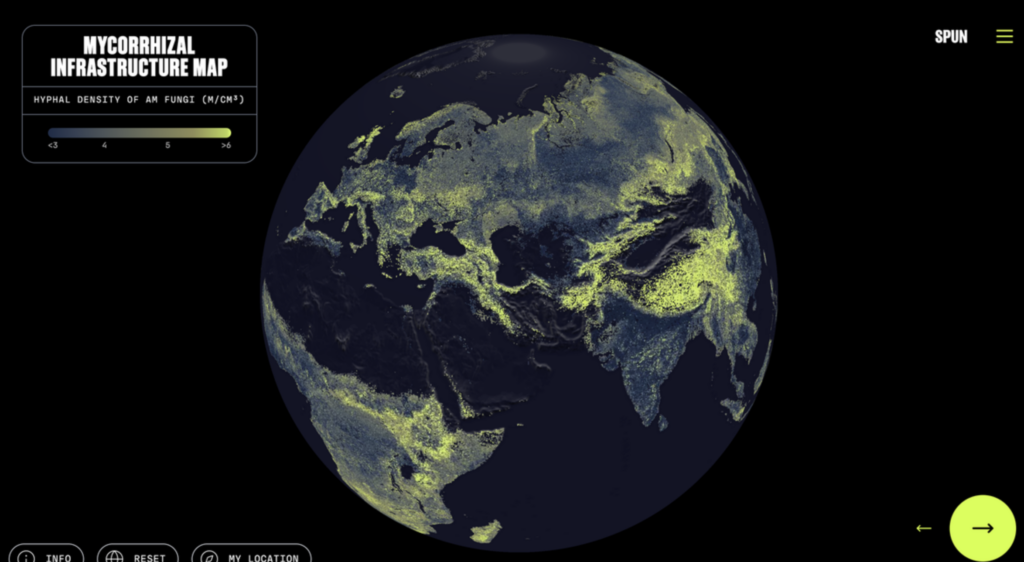
A study published in the journal Science produced the first global map of arbuscular mycorrhizal (AM) fungi, revealing the enormous extent of underground fungal networks and their importance for climate regulation.
Key Findings
Topsoils worldwide contain about 110 quadrillion km of fungal hyphae.
This distance is equivalent to nearly one billion trips between the Earth and the Sun.
AM fungal networks store around 300 million tonnes of carbon.
This is 4 to 6 times the weight of the entire human population.
The study analysed data from more than 16,000 soil cores using machine-learning techniques.
Role in Climate Regulation
AM fungi form symbiotic associations with nearly 70% of all plant species.
They exchange Nutrients and water with plants, in return for carbon compounds produced through photosynthesis.
These networks sequester approximately 4 billion tonnes of CO₂-equivalent annually.
This equals roughly 11% of global human-related carbon emissions.
Arbuscular Mycorrhizal (AM) Fungi
A group of fungi belonging to the phylum Glomeromycota.
They colonise plant roots and form mycorrhizae (fungus-root associations).
The fungal filaments, called hyphae, extend into the soil and improve nutrient uptake.
Benefits
Enhance absorption of: Phosphorus, Nitrogen, Micronutrients, and Water.
Improve plant growth and drought tolerance.
Increase soil aggregation and fertility.
Contribute to long-term carbon storage.
Biodiversity Hotspots Identified
The study found that around 40% of global AM fungal networks occur in grassland ecosystems, including South Sudan, The Tibetan Plateau, and Banni Grasslands.
Major Threats
Croplands contain about 50% lower fungal density compared to natural ecosystems.
Grasslands are being converted into agricultural land four times faster than forests.
This threatens underground fungal biodiversity and its ecosystem services.
Why is the Study Important?
Highlights fungi as a form of “living infrastructure” supporting ecosystems.
Emphasises the need to include soil biodiversity and fungi in climate policy.
Strengthens the case for grassland conservation alongside forest protection.
[2021] Which of the following have species that can establish symbiotic relationship with other organisms? 1. Cnidarians 2. Fungi 3. Protozoa Select the correct answer using the code given below.
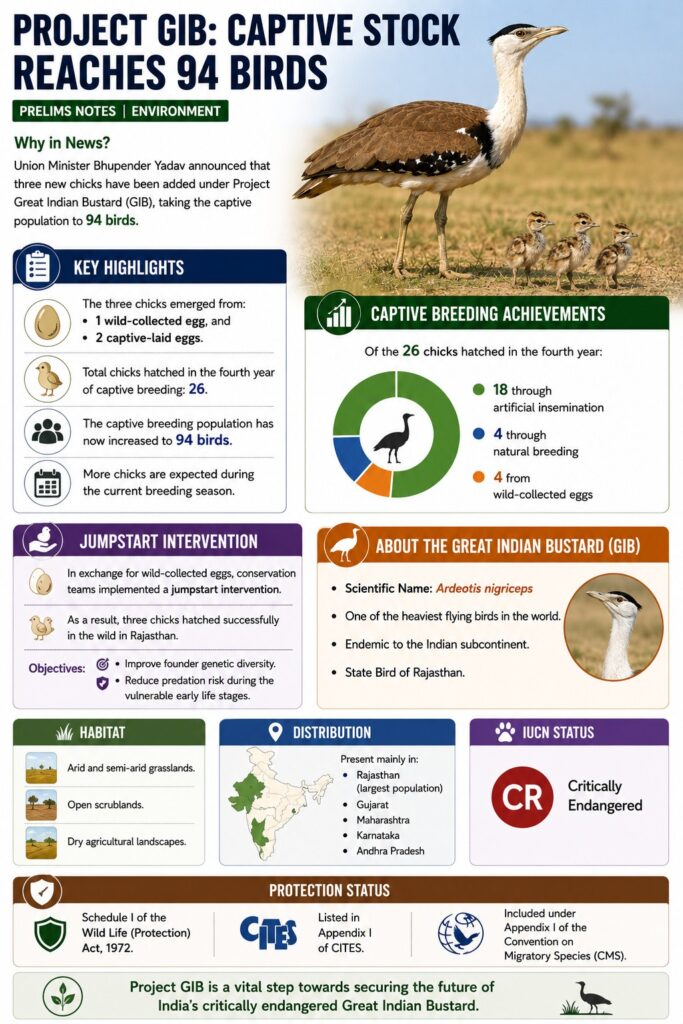
Union Minister Bhupender Yadav announced that three new chicks have been added under Project Great Indian Bustard (GIB), taking the captive population to 94 birds.
Key Highlights
The three chicks emerged from: 1 wild-collected egg, and 2 captive-laid eggs.
Total chicks hatched in the fourth year of captive breeding:26.
The captive breeding population has now increased to 94 birds.
More chicks are expected during the current breeding season.
About the Great Indian Bustard (GIB)
Scientific Name: Ardeotis nigriceps
One of the heaviest flying birds in the world.
Endemic to the Indian subcontinent.
State Bird of Rajasthan.
Habitat
Arid and semi-arid grasslands.
Open scrublands.
Dry agricultural landscapes.
Distribution: Rajasthan (largest population), Gujarat, Maharashtra, Karnataka, and Andhra Pradesh.
IUCN Status: Critically Endangered.
Protection Status:Schedule I of the Wild Life (Protection) Act, 1972.
Listed in Appendix I of CITES.
Included under Appendix I of the Convention on Migratory Species (CMS).
[2010] With reference to India’s Desert National Park, which of the following statements are correct?
1. It is spread over two districts. 2. There is no human habitation inside the Park. 3. It is one of the natural habitats of the Great Indian Bustard. Select the correct answer using the code given below: a) 1 and 2 only b) 2 and 3 only c) 1 and 3 only d) 1, 2 and 3
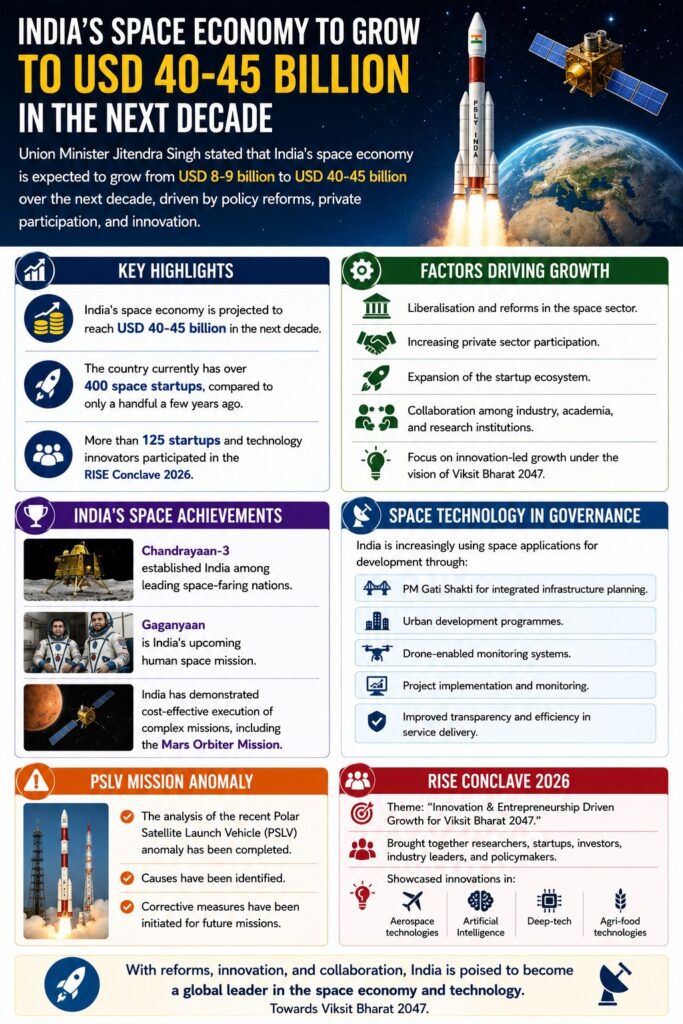
Union Minister Jitendra Singh stated that India’s space economy is expected to grow from USD 8-9 billion to USD 40-45 billion over the next decade, driven by policy reforms, private participation, and innovation.
Key Highlights
India’s space economy is projected to reach USD 40-45 billion in the next decade.
The country currently has over 400 space startups, compared to only a handful a few years ago.
More than 125 startups and technology innovators participated in the RISE Conclave 2026.
Factors Driving Growth
Liberalisation and reforms in the space sector.
Increasing private sector participation.
Expansion of the startup ecosystem.
Collaboration among industry, academia, and research institutions.
Focus on innovation-led growth under the vision of Viksit Bharat 2047.
India’s Space Achievements
Chandrayaan-3 established India among leading space-faring nations.
Gaganyaan is India’s upcoming human space mission.
India has demonstrated cost-effective execution of complex missions, including the Mars Orbiter Mission.
Space Technology in Governance
India is increasingly using space applications for development through:
PM Gati Shakti for integrated infrastructure planning.
Urban development programmes.
Drone-enabled monitoring systems.
Project implementation and monitoring.
Improved transparency and efficiency in service delivery.
PSLV Mission Anomaly
The analysis of the recent Polar Satellite Launch Vehicle (PSLV) anomaly has been completed.
Causes have been identified.
Corrective measures have been initiated for future missions.
RISE Conclave 2026
Theme: “Innovation & Entrepreneurship Driven Growth for Viksit Bharat 2047.”
Brought together researchers, startups, investors, industry leaders, and policymakers.
Showcased innovations in Aerospace technologies, Artificial Intelligence, Deep-tech, and Agri-food technologies.
[2025] GPS-Aided Geo Augmented Navigation (GAGAN) uses a system of ground stations to provide necessary augmentation. Which of the following statements is/are correct in respect of GAGAN? I. It is designed to provide additional accuracy and integrity. II. It will allow more uniform and high quality air traffic management. III. It will provide benefits only in aviation but not in other modes of transportation. Select the correct answer using the code given below.
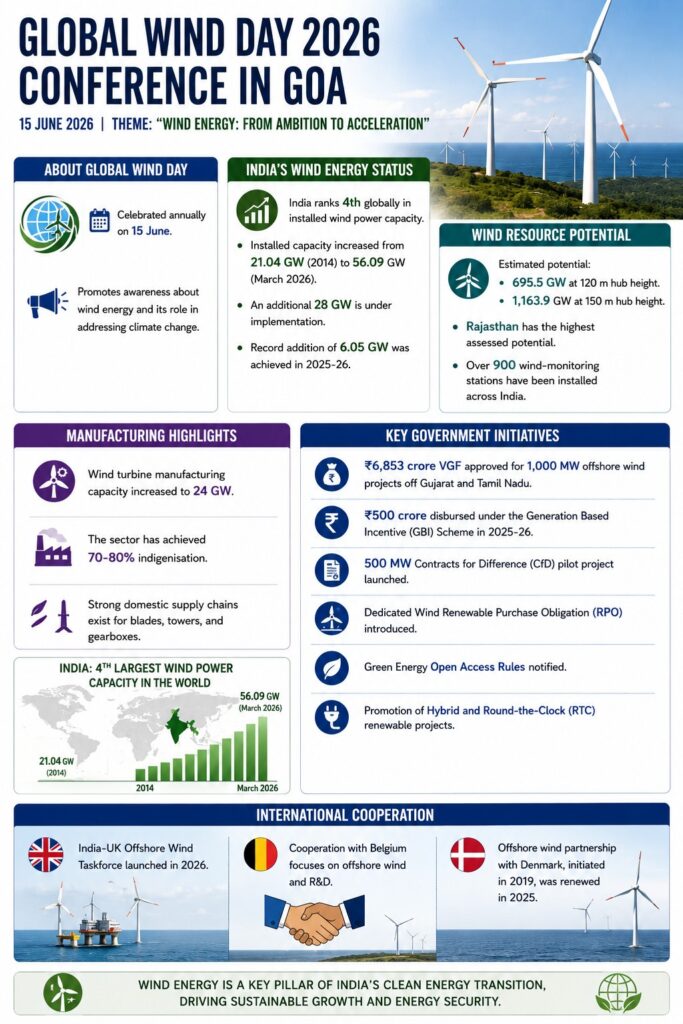
Promotion of Hybrid and Round-the-Clock (RTC) renewable projects.
International Cooperation
India-UK Offshore Wind Taskforce launched in 2026.
Cooperation with Belgium focuses on offshore wind and R&D.
Offshore wind partnership with Denmark, initiated in 2019, was renewed in 2025.
[2025] Consider the following statements about ‘PM Surya Ghar Muft Bijli Yojana’: I. It targets installation of one crore solar rooftop panels in the residential sector. II. The Ministry of New and Renewable Energy aims to impart training on installation, operation, maintenance and repairs of solar rooftop systems at grassroot levels. III. It aims to create more than three lakhs skilled manpower through fresh skilling, and upskilling, under scheme component of capacity building. Which of the statements given above are correct?
PYQ Relevance[UPSC 2022] The Rights of Persons with Disabilities Act, 2016 remains only a legal document without intense sensitisation of government functionaries and citizens regarding disability. Comment.Linkage: The PYQ examines the gap between statutory rights and actual social, administrative and economic inclusion of Persons with Disabilities. The proposed Minimum Universal Disability Pension Floor Rate (MUDPFR) represents the next step in translating legal rights into meaningful social protection and economic security for PwDs.
Mentor’s Comment
India’s welfare architecture has achieved remarkable success in digital inclusion and benefit delivery, yet disability pensions remain fragmented and dependent on State-level discretion. A Minimum Universal Disability Pension Floor Rate (MUDPFR) would establish a nationally guaranteed minimum social security entitlement for Persons with Disabilities, ensuring equality, dignity and portability of benefits while strengthening India’s transition towards a rights-based welfare state.
Why does India’s disability pension system remain inadequate despite a rights-based legal framework?
Large Beneficiary Base: Census 2011 recorded 2.68 crore PwDs; current estimates place the number at around 4.5-6 crore due to population growth and changing disease profiles.
Constitutional Recognition: Supreme Court has recognized the right to live with dignity as a fundamental right.
Legal Protection: Rights of Persons with Disabilities Act, 2016 provides statutory protection and mandates social security support.
Fragmented Pension System: Disability benefits vary significantly across States.
Low Pension Amounts: Most States provide pensions ranging between ₹300 and ₹500 per month.
Limited Coverage: Indira Gandhi National Disability Pension Scheme covers only a small fraction of eligible beneficiaries.
Domicile-Based Inequality: Pension support often depends on place of residence rather than disability status.
How does India’s spending on disability welfare compare internationally?
Low Public Spending: India spends only about 0.02% of GDP on disability welfare, including pensions.
South Africa Comparison: Allocates approximately 0.12-0.15% of GDP.
Brazil Comparison: Allocates around 0.45-0.50% of GDP.
OECD Countries: Average spending around 2.2% of GDP.
Australia Comparison: Allocates approximately 0.35-0.40% of GDP.
Resource Gap: India’s spending remains multiple times lower than comparable welfare systems.
What are the economic and social costs of inadequate disability support?
GDP Loss: World Bank and UNDP estimates indicate low- and middle-income countries lose 3-7% of GDP from exclusion of PwDs.
Educational Exclusion: Limited support reduces access to education.
Employment Barriers: Inadequate social security weakens labour force participation.
Household Vulnerability: Disability income support improves household stability.
Consumption Multiplier: Studies indicate multipliers ranging between 1.4 and 1.6.
Disability pensions have a consumption multiplier of 1.4-1.6, meaning every ₹100 transferred to beneficiaries can generate approximately ₹140-₹160 in economic activity through increased spending on food, healthcare, transport and local services.
Economic Returns: Pro Bono Economics (2025) found socio-economic returns from disability pensions exceed costs by nearly 48%.
Investment Perspective: Disability pensions function as economic investments rather than welfare expenditures alone.
Why is a Minimum Universal Disability Pension Floor Rate (MUDPFR) being proposed?
Constitutional Obligation: Supports Article 41 directing public assistance in cases of disability.
Implementation of RPwD Act: Operationalises Section 24 guaranteeing social security measures.
Universal Minimum Guarantee: Ensures a baseline pension irrespective of State of residence.
Rights-Based Welfare: Shifts support from charity-based approaches to citizenship-based entitlements.
Portability: Ensures continuity of benefits across States.
Equity: Reduces interstate disparities in pension access and quantum.
Proposed Design
National Floor Rate: Central government guarantees a minimum pension.
State Top-Ups: States remain free to provide higher benefits.
Uniform Eligibility: Common eligibility standards across India.
Portability: Benefits remain accessible across State boundaries.
Is a universal disability pension financially feasible?
₹8,000 Monthly Pension Scenario: Cost estimated at approximately ₹38,400 crore annually.
GDP Share: Around 0.08% of GDP.
10 Lakh Beneficiaries Scenario: Cost around ₹65 lakh crore? (Article indicates cost projections for larger coverage; emphasis remains below 0.2% GDP even under expanded coverage assumptions.)
₹15,000 Monthly Pension Scenario: Public expenditure would still remain below 0.2% of GDP.
Comparative Fiscal Context:
Food Subsidy: ₹2.05 lakh crore.
Rural Development: ₹1.80 lakh crore.
Tax Concessions and Revenue Foregone: ₹1.72 lakh crore.
Infrastructure: ₹11.11 lakh crore.
How can India move from fragmented welfare to integrated disability support?
Institutional Fragmentation: Pension administration is divided between the Ministry of Rural Development and the Department of Empowerment of Persons with Disabilities.
Administrative Delays: Multiple authorities create duplication and accountability gaps.
International Practice: Several countries operate through unified disability-support institutions.
Proposed Institutional Reforms
National Disability Pension Authority: Oversees eligibility, portability and grievance redress.
National Registry: Creates integrated beneficiary database.
Digital Integration: Links welfare databases through interoperable platforms.
Performance Monitoring: Enables State-wise accountability and benchmarking.
Single Governance Framework: One standard, one system, one nation.
What lessons can India learn from international experience?
South Africa
National Disability Grant: Uniform eligibility and nationwide coverage.
Centralized Standards: Ensures portability and consistency.
Brazil
BPC Programme: Guarantees a national minimum income for persons with disabilities.
Australia
Nationwide Disability Pension: Central administration with State coordination.
Employment Incentives: Combines social security with labour participation.
New Zealand
Universal Framework: Nationwide disability support system.
Other Developing Countries
Kenya, Rwanda, Thailand and Indonesia: National disability income support mechanisms demonstrate feasibility even in developing economies.
Why should disability pensions be linked with employment and economic participation?
Inclusive Growth: Moves beneficiaries from survival support to productive participation.
MUDPFR Advantage: Creates financial security necessary for skill development and employment.
Employer Incentives: Encourages hiring of persons with disabilities.
Singapore: Integrates disability support with skills training and workforce participation programmes.
South Korea: Combines income support with vocational rehabilitation and employment assistance.
South Africa: Provides a nationwide Disability Grant ensuring minimum income security for PwDs.
Brazil: Guarantees income support through the Benefício de Prestação Continuada (BPC) programme.
Nigeria: Offers tax incentives to employers hiring persons with disabilities, encouraging workplace inclusion.
United Kingdom (Access to Work): Provides financial assistance for workplace accommodations and support services.
Australia (Wage Subsidies): Offers wage subsidies to employers to improve employment opportunities for persons with disabilities.
Existing Indian Base: PM-DAKSH, NAPS and State-level incentives provide foundations for expansion.
How does a universal disability pension strengthen constitutional morality?
Equality: Reduces domicile-based discrimination.
Dignity: Recognises persons with disabilities as rights-bearing citizens.
Citizenship: Moves welfare from discretionary charity to guaranteed entitlement.
Article 14: Advances equality before law.
Article 21: Supports dignified living.
Social Justice: Aligns welfare architecture with constitutional commitments.
Federal Balance: Preserves State flexibility while guaranteeing minimum national standards.
Conclusion
A Minimum Universal Disability Pension Floor Rate (MUDPFR) would mark a shift from fragmented welfare to rights-based social protection by ensuring that disability support is determined by citizenship and need rather than geography. As India aspires to become a developed nation, guaranteeing a minimum income floor for Persons with Disabilities is not merely a welfare measure but a constitutional imperative that advances equality, dignity, inclusion and human capital development.