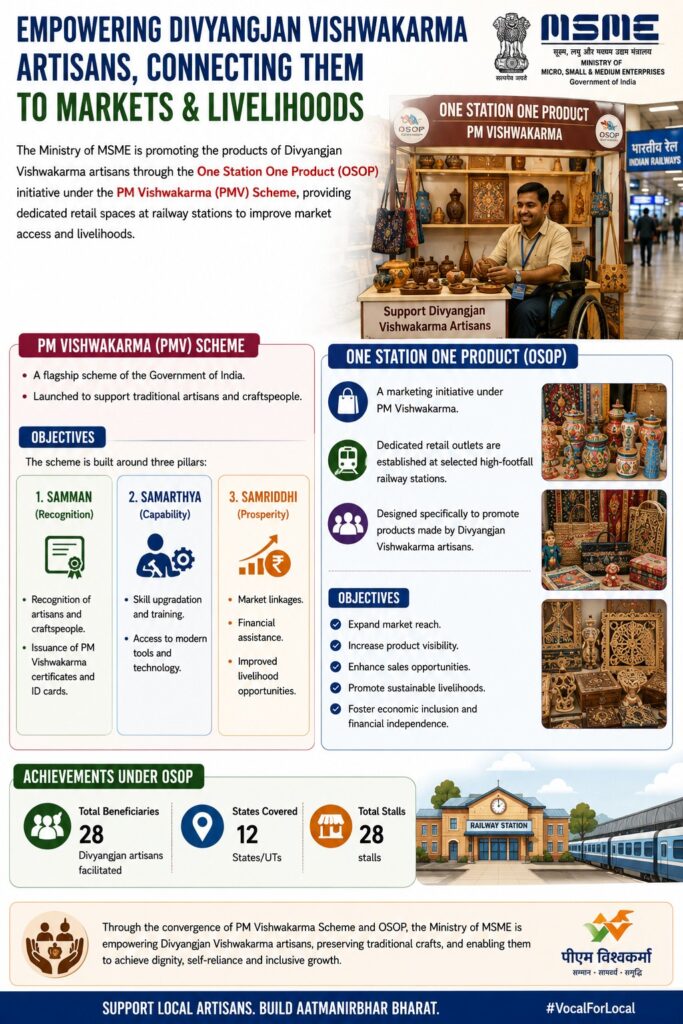
The Ministry of MSME is promoting the products of Divyangjan Vishwakarma artisans through the One Station One Product (OSOP) initiative under the PM Vishwakarma (PMV) Scheme, providing dedicated retail spaces at railway stations to improve market access and livelihoods.
PM Vishwakarma (PMV) Scheme
A flagship scheme of the Government of India.
Launched to support traditional artisans and craftspeople.
Objectives
Recognition of artisans and craftspeople.
Issuance of PM Vishwakarma certificates and ID cards.
Dedicated retail outlets are established at selected high-footfall railway stations.
Designed specifically to promote products made by Divyangjan Vishwakarma artisans.
Objectives
Expand market reach.
Increase product visibility.
Enhance sales opportunities.
Promote sustainable livelihoods.
Foster economic inclusion and financial independence.
Achievements under OSOP
Total Beneficiaries: 28 Divyangjan artisans facilitated.
States Covered: 12 States/UTs
Total Stalls: 28 stalls
[2023] Consider the following statements with reference to India: 1. According to the Micro, Small and Medium Enterprises Development (MSMED) Act, 2006, the ‘medium enterprises are those with and machinery between is crore and 25 crore. 2. All bank loans to the Micro, Small and Medium Enterprises qualify under the priority sector. Which of the statements given above is/are correct?
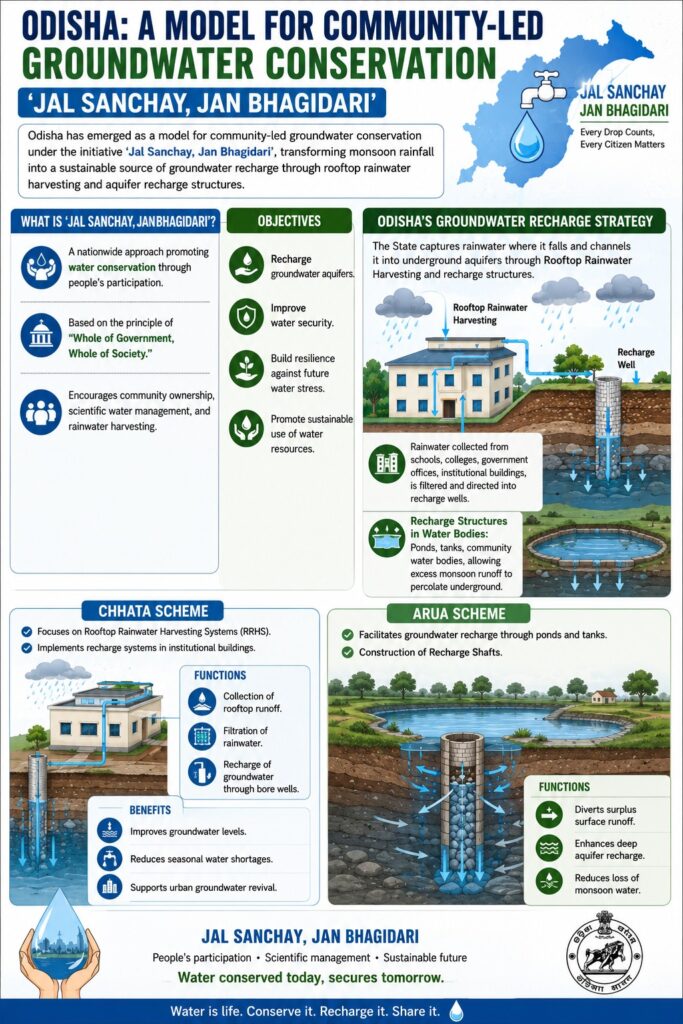
Odisha has emerged as a model for community-led groundwater conservation under the initiative ‘Jal Sanchay, Jan Bhagidari’, transforming monsoon rainfall into a sustainable source of groundwater recharge through rooftop rainwater harvesting and aquifer recharge structures.
What is ‘Jal Sanchay, Jan Bhagidari’?
A nationwide approach promoting: Water conservation through people’s participation.
Based on the principle of “Whole of Government, Whole of Society.”
Encourages Community ownership, Scientific water management, and Rainwater harvesting.
Objective
Recharge groundwater aquifers.
Improve water security.
Build resilience against future water stress.
Promote sustainable use of water resources.
Odisha’s Groundwater Recharge Strategy
The State captures rainwater where it falls and channels it into underground aquifers through Rooftop Rainwater Harvesting
Rainwater collected from: Schools, Colleges, Government offices, Institutional buildings, is filtered and directed into recharge wells.
Recharge Structures in Water Bodies: Ponds, Tanks, Community water bodies, allowing excess monsoon runoff to percolate underground.
CHHATA Scheme
Focuses on Rooftop Rainwater Harvesting Systems (RRHS).
Implements recharge systems in institutional buildings.
Functions
Collection of rooftop runoff.
Filtration of rainwater.
Recharge of groundwater through bore wells.
Benefits
Improves groundwater levels.
Reduces seasonal water shortages.
Supports urban groundwater revival.
ARUA Scheme
About: Facilitates groundwater recharge through ponds and tanks.
Construction of Recharge Shafts.
Functions
Diverts surplus surface runoff.
Enhances deep aquifer recharge.
Reduces loss of monsoon water.
[2022] Which one of the following has been constituted under the Environment (Protection) Act, 1986?
The Bureau of Indian Standards (BIS) under the Department of Consumer Affairs has released IS 20201:2026 – Community Seed Bank Management: Requirements, providing the first standardised framework for the management of Community Seed Banks (CSBs) in India.
What is IS 20201:2026?
Title: IS 20201:2026 Community Seed Bank Management – Requirements
Released by: Bureau of Indian Standards (BIS)
Parent Ministry: Department of Consumer Affairs, Ministry of Consumer Affairs, Food and Public Distribution.
Developed by: Biodiversity Sectional Committee (EED 06) Under BIS’s Environment and Ecology Department (EED).
Objective
The standard seeks to:
Conserve indigenous seed varieties.
Protect agricultural biodiversity.
Promote community-led seed conservation.
Enhance climate resilience in agriculture.
Ensure long-term food and nutritional security.
Empower farmers through decentralised seed systems.
What are Community Seed Banks (CSBs)?
Community Seed Banks are Decentralised, community-managed repositories that collect, conserve, multiply, store, and exchange locally adapted seeds.
Functions
Preservation of traditional crop varieties.
Seed exchange among farmers.
Maintenance of seed diversity.
Supply of quality seeds during climatic shocks.
Protection of farmers’ knowledge.
[2017] Consider the following statements:
1. The Standard Mark of Bureau of Indian Standards (BIS) is mandatory for automotive tyres and tubes.
2. AGMARK is a quality Certification Mark issued by the Food and Agriculture Organisation (FAO).
Which of the statements given above is/are correct?
PYQ Relevance[UPSC 2020] National Education Policy 2020 is in conformity with the Sustainable Development Goal-4 (2030). It intends to restructure and reorient education system in India. Critically examine the statement. Linkage: While the PYQ focuses on evaluating NEP 2020’s educational reforms, the article examines how the implementation of those reforms has generated new Centre-State tensions and debates over federalism, autonomy, and governance in higher education.
Mentor’s Comment
The implementation of the National Education Policy 2020, growing central control through regulatory and funding mechanisms, and disputes over language policy and Vice-Chancellor appointments have intensified Centre-State tensions in higher education. The debate highlights concerns that, despite education being in the Concurrent List, governance is becoming increasingly centralised. This raises questions about State autonomy and Indian federalism.
How Has Higher Education Become a Site of Federal Contestation?
Federal Interface: Higher education has evolved beyond a sectoral policy issue and now reflects broader Centre-State power relations.
Governance Disputes: Regulatory authority, curriculum design, language policy, public funding, and digital governance have become contested domains.
Political Divergence: Different States have responded differently to central reforms, reflecting diverse political and developmental priorities.
Constitutional Significance: Debates increasingly concern the distribution of authority within the Indian Union rather than merely educational administration.
How Is the Centre Expanding Its Influence in Higher Education Governance?
Concurrent List Position: Education falls under the Concurrent List, enabling both Union and State governments to legislate.
Institutional Leverage: The Union exercises influence through the Ministry of Education, UGC, accreditation agencies, and national regulatory frameworks.
Regulatory Expansion: National standards increasingly shape university functioning across States.
Policy Coordination: Central institutions possess significant capacity to standardise governance structures nationwide.
Constitutional Basis
Provision
Significance
Entry 66, Union List
Coordination and determination of standards in higher education
Global Integration: Facilitates international academic partnerships.
How Are Funding Mechanisms Strengthening Central Influence?
Conditional Funding: Access to central financial support increasingly depends on compliance with nationally designed reforms.
Institutions of Eminence (IoE): Links excellence funding with centrally determined criteria.
Research Incentives: Competitive funding structures influence institutional priorities.
Anusandhan National Research Foundation (ANRF): Expands central role in research governance and resource allocation.
Policy Alignment: Financial incentives encourage States and institutions to adopt national reform agendas.
Fiscal Federalism and Higher Education
Vertical Fiscal Imbalance: States bear substantial implementation responsibilities while major funding flows remain centrally influenced.
Conditional Grants: Strengthen policy convergence across States.
Performance-Based Funding: Links resources with nationally determined outcomes.
Why Are National Regulatory Reforms Creating Concerns Among States?
Regulatory Restructuring: Proposed reforms seek to replace existing higher education regulatory bodies with new frameworks.
Authority Concerns: States fear gradual erosion of their influence over university governance.
Centralised Oversight: National regulators may exercise greater supervisory powers.
Governance Uniformity: Increased standardisation may reduce flexibility for regional requirements.
Example Mentioned
Viksit Bharat Shiksha Adhishthan Bill, 2025: Proposed restructuring of higher education regulatory architecture has generated apprehensions regarding State autonomy.
How Is Digital Governance Contributing to Centralisation?
Academic Bank of Credits (ABC): Creates nationally integrated academic records.
Standardisation: Enables uniform academic tracking and credit recognition.
Monitoring Capacity: Enhances the Centre’s ability to oversee institutional performance.
Data Governance: Strengthens central regulatory visibility across States.
What Are the Major Centre-State Conflicts in Higher Education?
Tamil Nadu: Opposes the NEP 2020’s three-language formula and has resisted UGC directives related to third-language implementation.
Kerala: Has raised concerns over university governance, particularly the appointment of Vice-Chancellors and the powers exercised by the Governor.
Karnataka: Has witnessed disputes over institutional autonomy, especially regarding university administration and appointments. West
Bengal: Has experienced recurring conflicts between the Governor and the State Government over control and administration of higher education institutions.
Broader Pattern
Vice-Chancellor Appointments: Emerging as a recurring federal conflict.
Governor’s Role: Increasingly linked to debates over educational autonomy.
Regional Identity: Language and curriculum issues reinforce federal tensions.
Are States Merely Resisting or Strategically Adapting?
Selective Adoption: States increasingly adopt reforms aligned with local priorities while resisting others.
Negotiated Federalism: Centre-State relations are becoming more adaptive rather than purely confrontational.
Policy Customisation: States modify implementation pathways according to regional political contexts.
Pragmatic Governance: Reflects a balance between compliance and autonomy.
Negotiated Federalism: A form of federalism in which States neither fully accept nor fully reject central policies but strategically adapt them to local circumstances.
How Is Internationalisation Reshaping Centre-State Dynamics?
Regional Education Hubs: States seek to attract international institutions and students.
Global Partnerships: State governments facilitate collaborations with overseas universities.
Economic Development Tool: Higher education is increasingly viewed as a driver of investment and knowledge-led growth.
Implementation Dependence: Despite central regulations, operational success depends heavily on State-level clearances, infrastructure, and facilitation.
What Does This Debate Reveal About the Future of Indian Federalism?
Beyond Constitutional Text: Federal outcomes increasingly depend on political negotiation.
Dynamic Federalism: Governance outcomes emerge through continuous negotiation rather than fixed constitutional arrangements.
Conclusion
Higher education has emerged as a key arena for negotiating Indian federalism, where issues of regulation, funding, language, and institutional governance increasingly shape Centre–State relations. The future of the sector will depend on balancing national standards with State autonomy through cooperative and negotiated federalism, ensuring both educational excellence and constitutional federal balance.
The near-completion breakthrough of the Zojila Tunnel, being constructed at an altitude of 11,578 feet, marks one of India’s most ambitious and technically demanding infrastructure achievements.
What is the Zojila Tunnel?
The Zojila Tunnel is a 13-km bi-directional road tunnel being constructed beneath the Zojila Pass in the Himalayas.
Located at an elevation of 11,578 feet, it aims to provide all-weather connectivity between Kashmir Valley and Ladakh.
The project is among India’s most challenging infrastructure undertakings due to the complex geological and environmental conditions associated with Himalayan terrain.
How does Himalayan geology make tunnel construction exceptionally difficult?
Young Fold Mountains: The Himalayas are geologically young and remain tectonically active, resulting in unstable rock formations.
Variable Rock Strata: Rock composition can change within a few metres, creating unpredictable excavation conditions.
Structural Weaknesses: Rock formations contain fractures, cracks, fault zones, and shear zones that reduce stability.
Loose Geological Material: Engineers encounter loose rocks, boulders, and weak strata requiring different support systems.
Why do altitude and climatic conditions increase construction risks?
High Elevation: Construction occurs at approximately 11,578 feet, reducing worker efficiency and equipment performance.
Extreme Cold: Temperatures may fall to -30°C.
Harsh Winters: Severe weather limits construction windows.
Avalanche Threats: Snow avalanches create risks for workers and infrastructure.
Operational Challenges: Combustion engines and heavy machinery experience reduced efficiency at high altitude.
Why is water ingress one of the biggest engineering challenges in the Himalayas?
Stored Water Reservoirs: Mountains contain large volumes of groundwater trapped within rock layers.
Snowmelt Contribution: Melting snow continuously adds to underground water systems.
Water Ingress: Excavation frequently intersects water-bearing zones.
Hydrostatic Pressure: Excessive water pressure can destabilize tunnel structures.
Flooding Risk: Uncontrolled seepage may trigger tunnel flooding and structural failures.
Striking Observation
Massive Water Storage: Geological assessments indicate that Himalayan mountains may contain water volumes comparable to an “ocean’s worth” of stored water.
Why are shear zones and tectonic stresses particularly dangerous?
Shear Zones: High-strain zones create instability during excavation.
Rock Deformation: Tectonic pressure continuously alters stress distribution.
Collapse Risk: Excavation may trigger localized failures in weak zones.
Dynamic Conditions: Geological conditions often change unexpectedly during drilling.
What safety measures were adopted during the Zojila Tunnel project?
Ventilation Infrastructure: Three shafts were constructed along the tunnel length.
Emergency Response: Shafts provide access for rescue and evacuation operations.
Deep Access Shafts: The first shaft is 474.3 m deep, making it the deepest in India.
Additional Shafts: The second shaft is 367.5 m deep, while the third shaft is 213.5 m deep.
Operational Safety: Ventilation systems ensure worker safety during construction and future operation.
How does the New Austrian Tunnelling Method (NATM) help overcome Himalayan challenges?
The New Austrian Tunneling Method (NATM) is a modern, observational tunneling approach that reinforces the surrounding rock or soil, allowing it to deform slightly and become part of the tunnel’s primary load-bearing structure.
Selective Excavation: Facilitates controlled blasting based on rock conditions.
Sequential Construction: Excavation proceeds in stages rather than full-face excavation.
Top-Heading Method: Upper tunnel section is excavated first, followed by the lower section.
Adaptive Design: Allows modifications according to changing geological conditions.
Risk Reduction: Enhances stability in weak and variable rock formations.
About the NATM
Principle: “The surrounding rock mass itself becomes part of the support system.”
Key Components
Shotcrete: Sprayed concrete for immediate stabilization.
Rock Bolts: Reinforce fractured rock.
Monitoring Systems: Continuous assessment of rock behaviour.
Flexible Design: Engineering response adjusted to site conditions.
How are water and structural stability managed during excavation?
Drainage Pipes: Facilitate controlled water discharge.
Pressure Management: Prevents buildup of hydrostatic pressure.
Rock Bolting: Stabilizes fractured rock masses.
Shotcrete Lining: Binds loose rock surfaces.
Alignment Modification: Tunnel route can be altered to bypass weak geological sections.
Site-Specific Design: Tunnel shape and support configuration vary according to local conditions.
Why does the Zojila Tunnel have strategic significance beyond engineering?
All-Weather Connectivity: Reduces dependence on the seasonally closed Zojila Pass.
Regional Integration: Strengthens connectivity between Kashmir and Ladakh.
Defence Logistics: Improves movement of military personnel and supplies.
Economic Development: Facilitates tourism, trade, and local livelihoods.
National Infrastructure Capacity: Demonstrates India’s capability to execute mega-projects in difficult terrain.
Conclusion
The Zojila Tunnel demonstrates the intersection of strategic infrastructure, geological science, and engineering innovation in one of the world’s most challenging mountain environments. Its construction highlights the necessity of adaptive engineering, advanced tunnelling techniques, and robust safety systems for infrastructure development in the Himalayas. The project serves as a model for future high-altitude infrastructure while strengthening regional connectivity, national security, and economic integration.
Value Addition
Major Himalayan Infrastructure Projects
Zojila Tunnel: Kashmir-Ladakh connectivity.
Atal Tunnel: Rohtang Pass, Himachal Pradesh.
Sela Tunnel: Arunachal Pradesh.
Z-Morh Tunnel: Sonamarg connectivity.
PYQ Relevance
[UPSC 2016] The Himalayas are highly prone to landslides. Discuss the causes and suggest suitable measures of mitigation.
Linkage: The question examines the geological fragility, instability, and hazard-prone nature of the Himalayan mountain system. The Zojila Tunnel highlights how young Himalayan geology creates major engineering and disaster-management challenges during infrastructure construction.
India’s net FDI has witnessed an extraordinary collapse, falling from almost $44 billion in 2020-21 to less than $1 billion in 2024-25, even as gross FDI inflows recovered to $94.6 billion. This sharp divergence has reignited debate over whether India is becoming a less attractive investment destination.
Why has India’s net FDI declined so sharply despite strong gross inflows?
Net FDI Measurement: Net FDI under the Balance of Payments (BoP) framework is calculated after adjusting gross inflows for FDI-related outflows.
Sharp Decline: Net FDI fell from nearly $44.0 billion in 2020-21 to less than $1 billion in 2024-25.
Strong Gross Inflows: Gross FDI inflows recovered to $94.6 billion in 2025-26.
Misleading Interpretation: Weak net FDI is often interpreted as a sign of declining investor confidence, while strong gross inflows are presented as evidence of economic strength.
Underlying Reality: Both views overlook the changing composition of international capital flows and the mechanisms governing inflows and outflows.
Does the conventional FDI debate overlook important structural changes?
Incomplete Narrative: Public discourse focuses primarily on aggregate FDI numbers rather than the nature of investments.
Shift in Focus: Policy gradually prioritised attracting larger inflows, while concerns regarding future external payment obligations and investment quality received less attention.
Need for Assessment: Evaluating FDI requires examining investor categories, sectoral allocation, and associated outflows rather than focusing solely on inflow volumes.
What types of FDI are entering India and how do they differ in developmental impact?
Traditional or Real FDI
Source: Multinational enterprises investing directly in production and services.
Contribution: Brings technology, brands, managerial capabilities, and production know-how.
Impact: Supports long-term industrial development and employment generation.
Financial Investor FDI
Source: Private equity funds, venture capital funds, sovereign wealth funds, and asset managers.
Objective: Capital appreciation rather than production expansion.
Impact: Provides financial capital but contributes less to technology transfer and industrial capacity creation.
Diaspora and SPV-Based Investments
Mechanism: Capital raised abroad and channelled through offshore financial centres.
Instrument: Special Purpose Vehicles (SPVs).
Characteristic: Frequently associated with round-tripping of domestic funds.
How has the composition of FDI changed in recent years?
Real FDI Share: Accounted for only 41.9% of effective inflows between 2022-23 and 2025-26.
Financial Investor Share: Contributed 40.5% of effective inflows.
Diaspora/SPV Share: Represented 17.6% of total inflows.
Developmental Concern: A rising share of financial investors and SPVs reduces the developmental gains usually associated with traditional FDI.
Technology Transfer: Becomes weaker when investments are motivated primarily by financial returns rather than production activity.
Why do rising investor exits matter for understanding net FDI trends?
Exit Signals: Business model of financial investors involves eventual exits through stake sales and disinvestment.
Large Exit Example: Singapore’s Temasek exited Schneider Electric India in 2025.
Scale of Exit: Exit generated approximately $6.4 billion.
Initial Investment: Around $637 million invested in 2020.
Return Multiple: Approximately 45 times the original investment.
PE and VC Exits: Foreign private equity and venture capital investors accounted for around $29 billion in outflows.
Implication: Such exits substantially increase capital outflows and depress net FDI.
Are gross FDI figures overstating actual fresh capital entering India?
Accounting Inclusion: Gross FDI statistics include intra-group ownership reorganisations.
Mergers and Acquisitions: Included even when no fresh capital enters the country.
Share Swaps: Recorded as FDI transactions despite limited resource transfer.
ECB Conversions: Conversion of external commercial borrowings into equity inflates inflow figures.
Blind Spot: Gross FDI figures often fail to distinguish between fresh investment and accounting transactions.
Illustrative Example: Large transactions involving Bosch and Mesee Technologies can significantly influence sectoral trends without necessarily bringing new productive capital.
Why can high gross FDI figures create a misleading picture of investment performance?
Gross FDI Recovery: Gross FDI inflows recovered to $94.6 billion, often cited as evidence of India’s continued attractiveness to foreign investors.
Accounting Transactions: Gross FDI statistics include intra-group ownership restructuring, mergers and acquisitions, share swaps, and conversion of external commercial borrowings (ECBs) into equity.
Limited Fresh Capital: Such transactions may alter ownership structures without necessarily bringing substantial new capital, technology, or productive capacity into the economy.
Sectoral Distortions: Large corporate restructuring exercises can inflate FDI numbers and create an impression of strong investment activity in particular sectors.
Developmental Concern: High gross inflows do not automatically translate into employment generation, manufacturing expansion, technology transfer, or export competitiveness.
Why is the decline in manufacturing FDI a major concern?
Four-Year Decline: Manufacturing FDI has fallen continuously for four consecutive years.
Low Share: Manufacturing accounted for only 10.6% of total effective inflows during the latest four-year period.
Employment Implications: Reduces potential for large-scale job creation.
Strategic Concern: Limits India’s ambition to become a major global manufacturing hub.
Does rising outward FDI represent globalisation or capital flight?
Rapid Growth: India’s outward FDI has increased significantly.
Sectoral Concentration: Around 45% of outward investments during 2023-24 to 2025-26 flowed into financial services, insurance, and business services.
Destination Pattern: Singapore and the UAE accounted for approximately 27% and 11% respectively.
Corporate Example: Tata Motors-owned subsidiary in Singapore invested $405 million to acquire IVECO Group in Italy.
GIFT City Link: FDI routed through GIFT City increased from $246 million in 2023-24 to $1.8 billion in 2025-26.
Extended Route: Total inflows and outward FDI through this channel reached approximately $1.40 billion, indicating expanding two-way flows.
Dual Interpretation: Outward FDI may indicate both global expansion of Indian firms and relocation of capital across jurisdictions.
How are FDI-related outflows reshaping India’s external sector?
Disinvestment Outflows
Magnitude: Disinvestment and capital withdrawals totalled approximately $178.9 billion.
Drivers: Secondary sales, IPO exits, and share buybacks.
Dividend Remittances
Amount: Reached $118.9 billion.
Source: Profits paid by multinational subsidiaries and affiliates, excluding reinvested earnings.
Intellectual Property Payments
Amount: Totalled $46.6 billion.
Nature: Payments for intellectual property and royalty use.
Estimated Allocation: Around 75% of total IPR payments assumed to be attributable to multinational subsidiaries and affiliates.
Technical and Service Payments
Amount: Around $250 billion transferred through technical and service/consultancy payments.
Difficulty: Separation between foreign and domestic company payments remains challenging.
Overall Outflows
Adjusted Outflows: Even after excluding OFDI, technical service payments, dividends and IPR-related outflows, total outflows remained around $344.4 billion.
Deteriorating Ratio: For every dollar of fresh inflow (excluding reinvested earnings), approximately $1.50 flowed out.
Historical Comparison: Outflow per dollar of inflow rose from 56 cents (2014-15 to 2017-18) to 70 cents (2018-19 to 2021-22) before reaching the current high.
Why should policymakers focus on the quality rather than the quantity of FDI?
Technology Transfer: Real FDI contributes more effectively to technological upgrading.
Industrial Development: Manufacturing-oriented FDI strengthens domestic production capabilities.
Investor Diversity: Different investor categories generate different developmental outcomes.
Policy Evaluation: FDI performance should be assessed through technology gains, industrial capacity creation, employment generation, and external-sector implications rather than gross inflow figures alone.
Core Message: Headline FDI numbers conceal important changes in investor composition, entry modes, exit strategies, and developmental impact.
Conclusion
India’s falling net FDI highlights that the quality and composition of foreign investment matter more than headline inflow numbers. Rising disinvestment, profit repatriation, and financial-investor-led flows have weakened net inflows despite strong gross FDI. Going forward, policy must prioritise productive, technology-intensive, and manufacturing-oriented FDI that strengthens industrial growth and external sector sustainability.
Value Addition
Net FDI vs Gross FDI
Indicator
Meaning
Gross FDI
Total foreign investment entering the economy
Net FDI
Gross inflows minus disinvestment and related outflows
Effective FDI
Fresh capital inflows after excluding accounting and restructuring transactions
Volatile Capital Flows: Increases external vulnerability.
Short-Term Orientation: Prioritises capital gains over industrial expansion.
PYQ Relevance
[UPSC 2016] Justify the need for FDI for the development of the Indian economy. Why is there a gap between MOUs signed and actual FDIs? Suggest remedial steps to increase actual FDIs in India.
Linkage: The question examines not merely the volume of FDI but its effectiveness, actual realization, and developmental contribution to the economy. The article highlights why the quality and developmental impact of FDI matter more than headline inflow numbers.
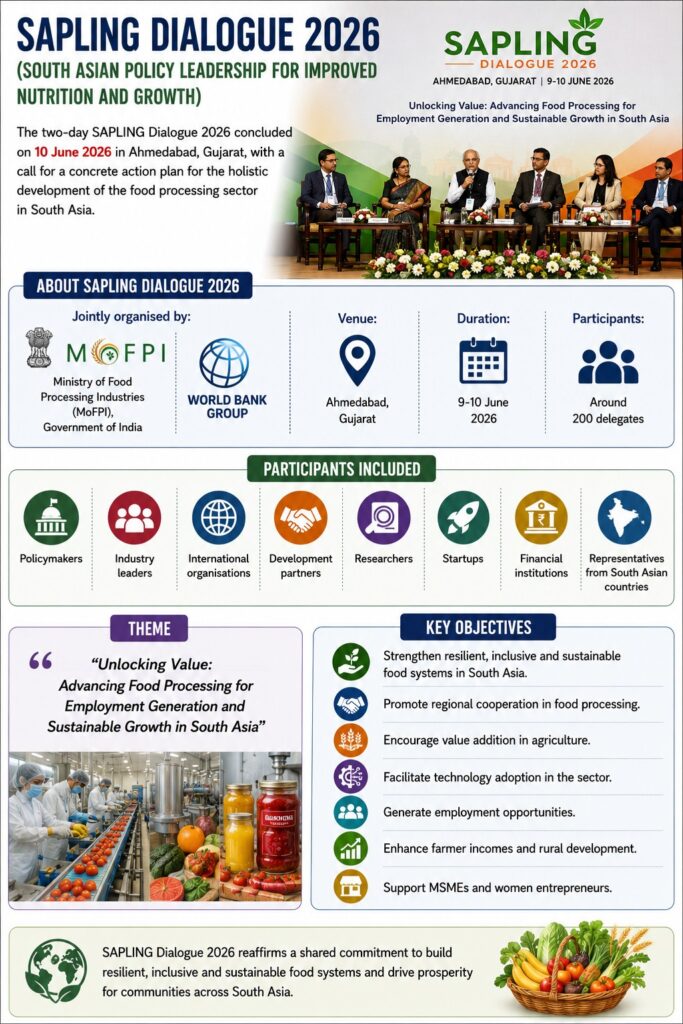
The two-day SAPLING (South Asian Policy Leadership for Improved Nutrition and Growth) Dialogue 2026 concluded on 10 June 2026 in Ahmedabad, Gujarat, with a call for a concrete action plan for the holistic development of the food processing sector in South Asia.
About SAPLING Dialogue 2026
Jointly organised by: Ministry of Food Processing Industries (MoFPI), Government of India and World Bank Group
Venue: Ahmedabad, Gujarat
Duration: 9-10 June 2026
Participants: Around 200 delegates.
Participants Included
Policymakers, Industry leaders, International organisations, Development partners, Researchers, Startups, Financial institutions, and Representatives from South Asian countries
Theme
“Unlocking Value: Advancing Food Processing for Employment Generation and Sustainable Growth in South Asia”
Key Objectives
Strengthen resilient, inclusive and sustainable food systems in South Asia.
Promote regional cooperation in food processing.
Encourage value addition in agriculture.
Facilitate technology adoption in the sector.
Generate employment opportunities.
Enhance farmer incomes and rural development.
Support MSMEs and women entrepreneurs.
[2023] Consider the following statements with reference to India: 1. According to the Micro, Small and Medium Enterprises Development (MSMED) Act, 2006, the ‘medium enterprises’ are those with and machinery between is crore and 25 crore. 2. All bank loans to the Micro, Small and Medium Enterprises qualify under the priority sector. Which of the statements given above is/are correct?
Ahead of the 2026 FIFA World Cup, the axolotl has emerged as Mexico City’s unofficial mascot. However, conservationists have raised concerns that the popularity of the critically endangered amphibian has not translated into meaningful efforts to protect its rapidly disappearing habitat.
About Axolotl
Common name: Axolotl
Scientific name: Ambystoma mexicanum
Group: Amphibian (salamander).
Endemic to: Mexico, particularly the canals of Xochimilco in Mexico City.
Name derived from: The Nahuatl word meaning “water monster”.
Unique Features
Exhibits neoteny, retaining larval characteristics throughout its life.
Remains aquatic throughout its life cycle.
Breathes through External gills and oxygen absorption through its skin.
Extraordinary regenerative ability can regrow limbs, Parts of the spinal cord, Heart tissue, and Portions of the brain.
Conservation Status
IUCN Red List: Critically Endangered.
Wild populations have witnessed a drastic decline.
[2019] Consider the following statements: 1. Asiatic lion is naturally found in India only. 2. Double-humped camel is naturally found in India only. 3. One-horned rhinoceros is naturally found in India only. Which of the statements given above is/are correct?
Taiwan conducted a live-fire exercise using the High Mobility Artillery Rocket System (HIMARS) on its west coast for the first time, simulating strikes against an invading force from China and demonstrating its “shoot-and-scoot” capability.
HIMARS (High Mobility Artillery Rocket System)
Full form: High Mobility Artillery Rocket System (HIMARS).
Manufacturer: Lockheed Martin.
Country of origin: United States.
Type: Wheeled Multiple Launch Rocket System (MLRS).
Mounted on: A 6×6 military truck chassis.
Designed for: Precision long-range strikes.
Range
Approximately 300 km (190 miles) using long-range precision rockets.
From western Taiwan, it can potentially strike targets in China’s Fujian Province across the Taiwan Strait.
What is “Shoot-and-Scoot”?
A battlefield tactic used by mobile artillery systems.
Involves:
Moving to a firing position.
Launching rockets.
Immediately relocating before enemy counter-attacks.
[2022] Which one of the following statements best reflects the issue with Senkaku Islands, sometimes mentioned in the news?
a) It is generally believed that they are artificial islands made by a country around South China Sea.
b) China and Japan engage in maritime disputes over these islands in East China Sea. c) A permanent American military base has been set up there to help Taiwan to increase its defence capabilities. d) Though International Court, of Justice declared them as no man’s land, some South-East Asian countries claim them.
On 9 June 2026, the death anniversary of Birsa Munda was observed across Jharkhand. Several tribal organisations pledged to protect his legacy amid renewed debates over the delisting of tribal converts from the Scheduled Tribes list, bringing Birsa’s ideas on Adivasi identity, land rights, and self-rule back into focus.
Who was Birsa Munda?
Born: 15 November 1875, Ulihatu (present-day Jharkhand).
Died: 9 June 1900, Ranchi Jail.
Belonged to the Munda tribe.
Revered as: Dharti Aba (“Father of the Earth”) and “Bhagwan” by followers.
Tribal leader, social reformer, religious preacher, and anti-colonial freedom fighter.
Ulgulan (The Great Tumult)
Tribal uprising led by Birsa Munda during 1899-1900.
“Ulgulan” means Great Tumult.
Centred in the Chotanagpur Plateau.
Causes
Encroachment on tribal lands.
Exploitative practices of:
British administration,
Zamindars,
Moneylenders,
“Dikus” (non-tribal outsiders).
Erosion of traditional tribal institutions.
Missionary influence and socio-cultural disruptions.
Objectives
Restoration of traditional land rights.
End of British rule.
Expulsion of exploitative outsiders.
Establishment of tribal self-rule.
Concept of “Disum”
Refers to self-rule or autonomous tribal governance.
Reflected Birsa’s vision of Adivasi sovereignty, Community control over resources, and Cultural autonomy.
Dombari Buru
Major centre of the Ulgulan.
In January 1899, thousands gathered to assert tribal rights.
British troops opened fire on the gathering.
Remembered in Adivasi memory as a massacre.
Became a symbol of tribal resistance.
Khuntkatti System
Traditional Munda system of collective land ownership.
Village lands belonged to descendants of original settlers called Khuntkattidars.
Combined land rights with customary governance.
Chotanagpur Tenancy (CNT) Act, 1908
Background
Enacted following decades of tribal resistance, including Birsa’s movement.
Objectives
Prevent transfer of tribal land to non-tribals.
Legally recognise customary tribal land rights.
Protect Khuntkatti tenure systems.
[2020] With reference to the history of India, “Ulgulan” or the Great Trumult is the description of which of the following events?
(a) The Revolt of 1857 (b) The Mappila Rebellion of 1921 (c) The Indigo Revolt of 1859-60 (d) Birsa Munda’s Revolt of 1899-1900