💥UPSC 2027,2028 Mentorship (April Batch) + Access XFactor Notes & Microthemes PDF

Archives: News

  • Tax Reforms

    New Income Tax Bill, 2025

    Why in the News?

    Parliament has passed the Income-tax Bill, 2025, replacing the 1961 law with a leaner, simpler version free of redundant provisions and archaic language, effective April 1, 2026.

    About New Income Tax Bill, 2025:

    • Purpose: Replaces the Income Tax Act, 1961 after more than 60 years to simplify the law, remove redundant provisions, and modernise tax administration.
    • Effective Date: Comes into effect from April 1, 2026.
    • Structural Changes: Sections reduced from 819 to 536; chapters from 47 to 23.
    • Conciseness: Word count cut from 5.12 lakh to 2.6 lakh, with 39 tables and 40 formulas for clarity.
    • New Concept: Introduces “tax year” defined as April 1 to March 31.

    Key Features:

    • Refunds: Restores refund claims on belated returns by removing the earlier restriction.
    • Tax Collected at Source (TCS) Clarity: Nil TCS for Liberalised Remittance Scheme (LRS) remittances for education funded by financial institutions.
    • Corporate Tax: Corrects errors in inter-corporate dividend deduction for companies opting for concessional tax rates.
    • Alternate Minimum Tax (AMT) Alignment: Aligns AMT provisions for Limited Liability Partnerships (LLPs) with existing rates.
    • Nil-Tax Deducted at Source (TDS) Certificate: Permits taxpayers with no liability to obtain a nil-TDS certificate.
    • Transfer Pricing: Clarifies transfer pricing provisions, set-off of losses, and alignment with Section 79 on “beneficial owner.”
    • Non-Profit Organisation (NPO) Benefit: Expands exemption to 5% of total donations, instead of only anonymous donations.
    • House Property Income: Clarifies 30% standard deduction after municipal taxes.
    • Search Definition: Retains “virtual digital space” definition to include cloud storage, email, and social media accounts.
    • Data Handling: Standard Operating Procedure (SOP) to be issued for handling personal digital data seized in searches.
    [UPSC 2025] Consider the following statements: Statement I: In India, income from allied agricultural activities like poultry farming and wool rearing in rural areas is exempted from any tax. Statement II: In India, rural agricultural land is not considered a capital asset under the provisions of the Income-tax Act, 1961.

    Which one of the following is correct in respect of the above statements?

    (a) Both Statement I and Statement II are correct and Statement II explains Statement I

    (b) Both Statement I and Statement II are correct but Statement II does not explain Statement I*

    (c) Statement I is correct but Statement II is not correct

    (d) Statement I is not correct but Statement II is correct


  • Global Geological And Climatic Events

    1950 Assam Earthquake and Future Seismic Risks in the Himalayas

    Why in the News?

    75 years ago on August 15, 1950, a magnitude 8.6 earthquake — the strongest recorded on land — struck Northeast India and surrounding regions.

    1950 Assam Earthquake and Future Seismic Risks in the Himalayas

    About the Earthquake:

    • Magnitude: 8.6, the strongest recorded earthquake on land.
    • Impact Area: Tremors lasted 4–8 minutes, felt over 3 million sq. km in India, Myanmar, Bangladesh, Tibet, and South China.
    • Casualties: Over 1,500 deaths in India and 4,000+ in Tibet; heavy livestock losses and infrastructure destruction.
    • Secondary Disasters: Triggered landslides blocking rivers, followed by devastating flash floods.

    Geological and Tectonic Setting:

    • Epicentre: 40 km west of Rima (Zayu), near India–Tibet border in the Mishmi Hills.
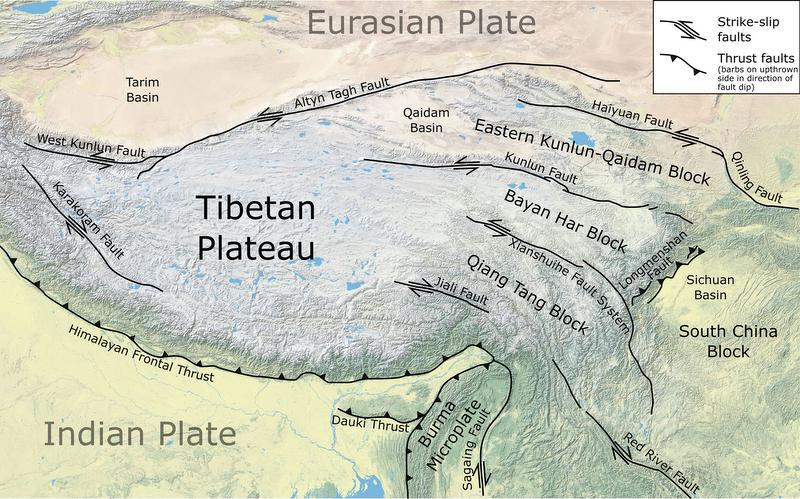
    • Tectonic Context: Located on Indian–Eurasian Plate boundary within Eastern Himalayan Syntaxis (EHS), influenced by the Sunda Plate.
    • Fault Type: Strike-slip motion with thrust faulting — atypical for Himalayan quakes.
    • Plate Convergence: Eastern Himalayas converge at 10–38 mm/year vs. ~20 mm/year elsewhere.
    • Aftershocks: Indicated activation of multiple faults from the Syntaxial bend to Himalayan thrust faults in Arunachal Pradesh.

    Lessons and Future Risks:

    • Magnitude Potential: Confirms Himalayan segments can produce ≥8.6 magnitude events.
    • Central Himalayan Risk: Identified as likely site for similar future quake.
    • Vulnerability Today: Increased due to urbanisation and large infrastructure in seismic zones.
    • Infrastructure Safety: Necessitates strict norms for dams and high-risk projects in Eastern Himalayas.
    • Preparedness: Highlights need for seismic hazard mapping and disaster readiness.
    [UPSC 2024] Consider the following statements:

    1. In a seismograph, P waves are recorded earlier than S waves.

    2. In P waves, the individual particles vibrate to and fro in the direction of waves propogation whereas in S waves, the particles vibrate up and down at right angles to the direction of wave propagation. Which of the statements given above is/are correct?

    Options: (a) 1 only (b) 2 only (c) Both 1 and 2* (d) Neither 1 nor 2


  • International Space Agencies – Missions and Discoveries

    Orbiting Carbon Observatories (OCO) Program

    Why in the News?

    The Trump administration seeks to end two NASA missions under the Orbiting Carbon Observatories (OCO) program, which monitor global carbon dioxide emissions and plant health.

    About Orbiting Carbon Observatories (OCO) Program:

    • Overview: A NASA Earth remote sensing initiative dedicated to monitoring atmospheric carbon dioxide (CO) from space.
    • Objective: Designed to enhance understanding of climate change by precisely tracking CO₂ sources and sinks.
    • Comprises three missions:
      • OCO-1: Launched in 2009 but failed shortly after launch.
      • OCO-2: Launched in July 2014 as a replacement.
      • OCO-3: Installed on the International Space Station in May 2019.

    Key Features:

    • Precision Measurement: Provides high-resolution global CO₂ data and maps of plant photosynthesis.
    • Dual Capability: Measures CO₂ levels and solar-induced chlorophyll fluorescence to assess photosynthesis.
    • Applications: Detects drought, forecasts food shortages, identifies carbon sinks/sources, supports crop planning.
    • Global Reach: Tracks CO₂ distribution over continents, oceans, and remote ecosystems like Amazon and boreal forests.
    • Major Discoveries: Amazon rainforest now emits more CO₂ than it absorbs; boreal forests identified as major carbon sinks.
    • Policy Relevance: Supplies key data for climate treaties and greenhouse gas reporting.
    [UPSC 2019] For the measurement/estimation of which of the following are satellite images/remote sensing data used?

    1. Chlorophyll content in the vegetation of a specific location

    2. Greenhouse gas emissions from rice paddies of a specific location

    3. Land surface temperatures of a specific location

    Select the correct answer using the code given below.

    Options: (a) 1 only (b) 2 and 3 only (c) 3 only (d) 1, 2 and 3*


  • UNDP Equator Initiative Prize, 2025

    Why in the News?

    A women farmers’ collective from Karnataka has been recognised among the ten global winners of the United Nations Development Programme’s (UNDP) Equator Prize 2025.

    About UNDP Equator Initiative Award:

    • Overview: Presented under the Equator Initiative of the UNDP.
    • Awarded biennially:  To community-led initiatives reducing poverty through biodiversity conservation and sustainable use.
    • Significance: Often called the “Nobel Prize for Biodiversity Conservation”.
    • Award: Includes a cash prize of $10,000.
    • Eligibility:
      • Initiative must have existed for at least three years.
      • Must be a community-based group in a rural area of a UNDP-supported country, or an Indigenous Peoples’ community in a rural area.
      • Actions must be nature-based and benefit two or more SDGs.

    Back2Basics: United Nations Development Programme (UNDP):

    • Established: 1966 by the UN General Assembly; Headquarters: New York, USA.
    • Mission: End poverty, promote democratic governance, rule of law, and inclusive institutions.
    • Focus Areas:
      • Sustainable development.
      • Democratic governance and peacebuilding.
      • Climate and disaster resilience.
    • Funding: Entirely from voluntary contributions of member states.
    • Role: Advocates for change, connects countries to knowledge, resources, and expertise for sustainable human development.
    • Key initiatives:
      • Human Development Index (HDI).
      • Sustainable Development Goals (SDG) Reports.
      • Gender Inequality Index (GII).
    [UPSC 2012] The Multi-dimensional Poverty Index developed by Oxford Poverty and Human Development Initiative with UNDP support covers which of the following?

    1. Deprivation of education, health, assets and services at household level

    2. Purchasing power parity at national level

    3. Extent of budget deficit and GDP growth rate at national level

    Options: (a) 1 only * (b) 2 and 3 only (c) 1 and 3 only (d) 1, 2 and 3


  • Organ & Tissue Transplant- Policies, Technologies, etc.

    [13th August 2025] The Hindu Op-ed: Clear the myths, recognise organ donation as a lifeline

    PYQ Relevance:

    [UPSC 2018] Appropriate local community level healthcare intervention is a prerequisite to achieve ‘Health for All’ in India. Explain.        

    Linkage: Organ donation supports “Health for All” by requiring grassroots awareness, local leader engagement, and trained counsellors at PHCs to address myths and secure consent. Integrating it into programmes like Ayushman Bharat ensures equitable access to life-saving transplants beyond metros.

    Mentor’s Comment:

    Organ transplantation is one of modern medicine’s greatest achievements, yet India’s deceased donor rate is among the lowest globally. This editorial breaks myths, outlines systemic gaps, and suggests awareness and policy measures, crucial for UPSC aspirants studying public health, ethics, and governance.

    Introduction

    On World Organ Donation Day (August 13), India’s organ shortage stands out starkly. Annual transplants rose from 4,990 in 2013 to 18,378 in 2023, but only 1,099 came from deceased donors. The donation rate remains just 0.8 per million, far behind Spain’s 45+, causing over half a million preventable deaths each year. Myths, misinformation, and mistrust worsen the crisis, making awareness drives, medical transparency, and strong policy reforms urgent.

    Scale of India’s Organ Donation Gap

    1. High fatalities: 5 lakh+ deaths yearly due to organ shortage
    2. PYQ LinkageLow deceased donor rate: 0.8/million vs Spain’s 45+/million
    3. Growing numbers, limited impact: 18,378 transplants in 2023 but majority from living donors.

    Prevailing Myths and Misconceptions

    1. Body disfigurement fear: Retrieval preserves appearance for rites
    2. Religious objections: All major faiths endorse donation as compassion
    3. Brain death mistrust: Legal safeguards under Transplantation of Human Organs and Tissues Act, 1994 ensure ethical process

    Eligibility Beyond Young Accident Victims

    1. Older donors viable: Kidneys, liver segments, lungs, corneas possible from natural deaths
    2. Tissue donations are valuable: Bone, skin, heart valves save/improve lives

    Strengthening Awareness and Trust

    1. Community workshops: Address myths, explain medical protocols
    2. Education integration: Include donation ethics in schools/colleges
    3. Media storytelling: Use real donor-recipient cases to inspire
    4. Medical leadership: Train healthcare staff for sensitive family outreach

    Policy Measures for Closing the Gap

    1. Presumed consent model: Opt-out system like Spain, Croatia
    2. Family support systems: Ensure transparency, grievance redressal
    3. Dedicated coordination teams: Guide families with empathy

    Conclusion

    India stands at a moral and medical crossroads. Organ donation must shift from being a rare, heroic act to a societal norm supported by robust legal safeguards and empathetic outreach. Busting myths, embedding awareness into education, and exploring bold policy innovations like presumed consent could ensure no Indian dies for want of an organ. On World Organ Donation Day, the call is clear: pledge, register, and respect the choice to give life.

    Value Addition

    1. Ethical dimension: Organ donation as a moral responsibility and act of altruism (GS4)
    2. Comparative policy analysis: Presumed consent systems in Europe (Spain, Croatia)
    3. Health policy reforms: Strengthening National Organ and Tissue Transplant Organisation (NOTTO) functioning
    4. Behavioral change models: Role of social proof, cultural integration, and trust-building in public health campaigns.

    Transplantation of Human Organs and Tissues Act (THOTA), 1994

    1. Provides a legal framework for removal, storage, and transplantation of human organs/tissues for therapeutic purposes.
    2. Recognizes brain death as a legal definition of death, enabling cadaver organ donation.
    3. Regulates hospitals, mandates authorization committees to approve donations (esp. for unrelated donors).
    4. Prohibits commercial trading of organs; penalizes violations with imprisonment and fines.
    5. Amended in 2011 to include tissues (e.g., cornea, skin) and strengthen enforcement.

    National Organ and Tissue Transplant Organization (NOTTO): Apex body under the Ministry of Health & Family Welfare.

    1. Maintains the National Waiting List & Organ Allocation Registry
    2. Coordinates procurement, distribution, and transplantation at the national level
    3. Provides training, guidelines, and awareness campaigns
    4. Oversees ROTTOs (Regional) and SOTTOs (State) for decentralized coordination

    Current Affairs Linkage

    1. The National Organ and Tissue Transplant Organization (NOTTO) has issued a landmark advisory recommending priority in organ transplants for women patients and relatives of deceased donors, a direct attempt to correct a deep-seated gender imbalance in organ transplantation.
    2. This is significant because, despite women making up 63% of living organ donors in 2023, they represented only 24% to 47% of beneficiaries across organ categories.

    Ethical challenges/dilemmas related to organ donation for GS-IV:

    1. Informed Consent & Autonomy: Ensuring the donor (or family) fully understands the implications and voluntarily agrees, without coercion.
    2. Equitable Allocation: Distributing organs fairly, avoiding favoritism, wealth or influence-based bias.
    3. Transparency vs. Privacy: Balancing public accountability with the donor’s and recipient’s confidentiality.
    4. Cultural & Religious Sensitivities: Respecting diverse beliefs while promoting organ donation awareness.
    5. Prevention of Commercialization & Exploitation: Safeguarding against organ trade, coercion of vulnerable groups, and unethical incentives.

    Micro Theme Mapping

    GS Paper Topic Micro Themes Example
    GS Paper II Health Organ donation rates & public health policy India’s 0.8 donors/million vs Spain’s 45/million
    GS Paper II Governance Legal safeguards in brain death declaration Transplantation of Human Organs and Tissues Act, 1994
    GS Paper II Education Health awareness through curriculum Introducing organ donation in schools/colleges
    GS Paper IV Ethics Compassion and altruism in health decisions Faith leaders endorsing organ donation

    Practice Mains Questions:

    “In India, organ donation is more a matter of societal will than medical capacity.” Critically examine, suggesting measures to improve donation rates. (250 words)

  • Innovations in Sciences, IT, Computers, Robotics and Nanotechnology

    How does satellite internet work?

    Why in the News:

    Elon Musk’s Starlink will soon launch in India, promising high-speed internet access in regions beyond the reach of ground-based networks. This is significant as it can bridge rural-urban gaps, improve disaster resilience, and strengthen defence capabilities. Globally, satellite internet has been a lifeline during Hurricane Harvey and a tactical tool in the Russia-Ukraine war. For India, it represents both a technological leap and a strategic necessity.

    Introduction:

    In today’s digitised and interconnected world, internet access is as vital as electricity or transport. Traditional cable and tower-based networks excel in cities but falter in remote terrains. Satellite internet, powered by mega-constellations like Starlink, offers a borderless, high-resilience alternative that operates irrespective of geography.

    Why are ground-based internet networks economically unviable in certain regions?

    1. Physical Infrastructure Limits: Cables and towers are uneconomical for sparsely populated or remote regions
    2. Disaster Vulnerability: Infrastructure can be wiped out during floods, earthquakes, or storms
    3. On-the-Go Connectivity Gap: Mobile and temporary operations (airplanes, ships, oil rigs) often remain underserved

    How does satellite internet overcome these challenges?

    1. Global Coverage: Operates regardless of terrain or terrestrial infrastructure
    2. Rapid Deployment: Can be set up quickly to meet sudden demand surges
    3. Mobility Advantage: Supports moving platforms and remote sites
    4. Dual-Use Potential: Functions for both civil and military purposes (e.g., Ukrainian defence, Siachen Glacier operations)

    What makes the new wave of satellite internet significant?

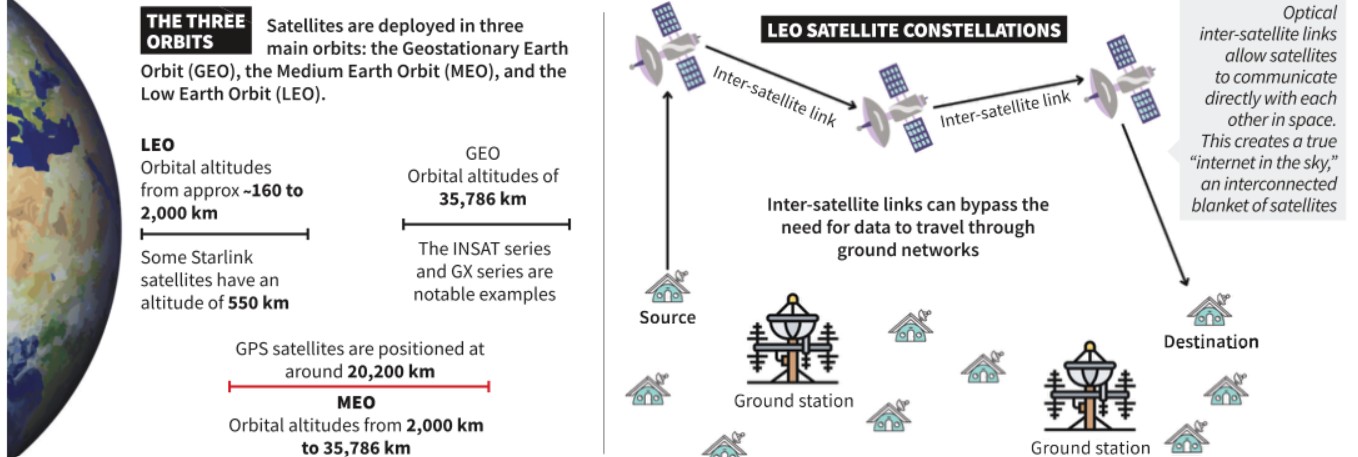
    1. Mega-Constellations: Networks like Starlink have thousands of satellites in Low Earth Orbit (LEO)
    2. Disaster Response Role: Viasat aided Hurricane Harvey operations when 70% of cell towers failed.
    3. Defence Integration: Ukrainian drones fitted with Starlink to bypass Russian jamming; Indian Army use in high-altitude conflict zones
    4. Security Concerns: Smuggled Starlink devices used by insurgent groups and drug cartels

    Working of satellite internet:

    1. Two Segments: Space segment (satellites) and ground segment (user terminals, gateways).
    2. Service Life: Satellites operate for 5–20 years depending on design.
    3. Orbits:
      1. GEO (35,786 km): Wide coverage, high latency; unsuitable for real-time apps. Example: Viasat GX.
      2. MEO (2,000–35,786 km): Medium latency, requires constellations. Example: O3b.
      3. LEO (<2,000 km): Low latency, small coverage; requires mega-constellations. Example: Starlink’s 7,000+ satellites.

    Key Differences between satellites in GEO, MEO AND LEO:

    Feature Geostationary Earth Orbit (GEO) Medium Earth Orbit (MEO) Low Earth Orbit (LEO)
    Altitude 35,786 km above equator 2,000 – 35,786 km Below 2,000 km
    Relative Motion Stationary relative to a point on Earth Moves relative to Earth Moves quickly relative to Earth
    Coverage ~1/3 of Earth (no polar coverage) Larger than LEO, smaller than GEO; needs constellation for global coverage Small footprint; single satellite covers area like an Indian metro city
    Satellite Size Large Large Smaller, often table-sized
    Cost & Deployment Expensive, long deployment Expensive, smaller constellations Cheaper, quicker to deploy
    Latency High (unsuitable for time-sensitive apps) Medium (lower than GEO but still limits real-time use) Very low (good for real-time use)
    Example Viasat Global Xpress (GX) O3b constellation (20 satellites) Starlink (7,000+ satellites, aiming for 42,000)
    Key Drawback High delay due to distance Still costly, latency not ideal for all uses Needs thousands of satellites for global coverage

    How do LEO mega-constellations maintain connectivity?

    1. On-Board Processing: Improves efficiency and reduces terminal complexity
    2. Optical Inter-Satellite Links: Satellites communicate directly in space for faster routing
    3. Seamless Handoff: Steerable antennas track multiple satellites to maintain uninterrupted service

    What are the key applications of satellite internet?

    1. Civil Connectivity: Rural broadband, IoE (Internet of Everything)
    2. Transportation: Navigation, self-driving cars, logistics optimisation
    3. Public Administration: Smart cities, disaster warnings, rescue coordination
    4. Healthcare: Telemedicine, remote diagnostics
    5. Agriculture: Precision farming, crop health monitoring
    6. Defence & Security: Real-time communication in conflict zones, strategic surveillance

    Conclusion

    Satellite internet represents not just a technological upgrade but a strategic asset in the digital era. For India, it offers a pathway to bridge the digital divide, enhance national resilience, and project influence in the global communications domain. However, its dual-use nature demands strong regulatory frameworks to balance innovation, accessibility, and security.

    Value Addition

    Key Terms & Phrases Explained

    • Satellite Internet: A communication service where internet connectivity is provided through satellites orbiting the Earth, rather than terrestrial cables/towers. It enables access in remote, disaster-hit, or mobile scenarios.
    • Mega-Constellation: A large network of hundreds or thousands of satellites, often in Low Earth Orbit (LEO), working in coordination to provide continuous coverage. Example: Starlink (planned 42,000 satellites).
    • Latency: Time taken for a signal to travel from sender to receiver; critical for real-time applications like video conferencing or online gaming.
    • Optical Inter-Satellite Links (OISL): Laser-based connections between satellites, enabling direct space-to-space data transfer without routing through ground stations, reducing delays and congestion.
    • Dual-Use Technology: A technology with both civilian and military applications. In satellite internet, the same network can support remote learning and healthcare or battlefield communication and drone operations.
    • Digital Divide: The socio-economic gap between those with access to modern digital technologies (internet, computing) and those without.
    • International Telecommunication Union (ITU): A UN agency responsible for coordinating global telecom networks, including orbital slot and spectrum allocation for satellites.
    • On-Board Processing: Satellite’s ability to process data directly in orbit, improving signal quality, speed, and reducing complexity of user terminals.
    • Seamless Handoff: Automatic switching of user connection from one satellite to another as satellites move, ensuring uninterrupted service.
    • Internet of Everything (IoE): An extension of IoT where not only devices, but also data, processes, and people are interconnected via the internet.

    Mapping  Micro Themes

    Paper Macro Theme Micro Themes Sub-Micro / Example
    GS Paper III Types of Orbits GEO (Geostationary) INSAT series, GSAT satellites
    MEO (Medium Earth Orbit) O3b constellation for broadband
    LEO (Low Earth Orbit) Starlink, OneWeb
    GS Paper III Application in Navigation GNSS Variants GPS (USA), GLONASS (Russia), Galileo (EU), IRNSS/NavIC (India)
    LEO & MEO in Navigation Faster signals, better coverage
    GS Paper II Policy & Governance India’s Space Policy 2023 PPP in satellite communication
    International Coordination ITU spectrum allocation

    Practice Mains Question:

    Discuss the potential of satellite internet in bridging the digital divide in India. Examine the associated security and regulatory challenges.

    PYQ Linkage:

    [UPSC 2018] Why is the Indian Regional Navigational Satellite System [IRNSS] needed? How does it help in navigation? 

    Linkage: IRNSS (also called NavIC) is India’s indigenous satellite-based navigation system providing accurate position information over India and surrounding regions.

    Just like IRNSS uses satellites for positioning, satellite internet uses similar orbital infrastructure for data connectivity. Understanding satellite orbits, latency, and ground segments from this topic directly aids in explaining IRNSS’s working, advantages, and strategic value in navigation.


  • Labour, Jobs and Employment – Harmonization of labour laws, gender gap, unemployment, etc.

    Debunking the myth of job creation

    Why in the News?

    The government has recently approved the Employment Linked Incentive (ELI) Scheme as one of the largest fiscal commitments towards employment generation in recent years. The scale of underemployment in India is striking, over 53% of graduates are working in semi-skilled jobs and 46% of low-skill workers earn less than ₹1 lakh a year raising questions about whether such a scheme can genuinely address unemployment or will deepen structural inequalities.

    Significance of ELI Scheme:

    1. Government Approval: Cleared on July 1, 2025, with ₹99,446 crore outlay.
    2. Primary Aim: Provide fiscal incentives to employers for job creation, especially in manufacturing.
    3. Significance: Represents one of the largest government-led employment incentive packages in India.

    Issues with the ELI Scheme’s design:

    1. Employer-Centric Approach: Focuses on incentivising employers rather than directly empowering workers.
    2. Capital-Labour Asymmetry: Risks strengthening employer bargaining power while leaving workers vulnerable.
    3. Exclusion of Informal Sector: 90% of India’s workforce, largely informal, is excluded as the scheme prioritises EPFO-registered firms.
    4. Underprepared Workforce: Only 4.9% of youth have received formal vocational training, creating a mismatch between jobs and skills.

    Skill Mismatch and Underemployment Trends in India:

    1. Low Skill Utilisation: Only 8.25% of graduates work in jobs matching their qualifications.
    2. High Underemployment: 53% of graduates and 36% of postgraduates in semi-skilled or elementary roles.
    3. Wage Disparity: 46% of low-skilled workers earn < ₹1 lakh/year, while only 4.2% of specialised graduates earn ₹4–8 lakh/year.
    4. Inefficient Education-to-Employment Pipeline: Shows systemic disconnect between education system and industry needs.

    Sectoral Imbalance and Employment Implications:

    1. Manufacturing Bias: Targets manufacturing despite its declining employment elasticity.
    2. Employment Share: Manufacturing employs <13% of total workforce, while agriculture and services employ ~70%.
    3. Potential Marginalisation: Rural youth, women, and informal workers, largely in low-skill services/agriculture, risk being left out.
    4. Automation Pressure: Capital-intensive manufacturing growth reduces labour absorption.

    Risks to Job Quality and Employment Sustainability:

    1. Disguised Unemployment: May encourage enterprises to relabel old jobs as new to claim subsidies.
    2. Structural Inequality: Channels fiscal benefits to already formalised enterprises.
    3. Bypassing Informal Workforce: Misses the majority of new labour market entrants in the informal sector.
    4. Stagnant Productivity: Without skill investment, job creation may remain low-quality.

    Policy Alternatives for Equitable Employment Generation:

    1. Investment in Skilling: Strengthen vocational training to prepare low-skilled workers
    2. Education Reforms: Align curricula with industry demands
    3. Social Security Inclusion: Extend benefits to informal workers for equity
    4. Shift to Long-Term Strategy: Focus on productivity, job quality, and labour rights rather than short-term headcount increases.

    Conclusion

    The ELI Scheme reflects a high-investment, employer-focused strategy that risks deepening existing inequalities in India’s labour market. Without addressing the skill mismatch, informal sector exclusion, and sectoral imbalances, the scheme may generate headcount without creating sustainable livelihoods. A shift towards worker-centric, skill-driven, and socially inclusive employment policies is essential to ensure equitable economic growth.

    Value Addition

    Economic Survey 2024–25

    • Key Insight: Reveals that only 8.25% of graduates are in jobs matching their qualifications, with 53% of graduates underemployed in semi-skilled or elementary roles.
    • Relevance: Strengthens arguments on the education–employment disconnect and the urgent need for targeted skilling reforms.
    • Application: Can be quoted in answers on unemployment, skill development, or human capital formation.

    Dual Labour Market Theory

    • Concept: The labour market is split into two segments, formal (primary) with stable jobs, better wages, and benefits; and informal (secondary) with insecure, low-paid work and no social protection.
    • Relevance to ELI Scheme: The scheme’s EPFO-based targeting inherently supports the formal sector while neglecting the 90% informal workforce, deepening this divide.
    • Application: Useful in analysing structural inequality in employment policies.

    Employment Elasticity

    • Definition: The responsiveness of employment growth to GDP growth.
    • India’s Case: Manufacturing’s employment elasticity is declining due to automation and capital-intensive processes.
    • Relevance to ELI Scheme: Explains why heavy focus on manufacturing may not yield proportional employment gains.
    • Application: Adds depth when evaluating sectoral choices in employment policy.

    ILO’s “Decent Work” Agenda

    • Framework: Promotes productive employment, rights at work, social protection, and social dialogue.
    • Relevance: The ELI Scheme lacks strong components on worker rights, social protection for informal workers, or job quality improvement — thereby falling short of ILO’s standards.
    • Application: Ideal for international comparison in labour policy answers.

    Disguised Unemployment

    • Definition: A situation where more workers are employed than necessary, resulting in negligible or zero marginal productivity.
    • Indian Context: Common in agriculture and informal services.
    • Relevance to ELI Scheme: Risk of enterprises relabeling existing jobs as new to claim subsidies, creating apparent employment without productivity gains.
    • Application: Can be linked to inefficiencies in job creation schemes and low productivity traps.

    Mapping Microthemes:

    GS Paper Theme Micro Theme Example from Article
    GS Paper III Economy Employment generation policies ₹99,446 crore ELI Scheme
    GS Paper III Economy Formal–informal sector divide 90% informal workforce excluded
    GS Paper III Economy Skill mismatch & underemployment 8.25% graduates in matching jobs
    GS Paper III Economy Sectoral imbalance Manufacturing bias despite low share in jobs
    GS Paper II Governance Policy design flaws Employer-centric incentives

    Practice Mains Question

    1. Critically evaluate the Employment Linked Incentive (ELI) Scheme in the context of India’s structural labour market challenges. Suggest policy measures to ensure equitable and sustainable employment growth. (250 words)

    PYQ Linkage:

    [UPSC 2014] “While we flaunt India’s demographic dividend, we ignore the dropping rates of employability.” What are we missing while doing so? Where will the jobs that India desperately needs come from? Explain.

    Linkage: Address the role of skilling in tackling unemployment, evaluate gaps in current initiatives, and connect with how ELI Scheme mirrors or misses these elements. The PMKVY question emphasises the necessity of industry-relevant skills for employment generation. The ELI Scheme, while aiming at job creation, lacks a robust skilling component, risking the same shortcomings seen in earlier programmes like PMKVY.


  • Judicial Reforms

    Removal of High Court Judges

    Why in the News?

    Lok Sabha Speaker has initiated removal proceedings against a Judge of the Allahabad High Court by admitting a motion signed by 146 members and forming a three-member inquiry committee.

    About Appointment of High Court Judges:

    • Constitutional Basis: Article 217 of the Constitution of India.
    • Appointing Authority: President of India, in consultation with the Chief Justice of India (CJI), Governor of the concerned State, and Chief Justice of the concerned High Court.
    • Collegium System: The proposal is initiated by the High Court’s Chief Justice, forwarded through the Chief Minister and Governor, and decided by the CJI along with the two senior-most judges of the Supreme Court.
    • Chief Justice Posting Policy: Chief Justices are appointed from outside the State to ensure impartiality.
    • Transfers: The CJI and senior-most judges of the Supreme Court decide transfers to maintain judicial independence.

    Removal Process:

    • Grounds: Proved misbehaviour or incapacity.
    • Procedure: Impeachment process under Articles 124(4) and 217, and Section 3(2) of the Judges (Inquiry) Act, 1968.
    • Initiation: Motion signed by at least 100 Lok Sabha MPs or 50 Rajya Sabha MPs.
    • Inquiry: 3-member committee comprising a Supreme Court judge, a Chief Justice of a High Court, and a distinguished jurist investigates the charges.
    • Voting Requirement: Two-thirds majority in both Houses of Parliament for removal.
    • In-House Mechanism: CJI can initiate internal inquiries and advise resignation in serious cases.

    Other Notable Cases:

    • Justice V. Ramaswami (1993): Faced impeachment for financial misconduct; motion failed in Lok Sabha.
    • Justice Soumitra Sen (2011): Resigned after Rajya Sabha voted for removal over fund misappropriation.
    • Justice K. Veeraswamy: Corruption case remained unresolved until his death.
    • Justice Shamit Mukherjee (2003), Justice Nirmal Yadav (2008), Justice S.N. Shukla (2017): Faced criminal charges for corruption after in-house inquiries.
    [UPSC 2007] Consider the following statements:

    1. The mode of removal of a Judge of a High Court in India is the same as that of the removal of a Judge of the Supreme Court.

    2. After retirement from office, a permanent Judge of a High Court cannot plead or act in any court or before any authority in India.

    Which of the statements given above is/are correct?

    Options: (a) 1 only * (b) 2 only (c) Both 1 and 2 (d) Neither 1 nor 2


  • Jallikattu Debate

    Dhiri Bull Fighting Festival of Goa

    Why in the News?

    Many legislators of the Goa Assembly across party lines demanded the legalisation of Dhiri Bull Fighting in Goa.

    About Dhiri Bull Fighting:

    • Overview: Goan sport where two bulls lock horns in paddy fields or grounds.
    • Cultural Link: Associated with post-harvest feasts and church celebrations.
    • Nature of Contest: Bulls push until one retreats; no matadors or killing involved.
    • Event: Bulls given unique names, treated like local icons.
    • Betting: High-stakes wagers involve locals and Goan diaspora.

    Recent Controversy:

    • Legal Ban: Banned in 1997 under Prevention of Cruelty to Animals Act after a fatality.
    • Judicial Position: Supreme Court upheld the ban; events continue secretly.
    • Political Push: Lawmakers (2024–25) seek legalisation for cultural/tourism value.
    • Proposed Model: Advocates want regulated events, citing Jallikattu’s example.
  • Health Sector – UHC, National Health Policy, Family Planning, Health Insurance, etc.

    [pib] State Health Regulatory Excellence Index (SHRESTH)

    Why in the News?

    The Union Health Ministry has launched the State Health Regulatory Excellence Index (SHRESTH), a first-of-its-kind national framework to benchmark and strengthen state drug regulatory systems.

    About State Health Regulatory Excellence Index (SHRESTH):

    • Purpose: National initiative by Union Health Ministry to benchmark and strengthen state drug regulatory systems.
    • Developer: Designed by Central Drugs Standard Control Organization (CDSCO).
    • Objective:  To benchmark and improve the performance of state-level drug regulatory authorities across India through a transparent, data-driven framework.
    • Method: Uses a transparent, data-driven framework and acts as a virtual gap assessment tool for maturity certification.

    Key Features:

    • State Categories: Manufacturing states assessed on 27 indices; distribution-focused states/UTs assessed on 23 indices.
    • Evaluation Themes: Human resources, infrastructure, licensing, surveillance, and responsiveness.
    • Data Submission: Monthly metric data submitted by the 25th; scores shared on the 1st of the next month.
    • Performance Benchmarking: Rankings encourage cross-learning and adoption of best practices.
    • Capacity Building: Workshops, joint trainings, and regulatory audits to strengthen state systems.
    • Digital Integration: Dashboards like Not of Standard Quality (NSQ) for real-time monitoring.
    • Global Standards: Supports India’s goal to meet WHO-equivalent medicine quality norms, building on WHO Maturity Level-3 vaccine status.
    [UPSC 2023] Consider the following statements:

    Statement-I: India’s public sector health care system largely focuses on curative care with limited preventive, promotive and rehabiliative care.

    Statement-II: Under India’s decentralized approach to health care delivery, the States are primarily responsible for organizing health services.

    Which one of the following is correct in respect of the above statements?

    Options: (a) Both Statement-I and Statement-II are correct and Statement-II is the correct explanation for Statement-I

    (b) Both Statement-I and Statement-II are correct and Statement-II is not the correct explanation for Statement-I *

    (c) Statement-I is correct but Statement-II is incorrect

    (d) Statement-I is incorrect but Statement-II is correct


Join the Community

Join us across Social Media platforms.