💥UPSC 2027,2028 Mentorship (April Batch) + Access XFactor Notes & Microthemes PDF

Archives: News

  • BRICS Summits

    BRICS inducts 6 new members to become BRICS Plus

    brics plus

    Central Idea

    • The BRICS alliance, consisting of Brazil, Russia, India, China, and South Africa, has extended invitations to six additional countries, namely Iran, the United Arab Emirates, Saudi Arabia, Argentina, Egypt, and Ethiopia.
    • This move aims to bolster the collective voice of the Global South and foster multipolarity in the international arena.

    Why discuss this?

    • As BRICS broadens its membership, it strengthens its claim to represent nearly half the world’s population and includes key oil-producing nations.
    • However, concerns also arise regarding China’s increasing influence within the alliance.

    BRICS Plus: Emerging Role

    • Heft and Influence: The inclusion of new members enhances BRICS’s position as a spokesperson for the developing world. The alliance currently represents 40% of the global population and over a quarter of the world’s GDP. With the addition of new members, it will encompass almost half the world’s population and include major oil-producing nations.
    • Global Solidarity: BRICS’s growth is driven by anti-US sentiment and a desire for multipolarity among countries in the Global South. It serves as a platform where nations can express solidarity and challenge Western-dominated narratives.

    BRICS: Evolution and Geopolitical Context

    • Emergence of BRICS: Established in 2009, BRICS initially comprised Brazil, Russia, India, and China, with South Africa joining in 2011. The alliance aimed to showcase the economic potential of these emerging markets.
    • Challenges and Opportunities: While BRICS’s economic performance has varied, geopolitical shifts like the Ukraine conflict have propelled it into a bloc with the potential to challenge Western influence and provide an alternative viewpoint.

    Dynamics of New BRICS Members

    • Unanimous Decisions: BRICS decisions require unanimous agreement from all members. While Russia and China face geopolitical challenges with the West, Brazil, South Africa, and India maintain significant partnerships with the US and Europe.
    • China’s Role: China is driving BRICS’s expansion, making membership expansion a core agenda item.
    • Inclusion of Iran: China and Russia’s influence is evident in the inclusion of Iran, highlighting their collaboration. This move brings together regional rivals Saudi Arabia and Iran within the same alliance, reflecting China’s mediation efforts.
    • Saudi Arabia’s Shift: Saudi Arabia’s inclusion marks its pursuit of a more independent foreign policy, diverging from its traditional US alliance.
    • Global Significance for Iran and Russia: For Iran and Russia, BRICS membership signifies their global partnerships and challenges to Western dominance.

    Implications for India

    • Balancing Act: India’s participation in the G7 summit and Quad summit reflects its multifaceted foreign policy approach. While engaging with Western alliances, India also places importance on its “anti-Western” stance within BRICS.
    • BRICS as a Non-Western Bloc: India views BRICS as a “non-Western” group and strives to maintain its independent voice within the alliance.
    • Concerns for India: Amid expansion, there are concerns that BRICS could tilt more toward China, potentially side-lining India’s interests.

    Conclusion

    • BRICS’s expansion signifies a step toward global multipolarity, providing a platform for diverse countries to unite against Western-centric narratives.
    • As the alliance grows, it gains greater representation and influence, strengthening the collective voice of the Global South.
    • However, with China’s increased influence, there are also legitimate concerns about the balance of power within BRICS and its impact on individual member states.

  • ISRO Missions and Discoveries

    K Kasturirangan explains: Chandrayaan-3 and India’s Evolving Space Ambitions

    Central Idea

    • The successful Chandrayaan-3 mission not only marks a significant achievement for India’s space program but also signifies the nation’s attainment of a pivotal capability: direct physical access to another celestial body.
    • This accomplishment propels India into an elite group of spacefaring nations and affords participation in shaping future planetary exploration endeavors and resource extraction from space.

    Who is Dr. K. Kasturirangan?

    • Dr. K. Kasturirangan is a prominent Indian space scientist and engineer.
    • He led ISRO as Chairman from 1994 to 2003, overseeing achievements like PSLV launches and Chandrayaan-1.
    • Chandrayaan-1, under his leadership, discovered water molecules on the Moon.
    • He’s been active in promoting science education and enhancing research quality.
    • Dr. Kasturirangan chaired the committee behind India’s NEP 2020, focusing on holistic education.
    • His accolades include Padma Shri and Padma Bhushan awards.
    • He’s been involved in international collaborations and represented India globally.
    • Besides leadership, he’s made academic contributions in space and atmospheric sciences.
    • His influence spans various positions in scientific and academic institutions.

    India’s Integration into Planetary Exploration and Decision-Making

    • Access to Celestial Bodies: Chandrayaan-3 provides India with a tangible gateway to planetary bodies, elevating its status in space exploration.
    • Frontiers of Technology: India’s pioneering capabilities place it at the forefront of space technology, enabling participation in shaping future planetary explorations and resource extraction policies.
    • A Seat at the Table: India’s involvement in this realm positions it naturally within the club of nations that influence and formulate space-related policies, ending a history of exclusion.

    Now, India’s stature in Global Space Dynamics

    • Historical Context: India’s past exclusion from technological clubs has driven its pursuit of self-reliance and global influence, transforming from a dependent to a self-sufficient nation.
    • Space Diplomacy: Space capabilities will play a pivotal role in shaping global equations in the 21st century, and India’s active participation will bolster its international standing.
    • Equitable Contributions: Chandrayaan-3 bolsters India’s potential to play a decisive role in space-related international decision-making, strengthening its voice on equal terms.

    Chandrayaan-3’s Significance for ISRO

    • Planetary Exploration Strategy: Chandrayaan-3 showcases ISRO’s comprehensive planetary exploration capabilities, encompassing satellite deployment, lunar orbits, surface study, and landing.
    • Direct Lunar Access: The mission grants India direct physical access to the Moon, offering new avenues for lunar exploration and resource utilization.
    • Kasturirangan’s Vision: The vision of Dr. K. Kasturirangan, former ISRO chairman, harmonizes with Sarabhai’s principles, building upon a foundation of technological self-sufficiency.
    • Progressive Continuation: ISRO’s pursuits of planetary exploration and Chandrayaan missions align with the trajectory Kasturirangan initiated, enhancing the nation’s profile on the global stage.

    Completing the Transformation: From Development to Exploration

    • Sequential Alignment: ISRO’s evolution from developmental needs to commercial launches and now to scientific and planetary exploration reflects its responsiveness to India’s evolving requirements.
    • Government Support: ISRO’s consistent success has been underpinned by unwavering government backing, which has enabled the organization to expand its horizons.
    • Strategic Role: Space technology’s growing influence necessitates robust capabilities, and ISRO’s achievements foster meaningful international partnerships, enhancing India’s global prestige.

    Conclusion

    • Chandrayaan-3 is more than a singular event; it signifies India’s ascendancy as a formidable force in space exploration.
    • As the nation transitions from a developing to a developed status, its capabilities to explore, innovate, and collaborate extend far beyond Earth’s boundaries.
    • Chandrayaan-3’s impact extends beyond the Moon’s surface, fostering diplomatic connections, winning allies, and amplifying India’s influence on the global stage under the visionary guidance of Dr. K. Kasturirangan.
  • Needed, a well-crafted social security net for all

    What’s the news?

    • Over half of India’s salaried workforce lacks social security benefits, revealing stark inequality and a deficient system ranked poorly internationally, prompting calls for urgent reforms to ensure equitable coverage and protection for all segments of the workforce.

    Central idea

    • Recent statistics from the Periodic Labour Force Survey Annual Report 2021–22 highlight a grim reality: approximately 53% of India’s salaried workforce lacks access to social security benefits, including provident funds, pensions, health care, and disability insurance. This dire situation extends to the informal sector, where around 91% of the workforce operates without social security. Meanwhile, India’s social security system ranks dismally low, according to Mercer CFS.

    Plight of gig workers and the informal sector

    • Gig Workers: Approximately 1.3% of India’s active labor force comprises gig workers, yet they rarely have access to any form of social security benefit. This absence of coverage leaves them without essential protections such as provident funds, pensions, health care, and disability insurance.
    • Informal Sector: A staggering 91% of India’s workforce operates within the informal sector, where access to social security remains severely limited. This lack of coverage extends to essentials like provident funds, pensions, health care, and disability insurance, contributing to a vulnerable and marginalized workforce.

    Failures within existing social security schemes

    • Underutilization of Funds: The National Social Assistance Programme, which aimed to support elderly individuals without able-bodied earners, suffered from stagnant contributions and poor funding allocation. The Center’s contribution to old-age pension schemes remained below minimum wage levels.
    • Mismanagement of Funds: Instances of mismanagement are evident in various schemes. The CAG audit revealed that the National Social Security Fund had accumulated Rs. 1,927 crore since its inception, yet the entire amount remained unutilized. Similarly, funds collected for the social security of construction workers in Delhi were poorly utilized, with a significant portion going unspent.
    • Beneficiary Mismanagement: The CAG identified instances of funds being transferred to deceased beneficiaries, indicating flaws in the implementation of social security schemes.

    Lessons from Brazil’s General Social Security Scheme

    • Comprehensive Coverage: Brazil’s General Social Security Scheme offers a contribution-based approach that covers a wide range of situations, including accidents, disabilities, illness, family burdens, and even unemployment. This comprehensive coverage provides income support for workers and their families in various circumstances.
    • Government Backing: Brazil’s scheme is designed with provisions for government intervention. In cases where funds are lacking, the National Treasury steps in to ensure that social security benefits are sustained, providing a safety net for workers.
    • Ease of Access: The scheme in Brazil allows easy access to social security benefits through simple processes such as phone calls or bank visits. This user-friendly approach reduces bureaucratic hurdles for beneficiaries.
    • Inclusivity: The Brazilian scheme extends its coverage to even low-income insured individuals who face incarceration. This inclusive approach ensures that marginalized groups are not left without support.

    The Way Forward: Urgent reforms are needed

    • Addressing India’s social security crisis necessitates immediate and strategic reforms. Three fundamental principles guide this transformation:
    • Expanded Contribution: Enhancing contributions under the Employees’ Provident Fund Organization (EPFO) system for formal workers, coupled with partial contributions from informal workers with meaningful income, could lay the foundation for a more inclusive system.
    • Government Intervention: The government must intervene to support those who are unemployed or earning insufficiently. Providing social protection to the poorest 20% of the workforce, including elderly, pregnant, and disabled individuals, could amount to approximately ₹1.37 trillion, or approximately 0.69% of GDP in FY20.
    • Streamlined Framework: Reforms should streamline and simplify existing schemes, ensuring coverage of all sectors. Establishing a pan-India labor force card and extending successful schemes like the Building and Other Construction Workers Schemes could substantially improve coverage.

    Conclusion

    • As India transitions towards an aging society, ensuring social security for all workers becomes paramount. The focus must shift from rhetoric to tangible actions. Reforming social security will not only provide a safety net for workers but also contribute to equitable growth. By embracing comprehensive and inclusive policies, India can propel itself towards a more secure and prosperous future.


  • Artificial Intelligence (AI) Breakthrough

    Can AI be ethical and moral?

    What’s the news?

    • In an era where machines and artificial intelligence (AI) are progressively aiding human decision-making, particularly within governance, ethical considerations are at the forefront.

    Central idea

    • Countries worldwide are introducing AI regulations as government bodies and policymakers leverage AI-powered tools to analyze complex patterns, predict future scenarios, and provide informed recommendations. However, the seamless integration of AI into decision-making is complicated by biases inherent in AI systems, reflecting the biases in their training data or the perspectives of their developers.

    Advantages of integrating AI into governance

    • Enhanced Decision-Making: AI assists in governance decisions by providing advanced data analysis, enabling policymakers to make informed choices based on data-driven insights.
    • Data Analysis and Pattern Recognition: AI’s capability to analyze complex patterns in large datasets helps government agencies understand trends and issues critical to effective governance.
    • Future Scenario Prediction: Predictive analytics powered by AI enable governments to anticipate future scenarios, allowing for proactive policy planning and resource allocation.
    • Efficiency and Automation: Integrating AI streamlines tasks, improving operational efficiency within government agencies through automation and optimized resource allocation.
    • Regulatory Compliance: AI’s data analysis assists in monitoring regulatory compliance by identifying potential violations and deviations from regulations.
    • Policy Planning and Implementation: AI’s predictive capabilities aid in effective policy planning and the assessment of potential policy impacts before implementation.
    • Resource Allocation: AI’s data-driven insights help governments allocate resources more effectively, optimizing limited resources for public services and initiatives.
    • Streamlined Citizen Services: AI-driven automation enhances citizen services by providing quick responses to queries through chatbots and automated systems.
    • Cost Reduction: Automation and efficient resource allocation through AI lead to cost reductions in government operations and services.
    • Complexity Handling: AI’s capacity to manage complex data aids governments in addressing intricate challenges like urban planning and disaster management.

    The ethical challenges related to the integration of AI into governance

    • Bias in AI: The biases inherent in AI systems, often originating from the data they are trained on or the perspectives of their developers, can lead to skewed or unjust outcomes. This poses a significant challenge in ensuring fair and unbiased decision-making in governance processes.
    • Challenges in Encoding Ethics: The article highlights the challenges of encoding complex human ethical considerations into algorithmic rules for AI. This difficulty is exemplified by the parallels drawn with Isaac Asimov’s ‘Three Laws of Robotics,’ which often led to unexpected and paradoxical outcomes in his fictional world.
    • Accountability and Moral Responsibility: Delegating decision-making from humans to AI systems raises questions about accountability and moral responsibility. If AI-generated decisions lead to immoral or unethical outcomes, it becomes challenging to attribute accountability to either the AI system itself or its developers.
    • Creating Ethical AI Agents: The creation of artificial moral agents (AMAs) capable of making ethical decisions raises technological and ethical challenges. AI systems are still far from replacing human judgment in complex, unpredictable, or unclear ethical scenarios.
    • Bounded Ethicality: The concept of bounded ethicality highlights that AI systems, similar to humans, might engage in immoral behavior if ethical principles are detached from actions. This concept challenges the assumption that AI has inherent ethical decision-making capabilities.
    • Lack of Ethical Experience in AI: The difficulty in attributing accountability to AI systems lies in their lack of human-like experiences, such as suffering or guilt. Punishing AI systems for their decisions becomes problematic due to their limited cognitive capacity.
    • Complexity of Ethical Programming: James Moore’s analogy about the complexity of programming ethics into machines emphasizes that ethics operates in a complex domain with ill-defined legal moves. This complexity adds to the challenge of ensuring ethical behavior in AI systems.

    Ethical Challenges: A Kantian Perspective

    • Kantian Ethical Framework: Kantian ethics, emphasizing autonomy, rationality, and moral duty, serves as a foundational viewpoint for assessing ethical challenges in the context of AI integration.
    • Threat to Moral Reasoning: Applying AI to governance decisions could jeopardize the exercise of moral reasoning that has traditionally been carried out by humans, as posited by Kant’s philosophy.
    • Delegation and Moral Responsibility: Kantian ethics underscores individual moral responsibility. However, entrusting decisions to AI systems raises concerns about abdicating this responsibility, a point central to Kant’s moral theory.
    • Parallels to Asimov’s Laws: The comparison with Isaac Asimov’s ‘Three Laws of Robotics’ highlights the unforeseen and paradoxical outcomes that can arise when attempting to encode ethics into machines, similar to the challenges posed by AI’s integration into decision-making.
    • Complexity in Ethical Agency: The juxtaposition of Kant’s emphasis on rational moral agency and Asimov’s exploration of coded ethics reveals the intricate ethical challenges entailed in transferring human moral functions to AI entities.

    Categories of machine agents based on their ethical involvement and capabilities

    • Ethical Impact Agents: These machines don’t make ethical decisions but have actions that result in ethical consequences. An example is robot jockeys that alter the dynamics of a sport, leading to ethical considerations.
    • Implicit Ethical Agents: Machines in this category follow embedded safety or ethical guidelines. They operate based on predefined rules without actively engaging in ethical decision-making. For instance, a safe autopilot system in planes adheres to specific rules without actively determining ethical implications.
    • Explicit Ethical Agents: Machines in this category surpass preset rules. They utilize formal methods to assess the ethical value of different options. For instance, systems balancing financial investments with social responsibility exemplify explicit ethical agents.
    • Full Ethical Agents: These machines possess the capability to make and justify ethical judgments, akin to adult humans. They hold an advanced understanding of ethics, allowing them to provide reasonable explanations for their ethical choices.

    Way forward

    • Ethical Parameters: Establish comprehensive ethical guidelines and principles that AI systems must follow, ensuring ethical considerations are embedded in decision-making processes.
    • Bias Mitigation: Prioritize data diversity and implement techniques to mitigate biases in AI algorithms, aiming for fair and unbiased decision outcomes.
    • Transparency Measures: Develop transparent AI systems with explainability features, allowing policymakers and citizens to understand the basis of decisions.
    • Human Oversight: Maintain human oversight in critical decision-making processes involving AI, ensuring accountability and responsible outcomes.
    • Regulatory Frameworks: Formulate adaptive regulatory frameworks that address the unique challenges posed by AI integration into governance, including accountability and transparency.
    • Capacity Building: Provide training programs for government officials to effectively manage, interpret, and collaborate with AI systems in decision-making.
    • Interdisciplinary Collaboration: Foster collaboration between AI experts, ethicists, policymakers, and legal professionals to create a holistic approach to AI integration.
    • Human-AI Synergy: Promote AI as a tool to enhance human decision-making, focusing on collaboration that harnesses AI’s strengths while retaining human judgment.
    • Testbed Initiatives: Launch controlled pilot projects to test AI systems in specific governance contexts, learning from real-world experiences.

    Conclusion

    • The integration of AI into governance decision-making holds both promise and perils. As governments gradually delegate decision-making to AI systems, they must grapple with questions of responsibility and ensure that ethics remain at the core of these advancements. Balancing the potential benefits of AI with ethical considerations is crucial to shaping a responsible and equitable AI-powered governance landscape.
  • Medical Education Governance in India

    Issues facing Medical Colleges in India

    What’s the news?

    • In Kerala, a case of medical negligence involving a forgotten surgical instrument inside a patient and increasing vacancies in dental courses across the nation’s colleges spotlight the efficacy and responsibilities of medical institutions in India’s healthcare system.

    Central idea

    • The rising incidents of medical negligence in leading Indian medical colleges and the Union Government’s 2019 Policy Proposal, which aims to convert district hospitals into medical colleges and establish AIIMS-like institutions in every state, prompt a revaluation of medical colleges’ contribution to patient care from a public health perspective.

    The government’s proposal

    • Conversion of District Hospitals: The government aims to convert district hospitals across the country into medical colleges. District hospitals are typically considered to be at a secondary level of healthcare, and this policy suggests upgrading them to medical colleges, which are institutions for medical education and training.
    • Establishment of AIIMS-like Institutions: The government also intends to establish institutions similar to the AIIMS in every state. AIIMS is renowned for providing advanced healthcare services, medical education, and research. The objective is to replicate AIIMS-like facilities in each state to enhance medical infrastructure and education.

    Purpose of a medical college

    • Educational Role:
    • The foremost purpose of a medical college is to provide education and training to students aspiring to become medical professionals.
    • This involves imparting the theoretical knowledge, practical skills, and clinical experiences necessary for students to become competent healthcare practitioners.
    • Medical Care:
    • A secondary purpose of a medical college is to offer medical care. This is facilitated through the associated medical college hospital, which is equipped with state-of-the-art facilities.
    • The hospital serves as a platform for the practical training and apprenticeship (internship) of medical students.
    • It provides bedside care, an essential requirement for medical training, and contributes to the development of clinical skills.

    Myths related to medical colleges

    • Myth of Comprehensive Healthcare: There’s a misconception that having a medical college in a district can address all healthcare needs, which can lead to an overestimation of the capabilities of medical colleges.
    • Myth of Increased Medical Seats: Establishing a medical college is often associated with the belief that it will increase the availability of medical seats for local students, creating a false hope for aspiring medical professionals.
    • Myth of Quantity Over Quality: There’s a misconception that producing more medical professionals will automatically resolve issues related to inadequate healthcare access, overlooking the importance of quality healthcare provision.
    • The Myth of Tertiary Care Solving All Issues: The belief that tertiary care services offered by medical colleges can cater to all healthcare needs may undermine the significance of strengthening primary and secondary care services.
    • The Myth of Medical Colleges as Ideal Solutions: The notion that medical colleges are the ultimate solution to healthcare challenges might oversimplify the complexities of healthcare delivery, particularly in areas where secondary-level care can have a significant impact.

    Back to basics

    • Primary Care: The initial level of healthcare involving routine check-ups, preventive services (vaccinations, screenings), and managing common illnesses to maintain general health and well-being.
    • Secondary Care: Specialized medical care that follows primary care, encompassing consultations, diagnostics (like MRI, CT scans), minor surgeries, and treatments for specific health conditions.
    • Tertiary Care: The highest level of specialized medical attention, involving complex surgeries (e.g., organ transplants), advanced treatments (such as cancer therapies), critical care in intensive care units (ICUs), and management of rare and intricate medical disorders.

    Challenges faced by medical colleges in healthcare delivery

    • Patient Overload: Higher-level medical facilities, including medical colleges, experience a heavy influx of patients seeking primary and secondary care, leading to patient overcrowding.
    • Mismanagement of Cases: A significant majority (over 80%) of cases treated in medical colleges are inappropriate for specialized tertiary care, suggesting a mismatch between patient needs and provided services.
    • Deficient Referral System: The absence of an effective referral system in India’s healthcare setup results in patients needing primary and secondary care seeking treatment at medical colleges, causing strain.
    • Resource Constraints: The varied patient influx, spanning primary to advanced cases, overburdens the resources and infrastructure of medical colleges, potentially affecting care quality.

    Examining tertiary care needs and challenges in district healthcare

    • It’s a well-established fact that approximately 1% of the total population annually requires advanced tertiary care.
    • For instance, in a district with a population of three million, this translates to a demand for 575-700 specialized beds (considering 100%-85% bed occupancy).Most district hospitals are intended to address this specialized tertiary care need.
    • However, the challenge arises as district hospitals, expected to operate and follow referral systems from lower-level facilities, face obstacles due to deficient infrastructure, a shortage of specialists, and a lack of referral systems. These issues are exacerbated by the non-functionality of secondary-level care facilities.

    Way forward

    • Redefine Priorities: Rather than assuming that medical colleges alone can address the diverse healthcare needs of a population, a shift in perspective is required. The primary focus should be on strengthening secondary-care facilities, particularly district hospitals, which can cater to a wider spectrum of curative care requirements.
    • Enhance Referral Systems: Implementing and reinforcing efficient referral systems from primary healthcare centers to well-equipped district hospitals can help streamline patient care.
    • Balance Educational and Practical Needs: While medical education remains crucial, a stronger emphasis on hands-on training within well-functioning hospitals is essential.
    • Strategic Resource Allocation: When contemplating new medical college establishments, a strategic approach is vital. Focus resources on areas with existing infrastructure, connectivity, and clinical facilities to ensure the institution’s viability and effectiveness.
    • Community Education and Awareness: To manage expectations and dispel myths, community engagement is paramount. Educate the public about the specific roles and capabilities of medical colleges, preventing false perceptions of comprehensive healthcare solutions.
    • Tailored Regional Approaches: Recognize that diverse regions have distinct challenges. Tailor the establishment and operation of medical colleges to local needs, acknowledging that a standardized approach may not effectively address unique community requirements.
    • Elevate District Hospitals: District hospitals should receive substantial support, including infrastructure upgrades, specialist staffing, advanced equipment, and improved connectivity. These efforts will bolster secondary-care facilities, reducing the load on higher-level medical institutions.

    Conclusion

    • The solution lies in dismantling myths and embracing pragmatic strategies. A reimagined healthcare system built upon patient-focused principles will not only fulfill the curative care needs of the populace but also redefine the role of medical colleges as beacons of comprehensive healthcare.
  • ISRO Missions and Discoveries

    Chandrayaan-3’s Success: Future Objectives

    Chandrayaan

    Central Idea

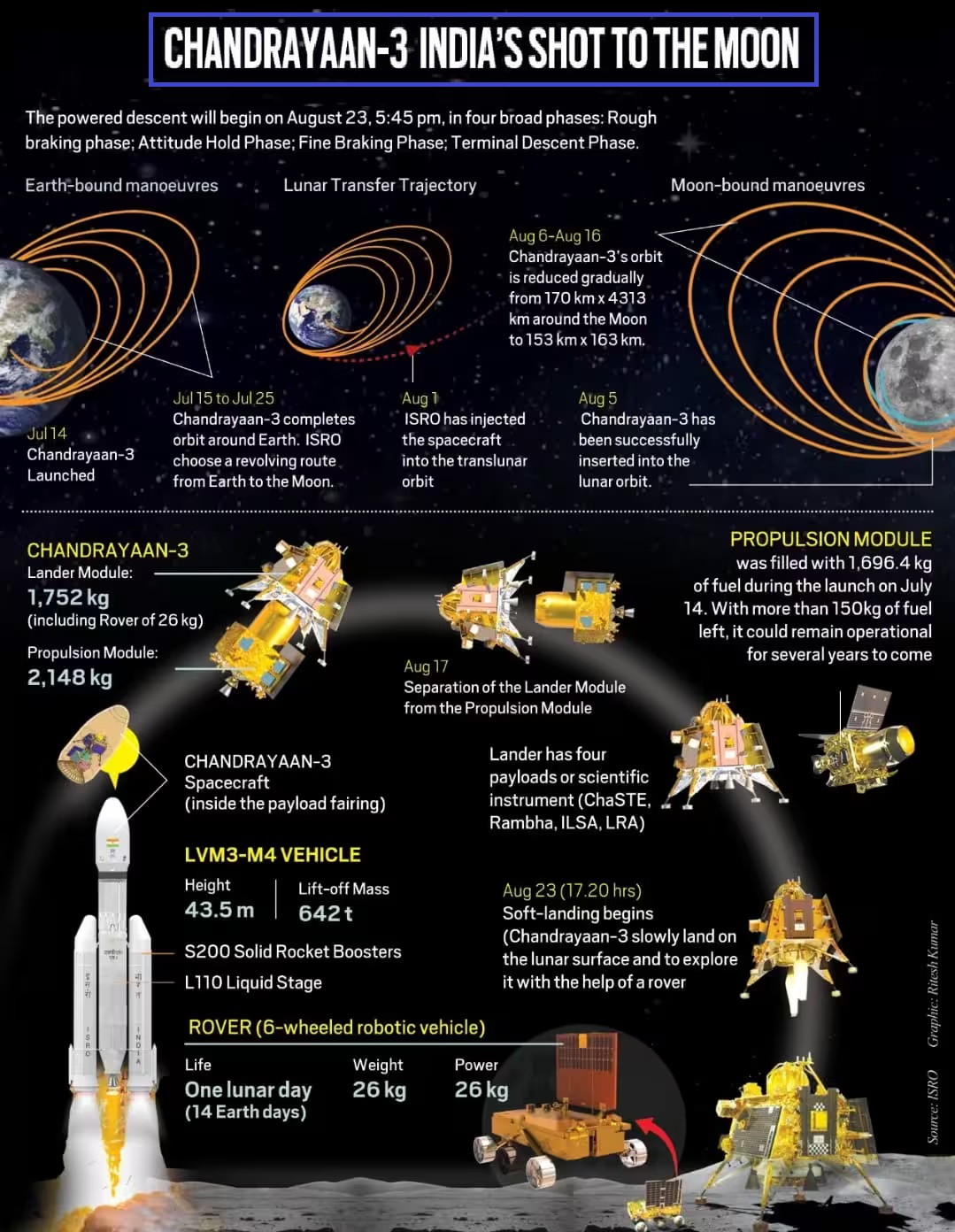
    • As Chandrayaan-3 succeeded on its lunar soft landing, its six-wheeled rover begins a journey to unravel the mysteries of the Moon.
    • With its payloads and instruments, the mission aims to build on the knowledge gained from its predecessors, investigating lunar quakes, mineral compositions, and water-ice presence.

    Chandrayaan-3 Mission: Journey post soft landing

    • Rover’s Arrival: The 26-kg rover, launched from the Chandrayaan-3 lander, is poised to cover up to 500 meters, commencing its lunar exploration.
    • Duration: The lander and rover, equipped with six payloads, are primed to collect valuable data during the single lunar day (equivalent to 14 Earth days) of operation.
    • Studying Lunar Quakes: The Chandrayaan-3 mission seeks to deepen insights into lunar quakes, expanding on the knowledge gained from its predecessors.
    • Mineral Composition: The rover’s endeavors include examining the mineral compositions of the Moon’s surface, shedding light on its geological history.
    • Electrons and Ions Study: The Radio Anatomy of Moon Bound Hypersensitive ionosphere and Atmosphere (RAMBHA) payload aims to study the behavior of electrons and ions near the lunar surface over time.
    • Thermal Properties: Chandra’s Surface Thermo physical Experiment (ChaSTE) will explore the thermal characteristics of the Moon’s Polar Regions.
    • Lunar Seismic Activity: The Instrument for Lunar Seismic Activity (ILSA) endeavors to measure lunar quakes and study the Moon’s crust and mantle composition.
    • Laser Retroreflector Array: A passive experiment by NASA, the LASER Retroreflector Array (LRA), will serve as a target for precise laser measurements in future missions.
    • Chemical Insights: The LASER Induced Breakdown Spectroscope (LIBS) aboard the rover is designed to identify the chemical and mineral composition of the lunar surface.
    • Elemental Analysis: The Alpha Particle X-ray Spectrometer (APXS) aims to analyze elements such as magnesium, aluminium, silicon, potassium, calcium, titanium, and iron in lunar soil and rocks.
    • Mineral Mapping: The CLASS X-ray Fluorescence experiment, covering nearly 95% of the lunar surface, offers detailed mineral mapping. Oxygen-rich minerals hold potential for future missions as fuel resources.

    Earlier Chandrayaan: Pioneering discoveries

    • Water Unveiled: Chandrayaan-1 played a pivotal role in uncovering the presence of water and hydroxyl molecules in the Moon’s atmosphere and surface, particularly in its southern polar regions.
    • Subsurface Water-Ice: Payloads like mini-SAR and Moon Mineralogy Mapper (M3) detected subsurface water-ice deposits within craters near the lunar South Pole.
    • Lava Tubes for Habitability: Terrain mapping on Chandrayaan-1 unveiled buried lava tubes that could provide protective habitats for humans, shielding against radiation and extreme lunar conditions.
    • Magma Ocean Hypothesis: M3 payload data suggested the possibility of a past magma ocean on the Moon, pointing to its formation and evolution.
    • Active Moon: Contrary to previous notions of lunar inactivity, Chandrayaan-1 revealed dynamic lunar processes, including volcanic activity evidenced by lava channels and vents less than 100 million years old.
    • Surface-Exosphere Interaction: Measurements indicated that the lunar surface interacts with the exosphere, evident in the emission of carbon dioxide and other gases.
    • Solar Mysteries: The Solar X-Ray Monitor on Chandrayaan-2’s orbiter observed solar microflares outside active regions, providing insights into coronal heating mysteries.

    Conclusion

    • Chandrayaan-3’s scientific journey exemplifies India’s dedication to unraveling the Moon’s mysterious nature.
    • As data pours in from its payloads and instruments, the mission builds upon its predecessors, propelling our understanding of lunar geology, composition, and mysteries.
  • Global Geological And Climatic Events

    Fujiwhara Effect: When cyclones dance

    fujiwhara

    Central Idea

    • In the ever-changing tapestry of Earth’s climate, the Fujiwhara effect has emerged as a captivating and consequential phenomenon.
    • With cyclones intensifying due to global warming, this intricate ‘dance’ between cyclones is garnering attention.

    Why in news?

    • Surprising Weather: Recently, a storm named Hurricane Hilary brought a tropical twist to the US west coast. It’s part of a series of odd weather happenings there.
    • Wet Weather: Earlier this year, California had an unexpected rainy season with lots of wet storms, called ‘atmospheric rivers.’
    • Fujiwhara Show: During one of these storms, something special occurred—an effect named after a scientist. Let’s dive into the details.

    Decoding the Fujiwhara Effect

    • Cyclone Waltz: Imagine two cyclones (or big storms) spinning in the same direction. When they get close, they begin a kind of dance around a common center.
    • Outcome of the Dance: Depending on the strength of the cyclones, they might merge, spin together, or one might absorb the other.
    • Super Cyclone: Rarely, if both cyclones are super strong, they can become one mega cyclone that causes big trouble.

    Historical Context and Impact

    • Origins and Discovery: The Fujiwhara effect got its name from a Japanese scientist who first talked about it in 1921. It was seen happening for real in 1964.
    • Effects Unleashed: This unusual dance can be fierce. It has caused strong winds, broken windows, and power problems in some areas.
    • Guessing Game: The Fujiwhara effect is tricky for weather experts. It’s hard to predict what will happen when two cyclones dance together.

    Climate Change Connection

    • More Frequent Moves: The Fujiwhara effect is showing up more often now. Experts believe it’s because our world is getting hotter and ocean waters are warming up.
    • Hotter Waters: Because of global warming, storms are getting stronger. For instance, in Taiwan, typhoons have become 35% stronger since 1977 due to warmer oceans.

    Implications

    • Nature’s Symphony: The Fujiwhara effect is like a nature’s concert, showing us how everything is connected in our climate.
    • Future Twist: As storms get more powerful, the Fujiwhara effect could become even more important and harder to understand.
    • Planet’s Dance: The Fujiwhara effect teaches us about our planet’s rhythm and how important it is to take care of our home.
  • North-East India – Security and Developmental Issues

    Special Provisions of NE States under Article 371

    Central Idea

    • The Supreme Court recently assured that special constitutional provisions protecting the interests of northeastern states under Article 371 will remain untouched.
    • As the Constitution Bench deliberates the challenge to Article 370’s abrogation in Jammu and Kashmir, we delve into the significance of these assurances and their implications.

    What is Article 371?

    • Article 371 of the Indian Constitution grants special provisions to various states to protect their unique cultural and tribal identities.
    • These provisions are aimed at preserving local customs, social practices, and land ownership.

    Preserving Tribal Culture

    • Context: Article 371 provides special provisions for several states, particularly in the northeast, to safeguard their tribal cultures and unique identities.
    • Article 371(A) – Nagaland: Article 371(A) ensures that acts of Parliament do not apply to Nagaland concerning Nagas’ religious and social practices, customary law, civil and criminal justice based on Naga customary law, and land and resource ownership.
    • State Assembly’s Role: These provisions only apply to Nagaland after the State Assembly passes a resolution to that effect.
    • Development Impediment: Some stakeholders, like Neikiesalie Nicky Kire of the NDPP, argue that Article 371(A) hampers development by preventing the government from carrying out development activities due to landowner preferences.

    Similar Provisions in Other States

    • Article 371-G – Mizoram: Similar to Nagaland, Article 371-G provides special provisions for Mizoram to protect Mizo religious and social practices, customary law, civil and criminal justice, and land ownership.
    • Article 371B – Assam: Article 371B facilitates the creation of the sub-state ‘Meghalaya,’ aiming to provide special provisions with respect to Assam.

    State-Specific Provisions

    • Article 371C – Manipur: This article addresses special provisions for Manipur, a state that was formed in 1972.
    • Article 371F and 371H – Sikkim and Arunachal Pradesh: These articles discuss special provisions for Sikkim and Arunachal Pradesh, respectively, to address their unique needs.
    • Article 371 – Separate Development Boards: Article 371 empowers the President to establish separate development boards for specific regions within Maharashtra, Gujarat, and Andhra Pradesh, promoting balanced growth.

    Further State-Specific Provisions except NE

    • Articles 371D and 371E – Andhra Pradesh, Karnataka, Goa: These articles provide special provisions for these states to ensure their cultural and economic development.
    • Articles 371J and 371I – Karnataka and Goa: These articles grant special provisions to Karnataka and Goa, respectively, to address their specific requirements.
  • Indian Missile Program Updates

    LCA Tejas successfully test-fires Astra BVR Air-to-Air Missile

    astra

    Central Idea

    • The Light Combat Aircraft (LCA) Tejas has achieved another milestone with the successful test firing of the indigenous Beyond Visual Range (BVR) air-to-air missile called Astra.

    Indigenous Marvel of Astra Missile

    • The Astra missile is an indigenous Beyond Visual Range (BVR) air-to-air missile developed by the Defence Research and Development Organisation (DRDO) of India.
    • The missile is intended for use by both the Indian Air Force (IAF) and the Indian Navy.

    Purpose and Capability

    • Astra is designed to engage and eliminate high-speed, agile aerial targets in air combat scenarios.
    • It boasts advanced air combat capabilities and can engage multiple high-performance targets simultaneously.

    Aircraft Integration

    • Astra is integrated with various aircraft platforms, including the Su-30MKI fighter jet, Mirage 2000 multi-role combat fighters, Tejas light combat aircraft (LCA), MiG-29 and MiG-21 Bison fighter jets, and the Indian Navy’s Sea Harrier jet fighter.

    Features and Specifications

    (A) Design:

    • The missile is designed for high agility, accuracy, and reliability, ensuring a high single-shot kill probability (SSKP).
    • Astra measures approximately 3.8 meters in length and has a diameter of 178mm.
    • It has a launch weight of around 160 kilograms.

    (B) Advanced Variants:

    • DRDO is working on developing an advanced variant called Astra Mk-II.
    • Astra Mk-II is expected to have an extended range of 160 kilometers.

    (C) Guidance and Warhead:

    • The missile utilizes dual-mode guidance for accurate target tracking.
    • It is equipped with a high-explosive pre-fragmented warhead for effective engagement against threats.

    (D) Propulsion and Performance:

    • The Astra missile is powered by a smokeless, single-stage, solid fuel propulsion system.
    • It is capable of achieving launch speeds ranging from Mach 0.4 to Mach 2.

    (E) Launch Range and Agility:

    • The missile’s launch range is approximately 80 kilometers.
    • It can execute maneuvers with up to 40 g turns near sea level while engaging moving targets.

    Collaborative Development

    • Astra Mk-III, a variant of the missile, is being developed in collaboration with Russia.
    • This variant employs advanced solid fuel ducted ramjet (SFDR) engine technology.

    Back2Basics: LCA Tejas

    lca

    • Origin: The LCA Tejas is an indigenous light combat aircraft developed by the Aeronautical Development Agency (ADA) in collaboration with the Hindustan Aeronautics Limited (HAL) in India.
    • Purpose: LCA Tejas is designed as a multi-role supersonic fighter aircraft for the Indian Air Force (IAF) and the Indian Navy.
    • Variants: There are two main variants of LCA Tejas:
    1. LCA Tejas Mark-I: Developed for the Indian Air Force, it is a single-seat, single-engine aircraft.
    2. LCA Tejas Mark-I Navy: Designed for the Indian Navy, it is adapted for carrier operations with features like reinforced landing gear and arrestor hook.
    • Design and Features:
    1. LCA Tejas features a delta wing design for enhanced maneuverability and stability.
    2. The aircraft incorporates advanced avionics, glass cockpit, and digital fly-by-wire controls.
    3. It is equipped with modern radar systems, electronic warfare systems, and weapons integration capabilities.
    • Powerplant: LCA Tejas is powered by a single engine, the General Electric F404-GE-IN20 turbofan engine.
    • Armament: The aircraft can carry a variety of air-to-air and air-to-ground munitions, including missiles, bombs, and rockets.
    • Performance:
    1. The aircraft has a maximum speed of around Mach 1.8 (1,390 mph or 2,240 km/h).
    2. Its operational range is approximately 500 kilometers (310 miles).
    3. LCA Tejas has a service ceiling of around 50,000 feet (15,240 meters).
    • Induction and Service:
    1. The LCA Tejas Mark-I was officially inducted into the Indian Air Force in July 2016.
    2. The aircraft has participated in various national and international airshows, showcasing its capabilities.
    • Development and Challenges:
    1. The development of LCA Tejas faced several challenges, including technical and financial issues, leading to delays.
    2. However, the successful development and induction of the aircraft marked a significant achievement for India’s aerospace industry.
  • BRICS Summits

    India backs BRICS expansion: PM

    Central Idea

    • India, a key member of the BRICS group (Brazil-Russia-India-China-South Africa), has affirmed its endorsement for the bloc’s expansion based on consensus.

    BRICS Group

    Full Form Brazil, Russia, India, China, and South Africa
    Formation Originally “BRIC” in 2001, South Africa joined in 2010 to become BRICS
    Economic Significance Represents significant portion of global population, land area, and economic output
    Objectives Enhance cooperation, dialogue on political, economic, social issues
    Principles Mutual respect, equality, non-interference in internal affairs
    Summits Holds annual summits for leaders to discuss economic, trade, development issues
    Cooperation Areas Finance, trade, investment, technology, energy, agriculture, health, education
    New Development Bank (NDB) Established in 2014, finances infrastructure and sustainable projects
    Contingent Reserve Arrangement (CRA) Established in 2015, provides financial assistance during currency crises
    Political Dialogue Advocates for peace, security, stability, coordinates positions on global issues

    Embracing BRICS Expansion

    • Indian Support: PM Modi reiterated India’s full support for the expansion of BRICS membership, emphasizing the need for consensus.
    • Collaborative Approach: Modi highlighted the potential for increased collaboration between BRICS countries in fields like space, education, and technology, using India’s expertise as a basis.
    • Shared Platforms: Modi offered to share India’s technological platforms with other BRICS members, fostering a cohesive and future-ready organization.

    BRICS’ Evolution and Vision

    • BRICS Progress: Modi recalled BRICS’ journey, from being defined as “Building Responsive, Inclusive and Collective Solutions” during India’s chairmanship in 2016 to its current vision of “Breaking barriers, Revitalising economies, Inspiring innovation, Creating opportunities, and Shaping the future.”
    • Chinese Perspective: Chinese President expressed support for speedy expansion to enhance global governance’s fairness and equity. He emphasized the enthusiasm of developing nations in joining BRICS cooperation.

    Ongoing Deliberations on Expansion

    • South African Insight: South African President Cyril Ramaphosa noted that discussions on BRICS expansion are ongoing, suggesting that a clear solution will be reached collectively among BRICS leaders.
    • Indian Initiative: India’s approach to BRICS expansion was guided by the inclusion of strategic partners as new members, emphasizing consensus and unstructured discussions during leaders’ retreats.

    Ensuring Equitable Growth

    • Diverse Candidates: Approximately 20 to 30 nations expressed interest in joining BRICS, with leading candidates like Argentina, Egypt, Indonesia, Nigeria, Saudi Arabia, and the UAE. India aims to prevent a China-centric grouping.
    • Counterpoint to the West: China aims to expand BRICS as a counterpoint to Western dominance, gaining support from Russia due to diplomatic isolation linked to the Ukraine conflict.

    Enhancing BRICS Cooperation

    • Modi’s Proposals: Modi emphasized collaboration in space, technology, digital infrastructure, and education among BRICS members.
    • BRICS Space Exploration Consortium: Modi proposed creating a Brics space exploration consortium for research and weather monitoring.
    • Education and Technology: Modi cited India’s innovative solutions like Diksha and Bhashini for education and the CoWIN platform for vaccination, offering to share these platforms with BRICS partners.
    • Skill Mapping and Conservation: Modi proposed skill mapping and cooperation for the preservation of various species of big cats found in BRICS countries.
    • Support for African Union: Modi sought BRICS states’ endorsement for India’s proposal to grant the African Union full membership in the G20, reflecting shared commitment and unity within the group.

    Conclusion

    • As India reaffirms its backing for BRICS expansion, the group’s shared vision of inclusive growth and equitable global governance is reinforced.
    • PM Modi proposals highlight the potential for collaboration in diverse domains, harnessing India’s technological prowess to foster a forward-looking and cohesive BRICS organization.
    • Amid evolving global dynamics, BRICS’ united stance and collaborative efforts stand to reshape the landscape of international cooperation and equitable development.

Join the Community

Join us across Social Media platforms.