💥UPSC 2026, 2027, 2028 UAP Mentorship (March Batch) + Access XFactor Notes & Microthemes PDF

Type: Schemes

  • Urban Transformation – Smart Cities, AMRUT, etc.

    Jal Jeevan Mission (Urban) to revive urban water bodies

    Note4Students

    From UPSC perspective, the following things are important:

    Prelims level: Jal Jeevan Mission

    Mains level: Drinking water scarcity in Urban India

    The urban water supply mission under the Jal Jeevan Mission announced in the Budget would include rejuvenation of water bodies as well as 20% of supply from reused water.

    Access to safe drinking water has been a grave problem for India, especially in rural areas where lack of usable water has resulted in decades-old sanitation and health problems.

    Jal Jeevan Mission

    • Jal Jeevan Mission, a central government initiative under the Ministry of Jal Shakti, aims to ensure access of piped water for every household in India.
    • The mission’s goal is to provide to all households in rural India safe and adequate water through individual household tap connections by 2024.
    • The Har Ghar Nal Se Jal programme was announced by FM in Budget 2019-20 speech.
    • This programme forms a crucial part of the Jal Jeevan Mission.
    • The programme aims to implement source sustainability measures as mandatory elements, such as recharge and reuse through greywater management, water conservation, and rainwater harvesting.

    Urban component of the mission

    • The mission is meant to create a people’s movement for water, making it everyone’s priority.
    • There are an estimated gap of 2.68 crore urban household tap connections that the Mission would seek to bridge in all 4,378 statutory towns.
    • The Mission would also aim to bridge the gap of 2.64 crore sewer connections in the 500 cities under the existing Atal Mission for Rejuvenation and Urban Transformation (AMRUT).
    • The mission would include rejuvenation of water bodies to boost the sustainable freshwater supply and the creation of green spaces.
  • Textile Sector – Cotton, Jute, Wool, Silk, Handloom, etc.

    [pib] Mega Investment Textiles Parks (MITRA) Scheme

    Note4Students

    From UPSC perspective, the following things are important:

    Prelims level: MITRA scheme

    Mains level: Textile sector of India

    The Finance Minister has proposed setting up of a scheme of Mega Investment Textiles Parks (MITRA) Scheme in her budget speech.

    Do not get confused over Sahakar Mitra Scheme and this one.

    MITRA Scheme

    • MITRA aims to enable the textile industry to become globally competitive, attract large investments, and boost employment generation and exports.
    • It will create world-class infrastructure with plug and play facilities to enable create global champions in exports.
    • It will be launched in addition to the Production Linked Incentive Scheme (PLI).
    • It will give our domestic manufacturers a level-playing field in the international textiles market & pave the way for India to become a global champion of textiles exports across all segments”.
  • Health Sector – UHC, National Health Policy, Family Planning, Health Insurance, etc.

    Ayushman Bharat for CAPFs

    Note4Students

    From UPSC perspective, the following things are important:

    Prelims level: Ayushman Bharat

    Mains level: Universal health coverage

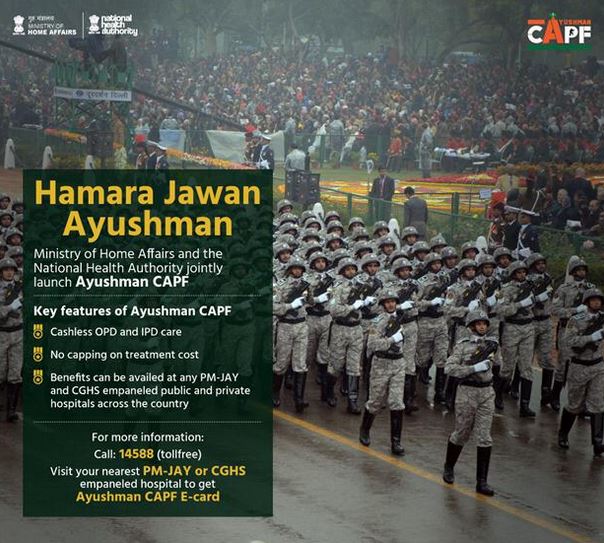
    Union Home Minister has rolled out the ‘Ayushman CAPF’ scheme, extending the benefit of the central health insurance programme to the personnel of all Central Armed Police Forces (CAPFs) in the country.

    Who are the CAPFs?

    • The CAPFs refers to uniform nomenclature of five security forces in India under the authority of the Ministry of Home Affairs.
    • Their role is to defend the national interest mainly against the internal threats.
    • They are the Border Security Force (BSF), Central Reserve Police Force (CRPF), Central Industrial Security Force (CISF), Indo-Tibetan Border Police (ITBP), Sashastra Seema Bal (SSB)

    Ayushman CAPF

    • Under this scheme, around 28 lakh personnel of CAPF, Assam Rifles and National Security Guard (NSG) and their families will be covered by ‘Ayushman Bharat: PM Jan Arogya Yojana’ (AB PM-JAY).
    • For the CAPF, the existing health coverage was not comprehensive as compared to other military forces.

    Do you know?

    The goal of universal health coverage (UHC) as stated in the UN Sustainable Development Goals (SDGs no. 3) is one of the most significant commitments to equitable quality healthcare for all.

    About Ayushman Bharat

    • PM-JAY aims to provide free access to healthcare for 40% of people in the country.
    • It is a centrally sponsored scheme and is jointly funded by both the union government and the states.
    • It was launched in September 2018 by the Ministry of Health and Family Welfare.
    • The ministry has later established the National Health Authority as an organization to administer the program.

    Key features:

    • Providing health coverage for 10 crores households or 50 crores Indians.
    • It provides a cover of 5 lakh per family per year for medical treatment in empanelled hospitals, both public and private.
    • Offering cashless payment and paperless recordkeeping through the hospital or doctor’s office.
    • Using criteria from the Socio-Economic and Caste Census 2011 to determine eligibility for benefits.
    • There is no restriction on family size, age or gender.
    • All previous medical conditions are covered under the scheme.
    • It covers 3 days of pre-hospitalization and 15 days of post-hospitalization, including diagnostic care and expenses on medicines.
    • The scheme is portable and a beneficiary can avail medical treatment at any PM-JAY empanelled hospital outside their state and anywhere in the country.

    Note these features. They cannot be memorized all of sudden but can be recognized if a tricky MCQ comes in the prelims.

    Must read:

    [Burning Issue] Ayushmaan Bharat

  • Skilling India – Skill India Mission,PMKVY, NSDC, etc.

    [pib] PMKVY 3.0

    Note4Students

    From UPSC perspective, the following things are important:

    Prelims level: PMKVY

    Mains level: Skill Development

    The Ministry of Skill Development and Entrepreneurship (MSDE) has launched Pradhan Mantri Kaushal Vikas Yojana (PMKVY) 3.0.

    Note the differences between all three versions of PMKVY.

    PMKVY 3.0

    • PMKVY 3.0 envisages training of eight lakh candidates over the scheme period of 2020-2021.
    • This phase three will focus on new-age and COVID-related skills.
    • The 729 PM Kaushal Kendras (PMKKs), empanelled non-PMKK training centres and more than 200 industrial training institutes under Skill India will be rolling out under it.
    • On the basis of the learning gained from PMKVY 1.0 and PMKVY 2.0, the MSDE has improved the newer version of the scheme to match the current policy doctrine and energize the skilling ecosystem.

    Implementation

    • PMKVY 3.0 will be implemented in a more decentralized structure with greater responsibilities and support from States/UTs and Districts.
    • District Skill Committees (DSCs), under the guidance of State Skill Development Missions (SSDM), shall play a key role in addressing the skill gap and assessing demand at the district level.
    • The new scheme will be more trainee- and learner-centric addressing the ambitions of aspirational Bharat.
    • PMKVY 2.0 broadened the skill development with the inclusion of Recognition of Prior Learning (RPL) and focus on training.
    • With the advent of PMKVY 3.0, the focus is on bridging the demand-supply gap by promoting skill development in areas of new-age and Industry 4.0 job roles.

    Back2Basics: PMKVY 1.0

    • PMKVY is a skill development initiative scheme of the Government of India for recognition and standardization of skills launched on16 July 2015;.
    • The aim of the scheme is to encourage aptitude towards employable skills and to increase the working efficiency of probable and existing daily wage earners, by giving monetary awards and rewards and by providing quality training to them.
    • For this qualification plans and quality, plans have been developed by various Sector Skill Councils (SSC) created with the participation of Industries.
    • National Skill Development Council (NSDC) has been made coordinating and driving agency for the same.
  • Crop Insurance – PMFBY, etc.

    PM Fasal Bima Yojana (PMFBY) completes 5 Years of operations

    Note4Students

    From UPSC perspective, the following things are important:

    Prelims level: PMFBY

    Mains level: Success of PMFBY

    The Pradhan Mantri Fasal Bima Yojana (PMFBY) has completed 5 Years of successful operations.

    It has become vital these days to remember and recognize every detail of government schemes.

    What is PMFBY?

    • 5 years ago, on 13th January 2016, the GoI took a historic step towards strengthening risk coverage of crops for farmers of India and approved the flagship crop insurance scheme – the PMFBY.
    • The scheme was conceived as a milestone initiative to provide a comprehensive risk solution at the lowest uniform premium across the country for farmers.
    • Premium cost over and above the farmer share is equally subsidized by States and GoI.
    • However, GoI shares 90% of the premium subsidy for the North Eastern States to promote the uptake in the region.
    • The average sum insured per hectare has increased from ₹15,100 during the pre-PMFBY Schemes to ₹40,700 under PMFBY.

    Coverage of Risks and Exclusions:

    Following stages of the crop and risks leading to crop loss are covered under the scheme.

    • Prevented Sowing/ Planting Risk: The insured area is prevented from sowing/ planting due to deficit rainfall or adverse seasonal conditions
    • Standing Crop (Sowing to Harvesting): Comprehensive risk insurance is provided to cover yield losses due to non-preventable risks, viz. Drought, Dry spells, Flood, Inundation, Pests and Diseases, Landslides, Natural Fire and Lightening, Storm, Hailstorm, Cyclone, Typhoon, Tempest, Hurricane and Tornado.
    • Post-Harvest Losses: Coverage is available only up to a maximum period of two weeks from harvesting for those crops which are allowed to dry in cut and spread condition in the field after harvesting against specific perils of a cyclone and cyclonic rains and unseasonal rains.
    • Localized Calamities: Loss/ damage resulting from the occurrence of identified localized risks of hailstorm, landslide, and Inundation affecting isolated farms in the notified area.

    Try this question from CSP 2020:

    Q.Under the Kisan Credit Card Scheme, short-term credit support is given to farmers for which of the following purposes? (CSP 2020)

    1. Working capital for maintenance of farm assets
    2. Purchase of combine harvesters, tractors and mini trucks
    3. Consumption requirements of farm households
    4. Construction of family house and setting up of village cold storage facility
    5. Construction of family house and setting up of village cold storage facility

    Select the correct answer using the code given below:

    (a) 1,2 and 5 only

    (b) 1,3 and 4 only

    (c) 2,3,4 and 5 only

    (d) 1, 2, 3 and 4

    Progress till date

    • The Scheme covers over 5.5 crore farmer applications year on year.
    • Till date, claims worth Rs 90,000 crores have already been paid out under the Scheme.
    • Aadhar seeding has helped in speedy claim settlement directly into the farmer accounts.
    • Even during COVID lockdown period, nearly 70 lakh farmers benefitted and claims worth Rs. 8741.30 crores were transferred to the beneficiaries.
  • Agricultural Sector and Marketing Reforms – eNAM, Model APMC Act, Eco Survey Reco, etc.

    PM-KISAN payout wrongly made to ineligible beneficiaries

    Note4Students

    From UPSC perspective, the following things are important:

    Prelims level: PM-KISAN

    Mains level: Not Much

    PM-KISAN payments worth ₹1,364 crores have been wrongly made to more than 20 lakh ineligible beneficiaries and income tax payer farmers.

    Try this PYQ:

    Q.Under the Kisan Credit Card Scheme, short-term credit support is given to farmers for which of the following purposes? (CSP 2020)

    1. Working capital for maintenance of farm assets
    2. Purchase of combine harvesters, tractors and mini trucks
    3. Consumption requirements of farm households
    4. Construction of family house and setting up of village cold storage facility
    5. Construction of family house and setting up of village cold storage facility

    Select the correct answer using the code given below:

    (a) 1,2 and 5 only

    (b) 1,3 and 4 only

    (c) 2,3,4 and 5 only

    (d) 1, 2, 3 and 4

    PM-KISAN

    • The Pradhan Mantri Kisan Samman Nidhi Yojana (PM-Kisan Yojana) is a government scheme through which, all small and marginal farmers will get up to Rs 6,000 per year as minimum income support.
    • Under the PM-KISAN scheme, all landholding farmers’ families shall be provided with the financial benefit of Rs. 6000 per annum per family payable in three equal instalments of Rs. 2000 each, every four months.
    • The definition of the family for the scheme is husband, wife, and minor children.
    • State Government and UT administration will identify the farmer families which are eligible for support as per scheme guidelines.
    • The fund will be directly transferred to the bank accounts of the beneficiaries.

    Why in news?

    • When it was launched just before the general election in 2019, it was meant to cover only small and marginal farmers who owned less than two hectares.
    • Later that year, large farmers were included in the scheme as the government removed land size criteria.

    Certain exclusions

    • However, certain exclusions remained.
    • If any member of a farming family paid income tax, received a monthly pension above ₹10,000, held a constitutional position, or was a serving or retired government employee, they were not eligible for the scheme.
    • Professionals and institutional landholders were also excluded.

    Who are NOT eligible for PM-KISAN?

    The following categories of beneficiaries of higher economic status shall not be eligible for benefit under the scheme.

    • All Institutional Landholders.

    Farmer families that belong to one or more of the following categories:

    • Former and present holders of constitutional posts
    • Former and present Ministers/ State Ministers and former/present Members of Lok Sabha/ Rajya Sabha/ State Legislative Assemblies/ State Legislative Councils, former and present Mayors of Municipal Corporations, former and present Chairpersons of District Panchayats.
    • All serving or retired officers and employees of Central/ State Government Ministries
    • All superannuated/retired pensioners whose monthly pension is Rs.10,000/-or more. (Excluding Multi-Tasking Staff / Class IV/Group D employees) of the above category
    • All Persons who paid Income Tax in the last assessment year
    • Professionals like Doctors, Engineers, Lawyers, Chartered Accountants, and Architects registered with Professional bodies and carrying out the profession by undertaking practices.

    Note: It is not so easy to remember all such exclusions. But one must be able to recognize them by applying pure logic and thumb rule. This can be well understood from the PYQ given.


  • J&K – The issues around the state

    [pib] New Industrial Development Scheme for Jammu & Kashmir (J&K IDS, 2021)

    Note4Students

    From UPSC perspective, the following things are important:

    Prelims level: JK IDS, 2021

    Mains level: Development of JK region

    The Union Govt. has formulated the New Industrial Development Scheme for Jammu & Kashmir (J&K IDS, 2021).

    Tap to read more about: Reorganization of J&K

    J&K IDS, 2021

    • It is a new Central Sector Scheme for the development of Industries in the UT of Jammu & Kashmir.
    • The main purpose of the scheme is to generate employment which directly leads to the socio-economic development of the area.

    Incentives available

    • Capital Investment Incentive at the rate of 30% in Zone A and 50% in Zone B on the investment made in Plant & Machinery (in manufacturing) or construction of the building is available.
    • Capital Interest subvention: At the annual rate of 6% for a maximum of 7 years on loan amount up to Rs. 500 crore for investment in plant and machinery (in manufacturing) or construction of the building.
    • GST Linked Incentive: 300% of the eligible value of actual investment made in plant and machinery (in manufacturing) or construction in building for 10 years.
    • Working Capital Interest Incentive: All existing units at an annual rate of 5% for a maximum of 5 years. Maximum limit of incentive is Rs 1 crore.

    Key features:

    • The scheme is made attractive for both smaller and larger units.
    • Smaller units with an investment in plant & machinery upto Rs. 50 crore will get a capital incentive upto Rs. 7.5 crore and get capital interest subvention at the rate of  6% for a maximum of 7 years
    • The scheme aims to take industrial development to the block level in UT of J&K, which is the first time in any Industrial Incentive Scheme of the GoI.
    • The scheme has been simplified on the lines of ease of doing business by bringing one major incentive- GST Linked Incentive- that will ensure less compliance burden without compromising on transparency.
    • It is not a reimbursement or refund of GST but gross GST is used to measure eligibility for industrial incentive to offset the disadvantages that the UT of J&K face

    Major Impact and employment generation potential:

    • The scheme is to bring about a radical transformation in the existing industrial ecosystem of J&K with emphasis on job creation, skill development and sustainable development.
    • It is anticipated that the proposed scheme is likely to attract unprecedented investment and give direct and indirect employment to about 4.5 lakh persons.
    • Additionally, because of the working capital interest subvention, the scheme is likely to give indirect support to about 35,000 persons.
  • Mother and Child Health – Immunization Program, BPBB, PMJSY, PMMSY, etc.

    Matru Sahyogini Samitis Scheme

    Note4Students

    From UPSC perspective, the following things are important:

    Prelims level: ICDS, Matru Sahyogini Samitis Scheme

    Mains level: Not Much

    The MP government has issued an order for the appointment of committees led by mothers to ensure better monitoring of services delivered at Anganwadi or day-care centres across the State.

    Try this PYQ:

    Q.Which of the following are the objectives of ‘National Nutrition Mission’?

    1. To create awareness relating to malnutrition among pregnant women and lactating mothers.
    2. To reduce the incidence of anaemia among young children, adolescent girls and women.
    3. To promote the consumption of millets, coarse cereals and unpolished rice.
    4. To promote the consumption of poultry eggs.

    Select the correct answer using the code given below:

    (a) 1 and 2 only

    (b) 1, 2 and 3 only

    (c) 1, 2 and 4 only

    (d) 3 and 4 only

    Matru Sahyogini Samitis

    • Called ‘Matru Sahyogini Samiti’ or Mothers’ Cooperation Committees, these will comprise 10 mothers at each Anganwadi centres.
    • They would be representing the concerns of different sets of beneficiaries under the Integrated Child Development Services, or National Nutrition Mission.
    • Beneficiaries’ would include children between six months to three years, children between three years and six years, adolescent girls and pregnant women and lactating mothers.
    • These mothers will keep a watch on weekly ration distribution to them as well as suggest nutritious and tasteful recipes for meals served to children at the centres.
    • The move is being taken as per the mandate of the National Food Security Act, 2013 (NFSA).

    Its’ functioning

    • The committees will include mothers of beneficiary children as well as be represented by pregnant women and lactating mothers who are enrolled under the scheme.
    • The Anganwadi scheme includes a package of six services delivered at the centres, including supplementary nutrition, health services including vaccination, early education, among others.
    • The Committees will also include a woman panch, women active in the community and eager to volunteer their support to the scheme, teachers from the local school, and women heads of self-help groups (SHG).

    Why such a move?

    • This is in a move that is aimed at strengthening community response to the problem of hunger and malnutrition in the State.
    • With the help of mothers, we will be able to turn anganwadis into a community health system, a nutrition management centre, and spread awareness against social evils.
    • These will turn into a model for local governance as well as allow for greater engagement between communities and the State government.

    Back2Basics: Integrated Child Development Services (ICDS)

    • The ICDS aims to provide food, preschool education, primary healthcare, immunization, health check-up and referral services to children under 6 years of age and their mothers.
    • The scheme was launched in 1975, discontinued in 1978 by the government of Morarji Desai, and then relaunched by the Tenth Five Year Plan.
    • The tenth FYP also linked ICDS to Anganwadi centres established mainly in rural areas and staffed with frontline workers.
    • The ICDS provide for anganwadis or day-care centres which deliver a package of six services including:
    1. Immunization
    2. Supplementary nutrition
    3. Health checkup
    4. Referral services
    5. Pre-school education (Non-Formal)
    6. Nutrition and Health information

    Implementation

    • For nutritional purposes, ICDS provides 500 kilocalories (with 12-15 grams of protein) every day to every child below 6 years of age.
    • For adolescent girls, it is up to 500-kilo calories with up to 25 grams of protein every day.
    • The services of Immunisation, Health Check-up and Referral Services delivered through Public Health Infrastructure under the Ministry of Health and Family Welfare.
  • Food Processing Industry: Issues and Developments

    [pib] PM Formalization of Micro Food Processing Enterprises Scheme

    Note4Students

    From UPSC perspective, the following things are important:

    Prelims level: PM-FME Scheme

    Mains level: Food processing industry and the required reforms

    Union Minister for Food Processing Industries has inaugurated the capacity building component of the Pradhan Mantri Formalization of Micro food processing Enterprises scheme (PM-FME Scheme).

    The event also sought the launch of the GIS One District One Product (ODOP) Digital Map of India.

    Practice question for mains:

    Q.What is the PM FME Scheme? Discuss its potential to neutralize various challenges faced by India’s unorganized food industries

    PM-FME Scheme

    • Launched under the Aatmanirbhar Bharat Abhiyan, the PM-FME Scheme is a centrally sponsored scheme.
    • It aims to enhance the competitiveness of existing individual micro-enterprises in the unorganized segment of the food processing industry and promote formalization of the sector.
    • It seeks to provide support to Farmer Producer Organizations, Self Help Groups, and Producers Cooperatives along their entire value chain.
    • Under the PM-FME scheme, capacity building is an important component.
    • The scheme envisages imparting training to food processing entrepreneurs, various groups, viz., SHGs / FPOs / Co-operatives, workers, and other stakeholders associated with the implementation of the scheme.

    Features of the scheme

    • The Scheme adopts One District One Product (ODODP) approach to reap the benefit of scale in terms of procurement of inputs, availing common services and marketing of products.
    • The States would identify food product for a district keeping in view the existing clusters and availability of raw material.
    • The ODOP product could be a perishable produce based product or cereal-based products or a food product widely produced in a district and their allied sectors.
    • An illustrative list of such products includes mango, potato, litchi, tomato, tapioca, kinnu, bhujia, petha, papad, pickle, millet-based products, fisheries, poultry, meat as well as animal feed among others.
    • The Scheme also place focus on waste to wealth products, minor forest products and Aspirational Districts.

     About ODOP Digital Map

    • The GIS ODOP digital map of India provides details of ODOP products of all the states to facilitate the stakeholders.
    • The digital map also has indicators for tribal, SC, ST, and aspirational districts.
    • It will enable stakeholders to make concerted efforts for its value chain development.
  • Health Sector – UHC, National Health Policy, Family Planning, Health Insurance, etc.

    What is the Viability Gap Funding (VGF) Scheme?

    Note4Students

    From UPSC perspective, the following things are important:

    Prelims level: Viability Gap Funding

    Mains level: Not Much

    The government has expanded the provision of financial support by means of viability gap funding for public-private partnerships (PPPs) in infrastructure projects to include critical social sector investments in sectors such as health, education, water and waste treatment.

    Note the minutes of VGF, its meaning, funding mechanism, various sectors included and its nodal ministry etc. UPSC can ask static statements based question.

    What is the move?

    • Now, under this scheme, private sector projects in areas like wastewater treatment, solid waste management, health, water supply and education, could get 30% of the total project cost from the Centre.
    • Separately, pilot projects in health and education, with at least 50% operational cost recovery, can get as much as 40% of the total project cost from the central government.
    • The Centre and States would together bear 80% of the capital cost of the project and 50% of operation and maintenance costs of such projects for the first five years.

    Viability Gap Funding (VGF) Scheme

    • Viability Gap Finance means a grant to support projects that are economically justified but not financially viable.
    • The scheme is designed as a Plan Scheme to be administered by the Ministry of Finance and amount in the budget are made on a year-to-year basis.
    • Such a grant under VGF is provided as a capital subsidy to attract the private sector players to participate in PPP projects that are otherwise financially unviable.
    • Projects may not be commercially viable because of the long gestation period and small revenue flows in future.
    • The VGF scheme was launched in 2004 to support projects that come under Public-Private Partnerships.

    Its’ funding

    • Funds for VGF will be provided from the government’s budgetary allocation. Sometimes it is also provided by the statutory authority who owns the project asset.
    • If the sponsoring Ministry/State Government/ statutory entity aims to provide assistance over and above the stipulated amount under VGF, it will be restricted to a further 20% of the total project cost.

    VGF grants

    • VGF grants will be available only for infrastructure projects where private sector sponsors are selected through a process of competitive bidding.
    • The VGF grant will be disbursed at the construction stage itself but only after the private sector developer makes the equity contribution required for the project.