💥UPSC 2026, 2027, 2028 UAP Mentorship (March Batch) + Access XFactor Notes & Microthemes PDF

Type: IOCR

  • Climate Change Impact on India and World – International Reports, Key Observations, etc.

    UN Adaptation Gap Report, 2020

    Note4Students

    From UPSC perspective, the following things are important:

    Prelims level: Adaptation Cost

    Mains level: Progress of global climate action

    The United Nations Adaptation Gap Report, 2020 was recently released by the UNEP.

    Must read edition: Five years of Paris Agreement

    UN Adaptation Gap Report

    • UN Environment Programme (UNEP) has managed the production of UN Environment’s Adaptation Gap Report series since its first edition in 2014.
    • The aim of the reports is to inform national and international efforts to advance climate change adaptation.

    Behind the concept: Adaptation Cost

    • Adaptation Cost includes costs of planning, preparing for, facilitating and implementing the climate change adaptation measures.
    • It thus derives benefits as the avoided damage costs or the accrued benefits following the adoption and implementation of adaptation measures.

    Highlights of the 2020 report

    • The annual cost of adaptation to the effects of climate change for developing countries is estimated to at least quadruple by 2050, according to the United Nations Adaptation Gap Report, 2020.
    • The current cost for developing countries is in the range of $70 billion (Rs 5.1 lakh crore) and may rise to $140-300 billion in 2030 and $280-500 billion in 2050.

    Funding gaps

    • The ever-increasing adaptation cost has also outpaced the growth in adaptation finance that refers to the flow of funds to developing countries to help them tide over the damages caused by climate change.
    • This, in turn, has kept the adaptation finance gap from closing with the current efforts, although the fund flow has increased, the report said.
    • Adaptation costs, in actual terms, are higher in developed countries but the burden of adaptation is greater for developing countries in relation to their gross domestic product.
    • These countries, especially in Africa and Asia, which are least equipped to tackle climate change will also, be the most impacted by it, the report noted.
  • Foreign Policy Watch: India – EU

    The ‘Difficult Four’ Countries

    Note4Students

    From UPSC perspective, the following things are important:

    Prelims level: Not Much

    Mains level: Global perception of India's image

    A UK think-tank ‘Royal Institute of International Affairs’ has listed India in ‘Difficult 4’; clubs India with China, Saudi Arabia, and Turkey.

    This newscard helps analyse the Western esp. that of the EU’s perception of India and its global image under the present regime.

    What is the news?

    • A report called ‘Global Britain, Global Broker’ has warned the UK government to consider India as more of a rival that a cooperative partner.
    • It accepts the fact that India is set to be the largest country in the world by population very soon and will have the third-largest economy and defence budget at some point in this decade.
    • But it cautions that gaining direct national benefit from the relationship, whether economically or diplomatically, will be difficult for the UK government.
    • The report also accepts India’s importance to the UK as being “inescapable”.

    The ‘Difficult Four’

    • Clubbing India with China, Saudi Arabia and Turkey as the “difficult four”, the report says the Johnson government should be more realistic about developing deeper ties with India.
    • They may be important to the UK’s commercial interests, but they will be rivals or, at best, awkward counterparts on many of its global goals, the report warns.
    • India is now classed as a country, destined to count among the UK’s “rivals” or “awkward counterparts” as it pursues its global goals.

    India has had bitter (colonial) past

    • The think-tank strikes a note of caution over the two countries’ shared colonial history proving a stumbling block to the promise of a deeper relationship.
    • India has a long and consistent record of resisting being corralled into a ‘Western’ camp.
    • As a result, India is always on the list of countries with which a new UK government commits to engage.
    • But it should be obvious by now that the idea of a deeper relationship with India always promises more than it can deliver.
    • The legacy of British colonial rule consistently curdles the relationship.

    Indian flaws

    • The report points to India’s “complex, fragmented domestic politics”, which make it one of the countries resistant to open trade and foreign investment.
    • It highlights concerns raised by domestic groups as well as the UN over a “crackdown on human rights activists and civil society groups” not being actively challenged by the judiciary.
    • It raises concern over India’s pursuance of extreme right-winged policies. Indian domestic politics also has entered a more ethnic-nationalist phase, the report argues.
    • Against this backdrop, the report reflects on the prospect of including India within any new Democratic 10 or D10 coalition of 10 leading democracies.

    Try this question from 2019 CS Mains:


    Q.What are the challenges to our cultural practices in the name of secularism? (150W)

    UK’s resentment

    • In a critique of India’s diplomatic behaviour, the report points out that despite border clashes with China, “India did not join the group of countries that criticized China at the UN in July 2019 over HR violations in Xinjiang.
    • India has also been muted in its criticism of the passage of the new national security law in Hong Kong.
  • Minority Issues – SC, ST, Dalits, OBC, Reservations, etc.

    Who are the persecuted Hazara Community of Pakistan?

    Note4Students

    From UPSC perspective, the following things are important:

    Prelims level: Not Much

    Mains level: Persecution of minorities in neighbouring countries

    Pakistan’s Hazaras finally ended a protest and agreed to bury the bodies of 11 coal miners from the community killed by the IS.

    Genocide and Pakistan are the two inseparable metaphors. Pakistan’s treatment of its minorities is the least highlighted global violation of Human Rights. Hindus, Sikhs and Christians are the most persecuted communities.

    Who are the Hazaras?

    • Around 1773, the mountainous region of Hazarajat in modern-day central Afghanistan was annexed and made a part of the territories of the Afghan Empire under Pashtun ruler Ahmad Shah Durrani.
    • The Sunni Muslim majority under the Pashtun ruler resulted in further marginalization of the Shiite Hazara community, to the extent that in the 18th and 19th century.
    • They were forced to leave fertile lowlands in central Afghanistan and make the dry, arid mountainous landscape their new home.

    Their persecution

    • Persecution of the Shiite Hazaras is nothing new in Pakistan or neighbouring Afghanistan.
    • They have been frequently targeted by Taliban and IS militants and other militant groups in both countries.

    Causes of persecution: Ethnicity and Religion

    • Their unique identity, ethnicity and religion always made the Hazaras stand out among the other communities.
    • Hazaras speak Hazaragi, which is close to Dari Persian, the official language of modern-day Afghanistan.
    • The community also shares physical similarities with the Mongols and their speech, specific terms and phrases, reflect strong Central Asian Turkic influences.
    • This sets them apart from their neighbours in Pakistan and other communities within Afghanistan.

    An attempted ethnic cleansing

    • In the 19th century, the Hazara community constituted approximately 67 per cent of Afghanistan’s total population.
    • Since then, primarily due to violence, oppression and targeted massacres, that number has come down to a little as 10 to 20 per cent of the population now.
    • The attacks reached a crescendo in 2013 when three separate bombings killed more than 200 people in Hazara neighbourhoods of Quetta.
    • In the aftermath of this incident, the Shia community in Pakistan had erupted in anger over the Pakistani government’s lack of protection of its minorities.
  • India’s Bid to a Permanent Seat at United Nations

    Explained: India at United Nations Security Council

    Note4Students

    From UPSC perspective, the following things are important:

    Prelims level: UNSC

    Mains level: India's agenda at UNSC

    India is back as a non-permanent member on the United Nations Security Council.

    Q.What objective India should pursue in its stint at the UNSC? What challenges India will face in achieving these objectives?

    India at the UNSC

    Take a look at its seven previous terms, and what its agenda will be amid events concerning China, Pakistan and the US:

    1. In 1950-51, India, as President of UNSC, presided over the adoption of resolutions calling for the cessation of hostilities during the Korean War and for assistance to the Republic of Korea.
    2. In 1967-68, India co-sponsored Resolution 238 extending mandate of UN mission in Cyprus.
    3. In 1972-73, India pushed strongly for admission of Bangladesh into the UN. The resolution was not adopted because of a veto by a permanent member.
    4. In 1977-78, India was a strong voice for Africa in the UNSC and spoke against apartheid. Then External Affairs Minister Atal Bihari Vajpayee spoke in UNSC for Namibia’s independence in 1978.
    5. In 1984-85, India was a leading voice in UNSC for resolution of conflicts in the Middle East, especially Palestine and Lebanon.
    6. In 1991-92, PM P V Narasimha Rao participated in the first-ever summit-level meeting of the UNSC and spoke on its role in the maintenance of peace and security.
    7. In 2011-2012, India was a strong voice for developing world, peacekeeping, counter-terrorism and Africa. The first statement on Syria was during India’s Presidency at the UNSC.

    India’s diverse role-play

    • India played an active role in discussions on all issues related to international peace and security.
    • It included several new challenges which the UNSC was called upon to deal with in Afghanistan, Cote d’Ivoire, Iraq, Libya, South Sudan, Syria and Yemen.
    • In view of the threat posed to international trade and security by piracy off the coast of Somalia, India promoted international cooperation against the pirates.
    • At India’s initiative, the UNSC mandated international cooperation for release of hostages taken by pirates as well as for prosecution of those taking hostages and those aiding and abetting these acts.
    • India also worked for enhancing international cooperation in counter-terrorism, prevention of the proliferation of weapons of mass destruction to non-state actors, and the strengthening of UN peacekeeping efforts.

    Issues at UNSC: The politics within

    • The seven previous terms have given Indian diplomats the experience of how diplomacy is conducted at the multilateral setting.
    • There have been instances where permanent members would like the non-permanent members to be “cooperative”, and no stand in the way of major resolutions.
    • Most non-permanent members get influenced by the P-5 members. They did not wish to irritate the permanent members and were keen to be perceived by them as ‘cooperative’.
    • This was precisely how the permanent members would like the non-permanent members to behave.

    Walk-alone moves by India

    • The Indians took P5 work more seriously and consequently had to fight a lonely battle.
    • This was the time when the Gulf War erupted and India voted in favour of the US-sponsored resolution in April 1991.
    • India’s vote was dictated by pragmatic considerations.
    • The US had made it clear to India that failure to support the resolution would make it very difficult for them to help India in the World Bank and the IMF.
    • Back then, India was going through a severe balance-of-payment crisis and needed funds from these organisations.
    • Also, India needed the US on its side, if and when the Kashmir issue came up.

    Twenty years later, when India again became a non-permanent member at the UNSC, it was stronger economically but still had to negotiate politics within the Council.

    Ugly faces of the council

    • Most professional diplomats shed their innocence before they arrive at the horse-shoe table around which the Security Council meets.
    • In the real world of foreign and security policy, decision-makers are invariably confronted by cruel choices that are equally problematic and come in various shades.
    • Practitioners are acutely conscious that it is only diplomacy’s outward packaging that dwells in a commitment to a higher moral purpose.
    • The shameless pursuit of narrowly defined interests is most often the motivation and seldom raises eyebrows in the world of multilateral diplomacy.

    Issues before India

    (A) Long slated UN reforms

    • New Delhi has said it is essential that the Security Council is expanded in both the permanent and non-permanent categories.
    • It says India is eminently suited for permanent UNSC membership by any objective criteria, such as population, territorial size, GDP, economic potential and ongoing contributions to UN activities.

    (B) Terrorism

    • The international effort against terrorism is a key priority for India in the UN.
    • With the objective of providing a comprehensive legal framework to combat terrorism, India took the initiative to pilot a draft Comprehensive Convention on International Terrorism (CCIT) in 1996.
    • A text of the Convention is being negotiated in the 6th Committee of the UN General Assembly.
    • India worked closely to ensure the listing of Pakistan-based terrorist Masood Azhar under the UNSC’s 1267 Sanctions Committee (May 2019) concerning al-Qaida and ISIS terrorists.

    (C) China challenge

    • India is entering the UNSC at a time when Beijing is asserting itself at the global stage much more vigorously than ever.
    • It heads at least six UN organisations — and has challenged the global rules.
    • China’s aggressive behaviour in the Indo-Pacific, as well as the India-China border, has been visible in all of 2020, and New Delhi will have to think on its feet to counter Beijing.
    • At Pakistan’s behest, China has tried to raise the issue of Kashmir at the UNSC — but has not found much support.
    • There is some discussion among the strategic community in New Delhi on raising the issues of Taiwan, Hong Kong and Tibet at the UNSC.

    Conclusion

    • India will weigh the pros and cons with partners on what steps to take in this direction.
    • But, the polarizing politics inside India gives a window of opportunity to its rivals and opens up the possibility of criticism — especially on human rights issues.

    Back2Basics: United Nations Security Council

    • The UNSC is one of the six principal organs of the United Nations and is charged with the maintenance of international peace and security.
    • Its powers include the establishment of peacekeeping operations, the establishment of international sanctions, and the authorization of military action through Security Council resolutions.
    • It is the only UN body with the authority to issue binding resolutions to member states.
    • The Security Council consists of fifteen members. Russia, the United Kingdom, France, China, and the United States—serve as the body’s five permanent members.
    • These permanent members can veto any substantive Security Council resolution, including those on the admission of new member states or candidates for Secretary-General.
    • The Security Council also has 10 non-permanent members, elected on a regional basis to serve two-year terms. The body’s presidency rotates monthly among its members.
  • Health Sector – UHC, National Health Policy, Family Planning, Health Insurance, etc.

    India’s burden of heart diseases

    Note4Students

    From UPSC perspective, the following things are important:

    Prelims level: Global Burden of Disease (GBD) Report

    Mains level: Not Much

    According to the Global Burden of Disease, nearly a quarter (24.8 per cent) of all deaths in India is due to cardiovascular diseases (CVDs).

    The fastest-growing economy has some perils. In this newscard, you will get to see how CVDs are a legacy of economic growth.

    Global Burden of Disease (GBD) Report

    • The GBD is a comprehensive regional and global research program of disease burden that assesses mortality and disability from major diseases, injuries, and risk factors.
    • GBD is a collaboration of over 3600 researchers from 145 countries.
    • It is based out of the Institute for Health Metrics and Evaluation (IHME) at the University of Washington and funded by the Bill and Melinda Gates Foundation.

    Indian burden of CVDs

    • About a third of the senior citizens have been diagnosed with hypertension, 5.2% with chronic heart disease and 2.7% with stroke
    • Even an analysis of the medical certification of cause of death (MCCD) reports points to an increase in the proportion of deaths due to CVD. It went from 20.4 per cent in 1990 to 27.1 per cent in 2004.
    • According to MCCD report, 2018, CVDs accounted for more than half (57%) of the total deaths in the age group of 25–69 years.
    • Case fatality due to CVD in low-income countries, including India, appears to be much higher than in middle and high-income countries.
    • In India, for example, the mean age at which people get the first myocardial infarction is 53 years, which is about 10 years earlier than their counterparts in developed countries.
    • About a third (32 per cent) of the senior citizens have been diagnosed with hypertension, 5.2 per cent were diagnosed with chronic heart disease and 2.7 per cent with stroke.

    Women are more vulnerable

    • Numerous studies have also pointed out that CVD remains the number-one threat to women’s health as more women than men die annually due to these diseases.
    • A Harvard study shows low high-density lipoproteins and high triglycerides appear are the main factors that increase the chances of death from cardiovascular disease in women over age 65.
    • As per the LASI report, gender differences were evident in cross-state variations.
    • CVD among men was higher in Kerala (45 per cent), Goa (44 per cent), Andaman and Nicobar (41 per cent) and lower in Chhattisgarh (15 per cent), Meghalaya (16 per cent), Nagaland (17 per cent).

    Why CVDs are prevalent in India?

    • Epidemiological evidence suggests that CVD is associated with behavioural factors such as smoking, alcohol use, low physical activity, and insufficient vegetable and fruit intake.
    • In the Indian context, poverty, maternal malnutrition, and early life changes enhance an individual’s risk of CVDs.
    • Rural to urban migration that happens in distress leads to over-crowded and unclean environments in urban slums.
    • Problems of inadequate housing, indoor pollution, infectious diseases, inappropriate diet, stress and smoking crop up as a result.

    Need of the hour

    • CVD-risk prevention is one of the important priorities among India’s sustainable development goals.
    • In an earlier estimate, WHO had said with India’s present CVD burden, the country would lose $237 billion from the loss of productivity and spending on healthcare over 10 years (2005–2015).
    • This is because the diseases affect the country’s working population.

    Way ahead

    • The government should devise an approach that can improve the efficiency of care and health system preparedness to curb the CVD epidemic currently sweeping India.
    • Attempts in direction to preserve the traditional lifestyle are also necessary.
  • Hunger and Nutrition Issues – GHI, GNI, etc.

    World Food Price Index

    Note4Students

    From UPSC perspective, the following things are important:

    Prelims level: FAO Food Price Index

    Mains level: Poverty and Hunger

    World food prices rose for a seventh consecutive month in December 2020, with all the major categories, barring sugar, said the United Nations Food and Agriculture Organization (UN-FAO).

    Try this PYQ:

    Q.Which one of the following is not a sub-index of the World Bank’s ‘Ease of Doing Business Index’? (CSP 2019)

    (a) Maintenance of law and order

    (b) Paying taxes

    (c) Registering property

    (d) Dealing with construction permits

    World Food Price Index

    • The FAO Food Price Index is a measure of the monthly change in international prices of a basket of food commodities.
    • It consists of the average of five commodity group price indices [cereal, vegetable, dairy, meat and sugar], weighted with the average export shares.
    • The index has become a critical and timely monthly indicator of the state of international food markets, gauging the change in food commodity prices over time in nominal and real terms.

    Why it matters?

    • High food prices have contributed to a surge in inflation
    • There are social and economic advantages from high food prices for example higher prices are an opportunity to improve farmers’ incomes and to stimulate investments in farming.
    • For developing countries that are major exporters of food, the rise in world prices helped to bring about an improvement in the terms of trade and a strong balance of payments.

    Concerns raised

    • That said higher food prices for domestic consumers created fresh problems of poverty and hunger.
    • Lower-income families spend a higher proportion of their budgets on food.
    • Higher prices hit them hardest causing a fall in real living standards.
    • This means that food price inflation can act as a tax on the poor and have a regressive effect on the distribution of income.
  • WTO and India

    Trade Policy Review of India at the WTO

    Note4Students

    From UPSC perspective, the following things are important:

    Prelims level: Trade Policy Review (TPR)

    Mains level: WTO and India

    India’s seventh Trade Policy Review (TPR) has begun at the World Trade Organization in Geneva.

    Q.In the wake of the global economic fallout of the COVID-19 pandemic, discuss the challenges ahead of WTO.

    Trade Policy Review (TPR)

    • The TPR is an important mechanism under the WTO’s monitoring function and involves a comprehensive peer-review of the Member’s national trade policies.
    • India’s last TPR took place in 2015.

    Why need a TPR?

    • To increase the transparency and understanding of countries’ trade policies and practices, through regular monitoring
    • To improve the quality of public and intergovernmental debate on the issues
    • To enable a multilateral assessment of the effects of policies on the world trading system

    India’s progress

    • Since previous TPR, India has worked diligently to reform and transform the entire economic eco-system to meet the socio-economic aspirations of a billion-plus Indians.
    • The introduction of the GST, the IBC, labour sector reforms, an enabling and investor-friendly FDI Policy, and various national programmes like Make in India, Digital India, Startup India and Skill were the path-breakers.
    • The improvement in the economic and business environment, on account of the wide-ranging reforms, has enabled India to better its position in the World Bank’s Doing Business ranking from 142 in 2015 to 63 in 2019.
    • This improvement is also endorsed by investors who continue to view India as a desirable investment destination even during the testing time of the pandemic.
    • In 2019-20, India received highest ever FDI inflow of USD 74.39 billion.

    A note of caution

    • India’s trade policy remained largely unchanged since the previous review.
    • India continues to rely on trade policy instruments such as the tariff, export taxes, minimum import prices, import and export restrictions, and licensing, WTO said.
    • These are used to manage domestic demand and supply requirements, protect the economy from wide domestic price fluctuations, and ensure conservation and proper utilization of natural resources.
    • As a result, frequent changes are made to tariff rates and other trade policy instruments, which create uncertainty for traders.

  • Minimum Support Prices for Agricultural Produce

    Agricultural policy monitoring and evaluation by OECD

    Note4Students

    From UPSC perspective, the following things are important:

    Prelims level: OECD , various parameters mentioned

    Mains level: Concerns of farmers other than MSP

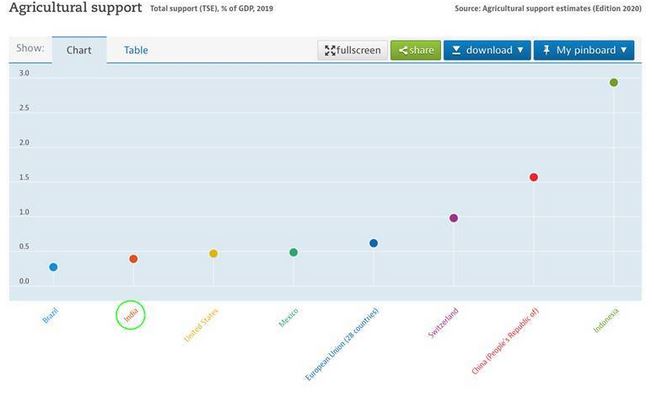
    The OECD (Organisation for Economic Co-operation and Development) has provided five sets of data on the issue of agriculture support and India trails on most counts:

    The ongoing debate about farmers protest has brought to light some of the key support mechanisms for agriculture in India. And it is being argued that the government has preferred the welfare of Indian consumers over the Indian farmers.

    Lets’ have a look at various OECD’s parameters:

    (1) Producer Support Estimates (PSE)

    • These are transfers to agricultural producers and are measured at the farm gate level.
    • They comprise market price support, budgetary payments and the cost of revenue foregone.

    (2) Consumer Support Estimates (CSE)

    • These refer to transfers from consumers of agricultural commodities. They are measured at the farm gate level.
    • If negative, the CSE measures the burden (implicit tax) on consumers through market price support (higher prices), that more than offsets consumer subsidies that lower prices to consumers.

     (3) General Services Support Estimates (GSSE)

    • GSSE transfers are linked to measures creating enabling conditions for the primary agricultural sector through the development of private or public services, institutions and infrastructure.
    • GSSE includes policies where primary agriculture is the main beneficiary but does not include any payments to individual producers.
    • GSSE transfers do not directly alter producer receipts or costs or consumption expenditure.

    (4) Total Support Estimate (TSE)

    • The TSE transfers represent the total support granted to the agricultural sector, and consist of producer support (PSE), consumer support (CSE) and general services support (GSSE).

    (5) Producer protection

    • Lastly, the OECD also provides data on “producer protection”.
    • The PP is the ratio between the average price received by producers (measured at the farm gate), including net payments per unit of current output, and the border price (measured at the farm gate).
    • For instance, a coefficient of 1.10, which China has, suggests that farmers, overall, received prices that were 10% above international market levels.
  • Foreign Policy Watch: India-China

    Reading the new US policy on Tibet

    Note4Students

    From UPSC perspective, the following things are important:

    Prelims level: Not Much

    Mains level: TIbetan issue and its political recognition

    The Tibet Policy and Support Act (TPSA) passed by the US Senate earlier this week, bookends a turbulent year in US-China relations.

    Must read:

    Tibetan Policy and Support Act (TPSA)

    Do you think that India’s support for the Tibetan cause is the root cause of all irritants in India-China relations?

    TPSA: A backgrounder

    • The TPSA is an amended version of the Tibet Policy Act of 2002, which came into existence during the Bush Administration.
    • The act once signed into law would make it the official policy of the US Government to oppose any effort by the govt. of the People’s Republic of China to select, educate, and venerate Tibetan Buddhist religious leaders in a manner inconsistent with Tibetan Buddhism.
    • The proposed legislation will empower the US Government to impose sanctions on China who might try to interfere in the process of selecting the next incarnation of the Dalai Lama.

    US and China, today

    • US-China relations have become much more difficult over the last two decades, particularly worsening in the Trump Administration.
    • The matters range from the pandemic to trade tariffs and its cross-world coalition-building against Chinese superpower ambitions.
    • Earlier in the year, President Donald Trump signed into law the Hong Kong Autonomy Act.

    Fuelled by TPSA

    • Adding much fuel to the issue, the TPSA introduces stronger provisions on Tibet, plus teeth in the form of a threat of sanctions, including travel bans on Chinese officials.

    The Dalai Lama

    • Among the most significant amendments is that the TSPA makes it US policy to oppose attempts by Beijing to install its own Dalai Lama in a manner inconsistent with Tibetan Buddhism.
    • The legislation makes reference to the Chinese government’s ‘Measures on the Management of the Reincarnation of Living Buddhas’ in 2007.
    • China had earlier insisted that the reincarnation of living Buddhas including the Dalai Lama must comply with Chinese laws and regulations.

    Other provisions of TPSA

    • The TPSA has introduced provisions aimed at protecting the environment of the Tibetan plateau, calling for greater international cooperation and greater involvement by Tibetans.
    • Alleging that China is diverting water resources from Tibet, the TPSA also calls for a regional framework on water security, or use existing frameworks… to facilitate cooperative agreements among all riparian nations.
    • While the 2002 Act said the US should establish a “branch office” in Lhasa, the TSPA ups the ante by changing that to a “consulate”.
    • It recognizes the Central Tibetan Administration, whose Prime Minister Lobsang Sangay takes credit for ensuring that the Senate took up the legislation for a vote.

    Chinese response to TPSA

    • China had earlier said the TPSA severely breached international law and basic norms governing international relations, interfered in China’s internal affairs, and sent a wrong message to ‘Tibet independence’ forces”.
    • After the passage of the Bill through the Senate, China said it “resolutely opposes” the “adoption of Bills containing such ill contents on China.

    India’s present stance on Tibet

    • If India is pleased with this latest US barb to China, it has not said so openly.
    • India has mostly refrained from playing the Tibet card against China, and like the US, has a one-China policy.
    • It was only this year, in the ongoing Ladakh standoff, that it used Special Forces made up almost entirely of Tibetan exiles to occupy strategic heights in Pangong Tso’s south bank.
  • Climate Change Negotiations – UNFCCC, COP, Other Conventions and Protocols

    World to breach 1.5°C threshold by 2027-2042

    Note4Students

    From UPSC perspective, the following things are important:

    Prelims level: GCM, Cancun COP

    Mains level: 1.5 C debate

    The planet will breach the threshold of 1.5 degrees Celsius above pre-industrial levels between 2027 and 2042 according to new research.

    Ever wondered why is there so much of hue to halt the temperature rise at 1.5°C above pre-industrial levels, and why not 2°C? Read this newscard to get aware….

    What does that mean?

    • The world will heat up more than it can take much earlier than anticipated.
    • The Intergovernmental Panel on Climate Change (IPCC) had estimated that breach to occur between now and 2052.
    • But researchers have now claimed to have introduced a more precise way to project the Earth’s temperature based on historical climate data.

    The fuss over 1.5°C threshold

    • For decades, researchers argued the global temperature rise must be kept below 2C by the end of this century to avoid the worst impacts.
    • The idea of two degrees as the safe threshold for warming evolved over a number of years from the first recorded mention by economist William Nordhaus in 1975.
    • By the mid-1990s, European ministers were signing up to the two-degree limit, and by 2010 Cancun COP it was official UN policy.
    • However, small island states and low-lying countries were very unhappy with this perspective, because they believed it meant their territories would be inundated with sea-level rise.
    • They commissioned research which showed that preventing temperatures from rising beyond 1.5C would give them a fighting chance.

    Why 1.5°C is preferred over 2°C?

    • Global warming is already impacting people and ecosystems. The risks at 1.5°C and 2°C are progressively higher.
    • There will be worse heatwaves, drought and flooding at 2°C compared to 1.5°C. It is characterized as “substantial differences in extremes”.
    • Sea levels are expected to rise 10cm higher this century under 2°C of warming than 1.5°C.
    • The collapse of ice sheets in Greenland and Antarctica could lead to rises of several metres.
    • The quantity and quality of staple crops suffer under 2°C warming compared to 1.5C, as do livestock. That is bad for the availability of food in many parts of the world.

    New model shows the breach in threshold

    • The study according to which prediction model deployed reduced uncertainties by half compared to the approach used by the IPCC.
    • The IPCC uses the General Circulation Models (GCM) to express wide ranges in overall temperature projections.
    • This makes it difficult to circle outcomes in different climate mitigation scenarios.

    What is the General Circulation Model (GCM)?

    • GCM represents physical processes in the atmosphere, ocean, cryosphere and land surface.
    • It is the most advanced tool currently available for simulating the response of the global climate system to increasing greenhouse gas concentrations.
    • GCMs depict the climate using a three-dimensional grid over the globe, typically having a horizontal resolution of between 250 and 600 km.
    • Many physical processes, such as those related to clouds, also occur at smaller scales and cannot be properly modelled.

    Why GCM is tricky?

    • Climate models are mathematical simulations of different factors that interact to affect Earth’s climate, such as the atmosphere, ocean, ice, land surface and the sun.
    • The data is tricky, and predictions can more often than not be inaccurate.
    • For example, an IPCC model would predict a temperature increase of a massive range — between 1.9oC and 4.5oC — if carbon dioxide in the atmosphere is doubled.

    Back2Basics: Intergovernmental Panel on Climate Change

    • The IPCC is an intergovernmental body of the United Nations that is dedicated to providing the world with an objective, scientific information relevant to understanding the scientific basis of the risk of human-induced climate change.
    • It was established in 1988 by the World Meteorological Organization (WMO) and the United Nations Environment Programme (UNEP).
    • Its membership is open to all members of the WMO and UN.
    • The IPCC produces reports that contribute to the work of the United Nations Framework Convention on Climate Change (UNFCCC), the main international treaty on climate change.
    • The IPCC’s Fifth Assessment Report was a critical scientific input into the UNFCCC’s Paris Agreement in 2015.