💥UPSC 2026, 2027, 2028 UAP Mentorship (March Batch) + Access XFactor Notes & Microthemes PDF

Type: PIB

  • Wildlife Conservation Efforts

    [pib] Fauna of India Checklist Portal

    Note4Students

    From UPSC perspective, the following things are important:

    Prelims level: Fauna of India Checklist Portal, ZSI

    Why in the News?

    • The Union Minister of Environment, Forest, and Climate Change (MoEFCC) has launched a portal documenting all animal species in India.
      • The Portal was launched on the 109th Foundation Day of the Zoological Survey of India (ZSI) in Kolkata.

    Back2Basics: Zoological Survey of India

    • The ZSI was set up by British zoologist Thomas Nelson Annandale, in 1916.
    • It is the premier taxonomic research organisation in India based in Kolkata.
    • It was established to promote surveys, exploration and research leading to the advancement of our knowledge of various aspects of the exceptionally rich animal life of India.
    • The ZSI had its genesis as the Zoological Section of the Indian Museum at Calcutta in 1875.
    • Since its inception, the ZSI has been documenting the diversity and distribution of the fauna of India towards carrying out its mandate of conducting exploration-cum-taxonomic-research programmes.
    • The ZSI has published an extremely large amount of information on all animal taxa, from Protozoa to Mammalia.

    About the Fauna of India Checklist Portal

    • The portal consists of records of more than 100,000 animal species, prepared by over 150 scientists of the Zoological Survey of India (ZSI) over two years.
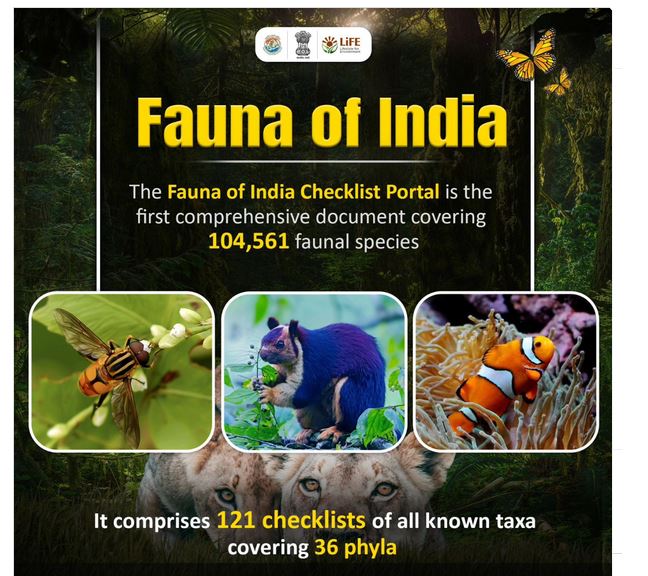
    • This checklist is the first comprehensive document on faunal species in India, covering 121 checklists of all known taxa across 36 phyla, including endemic, threatened, and scheduled species.
    • It is a compilation of all animal species recorded in India since the 1750s, including endemic, threatened, and scheduled species.
    • It provides essential data for conservation and management efforts, forming the basis for all biological sciences.
    • Significance of Portal: 
      • With this, India has become the first country to prepare a checklist of its entire fauna, covering 104,561 species, positioning itself as a global leader in biodiversity conservation.
      • The comprehensive documentation of India’s fauna aligns with Mission LiFE by providing crucial data for biodiversity conservation.

    Details from the ZSI Report

    • A 2023 ZSI report highlights that India is one of the world’s 17 megadiverse nations, hosting around 7-8% of the world’s documented species and containing four of the 34 globally recognised biodiversity hotspots.
    • The report lists 641 discoveries made by scientists and experts from India during 2023 with Kerala topping the list, followed by West Bengal.
    • It includes 442 new species globally and 199 newly recorded species in India.

    Significant Discoveries in 2023

    • New Species: The 2023 findings include 112 hymenopterans, 86 arachnids, 47 new fishes, 20 reptiles, and two mammals.
    • New Mammals: An ibex species found in Himachal Pradesh and Ladakh, named Capra himalayensis, and a new bat species, Miniopterus srinii, was discovered in Kodagu district, Karnataka.
    • State Rankings: Kerala recorded the highest number of new discoveries with 101, followed by West Bengal with 72, Tamil Nadu with 62, and Arunachal Pradesh and Karnataka with 45 each.

    About Mission LiFE

    • Mission LiFE, or Lifestyle for Environment, is a global mass movement initiated by India to encourage individual and community action towards environmental protection and preservation.
    • It was inaugurated by the PM Modi at the 26th UN Climate Change Conference of the Parties (COP26) in Glasgow in November 2021.
    • The program aims to mobilise one billion Indians and individuals worldwide to adopt sustainable lifestyles.
    • It aligns with the P3 model, promoting Pro Planet People and fostering a sense of collective responsibility.
    • It operates based on the principles of ‘Lifestyle of the planet, for the planet, and by the planet’.


    PYQ:

    [2020] With reference to India’s Biodiversity, Ceylon frogmouth, Coppersmith barbet, Gray-chinned minivet and White-throated redstart are:

    (a) Birds

    (b) Primates

    (c) Reptiles

    (d) Amphibians

  • Indian Navy Updates

    [pib] INS Sunayna in Port Victoria, Seychelles

    Note4Students

    From UPSC perspective, the following things are important:

    Prelims level: INS Sunayna, SAGAR Doctrine

    Why in the News?

    • INS Sunayna, an Offshore Patrol Vessel based at Southern Naval Command, entered Port Victoria, Seychelles.
      • The ship will undertake joint EEZ surveillance with the Seychelles Coast Guard during the deployment.
      • The visit is aimed at further strengthening mutual cooperation in line with the vision of SAGAR (Security & Growth for All in the Region).

    About INS Sunayna

    • INS Sunayna is the second Saryu-class patrol vessel of the Indian Navy launched in 2009.
    • It was designed and constructed indigenously by the Goa Shipyard Limited.
    • It is designed to undertake fleet support operations, coastal and offshore patrolling, ocean surveillance and monitoring of sea lines of communications and offshore assets and escort duties.

    Key operations undertaken

    • In June 2018 she was deployed to Yemen’s Socotra Island as part of “Operation Nistar“, an HADR mission to evacuate around 38 stranded Indian nationals in/around Socotra after a cyclone hit the area.
    • INS Sunayna, along with INS Chennai, was sent to the Persian Gulf and Gulf of Oman in June 2019 to protect Indian shipping interests amid tensions in the Strait of Hormuz.

    Back2Basics: SAGAR Strategy

    • SAGAR stands for “Security and Growth for All in the Region.”
    • It is a strategic policy framework initiated by India in 2015, designed to enhance its engagement with countries in the Indian Ocean Region (IOR) and neighbouring islands.

    The primary objectives of SAGAR include:

    1. Security: Ensuring the safety and protection of India’s land and maritime territories, as well as its national interests in the IOR.
    2. Economic Growth: Promoting sustainable economic growth and development through collaborative efforts with IOR littoral states. This includes initiatives in marine biotechnology, ocean mineral resources, sustainable fishing practices, and ocean energy.
    3. Disaster Management: Facilitating collective action and providing assistance to IOR countries during natural disasters, thereby fostering regional cooperation and goodwill.
    4. Sustainable Development: Supporting initiatives for sustainable regional development, including marine research, eco-friendly industrial technologies, and the conservation of the maritime environment.


    PYQ:

    [2022] What are the maritime security challenges in India? Discuss the organisational, technical and procedural initiatives taken to improve maritime security.

    [2017] Consider the following in respect of the Indian Ocean Naval Symposium (IONS):

    1. Inaugural IONS was held in India in 2015 under the chairmanship of the Indian Navy.

    2. IONS is a voluntary initiative that seeks to increase maritime cooperation among navies of the littoral states of the Indian Ocean Region.

    Which of the statements given above is/are correct?

    (a) 1 only

    (b) 2 only

    (c) Both 1 and 2

    (d) Neither 1 nor 2

  • Artificial Intelligence (AI) Breakthrough

    [pib] Sangam: Digital Twin Initiative enters Stage I

    Note4Students

    From UPSC perspective, the following things are important:

    Prelims level: Sangam Digital Twin Initiative, Digital Twin Technology

    Why in the news?

    The Department of Telecommunications (DoT) has unveiled the selected participants for Stage I of the ‘Sangam: Digital Twin with AI-Driven Insights Initiative’.

    What is Digital Twin Technology?

    • A digital twin is a digital representation of a physical object, person, or process, contextualized in a digital version of its environment.
    • Digital twins can help an organization simulate real-time situations and their outcomes, ultimately allowing it to make better decisions.

    About Sangam: Digital Twin Initiative

    • Launched in February 2024, it aligns with the past decade’s technological advancements in communication, computation, and sensing, in line with the vision for 2047.
    • Department of Telecommunications (DoT) will begin this with a campaign to engage potential participants, including industry experts, academia, and other relevant stakeholders to spread awareness and interest wide.
    • It is a Two-stage Initiative: It will be distributed in two stages, and conducted in one of India’s major cities.
      1. First Stage: An exploratory phase focusing on clarifying horizons and creative exploration to unleash potential.
      2. Second Stage: A practical demonstration of specific use cases, generating a future blueprint for collaboration and scaling successful strategies in future infrastructure projects.
    • Objectives:
      1. To demonstrate practical implementation of innovative infrastructure planning solutions.
      2. To develop a Model Framework for facilitating faster and more effective collaboration.
      3. To provide a future blueprint for scaling and replicating successful strategies in future infrastructure projects.

    Features: It represents a collaborative leap towards reshaping infrastructure planning and design.

    • It integrates 5G, IoT, AI, AR/VR, AI native 6G, Digital Twin, and next-gen computational technologies, fostering collaboration among public entities, infrastructure planners, tech giants, startups, and academia.
    • Sangam brings all stakeholders together, aiming to translate innovative ideas into tangible solutions, bridging the gap between conceptualization and realization, and paving the way for groundbreaking infrastructure advancements.

    PYQ:

    [2020] In India, the term “Public Key Infrastructure” is used in the context of:

    (a) Digital security infrastructure

    (b) Food security infrastructure

    (c) Health care and education infrastructure

    (d) Telecommunication and transportation infrastructure

  • Air Pollution

    [pib] Sub-Committee for GRAP reviews the Air Quality scenario in New Delhi

    Note4Students

    From UPSC perspective, the following things are important:

    Prelims level: GRAP and its implementation, AQI;

    Why in the News?

    • Delhi’s Air Quality Index (AQI) registered at 243, falling under the ‘Poor’ category, as reported by the Central Pollution Control Board (CPCB).
      • In response to this, the Sub-Committee under the Commission for Air Quality Management in NCR & Adjoining Areas (CAQM) convened to assess the situation and strategize under the Graded Response Action Plan (GRAP).

    About Graded Response Action Plan (GRAP)

    • The GRAP was conceived as a response to the alarming findings of a WHO study in 2014, which ranked Delhi as the most polluted city globally.
    • It is a framework designed to combat air pollution in the Delhi-NCR region.
    • The Supreme Court (M. C. Mehta vs. Union of India Case, 2016) approved GRAP after multiple expert consultations.
    • First GRAP was notified in January 2017 by the Ministry of Environment, Forest and Climate Change.

    Implementation of GRAP:

    • The Commission for Air Quality Management in NCR & Adjoining Areas (CAQM) took over the responsibility of implementing GRAP in 2021.
    • Before 2021, the SC appointed Environment Pollution (Prevention and Control) Authority (EPCA) would instruct states to enforce GRAP measures.
    • The CAQM recommendations depend on the Air Quality Index (AQI) and meteorological predictions provided by the Indian Institute of Tropical Meteorology (IITM) and the India Meteorological Department (IMD).

    Revised measures to implement:

    Air Quality Stage AQI Range Measures to be implemented
    Stage I (Poor) 201-300 Enforce NGT/Supreme Court’s order on over-aged diesel/petrol vehicles.
    Stage II (Very Poor) 301-400 Implement rigorous actions to combat air pollution at identified hotspots.
    Stage III (Severe) 401-450 Impose strict restrictions on BS III petrol and BS IV diesel vehicles. Suspend physical classes in schools for primary grade children up to Class 5 in certain areas.
    Stage IV (Severe Plus) >450 Prohibit the entry of four-wheelers registered outside Delhi, except for electric vehicles, CNG vehicles, and BS-VI diesel vehicles.


    Current Air Quality Scenario: Factors Contributing 

    • The GRAP sub-committee noted the following natural causes exacerbating dust suspension across the National Capital Region (NCR):
    1. Fluctuating wind patterns,
    2. Higher convection rates, and
    3. Arid weather conditions.
    • Additionally, increased instances of agricultural residue burning and forest fires in neighboring states were identified as potential contributors to deteriorating air quality.

    Action Plan suggested by GRAP Sub-Committee

    • Intensive Drives at Pollution Hotspots: The concerned Pollution Control Boards (PCBs) and NCR committees were tasked with conducting rigorous inspections at major pollution hotspots, prioritizing dust abatement measures.
    • Enhanced Dust Control Measures: Measures such as increased deployment of water sprinklers and mechanical road sweeping equipment were recommended to mitigate dust levels.
    • Preventing Open Burning: Vigilance against instances of open burning, including municipal solid waste (MSW) and agricultural residue, was emphasized to curb further pollution.
    • Strict Enforcement: Dust Control & Management Cells (DCMCs) and enforcement teams were instructed to intensify monitoring and enforcement efforts at construction sites and road projects.
    • Inspections and Compliance: Flying Squads of CPCB were directed to conduct thorough inspections and take appropriate action against violators of environmental regulations.

    PYQ:

    [2016] In the cities of our country, which among the following atmospheric gases are normally considered in calculating the value of Air Quality Index?

    1. Carbon dioxide

    2. Carbon monoxide

    3. Nitrogen dioxide

    4. Sulphur dioxide

    5. Methane

    Select the correct answer using the codes given below:

    (a) 1, 2 and 3 only

    (b) 2, 3 and 4 only

    (c) 1, 4 and 5 only

    (d) 1, 2, 3, 4 and 5

  • Tourism Sector

    [pib] IMEX 2024, Frankfurt 

    Note4Students

    From UPSC perspective, the following things are important:

    Prelims level: IMEX-2024

    Why in the News?

    The Union Ministry of Tourism is actively engaging in IMEX, Frankfurt to position India as a premier MICE destination on the International stage.

    Back2Basics: IMEX

    • IMEX is an international trade show for the meetings, events, and incentive travel industry.
    • It stands for “International Meeting Exchange” and is held annually in Frankfurt, Germany.
    • It was established in the year 2001.
    • IMEX provides a platform for professionals in the global events industry to network, conduct business, and gain insights into the latest trends and innovations in event planning and management.
    • IMEX hosts two major annual events:
    1. IMEX America in Las Vegas and
    2. IMEX in Frankfurt, Germany.
    • These events are significant for facilitating connections within the industry, offering extensive educational opportunities, and showcasing industry innovations.

    What is MICE Tourism?

    • MICE Tourism refers to “Meetings, Incentives, Conferences, and Exhibitions,” representing a sector of the travel industry specializing in the planning and booking of logistics for large and small-scale corporate events.
      • Meetings: Involves small to large gatherings where business topics and are organized to discuss and exchange information.
      • Incentives: Involves company-organized trips as rewards or incentives to employees or partners to motivate them or reward them for their performance.
      • Conferences: These are large gatherings focused on particular topics, where participants discuss issues of mutual interest.
      • Exhibitions: Also known as expos, these events are where businesses showcase and demonstrate their new products and services.
    • This sector is highly valued for its contribution to the economic development of a region by bringing in significant numbers of visitors, who then utilize various services such as hotels, restaurants, and other amenities.

    India’s Focus on MICE Tourism:

    • Addressing Seasonality: The Ministry of Tourism has identified MICE tourism as a niche sector to mitigate the issue of seasonality and promote India as a year-round destination for international travelers.
    • Meet in India Initiative: Under the umbrella of the ‘Incredible India’ campaign, the Ministry has launched the ‘Meet in India’ sub-brand, aimed at showcasing India’s robust MICE infrastructure, connectivity, and diverse tourist attractions to a global audience.

    Success Stories and Global Recognition:

    • G20 Presidency Impact: India’s G20 Presidency witnessed over 200 meetings in 56 cities nationwide, showcasing the country’s strong MICE infrastructure and cultural heritage to the world.
    • Enhanced Global Visibility: Through these initiatives, India has gained prominence as a premier global hub for MICE activities, attracting increased tourism and business opportunities both domestically and internationally.
    • ICCA Ranking: India’s efforts have been recognized internationally, positioning the country at the 9th rank in the ICCA (International Congress and Convention Association) ranking of countries in the Asia Pacific region in 2022.


    PYQ:

    [2017] The term ‘Digital Single Market Strategy’ seen in the news refers to-

    (a) ASEAN

    (b) BRICS

    (c) EU

    (d) G20

  • Coal and Mining Sector

    [pib] Critical Minerals Summit

    Note4Students

    From UPSC perspective, the following things are important:

    Prelims level: Critical Minerals, Mineral Security Partnership (MSP)

    Mains level: NA

    Why in the news?

    The Ministry of Mines has organized a pivotal summit in New Delhi aimed at fostering collaboration, sharing knowledge, and driving innovation in Critical Mineral beneficiation and processing.

    What are Critical Minerals?

    • Critical Minerals are indispensable for economic development and national security, with their scarcity or concentration in specific regions posing potential supply chain vulnerabilities.
    • The declaration and identification of Critical Minerals is an ongoing process, influenced by technological advancements, market dynamics, and geopolitical factors.

    Critical Minerals in India:

    • India has identified 30 Critical Minerals (July 2023) based on factors like disruption potential, import reliance, and cross-sectoral usage.
      • Antimony, Beryllium, Bismuth, Cobalt, Copper, Gallium, Germanium, Graphite, Hafnium, Indium, Lithium, Molybdenum, Niobium, Nickel, PGE, Phosphorous, Potash, Rare Earth Elements, Rhenium, Silicon, Strontium, Tantalum, Tellurium, Tin, Titanium, Tungsten, Vanadium, Zirconium, Selenium and Cadmium.

    Critical Minerals

    Global Perspective:

    Various nations have outlined their lists of Critical Minerals based on unique circumstances:

    • The US recognizes 50 minerals critical for national security and economic development.
    • Japan has identified 31 minerals crucial for its economy.
    • The UK, EU, and Canada have their respective lists, reflecting their strategic priorities.

    India became the 14th member of the Mineral Security Partnership (MSP) in June 2023. 

    • MSP seeks to bolster critical minerals supply chains to support economic prosperity and climate objectives.
    • It seeks to ensure that critical minerals are produced, processed and recycled by catalyzing investments from governments and private sector across the full value chain.
    • Members: The other member countries are United States, Australia, Canada, Finland, France, Germany, Italy, Japan, Norway, the Republic of Korea, Sweden, the United Kingdom and the European Commission.

    Note: Copper, gold and silver are not on the list of minerals under MSP (Wiki).

    Various Government Initiatives:

    • MMDR Act Amendment (2023):   24 minerals were designated as critical and strategic under the Mines and Minerals (Development and Regulation) Act.
    • National Mineral Policy (2019): The updated policy emphasizes the exploration and exploitation of Critical Minerals to harness India’s mineral potential effectively.
    • Khanij Bidesh India Ltd (KABIL): A joint venture comprising National Aluminium Company Ltd (NALCO), Hindustan Copper Ltd (HCL), and Mineral Exploration Corporation Ltd (MECL), KABIL aims to secure a consistent supply of Critical Minerals by acquiring and developing assets overseas.
    • Indian Rare Earths Limited (IREL): It is a PSU that plays a significant role in the research and production of rare earth minerals.

    India’s Critical Mineral Imports:

    • Lithium Imports: In FY23, India imported 2,145 tonnes of lithium carbonate and lithium oxide, costing Rs 732 crore.
    • Nickel and Copper Imports: The country imported 32,000 tonnes of unwrought nickel and 1.2 million tonnes of copper ore, costing Rs 6,549 crore and Rs 27,374 crore, respectively.
    • Import Dependence: India relies entirely on imports for lithium and nickel, and 93% for copper.

    Country-wise dependence:

    1. China: India heavily relies on China for the import of critical minerals like lithium, cobalt, nickel, and graphite.
    2. Australia: India is actively engaged with Australia for acquiring mineral assets, particularly lithium and cobalt, to secure its supply chain for critical minerals.
    3. Argentina, Bolivia, and Chile: India is engaging with these countries, known for their reserves of battery metals like lithium and cobalt, to diversify its sources for critical minerals.


    PYQ:

    [2019] With reference to the management of minor minerals in India, consider the following statements:

    1. Sand is a ‘minor mineral’ according to the prevailing law in the country.
    2. State governments have the power to grant mining leases of minor minerals, but the powers regarding the formation of rules related to the grant of minor minerals lie with the Central Government.
    3. State Governments have the power to frame rules to prevent illegal mining of minor minerals.

    Which of the statements given above is/are correct?

    (a) 1 and 3

    (b) 2 and 3

    (c) 3 only

    (d) 1, 2 and 3

  • Indian Navy Updates

    [pib] Launching of LSAM 20 (Yard 130)  

    Note4Students

    From UPSC perspective, the following things are important:

    Prelims level: LSAM 20;

    Mains level: NA

    Why in the News?

    The Indian Navy has inducted the ‘Ammunition Cum Torpedo Cum Missile Barge, LSAM 20 (Yard 130) into its fleet.

    What is LSAM 20?

    • LSAM 20 (Yard 130) is the Ammunition Cum Torpedo Cum Missile Barge (Storage) inducted by the Indian Navy.  (built by MSME Shipyard, M/s Suryadipta Projects Pvt Ltd, Thane).
    • LSAM 20 facilitates transportation, embarkation, and disembarkation of articles/ammunition to IN Ships.
    • These Barges are indigenously designed and built under relevant Naval Rules and Regulations of the Indian Register of Shipping.

    Objective 

    • A Torpedo Cum Missile Barge is a specialized vessel used by the Indian Navy to transport various types of ammunition, torpedoes, and missiles to operational areas.
    • These barges play a crucial role in providing logistical support to naval vessels by ensuring the uninterrupted transportation of essential military supplies. 

    PYQ:

    [2016] Which one of the following is the best description of ‘INS Astradharini’, that was in the news recently?

    (a) Amphibious warfare ship

    (b) Nuclear-powered submarine

    (c) Torpedo launch and recovery vessel

    (d) Nuclear-powered aircraft carrier

  • Tax Reforms

    [pib] Net Direct Tax collections exceed 2023-24 target

    Note4Students

    From UPSC perspective, the following things are important:

    Prelims level: Direct Taxes and its types

    Mains level: NA

    Why in the news?

    • India’s net direct tax collections witnessed a remarkable growth of 17.7% in the fiscal year 2023-24, reaching ₹19.58 lakh crore.
      • This performance indicates a strong revenue stream for the government.

    Direct Tax Collections Trends in this Fiscal

    • Notably, Personal Income Taxes (PIT) played a pivotal role in driving the surge, accounting for 53.3% of the total tax kitty, up from 50.06% in the previous year.
    • Conversely, the contribution of corporate taxes dipped to 46.5% from 49.6% in the preceding fiscal.
    • While gross corporate tax collections increased, net tax receipts from Corporates, adjusted for refunds, experienced a slight decline.

    What Is Net of Tax?

    The term net of tax refers to the amount left after adjusting for the effects of taxes. Net of tax can be a consideration in any situation where taxation is involved. In the financial industry, ‘gross’ and ‘net’ are two key terms that refer to before and after paying certain expenses.

    It’s Significance:

    • Individuals and businesses often analyze before and after-tax values to make investment and purchasing decisions.
    • Net tax is also an important part of expense analysis when reviewing annual tax filings and the net income of businesses.

    Types of Direct Taxes:

    • Income Tax: Depending on an individual’s age and earnings, income tax must be paid. Various tax slabs are determined by the Government of India which determines the amount of Income Tax that must be paid.
      • The taxpayer must file Income Tax Returns (ITR) on a yearly basis. Individuals may receive a refund or might have to pay a tax depending on their ITR. Huge penalties are levied in case individuals do not file ITR.
    • Wealth Tax: The tax must be paid on a yearly basis and depends on the ownership of properties and the market value of the property. In case an individual owns a property, wealth tax must be paid and does not depend on whether the property generates an income or not.
      • Corporate taxpayers, Hindu Undivided Families (HUFs), and individuals must pay wealth tax depending on their residential status.
      • Payment of wealth tax is exempt for assets like gold deposit bonds, stock holdings, house property, commercial property that have been rented for more than 300 days, and if the house property is owned for business and professional use.
    • Estate Tax: It is also called an Inheritance Tax and is paid based on the value of the estate or the money that an individual has left after his/her death.
    • Corporate Tax: Domestic companies, apart from shareholders, will have to pay corporate tax. Foreign corporations who make an income in India will also have to pay corporate tax. Income earned via selling assets, technical service fees, dividends, royalties, or interest that is based in India are taxable. The below-mentioned taxes are also included under Corporate Tax:
      • Securities Transaction Tax (STT): The tax must be paid for any income that is earned via taxable security transactions.
      • Dividend Distribution Tax (DDT): In case any domestic companies declare, distribute, or are paid any amounts as dividends by shareholders, DDT is levied on them. However, DDT is not levied on foreign companies.
      • Fringe Benefits Tax: Companies that provide fringe benefits for maids, drivers, etc., Fringe Benefits Tax is levied on them.
      • Minimum Alternate Tax (MAT): For zero-tax companies that have accounts prepared according to the Companies Act, MAT is levied on them.
    • Capital Gains Tax: It is a form of direct tax that is paid due to the income that is earned from the sale of assets or investments. Investments in farms, bonds, shares, businesses, art, and home come under capital assets.
      • Based on its holding period, tax can be classified into long-term and short-term. Any assets, apart from securities, that are sold within 36 months from the time they were acquired come under short-term gains.
      • Long-term assets are levied if any income is generated from the sale of properties that have been held for a duration of more than 36 months.

    PYQ:

    [2014] The sales tax you pay while purchasing a toothpaste is a

    (a) Tax imposed by the Central Government

    (b) Tax imposed by the Central Government but collected by the State Government

    (c) Tax imposed by the State Government but collected by the Central Government

    (d) Tax imposed and collected by the State Government

  • Innovations in Biotechnology and Medical Sciences

    [pib] Project ANAGRANINF

    Note4Students

    From UPSC perspective, the following things are important:

    Prelims level: Project ANAGRANINF, AMR

    Mains level: NA

    What is the news?

    • The Technology Development Board (TDB) has allocated a grant of ₹75 Lakhs for the project “ANAGRANINF – Development of a Novel Class of Antibiotics against Gram-Negative Bacterial-Infections,” totalling ₹1.5 crores.

    What is Project ANAGRANINF?

    • Project ANAGRANINF is titled “Development of a Novel Class of Antibiotics Against Gram-Negative Bacterial-Infections.”
    • It is a collaborative initiative involving M/s Peptris Technologies Pvt. Ltd. and the Foundation for Neglected Disease Research (FNDR) in India, along with ABAC THERAPEUTICS SL from Spain.
    • The primary objective of the project is-
    1. To develop a novel antibiotic capable of inhibiting the FabI enzyme and
    2. Combating critical gram-negative pathogens.
    • Project ANAGRANINF aims to produce a series of compounds with enhanced efficacy against gram-negative bacterial infections.
    • The project aims to identify a candidate molecule that meets WHO’s innovation criteria, ensuring a new chemical structure, no cross-resistance with existing antibiotic classes, and a novel mechanism of action.

    About the Candidate Molecule ‘MMV1578564’

    The selected hit molecule from the project, MMV1578564, has exhibited promising activity against gram-negative pathogens, providing a foundation for further research and development efforts.


    Back2Basics:

    1. Gram-Negative Bacteria:
      • Gram-negative bacteria have a thin peptidoglycan layer in their cell wall, which is located between the outer and inner membranes.
      • They stain pink or red when subjected to the Gram staining technique.
      • Gram-negative bacteria are generally more resistant to antibiotics due to the presence of an outer membrane that acts as a barrier against certain antibiotics.
      • Examples of gram-negative bacteria include Escherichia coli (E. coli), Salmonella spp., Pseudomonas aeruginosa, and Neisseria gonorrhoeae.
      • They are known to cause infections like pneumonia, bloodstream infections, wound infections, and meningitis in healthcare settings
    2. Gram-Positive Bacteria:
      • Gram-positive bacteria have a thick layer of peptidoglycan in their cell wall, which retains the crystal violet stain used in the Gram staining technique.
      • They appear purple or blue under a microscope after staining.
      • Gram-positive bacteria are generally more susceptible to antibiotics because their thick peptidoglycan layer allows antibiotics to penetrate more easily.
      • Examples of gram-positive bacteria include Staphylococcus aureus, Streptococcus pneumoniae, Bacillus subtilis, and Clostridium difficile.
      • Some examples of diseases caused by Gram-positive bacteria include anthrax, diphtheria, enterococcal infections, erysipelothricosis, and listeriosis.These bacteria can cause a range of infections from food poisoning to serious respiratory diseases and may require specific antibiotics for treatment.


    PYQ:

    2021: Consider the following:​

    1. Bacteria​
    2. Fungi​
    3. Virus​

    Which of the above can be cultured in artificial/synthetic medium?​

    1. 1 and 2 only ​
    2. 2 and 3 only​
    3. 1 and 3 only ​
    4. 1, 2 and 3​


    Practice MCQ:

    The recently launched Project ‘ANAGRANINF’ deals with:

    1. Agricultural Grant
    2. Artificial Intelligence
    3. Antibiotics Development
    4. None of these
  • Digital India Initiatives

    [pib] NIXI and MeitY to unveil BhashaNet Portal  

    Note4Students

    From UPSC perspective, the following things are important:

    Prelims level: BhashaNet Portal, Universal Acceptance Principle

    Mains level: NA

    What is the news-

    • The National Internet Exchange of India (NIXI) is proud to announce the launch of the BhashaNet portal for the upcoming Universal Acceptance (UA) Day.
    Universal Acceptance is the principle that all domain names and email addresses should be treated equally, regardless of the characters used in them.

     What is BhashaNet Portal?

    • The Bhasha-Net Portal is a digital platform launched by NIXI, aimed at promoting Universal Acceptance (UA).
    • The portal specifically focuses on ensuring that individuals, regardless of the language or script they use, can fully participate in the digital world.
    • The portal is designed to provide resources, tools, and information to support the integration of diverse languages and scripts into online platforms, websites, and applications.

    Objectives:

    1. To provide a truly multilingual internet, where local language website name and local language email id, work everywhere seamlessly.
    2. To foster digital inclusivity by addressing linguistic barriers and promoting the use of local languages and scripts in digital communication.

    About National Internet Exchange of India (NIXI)


    • Established on June 19, 2003, the NIXI is a not-for-profit organization under the auspices of MeitY.
    • NIXI is dedicated to enhancing internet penetration and adoption in India by facilitating essential infrastructure and services.
    • It plays a crucial role in enabling the internet ecosystem to be accessible and utilized by the masses, thereby promoting digital empowerment and inclusion nationwide.

    Four key services include-

    1.    Setting up Internet Exchange Points,

    2.    Managing the .IN Registry,

    3.    Promoting IPv4 and IPv6 address adoption through IRINN, and

    4.    Offering data center services under NIXI-CSC.


    Back2Basics:

    IPv4 IPv6
    Address Format 32-bit address format (e.g., 192.0.2.1) 128-bit address format (e.g., 2001:0db8:85a3:0000:0000:8a2e:0370:7334)
    Address Representation Decimal dotted notation (e.g., 192.0.2.1) Hexadecimal colon-hex notation (e.g., 2001:0db8:85a3:0000:0000:8a2e:0370:7334)
    Address Space Limited address space (~4.3 billion addresses) Vast address space (approximately 3.4×10^38 addresses)
    Header Length Fixed-length header (20 bytes) Variable-length header (40 bytes or more)
    Header Options Limited options Expanded options for quality of service, security, and mobility
    Broadcast Uses broadcast addresses for network discovery and ARP (Address Resolution Protocol) Uses multicast addressing for efficient communication
    Security Limited built-in security features Built-in IPsec (Internet Protocol Security) support for end-to-end encryption and authentication
    Adoption Status Widely deployed and used Increasing adoption but not yet fully ubiquitous


    PYQ:

    2011: What is “Virtual Private Network”?

    1. It is a private computer network of an organization where the remote users can transmit encrypted information through the server of the organization
    2. It is a computer network across a public internet that provides users access to their organization’s network while maintaining the security of the information transmitted
    3. It is a computer network in which users can access a shared pool of computing resources through a service provider
    4. None of the statements (A), (B) and (C) given above is a correct description of Virtual Private Network