💥UPSC 2026, 2027, 2028 UAP Mentorship (March Batch) + Access XFactor Notes & Microthemes PDF

Type: Prelims Only

  • Global Geological And Climatic Events

    Shiveluch Volcano

    Note4Students

    From UPSC perspective, the following things are important:

    Prelims level: Shiveluch Volcano

    Why in the News?

    The Shiveluch Volcano in Russia erupted following a 7.0 magnitude earthquake off the country’s eastern coast.

    About Shiveluch Volcano

    Details
    Location
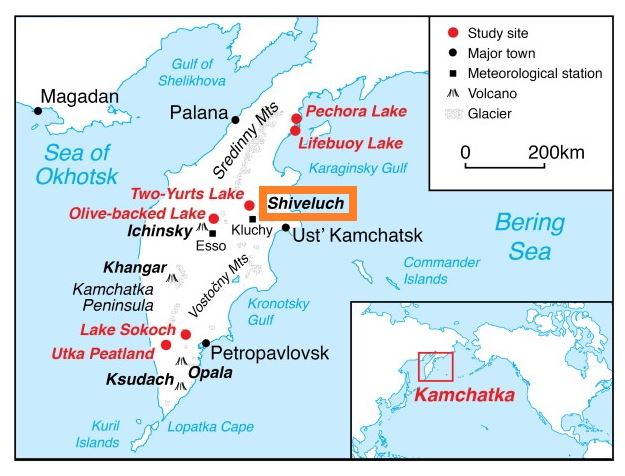
    • Kamchatka Peninsula, Russia
    • Approximately 56°39′N 161°21′E
    • Stratovolcano (Composite Volcano)
    • Approximately 3,283 meters (10,771 feet)
    Geological Features Large actively growing lava dome, andesitic to dacitic lava
    Eruption History Frequent eruptions; significant activity in 2005, 2010, and ongoing in 2023-2024
    Hazards Ash plumes, pyroclastic flows, lahars
    Kamchatka Peninsula
    • Lies in far eastern Russia, between the Sea of Okhotsk on the west and the Pacific Ocean and Bering Sea on the east.
    • One of the world’s most concentrated areas of geothermal activity, with about 30 active volcanoes.
    • Approximately 1,200 km long and 480 km across at its widest.
    • Climate: Severe, with prolonged, cold, and snowy winters and wet, cool summers.
    • Regional Capital: Petropavlovsk-Kamchatsky.
    • Kuril Island chain runs from the southern tip of the peninsula to near Japan’s northern Hokkaido Island.
  • Health Sector – UHC, National Health Policy, Family Planning, Health Insurance, etc.

    WHO investigating new Polio strain in Meghalaya

    Note4Students

    From UPSC perspective, the following things are important:

    Prelims level: Polio and its eradication

    Why in the News?

    The World Health Organization (WHO) is investigating a suspected new strain of polio in a two-year-old child from Tikrikilla, Meghalaya.

    What is Vaccine-Derived Polio?

    • The Oral Polio Vaccine (OPV) contains a weakened form of the poliovirus that activates an immune response in the body.
    • The vaccine-virus is excreted after vaccination and can circulate in the environment.
    • In rare cases, if the population is under-immunized, the excreted virus can mutate over time and revert to a form capable of causing paralysis.
    • This mutated virus is known as circulating vaccine-derived poliovirus (cVDPV).

    About Polio:

    Details
    Nature of Disease Crippling and potentially deadly viral infectious disease affecting the nervous system.
    Types of Poliovirus WPV1 (Wild Poliovirus type 1)
    WPV2 (Wild Poliovirus type 2, eradicated globally)
    WPV3 (Wild Poliovirus type 3, eradicated globally)
    Current Status WPV1 remains in circulation in Afghanistan and Pakistan.
    Transmission Primarily through the faecal-oral route or contaminated water/food.
    Affected Population Largely affects children under 5 years of age.
    Impact Virus multiplies in the intestine, may invade the nervous system, causing paralysis.
    Prevention No Cure: Preventable through immunization.
    Vaccines:
    OPV: Oral Polio Vaccine given at birth, with doses at 6, 10, 14 weeks, and a booster at 16-24 months.
    IPV: Injectable Polio Vaccine given with the 3rd dose of DPT under UIP.
    India’s Status
    • Pulse Polio Immunization Initiative (1995)
    • Declared polio-free by WHO in 2014, with the last wild poliovirus case reported in 2011.


    PYQ:

    [2016] ‘Mission Indradhanush’ launched by the Government of India pertains to:

    (a) immunization of children and pregnant women

    (b) construction of smart cities across the country

    (c) India’s own search for the Earth-like planets in outer space

    (d) New Educational Policy

  • International Space Agencies – Missions and Discoveries

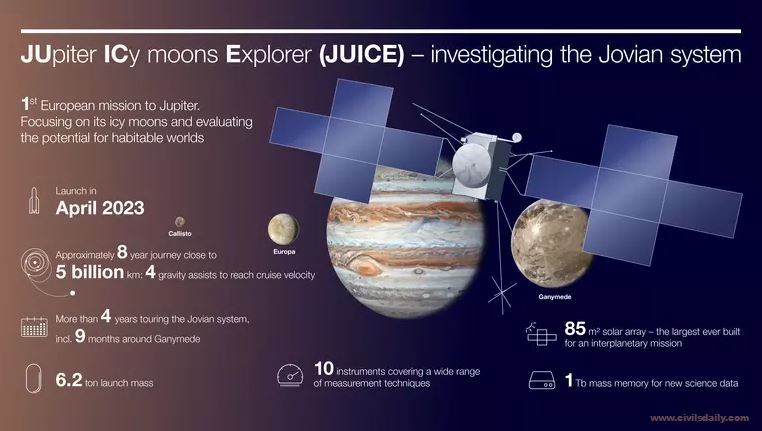
    Jupiter Icy Moons Explorer (JUICE) Mission

    Note4Students

    From UPSC perspective, the following things are important:

    Prelims level: JUICE Mission

    Why in the News?

    European scientists are preparing to execute a first-of-its-kind ‘Double Slingshot’ orbital maneuver to guide the JUICE probe towards Jupiter using a double slingshot technique.

    About JUICE Mission:

    Details
    Launch
    • By European Space Agency (ESA) on April 14, 2023, Ariane 5 rocket
    • To study Jupiter’s Moons
    Aim Investigating the potential for life on Jupiter’s moons and understanding the Jovian system
    Mission Duration
    • Approximately 12 years
    • Expected arrival at Jupiter in July 2031
    Primary Objectives
    • Ganymede Exploration: Study its surface, subsurface, magnetic field, and potential subsurface ocean to assess habitability.
    • Europa Exploration: Investigate the surface, subsurface, and potential ocean beneath the ice; analyze interactions with Jupiter’s magnetosphere to assess its potential to support life.
    • Callisto Exploration: Study its surface, geological diversity, and possible subsurface ocean; understand its history of impacts and tectonic activity.
    • Jupiter System Exploration: Analyze Jupiter’s atmosphere, magnetosphere, and their interactions with the moons; study the dynamics of the magnetosphere and its influence on the surrounding environment.
    Key Instruments
    • JANUS: Jovis, Amorum ac Natorum Undique Scrutator (Optical Camera)
    • RIME: Radar for Icy Moons Exploration
    • J-MAG: JUICE Magnetometer
    • MAJIS: Moons and Jupiter Imaging Spectrometer
    Significance
    • First interplanetary spacecraft to the outer Solar System planets not launched by the United States
    • First mission set to orbit a moon other than Earth’s Moon

    What is the Double Slingshot Maneuver?

    • The JUICE probe will first use the moon’s gravity to set itself on the correct trajectory towards Earth.
    • Immediately after, it will use Earth’s gravity to slow down and redirect towards Venus and, eventually, Jupiter.

    Significance of the Gravity Assist

    • This technique, used for decades in space exploration, involves using a planet or moon’s gravity to alter the speed or direction of a spacecraft.
    • It is unique as it involves back-to-back gravity assists using both the moon and Earth’s gravity, which has never been attempted before.

    PYQ:

    [2020] The experiment will employ a trio of spacecraft flying in formation in the shape of an equilateral triangle that has sides one million kilometres long, with lasers shining between the craft.” The experiment in question refers to

    (a) Voyager-2

    (b) New Horizons

    (c) LISA Pathfinder

    (d) Evolved LISA

  • Wildlife Conservation Efforts

    [pib] Schedule IV of the Wild Life (Protection) Act, 1972

    Note4Students

    From UPSC perspective, the following things are important:

    Prelims level: Schedule IV of the Wild Life (Protection) Act, 1972

    Why in the News?

    • Many individuals, organizations, and zoos in India currently possess living specimens of exotic animal species listed under Schedule IV of the Wild Life (Protection) Act, 1972.
      • These exotic species must be reported and registered as mandated by the Ministry of Environment, Forest and Climate Change in the PARIVESH 2.0 Portal.

    Legal Framework for Reporting of Animals in Possession

    • The Living Animal Species (Reporting and Registration) Rules, 2024, were notified under Section 49 M of the Wild Life (Protection) Act via a Gazette Notification on February 28, 2024.
    • Who Must Register: Any person or entity in possession of a living specimen of species listed in Schedule IV of the Wild Life (Protection) Act, 1972.
      • Failure to report and register these species within the stipulated time frame may result in penal actions.

    About Schedule IV of the WPA

    Details
    Protection Level Provides legal protection to species, prohibiting their hunting, capture, or trade. Protection is less stringent compared to Schedules I & II.
    Offenses and Penalties Violations can lead to fines and imprisonment, but penalties are generally less severe than those for species in higher schedules.
    New Amendment (2022) The Wildlife (Protection) Amendment Act, 2022, inserted a new Schedule IV for specimens listed in the CITES Appendices.
    Examples of Species Flamingos, Hares, Falcons, Kingfishers, Magpie, and Horseshoe Crabs.
    Purpose Ensures legal protection to prevent exploitation and population decline of species that are not critically endangered but still need protection.
    General Protection Role Plays an important role in broader conservation efforts, offering safeguards to a wider range of species in India.


    PYQ:

    [2020] If a particular plant species is placed under Schedule VI of The Wildlife Protection Act, 1972, what is the implication?

    (a) A licence in required to cultivate that plant.

    (b) Such a plant cannot be cultivated under any circumstances.

    (c) It is a Genetically Modified crop plant.

    (d) Such a plant is invasive and harmful to the ecosystem.

  • Innovation Ecosystem in India

    What is Quantum Non-Locality?

    Note4Students

    From UPSC perspective, the following things are important:

    Prelims level: Quantum Non-Locality

    Why in the News?

    A recent study published in Physical Review Letters by Indian researchers has revealed that a universal standard for measuring quantum non-locality is impossible.

    What is Quantum Nonlocality?

    • Quantum Nonlocality is a mysterious connection between distant objects that challenges the classical idea of local realism, where no faster-than-light communication is allowed.
    • It’s crucial for technologies like secure communication, random number generation, and cryptographic key creation.
    • Easy Explanation:
      • Imagine two particles that are created together and then move far apart, even to opposite ends of the universe.
      • In classical physics, any effect on one particle would need a signal to travel to the other, taking time.
      • But in quantum physics, Quantum Nonlocality means these particles are instantly connected, affecting each other no matter the distance, as if linked by an invisible thread that works faster than light.

    Historical Background: Bell’s Theorem (1964)

    • Physicist John Stewart Bell introduced a theorem that challenged the classical idea of ‘local realism’ in quantum systems.
      • Local Realism: In classical physics, objects are believed to have definite properties independent of observation and are only influenced by their immediate surroundings.
      • Quantum Challenge: Bell demonstrated that in quantum systems with multiple, distant parts, correlations appear that cannot be explained by local realism.
    • Bell’s theorem was confirmed through experiments, leading to the recognition of quantum nonlocality, which was honored with the 2022 Physics Nobel Prize.

    Recent Research and Findings

    • The research demonstrates that a universal standard for measuring and comparing quantum nonlocality is impossible.
      • It shows that the nature of nonlocality varies based on the type of correlation, with infinite unique points on the correlation boundary.
      • There is no single, universal resource in the realm of quantum nonlocality; instead, each nonlocal resource is unique, capable of performing specific tasks that others cannot.
    • This observation plays a key role in secure communication, random number certification, and cryptographic key generation.

    PYQ:

    [2022] Which one of the following is the context in which the term “qubit” is mentioned?

    (a) Cloud Services

    (b) Quantum Computing

    (c) Visible Light Communication Technologies

    (d) Wireless Communication Technologies

  • Innovations in Biotechnology and Medical Sciences

    What is the Hayflick Limit?

    Note4Students

    From UPSC perspective, the following things are important:

    Prelims level: Hayflick Limit

    Why in the News?

    Leonard Hayflick, the renowned biomedical researcher who made a discovery about the limits of cell division in somatic cells (Hayflick Limit) has passed away at 98.

    What is the Hayflick Limit?

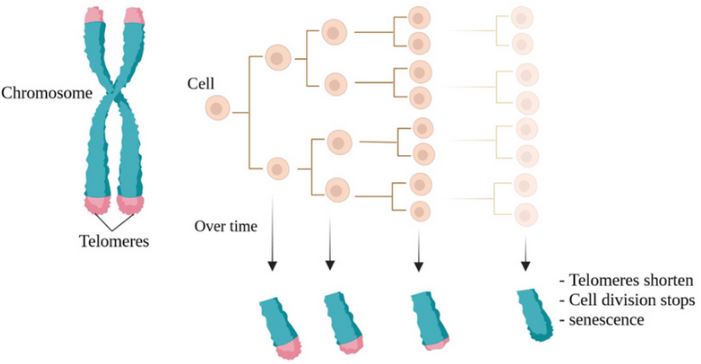
    • In the early 1960s, Hayflick discovered that somatic (non-reproductive) cells have a finite number of divisions, typically between 40-60 times.
    • This phenomenon, the ‘Hayflick limit’ suggests that aging occurs because cells eventually stop dividing.
      • This leads to the accumulation of senescent cells that contribute to the aging process.
    • The “ultimate Hayflick limit” for humans is estimated to be around 125 years.
    • Beyond this, no amount of lifestyle changes or medical interventions can extend the human lifespan.
    • Hayflick’s discovery has been applied to cells from various animals, revealing different Hayflick limits based on species’ lifespans.
    • Ex. Galapagos turtles, have cells that can divide approximately 110 times, whereas laboratory mice have a much lower limit of around 15 divisions.

    Broader Implications and Research

    • Hayflick’s discovery led to the discovery of telomeres in the 1970s.
      • Telomeres are protective DNA sequences at the ends of chromosomes, which shorten with each cell division.
    • When telomeres reach a critical length, cell division stops, which correlates with the Hayflick limit.
    • In the 1980s, scientists discovered telomerase, a protein capable of replenishing telomeres, which is naturally active in cancer cells, allowing them to bypass the Hayflick limit.

    PYQ:

    [2011] Regular intake of fresh fruits and vegetables is recommended in the diet since they are a good source of antioxidants. How do antioxidants help a person maintain health and promote longevity?

    (a) They activate the enzymes necessary for vitamin synthesis in the body and help prevent vitamin deficiency

    (b) They prevent excessive oxidation of carbohydrates, fats and proteins in the body and help avoid unnecessary wastage of energy

    (c) They neutralize the free radicals produced in the body during metabolism

    (d) They activate certain genes in the cells of the body and help delay the ageing process

  • Global Geological And Climatic Events

    What is a Waterspout?

    Note4Students

    From UPSC perspective, the following things are important:

    Prelims level: Waterspout

    Why in the News?

    A yacht sank off the coast of Sicily, Italy after being hit by a Waterspout.

    What are Waterspouts?

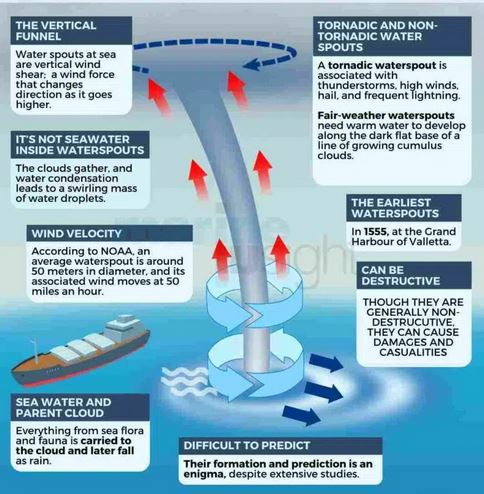
    • A waterspout is a rotating column of air and mist over a water body.
    • It is a weaker relative of tornadoes and typically lasts for about five minutes, although it can occasionally last up to 10 minutes.
    • Size and Strength:
      • Average diameter: Around 165 feet.
      • Wind speeds: Can reach up to 100 km/hr.
    • Waterspouts are more common in tropical waters but can form anywhere with high humidity and relatively warm water temperatures compared to the overlying air.

    Types of Waterspouts:

    • Tornadic Waterspouts
        • These are actual tornadoes that either form over water or move from land to water.
    • They are associated with severe thunderstorms and can be accompanied by high winds, large hail, and dangerous lightning.
    • Fair-Weather Waterspouts:
      • These are more common and form only over water during fair weather.
      • They are generally smaller and less dangerous than tornadic waterspouts.

    PYQ:

    [2020] Consider the following statements:

    1. Jet streams occur in the Northern Hemisphere only.

    2. Only some cyclones develop an eye.

    3. The temperature inside the eye of a cyclone is nearly 10ºC lesser than that of the surroundings.

    Which of the statements given above is/are correct?

    (a) 1 only

    (b) 2 and 3 only

    (c) 2 only

    (d) 1 and 3 only

  • Wildlife Conservation Efforts

    Yaks from China stray into eastern Ladakh

    Note4Students

    From UPSC perspective, the following things are important:

    Prelims level: Himalayan Yaks

    Why in the News?

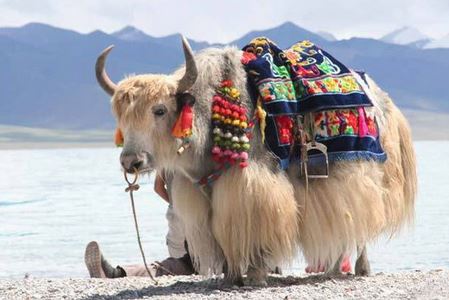
    Around 40 Chinese yaks ventured into Indian Territory in the “Demchok” area of eastern Ladakh and are currently under the control of the local villagers.

    Grazing land issue at LAC:

    • Nomads from both sides traditionally access grazing grounds across the LAC.
    • Indian nomads have been stopped by Chinese soldiers when crossing to the Chinese side.
    • Demchok nomads lost access to Lungkar Valley in 2022 and Nilung Valley in 2017.
    • Loss of these areas has negatively impacted the livelihoods of border residents.
    • China expanded its presence on the Indian side of Charding nala (adjacent to Demchok) since 2020 stand-off.

    About Himalayan Yaks in India:

    Details
    Species Belongs to the Bovini tribe, including bison, buffaloes, and cattle.
    Adaptation Can tolerate extreme cold, down to -40°C; adapted for high altitudes with long, insulating hair.
    Cultural Significance Valued by Himalayan peoples;

    Linked to Tibetan Buddhism legend of Rinpoche.

    Raising Method Traditionally reared under a transhumance system; involves significant hardship.
    Habitat Endemic to the Tibetan Plateau and high-altitude regions.
    Altitude Preference Thrives above 14,000 feet; typically climbs to 20,000 feet and rarely descends below 12,000 feet.
    Yak-Rearing States in India Arunachal Pradesh, Sikkim, Uttarakhand, Himachal Pradesh, Jammu & Kashmir.
    Population Decline 2019 census: 58,000 yaks in India, a 25% drop from 2012; decline due to low remuneration and market.
    Significance Provides crucial nutritional and livelihood security for pastoral nomads in high-altitude regions.
    Threats Climate change causing heat stress; inbreeding due to closed borders limiting genetic diversity.
    Protection Status* – IUCN Red List: Vulnerable
    – CITES: Appendix I
    – Indian Wildlife Act: Schedule I
    Food Status* Approved as a ‘food animal’ by the Food Safety and Standard Authority of India (FSSAI).


    PYQ:

    [2016] What is/are unique about ‘Kharai camel’, a breed found in India?

    1. It is capable of swimming up to three kilometres in seawater.

    2. It survives by grazing on mangroves.

    3. It lives in the wild and cannot be domesticated.

    Select the correct answer using the codes given below:

    (a) 1 and 2 only

    (b) 3 only

    (c) 1 and 3 only

    (d) 1, 2 and 3

  • Modern Indian History-Events and Personalities

    [pib] Maharaja Bir Bikram Kishore Manikya Bahadur

    Note4Students

    From UPSC perspective, the following things are important:

    Prelims level: Maharaja Bir Bikram Kishore Manikya Bahadur

    Why in the News?

    The Prime Minister has paid homage to the great Maharaja of Tripura Bir Bikram Kishore Manikya Bahadur on his birth anniversary.

    Who was Maharaja Bir Bikram Kishore Manikya Bahadur?

    Details
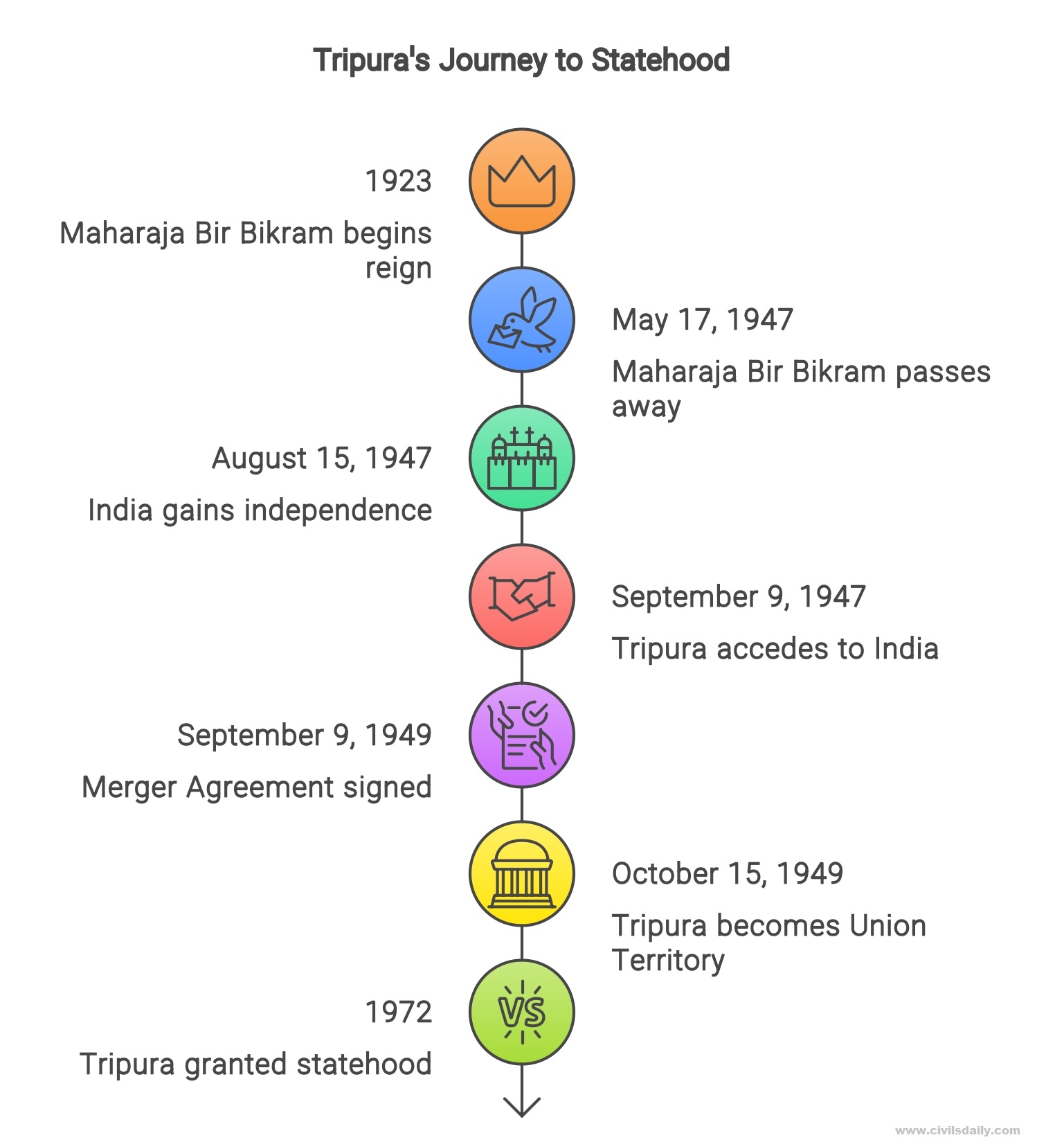
    Reign 1923 – 1947
    Birth August 19, 1908
    Contributions to Tripura – Modernized Tripura with infrastructure and educational reforms.
    – Planned and designed the city of Agartala, earning the title “Architect of Modern Tripura.”-He took initiatives to explore tea cultivation and established several tea estates in Tripura.
    Education and Infrastructure – Established schools, colleges, and hospitals.
    – He was instrumental in establishing the first airport in Tripura, the Maharaja Bir Bikram Airport, which greatly improved connectivity and facilitated economic growth
    Social Reforms Introduced land reforms, granted land rights to indigenous people, and worked to abolish untouchability.

    Maharaja Bir Bikram was a patron of the arts and culture, supporting various cultural activities and institutions.

    Military Role Supported the British during World War II.
    Legacy Died on May 17, 1947

    Remembered as a visionary ruler who played a crucial role in shaping modern Tripura.

    PYQ:

    [2022] The political and administrative reorganization of states and territories has been a continuous ongoing process since the mid-nineteenth century. Discuss with examples. (250 words, 15 marks)

    [2007] Which one of the following is the correct chronological order of the formation of the following states as full states of the Indian Union?

    (a) Sikkim, Arunachal Pradesh, Nagaland, Haryana

    (b) Nagaland , Haryana, Sikkim, Arunachal Pradesh

    (c) Sikkim, Haryana, Nagaland, Arunachal Pradesh

    (d) Nagaland, Arunachal Pradesh, Sikkim, Haryana

  • Forest Conservation Efforts – NFP, Western Ghats, etc.

    Banni Grasslands of Kachchh

    Note4Students

    From UPSC perspective, the following things are important:

    Prelims level: Banni Grasslands of Kachchh

    Why in the News?

    A study conducted by researchers at Kachchh University assessed the suitability of different areas in Banni for sustainable grassland restoration, with ecological value being the primary criterion.

    Restoration of Banni Grasslands: Highlights of the Study

    Recent Study:

    • Objective: A study conducted by researchers at KSKV Kachchh University assessed the suitability of different areas in Banni for sustainable grassland restoration, with ecological value being the primary criterion.
    • Need for restoration: Originally covering about 3,800 sq. km, the Banni grasslands have shrunk to about 2,600 sq. km.
    • Categories of Restoration Zones: The researchers divided the grassland into five categories based on restoration suitability:
      • Highly Suitable: 937 sq. km (36%)
      • Suitable: 728 sq. km (28%)
      • Moderately Suitable: 714 sq. km (27%)
      • Marginally Suitable: 182 sq. km (7%)
      • Not Suitable: 61 sq. km (2%)
    • Restoration Potential: The “highly suitable” and “suitable” zones, making up nearly two-thirds of the Banni grasslands, can be restored easily by providing adequate water sources.

    About Banni Grasslands:

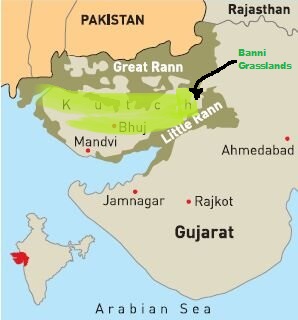
    • The Banni Grassland is a salt-tolerant ecosystem located in the Kutch district of Gujarat, covering around 3,847 square km.
    • It is said to be Asia’s largest grassland (TOI).
    • The climate is arid and semi-arid, with extremely hot summers (temperatures above 45°C) and mild winters (12°C to 25°C), receiving 300-400 mm of annual rainfall mainly during the monsoon.
    • It is inhabited by pastoral communities like the Maldharis, who rely on livestock grazing (cattle, buffalo, and sheep) for their livelihood.
    • Agriculture is limited due to arid conditions, with some areas used for salt production.
    • Flora: Grasses such as Dichanthium, Sporobolus, and Cenchrus species, with salt-tolerant plants, shrubs, and trees like Acacia and the invasive Prosopis juliflora.
    • Fauna: Indian wolf, hyena, chinkara, Great Indian Bustard, flamingos, and various raptors, reptiles, and invertebrates.

    PYQ:

    [2021] The vegetation of Savannah consists of grassland with scattered small trees, but extensive areas have no trees. The forest development in such areas is generally kept in check by one or more or a combination of some conditions. Which of the following are such conditions?​

    1. Burrowing animals and termites​

    2. Fire​

    3. Grazing herbivores​

    4. Seasonal rainfall​

    5. Soil properties​

    Select the correct answer using the code given below.​

    (a) 1 and 2

    (b) 4 and 5​

    (c) 2, 3 and 4

    (d) 1, 3 and 5​