💥UPSC 2026, 2027, 2028 UAP Mentorship (March Batch) + Access XFactor Notes & Microthemes PDF

Type: Prelims Only

  • Wetland Conservation

    [pib] Bhoj Wetland

    Note4Students

    From UPSC perspective, the following things are important:

    Prelims level: Bhoj Wetland

    Why in the News?

    The Madhya Pradesh State Wetland Authority has reported that Bhoj Wetland in Bhopal is not at risk of being removed from the Ramsar Convention List of important international wetlands.

    About Bhoj Wetland

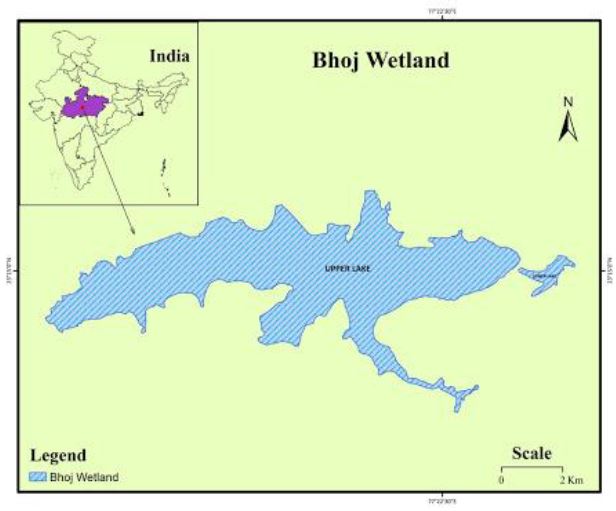
    • Bhoj Wetland is located in the center of Bhopal district in Madhya Pradesh.
    • The wetland includes two man-made lakes: the upper lake and the lower lake.
    • Since August 2002, they have been recognized as a wetland of international importance under the Ramsar Convention.
    • The upper lake, created by King Bhoj in the 11th century, is one of the oldest large man-made lakes in central India.
      • It was formed by building an earthen dam across the Kolans River, which used to be a tributary of the Halali River.
      • Now, the upper part of the Kolans River and the Bhojtal drain into the Kaliasot River through a diversion channel.
      • Bhadbhada Dam, built in 1965, controls the outflow to the Kaliasot River.
    • The lower lake was created in 1794 by Nawab Chhote Khan to beautify the city.
      • It also has an earthen dam and drains into the Halali River through the lower part of the Kolans River, now called the Patra Drain.
      • Both the Kaliasot and Halali Rivers flow into the Betwa River.

    Significance of Bhoj Wetland

    • The upper lake provides 40% of Bhopal’s drinking water, while the lower lake supplies raw water and enhances the city’s beauty.
    • It supports over 700 species of plants and animals, including zooplankton and phytoplankton.
    • Both lakes are rich in biodiversity, supporting various fish species, birds, insects, reptiles, and amphibians.

    PYQ:

    [2018] Which one of the following is an artificial lake?

    (a) Kodaikanal (Tamil Nadu)

    (b) Kolleru (Andhra Pradesh)

    (c) Nainital (Uttarakhand)

    (d) Renuka (Himachal Pradesh)

  • Tourism Sector

    [pib] Adopt a Heritage Scheme 2.0 

    Note4Students

    From UPSC perspective, the following things are important:

    Prelims level: Adopt a Heritage Scheme 2.0

    Why in the News?

    Under the Adopt a Heritage Scheme 2.0, 19 MoUs have been signed so far covering a total of 66 monuments.

    About Adopt a Heritage Scheme 2.0 

    Aspect Details
    Revamped version of the original Adopt a Heritage Scheme.

    Launched in 2023.

    Legal Framework Defined as per the Ancient Monuments and Archaeological Sites and Remains Act (AMASR), 1958
    Application Process Stakeholders apply through a dedicated web portal listing available monuments for adoption
    Collaboration Encourages corporate stakeholders to contribute to monument preservation
    Term of Appointment Initially 5 years, extendable up to another five years
    Objective Foster collaboration for preservation of monuments for future generations
    Key Stakeholders Corporate stakeholders, Ministry of Tourism, Ministry of Culture, ASI, State/UT governments
    Program Goal Develop and maintain amenities at heritage sites
    Initial Scheme
    • Launch Date: 27 September 2017 (World Tourism Day) by the President of India.
    • Collaborators: Ministry of Tourism, Ministry of Culture, ASI, and State/UT governments.
    • Objective: Address challenges in operations and maintenance of heritage sites, develop mechanisms for amenities provision.
    • Monument Mitras: Agencies/Companies become ‘Monument Mitras’ through ‘Vision Bidding’.
    Note: Red Fort was the first monument to be adopted under the scheme by the Dalmia Bharat group in 2019.


    PYQ:

    [2018] Safeguarding the Indian Art Heritage is the need of the moment. Discuss.

  • Disasters and Disaster Management – Sendai Framework, Floods, Cyclones, etc.

    Kerala requests Centre to declare Wayanad landslide as a – ‘National Disaster’

    Note4Students

    From UPSC perspective, the following things are important:

    Prelims level: Declaring a National Disaster

    Why in the News?

    • The Kerala government has requested the Centre to declare the landslide in Vythiri taluk, Wayanad district, as a national disaster.
      • The Central government is considering the legality of declaring the landslide a national disaster.

    Wayanad Landslide: Destruction and Casualties

    • The landslide, triggered by heavy rain, devastated at least three villages.
    • Kerala’s official death toll stands at 221, with over 200 people still missing.
    • Rescue workers continue to retrieve bodies and body parts from the mud and debris.
    • Approximately 9,000 people displaced by the disaster have taken refuge in government-run relief camps in Wayanad.

    Defining a Disaster:

    • A natural disaster includes natural events like earthquakes, floods, landslides, cyclones, tsunamis, urban floods, and heatwaves.
    • Man-made disasters can include nuclear, biological, and chemical incidents.
    • According to the Disaster Management Act, 2005, a disaster is defined as:
      • A catastrophe, mishap, calamity, or grave occurrence in any area arising from natural or man-made causes.
      • It results in substantial loss of life or human suffering, damage to or destruction of property, or environmental degradation.
      • The damage must be of such a nature or magnitude that it is beyond the coping capacity of the affected community.

    Is there any provision to declare a ‘National Disaster/Calamity’? 

    • There is NO provision under the existing guidelines to declare any disaster, including floods, as a national calamity.
    • The guidelines do NOT contemplate declaring a disaster as a National Calamity.

    Attempts to Define National Calamity:

    • National Committee (2001):
      • Chaired by the then Prime Minister, the committee was tasked with defining parameters for a national calamity.
      • The committee did not suggest any fixed criteria for such a declaration.
    • 10th Finance Commission (1995-2000):
      • It proposed that a disaster be termed “a national calamity of rarest severity” if it affects one-third of a state’s population.
      • It did not define “calamity of rare severity” but suggested that each case be adjudged individually.

    Response to such calamities in India

    • When a calamity is declared as such, support is provided at the national level.
    • The Centre considers additional assistance from the NDRF.
    • A Calamity Relief Fund (CRF) is established, with the corpus shared 3:1 between the Centre and the state.
    • If resources in the CRF are insufficient, additional assistance is considered from the National Calamity Contingency Fund (NCCF), funded entirely by the Centre.
    • Relief measures can include the repayment of loans or the provision of fresh loans to affected individuals on concessional terms.

    PYQ:

    [2020] Discuss the recent measures initiated in disaster management by the Government of India departing from the earlier reactive approach.


    [2019] Vulnerability is an essential element for defining disaster impacts and its threat to people. How and in what ways can vulnerability to disasters be characterized? Discuss different types of vulnerability with reference to disasters.

  • Indian Navy Updates

    [pib] INS SHALKI  

    Note4Students

    From UPSC perspective, the following things are important:

    Prelims level: INS SHALKI

    Why in the News?

    • Indian Navy’s submarine INS Shalki, recently docked at Colombo Port on its two day visit to Sri Lanka.
      • This visit comes against the backdrop of China’s persistent attempts to enhance its strategic and military influence over the island nation.

    About INS SHALKI  

    • INS Shalki is a Shishumar class diesel-electric submarine, commissioned into the Indian Navy on 07 Feb 1992.
      • Shishumar class submarines are an Indian variant of the Type 209 submarines developed by the German yard Howaldtswerke-Deutsche Werft under the internal designation “Type 1500”.
    • This is the first ever submarine to be built in India.
    • It was constructed under licence by the Mazgaon Dock Limited, Mumbai.

    Significance of Sri Lanka Visit

    • India sends submarines to a handful of countries with whom it has close defence and strategic ties.
    • This is the third submarine to visit Sri Lanka after the visit of INS Vagir and INS Karanj in June 2023 and February 2024, respectively.
    • India has been expanding its defence and strategic ties with Sri Lanka amid concerns over China’s attempts to increase its military presence in the Indian Ocean.
    • Countering Chinese presence:
      • The docking of the Chinese missile and satellite tracking ship ‘Yuan Wang’ at Hambantota port in August 2022 had triggered a diplomatic row between India and Sri Lanka.
      • Another Chinese warship docked at the Colombo port in August last year.

    PYQ:

    [2017] Consider the following in respect of Indian Ocean Naval Symposium (IONS):

    1. Inaugural IONS was held in India in 2015 under the chairmanship of the Indian Navy.

    2. IONS is a voluntary initiative that seeks to increase maritime co-operation among navies of the littoral states of the Indian Ocean Region.

    Which of the statements given above is/are correct?

    (a) 1 only

    (b) 2 only

    (c) Both 1 and 2

    (d) Neither 1 nor 2

  • Innovations in Sciences, IT, Computers, Robotics and Nanotechnology

    What is ‘PrecivityAD2’ the new Alzheimer’s Blood Test?

    Note4Students

    From UPSC perspective, the following things are important:

    Prelims level: Alzheimer’s Disease (AD), PrecivityAD2 Test

    Why in the News?

    Researchers in Sweden have developed a new blood test, PrecivityAD2, which is about 90% accurate in identifying Alzheimer’s Disease (AD) in people experiencing cognitive symptoms.

    What is Alzheimer’s Disease (AD)?

    • Alzheimer’s disease is the most common type of dementia (loss of memory and cognitive abilities).
    • It is a progressive disease beginning with mild memory loss and possibly leading to loss of the ability to carry on a conversation and respond to the environment.
    • Alzheimer’s disease involves parts of the brain that control thought, memory, and language.
    • Brain cell connections and the cells themselves degenerate and die, eventually destroying memory and other important mental functions.
    • Memory loss and confusion are the main symptoms.
    • No cure exists, but medication and management strategies may temporarily improve symptoms.

    How PrecivityAD2 Test works?

    • The test measures a combination of two ratios within a blood sample:
    1. Plasma Phosphorylated-tau217 (p-tau217) to Not-Phosphorylated-tau21: The test measures the ratio of p-tau217 to non-phosphorylated tau21. Tau proteins are associated with the formation of neurofibrillary tangles in the brain, a hallmark of AD.
    2. Amyloid-beta (AB42 and AB40): The test also measures the ratio of two types of amyloid-beta proteins, AB42 and AB40. Amyloid plaques are another key pathological feature of AD.
    • Both tau and amyloid-beta proteins are considered pathological hallmarks of AD.

    Benefits of PrecivityAD2

    • Early Detection: PrecivityAD2 can diagnose AD at the early stage of mild cognitive impairment, enabling timely intervention and management.
    • Accurate Identification: With an accuracy rate of around 90%, the test provides reliable results, reducing the chances of misdiagnosis.
    • Non-Invasive: Unlike current diagnostic methods that involve complex PET scans or lumbar punctures, PrecivityAD2 requires only a simple blood draw.
    • Cost-Effective: The test is expected to be more affordable compared to expensive PET scans and cerebrospinal fluid analysis, making AD diagnosis more accessible.
    • Ease of Use: The blood test simplifies the diagnostic process, making it easier for primary care physicians to screen for AD.
    • Wider Reach: By reducing the complexity and cost of diagnosis, more patients can be tested, particularly in resource-limited settings.

    Significance of the Test

    • Standard of Care: PrecivityAD2 has the potential to become the standard first-line test for AD diagnosis, replacing more invasive and costly methods.
    • Support for Early Intervention: Early and accurate diagnosis allows for timely intervention, which is crucial for managing AD and improving patient outcomes.
    • Reduction in Misdiagnosis: The test’s high accuracy rate can help reduce the rates of misdiagnosis, particularly in primary care settings.

    Prevalence of Alzheimer’s Disease in India:

    • Alzheimer’s disease and dementia are significant public health concerns in India with a rapidly increasing prevalence rate.
    • According to CSIR-NIScPR, in 2019, there were 37 lakh active cases of Alzheimer’s disease and other dementias.
    • By 2050, dementia cases in India could exceed 11 crore as per projections from the Global Burden of Disease Study (GBDS).
    • The burden of non-communicable neurological disorders, including Alzheimer’s, more than doubled between 1990 and 2019.

    Feasibility for India:

    • In India, the current diagnostic tools for Alzheimer’s disease primarily include MRI and regular PET scans.
    • Advanced diagnostic tools like amyloid or Tau PET scans are not yet commercially available.
    • The introduction of PrecivityAD2 in India will require approval from the Drug Controller General of India (DCGI) and other relevant regulatory bodies.
  • Mother and Child Health – Immunization Program, BPBB, PMJSY, PMMSY, etc.

    [pib] Schemes implemented by the WCD Ministry clubbed into 3 Verticals

    Note4Students

    From UPSC perspective, the following things are important:

    Prelims level: Schemes mentioned in the newscard

    Mains level: NA

    Why in the News?

    • For better implementation and efficient monitoring, all schemes implemented by the Ministry for the betterment of children have been consolidated into 3 verticals:
    1. Saksham Anganwadi & Poshan 2.0,
    2. Mission Shakti, and
    3. Mission Vatsalya.
    • These verticals aim to improve nutrition and health indicators, ensure safety and empowerment of women, and provide protection and welfare for children in difficult circumstances.

    Scheme Details:

    [1] Saksham Anganwadi & Poshan 2.0 (Mission Poshan 2.0)

    • The Anganwadi Services Scheme, POSHAN Abhiyaan, and Scheme for Adolescent Girls have been reorganized into three primary sub-verticals:
      1. Nutrition Support: For POSHAN and Adolescent Girls.
      2. Early Childhood Care and Education: Targeting children aged 3-6 years.
      3. Anganwadi Infrastructure: Upgrading and modernizing Saksham Anganwadis.
    • Key Features:
    • Fortified rice supplied to Anganwadi Centres to meet micronutrient requirements and control anemia among children.
    • Emphasis on the use of millets for Hot Cooked Meals at least once a week and Take Home Ration (THR) at Anganwadi centers.

    [2] Mission Shakti

    • Sambal: Focuses on the safety and security of women.
      • Includes schemes like One Stop Centres (OSC), Women Helpline (181-WHL), and Beti Bachao Beti Padhao (BBBP).
    • Samarthya: Aims at the empowerment of women.
      • Encompasses schemes like Pradhan Mantri Matru Vandana Yojana (PMMVY), Ujjwala, Swadhar Greh (renamed as Shakti Sadan), Working Women Hostel (renamed as Sakhi Niwas), National Hub for Empowerment of Women (NHEW), and National Creche Scheme (renamed as Palna).

    [3] Mission Vatsalya

    • Objective: To provide better outreach and protection for children in need of care in a mission mode.
    • Goals:
      1. Support and sustain children in difficult circumstances.
      2. Develop context-based solutions for the holistic development of children from varied backgrounds.
      3. Encourage innovative solutions through green field projects.
      4. Facilitate convergent action by gap funding if required.

    PYQ:

    [2016] Which of the following are the objectives of ‘National Nutrition Mission’?

    1. To create awareness relating to malnutrition among pregnant women and lactating mothers.

    2. To reduce the incidence of anaemia among young children, adolescent girls and women.

    3. To promote the consumption of millets, coarse cereals and unpolished rice.

    4. To promote the consumption of poultry eggs.

    Select the correct answer using the code given below:

    (a) 1 and 2 only

    (b) 1, 2 and 3 only

    (c) 1, 2 and 4 only

    (d) 3 and 4 only

  • Port Infrastructure and Shipping Industry – Sagarmala Project, SDC, CEZ, etc.

    [pib] Approval of Major Port at Vadhavan, Maharashtra

    Note4Students

    From UPSC perspective, the following things are important:

    Prelims level: Vadhavan Port

    Why in the News?

    The Ministry of Ports, Shipping and Waterways has approved the project proposal for setting up a Major Port at Vadhavan, Palghar District of Maharashtra.

    About Vadhavan Port Project 

    • The project involves the development of core infrastructure, terminals, and other commercial infrastructure through a public-private partnership (PPP) mode.
    • The shareholding for the project is divided between the Jawaharlal Nehru Port Authority (74%) and the Maharashtra Maritime Board (26%).
      • The project aims to create a total capacity of 298 million metric tonnes per annum (MMTPA).
    • Trade routes facilitated:

    Existing Major Ports in India

    • India has 12 Major Ports: Chennai, Cochin, Deendayal (Kandla), Jawaharlal Nehru (Nhava Sheva), Kolkata, Mormugao, Mumbai, New Mangalore, Paradip, V.O. Chidambaranar (Tuticorin), Visakhapatnam, and Kamarajar Port Limited.
    • Private Sector participation is allowed in Major Ports for specific projects/berths/terminals through concession agreements for a specific period via open competitive bidding on revenue share/royalty between the Concessionaire and the Major Port Authority.
    • After the expiry of the concession period, the asset is handed over to the Port Authority.

    Significance of Major Ports

    • Major ports play a critical role in facilitating international trade and commerce.
    • They serve as gateways for the import and export of goods, significantly contributing to the country’s economy.
    • Ports generate substantial revenue for the government through customs duties, port fees, and other related charges.
    • Ports facilitate international collaboration and partnerships, enhancing diplomatic and trade relations with other countries.

    PYQ:

    [2016] Recently, which of the following States has explored the possibility of constructing an artificial inland port to be connected to sea by a long navigational channel?

    (a) Andhra Pradesh

    (b) Chhattisgarh

    (c) Karnataka

    (d) Rajasthan

  • Food Procurement and Distribution – PDS & NFSA, Shanta Kumar Committee, FCI restructuring, Buffer stock, etc.

    States can directly buy Rice from FCI

    Note4Students

    From UPSC perspective, the following things are important:

    Prelims level: FCI, Open Market Sale Scheme

    Why in the News?

    The Union Food and Consumer Affairs Minister announced that States can now directly purchase rice from the Food Corporation of India (FCI) under the Open Market Sale Scheme (Domestic) without participating in e-auctions.

    Key Announcements:

    Direct Rice Purchase of Rice by the States:

    • States can procure rice directly from FCI at ₹2,800 per quintal (excluding transportation cost), down from the earlier rate of ₹2,900 per quintal.
    • This new rate applies to rice procured over the stipulated 5 kg of free grain per individual under the Pradhan Mantri Garib Kalyan Anna Yojana (PMGKAY).

    Launch of Price Monitoring System (PMS) 4.0:

    • Minister Joshi launched the 4.0 version of the Price Monitoring System (PMS) mobile app.
    • The app, which previously monitored prices of 22 commodities daily, will now include 38 commodities.
    • The additional 16 food items are bajra (whole), jowar (whole), ragi (whole), suji (wheat), maida (wheat), besan, ghee, butter (pasteurised), brinjal, egg, black pepper, coriander, cumin seed, red chillies, turmeric powder, and banana.


    About Open Market Sale Scheme

    Details
    Purpose Enhance the supply of food grains, especially wheat, during the lean season to moderate open market prices, especially in deficit regions.
    Administered by Food Corporation of India (FCI)
    Method of Sale Surplus stocks of wheat and rice sold at pre-determined prices through e-auction on the National Commodity and Derivatives Exchange (NCDEX) platform.
    Participants Bulk consumers, private traders, State Governments, and Union Territory Administrations
    Auction Frequency Weekly
    Reserve Price Fixed by the government; bidders cannot quote less than the reserve price.
    Schemes under OMSS
    1. Sale of wheat to bulk consumers/private traders through e-auction.
    2. Sale of wheat to bulk consumers/private traders through e-auction by dedicated movement.
    3. Sale of Raw Rice Grade ‘A’ to bulk consumers/private traders through e-auction.


    PYQ:

    [2017] Which of the following is/are the advantage/advantages of implementing the ‘National Agriculture Market’ scheme?

    1. It is a pan-India electronic trading portal for agricultural commodities.

    2. It provides the farmers access to nationwide market, with prices commensurate with the quality of their produce.

    Select the correct answer using the codes given below:

    (a) 1 only

    (b) 2 only

    (c) Both 1 and 2

    (d) Neither 1 nor 2

  • Sports Authority of India (SAI) and the Board of Control for Cricket in India (BCCI)  

    Note4Students

    From UPSC perspective, the following things are important:

    Prelims level: SAI, BCCI

    Why in the News?

    The Health Ministry has requested the Sports Authority of India (SAI) and the Board of Control for Cricket in India (BCCI) to implement measures to prevent surrogate advertisements of tobacco and alcoholrelated products by sportspersons.

    About Sports Authority of India (SAI)

    Details
    Establishment Founded in 1984 by the Ministry of Youth Affairs and Sports, Government of India
    Headquarters Jawaharlal Nehru Stadium Complex, New Delhi, India
    Objectives
    • Promote sports and physical education
    • Develop sports infrastructure
    • Identify and nurture sports talent
    • Conduct coaching and training programs
    Key Programs
    • National Sports Talent Contest Scheme (NSTC)
    • Special Area Games (SAG)
    • SAI Training Centres (STC)
    • Centres of Excellence (COE)
    • National Sports Academies (NSA)
    Major Facilities
    • Jawaharlal Nehru Stadium, New Delhi
    • Indira Gandhi Stadium Complex, New Delhi
    • Major Dhyan Chand National Stadium, New Delhi
    • Netaji Subhas National Institute of Sports (NSNIS), Patiala
    Notable Initiatives
    • Khelo India Program
    • Target Olympic Podium Scheme (TOPS)
    • Mission Olympic Cell (MOC)


    About Board of Control for Cricket in India (BCCI)

    Details
    Establishment Founded in December 1928
    Headquarters Cricket Centre, Wankhede Stadium, Mumbai, India
    Objectives
    • Promote and develop cricket in India
    • Organize domestic and international cricket matches
    • Identify and nurture cricket talent
    • Maintain cricket infrastructure and facilities
    Key Responsibilities
    • Selection of national cricket teams (men’s, women’s, and junior)
    • Organization of domestic cricket tournaments
    • Administration of Indian Premier League (IPL)
    • Conducting training and coaching programs
    Major Tournaments
    • Indian Premier League (IPL)
    • Ranji Trophy
    • Vijay Hazare Trophy
    • Syed Mushtaq Ali Trophy
    • Duleep Trophy
    • Irani Cup
    Funding and Support
    • Funded through sponsorships, broadcasting rights, and match revenues
    • Provides financial assistance and contracts to cricketers
    Reforms  Justice Lodha Committee: Result of the report submitted by the Justice Mukul Mudgal Committee after an investigation into the 2013 IPL betting scandal.


    PYQ:

    [2021] Consider the following statements in respect of the ICC World Test Championship:

    1. The finalists were decided by the number of matches they won.

    2. New Zealand was ranked ahead of England because it won more matches than England.

    Which of the above statements is/are correct?

    (a) 1 only

    (b) 2 only

    (c) Both 1 and 2

    (d) Neither 1 and 2

  • Animal Husbandry, Dairy & Fisheries Sector – Pashudhan Sanjivani, E- Pashudhan Haat, etc

    [pib] Artificial Insemination in Cattle

    Note4Students

    From UPSC perspective, the following things are important:

    Prelims level: Rashtriya Gokul Mission and its Components

    Why in the News?

    • The Department of Animal Husbandry and Dairying is implementing the Rashtriya Gokul Mission.
      • The mission aims to develop and conserve indigenous bovine breeds, genetically upgrade the bovine population, and enhance milk production and productivity.

    About Rashtriya Gokul Mission:

    Details
    About
    • Initiated in December 2014.
    • Announced under the National Programme for Bovine Breeding and Dairy Development during the 12th Five Year Plan. 
    • Continued under Rashtriya Pashudhan Vikas Yojana (2021-2026) with a budget of Rs. 2400 crore.
    Nodal Ministry Ministry of Fisheries, Animal Husbandry, and Dairying
    Objectives
    • Enhance productivity of bovines and increase sustainable milk production using advanced technologies.            
    • Propagate the use of high genetic merit bulls for breeding.
    • Expand artificial insemination coverage by strengthening the breeding network and delivering services at farmers’ doorsteps.
    • Promote scientific and holistic conservation of indigenous cattle and buffalo rearing.
    Significance
    • Increased productivity, benefiting all cattle and buffaloes in India, with a focus on small and marginal farmers.
    • Empowers women, who perform over 70% of livestock farming tasks.
    Components
    1. Availability of High Genetic Merit Germplasm
    2. Extension of Artificial Insemination Network
    3. Development and Conservation of Indigenous Breeds
    4. Skill Development
    5. Farmers’ Awareness
    6. Research, Development, and Innovation in Bovine Breeding
    Implementing Agency State Implementing Agency (SIA) viz. Livestock Development Boards
    Significant Initiatives
    • Gopal Ratna Awards: For farmers maintaining the best herd of Indigenous Breed and practicing best management practices.          
    • Kamdhenu Awards: For best-managed Indigenous herd by Institutions/Trusts/ NGOs/ Gaushalas or best-managed Breeders’ societies.
    • Gokul Grams: Integrated cattle development centers focusing on promoting indigenous cattle rearing and conservation in a scientific manner.
    • National Kamdhenu Breeding Centre (NKBC): Centre of Excellence for the holistic and scientific development and conservation of Indigenous Breeds.
    • E-Pashu Haat: Web portal providing information on pet cattle and facilitating trading of bovine animals.
    • Nakul Prajnan Bazaar: E-market portal connecting breeders and farmers for quality, disease-free bovine germplasm.
    • Pashu Sanjivni: Animal wellness program providing animal health cards and unique identification, uploading data on the National Database.
    • Advanced Reproductive Technology (ART): Includes Assisted Reproductive Technique- IVF/Multiple Ovulation Embryo Transfer (MOET) and sex-sorted semen technique.
    • National Bovine Genomic Center for Indigenous Breeds (NBGC-IB): To be established for selecting breeding bulls of high genetic merit at a young age using highly precise gene-based technology.

    Key Initiatives for Artificial Insemination:

    • Multi-Purpose Artificial Insemination Technicians in Rural India (MAITRI): This initiative provides trained manpower for delivering quality artificial insemination services at farmers’ doorsteps.
    • Nationwide Artificial Insemination Programme: This programme extends artificial insemination coverage among bovines using semen from high genetic merit bulls of indigenous breeds.
    • Induction of High Genetic Merit Bulls: This program produces bulls with known genetic potential through progeny testing and pedigree selection, supplying these bulls to semen stations for quality semen dose production.
    • Strengthening of Semen Stations: Efforts are made to improve the quality of semen production by formulating minimum standard protocols and establishing a Central Monitoring Unit for evaluation and grading of semen stations.
    • Breed Purity Tests: To protect indigenous breeds from indiscriminate breeding, breed purity tests are conducted for all imported germplasm.
    • Guidelines for Import and Export of Bovine Germplasm: The Department has formulated guidelines to regulate the import of germplasm and prevent the ingress of exotic diseases, ensuring the safety and purity of bovine genetics within the country.

    PYQ:

    [2012] Consider the following crops of India:

    1. Cowpea
    2. Green gram
    3. Pigeon pea

    Which of the above is/are used as pulse, fodder and green manure?

    (a) 1 and 2 only

    (b) 2 only

    (c) 1 and 3 only

    (d) 1, 2 and 3

    [2015] Livestock rearing has a big potential for providing non-farm employment and income in rural areas. Discuss suggesting suitable measures to promote this sector in India.